

Spiritual-Scientific Perspectives on Therapy
GA 313
11 April 1921, Dornach
Translated by Steiner Online Library
First Lecture
[ 1 ] It is to be hoped that this supplementary course to last year’s will once again be able to offer something that can truly be regarded as a supplement and that, especially as we approach the end of the course, will crystallize into a number of therapeutic perspectives. In this course, I will endeavor to approach from a different angle the very topics that formed the subject of our previous course—namely, the conditions of the sick person and the person in need of healing. But by viewing the matter from a different angle, we will not only arrive at different perspectives but also achieve a broadening of the material we have examined. For this time, I would like to show how what you all know as anthroposophists—the division of the human being into physical body, etheric body, and so on—works, so to speak, in the processes of becoming ill and being healed. While last time I had to limit myself more to describing the outer manifestation of the inner human being, this time I will attempt to show how these various parts of the human being are influenced by substances outside the human being—namely, those substances that can then be used as remedies—and what can act as a remedy by influencing the human organism in ways other than merely materially. Here, however, I must immediately make a preliminary assumption.
[ 2 ] Last time, when we discussed the same topic here, we were also able to speak in many respects about the material and, more generally, the physical as a means of healing. At the moment when we must now move on to the higher aspects of human nature—to the supersensible aspects of human nature—we will no longer be able to speak of the same kinds of substances. We will, I would say, do so—for the sake of abbreviations, to be able to speak in a condensed manner—but we will have to become aware of a fundamental fact throughout this entire discussion. Namely, we will have to realize that one cannot proceed from the material realm in the way one is accustomed to today in conventional science if one truly wishes to understand the human being’s relationship to the environment and human behavior in both healthy and diseased states. What one must take as a starting point is not actually matter, but processes; it is not something finished, but rather a process of becoming. And when we speak of matter, we must actually have in our mental image that in matter—in what appears to us in the external sensory perception as matter—we have nothing other than a process, a process that has come to rest.
[ 3 ] When we have, say, silica before us, we initially refer to silica as a substance. But we have not grasped the essence at all if we conceive of the so-called body—which has certain boundaries—in a mental image. We have grasped the essence only when we take in with the eye of the soul the very comprehensive process that exists as a single process throughout the entire universe—a process that can, so to speak, crystallize, come to rest, reach a kind of equilibrium, and then, once it has come to rest, manifest itself in what we perceive as silica. It is essential to grasp the interplay between the processes within the human being and those taking place outside in the universe, with which both the healthy and the sick person are in constant interaction.
[ 4 ] So that we can begin our actual subject matter tomorrow, I would like to start today by presenting to you what can truly lead us to a mental image of this interaction. To do this, we must seek to truly grasp the essence of the human being from the perspective of anthroposophical Spiritual Science. I will—I might say—begin by expressing myself schematically, by truly focusing today on what I have often presented as the threefold division of the human being, as it is concentrated in the physical human being. We know, of course, when we distinguish the nerve-sense human being, that it is concentrated mainly in the head, but that what is concentrated there extends throughout the entire human being and is present in the whole person; that the human being is, so to speak, most of all a nerve-sense being in the head, and that, on the other hand, the whole human being is head, though there is less “head” in the other two members than in the head itself. And so we can conceive of what we call the “nervous-sensory human being” as being localized in the head. But then, in order to make this division of the human being fruitful for our present purposes, we must actually conceive of the rhythmic human being—which would encompass everything that constitutes the respiratory and circulatory organism—as being divided into two parts: one part tending more toward the respiratory system, the other toward the circulatory system. And everything that constitutes the connection between the human being as a system of limbs and the human being as a metabolic system is then integrated into this circulatory system.
[ 5 ] When one studies the human head, one is, in a sense, studying the part of the human organism that is most fundamentally a being of nerves and senses. The organization of the human head differs quite significantly from that of the other parts of the human being, even with regard to the higher form of this human entity. For when we consider the human head from the perspective of Spiritual Science, this head is a kind of imprint—one might even say a kind of projection—of the “I,” the astral body, and the etheric body. And then there is also the physical body to consider in relation to the head. But this physical body is, so to speak, present in the head in a different way than the physical aspect that is the imprint of the “I,” the astral body, and the etheric body. I would like to emphasize the higher aspect of this matter by pointing out that the human head, as it is initially formed in the human embryo, does not take shape merely from the forces of the parental organism, but that cosmic forces are at work in the human head—that cosmic forces simply act within the human being. In what we call the etheric forces, much of the parental organism is still at work, but even within the etheric, cosmic forces are at work from the spiritual-soul life that existed before birth—or, let us say, before conception. And especially in the astral body and in the “I,” what was lived in the spiritual world prior to conception continues to have an effect. This effect shapes the human head. The “I” creates its imprint on the human head; the astral body creates its physical imprint; the etheric body creates its physical imprint. Only the physical body—which, after all, is acquired here on the physical Earth—is, so to speak, a primary active force; it is not an imprint, but rather a primary active force, so that I can say, if I were to draw a schematic diagram, that the formation of the human head is such that it is an imprint of the “I.” This organizes itself within—we will have to speak of this organization more often—it organizes itself in a certain way. It organizes itself primarily, at first, by differentiating the thermal conditions of the head within itself. Furthermore, the astral body, which is contained in an organizing capacity primarily within what permeates the head as gaseous, air-like processes, differentiates itself there (see drawing). Then the etheric body takes shape, and what constitutes the physical body of the head is a physical process, a truly physical process (see drawing, hatched). I will indicate this by pointing out, schematically so to speak in the drawing, that part of the head which is the bony occiput—as if the eyes were located there. But what is concentrated here in terms of physical forces extends, in turn, over the entire head. There, in this physical aspect of human head formation, is a genuine primary physical process. This is not the expression of anything else; rather, what is present there carries out its own process. But within this physical process of the head, we actually find a duality—an interplay of two processes. What takes place there is an interplay of two processes that can truly be understood only when, from a spiritual-scientific perspective, they are considered in conjunction with certain other processes taking place out there in the universe.

[ 6 ] When you observe, out there in the universe, in the primordial mountains, the process that manifests itself in the formation of shale, namely in everything that leads from silica to the formation of shale, then you will find in the forces at work within this process—the process of shale formation originating from silica—the polar opposite of the process that takes place here, on the one hand, in the physical formation of the head. This is an important connection between the human being and his environment. This process—which takes place externally in mineralization—is also present within the human head. It is, in fact, almost clear today—I would say almost clear to geology, even if not yet entirely—that the entire process of slate formation, the process of all mineralization in which silica (silicon) is involved, is connected to what one might call “de-vegetalization.” We must, so to speak, seek out the plant world that has become mineralized in the formation of shale; and by seeking to grasp this “de-vegetalization”—which is synonymous with the Earth’s shale formation—we grasp the very process that plays out in a different way, as its polar opposite, here within the human head. However, another process interacts with this one. And we must, in turn, seek this other process—which interacts with the first—out in the world. We must look for it where, for example, limestone mountains form. And today it is already almost an established geological fact for external science that limestone mountains are essentially based on a process of Earth formation that we can call the process of de-animalization. It is the opposite process of becoming animal. And here, in turn, the polar opposite process is at work. So when we attribute a role in the formation of the human physical head to silicon and calcium—which are processes that have come to rest—we must be clear that this introduces into the formation of the human physical head something that plays a very significant role out there, at least in the entire natural world of our Earth. At the same time, we can already begin to orient ourselves to the fact that, when we look on the one hand at silica, at silicon, it has an essential connection to what is taking place precisely in the physical head; when I speak of silicon, it is precisely the process that has come to rest. That which, in turn, is the process of calcification—which comes to rest in calcium—has something to do with everything that constitutes the opposite pole, the force that interacts polaristically with the other force in the human physical head. These processes, which we can still observe all around us today, are connected in the human head to other processes that we do not find on Earth, but which exist only as imprints, since the head is itself an imprint of the etheric body, the astral body, and the I.
[ 7 ] With regard to these aspects of human nature, we have just brought processes to rest that are not direct earthly processes. Only what I have described to you as the actual physical head is a true earthly process in the human being. The other processes are not true earthly processes, although, as we shall see, we find them connected to earthly processes.

[ 8 ] To provide an overview, I would like to say right away that as I now turn to the second member of the human organism—let us call it, roughly speaking, the chest member. It is the member of the human organism that essentially encompasses the rhythmic human being, and let us immediately divide it schematically into everything that comprises the respiratory rhythm and everything that comprises the circulatory rhythm. If we now wish to consider this second member of the human being as a whole, we must say the following. Everything that I have described here (see drawing) as the organization of the respiratory rhythm in the broadest sense is, in fact, first and foremost an imprint of the I and the astral body. Just as the head is an imprint of the “I,” the astral body, and the etheric body, so too is what we here call the respiratory rhythm an imprint of the “I” and the astral body; and it has an aspect that is primarily active in and of itself (see diagram, hatched), within which, however, the physical body and the etheric body interact. In the human head, only the physical body acts primarily on its own. The etheric body is, after all, also an imprint. In the respiratory rhythm system, however, what is primarily at work is an interaction between the physical and etheric bodies, and the imprint consists only of the “I” and the astral body. This is essentially still present in the organization of the circulatory rhythm as well, but to a lesser degree, because the entire metabolic organism is integrated into the circulatory system. But this is where what then also applies to the metabolic human being in the limbs begins. Here we are dealing with the fact that the limbs, with everything that extends into them as metabolism—with the exception of the actual circulation, that is, the movement that is present there—are essentially an imprint of the “I” and an interaction of the physical body, the etheric body, and the astral body (see Plate 1, drawing), so that we can say: When we consider the chest-centered human being, we find in him, in terms of imprinted organization, only that which relates to the “I” and the astral body; and we find in him a primary organization that is not merely physical, but one that causes the physical to appear as if structured by the etheric. This is even more pronounced in the case of the respiratory rhythm, and in the circulatory system, the metabolic system also comes into play.

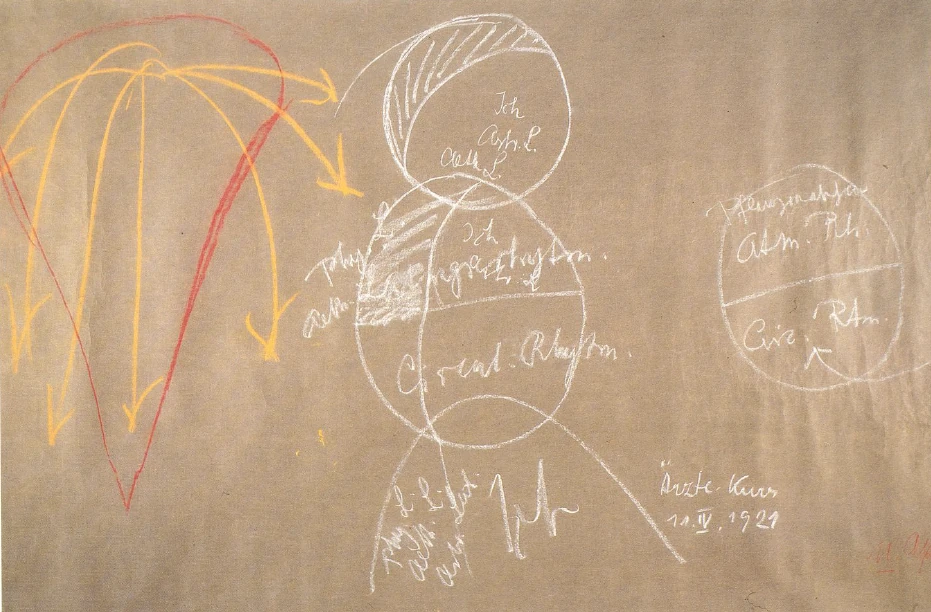
[ 9 ] You can see this interplay taking place in various ways among the different parts of the human being. For these various physical parts—which we refer to as the head system, the chest system, and the limb system—the parts that we otherwise call, in Spiritual Science, the physical body, the etheric body, the astral body, and the “I” interact with one another in various ways. The human head, as it exists as a process, is essentially the physical body, for whatever is not the physical body is an imprint of the I, the astral body, and the etheric body. What constitutes the average human being is essentially an interplay between the physical body and the etheric body. That which is not the physical body or the etheric body is an imprint of the I and the astral body. The human being in terms of limb metabolism—though the last two overlap—is essentially an interaction of the physical body, the etheric body, and the astral body—this only extends into the other limbs, as I have explained to you—and an imprint of the “I” (see drawing on p. 16).
[ 10 ] Now the point is that we must first consider what we can find in the middle human being regarding, for example, the aspect of that process in the physical realm—specifically, in the physical organization of the head—which we must regard as having come to rest in silica. What is peculiar here is that in the middle human being, the process of silica formation is stronger and more widespread. It acts more subtly in the head. Here, in the middle human being, it acts more strongly, more widely, and, in a sense, in a more differentiated way. And it acts most strongly in the human being whose metabolism is centered in the limbs. So when we consider the process that we have understood to be bound to silica, we must say: This process is strongest where it is meant to assist the “I”—we will then see the interaction with other processes—in relation to the effect of the independent “I,” which leaves its imprint only in the physical metabolic human. This process of silica formation is most active where it is meant to assist the “I” in its influence on the metabolic limb-human. This process, which can thus be characterized by silica, is somewhat weaker where it need only assist the astral body, and it is weakest where it need only assist the etheric body, in the head.
[ 11 ] This could also be expressed in the opposite way: With regard to what we must regard as the process that comes to rest in silica, we must say that in the human organism as a whole, this process has its greatest material effect. In terms of its dynamic aspect, it has the weakest effect as a force. But where it acts weakest as a force, it acts strongest as it approaches the point where it then comes to rest in the substance. So if we consider silica as the substance before us, we must say: its effect is strongest in the head. If we consider it as the outward sign of a process, then we must say: its weakest effect is in the head. Where the strongest material effect is, there is the weak dynamic effect. In the average human being, the material and force effects are roughly in balance, particularly with regard to silica. And with regard to the human being as a metabolic entity of the limbs, the force effect essentially has the upper hand. There, the material effect is weakest and the force effect strongest, so that the process that produces silica actually permeates the entire human being. Now, having asked ourselves what the relationship is between the physical organization of the head and the external environment with which the human being interacts, we can also ask what the nature of the interaction is between the middle human being—insofar as it possesses the organization of the respiratory rhythm—and the external environment.
[ 12 ] If one wishes to study and understand the human head from a Spiritual Science perspective, one must look at the two processes involved in the formation of the Earth: the process of lime formation and the process of silica formation—or, if you will, the process of silicic acid formation. We will be able to go into this in greater detail later. Now, that which lies less on the outside, less peripherally, and more toward the inner core of the human being—the organization of the rhythmic respiratory system—offers us, in that it is an interplay, primarily an interplay of the physical and the etheric, into which the imprints of the ego and the astral body are woven—at first, there is nothing in the environment that already exists directly as a process, nothing that is immediately present in the nature we encounter as a process. At least, this is not usually the case. If we wish to find a characteristic process for what is happening there through this peculiar interplay of the ego, the astral body—which are more or less free because they have created imprints—and that which is primarily an interplay of the physical and the etheric, if we wish to find, for this entire interplay, if we are to seek some process in the external world for this entire interplay, then—in order to have it properly—we must actually first create it ourselves. When we burn plant matter and obtain plant ash, what is reflected there as a process—manifested in the burning, in the formation of the ash, and in the ash’s subsequent settling —we will speak of the individual ashes—what is manifested there in the process of fire and in the process of ash formation is related to the respiratory process in a similar way that the silica process is related to the process that takes place physically in the head. And if we wish to activate that which has its counterpart in the respiratory rhythm process within this ash-formation process, then we cannot, of course, introduce it into the breath—we can never do so in the human organism—but rather we must introduce it into that which is, so to speak, the other pole of the process in question. If I illustrate this here (see drawing on p. 20), we have the respiratory rhythm process and the circulatory rhythm process: In the respiratory rhythm process, plant ashes are what characterize the active processes. But we must bring these plant ash processes into effect indirectly through metabolism in the other pole, in the circulatory rhythm organism (see diagram on p. 20). We must incorporate this plant ash—that is, these forces—into the circulatory rhythm so that they may then evoke their polar counteraction in the respiratory rhythm process.

[ 13 ] These connections are, in fact, immediately apparent to the observer, and one can see that they are of the utmost importance for understanding the human organism. For we now realize—as we had to tell ourselves—that what we observe in the process of silica formation has something to do with the whole human being; and by applying this here to the process of plant incineration, we gain a mental image of this middle human being, who, in turn, because he has a respiratory and circulatory rhythm, is, so to speak, divided into two parts. We gain a mental image by saying to ourselves: If we first consider the upper part—the respiratory rhythm—the structure of these organs is essentially determined by a process that is polar opposites to the process that appears to us when we burn plants and obtain ash. It is, in a sense, a struggle within the respiratory rhythm process—a constant struggle against the formation of plant ash—but a struggle that does not take place without the very opposite of this process actually penetrating the organism as a challenge to it. We, as human beings, are placed on Earth, where there are silica processes and there are calcium processes. We would not be human if these processes were to fill us. We are human precisely because we carry within us the polar opposites of these processes—that is, because we can counteract the silica-formation process by carrying its opposite pole within us, and because we counteract the lime-formation process by carrying its opposite pole within us. We carry these poles within us through the formation of our head, and through the whole human being, in the gradations I have described. Through our breathing rhythm, we carry within us the struggle against the process of plant incineration. We carry within us the opposite pole of this process of plant incineration. When one considers these things, it will not seem surprising that, so to speak—if I may put it bluntly—a push gives rise to a counter-push. It is quite clear that if I intensify the silica-forming process in the organism accordingly, the counteraction is modified; and it is just as clear that if I introduce the product of the combustion process into the organism, the counteraction is generated, and the big question arises: How do we bring this interplay of action and counteraction under our control? - This is what I, when describing it in abstract terms, always express by saying that it depends, first of all, on recognizing which processes—extending all the way up to the “I”—occur within the human organism, and which processes occur outside the human organism. These processes are differentiated between inside and outside. But inside and outside, they are polar opposites. And the moment something—which by its very nature should lie outside my skin—lies within my skin, or the moment something—even if only through a slight physical pressure—acts from the outside toward the inside, which should not actually be an effect from the outside toward the inside, an inner counteraction arises; and at that moment, I have the task of generating such an inner counteraction to that something. If, for example, I observe that in a person, instead of the normal process counteracting silica, there is an excessive, overly intense tendency toward this process, then I must regulate this from the outside by administering the relevant substance and inducing the counteraction; this arises of its own accord.
[ 14 ] This is what enables one to gradually gain insight into this interaction between the human being and the external world. If you truly come to understand how what lies in the silica-forming process most directly corresponds to the “I” as a force effect—when the “I” wishes to act through the limbs and metabolism—and if you further realize that what constitutes a material effect in the silica-forming process is most strongly at work in the human head, and if you can then tell yourself that what is a force effect must come to the aid of the “I” in the human head—albeit with reduced intensity—then you have an opportunity to glimpse how this “I” works in a graded manner within the human being. Now, when one considers the relationship between the human “I” and the limb-metabolic system, the origin of human egoism actually lies in this relationship. The sexual system, after all, also belongs to this system of human egoism. And it is precisely through the sexual system—as a roundabout route—that the “I” most profoundly permeates the human being with egoism.
[ 15 ] If you grasp this, you will say: Then there is indeed a certain contrast between the way the “I” makes use of silica to influence the human being through the limb system, and the [way] in which this “I” acts through silica from the human head. There, it acts, so to speak, free of egoism. And when one investigates this from a Spiritual Science perspective, one sees that it has a differentiating effect.
[ 16 ] If I were to illustrate this remarkable effect schematically, I would have to say: What the “I”—now understood as a genuine organizing element—does in the human being through the silica (see diagram, red) from the limb system is, in essence, to synthesize the human being; in a sense, it binds all the fluids present in the human being into an undifferentiated unity, so that it forms an undifferentiated, unified whole.

[ 17 ] Everything that is part of the same process, but with silica formation that is as non-intensive as possible in terms of its force, acts in the opposite direction (see diagram on p. 22, yellow); it acts in a differentiating, radiating manner. From below, the human being is unified and made undifferentiated by silica; from above, he is differentiated, broken down into distinct parts. But this means, with regard to the human being, that the forces primarily present in the head are differentiated in their effects on the individual organs. They are, so to speak, stimulated by the unique silica process in the head organism to act properly within their organs, to distribute themselves properly to the heart, liver, and so on.
[ 18 ] We are faced here with a process that, when it acts from the bottom up, throws everything into disarray within the human being; when it acts from the top down, it systematically breaks everything down, so to speak, governing the organization and bringing order through the individual organs. If, on the other hand, we gain an understanding of what occurs in human beings—on the one hand, through this intermingling, and on the other, through this dispersal into the various organs—that is, differentiating organization as opposed to synthesizing organization— and how this can be irregular in the individual human being, then we gradually learn to treat the human being in this direction when something is not right with them. We will see this in the following lectures. However, we must be extremely cautious when it comes to investigations in this direction. For you see, what does, let’s say, external science do when it examines the human organism? This external science says, for example: There is silica in the human organism, there is fluorine in the human organism, there is magnesium in the human organism, there is calcium in the human organism. So external science says of silica that it is found in the hair, in the blood, and in the urine. Well, let’s take these two: Silica is found in the hair and in the urine.
[ 19 ] For materialistic science, there is simply nothing more to it than this: when one examines hair, silica is found in it, and when one examines urine, silica is found in it. But that is not the essential point at all—that some substance is found somewhere inside. That is not the essential point at all, because the silica in the hair is there so that it can act from that location. We do not have hair for no reason; rather, forces also flow from the hair back into the organism—and these are the finest forces; the finest forces flow from the hair back into the organism. Silica is present in urine for the reason that it is there as something that is otherwise in excess. What is not needed is excreted there. It is entirely irrelevant that it is present there; it is not active there; rather, what is expelled is the silica that is not meant to be active—the excess silica. It is precisely that silica that is present there which must not be present in the organism—which therefore has not the slightest significance for it. This is how it is when we examine any individual substances—let us take magnesium, for example. If there were no magnesium in the teeth, they could not be teeth, for the forces that are involved in the formation of the teeth in the very highest sense live in the magnesium process. You heard this in Professor Römer’s lecture. But magnesium, says materialistic science, is also found in milk. Yet in milk, magnesium has no significance. Milk owes its very nature as milk to the fact that it is powerful enough to excrete the magnesium contained within it; magnesium, as such, has no place in milk. We can, of course, analyze it, but in the milk-forming process, the situation is such that the milk-forming process can arise precisely because it is able to repel the magnesium forces. We only learn about this peculiar contrast between the tooth-forming process and the milk-forming process because we know that magnesium is something essential in the tooth-forming process—something that dynamically belongs there. In the milk-forming process, it is the element that is excreted as the “fifth wheel on the wagon.” And similarly, this is the case, for example, with fluoride, which is an essential component of tooth enamel; without it, we cannot understand the entire process of tooth development. It is also present in urine, but only as a byproduct of excretion, without having any significance there. The fluoride present in urine is precisely what the organism is powerful enough to excrete because it cannot use it.
[ 20 ] A mere physical examination to determine whether something is present somewhere does not actually determine what is essential; rather, one must determine in every case whether something is rightfully present at the location in question as an active entity, or whether it is there because it has been expelled. That is what matters. And that is the essential point: that we acquire such concepts in order to understand human beings—and, for that matter, other organic beings as well—in their healthy and diseased states. Of course, when speaking in more accessible terms, one is always forced to forgo all these conceptual tools, because in our age there is far too little general education regarding more subtle concepts, and one must then speak more in abstractions, which makes one’s meaning less clear. In combating materialism, one very often fails to make oneself understood. But if one descends—and one could descend even further into entirely different realms—into the characteristic features of those areas that the scientist is actually supposed to know and for which he has facts at his disposal that he can investigate, then it is precisely through Spiritual Science that one arrives at those points where one can demonstrate that a mental image of something—which has been analyzed as matter and investigated using physical and chemical science—about which one can say, ‘this is in it and that is in it’—how such a mental image leads to nothing but error.
[ 21 ] That's what I wanted to share as an introduction today. Tomorrow, we'll continue talking about it.