

Spiritual-Scientific Perspectives on Therapy
GA 313
12 April 1921, Dornach
Translated by Steiner Online Library
Second Lecture
[ 1 ] As I said yesterday, we will consider the human being in relation to his supersensible being in order to examine the pathological and therapeutic phenomena from this perspective this time. Yesterday we had to characterize the physical body by saying that, in essence, a truly physical activity in the human being exists only in the head. If we wish to view this physical body correctly, then we must, of course, also rise to the level of viewing the etheric body correctly and concretely. For when one looks deeply into the human being, one finds that a distinct activity of the physical body exists only in the head. In the remaining parts of the human organism, there is a more undifferentiated interaction of the physical body with the higher, supersensible constituents of the being. In the head, therefore, the supersensible members of the being can function as such in or through thinking, feeling, and willing, because it is in the head that they first leave their imprints—that is, their etheric imprint, their astral imprint, and also their “I” imprint. These are present there. They are present as imprints, so to speak, as images of the supersensible members. Only the physical body has no imprint in the head yet; it creates this imprint only during the course of life. Therefore, the physical body—I would say—exerts a purely physical influence within the head. In the other members, there is no purely physical influence within human nature.
[ 2 ] Now, some people did not understand yesterday when I said that the “I” creates an imprint for itself. The “I” creates an imprint for itself—this is a statement that can be properly understood if one does not interpret it too literally in the ordinary sense. Certainly, what the “I” creates as an imprint—when it is still free, as in the case of people with limb metabolism—cannot be examined, for example, by drawing a comparison with a plaster cast; rather, the imprint that the “I” creates is a very dynamic one. You can even perceive it more clearly when you walk than when you stand. The imprint that the “I” creates is an imprint within a system of forces that manifests itself when one walks—within a whole interplay of forces, including the act of holding oneself upright. Therein lies the physical imprint of the “I.” So you must not seek the imprint of the “I” in something comparable to a plaster cast; rather, it is an imprint within a system of forces. And this is ultimately the case in the human head as well, only within a different system of forces. I even pointed out yesterday that the “I” leaves an imprint in the thermal conditions of the head—that is, in the way the head is warmed differently in its various organs. That is an “I-imprint.” This “I-imprint” is also an imprint within a system of forces—only in this case, a system of thermal forces. So the “I” creates these imprints in the most diverse ways. Where it remains free from other influences on the human organism, it creates a pure—I would say mechanical—imprint of forces. It is an imprint of equilibrium and dynamic forces that the “I” creates in relation to the human being as a metabolic entity of the limbs. But one must take this into account, for the human being is in fact also a different being, depending on whether he is standing, walking, or perhaps even swimming. Unfortunately, this is always taken into account far too little. And regarding certain things that, from the standpoint of Spiritual Science, are seen to be given too little consideration, one must simply say: One can see very clearly from the boundaries that current science draws where it can go no further, yet where facts still exist. — For example, one thing has interested me in this regard—something I’ll only hint at now, presenting it to you, so to speak, as a question—but which will be answered for us in the course of the lectures. I’ve been following the standard literature on this point to some extent, and it’s quite amusing how almost everywhere you find the claim that the amount of nitrogen inhaled and exhaled does not differ significantly from one another. You can find this statement almost everywhere. But it is not true. The figures immediately show that it is not true that more nitrogen is exhaled than inhaled. And because materialism doesn’t know what to make of this difference, it simply erases it. It brushes it aside with a wave of the hand. And one can find many such things in contemporary scientific practice. As I said, I’ll leave this as a question for now; I’ll return to the matter later.
[ 3 ] But now I want to focus specifically on what is present in human beings as the etheric body. Well, it is, of course, quite natural that this etheric body is not considered in its differentiation by a purely physical science. However, if you can convince yourself that this etheric body exists, then you will also have to ask yourself: Well, what if one were to view the physical body in such a way that one said, “Oh, come on—the stomach, heart, and liver—they’re all one and the same; they’re all just a blurred mass”? —What would that be? But that is precisely how one behaves toward the etheric body when one regards it merely as a general, somewhat differentiated cloud of mist. One really must study it, and today we will see how its study is connected to a very essential mental image that we already considered from a different perspective in the last lecture, but which we now wish to point out from this more Spiritual Science perspective.
[ 4 ] When we consider the ether in general—of which the human etheric body is, after all, a part, a specific manifestation—as you already know from general Spiritual Science literature, it does not present itself as undifferentiated, but rather, at first glance, as consisting of four types of ether: thermal ether, light ether, chemical ether, and life ether. “Light ether” is a term that is, of course, coined from the perspective of sighted people. That which is connected with light is indeed the most prominent effect of this ether for sighted people, but there are other effects within it as well, which we simply disregard because the majority of us are sighted. If the majority of humanity were blind, it would naturally have to give this ether a different name, because the other entities would stand out more strongly; they do so among the blind as well.
[ 5 ] The third type of ether is the chemical ether. The chemical ether is the one that acts primarily in the so-called chemical part of the spectrum, and when we speak of the chemical ether, we must not think of the forces that act in chemical syntheses, but rather of those forces that are ‘internally polar opposites.’ The etheric forces are always polar opposites of the forces acting in physical substances. So, when a chemical synthesis takes place, the etheric forces act in an analyzing manner. So, there are analyzing forces present everywhere within the synthesizing forces. And when we perform a chemical analysis, the situation is always as follows for the spiritual observer: We perform a chemical analysis—I will now sketch this schematically—that is, we chemically break down a substance; what remains is all the more dense as the etheric forces synthesize, and the etheric body remains, just as, when a human being dies, the soul-spiritual remains. To the one who, if I may put it this way, performs a chemical analysis with the spiritual eye, a phantom of the chemical substance that remains appears—after the substances have been separated—in an all the more condensed and dense form. So, I mention this only to guide you to the realization that, when considering the chemical etheric forces, you must not think merely of the chemical forces—the synthesizing and analyzing forces—but always of their polar opposite as well. And then there is the life ether, which is to be regarded as a special kind of ether and is the truly animating element in all organic beings.
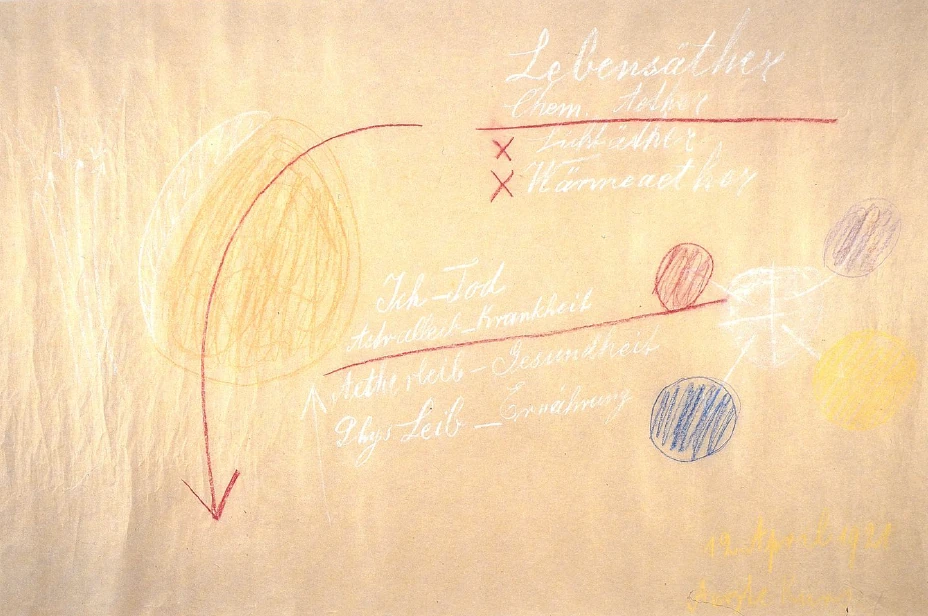
[ 6 ] Now, this ether is an entity that exists universally throughout the universe, and as such, it naturally cannot be perceived directly through physical observation. In this regard, science has indeed become somewhat more honest today than it was before, because it has realized that ether theories cannot, after all, be formulated based solely on physical observation. After having formulated countless such theories, science has come to the conclusion, through relativity, that there is no ether at all—the world must be explained without it. That is to say, science has become honest and, through Einstein, has acknowledged that physical observations lead neither to the existence of an ether nor to any other method of analysis. Because the ether could no longer be perceived, it was simply dismissed.
[ 7 ] The point is this: when something supersensible has created an imprint in the physical-sensory realm, then that which has appeared there as an imprint becomes permeable to the supersensible in question. So you see, the ether—the general ether—creates an imprint in the watery component of the human head. What we must regard as the watery content of the brain is not to be viewed as undifferentiated water, but is just as internally organized as the solid components are. It is, after all, a very peculiar way of viewing the human being—to regard him as we depict him. When we depict a person with their liver and stomach, this depiction is actually only a silhouette of what is firmly woven into the fluid and airy parts, and we are really only ever drawing what is present there as tiny granules. That is not even ten percent of the entire human being. In reality, of course, the human being is just as much an organization of water, air, and warmth when we consider him physically. The water—I mean the liquid part—is, of course, just as organized within the human being as the solid parts. We never depict this when we make anatomical or physiological drawings. However, the watery content of the human being is, of course, substantial in the sense that it is constantly in a state of dissolution and renewal. It is, so to speak, captured in form for only a moment, but it is indeed shaped. In this aqueous part of the human head, we find precisely the imprint of the etheric, so that if I were to draw a schematic, I would have to depict, for example, the physical activity that is particularly pronounced at the back of the head (see drawing, light). It naturally permeates the entire organism. Then I would have to draw the rest to represent the aqueous aspect (see drawing, yellow). This is organized, thoroughly organized, so that this aqueous aspect is an imprint of that which is of an etheric nature. Whatever is an imprint always becomes permeable in this way. Because the eye, viewed in a truly Goethean sense as a being of light, is permeable to light. This is not merely a metaphor, but a profound wisdom: that the eye has arisen out of light. It can also be traced embryologically that the eye is actually organized from the outside in, and it is permeable to light precisely because it is organized by light. But overall, due to its watery organization, the human head is permeable to the ethereal, because it is an imprint from the ether; so it can be said: Here, the ethereal can pass through the head (see drawing on p. 31, red arrow), without being held back in any way, without its passage being disturbed in any way, and can penetrate the rest of the human organism.

[ 8 ] This is precisely what can be observed in the Spiritual Science as well. However, one modification must still be made here. Namely, this part of the human head is truly permeable only to the heat ether and the light ether. Thus, only the heat ether and the light ether can act upon the human head from the outside. The warmth ether does not act through direct exposure to heat; rather, it acts on the human head by virtue of our being within a specific climatic region. So the effect of the warmth ether on the human head is not to be found in whether you sweat or not, but rather in whether you live in the equatorial zone, the temperate zone, or the cold zone. Thus, there is a much deeper connection between the warmth ether and the human head than the mere external exposure to its radiation. Similarly—as long as we remain within the realm of physiology (in psychology it would be different, but that is not our concern here)—we can consider the influence of the light ether on the human organism, though this influence is much more enduring than that of mere light, so that the effect of this light ether passes through the etheric imprint in the human head and permeates the entire human being. Now, as I said, the human head is permeable to the heat ether and the light ether. It is not entirely correct, but approximately so: the human head is somewhat permeable to the chemical ether and the life ether. But we can disregard this here, because the result is nonetheless the one I am about to indicate. Now, what exists as chemical ether and life ether is such that, as you can see from what has just been stated, it is repelled by the head’s organization. It is repelled. Instead, however, it passes through the human organism. Simply by living on Earth as a human being, a person is inwardly filled with what constitutes life ether and chemical ether.

[ 9 ] So, if I may put it this way: The influence of the heat and light ethers radiates in from all sides (see diagram, arrows from above). The influence of the chemical and life ethers radiates upward through the metabolic limb system toward the incoming heat and light ethers (see diagram, arrows from below). Just as the human head is—I would say—carefully organized to admit only traces of life ether and chemical ether, so too does the metabolic-limb-organism literally draw life ether and chemical ether out of the elements of the earth. These two types of ether meet within the human being, and the human being is organized in such a way that this organization culminates in an orderly separation of these two types of ether: life ether and chemical ether on the one hand, flowing from bottom to top, and heat ether and light ether on the other hand, flowing from top to bottom.

[ 10 ] It is a characteristic of the human organism that what radiates from above—light ether and warmth ether—is not, so to speak, organically incorporated into the lower organization, but rather flows in precisely in this way. Nor may anything flow in from below into anything else. Thus, light ether and warmth ether must flow in from the outside, while life ether and chemical ether must flow in from below; and these two are brought into interaction within the human being by the organization, which must be thoroughly maintained if the human being is to remain within his or her normal organization. We gain an understanding of how this interaction works when, on the one hand, we engage in contemplative observation of clearly malnourished people. When we contemplate the sight of clearly malnourished people, we gain an impression—a purely imaginative impression—to which a person can easily rise if they have even once been gently made aware that such a thing as imagination exists. For nothing evokes imaginative visions as easily as the pathological conditions of human beings when they are observed. Now, when you have a malnourished person before you, you see that their metabolic system—that is, what is going on within their metabolism—binds the ether; it does not release the ether. You look, say, at the stomach or liver of a malnourished person, and you find that they are holding back the life ether and the chemical ether; they bind it to themselves; they do not let it go, so that there is a deficiency of upward-flowing life ether and chemical ether in the malnourished person. As a result, the light ether and the warmth ether press down on him from above, and the consequence of this is that his organism takes on a form similar to that previously brought about by light and warmth ether in the head. They transform the entire organism in such a way that it, so to speak, comes to resemble the head’s organization too closely. A person becomes almost entirely a “head” as a result of malnutrition. He transforms, so to speak, into nothing but a “head-person” through malnutrition, and this is what is particularly significant when studying malnutrition. One can observe a person suffering from the opposite of malnutrition. These things only come to light through very specific conditions; one must always be able to observe them correctly. You will naturally ask: What is the opposite of malnutrition? Well, for the spiritual researcher, the opposite of malnutrition is, in one case for example, what is called cerebral softening. Just as malnutrition stems from a person actually saturating themselves with what should only be in their head—what only reaches into the upper organism—so, in the case of cerebral softening, they saturate their head with that which is meant only for the stomach—what does not belong in the brain, what belongs only in the stomach, and what has an organizing effect only there. Consequently, the organism processes what it takes in during digestion too vigorously. It processes it too thoroughly; it does not hold back enough of it before it passes through the gateway through which it enters the head. The consequence of this, of course, is that the human organism in question—because, so to speak, too much is poured into the head—ends up eating too much as well. These things can also be clearly observed as they unfold. For this is precisely the crucial point: in order to make any headway at all in the area we are now discussing, one must form a mental image of how such processes unfold. What happens, then, when these processes—which are actually quite normal at their starting points, such as eating, digesting, processing in the abdomen, and the flow toward the head, and so on—are allowed to continue, when they overshoot the goal normally assigned to them by the organism? Then, in the malnourished person, the irregularity arising down below leads to an abnormal interaction between these two types of ether; or, in the overnourished person, the irregularities arising above lead to the same result; the types of ether do not interact as they are meant to within the human organism. And because the ether acting from the outside interacts incorrectly with the ether rising from within, the following occurs: Any ether that acts from the outside and does not stop at the right place, but penetrates the human being more deeply than it should, is a poison to the human organism; it has a toxic effect, so that one can say that ether, if it is not held back at the right place, is a poison to the human organism. It must interact in the proper way with the ether rising from within.
[ 11 ] And again, when one looks at the inner ether—the other kind of ether that acts from within—the excessive influence of this ether has a softening effect on the human being as a whole; whereas, in contrast, the poisonous effect consists in the human being becoming, so to speak, etherically rigid, he melts away under the influence of the other effect. Too much life is poured out upon him, and too much of the chemical-polar is poured out upon him. He cannot then endure. He softens. These, too, are two polar effects: the poisonous effect and the softening effect. When one looks at a human being in this way, one asks oneself: What, then, is this human being actually?—Insofar as he is a physical human being, he is an organic being who correctly distinguishes between the two types of ether and, in turn, allows them to interact in the proper way. The entire human organism is, in fact, predisposed to allow the two types of ether to interact within itself in the proper way.
[ 12 ] Now we are getting closer to what I said: the human being is thoroughly organized. It is, after all, evident that he is internally differentiated—that is, organized—with regard to water, air, and heat. But he is also differentiated with regard to the ether. Only this differentiation is a fluctuating one. It is a continuous process, a continuous interplay within the human being between light and warmth ether on the one hand—which pushes downward and outward from the top—and life and chemical ether on the other, which pushes upward from the bottom, centrifugally outward, so to speak. And this gives rise to the etheric form known as the human being, which is actually a transformation of the vortex formed by the collision of these two types of ether. The form that stands before you must be understood precisely through the interaction of these two types of ether. It is of some importance to form [to form mental images of the sick and healthy human being]. But organic overnutrition—one is not yet overnourished merely by stuffing one’s stomach; if one has developed even an excessively good digestion, one needs far less to become overnourished than if one has disrupted the digestive process and the food is not being processed properly. So, one must try to start from what presents itself when observing these initial processes, which are still very much part of what is normal for human beings. It must also be said: If we could not become ill, we could not be human at all, for illness is merely the continuation—beyond their proper measure—of processes that we need, that we absolutely must have. Good health is actually the state in which the disease-causing processes and the healing processes are in a proper balance. For a person is not only at risk when the disease-causing processes manifest themselves, but also when the healing processes go beyond their intended goals. Humans are also at risk in that situation. Therefore, it is important not to proceed too intensively when initiating the healing process; otherwise, one overshoots the other goal, drives the disease away, and once it has reached its zero point, it leaps in the opposite direction.
[ 13 ] This becomes particularly evident when one realizes that older human beliefs still contained instinctive therapeutic insights. I believe anyone who has studied this subject will admit that in ancient cultures, wonderful therapeutic insights arose from human instincts—insights that could not be fully understood by the conscious mind, but which were certainly present, and which, even when encountered in a state of decadence—as with today’s so-called “primitive” peoples—can still be quite impressive. Not so long ago, the somewhat amateurish dabbling in this matter by gentlemen who were extraordinarily learned in other fields—in their own specialties—caused quite a stir. You see, when the dispute broke out between the Jena scholars and the Berlin scholars over Pithecanthropus erectus, as is well known, Virchow objected to Haeckel that the Pithecanthropus discovered by Dubois showed clear signs of healing—specifically, bone healing—which a modern physician can interpret as evidence that a healing process had been artificially induced. This was one of Virchow’s main objections, and therefore he concluded that this Pithecanthropus erectus had been healed by a physician—meaning that there must have already been physicians at that time, like Virchow at the university, right, who initiated the external healing process—and that the Pithecanthropus could not have been an intermediate form, because humans did not yet exist; it must simply be a human. It could, of course, also be the case that a real doctor could have healed an ape, but that was not accepted. The other side, which essentially dabbled in the matter just as amateurishly because it merely expressed a general sentiment, said: Well, natural healings do occur in animals as well, without human intervention, and they look just like the healing that occurred in the case of the Pithecanthropus.
[ 14 ] Well, I just want to point out how vague the terminology is today. A great deal was written and published about this issue in the early 1890s, so one can see from such scholarly debates how these kinds of things can arise today.
[ 15 ] So even in the instinctive mental images of a more primitive humanity, we can certainly find what one might call instinctive therapy. And this instinctive therapy has given rise to the very significant statement: One must not impart the art of healing to every untrustworthy person, because in doing so one must simultaneously reveal to them the art of causing illness. This is a maxim of ancient medicine that has also been strictly observed from a moral standpoint, and one of the maxims that explain why certain matters have been kept secret in educational institutions.
[ 16 ] The point is that the processes that cause illness are simply continuations of what we absolutely must have in a healthy person. If we could not become ill, we could not think or feel. Everything that ultimately manifests itself psychologically in thinking and feeling is, organically speaking, a system of forces which, when it exceeds its proper measure, becomes pathogenic. And the other point is that a strictly physical process takes place only in one part of the human head. This physical process, which takes place in the human head, is a necessary accompaniment to the human experience of the “I.” If this process is disrupted—that is, if a vital process overpowers this purely physical process in the human being—then the “I” is, in a certain sense, also paralyzed in consciousness. And every instance of a person losing their composure—every instance in which people become mentally impaired or the like—is partly based on, and must be understood in terms of, what has taken place within the person as purely physical processes. Of course, other organic causes may also be at play in such cases.
[ 17 ] So what is initiated in the human head and radiates from there throughout the entire organism—that is the purely physical process that pours into the entire organism at the moment of death. This moment is always present in the human head—or at least emanates from it as a central point. It is merely paralyzed by the vitalizing process originating from the rest of the organism. Human beings do in fact continually carry within themselves the forces that also bring about their death, and they would not be an “I” if they did not carry the forces of dying within themselves. Human beings could only wish to be immortal as physical beings walking the earth—as physical human beings—if they were to renounce having an “I”-consciousness. I would like to point out that it is necessary to acquire certain intimate powers of observation for the external verification of this matter, but that it will nevertheless be very fruitful if a great many dissertations are also written on the effect that rejuvenation treatments—which thus work against this process—have on a person’s spiritual and psychological constitution; though, of course, this is not meant as a criticism of such rejuvenation cures, for people may still consider it sufficiently satisfying to their longing if they can extend their later years by a few years, even if this comes at the cost of trading a bit of mental dullness for it. But these factors, which do in fact exist and are simply overlooked—just as, for example, the greater amount of nitrogen exhaled compared to that inhaled—must be taken fully into account by anyone who wishes to properly address processes of illness and healing. For to the extent that one delves into these subtleties of the human organism, one begins to approach an understanding of those processes that manifest as disease processes—which are nothing other than a coarsening of these finer processes. What I have said is merely a coarsening of these finer processes. But it must be said that what acts within the human being as a physical process—what pervades him as a physical process—is counteracted for as long as possible by the “I,” which, however, is bound to this counteraction, to this reactive effect. It is counteracted for as long as this physical process does not become too strong. This physical process is what dying always entails in the human organism, and what ultimately lies at the heart of dying. For when the physical process becomes, so to speak, hypertrophied, so that it can no longer be controlled by the “I,” then the “I” must separate from the physical body—which, of course, can also occur when an excessive physical effect arises at some point in the body and drags the others along with it from an earlier stage of life, so that one can say: That which is the human “I” is intimately connected with that which is death:
I — Death
[ 18 ] And the best way to arrive at the most accurate understanding of the self is to study death—but not in that generally vague way in which people have a mental image of death, which, after all, allows for all sorts of interpretations. Isn’t it true that the mental image people have of death today is the same image they might have of the destruction of a machine, because when they think of death, they merely imagine that something comes to an end? They do not imagine the actual process. That is why people then also imagine the destruction of a machine when they think of death. But having this mental image means nothing; one must arrive at the concrete facts. The cessation of life is not death; rather, for humans, death is what I have just explained here, and for animals, death is something entirely different. Those people who regard death in humans and animals as something entirely equivalent are the same people who, because they find a razor and “a knife is a knife,” now begin to cut their flesh with the razor, because “a knife is a knife.” For others, death is simply death. Death is, as I have just shown, a completely different matter for humans than for animals. In animals, where one is not dealing with a “self” at all, but only with an astral body, death is something entirely different; there, death is based on an effect of the astral body, which is of a completely different nature.
[ 19 ] That in which the life-destroying forces are weakened—paralyzed, so to speak, within the normal organism—is what we call illness. Just as death is linked to the ego, so illness is linked to the human astral body:
Astral Body — Illness
[ 20 ] It is actually in the astral body that what has to do with the processes of illness resides. And whatever the astral body does is, in turn, imprinted into the etheric body. Therefore, the disease then appears in its actual imprint in the etheric body. But the etheric body is not the one that is directly involved in disease.
[ 21 ] I described to you earlier the pattern of this irregular intermingling and interaction of the two types of ether. But what is happening there in an irregular way is itself, in turn, an effect of the astral body, manifesting itself in the etheric body. If one looks at this more closely, one enters the astral body. Let us elaborate on this further. Then, however, we have that which counteracts the disease in a polar way, and that is health:
Etheric Body — Health
[ 22 ] Health—we’d rather not define it just yet—but even by analogy, you can see here what is becoming increasingly clear in spiritual research: that health is just as closely associated with the etheric body as illness is with the astral body, and as death is with the “I,” so that healing, restoring health means having the ability to generate counterforces in the etheric body against the disease-causing effects emanating from the astral body. One must act from the etheric body in order to paralyze the forces of the astral body, which are precisely the processes that cause illness.
[ 23 ] Then there is a fourth one. This is the one that, in a certain sense, is polar to death. Now, I must first say that, viewed in concrete terms, a person’s death occurs when their entire internal organization has passed into the physical realm to such an extent that no nutritional process—no thorough nutritional process—can be initiated anymore. This is death from old age. Death from old age is, in fact, the inability to absorb nutrients into the organism. Essentially, this phenomenon—which is so rarely observed because people usually die from other causes before the actual marasmus reaches its full bloom, or rather, its lack of bloom—has not yet been fully observed. But it is indeed a failure of nutrition. The body can no longer fully carry out the process of nutrition; it has become too physical for this, so that the polar opposite of death is nutrition, and in humans, nutrition is precisely associated with the physical body:
Physical Body — Nutrition
[ 24 ] These processes, in turn, have a reciprocal effect. The nutritional processes that take place in the physical body have a reciprocal effect on the etheric body and are therefore also related to the healing process. And this, in turn, is something that acts as a reaction to what emanates from the astral body.
[ 25 ] If, so to speak, one observes in everyday life what I have just described, one can also verify it from the other side. By taking what has been known from our Spiritual Science since earlier times, you will have to draw a line here:
I — Death
Astral Body — Illness
----------------------
Etheric Body — Health
Physical Body — Nutrition
[ 26 ] For in part—at least as far as the head and respiratory systems are concerned—the “I” and the astral body separate completely from the physical body and the etheric body during sleep; this is not the case for the metabolic and circulatory bodies, which remain inside. It is not strictly accurate to say that the “I” and the astral body “go out.” It is actually correct to say—and I have indeed hinted at this many times before, even many years ago—that during sleep, the “I” and the astral body leave the physical body and the etheric body in the case of the head and respiratory systems, but in the metabolic and circulatory systems, they penetrate them much more deeply. It is, in fact, a rearrangement. It is the parallel phenomenon to the alternation of day and night on Earth. For there, too, it is not the case that day comes over the entire Earth and night over the entire Earth, but rather day and night shift places due to the prevailing conditions. It is exactly the same with the truly precise reflection of day and night in human sleep and wakefulness. During wakefulness, the physical body and etheric body of the head and respiratory organism are intimately connected with the I and the astral body; and during sleep, the physical body and etheric body of the metabolic and circulatory organism are connected with the I and the astral body much more intimately than during wakefulness. This is a rearrangement, a truly rhythmic process that takes place in connection with sleep and wakefulness.
[ 27 ] Now, however, one might say: What happens during sleep—at least for the higher organization of the human being—is that the astral body, together with the “I,” leaves the body. However, observation may reveal that, in a person, the astral body and the “I” exert too strong a hold on the head or perhaps also on the respiratory system. They exert too strong a hold on them, they attack them too strongly; then the astral body acts out of its disease-causing forces. And then one may find oneself in a situation where one must work on the person in such a way that this astral body is driven out again from the head and respiratory systems, so that they are separated from one another in a certain way, allowing the normal relationship to be restored. And that this can happen can be observed with the administration of very small amounts of phosphorus and sulfur. In reality, small amounts of phosphorus and sulfur have the effect of expelling the astral body that has become too deeply entrenched in the physical and etheric bodies; sulfur acts more on the astral body, while phosphorus acts more on the “I,” which, however, naturally—because it permeates the astral body—actually functions in unity with it. This makes it possible to see clearly what kind of person someone is when they present with a pathological condition that is also characterized by the symptom of being driven too strongly toward sleep. So if one simply has a complex of symptoms that includes, among other things, the tendency to drift into twilight states, then there is a need to work in the manner I described, using phosphorus and sulfur.
[ 28 ] If the other condition arises—one that is rooted in the metabolic and circulatory system and consists in the astral body and the “I” not intervening sufficiently in the physical body—then one must say to them: “Please step further in, gentlemen; you must become more active, more involved in the human being”—then the issue is that one does not need the effects of arsenic that have been diluted too much. In this case, one is simply working to draw the astral body into the physical organism.
[ 29 ] And now I will point this out to you in a way that is drawn directly from the human being’s concrete perception. So if the astral body becomes too active internally, so that it exerts too strong an influence on the physical body, sulfur and phosphorus can be used; if, on the other hand, it is not active enough—that is, if it becomes too sluggish—so that the etheric body predominates—predominates because it lacks sufficient resistance to what acts from below—then arsenic can be used.
[ 30 ] Now, so to speak, we have two polar opposites in the phosphorus-sulfur effect and in the arsenic effect. One may also find oneself in a situation where one must say: Yes, merely regulating one pole or the other is not enough, for an irregularity in one part of the human being immediately has a counteracting effect and continues as an opposite irregularity in the other part; the irregularity in the upper human being also very soon manifests itself as an irregularity in the lower human being. And this interplay of two irregularities—this is something that—forgive me, this is not an expression of life, but rather an expression of what I would call a clinical perspective—is among the most fascinating aspects: this irregular interplay, where the two activities simply do not converge, and a force that is too weak above causes one that is too strong below, or a force that is too strong below causes one that is too weak above. These forces are not only polar opposites in terms of position and direction, but also, of course, in terms of intensity. This interplay is the most complex aspect of the human being. Once one understands this, it also leads to the realization of the necessity to restore balance—that one must, so to speak, draw upon the forces that human beings possess in order to create a balance between the two. And one can assist this process through the antimonial effect. The effects of antimony—which, as I believe, are more or less completely disregarded today by conventional external medicine, but which—as people in earlier times knew—act in a way that is no longer fully comprehensible to people today—are essentially based on the fact that they shift their effects very strongly into the inner being of the human being and create a kind of balancing point. It is indeed extraordinarily interesting to observe the contrasting behavior of phosphorus, arsenic, and antimony with regard to what they bring about within the human being. Even that which comes to a certain state of rest in the material world reveals its true nature when it becomes active within the human being. For it is only there that one actually sees what is still alive, whereas from the outside one sees only that which, I might say, has been cobbled together from the process of becoming. When one sees arsenic externally, one actually sees the end of a process in the external world, the beginning of which is visible within the human being; thus, one never truly recognizes anything observed in the external world as matter unless one simultaneously knows what effect it has within the human organism. — For there is, in fact, a chemistry, but there is also an anti-chemistry. And chemistry simply means viewing a being that has a front and a back from only one side—from the back. One must also view a being that has a back from the front; only by holding these two aspects together does one gain an impression of the whole being. Once you have viewed what lives within a substance—by observing the substance itself—from the back, you must also view it from the front to see how it acts within the human organism. One must not only practice chemistry but also “anti-chemistry.” And it is only through the interplay of chemistry and anti-chemistry that an understanding of what truly underlies things arises. Well, let’s continue talking about this tomorrow.