

Spiritual-Scientific Perspectives on Therapy
GA 313
13 April 1921, Dornach
Translated by Steiner Online Library
Third Lecture
[ 1 ] The true domain of the study of disease should be those illnesses in which the improper influence of the so-called astral body manifests itself most clearly. These diseases—I mean, those in which these influences of the astral body are most evident—are those that must be observed within the space enclosed by the rib cage. This domain is at once the most important for the study of disease, yet the most difficult for healing, or rather, for understanding healing. It is the part of the human being that has most recently given rise to those shortcomings in the medical art which Dr. Scheidegger particularly emphasized in the lecture he was kind enough to deliver to the assembled medical professionals during the first lecture series. It was emphasized at that time how much recent medical developments have led to advances in pathology and to a certain nihilism in therapeutics. And it was precisely those significant remarks made at that time that pointed to the need to focus particularly strongly on what we must emphasize today.
[ 2 ] Diseases of the human chest and circulatory regions differ significantly, in a certain sense, both from diseases of the head organs and the human nervous-sensory system, as well as from metabolic diseases proper, although they are, in turn, closely related to both. And the fact is that the head organization must be treated separately precisely because, as we have seen, it is permeable to the etheric, astral, and ego beings. The chest organs are no longer permeable to the etheric, but only to the astral and the ego being. In the chest organs, the physical body and the etheric body work together intimately. And this cooperation forms a unity. It is no longer a sum of strictly physical processes in the human chest organism, but rather an interaction between the etheric and the physical. What takes place there—and is of particular relevance to the chest—is, in essence, a process of becoming like a plant. However, this process of becoming like a plant is highly concealed and greatly modified by everything else in the human organism that is connected to it. But what is relevant to the chest organs is a plant-like process that then converges and interacts with everything that comes from the astral realm and from the human ego; this must be taken into particular consideration.
[ 3 ] Now, as I said yesterday, the astral is the actual source of what causes illness in human beings, so that in the human chest region there is a constant tendency for the actual cause of illness to take effect; for the cause of illness must be in constant interaction with the healing force within the human chest organ. The normal human state in this region can only come about by, so to speak, constantly oscillating back and forth: the strong forces of the healthy person paralyze the constantly present disease-causing forces, and conversely, the overwhelming health—which would otherwise lead to proliferation— is constantly countered in the etheric by the restraining influence of the astral, which, when it exceeds its proper measure or takes too strong a hold on the body, leads precisely to the pathogenic. This fact concerning the human chest organs is particularly important because it is actually the result of a rhythm. And this result of the rhythm is influenced, on the one hand, by everything that takes place in the head, and on the other hand, by everything that takes place in the metabolism. Therefore, the cause of the balance of this necessary rhythm actually lies outside the chest, and we can in fact say: In the human chest organs, there are essentially only effects; the causes that need to be addressed are not actually present in the chest organs themselves. Therefore, during the period when human cognitive faculties had completely distanced themselves from the concrete perception of things—a quality that was most prominent and also most brilliant in the Vienna School of Medicine, which has been described as nihilistic and which essentially wanted to say that that one must simply remain within the realm of pathology and cannot proceed to therapy—this direction in modern medicine has led, in particular, to the gradual elimination of therapy, to an inability to make any use of it. We see that, on the other hand, it has once again brought its particular genius to light in the diagnosis of the chest. It was precisely at that time that significant advances were made in the field of diagnosing the chest organs—an area where one can proceed primarily through insight, yet where one has the least of this kind of insight, for one must also take the other parts of the human being into account. Therefore, unless other factors are taken into account, very little is actually achieved by merely understanding what is happening in the human respiratory and circulatory systems. Of course, I am not claiming that absolutely nothing has been achieved, but the knowledge gained—for example, through the stethoscope and so on—is only truly meaningful when it is accompanied by an understanding of the whole person, allowing one to tackle the issue from an entirely different angle—literally: to tackle what is gained through such a diagnosis. Otherwise, the results of such a diagnosis are, in essence, merely interesting scientific facts. Of course, if one wishes to discuss such matters from a historical perspective, one must speak somewhat radically, but behind this radicalism lies precisely what is true about these matters.
[ 4 ] Such diseases, which specifically affect the human breast, have also become particularly characteristic in recent times because attempts have been made to divert attention, so to speak, from the actual thing and to push it toward a mystical concept—a concept that need not remain mystical, but which is certainly a mystical concept for modern materialism. It is precisely in connection with such diseases that there is much talk of “widespread diseases.” Yes, these “widespread diseases”—that is, of course, a catch-all term into which one tosses whatever one does not wish to recognize and which, in a certain respect, actually eludes the medical profession as it exists today. I’m simply drawing attention to the fact—which is interesting in its own right—that the Viennese physician and professor Moriz Benedikt once had the idea—which seemed somewhat peculiar coming from him—to run for the Imperial Council, [and] justified this by saying that his medical perspective, in particular, compelled him to take such a step, for so many patients came to him to whom he could never actually prescribe what he ought to prescribe—namely, better clothing, better housing, better air quality, and so on. But these things could only be achieved through social action. Therefore, as a physician, he felt compelled to engage in social work. So you see a real shifting of focus away from what is actually at stake here. Now, behind all these things lies precisely what must be taken into account in a very special way for this aspect of the human being. For what manifests as a disease process in the human chest organism—and which ultimately stems from an irregular interplay between the astral and etheric—must also be viewed within such a context. Here, one can no longer proceed without a understanding that is willing to ascend somewhat into the supersensible. And so the following must be said.
[ 5 ] It is the process of breathing, which takes place between the outer world and the inner world—a process that, in fact, cannot be understood at all unless one draws upon an understanding of the astral realm. The specific interaction between oxygen and carbon that occurs here is indeed a continuous interplay between the astral and the etheric. Now I ask you to consider that a person normally spends one-third of their life with a large part of their astral body outside the etheric body—namely, while sleeping. And here you can see the significant influence of the astral realm on human health; for it goes without saying that the astral realm is also at work within a person while they sleep. But it does not operate from the head; rather, it operates within the human being, emanating from the rest of the organism. Thus, during sleep, the astral body unfolds an activity that must properly remain behind, even though the astral body that has passed through the head is outside the human being during sleep.
[ 6 ] So you see that simply by recognizing the interplay between the etheric and astral bodies in the health and disease conditions of the human chest, we are led to yet another rhythm that takes place within the human being. And that is the rhythm of waking and sleeping. Now, actual sleep—which, as we shall see, is closely linked to the metabolic process—is of less significance for the chest organs than for something else. And this other factor is precisely what makes observation exceptionally difficult. You may recall—if you were here last time—the interesting symptom complexes that arose from the use of the substances with which experiments were conducted here last time. For Dr. Scheidegger did, after all, demonstrate this on the blackboard. But you will also recall that these symptom complexes consist of many, many details, and that it requires a certain skill to appropriately bring the individual symptoms together and hold them together. For example, a difficulty immediately arises when one must proceed as follows with a symptom complex. For instance, in order to correctly assess a pathological condition, one must consider the symptoms that occur in the upper human being. If one now mixes in a symptom that, although it occurs spatially in the upper part of the human being, is essentially just a symptom from the metabolism that has been pushed upward, one immediately makes a mistake in the assessment of the symptom complex, and one is thereby misled in the assessment of the entire disease condition. Therefore, one must not lose sight of just how difficult it actually is to correctly integrate the details of a symptom complex.
[ 7 ] On the one hand, it is certainly true that one can gradually develop a sense of how to correctly interpret the details of a complex of symptoms as a whole. But on the other hand, it is true that nature does indeed help us, and at the same time, the help it grants us in this area makes it extraordinarily difficult to put that help to use. For nature itself synthesizes all these symptom complexes; I would say it does the same thing we do in a formula when we summarize the details of a symptom complex—it does the same thing—but it makes it extraordinarily difficult for us to observe what it is doing there. Namely, it synthesizes the individual acts of a symptom complex into falling asleep and waking up—into the manner of falling asleep and waking up. It is, in fact, exactly what takes place when a person falls asleep and wakes up—an—if I may use this paradoxical expression—“extraordinarily ingenious” synthesis of precisely what comes into consideration from any given perspective. But of course, in very few cases is the physician able to orient himself in any other way than, at most, through the patient’s reports, which in turn will be inaccurate in most cases—and especially in the most difficult ones; he is least able to properly observe the patient while falling asleep and waking up, and what the patient tells him—even if, according to the patient’s own awareness, it is supposed to correspond accurately to the facts—is precisely what is least reliable. When falling asleep and waking up are disturbed, the patient naturally recounts things about these processes that, while vivid in his consciousness, are nevertheless clouded when it comes to assessing the situation on a sound basis. Here, once again, one must see through what the patient is actually saying. And you will best understand that this is the case if you try to approach this fact step by step through your own reflection. Above all, experience will reveal to you the remarkable connection between the etheric body and the astral body when you observe how worry, grief, and so on continue to affect a person. You must not merely observe the worries and griefs that have occurred in the last day or week—for these are, after all, the least significant—but rather those that lie further in the past. For a certain period must always elapse from the time when worries and sorrows affect a person until the time when they have, so to speak, become organic—when they have passed into the functioning of the organism. Worries and troubles, when they reach a certain degree, always manifest later on as anomalies in organic functioning—specifically in rhythmic organic functioning. They progress to the point of disrupting the rhythmic organism, and only then can they continue to affect the metabolic organism and so on. We must regard this as a fundamental fact. Above all, however—as improbable as it may seem to materialistic mental images—it is true that hasty thinking—thinking that does not take account of the reasons why it thinks, hasty thinking where one thought jumps over another—a fundamental evil of human thinking in our time—this kind of thinking, where one thought tramples on the other, is something that, after some time has passed, continues to have an effect on the human organism—specifically, on the rhythmic organism. This is of particular significance from one perspective. One must not overlook the psychological processes if one wishes to understand abnormalities of the human rhythmic organism, particularly those occurring in the chest organs. We can, however, also include in this organism that which, in a sense, belongs to the periphery of this rhythmic organism: the rhythm of nutrition and the rhythm of elimination. For it is only by including the rhythm of nutrition and the rhythm of elimination that the complete rhythmic system is brought together.
[ 8 ] On the other hand, however, something else is particularly important. The other pole of the human being—the metabolic system—also exerts a reciprocal influence on the rhythmic system, and we can perhaps best understand the nature of this influence by bearing the following in mind: Hunger and thirst are, first and foremost, phenomena that manifest with great clarity in the human astral body. For just as the ordinary person experiences hunger and thirst, they naturally experience them as astral phenomena. What one experiences consciously as hunger and thirst is, first and foremost, an astral experience. One must be completely clear about this. For the ordinary person knows nothing at all about what is not experienced astral; what is experienced only etherically lies so deep down in the subconscious that he knows nothing of it. So, in ordinary life, hunger and thirst are—if we may use the term—astral experiences. But they cease to be astral experiences when they give way to the experiences that take place during sleep; then they cease to be ordinary astral experiences; yet they are no less connected to the astral body, which also acts during sleep, from below upward. And what emanates from this side—that is, hunger and thirst that act within the human being—when they are persistent, act back upon the rhythmic system by making it irregular and causing illness. This, of course, does not refer to the hunger and thirst we have experienced on the day in question and with which we go to sleep. It would be wrong to view the matter as though going to sleep hungry now and then—or even going to sleep hungry for a longer period of time, for that matter—were the problem; that is not the worst part. Rather, the problem arises when the state of hunger and thirst becomes habitual—and especially when it is caused by a metabolic imbalance that prevents the rest of the body from being properly nourished. Thus, the aftereffects of hunger and thirst in this regard are precisely what underlie the disturbances of the respiratory and circulatory systems.
[ 9 ] But now, if we set aside these effects on the human _ chest organs, then what we are left with as the third point is, in fact, merely that which is still brought about by the external world; for through breathing, the human being is connected to the external world, and the influences of the external world take place within him. Thus, you have here the remarkable fact that what is enclosed within the human chest is, in part, also enclosed within the abdominal cavity, in that the rhythm extends thither—the extraordinarily significant fact that within this space, in fact, a multitude of effects are taking place: effects of the upper human being, effects of the lower human being, effects of the external world—so that a more precise understanding of this tract of the human being actually leads us to conclude that the effects are actually taking place in there, and we cannot eliminate the causes from within; we must seek the causes elsewhere so that we can eliminate them appropriately. Well, that is why it is so clear that, while this realm of the human being is indeed the domain from which to study the nature of disease in general, once one has been inspired to study from this domain, the research must then proceed precisely into the other realms. One must start from this domain in order to then advance from there into the other realms.
[ 10 ] Now, the most striking and significant aspect is the realm of causes that actually lies outside the human being; since the interaction between oxygen and carbon takes place there, the essential astral influence on this aspect of the human being is, in essence, external to it. And the point here is that we must now seek the corresponding connections between this aspect of the human being and the external world. And the following emerges for Spiritual Science research: the Earth also has an interrelationship between what takes place beneath its surface—whereby the effects of water must certainly be counted as part of the earthly realm—and [what] takes place above its surface. Essentially, a process is taking place between the Earth and its surroundings that is not yet fully comprehensible to conventional science today. And this process presents extraordinarily interesting aspects. One can study it particularly well by comparing those areas of earthly existence where this process between the extraterrestrial and the terrestrial is quite intimate, where much of the extraterrestrial penetrates into the inner Earth.
[ 11 ] This is the case in the tropical world. The very special conditions of the tropical world are actually based on an intimate interaction between extraterrestrial forces—air, light, and extraterrestrial heat—and what lies within the Earth itself. Furthermore, it is no coincidence that one must look for a certain pole, so to speak, of the Earth’s magnetic and electrical effects in the tropical zone.
[ 12 ] If I may put it in relative terms, I would say: In the tropical zone, the Earth absorbs the most of the extraterrestrial element and, from this absorbed extraterrestrial element, develops what it then causes to sprout forth as vegetation. Where the Earth is polar, it absorbs little of the extraterrestrial; there, it resists the extraterrestrial; there, it rejects the extraterrestrial on a vast scale, so to speak. So, if I may put it this way, in the tropics the Earth shines the least when viewed from the outside; it reflects the least; that is where the most is absorbed. At the poles, the Earth shines the most; there, the most of the extraterrestrial energy is reflected back; there it shines the most; there it develops the greatest radiance.
[ 13 ] This is an extraordinarily significant fact. For by taking such a factor into account, we gain the insight that, first of all, in the tropics there is an extraordinarily strong interplay between the ethereal-earthly and the extraterrestrial-astral, whereas at the poles the astral is, in a certain sense, repelled. But this insight can prove extraordinarily fruitful, for the following becomes apparent when one explores this connection further. Let us take the case of placing a sick person in conditions where light has an excessive effect, where the air is intensely illuminated, and where the person is thus surrounded by light. Then we can say, in a certain sense: We are placing them in a region where we essentially repel the earthly elements—that is, those that act upon them—and expose them to the influence of the extraterrestrial. For in the intense sunlight lies, in fact, that which is no longer consumed by the Earth but is instead reflected back by it. And the sick person then enters the realm of this extraterrestrial influence. So if we simply place a sick person in sun-drenched air, we are acting upon their rhythmic organism. We are acting upon their rhythmic organism to a remarkable degree. And we act in such a way that an irregular metabolism is directly counteracted by the rhythm itself, as the rhythm regulates itself through this exposure to light.
[ 14 ] This is the context that leads us to understand what sun and light therapies are actually based on. And if we find that someone is particularly susceptible to parasitic infections, then such a therapy will be especially recommended. One does not, therefore, need to be a proponent of the germ theory; one need only be aware that the presence of parasites indicates that the person in question has underlying causes that allow the germs to accumulate and remain in the body. After all, they are never actually the real pathogens; rather, they are always merely indicators that the patient harbors the “pathogens” within themselves. That is why germ research is important, but only as a basis for understanding. The actual organic causes lie within the human being themselves. And these organic causes, which lie within the human being themselves, are counteracted by that which flows toward Earth from the extraterrestrial cosmos and surrounds the Earth, but is no longer fully absorbed by the Earth. It is an excess—a super-sun, a super-light, and so on. So where the Earth not only sprouts and grows, but where it begins to shine—where it thus also contains light that is more than what is necessary for sprouting and growing—there we find that which has a particularly beneficial effect in this regard.
[ 15 ] Another factor that has a particularly beneficial effect in this regard is the following. If we find a patient who, due to an irregular circulatory system, is particularly susceptible to parasitic influences, it is always advisable—taking all other circumstances into account, of course; such circumstances will, of course, arise in many forms in the following considerations—place them in a living situation that is higher than the one to which they are accustomed, simply higher above sea level, that is, if we arrange, so to speak, for a high-altitude cure. And the beneficial effect of high-altitude therapy—which, of course, can also be harmful in other cases; everything that is useful can also be harmful, as we discussed yesterday—is also to be found in this regard. But now there is something else to consider. We must not forget what we are dealing with in certain phenomena that are actually—as I have already pointed out—artificially induced by us, or that, when unleashed upon human beings, must first be evaluated by us. When I speak of artificially induced phenomena, in this context I mean those in which we do not simply enjoy the fruits of nature as they are in the natural world, but rather cook them, or even prepare them for introduction into the human organism in such a way that we first burn them and then use the ashes, or the like. In doing so, we ourselves subject the earthly to a process that actually takes on extraterrestrial effects. Cooking and burning already extract from the earthly that which is cooked or burned. Thus, by providing a person with cooked or burned food, we allow an effect to be exerted on them internally in a similar way to how we allow the effects of heightened sunlight or a high-altitude climate to act upon them. We must also turn our attention to situations where we are now in a position to say, on the one hand, that this is a person who, first of all, must change their diet in a certain way, and secondly, to whom we must administer some kind of remedy. An irregular rhythmic system becomes apparent. Under all circumstances, we will have to direct our attention to whether we need to give him anything that has been produced by the burning of plant matter; for in all burning of plant matter, we surpass the ordinary plant process. We continue it through an external process, namely through burning.
[ 16 ] But the following is also of particular importance: A process on Earth—or a series of processes on Earth—that is intimately connected with what must be called earthly and extraterrestrial—that is what takes place within the constituents of electricity and magnetism. Electricity and magnetism is a field that really ought to be studied more deeply in relation to healthy and sick people—yet it is also the area where one is most likely to stumble, because the situation is as follows: If you have a mental image of the Earth’s surface schematically (see diagram)—here the interior, here the exterior—then what constitutes electricity and magnetism has an intimate connection to the earthly realm as such. As you know, electricity conducts itself from one ground wire to another, from one Morse telegraph to another; it is always simply a wire connection—the circuit closes underground—and we are dealing there with the electric field that the Earth has already appropriated. We can say: Essentially, what lies behind electricity and magnetism is extraterrestrial and intra-terrestrial (yellow); but the fact is that the Earth now appropriates the electrical aspect and contains within itself electrical effects that are actually extraterrestrial (blue), while the electrical and magnetic effects that have not been appropriated by the Earth can be retained in the Earth’s vicinity (red). These are all the electrical and magnetic effects that we have in our electrical and magnetic fields.
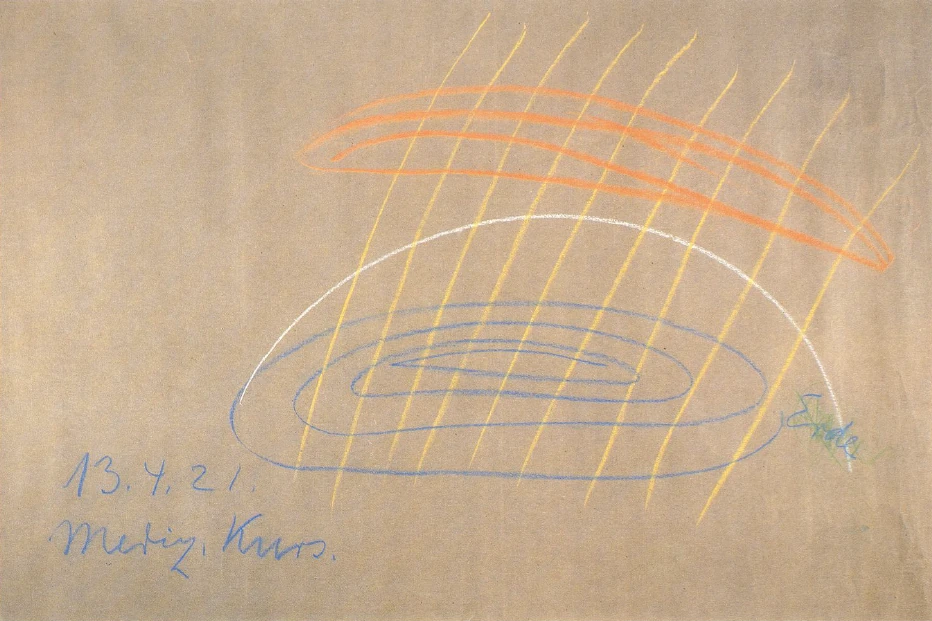
[ 17 ] When we magnetize iron, what this actually means in relation to the Earth is that we are turning the magnet into a little thief. We endow it with the ability to steal from the cosmos—specifically, whatever the Earth actually intends to absorb—and to keep it for itself before the Earth can absorb it. We turn the magnet into a little thief. It appropriates what the Earth would like to have, but it possesses the inner power to keep it for itself. All the surrounding electric and magnetic fields we have on Earth are actually something we have stolen from the Earth for human use, thereby tempting nature itself to steal, while we keep the extraterrestrial element above. And so we have something eminently extraterrestrial that we even cleverly keep above the Earth, even though the Earth, with all the power at its disposal, wants to draw it into itself so that it acts from within. But we do not allow it to act from within; we hold it back. And that is why we must seek out very special countermeasures against irregular human processes in electrical and magnetic fields, and a therapy should actually be developed that is specifically aimed at—for example, when a severe arrhythmia or some other severe disturbance, or even a mild one—in the case of a mild one, even better—occurs in the human rhythmic system, simply holding a strong magnet at a greater or lesser distance—which must then be determined by trial and error—not to apply it directly, but to keep it near the human organism. As I said, the distance must be determined by trial and error. I would also like to tell you how the scientific findings to date could best be applied here—not so much to share an—I would say—interesting fact with you, since that is not yet quite ready for public scientific discussion, but to draw your attention to something through which an entirely different complex of ideas can be mastered.
[ 18 ] Professor Benedikt, whom I mentioned earlier, has conducted very interesting experiments in the darkroom on the lowest human auric emanations, which have nothing to do—at least not directly, though indirectly they do—with what I have described in *Theosophy*, for example. These are higher emanations that can only be perceived in the supersensible realm. But between these higher emanations and the coarser indications that the eye perceives in human beings lies a realm that can be perceived in the darkroom, and Professor Benedikt has provided an interesting description of his work in the darkroom. In particular, he used individuals who were receptive to the phenomena of dowsing. That is, individuals in whom the divining rod produced distinctive reactions; Moritz Benedikt used these individuals to examine their auric emanations in the darkroom. The following findings emerged regarding these auric emanations. Moriz Benedikt describes particularly interesting results: these auric radiations in dowsing-reactive individuals are quite different from those in other people, notably because the asymmetry increases very strongly—the radiation from the left-handed person is different from that of the right-handed person. The radiation from the head also becomes quite different. So it is indeed the case that a start has already been made today—even if it is still met with great skepticism—to observe human emanations even in physical demonstrations. But one must always be clear: these are only the lowest emanations connected to the physical organization. This does not yet constitute an entry into the realm of the supersensible, as some who wish to take the easy way out with the supersensible would have us believe. On the other hand, however, it marks a starting point for achieving a therapeutic result. Specifically, it is necessary to investigate what occurs when, for example, a person with early-stage so-called tuberculosis a strong magnet is placed on their back—that is, allowing the person to be permeated by a magnetic field, which can be made even more effective by holding the magnet horizontally and moving it from top to bottom and from bottom to top, so that, so to speak, the entire chest region is gradually permeated by the magnetic field. When applying this magnetic field, there is no need to use a light source at the same time; that would only interfere. One can therefore place such a patient in a darkroom, and one can indeed soon observe the radiations emanating from the fingers, which will become quite clearly visible there. Once this has been done—once the patient has been placed in the darkroom, a strong magnet has been applied to their back, and one has observed the fine radiations emanating from the fingertips, which appear cone-shaped and point outward—one has gained the conviction that the patient has indeed been irradiated by the magnetic field. In this way, one will see that, precisely through the magnetic field, one can achieve various and extraordinarily beneficial results in the treatment of, for example, pulmonary tuberculosis symptoms.
[ 19 ] These are things that, at the same time, show us just how seriously we must take the statement that we actually have an effect only within the human breast; that is, even when we want to heal, we must turn to the environment; that we must apply something that belongs to the human being’s external world: light, the effects resulting from climatic influences when we move a person to a higher elevation, and everything we can consider to be part of the magnetic field. The same applies to the electric field; the only difference is that the method of treatment involving the electric field must be taken into account. It is certainly the case that when electricity is passed through a person by directly applying the poles to the body, the situation is entirely different from when, for example, an electric field is generated as such and the person is placed within this electric field without the path from one pole to the other passing directly through them. Experiments will also have to be conducted in this area that are of extraordinary significance. Under certain circumstances, beneficial effects can even be achieved by allowing the current path between the poles to pass through the human body. But in that case, the only effect is that which passes from the metabolic system to the rhythmic system. Nothing other than the metabolic system is influenced when I direct the electric currents—which run from one pole to the other—through the human being himself, when I, as it were, include the human being in the line of action of the electric effect. If, on the other hand, I place him in the electric field, I will be able to observe that, so to speak, those dark-room radiations are present in him wherever there are pointed areas—on the toes, on the fingers, and so on— and I will observe that I can then intervene therapeutically even in those patients who have perfectly regular digestion and so on, yet still exhibit so-called symptoms of tuberculosis; thus, in the vast majority of cases, this will be the situation with diseases that occur particularly in this area.
[ 20 ] So today we began by focusing on the environment. I have also pointed out that nature, in the processes of falling asleep and waking up, encapsulates what has been broken down into a complex of symptoms, and I will begin at this point tomorrow to first examine the important diagnostic significance of the moment of falling asleep and waking up, but also to study, how we can observe what nature is trying to indicate to us through falling asleep and waking up, and how we can then—provided we know the principle—apply this to guide our observation of symptom complexes, and that there lies, in particular, something that also provides an important clue regarding the different treatments that must be applied to chronic and acute diseases.