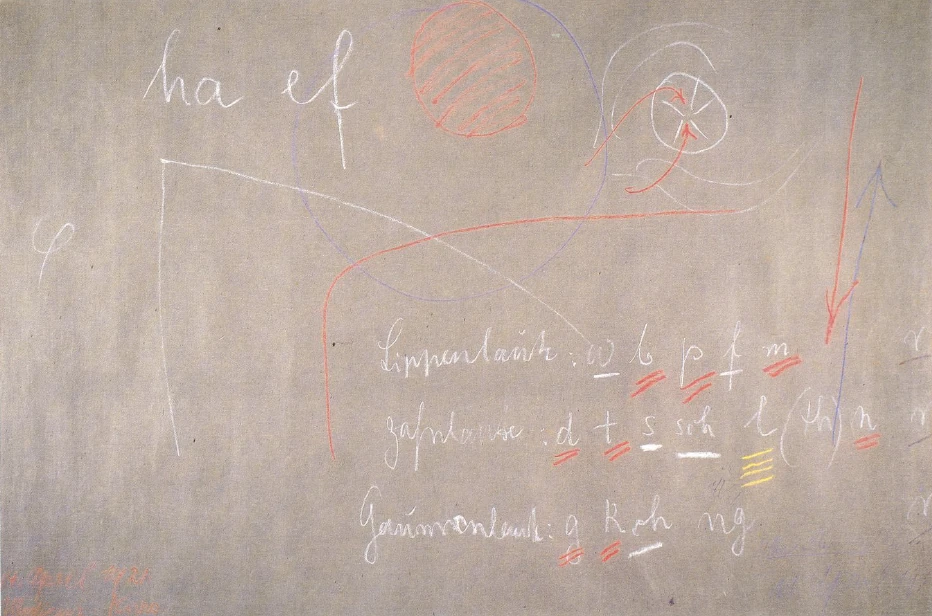
Spiritual-Scientific Perspectives on Therapy
GA 313
14 April 1921, Dornach
Translated by Steiner Online Library
Fourth Lecture
[ 1 ] Yesterday I said that certain complexes of symptoms can be summarized in the phenomena of falling asleep and waking up. First and foremost, it is important to consider the symptoms that are associated with the process of falling asleep, and in this regard, the following must be said: Difficulty falling asleep always indicates that the astral body—I’ll use this term for now, which you all know very well—is clinging to the physical and etheric organs, particularly the latter, and that it is too strongly connected to them. This clinging of the astral body is, of course, readily apparent to the spiritual researcher by the fact that the organs—the physical and the other organs—continue to function just as they do while awake when sleep is supposed to set in, whereas in a normal person they undergo a marked slowing down.
[ 2 ] Now, of course, this is the very point I was discussing yesterday: that one usually cannot properly educate oneself about everything that this difficulty falling asleep entails. Therefore, it is necessary to acquire, so to speak, a comprehensive overview of those phenomena that, in the waking state, are accompanying symptoms of difficulty falling asleep. And here one must say that everything that in a certain way points to an involuntary functioning of the organism is an accompaniment to difficulty falling asleep. Thus, every involuntary twitching of the lips, every involuntary blinking of the eyelids, every excessive movement of the fingers and the like—especially those that are not an expression of an internal process—in short, all restlessness in a person—is a waking symptom accompanying difficulty falling asleep. Of course, this process can usually only be observed when it manifests strongly outwardly. When such restlessness occurs in relation to the internal organs, it is a matter of having already developed a certain sensitivity to such things and of being able to truly connect certain phenomena. I would like to note here that, for example, certain sounds can be heard in sick people suffering from chlorosis in the veins that run along the left and right sides of the neck and then descend. These sounds, which used to be called “nun’s sounds”—I don’t know if they’re still called that—are also noticeable in every person when they turn their head sharply to the left and right, that is, when they bring about a very strong unfolding of the astral body, which always occurs when a movement that would otherwise be performed only voluntarily is carried out involuntarily. So every time a movement that is otherwise performed voluntarily—that is, a movement dependent on the “I”—is performed involuntarily, the astral body is strained too much, overused, and pressed too strongly against the organ; in other words, when that “fidgeting” is present. And in this way, through such indirect observations, attention can be directed toward the “fidgeting” of the internal organs.
[ 3 ] Now it must be said that in this type of difficulty falling asleep, there is always an irregularity that is quite removed from immediate external influences—an irregularity that is far removed from everything I said yesterday, for example, about light and about magnetic and electric fields. All of these things are somewhat removed from what corresponds to difficulty falling asleep. In such cases, it is necessary to resort to remedies. So when there is a complex of symptoms that can be summarized under the term “difficulty falling asleep,” it is necessary to resort to remedies—specifically those in which processes, particularly in plant matter, must first be induced, such as boiling, burning, and so on. In cases where difficulty falling asleep is present and one is dealing with diseases within the human chest cavity, everything that can be obtained as remedies through the decoction of roots, through reduction to ash, and through burning will play a major role, because there is always an irregular attachment of the astral body to the human organs in such cases as well. All the power still present in root decoctions and plant ash is what must play a particularly strong role here. In contrast, everything I mentioned yesterday will play the most significant role in cases of difficulty waking up.
[ 4 ] Inadequate awakening always indicates that the astral body is not interacting sufficiently with the organs. In the case of chest ailments, this insufficient interaction of the astral body has a different meaning than when dealing with general illnesses of the human organism. In the latter case, one must attempt to bring the entire astral body into play. Then what I said a few days ago regarding the effects of arsenic comes into play. These effects, however, are effective when it comes to treating the astral body that is already permeated by the “I,” whereas, if one wishes to treat the astral body alone, it is of particular importance to apply precisely those methods I spoke of yesterday. In cases of inadequate awakening, a state that might be described as drowsiness—a tendency to keep consciousness generally clouded—will always arise as a symptom accompanying wakefulness. Thus, these are essentially psychological phenomena that must be regarded as symptoms accompanying inadequate awakening. And for this reason, it is also of particular importance for individuals who exhibit some deficiency in their thoracic system and who, at the same time, display precisely such psychological accompanying symptoms to undergo these treatments using magnetic or electric fields; in this regard, regarding a question that was posed to me yesterday —I will address all questions in the course of the lectures, as time permits, of course—regarding the difference between direct current and alternating current treatment—which is what the question was likely referring to—I would like to make the following observation: When dealing with frail individuals—people in whom it is clear that the problems stem from malnutrition and the like, that is, disorders originating, so to speak, in the lower part of the middle human being—it is better to use alternating current. However, if it is clear that the disorders originate in the upper human being, then it is better to use direct current. It should be noted, however, that the difference is not very great, and that if one uses one method in the appropriate case and the other in the other case, no major mistakes can occur in this regard.
[ 5 ] Well, you will have seen from this that precisely in this realm of human health and illness there are also important pointers for diet in general, because there is—I would say—a subtle transition between effects that are of a more dynamic nature and are introduced into the human being from the outside, and effects that arise from plant substances that have first been processed and transformed by the human being themselves. But you will understand that, since we are in a realm where everything is actually based on rhythm—on the rhythmic functioning of the human organism—there is also something that, when assessing healthy and sick people, cannot be emphasized enough: namely, that any form of fanaticism should be absent from this approach. In fact, any form of fanaticism should be absent from the medical profession. And regarding that fanaticism which expresses itself, for example—let’s say—in a fanatical adherence to a raw food diet, that is, raw foods fanatically enforced as a dietary prescription—here you must take note of what we had to say: A raw food diet—that is, never consuming overcooked plant matter, particularly the parts of the plant that extend downward toward the root—has a very specific effect on the entire human organism; it has the effect of gradually undermining the health of the respiratory system. Of course, because the human organism is not so easily destroyed, such fanaticism regarding raw food can have a ruinous effect on a person for a long time without being noticed; but over time, fanatical adherence to a raw food diet will indeed manifest itself in pronounced shortness of breath or similar symptoms.
[ 6 ] Now, someone might come along and say: “Yes, but I’ve had excellent results with a fruit diet.” You see, here again the following must be said. Fruits are not roots; fruits are strongly influenced by the external sun. A very intense, almost extraterrestrial process takes place there; it comes very close to cooking when one makes use of the dynamic force within the fruits. Thus, for example, if one allows certain sick people to eat fresh fruits rather than roots, one causes them far less harm—far less—than if one were to have them eat raw roots. So one must not become fanatical on either side, but must in fact tailor the approach to the individual in both cases. There may well be cases where one must say to oneself: This is a person in whom it is quite clearly evident that their irregularity in the chest system stems from the circulation and not from the respiratory rhythm; I can demonstrate that it originates from the circulation, not from the respiratory rhythm. In that case, I will be compelled to address the factors that influence the circulatory functions from the digestive functions, and there I will be able to properly remedy what is lacking through a diet of raw fruits. That is quite correct; I can do this, so that this individual case could indeed point toward a raw fruit diet. But if I have a person who tends to attribute the origins of the chest’s impaired functioning to breathing, then I will not be able to achieve anything with such a treatment—and may even cause harm—because in that case I will need to prescribe a diet that provides the person with overcooked root vegetables. This thoroughly unstable system clearly demonstrates just how harmful fanaticism in one direction or the other can be.
[ 7 ] Well, we will not be able to fully understand this system and will therefore have to return to it again unless we first, I would say in this first part of our considerations—which are more pathological-therapeutic, whereas the next ones are intended to be therapeutic-pathological—if we do not take into account in this first part that which exists as a process within the human organism that very often eludes external observation entirely, and thus remains unobserved to the detriment of human health. In the general lectures, where I spoke about linguistics—I was unable to include it in the chapter on the natural sciences, though it could just as well have been considered there—I spoke of the peculiar processes that manifest more outwardly from the organism at sexual maturity and manifest inwardly in the period between birth and the change of teeth—that is, when a person learns to speak —that the processes taking place there between the astral body and the human etheric body, as well as the physical body, underlie the learning to speak and all the changes in the human organism associated with it. These are the processes that should therefore be carefully observed in the child. A child’s learning to speak is always accompanied by a parallel change in the rest of the organism. And as mentioned, one should also observe the change moving forward, toward birth—that is, trace back from the radical change during the change of teeth to the onset of speech. But now there is an equally significant change that is directed inward; it does not manifest itself outwardly in the same way as, for example, the emergence of the second set of teeth—which anyone can observe—or the process of learning to speak: anyone can observe that as well, because it manifests itself outwardly. But there is also a change taking place—one that is almost more important for human health and illness than the other, where, I would say, a great deal is already done instinctively in child-rearing because these things are so clearly evident. In fact, there is a much greater significance underlying this other process, which now takes place in the period between the change of teeth and sexual maturity—the process that lies directly in the middle and consists in the fact that the true “I,” which is, after all, only born in the sense that I usually describe, I would say, in the exoteric, in the fully exoteric sense, only around the age of twenty—that this “I” is now also born inwardly, just as the astral body is born outwardly through speech. This reaches its culmination between the ages of nine and ten.
[ 8 ] And now, please consider the following. What is actually inherent in human beings with regard to their “I” is almost entirely overlooked. The “I,” as an inherent part of the human organism, performs a very special function. Everything else in the human being—the physical aspect, especially— we will return to this later—the etheric and also the astral aspects of the human being, which are actually connected to the human exterior only through oxygen, are parts of the human being that are in fact very strongly bound to the human interior. During sleep, the ego takes with it almost only the astral body from the human organism. It has a very strong affinity for the physical body and, in particular, for the etheric body. But this is not the case with the “I.” And it is here, in the “I’s” relationship—specifically in its relationship to the external world—that the profound difference between humans and animals truly becomes apparent. When we eat, we take in substances that are, in the external world, simply substances. These must be transformed within the human being. Who brings about this transformation—this fundamental transformation of external substances within the human being? Who brings it about? In truth, it is the “I” that brings it about. The “I” alone is powerful enough, I might say, to extend its sensory antennae all the way down into the forces of the external substances. I would say that if you have an external substance—drawn schematically—it possesses certain forces that must be broken down if they are to be recombined within the human organism. The etheric body and the astral body, so to speak, merely circle around the substances; they lack the power to penetrate into the interior of the substances—they merely circle around them. It is the “I” alone that is truly involved in penetrating downward, in entering into the substances themselves. So when you introduce a food substance into the human organism, this food substance is initially inside the person. The “I,” however, encompasses the entire human organism and enters directly into the food substance. An interaction arises between the inner forces of the food substance and the human “I.” Here, the external world—in terms of chemistry and physics—and the inner world of the human being—in terms of anti-chemistry and anti-physics—overlap. That is the essential point.
[ 9 ] The fact is that in children, right up until the time when the second set of teeth begins to emerge—that is, right up until the time when tooth replacement begins—this intervention into the substance of the materials is regulated primarily by the head. The child is born in such a way that, through the indirect path of the head during embryonic development, it is endowed with the forces that are active in human beings to process substances from within. But in the period following the change of teeth up to sexual maturity—with the culmination between the ages of nine and ten—the “I” that acts from the lower human being, the lower “I,” must now encounter the upper “I.” In the child, it is always the “I” that acts from the higher human being that still processes the substances right up to this period I have described. Of course, I am referring to the instruments of the “I.” After all, the “I” is a unified entity. But the instruments of the “I”—the polarity of the “I,” that is, the lower aspect of the “I” that encounters the upper aspect—only establishes a proper relationship during the period I have indicated. Thus, in human beings, the “I” must enter into the organism in the same way that, when learning to speak, the astral body must intervene in the human organism.
[ 10 ] Now, with these premises in mind, observe all the phenomena that manifest in children from around the ages of eight or nine through to twelve or thirteen—precisely those phenomena that are so essential to observe during the elementary school years. Consider these phenomena from this perspective. They find their outward expression in a process of seeking on the part of the human organism. And this seeking consists precisely in the search for a balance—a harmony that can only be established over the course of a lifetime—between the substances that are taken in and the inner human organization. Observe carefully how, when the head is not quite ready to absorb the inner forces of the substances during this period—when it refuses to do so—this manifests itself in childhood headaches around the ages of nine, ten, and eleven. Observe how the accompanying symptoms then manifest in metabolic disturbances—disturbances that are relatively far removed from the core—such as in gastric acid secretion and so on; observe all of this, and you will see that there are children who, so to speak, are constantly ailing due to this inadequate adjustment of the “I” from both below and above. If such matters are carefully taken into account, then they can be addressed, and they generally disappear; they subside after puberty, when the astral body finally takes over and compensates for what the “I” cannot do. This gradually subsides between the ages of fourteen to fifteen and twenty to twenty-one. It is precisely during this period between the change of teeth and puberty that children who have been sickly can subsequently become exceptionally healthy. This is something that is very instructive to observe. You will often have noticed how sickly children—particularly those whose illness manifests very strongly outwardly in digestive symptoms, such as irregular digestion—go on to become perfectly healthy adults when they are carefully treated. And of particular importance in this treatment is that one must proceed with extraordinary care when it comes to dietary guidelines. Remarkable results can be achieved in this regard if the parents or caregivers of such children—who are frail in this way—do not constantly provide them with all kinds of abundant food and persistently try to persuade them to eat more. That only makes matters worse. Rather, one must try to determine what the child digests particularly well, what agrees with them best, and then provide it in smaller portions more frequently—that is, by spreading the food out over a greater number of meals. One must pay attention to this; in doing so, one can do such children a great service. On the other hand, believing that one can achieve anything through overfeeding and the like is a completely mistaken view. If one also ensures that such children do not have excessive schoolwork—which would continually worsen their condition—and thus grants them the necessary rest, one is doing exactly what, in turn, promotes this internally necessary digestive activity, which itself relies on food being provided in smaller portions. There is scarcely anything against which people sin as gravely as against precisely what is implied in these remarks. For one can certainly say that if these principles are disregarded—if one fails to ensure healthy human development in this regard—then all manner of predispositions to illness, stemming from the harmful influences of this stage of life, will remain with the individual for the rest of their life.
[ 11 ] Well, people are quick to complain that we are extremely sparing with homework at the Waldorf School. We have good reasons for this. A realistic approach to education does not focus solely on abstract principles and abstractions in general—which are so often emphasized in life today—but takes into account everything that must be considered in the actual development of the human being, and this includes, above all, not burdening children with homework; for homework is, in essence, sometimes the very, very hidden cause of poor digestion. These effects always manifest themselves later, but they are indeed very potent. It is a peculiar feature that, in human development, a spiritual assessment of a person simultaneously serves as an indication that what is being prepared in an earlier stage of life for later life can indeed be seen in its early signs during that earlier stage.
[ 12 ] Well, the danger inherent in this—if I may put it that way—integration of the “I” into the human organism from below is, in fact, an extraordinarily great one for almost all people, and especially for cultured people of our time when they are children; and therefore, one really must take these matters into account for every person, unless they happen to be of robust peasant stock. A certain marked difference still exists, particularly with regard to such matters, between peasant stock and—one might well say—the rest of the world’s population. For in this respect, a distinction must be drawn. The rest of the world’s population is highly prone to dangers arising from this inadequate integration of the “I” into the organism—which is thoroughly corrupted before this “I” is supposed to integrate—as well as to the dangers that arise precisely during this integration of the “I.” From the perspective of the respiratory system and also the cranial system, the female sex is even more receptive to this peculiar, unstable equilibrium that exists. The male sex is, in terms of its thoracic organization, somewhat—not more stable—but even more robust, and thus less sensitive. The same damages can occur there as well, but they manifest themselves less. The female sex is more sensitive to everything that occurs, and what I have described—the search for the proper integration of the “I”—results either in a healthy individual or in pallor. Anemia is the direct continuation of everything that occurs abnormally in this way from the age of seven onward. Anemia does not manifest itself until later, but it is precisely the intensification of everything that is still imperceptible in this regard during the previous lifetime.
[ 13 ] In this regard, we must point out something that is exceptionally important to distinguish. When we consider the circulatory system, we must distinguish the actual circulation—which is a sum of movements—from that which is intimately intertwined with this circulation, which, so to speak, interweaves itself into this circulation: that is metabolism. In the circulatory system, there is indeed a balance between the metabolic system and the rhythmic system, whereas in the respiratory organism, there is a balance between the rhythmic organism and the nervous-sensory organism. So when you consider this middle human being, this “chest human,” you must certainly note that this chest human is organized in a polarized manner in two directions. Through respiration, it is organized toward the head; through circulation, it is organized toward the metabolic-limb system. Everything that is part of metabolism itself or intimately connected with it—in the human being’s mobility, which is of great importance especially in the first or ascending half of life—all of this pushes its way into the circulatory forces as metabolic forces. And this upward movement must then advance further, so that in the process I have described, we are actually dealing with an advancement of that which the “I” brings about in metabolism—already in the absorption of substances, and then in its engagement with the inner forces of those substances. We are dealing with an upward movement through circulation and respiration all the way into the head system, and this must be properly organized within the specified period between the change of teeth and sexual maturity. The “I’s” engagement with the forces of external substances must move upward through circulation and respiration until it properly intervenes in the head system. This is precisely the very complicated process we are dealing with here, and this complicated process can actually be studied in such a way that one attempts to grasp its influence—I would say—in the external digestive tract, where the substances are still very similar to the external world, where they are only weakly grasped by the inner being. For what is the first apprehension of external substances? What does the “I” do when it first apprehends external substances?
[ 14 ] The ego’s first perception of external material forces occurs alongside the sensation of taste—the act of tasting and processing external substances—so that it subjectively manifests itself in the act of tasting. This is the first perception of inner forces. Then the process continues inward. But the act of tasting also continues inward. The inner digestive system—which lies beyond the intestines and then transfers nutrients into the blood—is still a gradually diminishing act of tasting. And so it actually continues upward until the act of tasting is counteracted within the head. There, the act of tasting is dulled. And therein lies the activity of the head in relation to the sense of taste. The head numbs the sense of taste. It turns against the sense of taste. This process must be orderly. Then, of course, as it penetrates further into the substances, the “I” grasps these substances more strongly than is the case merely externally and subjectively in the sense of taste.
[ 15 ] What takes place, so to speak, in the external digestive tract is strongly influenced by mineral salts. You can harmonize what I am about to say with what I said in the previous course; you will see that what I am presenting now is essentially a supplement to what was said there. The fact is this: When we ask ourselves, “What exactly is a remedy from the outer realms of nature? What is a remedy?”—this fundamental question is, in fact, a basic question of medicine, one might say. What is a remedy?
[ 16 ] Anything that the organism can digest in its healthy state is not a remedy. That is not a remedy. The remedy begins only when one introduces into the organism something that it cannot digest in its healthy state—something that must first be digested by the abnormal human organism. We challenge the abnormal human organism to digest something that is not digested in the healthy human organism. Healing is actually a continuous process of digestion, but one that is gradually shifted into the interior of the human organism.
[ 17 ] Among the accompanying symptoms of what then manifests itself—let us say, in pallor—in its most striking forms, as previously indicated, are all of the following: fatigue, listlessness, difficulty falling asleep, and waking up. When all these symptoms occur—which can occur in most children at the age mentioned today—it is necessary to begin by addressing the external digestive tract. There, one must administer mineral remedies, specifically those that are entirely mineral in nature. And there one will see that results are achieved. Initially, these effects can be observed through the symptoms that arise. For example, one will see that strong symptoms arise, all of which indicate how the “I” externally captures the forces of external substances, and how it is supported in this regard by, let’s say, ferrous carbonate. Ferrous carbonate is something that acts as a support against weakness when the “I” is to engage with the external world.
[ 18 ] If we take it a step further and consider a deficiency in the ego’s involvement in the circulatory system, we will see how this deficiency can be supported, for example, by Ferrum muriaticum—that is, by a remedy that has already been potentized within the pure mineral realm.
[ 19 ] Let us turn to what is present in the respiratory organism; in other words, let us ascend another level, and we will gain a very special support for the “I” through plant acids; and, moving further up to the head system, through the pure metals—which, of course, must then be applied not as externally pure metals, for in that form they initially have no real connection to the human organism, but rather through their finest forces. That is why I said last year that, fundamentally speaking, the human organism does not allow itself to be treated allopathically with regard to metals; rather, it homeopathizes them itself—it breaks down the metals itself as they pass from the digestive system to the head organism. Of course, one supports this organism by developing the potentization process.
[ 20 ] But you will see—and we will return to this from a different angle—that even this alone provides some insight regarding potentization. For one must form a mental image of the actual center of the deficiency. The deeper the center of the deficiency lies—the farther it is from the organization of the head—the lower the potencies. The more one can ascertain that it lies close to the organization of the head, the more one must apply higher potencies. Of course, this means that whatever comes too close to the organization of the head can manifest and express itself in every possible way.
[ 21 ] If you start from the correct perspective of the “I” perceiving the external world, then you will—I would say—be able to see through those phenomena that present themselves to you as symptoms. You see, if you refer back to what I have said in recent days—and what I have emphasized elsewhere as well—the human organism is simply not what we depict with lines; that is, after all, only the solid form. The human organism is essentially also organized fluid, organized air, and organized warmth. And the “I” must now intervene in these various aspects of the organism. Particularly important and subtle is the “I’s” intervention in the body’s thermal conditions. The “I” must intervene in the body’s thermal conditions in the following manner.
[ 22 ] First of all, when a human being is born, we have the image of the “I.” As I have said, the image of the “I” is present in the head. We have the image of the “I.” This is active during childhood. For this to happen, the “I”—or, I would say, Being—must rise up from below; it must intervene there. And this manifests itself in the fact that this image of the “I” that we have in our heads has a thoroughly warming effect on the organism during childhood. This has something to do with the warming of the human organism. But this warming follows a downward curve. This warming is strongest at birth, insofar as the warmth emanates from the head, and then follows a downward curve. And as human beings, we are compelled, in later life, to maintain at its peak what develops along that warmth curve—from below upward—through this intervention of the “I” in these thermal conditions. Later on, we must counter this curve with another one that is ascending, and which essentially depends on the absorption of the rising substantial forces through food, their transmission into the circulation, into breathing, and then into the head system.
[ 23 ] Now suppose this process does not occur properly. This transfer of the inner, substantial forces from the external world into the human organism is too weak. Suppose this is too weak—that it is not developed with the necessary intensity—then, through the ego pathway—which is, of course, necessary—you are not supplying the organism with sufficient warmth. The head, which then follows only a downward trajectory, allows the body to grow cold. This first occurs at the peripheries. And please, observe how those individuals who continue to experience this state of lethargy—which stems precisely from everything I have described today—suffer from cold hands and cold toes. There it is palpable, for you can feel how the process that took place from above through the image of the “I” in childhood is not counteracted by the active “I”—the “I” that must be developed—which carries warmth all the way to the outermost periphery of the limbs. This is something that will show you how, as soon as you turn to pictorial observation, as soon as you take into account how the various forces—those above and those below—interact within the human being in such a subtle way as to become pictorial, you then actually have, so to speak, images in what is expressed. In the chill of the hands, in the chill of the feet, you have images of something that is taking place throughout the entire human organism. And then it happens that one learns to interpret the symptoms in such a way that the understanding of the whole human being emerges from them. It is, in the deepest sense, indicative that this “I” does not function properly in later life when a person has cold hands and feet. For if one pays attention to such things—if one even merely engages with what Spiritual Science has to say based on its premises—one gains a connection with the human organism. If one does not engage with this, one will see how, through this failure to pay attention, one gradually loses the connection to a true understanding of the human organism. But if one engages with what Spiritual Science has to offer, one gains a connection to the human organism. One grows into it.
[ 24 ] Take the following, for example. This Spiritual Science constantly emphasizes: There is something in the human being’s power of self-elevation, but this power of self-elevation, in turn, is connected to the development of the “I” from the bottom up. What happens first, earlier on, is a force of uprightness that, in a certain sense, manifests itself only externally. It is supported by what flows from top to bottom. Once the change of teeth is complete and this directing force has fulfilled its purpose in the appropriate way, this elementary upward-directing force comes to an end; the upward-directing force then shifts entirely to the inner realm, and a balance must be established within—from the bottom up and from the top down. And then the forces flowing from the top down and from the bottom up come into opposition. And they meet. In this—I would say one-dimensional—encounter between the forces from above and the forces from below, one can particularly see what is taking place at this stage of life. And now observe what causes people—let’s say those prone to chlorosis—to become especially tired. They always become most tired not when walking on level ground, but when climbing stairs. This points directly to these phenomena. It is precisely when climbing stairs that people prone to pallor are particularly burdened, so that here again, through the symptoms—in what manifests itself vividly in the process of becoming—one can grasp what stands spiritually behind the human being. Then one can proceed to—I would say simply derive from what one gains in this way through diagnostic pathology—the measures one must take against these abnormal phenomena. More on that tomorrow.