

Spiritual-Scientific Perspectives on Therapy
GA 313
15 April 1921, Dornach
Translated by Steiner Online Library
Fifth Lecture
[ 1 ] The aim will be to bring these reflections to a climax in a description of the nature of those remedies that we have compiled and that we intend to disseminate. However, it will not be possible to speak properly about what one must, so to speak, know and master with regard to these remedies unless we have the overall preparation for them. This must first be established. Therefore, let us also consider today some of what can lead us into the entire fabric of the human being, which takes shape there through the interplay of the ego, the astral body, the etheric body, and the physical body. It has already been mentioned how, through a certain effect of arsenic, the astral body—which, of course, then also draws the “I” into itself or along with it, I might say—can be brought more deeply into the organs than is otherwise naturally the case in the people in question.
[ 2 ] Well, by integrating the astral body more deeply into the organs, the mineralization process of the organs is enhanced, so that one can also say: If one notices that the organs themselves are becoming overly vitalized—that they are developing excessive life forces within themselves, proliferating in an ethereal sense, so to speak—then the remedy that can have a healing effect will be the administration of arsenic. But one can even, if one wishes, describe what is taking place internally within a person through an external process that, in a sense, stands in elective affinity with the human process. If one wishes to express this affinity of the astral body to the etheric body—and thereby to the physical body—by name, one can certainly call it “arsenization.” A subtle process of arsenicization takes place continuously within the human being, and it is particularly strong at the moment of waking. We must simply be clear that the human organism possesses within itself, as a system of forces, precisely what is found in metals. This elective affinity between the human being and his earthly-cosmic environment is such that certain processes taking place externally—and which, for example, find their culmination in metals—also take place within the human being. One must therefore not assume, when speaking of the “arsenization” of the human being, that arsenic is directly at work here; rather, the human being itself acts within itself in the same way that arsenic acts externally. And through this, one will gain an insight into how one must assist such effects within the human being. So if you consider this “arsenization”—I could also say “astralization”—of the human organism, you will notice that when it acts too strongly, this manifests as a certain warmth in the stomach region; it also manifests in that certain digestive ease even occurs—that eating and digestion become easier—which, however, if it becomes too easy, is, in a certain sense, cause for concern, because all such reliefs in humans are then followed by reactions and complications; for all of this is connected with a certain mineralization of the human being. And there is, for example, certainly a direction in which research should be conducted. One must simply conduct them in the proper manner—namely, by taking all other factors into account—so that in people who are highly astralized, that is, who exhibit arsenic-like processes in their organic-physical systems, the corpses decompose less readily than in those people who connect the astral body to the organs too weakly. This is certainly something worth observing. One sees it, after all, in its extreme form in the tendency of corpses poisoned by arsenic to mummify. They mummify; they are easily preserved and decompose very slowly.
[ 3 ] Now the question is: How can one counter this when this process of arsenicization—or astralization—is too strongly at work within a person, when, so to speak, a person mummifies themselves while still alive? One must simply combine observation—a certain perspective—with such a process. If a person becomes too heavily mummified, how can one counteract this, how can one combat it? And here I would like to say, to put it radically: Turn the whole person, for a time, into a tooth. This will, after all, be something that can lead one to certain clues in the mysterious workings of the human organism. Let us turn the whole human being into a tooth. Let us try, in whatever way possible—taking the entire organism into account—to supply the human being with the radiant power of magnesium by administering magnesium in some form of preparation. This is what is meant by the radiant power of magnesium described by Professor Römer being evoked throughout the entire organism, and this is what, I would say, truly provides a thorough insight into the relationship that exists between the astral body—which thus encompasses the “I”—and the etheric and physical bodies on the other side.
[ 4 ] Now let us try to turn to the opposite—to that state in the human being in which the astral body, together with the “I,” has little inclination to permeate the organs, and in which the organs, insofar as they are supplied by physical and etheric influences, begin to be left to their own devices. This is a state that manifests itself in the fact that, so to speak, there is no proper connection between what should exist as an interaction—namely, the human being’s nutritional interaction with its environment—and the inner organic processes. The inner organic processes begin to develop their vital force strongly. They receive no influence from the outside; the interpenetration of nutrients with the forces of the “I” diminishes. As a result, the astral body also becomes engaged in one particular direction. It cannot properly transition to the etheric body. There is—I would say—a proliferation of physical and etheric activity, which initially manifests in the occurrence of diarrhea, which is essentially associated with such phenomena as the presence of blood in the stool, and even with the internal vital activity becoming so intense that small pieces of organic tissue break off from the intestinal walls and are found in the stool, and that the stool itself takes on the consistency of meat broth—which clearly indicates that the vital force within is proliferating unhindered by the astralizing force. These are the symptoms. Finally, protein is also carried away and excreted without being properly processed. These are the kinds of conditions that are brought about. And essentially, what must act upon the human being’s physical and etheric bodies so that these semi-conscious movements—which are, after all, necessary in the human organism—can be carried out, is precisely the astral body and the “I.” So imagine: if the astral body and the “I” are not properly engaged here, and the etheric body and the physical functions remain isolated from one another, then the nervous urge to defecate—which is characteristic of such conditions—arises. And the further you describe the matter—the further you move from ordinary cases of diarrhea to dysentery and so on, that is, the further you go in describing this clinical picture—the more you will see that you must describe it in such a way as to evoke, in all these phenomena, the opposite of arsenicization or astralization. The opposite of astralization or arsenicization is present everywhere. And since the astral body is heavily involved in this, you will now actually—I would say of your own accord—be led to the conclusion that whatever comes from arsenic must be used as an antidote, that is, that these conditions must be counteracted precisely through arsenicization.
[ 5 ] I believe that one’s mental image of human beings can be extraordinarily enriched and deepened with regard to such matters if one realizes that, fundamentally, for everything that takes place within a human being, there are corresponding processes in the external world. And even though this must sound terribly offensive to anyone who has come of age in today’s school system, I would nevertheless not wish to avoid using certain expressions here that have a very serious meaning for Spiritual Science and that, if taken correctly, can lead one quite thoroughly into the heart of the matter.
[ 6 ] What one observes in human beings during arsenicization and astralization—that is, I would say, the crumbling, the mummification of the physical organism—is, fundamentally speaking, exactly the same process that takes place when the earth becomes rocky. Wherever the Earth manifests as rock-forming, it is, so to speak, arsenic-poisoned or in the early stages of arsenic poisoning. In contrast, imagine now that the outer astral realm—which, as I hinted at in the last lecture series, surrounds the Earth everywhere—manages, so to speak, to bypass the Earth’s surface and circumvent the task the outer astral realm is meant to perform in bringing forth flowers and plants, and in the plants’ emergence from the Earth into the upper world; if, in a sense, the outer astral realm manages to penetrate beneath the ground, bypass the earth, and cling to the water, then in such areas the earth contracts dysentery. When the outer cosmic astral realm acts upon or is able to act upon the groundwater, then in such cases the earth contracts dysentery. And it is indeed a process that I am describing here, one that has real underlying causes—many real underlying causes—and which should be taken into account. For it sheds light on the connection between what takes place beneath the earth and phenomena such as dysentery, which one must often study in such a way as to observe in it a kind of effect of the subterranean realm, particularly in water, on human beings. The essential point now is to take into account that the astral body is very actively involved in this process, and that it will therefore be necessary to use moderate dosages and moderate potencies in the healing process, because the astral body’s effectiveness depends precisely on the middle member of the human organism.
[ 7 ] Well, phenomena that manifest themselves in a diphtheria-like manner are particularly well-suited to providing significant insight into certain—I would say—intimate aspects of the human organism. And these phenomena, which manifest themselves in a diphtheria-like manner, should be studied more closely, if only for the sake of finding effective treatments. After all, I believe that even today there is still a view—one that stems largely from a materialistic perspective—that diphtheria should be treated as locally as possible, that one should focus as much as possible on the local manifestation of diphtheria, although, of course, numerous opposing views have emerged precisely in this regard.
[ 8 ] Well, the important thing regarding the development of diphtheria and everything related to it is that we must add a few points to what we considered in the previous course, because we were not yet able to go into such detail there regarding this interaction of the four members of the human organism from Spiritual Science. I have pointed out in another context that a child’s learning to speak is accompanied by all sorts of organic processes. The child learns to speak. While it is learning to speak—that is, while something special is taking place in its respiratory system—something quite opposite is also taking place in its circulatory system, which, after all, governs the processes of metabolism.
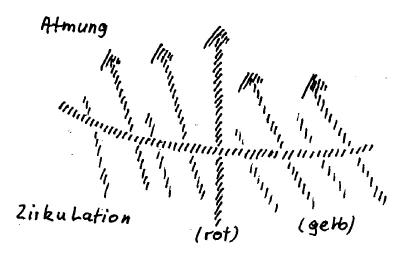
[ 9 ] Now, in a completely different context, I have pointed out how what becomes apparent during sexual maturity in the human being’s interaction with the outside world takes place internally during the process of learning to speak—that is, in a sense, this urge of the astral body, which occurs from the inside out as the human being reaches sexual maturity, takes place from the bottom up in the process of astralization; after all, the ability to learn to speak develops in the direction from below to above. We are thus also dealing here with a process of astralization, and we will be able to see clearly how—when we have, so to speak, the boundary here between the respiratory system and the circulatory system (see diagram on p. 87)—an interplay takes place between what rises from below to above as astralization (yellow), and the organs that meet this astralization from above and thereby strengthen their capacity for speech. What must be of particular interest to us, then, is what is happening simultaneously below. For what is happening there at the same time has the urge to rise upward. The entire process is one that moves from bottom to top. The whole process has the urge to move from bottom to top (arrows, yellow). If the process moving from below to above now spreads too strongly upward—if, during children’s speech development, there is an excessive upward surge of astral energy—then this excessive upward surge of astral energy creates a predisposition to develop something akin to diphtheria-like symptoms. This is how diphtheria-like symptoms are created. And it is indeed very important to give this connection due consideration.
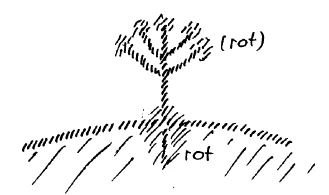
[ 10 ] Now let us also consider the external process of the Earth, which bears a certain affinity to the process I have just described to you. Suppose this is the Earth’s surface (see the following diagram). In a plant that—I would say—behaves properly toward the cosmos, what happens is that the Earth plays a part in the formation of its roots; then the Earth’s influence wanes and the extraterrestrial influence grows stronger and stronger, but this extraterrestrial influence unfolds particularly in the flower (red). What unfolds here in the flower is, in fact, a kind of external astralization of the flower, which then leads to fruit formation. If what is supposed to happen here (see lower drawing, p. 87, red at the top) in the normal course of world processes were to occur down below instead, it could only settle into the water, and we would then have what I just mentioned a moment ago: the “dysentery of the Earth.” But what actually happens there—which, as I said, when the plant develops into a healthy plant, always takes place a little way above the earth’s surface, where the flower unfolds—can also develop precisely where the earth’s surface is (see the lower drawing on p. 87, red at the bottom), and that is when fungi arise. That is the reason for the formation of fungi.
[ 11 ] Now you’re probably close to saying to yourself: If fungi arise through such a peculiar astralization, then the same process—and this is indeed the case—must take place from the bottom up when this strange astralization occurs internally toward the head, as in diphtheria. And that is why there is a tendency toward fungal growth in diphtheria. This tendency toward fungal growth in diphtheria is something that must be taken into account to a very high degree. The fact that, fundamentally, a truly occult process is taking place there—all external manifestations are actually only signs that irregular astral currents prevail within the human being— will also indicate that a pathology that seeks to deal solely with the external symptoms can only grasp the external manifestation of the entire process; that it regards the process as local because it looks only at the exterior; and that this inward pressure remains unaccounted for, particularly in such a case. The entire skeptical attitude toward this process is entirely understandable when one considers the points we have just discussed.
[ 12 ] Now, the risk of infection is indeed high in cases of diphtheria. Why is it high? It is high because diphtheria occurs in direct connection with the process of learning to speak; hence, it occurs most frequently in children between the ages of two and four. The likelihood of their occurrence then diminishes. But every process in the human organism that occurs at some point in the normal course of life can also occur abnormally. Thus, this process—which is simply a childhood process—can also occur at other stages of life, albeit in a certain modified or transformed form. When diphtheria occurs at a later age, it is nevertheless a case where something infantile is at work within the human being. And the fundamental character of the infantile is, as you know—in the external communication of facts from Spiritual Science, it is simply necessary to speak more about the psychological—the external process of the childlike, of the infantile, is imitation, pure and simple imitation. And this imitation is sought after. The organism itself is prompted to become an imitator when it develops diphtheria. Therefore, the infection actually rests on this process of the human being becoming an imitator. There is already something of a gentle sensitivity inherent in this imitation. One can certainly perceive a gentle sensitivity in this imitation. If one examines the matter from a perspective of Spiritual Science, one finds that the “I” does indeed play a certain role in this transmission of diphtheria. And for this reason, what develops as a fungal-like, parasitic entity is, for this very reason, more contagious in diphtheria than in other diseases, because the human organism, through its instinct to imitate, accommodates the pathogen. As soon as it—to put it crudely—somehow perceives the diphtheria toxin, it becomes receptive to it and mimics it. Therefore, psychological intervention—if possible, when the condition is just beginning to manifest—and strengthening through emotional encouragement will, after all, have a beneficial effect.
[ 13 ] However, with processes that interfere so deeply with the organism, one will naturally be able to achieve much less than if one were to attempt—I would say—to find the specific remedy that counteracts the process taking place there. As far as I am aware, at least, no attempts have been made—not even on an empirical, exploratory basis—to seek a specific remedy specifically against the symptoms of diphtheria. One must seek it, for example, in cinnabar potentized to a medium potency. Cinnabar is the substance whose effects one must seek as counteractions to all the symptoms I have just mentioned. Cinnabar already expresses this counteraction in its outward appearance. But an outward appearance explains something only when it is accompanied by inner insight. The ancient doctrine of signatures was based on the existence of an instinctive inner insight; it has essentially disappeared simply because people today lack the capacity for observation required for such things—because this capacity for observation has vanished. But it is important that one be able to ultimately grasp that inner activity—which, after all, manifests itself in all the outward appearances of the world. And so the person who—let’s say—does not get stuck in mysticism and then inject all sorts of mystical elements into the matter, but who thoroughly retains his common sense in such matters, will have to say to himself: Cinnabar red is something that, in a certain way, already expresses this counteracting force against the process of becoming fungal; whatever tends toward colorlessness can become fungal. If, in the process of becoming fungal, an excessive astralization of the Earth’s surface is at play, then cinnabar exerts a counterforce, a counteraction against this astralization—and hence the reddening. Wherever a reddening occurs in a natural process, there is a strong counteraction against astralization. I would say that, expressed in moral terms, the situation would be that the rose, by turning red, is attempting to defend itself against astralization. These, then, are areas of pathological-therapeutic observation that are certainly interconnected in a certain way, and which lead one into this peculiar interaction between the ego and the astral body in relation to the other organs—whether in taking hold of the other organs, in withdrawing from them, or in expressing the effects of the astral in a flow from below to above.
[ 14 ] In this way, one can, so to speak, gradually gain insight into the entire human body. One can gain this insight if one moves on from such reflections to something else. And there you will again have to consider something that I would now like to add as a supplement to the points I raised last year.
[ 15 ] It is quite remarkable how the human “I”—when we now consider it as acting within the human being on the spiritual, psychological, organic, and even mineralizing levels—is, so to speak, a kind of phosphorous-bearer. And this “I” carries out its task of carrying phosphorus in such a way that it extends this process all the way to the periphery of the organic human being. The carrying of phosphorus—the permeation of the human organism with phosphorus—is an activity of the “I.” This carrying of phosphorus to the outermost limit, to the periphery of the organic human being, is now, I would say, carried out by the “I” in an extraordinarily artful manner, in that—up to a certain limit, which must, however, be observed—the “I” can actually carry phosphorus through the organism only by attaching it to other substances, by chemically binding it to other substances, and in doing so essentially prevents the chemical release of phosphorus as it is carried through the organism. It is one of the tasks of the “I” to prevent this chemical release of phosphorus, down to the traces of phosphorus that are precisely necessary for what would occur on a large scale if the “I” were unable to prevent the introduced phosphorus from being released. If, then, the phosphorus were, so to speak, set free and were to exert an intense effect on the human organism, a very special process would ensue. I have told you in the course of these lectures that when a human being enters the world—that is, when he embodies what previously existed in him spiritually and soulfully—the images of the etheric body, the astral body, and the “I” are first formed. And I told you that everything that is a reflection of the “I” actually lies in dynamic systems, in systems of movement that come into equilibrium. This is something that must be thoroughly taken into account, especially at this point in our considerations. As the “I” works to develop equilibria from unequal weights, from disturbed states of equilibrium—and when I take a step, the state of equilibrium is disturbed; I must restore it, but the same thing also occurs through inner processes—as the “I” works in this way, it requires phosphorus. This work is essentially carried out with phosphorus.
[ 16 ] If the “I” does not function in such a way that it exhausts its phosphorescence by rendering human dynamism static, then it approaches, with this phosphorescence, that which is already, from the very beginning, a reflection of the “I”—namely, this act of rendering the dynamic static. Well, as I have already pointed out, we must also take into account the fluid human being, the air-like human being, and the thermal human being. Just imagine that you are dealing with the liquid human being and with what enters the etheric body from the image of the “I”—the astral body, in which the “I” is in turn imprinted—then the point is that even in this etheric body there must be brought about a continuous transition of the dynamic, of a state of imbalance into equilibrium.
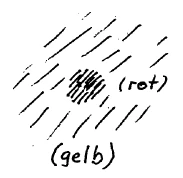
[ 17 ] Now, what we are considering here are extraordinarily subtle effects—truly very subtle effects. And these subtle effects are regulated by the presence in the human body of tiny spheres that, in a sense, float freely yet are connected to the entire movement of the organism, including its internal movement. These are, in fact, the blood corpuscles. What the “I” does—by influencing mobility, including, for example, internal thermal mobility—must act upon these blood corpuscles. These blood corpuscles—which are not actually “little spheres,” but are essentially of such a nature that their very form reveals how they are designed to bring movements into equilibrium— I would like to say: What the “I” does by intervening in the human organism’s capacity for movement reaches its limit precisely at the blood corpuscles; and there it must be halted; there that—I would call it the most intimate interaction—must take place between the human “I” and the entire human organism. And it is there that what I would like to call the most hidden struggle takes place—the ongoing phosphorization of the human being against what lies within the formative processes of the blood. For when phosphorus is introduced freely into the human being, the blood cells are destroyed by the phosphorization. This is what can vividly introduce us to this peculiar interaction of the “I,” which is, of course, a spiritual entity—a thoroughly spiritual one—but which, through the blood cells, stands in constant interaction with the physical. Blood is also, in this sense, a very special fluid—as not Goethe, but an old saying puts it: blood is a very special fluid; it is the medium through which the human being’s outer physical nature interacts with the most spiritual aspect he initially possesses—the “I”—and where the most ruinous effects can occur if the “I” enters into this interaction in a wrong way. Therefore, under such a wrong interaction, so much can be ruined in the physical realm: epithelial decay, fatty degeneration extending into the muscle fibers—especially the striated muscle fibers, because these are the ones on which the “I” has a particularly strong effect—the breakdown of blood cells, and so on. Indeed, this process of decay can extend all the way into the bones in the physical body if the phosphoric processes are not functioning properly.
[ 18 ] It becomes quite clear, I would say, from this interplay between the “I”—which naturally draws the astral body along with it— and the physical body—which in turn draws the etheric body along with it—that there is quite clearly a striving toward the normal and the abnormal, so to speak: a continuous process of normalization up to a certain culmination, followed by a subsiding, and how this manifests itself, for example, in cases of phosphorus poisoning. When dealing with phosphorus poisoning, one will notice that at first both the astral body and the etheric body resist what is asserting itself in the physical body and in the “I.” They resist; and they resist with all their might, with the greatest strength the etheric body possesses. It seeks to counteract what is exerting too strong an influence within the “I,” and in doing so, it even strengthens its own powers. That is why the process in the early stages of phosphorus poisoning bears such a close inner resemblance to another process—namely, the occurrence of a certain retrospection experienced by a person after death, which, as you know, can last for days—a day and a half, two days, or three days. In this retrospective review, we see the etheric body being held within the astral body. They hold each other together, so to speak. They do the same thing initially within the human body as well when phosphorus poisoning occurs. Everything that can be developed through the interaction of the astral body and the etheric body is developed, and this is precisely what occurs when this retrospective review takes place through the etheric body after death. Therefore, through this expended energy, in the early stages of phosphorus poisoning—after a period of time equal to how long such a review would take—an improvement will occur, followed by a weakening, a ebbing away. Then, after this ebbing has taken place, the abnormal effect of the “I” sets in all the more strongly. True phosphorus poisoning is, after all, something that is extremely difficult to combat—something that could probably only be combated if one were to attempt, in the most rigorous manner, to influence the entire organism in such a way that a strong interaction between the astral and the etheric would take place within it—which one would likely achieve by counteracting the phosphorus poisoning, for example, through the vigorous application of very potent drawing plasters to various parts of the human body and the like. One would certainly achieve results in this way. One must then be clear that one needs a sense of how far one must go in such a case.
[ 19 ] So you see, when the “I” intervenes in the physical organism, it is deeply engaged in what one might call the “phosphorization” of the human being. But then, when the “I” intervenes strongly—that is, when it intervenes destructively in the physical organism—then the polar opposite must necessarily occur as well; then that which the “I” normally brings about in the normal human organism—if it did not intervene too strongly—must also suffer. Therefore, in cases of excessive phosphorization, you will encounter states of insomnia that are simply due to an excessive striving of the astral body and the “I.” You can deduce this from everything I have said: you will find headaches, delirium, and a craving for sleep. And in cases of phosphorus poisoning, all of these symptoms occur, as well as—usually prior to paralysis—anemic conditions, which naturally arise in accordance with what I have said about the interaction with the blood. And what is now at the center of this—that is, what occurs during phosphorization when, I would say this attack on the blood cells originating from the “I” takes place, and is in turn repelled when such a back-and-forth oscillation occurs—this manifests as jaundice-like symptoms; indeed, in jaundice-like symptoms in general, one must certainly recognize an interplay of the psychological and the physical.
[ 20 ] From what I have presented to you here, you can see that, in essence, the human life process is actually a collaboration between the “I” and the astral body with the forces of the external world, within the space enclosed by the human skin. It is a process of working within this space, and one must be able to properly grasp how this process can be regulated, how one can, so to speak, achieve a kind of mastery over it.
[ 21 ] Well, I would say that, on a very basic level, if one keeps this perspective in mind, certain dietary rules emerge quite naturally—since we know that when a person’s ego is too dominant, irregularities in the stomach occur precisely as a result, but at the same time an overvitalization occurs in the form of abnormal diarrhea and the like, it is indeed necessary, isn’t it, to counteract this appropriately through diet. It is precisely the case that the actual “I” process and the process of the astral body in the human being represent a kind of analysis, a breaking down of that which exists synthetically in the external world. While we—I would say—have a primary process of synthesis in the physical and etheric foundations of the human organism, we have a process of analysis in the activity of the “I” and in astral activity; and this analysis is certainly one of the normal activities of the human being and is expressed so strongly in its distinctive nature that this very process of analysis must be appropriately restrained. If the ego becomes too strong an analyzer with regard to phosphorus salts, then it analyzes the phosphorus salts all the way down to the phosphoric, and then the analysis begins to wreak havoc in the human organism. The point at which analysis is permitted to have its strongest effect—one to which I already referred in last year’s lectures—is where analysis proceeds all the way down to iron.
[ 22 ] This analysis down to iron—which is related to the iron content of the blood—is, in many respects, the polar opposite of the analysis of other metals, where, in a certain sense, one must exercise restraint in the analysis.
[ 23 ] So today I wanted to show you, in a sense, how the outer appearances actually reflect what develops from the inner spiritual realm. And that is why the external observation of a person in a healthy or sick state must be supplemented by what we can know about the inner, spiritual human being.
[ 24 ] On this basis, we will then be able to gain insights into our remedies as well as establish the prerequisites for answering some of the questions that have been raised. All of this will be discussed—as thoroughly as possible—in the three lectures that lie ahead.