

Spiritual-Scientific Perspectives on Therapy
GA 313
16 April 1921, Dornach
Translated by Steiner Online Library
Sixth Lecture
[ 1 ] Yesterday I said that, through our examination of the nature of the very remedies we are proposing here, we intend to move toward a clear understanding, and that we intend to structure the entire framework of these considerations accordingly. Today, I would first like to make one more remark that may shed light on certain methodological aspects.
[ 2 ] It very often happens during—let’s say—the imaginative observation of a particular clinical picture, or indeed any complex of symptoms, that one gains an immediate, intuitive knowledge of the remedy, and that one is then—as is only natural—tempted to reflect on the matter in light of the judgments available to one within that context as external scientific findings, and one then concludes that the matter is incorrect, that it cannot be so. This is a very common phenomenon that—not only in relation to therapy—anyone capable of conducting occult investigations very often encounters. Only when one then reflects more deeply on these matters and pursues them further does one come to realize to what extent they are, in fact, correct. What emerges through imaginative investigation followed by intuition is always correct—provided, of course, that it is based on sound powers of perception. But one’s judgment must always first—I would say—rise up to the level of what one recognizes in this way. One must come to terms with the fact that the human organism is something of the utmost complexity, so that grasping it intellectually actually presents the greatest conceivable difficulties, especially when one attempts to relate this human organism to the external world. This becomes particularly evident when one examines more closely what I have already alluded to in these lectures, namely, the function of nitrogen in the human organism. As we have said, nitrogen is found in greater quantities in exhaled air than in inhaled air. And materialistic thinking can hardly arrive at any other conclusion than to say that this difference is irrelevant. This is because the materialistic view of human beings, when taken to its logical conclusion, cannot actually take the function of nitrogen into account at all. It only becomes clear when one considers the following:
[ 3 ] As you know, there are a wide variety of nutritional theories, and when it comes to interpreting nutrition—I would say that researchers actually hold diametrically opposed views on the question: What role does the protein ingested with food actually play in the human organism? Why does the human body need protein?—As I said, researchers hold diametrically opposed views on the answer to these questions; some tend to say that the entire structure of human protein organisms is a constant—that is, that there is something constant, or at least relatively constant—and that the ingested protein undergoes rapid breakdown and, in essence, has little significance for the constructive, plastic forces of protein in the human organism. Others take the position—which is currently considered somewhat outdated—that the human body’s protein structures are themselves constantly being broken down and constantly being rebuilt anew from ingested protein. These two theories, which have appeared in the most diverse forms and represent a kind of diametric opposition, both fail to address the actual issue at hand, because they evaluate protein in isolation from protein and do not take the entire human organism into account.
[ 4 ] In the human organism, we are dealing with the contrast that exists between the development of the head—that is, the development of the nervous and sensory systems—and the development that originates from the metabolic system of the limbs. This is a diametrically opposed contrast inherent in human nature, and one that cannot be emphasized enough. For the sequence of stages in the structure of the human being—which is so important for therapeutic considerations—cannot be understood at all without taking into account what I have just said. For example, one will be completely unable to understand how the lungs actually function within the entire human organism unless one begins with an investigation that poses the question: If we are dealing with the head organism, then certain forces are undoubtedly predominant there. Then we are dealing with the chest organism; the lungs are located within it. The lungs are an organ which—since the entire human organism contains the same forces everywhere, albeit with varying degrees of intensity—also carries within itself the forces of head formation, but to a lesser extent, less intensely. And when one investigates how the I, the astral body, and the etheric body work on the entire plastic formation and also the degeneration of the organs, one arrives at the paradoxical statement: Lung formation is a less intense form of head formation; lung formation is a metamorphosis of head formation; lung formation merely remains at an earlier stage, while the head advances further with regard to the same formative forces that are also present in the lungs but which lag behind.
[ 5 ] This lung is a metamorphosis of the head form, and precisely because it is a retained metamorphosis of the head form, it is well-suited for its functions—namely, breathing—whereas, as the same forces that have been retained in the lung and make it suitable for breathing continue to develop, the lung becomes more and more like a head. The consequence of this is that, as it becomes more and more like the head, it then absorbs the powers of thought themselves—the organic powers of thinking—and thus strives to become an organ of thought. As it strives to become an organ of thought—by absorbing too strongly the forces that are quite rightly situated in the head—it becomes predisposed to what is known as pulmonary consumption.
[ 6 ] This pulmonary consumption can only be understood in this way when viewed in the context of the whole human being. It can certainly be understood in such a way that one might say: In a consumptive lung, the arm strives to become a thinking entity. For in the head, breathing is transformed, and all functions of thought—right up to the processing of perceptions—are nothing other than a form of breathing directed upward, that is, toward further development. The head is an advanced respiratory organ—one that has progressed beyond the level of the lungs—which merely restrains breathing and replaces the intake of air through breathing with the intake of etheric forces through the senses. Sensory perception is nothing other than a refined breathing process—that is, one driven into the etheric realm. The head breathes; the lungs breathe. But there is something else within the human being that breathes, which is still at a lower stage in this metamorphic development: this is the liver. The liver—which is an unfinished lung, an unfinished head formation—also breathes. In the liver, however, what predominates is what constitutes the other metamorphosis—the polar metamorphosis of sensory perceptions: the intake and processing of food. Therefore, the formation of the lungs and the liver lies midway between the formation of the stomach and the formation of the brain and head in general.
[ 7 ] If you take these considerations as your starting point, you will not be far from understanding what must be said: that the human organs—that is, certain human organs as such—are, in essence, respiratory organs. All human organs that have such a structure—such as the brain, lungs, and liver—are also respiratory organs. But because they are respiratory organs, they have an outward urge to breathe. They therefore also excrete carbon dioxide outward. This outward excretion of carbon dioxide is the essence of breathing. They take in oxygen, and this intake of oxygen and release of carbon dioxide—which applies not only to the lungs but to the entire organism, to every organ—is essentially an activity of the astral body, which unfolds its activity through sympathy and antipathy. Sympathy is the force corresponding to inhalation, while antipathy is the force corresponding to exhalation in the astral body. And when you read about the astral body in my book *Theosophy*, you will find it described as permeated by the forces of antipathy and sympathy. It works within the human being in the overall process of breathing according to antipathy and sympathy. This is what must now be regarded as the inner activity of the astral body.
[ 8 ] And this brings you to what I would call the final point of these observations, which tells you that the protein substances present in the human body—insofar as they belong to organs such as those described—are essentially dedicated to respiration and are expressed outwardly through respiration. But everything that manifests outwardly also manifests inwardly. If I were to draw a schematic diagram, I would draw it like this: If you have any protein-containing organ in the human body that belongs to the organic group I have mentioned, it manifests outwardly by carrying out the activity of respiration (see diagram, red). But by breathing outward, it unfolds another activity inward—the polar opposite of breathing, the spirit-liberating activity, the soul-liberating activity. Soul-liberating activity—by breathing outward, by developing outward breathing, you develop inwardly a spiritual-soul activity that, of course, requires no space; on the contrary, one could even say: it continually disappears into space, continually emerges from three-dimensional space. But this activity manifests itself inwardly, toward the inside, and it is essentially a characteristic of human protein in particular that it develops this inward activity. In the head, that which functions as inner activity is conveyed from the outside through the senses. Therefore, the organs of the head are the organs that contain the least spirit. They take in the spirit from the outside by working it out through the senses. The head is the least spiritual organ of the human being.
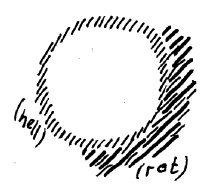
[ 9 ] In contrast, a person’s spirituality—specifically, with their development within the body, the inward development of the spirit, the real spirit, not the abstract one—begins in the respiratory system and works from the outside in, in the opposite direction of breathing. And the most spiritual organs are those that belong to the liver system. They are the organs that develop the greatest spiritual activity inwardly. This, in fact, explains why intellectual types become materialistic, because the head can process only external spirituality, and one is thereby led to believe that everything developed in the spirit is absorbed from the external sensory world. That is why, if one is a true intellectual, one simultaneously becomes a materialist. The more of a thinker one is—a head thinker—the greater the tendency to become a materialist. In contrast, when the whole person strives to reach this insight, when the person begins to develop an awareness of how their entire being thinks through the organs located further back, then materialism ceases to have any justification in consciousness.
[ 10 ] The activity that manifests itself in breathing is also evident externally, namely in the excretion of carbon in the form of carbonic acid. The activity, however, that is carried out internally in this process—the activity of spiritualization—is linked to nitrogen. And when nitrogen is consumed, it is excreted precisely for the purpose of spiritualization. The extent of nitrogen excretion is a measure of the inner workings of the human organs toward spirituality. You can deduce from this that anyone who does not believe in such spirituality will, of course, remain in the dark regarding the absorption of nitrogen in the human organism. Only when one understands that, as in every process of protein formation and protein synthesis, an outward-directed and an inward-directed activity unfold—only then can one truly grasp the role that nutrition plays. When you consider this process—which is essentially a respiratory process with its polar opposites—you will say: Everywhere, the processes of nutrition and digestion are closely linked to the processes of respiration; everywhere, the process of breathing and spiritualization is set in opposition to nutrition and digestion. In this process of spiritualization—that is, in the other aspect of respiration—lies what constitutes the formative, truly plastic forces in protein formation; there lies everything that shapes the human being. From this you will also be able to deduce the following: It is essentially what is at work here that points to an interaction between the astral body and the etheric body. The astral body acts in respiration through sympathy and antipathy; the etheric body acts by encountering, through its own activity, the sympathies and antipathies of the astral body. Everywhere, the etheric body’s effects interact with respiration in the human organism. The etheric forces primarily act upon the liquid components of the human being. After all, the human being consists of at least two-thirds water. It is within this watery organism—where the etheric body is primarily active—that the etheric forces manifest physically. In the other organism—which is an air organism, built into the human being from the air—the forces of respiration manifest themselves. And so we can also view what takes place between the astral body and the etheric body as an interaction between the forces of water and the forces of air. This interaction between the forces of water and the forces of air takes place continuously within the human organism. Of course, neither side completely suppresses the other. That is why, when breathing in air, a person always inhales traces of water vapor. In this way, the etheric aspect spills over into the realm of respiration. Likewise, the activity of respiration spills over into the actual digestive and nutritional organs. Insofar as they are also composed of protein, they, too, are breathers. So one activity always spills over into the other, and we are actually never dealing with anything other than the predominance of one activity or the other in any given organ. We are never dealing with something that we can describe in a one-sided manner. If we claim that any organ is exclusively a respiratory organ—for example, if we claim this of the lungs—then we are stating something false. The other activity is always present there as well, albeit to a lesser degree. Nutrition proceeds primarily through an activity that manifests in the ethereal-liquid and physical-solid realms. Thus, the main aspect of the nutritional and digestive processes takes place in the etheric-liquid and physical-solid realms; the main aspect of the respiratory process takes place in the astral-airy realm; and the main aspect of the “I” activity—the actual spiritual activity—takes place in the thermal conditions in connection precisely with the “I.” Spiritual activity in the physical organism is an interaction of the “I” with thermal conditions, with all those systems where heat can influence the physical. The “I” must always be in harmony with warmth; it must always act from warmth. When we put a sick person to bed and cover them up, this means nothing other than that we are making an appeal to the “I,” which is expressed in the act of making appropriate use of the resulting warmth.
[ 11 ] But this also sheds light on human nutrition in general. This nutrition is an interaction between the interstitial fluid—that is, the aqueous medium in which nutrition and excretion primarily take place—and that which remains exceptionally stable in relative terms, which, in a certain sense, is unstable only during the growth period, then becomes stable, and undergoes a kind of breakdown at most in the second half of life: the human body’s actual protein organism. In the tissue fluid, there is a continuous process of absorption and breakdown of the protein found in food. And in this activity lie the attacks directed against that which seeks to remain stable in protein formation: the human internal protein organs in general. They want to remain stable. They want to remain stable because they wish to secrete and liberate spiritual-psychic activity inwardly. In this continuous interplay between the dynamic absorption and breakdown of protein and the interplay of forces that arises there—in this interplay between this exceptionally dynamic interplay of forces and the interplay of forces striving for rest, which arises in this interplay of the human internal protein—lies, in fact, the very essence of what is brought about by the nutritional process. It is therefore partly a superstition and partly a truth when one says: Human beings build themselves up through the nutrients they consume. - It is a superstition because the building forces are contained from the outset in a person’s protein bodies simply by virtue of the fact that the person is human at all; and on the other hand, at the opposite pole, the person carries out an activity that actually constitutes a continuous attack on the stability of their own protein structure, so that one can say: It is not correct to believe that it is solely the intake of food that sustains human life. That is simply not correct; rather, the opposite is equally true—that the maintenance of the interplay of vital forces in the interstitial fluid sustains life. So if you prepare meals in such a way that they stimulate this activity in the interstitial fluid, you thereby sustain life—not by supplying the body with nutrients, but by exerting an impact on the stable forces of its own protein structures. The very essence of sustaining life lies in a process that you stimulate through food intake, so that we must focus on the process itself. For example, it may well be the case that in an adult, substances that we know work quite well in children are ineffective, because the child is in the phase of plastic growth and therefore needs the absorption of these substances—the inward penetration of the substances and the unfolding of the forces within them. If you know that a certain substance works well for a child, that does not mean it will necessarily have the same effect on an adult. For an adult, it may be far more necessary simply to sustain the forces in the tissue fluid that are striving toward rest—that is, to introduce stimulants into that fluid to promote activity. If you now consider everything that takes place in the—I would say—organs of the human being that are oriented backward—the head, after all, is also oriented backward—in the lungs and the liver; if you turn your attention from the organs that face backward to those that are, I would say are more embedded in the interstitial fluid and in this activity—then you arrive at the heart, enclosed by the lungs, as the primordial organ. This human heart is formed entirely out of the activity of the interstitial fluid, and its activity is nothing other than the reflection of the inner activity of the interstitial fluid.
[ 12 ] The heart is not a pump—as I have often said—but rather, the heart functions, as I would prefer to say, like a reading device for the activity taking place in the interstitial fluid. The heart is moved by blood circulation; blood circulation is not produced by the heart’s pumping action. The heart has as little to do with what functions as circulation in the human body as a thermometer has to do with the generation of external heat and cold. Just as a thermometer is nothing more than a measuring device for heat and cold, so the heart is nothing more than a measuring device for human circulation and for what flows from the blood’s metabolic system into the human circulatory system. This is a golden rule that one must absolutely observe if one wishes to understand human beings in any way. For with the belief that the heart is a pump and drives the blood through the veins—with this belief—one actually holds the very opposite of the truth as understood in modern science. Anyone who subscribes to this “heart superstition” should, if they follow this line of reasoning consistently, also be perfectly comfortable with the belief: “Yes, why has it gotten warmer in my room? Because the thermometer has gone up!” — It is, when thought through consistently, exactly the same thing.
[ 13 ] You can see the consequences of a view that simply fails to take into account the by far most significant part of the human being—the spiritual-soul aspect—that disregards the mobile and the dynamic, and proceeds from the merely material, seeking to derive from the material those forces that are actually imprinted upon the material. It seeks to impose upon the heart the forces that are actually first imprinted upon the heart through the dynamic, through the interplay of forces.
[ 14 ] Thus, we can actually say: In the activity of the heart and in the heart organ itself lies the most advanced form of organization of that which is opposed to respiration and spiritual liberation in the human being. Therein lies what can now be called polar metamorphosis, in contrast to mere transformation. When one considers the head, lungs, and liver, one observes various stages of metamorphic transformation. As soon as one considers the heart in relation to the lungs, one must speak of a polar metamorphosis; one must speak of the fact that the heart, in its form, is the polar opposite of the lungs. And all those organs that develop more toward the front—to which, for example, the female uterus belongs to a most prominent degree—are, in turn, gradual transformations of the heart’s form. I speak of the female uterus because there is also a male uterus, though it exists only as an etheric body in men. The uterus is nothing other than a transformed heart. From this perspective on these matters emerges everything one needs to understand the human organism.
[ 15 ] It is now into this other activity—which, if I may say so, has its center and finds its rest in the movement of the heart—that fats and carbohydrates primarily intervene, especially in human beings. This is where these fats and carbohydrates exert their effects. Of course, this extends throughout the entire body, for just as the whole body is a breather and a developer of the spirit, so, on the other hand, it is also a depositor of matter and a functional shaper of energy systems that are directed toward combustion. This will now also shed some light on the matter—and we see how one always moves from such a truly inner contemplation of the human organism to therapeutic considerations—shedding light on how what was formerly called pulmonary tuberculosis—which has now been given other names based solely on theory —consists in the fact that, through the various influences that can be at work there—and which are all essentially the same—the human being is distracted from the extraterrestrial and driven toward the earthly, toward living in poor housing and so on. All the symptoms associated with pulmonary tuberculosis can be summarized as follows: the person is distracted from the sun and outer space and is directed toward that which cuts him off from the sun and outer space—which thus causes the joy in the extraterrestrial, which essentially rests in sensory reception and perception, to be dulled; so that his soul, his mind, is not allowed to reach into the senses and thereby descends into the lungs, so that the lungs strive to become an organ of thought, to become a head, and indeed then clearly shows in its external form how it wants to become a head, how it takes on a shape in which one can indeed see how the forces that ossify the human head then find expression in the lungs, how the hardening of the lungs occurs there, and so on. And if one wants to counteract this, what must one do?
[ 16 ] If one wishes to counteract this “headiness” of the lungs, one must first and foremost consider that there is a necessary waning of astral activity and an excessive strengthening of the activity that is the “I” activity. In other words, the “I”-activity begins to overpower the astral activity. And this must be addressed. Everything that particularly stimulates the “I”-activity is, after all, precisely the sensory perception from the outside. But what is sensory perception from the outside continues, throughout the entire human organism, in the form of salt deposits. These are not properly regulated in those who show a tendency toward pulmonary tuberculosis. Therefore, one must intervene from this angle and attempt, at the right moment, to counteract—with sufficiently strong salt rubs—what the lungs can no longer accomplish: salt rubs, applied externally, will counteract the hardening processes that form from within.
[ 17 ] Now, of course, one must structure such an activity—as one does through the external effects of salt—in such a way that one tries to predispose the organism internally to absorb what is coming in from the outside. One can also take salt baths—strong salt baths—but one must prepare the organism to actually process this internally, that is, to counteract it from within. Here you can then consider the following; it will follow in part from what we discussed here last year.
[ 18 ] If one wishes to stimulate the organism to develop an activity from within that regulates certain external organizational forces through their interaction, then the approach involves administering mercury in small doses—that is, in accordance with homeopathic principles. In this context, mercury is an important remedy, an important regulating agent. It is precisely here that what is generally important to observe regarding dosages comes strongly into play. You can conclude from all of this, if you summarize what I have presented: That which most closely resembles external nature is the metabolic limb system. If something is lacking there, if something needs to be addressed there, one must use the low potencies. As soon as one reaches the middle part of the human being, one must use medium dosages. But as soon as one wishes to act from the head, as soon as one wishes to act at all from that which has to do with the spiritual in the head, then one must work with the highest potencies; one must work with the higher potencies. Here, in this case, we are dealing with lung activity—that is, something that belongs to the middle human being. The mercury dosage must be moderate. The point is that whatever is specifically intended to act on the head organization—and from there back through the entire organism—requires the highest potencies, which will therefore be particularly beneficial wherever one believes one can achieve something with silicon compounds. By their very nature—because they always resonate toward the head and the periphery of the body, which is indeed part of head formation—silicon compounds actually require the greatest dilution, whereas, for example, with calcium compounds, one will almost always get it right—if there are other reasons to use them—by not going up to the highest potencies but rather using them in the lower potencies. In short, a criterion for potentization is certainly the insight one gains regarding whether one must intervene in the metabolism of the limbs, in the middle rhythm organism, or in the head organism; whereby, of course, the head organism must be taken into account in the sense that it actually permeates the entire organism from the other side. For example, one may well come to the conclusion that a person has a foot ailment that is actually a disguised head ailment originating in the head; in which case, however, the treatment must not be directed at the metabolism but at the head—meaning one must use high potencies of a remedy that might be effective in lower potencies if one knew that the treatment had to be directed at the metabolism. So, these matters can certainly be brought into line with reason and must be done so gradually. The specific details will only become clear when one engages in the precise observation of what the experiments reveal. The approaches must be sought in the manner I have indicated.
[ 19 ] The point is that only those who carefully retain in their memory everything they have encountered in their experience can speak about specific cases of healing, for every single experience is, of course, instructive in itself and bears fruit for whatever follows. Now, if you take into account what I have just said, you will find that it no longer seems so mysterious that there are, for example, diseases in which the brain and the liver are affected at the same time, for the liver is, after all, merely a metamorphosed brain. So when one finds both liver degeneration and degeneration of the brain ganglia at the same time, this points in exactly the same direction, and what one has then is a form of disease that is, in turn, an intensified version of what causes pulmonary tuberculosis. It is simply the intensified metamorphosis of pulmonary tuberculosis. Therefore, the approach involves administering higher internal doses of mercury, and externally, one should not limit treatment to salt rubs and the like, or to baths using sodium salt—ordinary table salt—but must instead move on to calcium salts. That is what needs to be said.
[ 20 ] But now you can see where the sources of error lie, and that one can truly arrive at the correct conclusion only by observing the human organism from the inside out. Just imagine someone coming along and saying: “Here is a disease; I will cure it with mercury.” And he actually achieves some effect. But the disease in question is not necessarily something related to syphilis; rather, he has simply formed a mental image that if mercury cures it, then it must be connected to syphilitic processes. That need not be the case at all. Likewise, you will now understand more precisely what I said last year when I spoke of “mental illnesses.” Of course, when I spoke a few days ago of cerebral softening, I was referring to paralytic disorders; but when one says “paralysis,” one is not actually speaking very vividly. One always has the feeling that one is already talking in terms of the external complex of symptoms. But now, of course, the question arises: How does this relate to what I said last year—that the actual causes of mental illnesses must be sought in the deformities of organs? That is indeed the case. And it is so very much the case that whenever one focuses solely on the mental symptoms, one actually gets nowhere; nothing really comes of it. One can certainly say: Similar psychological complexes actually stem from very different causes of illness. It is increasingly a matter of looking for deformities of the organs—some organ that is not functioning properly—precisely in so-called mentally ill patients, and then asking: Why isn’t it functioning properly? Because those forces have become impaired that are actually the stable ones involved in protein formation—not the variable ones, but the stable ones. So, there is something within the patient “that constantly strives to destroy the organ’s original plastic structure,” and therefore it is also unhelpful to focus too heavily on what is happening in the tissue fluids—which represent the other pole of metabolism. Thus, if one proceeds on the basis of the symptoms, one will gain nothing regarding what constitutes metabolism within the organism itself. On the other hand, it will be of extraordinary importance to seek insight into mental illnesses in the excretions. There one will always find quite important clues. And investigating the nature of the excretions in a mentally ill person is of the utmost importance, for I said last year that certain forms of mental illness involve an addiction to forming imaginations and inspirations. This is precisely what it means for the spiritual to be set free within.
[ 21 ] If this addiction is present, it is because the organ has become defective. If the organ is not defective but is normally developed, it does form the imagination, but it remains unconscious; if, however, it has become defective, it is unable to properly form this imagination. On the one hand, the organ is impaired, and this gives rise to an addiction to the formation of imagination; on the other hand, the imagination remains uncovered by the organ and manifests as a hallucination and so on. So I would like to say: When we are dealing with an organ and the imaginations developing within it (see drawing on p. 114, red), which then radiate into the rest of the human organism (see drawing, light) and are perceived, then we are dealing with a deformed organ in such a way that the formation of imagination (red) cannot unfold properly in its plasticity and, as a result, on the one hand—because it is abnormal—imposes itself on consciousness. Thus, hallucinations and visions arise. On the other hand, the organ is damaged, and this gives rise to a craving for proper imaginations. It is only by seeing through these things from within in this way that such phenomena can be explained.
[ 22 ] We will now proceed, on the one hand, to answer the individual questions that have been asked, and, on the other hand, to explain our remedies. Now let us conclude and listen to Dr. Scheidegger’s lecture.