

Spiritual-Scientific Perspectives on Therapy
GA 313
17 April 1921, Dornach
Translated by Steiner Online Library
Seventh Lecture
[ 1 ] Turning now to the theory of remedies, I would like to note that, even in light of what we have already attempted to introduce as remedies—which should also be discussed— more specifically, I would like to note that I am, of course, not interested in explaining how the thoughts arise within me that one thing or another might be a remedy, but rather that you, so to speak, come to understand the use of any given substance as a remedy. So, in a sense, I would like the insight that must develop regarding a certain substance to take place within your own soul, if that substance is to have value as a remedy. That is why I would like to structure today’s discussion, so to speak, in such a way that we first go through some preliminary considerations of how one arrives at the insight that something might be a remedy. It must, of course, be noted in advance that a foundation for this is a knowledge of the main principles of anthroposophical anthropology. For only in this way will the correct interpretation of the remedy arise—when one is, so to speak, inspired from within to conduct the entire line of reasoning in the anthroposophical sense. You will therefore also see that what I have said in recent days flows into what we are, so to speak, undertaking today as a series of preliminary considerations. |
[ 2 ] Let us assume that the plant, in particular, can be used to study the interaction between the human environment and the human being itself. It is precisely by first familiarizing ourselves with these processes in the plant world that we will be able to gain a proper insight into the continuation of the mineralization processes within the human being. When one considers this—and this naturally follows from everything we have also been examining over the past few days—one must be clear that within the entire process of plant formation, within the process of shaping roots, leaves, flowers, seeds, and so on, there is something that takes shape from the entire cosmos, and that this process—which is specifically directed toward plant formation, including the plant’s inner structure—cannot be replaced merely by an artificial synthesis, that is, by a chemical synthesis. At best, it can be replaced in this way in only the very rarest of cases. One must, for example, be clear about the following. When one deals with the root of the plant, one is dealing with that which, in the process of plant formation, is bound to the more or less inner surface forces of the earth. The human being is, in terms of spirit and soul, a being that grows from top to bottom in a plant-like manner. The human head harbors many of the forces that interact with the forces of the earth itself, and there is a deep kinship between what takes shape in the plant as a root and all that constitutes the forces of the human head. Therefore, whenever one seeks to understand the process taking place in the root system of the plant, one must always bear in mind that this process stands in a reciprocal relationship to the human head. Let us, however, consider some specific details so that you can see how such considerations should be made. Let us simply consider, for example, the root of the gentian, Gentiana lutea, and note the following: The gentian is a plant that manifests itself outwardly very strongly in a flower-like manner. We will therefore find forces in the root that are already strongly drawn toward the floral aspect; in other words, these root forces are somewhat weak. The gentian expends a great deal of energy toward the floral and leafy aspects. Nevertheless, the entire formation of the flower shows that the root-like aspect is still strongly present. We cannot, therefore, necessarily expect gentian to exert a strong effect on that which, in the human organism, emanates directly from the head as a head-related function—namely, as physical external effects—but rather we should expect it to act primarily on that which, emanating from the head, promotes respiration. And since the organism always functions in a polar manner, we must create a mental image of the digestive organs themselves being led into more vigorous breathing in the sense described yesterday when we use the roots of gentian. We thus stimulate the stomach and intestines to active respiratory activity, but we must now consider what we have learned in these lectures: that to stimulate this respiratory activity, the plant substance must be further processed—that is, we must boil the roots. We must use the decoction of the roots. You see, one can work through the whole process correctly. Now we turn first to the external aspect. We tell ourselves that the gentian root has a bitter taste and a strong odor, so this is something that has a very powerful effect on the astral body. We are thus dealing with an effect on the astral being in the human digestive system. But gentian root also contains sugar. You will recall that I have repeatedly pointed out on various occasions how the processing of sugar in the human organism strongly stimulates ego activity. You can also study this externally through statistics, as I’ve said, by observing, for example, that peoples with little “I” activity—such as the Eastern European and Russian peoples, among whom the “I” takes a back seat—have a very low annual per-capita sugar consumption, whereas among the English, among whom the “I” develops an extraordinarily active role, —in fact, the further west we go, the higher sugar consumption appears in the statistics. So, such things must certainly be taken into account if one wishes to arrive at any understanding of the world at all.
[ 3 ] But gentian root is rich in fatty oils. Fatty oil—that is what, in turn, I would say, when it enters the digestive system, has a strong effect on lower respiration, because the fatty oil enhances the mobility, the internal mobility, of the stomach and intestinal organs. So you see how one can literally describe what is taking place in the human organism, and one immediately notices that astral activity is stimulated—that is, the respiratory mobility of the stomach and intestines is stimulated—so that one can say: The intestines become more active, and the stomach is strengthened. The whole process works in such a way that what generally occurs when the astral body is strengthened comes about. It works in such a way that mineralization processes occur in the human being only to the extent that they fortify the organs themselves and thereby make them stronger. This is the subtle influence of the “I” through the sugar present there. One could therefore say: When one uses the decoction of gentian root, one stimulates the astral body into active function, and through the root’s sugar content, one allows the “I” to assist. However, precisely because the “I” assists, a danger arises. For when the “I” exerts a whipping-like effect from below, a polar reaction arises in the head, and one can observe that such patients will indeed experience headaches as a side effect. Nevertheless, it is a remedy that acts in all the ways I have described. Thus, we have what is essentially a stimulating, invigorating intestinal activity, and we will therefore use such a remedy either on its own or in some combination when we notice that the symptoms of the illness are associated with loss of appetite, dyspepsia, for example, but especially when there is stagnation in the lower abdomen. We can also see how this activity of the stomach and intestines stimulates metabolism in general, so that metabolism is, as it were, internally stimulated and becomes more active, and through this we can also address tendencies toward gout and rheumatism. Furthermore, by using gentian root appropriately, we will have introduced a substance that, although not very potent, nevertheless proves to be antipyretic. For when intestinal activity is impaired, a reaction is triggered in the “upper human,” and it is from the “upper human” that the febrile activity then originates. So when we strengthen the lower human being—creating a counterbalance to the upper human being—we have provided it with something that counteracts fever.
[ 4 ] This is the kind of consideration one must make when seeking to understand the concrete relationships between the external world and the inner life of the human being. The point is that it is entirely correct to point out that currents act upon the human being from the outside. In this regard, someone like Rosenbach has done exceptionally good groundwork. But if one speaks only in abstract terms of currents, then, first of all, one is not aware that what acts from the outside actually originates from concrete things. It stems from the fact that such relationships exist between the root systems of the plant world—the forces active in the root systems—which then, in turn, enter into the human being. Then one truly grasps these things, which one would otherwise characterize only abstractly as currents; one has them, so to speak, right at one’s fingertips. And this is what Spiritual Science is all about: it brings out what is truly concrete, what is truly material and processual.
[ 5 ] From this perspective, let’s consider an exceptionally instructive plant, the avens (Geum urbanum), and once again focus on its root. So let’s once again prepare a decoction of the root. It is now exceptionally interesting to consider these points about the avens and then recall what we just said about the gentian root. Of course, we must again assume that, since we are dealing with the root, there is an interaction with the head faculties. Now, however, the avens has a bitter taste. The taste is exceptionally bitter. The clove root contains essential oils—an oil about which we must assume from the outset that it acts on those parts of the organism that are not yet as close to the intestine or as deeply within the intestine as the parts we discussed in connection with the gentian root; in other words, we are dealing more with what is still in the stomach, perhaps only in the esophagus, and so on. But then we must take into account the most essential point: that clove root contains starches, meaning that we are, so to speak, appealing to those forces that process substances in a more intensive manner than is required for sugar, for the digestive force must be directed further back when processing starch. After all, the sugar must first be extracted. As you can see, one really must follow the processes closely. But then we have tannins in the clove root; and one must always take this into account when testing anything for its healing effects. Tannin means that what actually opposes the tannin is processed in a way that still has a strong effect on the physical body, so that with the clove root we must direct the entire effect more toward the ego than toward the astral body. Here we have a strengthening of the stimulation of the “I.” And therefore, because we have a strengthening of the stimulation of the “I,” we are dealing with what takes place in the lower human organism. It is thus a completely polar effect to the stimulation of the head that occurs through the “I.” We are dealing with what I would like to call “external digestion”—the breakdown of substances still in the stomach, even before they have passed into the intestinal tract. If I may put it this way, what remains of the nervous-sensory apparatus in the intestines—since it is, after all, spread throughout the entire human organism—is stimulated; specifically, the nervous-sensory apparatus in the digestive organs is stimulated, and we are thus dealing here with the predominant activity of the “I.”
[ 6 ] What will be the result? First, that the carnation root possesses a powerful antipyretic effect. Second, however, the consequence will be that we can influence digestion from the front to the back by no longer placing such a heavy burden on this rear digestion—the actual intestinal activity. We will therefore have to combat diarrhea in particular; we will have to combat mucus secretions from the intestines, if we take into account that these very things stem from placing too much strain on that which is more closely related to internal digestive activity. So you see, these considerations all lead us to examine how external forces penetrate what is within the human being.
[ 7 ] Since this examination of roots is of particular importance, let us consider another root and take Iris germanica, the German iris, as an example. Let us prepare a root decoction from it as well. Now, with the iris, we are dealing with something that, even from its outward appearance, shows that it has a strong effect on the “I.” The repulsive odor and the bitter taste immediately reveal that we are dealing with something in which the “I” enters into a strong physical interaction with the outside world. But in the iris root we also have something that stimulates this physical activity quite strongly, namely tannic acid. We also have something in it that acts on the activity of the “I”: starch. And finally, we have something that, through its physical effect, acts wherever it goes when stimulated to do so: we have resins in the iris root. All of this sets the “I” in motion with particularly vigorous activity. And this vigorous activity of the “I”—this driving force of the “I”—can be recognized by the fact that urinary activity and a certain purgative effect occur. These are the outward manifestations of what “I”-activity is. And what we can combat becomes clear simply when we ask ourselves: To what is the human organism exposed when all of this is out of balance? Then dropsy and similar conditions arise, and so in the iris root decoction we have something with which we should attempt to combat dropsy-like conditions and even dropsy itself.
[ 8 ] You see, these are the kinds of considerations one must make. Now, as we move slightly upward in the plant kingdom, consider, for example, the herb, *Herba*, of plants, and let’s take a characteristic plant such as *Majorana hortensis*, marjoram. But let’s be clear: When we move up to the herb, it is already nature itself that carries out certain processes which we must first carry out at the root. Therefore, when we take the herb, it is not good to make a decoction directly; rather, we need the finer forces of the herb, and we extract them by making an infusion. The forces we actually need pass from the herb into the infusion. And now you can once again—I would say—perceive with your senses what is present here. You have the distinctive taste in this infusion, which one might call a warming taste. —This taste also has a certain bitterness. But then you have what truly demonstrates how it acts outwardly: the aromatic scent, the essential oils. And then you have something that simply needs to be added to further enhance all of this—something whose physical effect does not manifest as quickly as that of other products, but rather manifests once it has passed through the stomach into the intestines. Namely, there are all kinds of salts in the herb, especially in marjoram. And so you can say to yourself—and the things one can say like this are, after all, all present in reality—that this herbal infusion has a particular effect on the respiratory activity of the internal organs. It induces a certain respiratory activity in the internal organs. This manifests in the fact that this infusion has a diaphoretic effect, meaning that the internal organic activity—in the form of respiration—is stimulated. It induces sweating, and through this, it has a reinforcing effect on the activity of the internal organs. One can treat catarrhal colds, but one can also treat uterine weakness on the other hand when using an infusion of marjoram.
[ 9 ] All of this will become even clearer when we turn to the effect of the flower. The effect of the flower—let us consider it where it is already particularly evident in the outer plant; let us consider it, for example, where many small flowers unfold into an inflorescence, as with elderberry or lilac, Sambucus nigra. And let us be clear that it is precisely those forces that surge into the plant which have much to do with the Earth’s surroundings—forces that contain within themselves the cosmic influences, the cosmic currents. We can see this in the fact that the elderflower also contains essential oils. But we notice it especially in the fact that elderflowers contain sulfur, so that within them, from the mineral realm, we also have that which proves particularly effective when we wish to stimulate respiration, but on the other hand—on the side of the actual respiratory system—while we previously spoke of stimulating respiration in the digestive organs and in the structures connected to them, before they are taken over by the respiration of the actual respiratory organs. So here, with the elderflower—when we use it as an infusion —which is almost self-evident—the etheric activity of the human organism is particularly stimulated, and only indirectly, through this etheric activity, is the activity of the astral body stimulated; that is, respiration is particularly stimulated in the upper posterior organs, not so much in the head organs as in those that belong to the actual respiratory system. Of course, reactions occur everywhere, and in these reactions we are naturally dealing with the fact that, in this example, purging and sweating occur. But now the respiratory organs are stimulated. Normal respiratory activity itself is stimulated, and because stimulation of normal respiratory activity necessarily results in an effect on the blood, this also leads to a stimulation—that is, a stimulation originating from within the human being—of blood circulation; and it is, I would say that it can be inferred from all of this that such a remedy can be used to combat catarrh, to combat suppressed sweating, that it can be used effectively for hoarseness and coughing, and that—because the effect that previously occurred directly now occurs in a polarized manner—it can also be used for rheumatism-like conditions.
[ 10 ] You see, it is always a matter of discerning from the way the remedies work what healing power may be contained within them. Now let us consider how it may become necessary to act specifically on the organization of the head. What, after all, depends on the organization of the head?
[ 11 ] The organization of the head determines its polar opposite, digestion; specifically, the coarser digestion—which is the cause of so many very serious illnesses—depends on the organization of the head. We must therefore be clear that we can essentially influence the head through gross digestion, and that if, through something we introduce into the human interior—that is, by acting on digestion—we manage to bring about a situation where these things, so to speak, radiate all the way into the head, so that they truly exert an effect originating from the head, then, of course, we must bring together everything possible that ensures that, even though we initially intend to introduce the plant substance into the body, we shape it in such a way that it acts upon the head. And this will be particularly important to observe when we wish to use seeds. Seeds, by their very nature, are very well suited to acting upon gross digestion. And by acting directly on the coarser digestive processes, they do indeed affect the head by eliciting reactions. But it is very difficult to convey this effect from the digestive system all the way up to the head. Therefore, it is advisable, when working with seeds, to prepare a—and indeed a very concentrated—decoction, provided the patient can tolerate it. This can be studied in particular by considering the effects of caraway seeds on the eye: boiling the seeds and then applying this decoction to the eye. In this decoction, one first has essential oils—which have essential effects on the “I”—and also substances that have a very strong physical effect, such as wax and resins, which likewise exert very strong physical effects. These strong effects are evident in the spicy odor. But this decoction also contains mucilage.
[ 12 ] All of this, when considered together with the reflections we have been making these past few days, has an extraordinarily strengthening effect on ego activity. It has a direct effect on the sensory-nervous activity that lies hidden within the digestive organs. This weak sensory-nervous activity, which lies hidden within the digestive organs—spread throughout the digestive organs in a very faintly developing metamorphosis—is particularly affected. One might say that, with regard to the lower aspects of the human being, such a decoction actually brings about something that resembles a subconscious metamorphosis of our external sensory perception. We are stimulated, I would say, to perceive sensually—through the digestive system—what is unfolding there as a process. And that is precisely why this remedy is particularly well-suited for enemas. When this remedy is used for enemas, what one is actually doing is inducing a process that must affect sensory-nervous activity, because it truly involves an external infusion of the finer forces contained in the caraway seeds, thereby evoking a kind of subconscious perception in the digestive organs. This particularly stimulates the lethargic tissue fluid; thus, by inducing a kind of sensory-nerve-strengthening process, perception is very strongly shifted into the inner being of the person. The human being becomes a perceiver within his digestive organs, and this is precisely what counteracts everything that—I would say—stands as the opposite pole to what occurs when an inner activity begins that can now also be perceived, but which essentially consists of inner perception; that is, when our organism begins to express itself in a truly eruptive manner. The fact that we ourselves can perceive it very strongly when it develops such organic activity—that we actually perceive ourselves—has a numbing effect, and thus has a healing effect on such activity, which constitutes a perception from within—that which develops as an activity, a sensory-nervous activity, that actually becomes metamorphically similar to external perception, so that when stomach cramps, colic-like conditions, or flatulence occur, we will be able to work fruitfully with this remedy in an appropriate manner.
[ 13 ] There is another process that is extremely interesting to observe. It is as follows. So try to vividly imagine what kind of subconscious activity is actually taking place there. This subconscious activity is extremely similar to external perceptual activity. The only difference is that it takes place, so to speak, internally. Consider that external perceptual activity and reflex activity are connected in a certain way. Perceptions, when they occur subconsciously, can immediately trigger defensive movements. Consider this interaction between perceptual activity and defensive activity, and now apply it to the internal activity of the interstitial fluid. There, as you were to say, “floating in the air,” you carry out this external perceptual activity. If I were to draw this schematically, I would say: If we have a mental image here (see drawing, light-colored) of the air in which we find ourselves—permeated by light and so on—then we have external perception (red) unfolding in this direction, and the internal reaction unfolding in this direction (blue). After all, in every sense organ there is an interplay of external action and internal reaction. This should be viewed in such a way that, if one wishes to use an external abstract image, one must by no means adopt the view chosen by the newer materialist perspective—namely, that centripetal and centrifugal nervous activity is at work there. For this interpretation is no more reasonable than saying that when one presses an elastic ball, it then restores its original shape through a force that is the opposite of the pressing force itself—that is, through its own rebound. It is no more reasonable to speak of motor nerves than it is to explain the elasticity of a ball by positing some center within it that pushes outward once it has been pushed inward. It is essentially nothing other than the restoration of the original shape; it is the effect that occurs, and for which no special nerves are needed, because the whole—action and reaction—is embedded in astral nature and in the essence of the “I.”
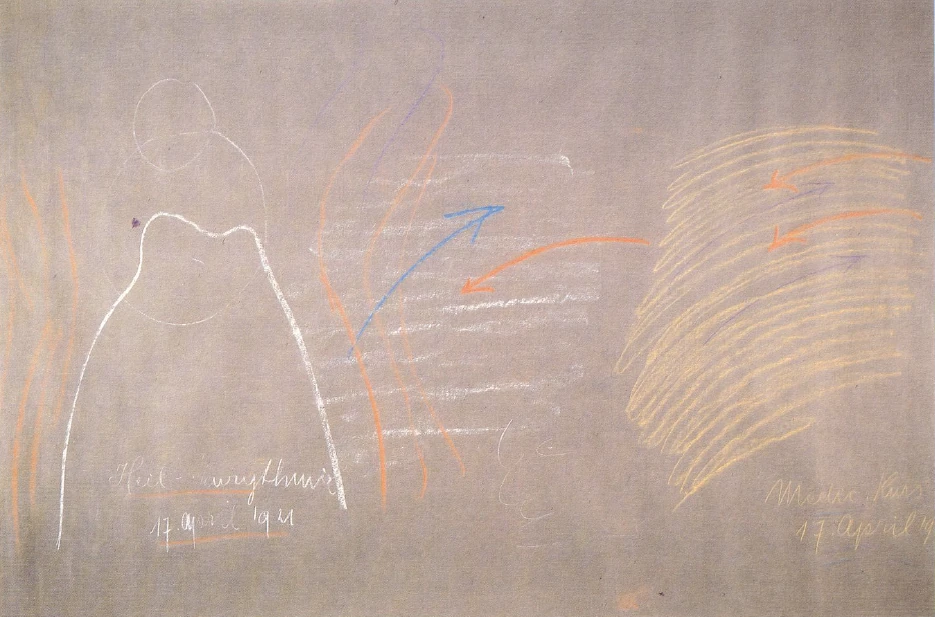
[ 14 ] Now, however, imagine this entire process taking place indirectly through the activity of the ether in the interstitial fluid (see diagram, yellow). Of course, under normal circumstances, a sensory process does not take place in the interstitial fluid, but it can be triggered by something like what I have just described. This gives rise to a kind of tendency toward contraction, toward an effect directed toward the organism, which I would like to illustrate here in the same way as the action involved in perception. But this (red) is a process that, in a sense, surges against the outward-directed force (violet) in the interstitial fluid. That force asserts itself and acts against it. So one is pushing a sensory process—a metamorphosis of the sensory process—into the interstitial fluid. It is extraordinarily interesting to observe how a metamorphosis of the external sensory process is pushed into the interstitial fluid. Now one must look around to see where, in normal life, something like this occurs—that is, where a kind of metamorphosis of the sensory process arises within the human being, a condensed sensory process in the interstitial fluid, so to speak. And it arises through the formation of milk secretion in women. Here we indeed have a condensed metamorphosis of the external sensory process that has been transferred inward: the milk secretion in women. Now, let us assume that if this process is present but deficient, we have every reason to carry out this sensory process—which is situated inwardly and condensed into the tissue fluid. And it is precisely in the decoction of caraway seeds that we find what brings about such a process, one that promotes milk secretion.
[ 15 ] I have just cited these examples to illustrate how one can grasp the entire functioning and interplay of this human organism and its connection to what exists in the external world. Just consider for a moment what I have presented to you here. Consider it—and I would say, specifically, by telling yourself: The decoction of caraway seeds contains resin and wax—that is, substances whose consistency produces particularly strong physical effects. As a result, this resin and this wax become extraordinarily similar to—only condensed inward—what makes an impression on my senses from the outside.
[ 16 ] And once again, this seed contains essential oil and mucilage. This is something that stimulates the reactivity of the “I.” You have everything there that you find in the sensory process: the external stimulus, the reaction extending inward to the “I.” Now, you transform this sensory process by not engaging in sensory perception, but rather by shifting this interaction inward, into the force system of the interstitial fluid; then you have what evokes an inner sensory process. For such a process is the secretion of milk. You will see how, in this way, the entire organism is revealed.
[ 17 ] These are the considerations one must make if one wishes to observe the external in terms of its material effect on the internal. Suppose, then, that one tries using mineral-metallic remedies. One will then be able to understand very easily what one has already learned from the effects of plant remedies. But one will be able to say something more. One will be able to say: Something has taken place with the mineral realm, in that the mineral realm has already continued into the plant process. And what has taken place there in the process of mineralization and vegetation is a transformation of the mineral forces. Thus, something in the healing process is based on the transformation of the mineral forces. So suppose we set up a sanatorium, surround it with land, and, so to speak, fertilize the land with various mineral substances, and now allow a soil to take effect whose actual composition is known to us; we grow various plants there, about which we say to ourselves, we use the root, herb, fruit, and so on—then we have control over the process itself, which consists of the plant transforming the mineral into a remedy. One can then reinforce this by cultivating such plants; one can treat them—already as such plants—in the manner we have just discussed. That is what we intend to do at our Stuttgart Institute, on the one hand; so that is how it must be organized. But one can go even further. One can take what has already been extracted from the plant itself as a remedy and use it, in turn, as a kind of fertilizer, thereby further intensifying its potency. One will obtain something that makes the ordinary physical trituration significantly more effective—that is, transforms it into something that is significantly effective—by, so to speak, entrusting the shaping and preparation to nature itself and to the forces at work in nature. Naturally, one will then also need to be clear about the following. For example, one might ask: If a mineral-metallic remedy is to take effect, how must it act?—The salts, which are also mineral remedies, tend to produce an effect directed more toward the inner being of the human being. The most peripheral activities, however, are influenced precisely by the mineral-metallic substances, which are, so to speak, the most substantial. We will have to give this some thought, but always—as I have said—based on the foundations of Spiritual Science knowledge; otherwise, our thoughts will scatter in all sorts of wrong directions. It is Spiritual Science thought that guides such thinking in the right direction. Let us say we have a certain metal; we know that such a metal is very difficult for the inner human organism to influence. The activity of the “I” must be greatly stimulated here, for it is the “I” that, so to speak, reaches down, penetrates into the innermost core of the substance, organizes the innermost core of the substance according to its purpose, and then calls forth the activity of the “I” within the organism, so that we —because the “I” can be strengthened in this activity through the astral body—when we use metals or minerals, we must always ensure that we stimulate “I”-activity or astral activity, which in turn acts back upon the “I,” or the interaction between astral activity and “I”-activity. Such stimulation can occur, for example, in the following way: We make a metal ointment and apply it. We apply it, say, to a skin rash. In doing so, we stimulate ego activity peripherally. This ego activity is likewise stimulated by a reaction within the human being; initially, heightened nervous-sensory activity arises within the person in some organ, and from there, heightened respiratory activity, as this transitions into the astral realm. And we bring forth the effect of those inner forces that counteract the skin rash. We mobilize the entire body to counteract the skin rash.
[ 18 ] Now one could say that, based on this, one can study the various metallic and mineral substances in general. For example, lead contains something that has an extraordinarily strong effect on nervous and sensory activity, and consequently on internal respiratory activity—but also on the internal respiratory activity that takes place, for example, in the external peripheral organs. So when we use lead, we can have a significant effect if it is necessary to bring about something like what has just been described—whether we use lead as an ointment or administer it internally. Of course, we must be clear that when we administer it, we are acting in such a way that, through the activity of the digestive organs—which are stimulated—we elicit a reaction in the upper human being. When we use carefully prepared lead ointments on the upper human being itself, we act directly on this upper system. And especially when we have people who suffer in some way from mental weakness—that is, in whom the upper human being does not develop proper nervous-sensory activity or proper respiration—we can achieve a great deal with such lead treatments, provided we administer them only to the extent that they cannot lead to poisoning. In all these matters—which we can, in a sense, deduce from what the last few days and also the previous course have taught us—the point is that we are clear about the following:
[ 19 ] Above all, there is a major contrast here. Everything that leans more toward silver behaves, in a certain sense, as a polar opposite to everything that leans more toward lead. Now, of course, our mineral systems are extremely deficient in this regard. Our mineral systems are, in essence, extremely deficient, for a natural mineral system would have to take these relationships among the metals into account, and we would see that in such a system, the lead compounds and lead itself would, so to speak, lie at one pole, silver at the other, with, for example, aurum—gold—in the middle, and the others arranged accordingly. arranged accordingly. Silver and lead are polar, I say, because silver acts directly on the metabolism of the limbs—and quite peripherally, very much on that which is situated on the outer periphery of the limb metabolic organism; likewise, lead acts on everything that is situated on the outer periphery of the head organism. Silver thus has a stimulating effect on nervous and sensory activity in the metabolic-limb system and, from there, promotes the activity that permeates the entire body—an activity that stimulates respiration in connection with what I referred to yesterday as the metamorphosis of the central heart organ.
[ 20 ] In contrast, everything that emanates from lead affects the nervous and sensory activity of the head, as well as the respiratory activity that is stimulated from there. Through this, it has a stimulating effect on everything that constitutes the other metamorphosis—namely, the formation of the head, the lungs, and the liver—that is, those organs that, in a sense, enclose the other human organism just as the lungs enclose the heart, and thus actually reveal the primordial form of what, in a certain sense, is the “circulatory human”—the whole human being. We have the lungs, which enclose the heart; we have, so to speak, the lungs encompassing and surrounding the circulatory system with the respiratory system. But just as we have—when we consider the human being in terms of the structure of the brain, the lungs, and the liver, that is, when we consider the entire upper and posterior human being—a more extensive respiratory system that encompasses all the circulatory vessels together with the heart. In this way, the digestive system and the reproductive system are thus enclosed by the upper and posterior parts of the human being. The structure is such that the upper and posterior parts of the human being actually enclose the lower and anterior parts. If one understands this thoroughly—and considers the coexistence, the interplay of the upper and posterior human with the lower and anterior human, which is primarily expressed in the interrelationship between the heart and the lungs—if we observe this carefully and study the rhythmic processes within this coexistence, and then study the nervous-sensory activity in that which which is located above and behind—but which, of course, has its opposite pole in the front and lower human being—and if we observe the metabolic and limb processes in the front and lower human being and, in turn, study them in their corresponding form in the upper and rear human being, then we have the whole human being before us and can, in this way, master him accordingly in his other processes as well. |
[ 21 ] Building on that, we will then move on tomorrow to a specific discussion of our own remedies, taking into account some of the questions that have been raised—whatever naturally may arise.