

The Educational Value
of Understanding Human Nature
GA 313
17 April 1921, Dornach
Translate the original German text into any language:
Versions Available:
Spiritual-Scientific Perspectives on Therapy, tr. SOL
Siebenter Vortrag
Seventh Lecture
[ 1 ] Indem ich mich nun zur Heilmittellehre wende, möchte ich bemerken, daß auch mit Rücksicht auf dasjenige, was wir schon an Heilmitteln zu inaugurieren versuchten, das auch besprochen werden soll; dann im Speziellen bemerke ich, daß es mir natürlich nicht von Interesse ist darzulegen, wie sich in mir die Gedanken ausbilden, daß das eine oder das andere ein Heilmittel sein kann, sondern daß Sie gewissermaßen dazu kommen, diese Verwendung irgendeiner Substanz als Heilmittel zu durchschauen. Also ich möchte gewissermaßen, daß die Anschauung, die sich entwickeln muß über eine gewisse Substanz, in der eigenen Seele sich abspielen kann, wenn diese Substanz Heilmittelwert haben soll. Deshalb möchte ich sozusagen heute die Besprechung so einrichten zunächst, daß wir gewissermaßen Probeerwägungen durchmachen, wie man zu der Anschauung kommt, daß irgend etwas ein Heilmittel sein kann. Voraus muß natürlich bemerkt werden, daß eine Grundlage dazu die ist, daß man die hauptsächlichsten Prinzipien der anthroposophischen Menschenkunde kennt. Denn nur dadurch wird die richtige Interpretation des Heilmittels entstehen, wenn man gewissermaßen von unten her angefeuert ist, die ganze Erwägung im anthroposophischen Sinne anzustellen. Sie werden deshalb auch sehen, daß dasjenige, was ich in den letzten Tagen gesagt habe, in dasjenige einfließt, was wir gewissermaßen heute als einige Probeerwägungen anstellen. |
[ 1 ] Turning now to the theory of remedies, I would like to note that, even in light of what we have already attempted to introduce as remedies—which should also be discussed— more specifically, I would like to note that I am, of course, not interested in explaining how the thoughts arise within me that one thing or another might be a remedy, but rather that you, so to speak, come to understand the use of any given substance as a remedy. So, in a sense, I would like the insight that must develop regarding a certain substance to take place within your own soul, if that substance is to have value as a remedy. That is why I would like to structure today’s discussion, so to speak, in such a way that we first go through some preliminary considerations of how one arrives at the insight that something might be a remedy. It must, of course, be noted in advance that a foundation for this is a knowledge of the main principles of anthroposophical anthropology. For only in this way will the correct interpretation of the remedy arise—when one is, so to speak, inspired from within to conduct the entire line of reasoning in the anthroposophical sense. You will therefore also see that what I have said in recent days flows into what we are, so to speak, undertaking today as a series of preliminary considerations. |
[ 2 ] Gehen wir davon aus, daß es sich insbesondere an der Pflanze studieren läßt, wie die Wechselwirkung der Umgebung des Menschen und des Menschen selber ist. Man wird auch gerade dadurch, daß man die Prozesse zunächst an dem Pflanzlichen sich zu eigen macht, dann den richtigen Einblick in die Fortsetzung der Mineralisierungsprozesse in das Innere des Menschen bekommen können. Wenn man eine solche Erwägung anstellt — und das geht ja natürlich aus alledem hervor, was wir wiederum in den letzten Tagen auch betrachtet haben -, muß man sich klar sein darüber, daß in dem ganzen Pflanzenbildungsprozefß, in dem Gestaltungsprozeß nach Wurzeln, Blättern, Blüten, Samen und so weiter etwas liegt, was aus dem ganzen Kosmos heraus sich gestaltet, und daß man diesen Prozeß, der im besonderen hintendiert zum Pflanzengestalten, auch zum inneren Pflanzengestalten, nicht durch eine künstliche Synthese etwa bloß, also durch eine chemische künstliche Synthese ersetzen kann. Mindestens in den allerwenigsten der Fälle kann man ihn in dieser Weise ersetzen. Man muß sich zum Beispiel über das Folgende klar sein. Wenn man es mit der Wurzel der Pflanze zu tun hat, dann hat man es mit demjenigen zu tun, was im Pflanzengestaltungsprozesse an die mehr oder weniger inneren Oberflächenkräfte der Erde gebunden ist. Der Mensch ist nun geistig-seelisch ein Wesen, das pflanzenartig von oben nach unten wächst. Sein Haupt birgt viele derjenigen Kräfte, die in Wechselwirkung stehen mit den Kräften der Erde selbst, und es ist eine tiefe Verwandtschaft desjenigen, was in der Pflanze wurzelhaft sich gestaltet, zu all demjenigen, was die Kräfte des menschlichen Hauptes sind. Man wird also immer, wenn man sich aufzuklären hat über den Prozeß, der sich im Wurzelhaften der Pflanze abspielt, zu denken haben, daß dieser Prozeß im Wechselverhältnis steht zum menschlichen Haupte. Wir wollen jedoch einmal an Einzelheiten die Erwägungen anstellen, damit Sie sehen, wie man solche Erwägungen anzustellen hat. Betrachten wir einmal einfach, sagen wir die Wurzel des Enzians, Gentiana lutea, und sagen wir uns das Folgende: Der Enzian, er ist eine Pflanze, welche sich nach außen sehr stark blütenhaft äußert. Wir werden also in der Wurzel Kräfte haben, welche sich schon sehr stark nach dem Blütenhaften zu ziehen, mit anderen Worten: diese Wurzelkräfte sind etwas schwach. Es wird vom Enzian viel ausgegeben nach dem Blütenhaften und Blätterhaften hin. Dennoch aber zeigt die ganze Formung der Blüte, daß das Wurzelhafte noch stark vorhanden ist. Wir werden also nicht unbedingt rechnen können darauf, daß der Enzian eine starke Wirkung auf dasjenige ausübt, was in der menschlichen Organisation vom Kopf als unmittelbar Kopfmäßiges ausgeht, nämlich als physische Außenwirkungen, sondern wir werden von ihm zu erwarten haben, daß er vorzugsweise auf dasjenige wirkt, was vom Kopfe aus als atmungfördernd wirkt. Und da immer im Organismus polarisch gewirkt wird, so haben wir uns vorzustellen, daß vorzugsweise die Verdauungsorgane selber in ein stärkeres Atmen in dem gestern ausgesprochenen Sinne kommen, wenn wir die Wurzeln des Enzians verwenden. Wir regen also Magen und Darm zu einer regen Atemtätigkeit an, müssen uns aber jetzt überlegen, was wir erfahren haben in diesen Vorträgen, daß zur Anregung dieser Atmungstätigkeit die pflanzliche Substanz weiter verarbeitet werden muß, das heißt, wir müssen die Wurzeln abkochen. Wir müssen die Abkochung der Wurzeln verwenden. Sie sehen, man kann das Ganze richtig durchgehen. Nun geht man zunächst etwas aufs Äußere. Man sagt sich, die Enzianwurzel hat einen bitteren Geschmack, einen starken Geruch, das ist also etwas, was auf das Astralische sehr stark wirkt. Wir haben es also zu tun mit einer Wirkung auf die astralische Wesenheit in den Verdauungsgebieten des Menschen. Nun aber ist die Enzianwurzel zuckerhaltig. Sie werden sich erinnern, daß ich wiederholt bei verschiedenen Anlässen darauf hingewiesen habe, wie in der Zuckerverarbeitung beim menschlichen Organisationsprozeß eine starke Anregung der Ich-Tätigkeit liegt. Das können Sie ja auch äußerlich statistisch, sagte ich, öfter studieren daran, daß zum Beispiel Völker, welche wenig IchTätigkeit haben, wie die östlich-europäischen, die russischen Völker, bei denen das Ich zurücktritt, eine sehr geringe Zuckermenge in ihrem jährlichen Verbrauch als Volk haben, während bei den Engländern, bei denen das Ich eine außerordentlich rege Tätigkeit entwickelt, also überhaupt je weiter wir nach Westen kommen, der Zuckerverbrauch desto stärker in den Statistiken auftritt. Also, solche Dinge sind durchaus zu berücksichtigen, wenn man überhaupt zu einer Erkenntnis in der Welt kommen will.
[ 2 ] Let us assume that the plant, in particular, can be used to study the interaction between the human environment and the human being itself. It is precisely by first familiarizing ourselves with these processes in the plant world that we will be able to gain a proper insight into the continuation of the mineralization processes within the human being. When one considers this—and this naturally follows from everything we have also been examining over the past few days—one must be clear that within the entire process of plant formation, within the process of shaping roots, leaves, flowers, seeds, and so on, there is something that takes shape from the entire cosmos, and that this process—which is specifically directed toward plant formation, including the plant’s inner structure—cannot be replaced merely by an artificial synthesis, that is, by a chemical synthesis. At best, it can be replaced in this way in only the very rarest of cases. One must, for example, be clear about the following. When one deals with the root of the plant, one is dealing with that which, in the process of plant formation, is bound to the more or less inner surface forces of the earth. The human being is, in terms of spirit and soul, a being that grows from top to bottom in a plant-like manner. The human head harbors many of the forces that interact with the forces of the earth itself, and there is a deep kinship between what takes shape in the plant as a root and all that constitutes the forces of the human head. Therefore, whenever one seeks to understand the process taking place in the root system of the plant, one must always bear in mind that this process stands in a reciprocal relationship to the human head. Let us, however, consider some specific details so that you can see how such considerations should be made. Let us simply consider, for example, the root of the gentian, Gentiana lutea, and note the following: The gentian is a plant that manifests itself outwardly very strongly in a flower-like manner. We will therefore find forces in the root that are already strongly drawn toward the floral aspect; in other words, these root forces are somewhat weak. The gentian expends a great deal of energy toward the floral and leafy aspects. Nevertheless, the entire formation of the flower shows that the root-like aspect is still strongly present. We cannot, therefore, necessarily expect gentian to exert a strong effect on that which, in the human organism, emanates directly from the head as a head-related function—namely, as physical external effects—but rather we should expect it to act primarily on that which, emanating from the head, promotes respiration. And since the organism always functions in a polar manner, we must create a mental image of the digestive organs themselves being led into more vigorous breathing in the sense described yesterday when we use the roots of gentian. We thus stimulate the stomach and intestines to active respiratory activity, but we must now consider what we have learned in these lectures: that to stimulate this respiratory activity, the plant substance must be further processed—that is, we must boil the roots. We must use the decoction of the roots. You see, one can work through the whole process correctly. Now we turn first to the external aspect. We tell ourselves that the gentian root has a bitter taste and a strong odor, so this is something that has a very powerful effect on the astral body. We are thus dealing with an effect on the astral being in the human digestive system. But gentian root also contains sugar. You will recall that I have repeatedly pointed out on various occasions how the processing of sugar in the human organism strongly stimulates ego activity. You can also study this externally through statistics, as I’ve said, by observing, for example, that peoples with little “I” activity—such as the Eastern European and Russian peoples, among whom the “I” takes a back seat—have a very low annual per-capita sugar consumption, whereas among the English, among whom the “I” develops an extraordinarily active role, —in fact, the further west we go, the higher sugar consumption appears in the statistics. So, such things must certainly be taken into account if one wishes to arrive at any understanding of the world at all.
[ 3 ] Dann ist aber die Enzianwurzel reich an fetten Ölen. Fettes Öl, das ist dasjenige, was nun wiederum, ich möchte sagen, wenn es in die Verdauung übergeht, stark auf die untere Atmung wirkt, denn es stärkt das fette Öl die Beweglichkeit, die innere Beweglichkeit von Magen- und Darmorganen. So also sehen Sie, wie man sich förmlich beschreiben kann, was da im menschlichen Organismus vor sich geht, und man merkt ja gleich, daß die astralische Tätigkeit angeregt wird, daß also die Atmungsbeweglichkeit des Magens und des Darmes angeregt wird, so daß man sich sagen kann: Der Darm entwickelt eine regere Tätigkeit, der Magen wird gestärkt. Es wirkt das Ganze so ein, daß dasjenige zustande kommt, was überhaupt bei einer Stärkung des astralischen Leibes zustande kommt. Es wirkt das Ganze so, daß Mineralisierungsprozesse nur bis zu dem Grade im Menschen auftreten, der die Organe selber festigt und sie dadurch stärker macht. Das ist die leise Einwirkung des Ich durch den Zucker, der da auftritt. Man könnte also sagen: Wenn man die Abkochung der Enzianwurzel verwendet, so bringt man den astralischen Leib in rege Tätigkeit, und durch den Zuckergehalt der Wurzel läßt man das Ich nachhelfen. Dadurch allerdings, weil das Ich nachhilft, steht eine Gefahr da. Denn wenn das Ich unten wie peitschend nachwirkt, so entsteht wiederum polarisch die Reaktion im Kopfe, und man kann bemerken, daß solche Patienten dann allerdings als Nebenwirkung Kopfschmerzen erhalten werden. Aber es ist dennoch etwas, was durchaus nach allen diesen Richtungen wirkt, die ich gesagt habe. So haben wir da eine im wesentlichen antreibende, anregende Darmtätigkeit, und wir werden daher solch ein Mittel verwenden entweder für sich oder in irgendeiner Kombination, wenn wir merken, daß die Krankheitserscheinungen zusammenhängen mit Appetitlosigkeit, Dyspepsie zum Beispiel, namentlich aber dann, wenn Unterleibsstockungen da sind. Wir können auch durchschauen, wie durch diese Tätigkeit von Magen und Darm der Stoffwechsel überhaupt angeregt wird, so daß also der Stoffwechsel innerlich gewissermaßen aufgeregt wird und ein regsamer wird, und wir können dadurch noch wirken auf die Tendenzen nach Gicht und Rheumatismus. Außerdem werden wir in der Enzianwurzel sachgemäß etwas verwendet haben, was sich, wenn auch in einem nicht sehr starken Grad, aber dennoch als fieberfeindlich erweist. Denn dadurch, daß die Darmtätigkeit untergraben ist, wird die Reaktion im oberen Menschen hervorgerufen, und vom oberen Menschen geht dann die Fiebertätigkeit aus. Wenn wir also den unteren Menschen stärken, ein Gegengewicht dem oberen Menschen schaffen, so haben wir ihm etwas Fieberfeindliches zugeführt.
[ 3 ] But gentian root is rich in fatty oils. Fatty oil—that is what, in turn, I would say, when it enters the digestive system, has a strong effect on lower respiration, because the fatty oil enhances the mobility, the internal mobility, of the stomach and intestinal organs. So you see how one can literally describe what is taking place in the human organism, and one immediately notices that astral activity is stimulated—that is, the respiratory mobility of the stomach and intestines is stimulated—so that one can say: The intestines become more active, and the stomach is strengthened. The whole process works in such a way that what generally occurs when the astral body is strengthened comes about. It works in such a way that mineralization processes occur in the human being only to the extent that they fortify the organs themselves and thereby make them stronger. This is the subtle influence of the “I” through the sugar present there. One could therefore say: When one uses the decoction of gentian root, one stimulates the astral body into active function, and through the root’s sugar content, one allows the “I” to assist. However, precisely because the “I” assists, a danger arises. For when the “I” exerts a whipping-like effect from below, a polar reaction arises in the head, and one can observe that such patients will indeed experience headaches as a side effect. Nevertheless, it is a remedy that acts in all the ways I have described. Thus, we have what is essentially a stimulating, invigorating intestinal activity, and we will therefore use such a remedy either on its own or in some combination when we notice that the symptoms of the illness are associated with loss of appetite, dyspepsia, for example, but especially when there is stagnation in the lower abdomen. We can also see how this activity of the stomach and intestines stimulates metabolism in general, so that metabolism is, as it were, internally stimulated and becomes more active, and through this we can also address tendencies toward gout and rheumatism. Furthermore, by using gentian root appropriately, we will have introduced a substance that, although not very potent, nevertheless proves to be antipyretic. For when intestinal activity is impaired, a reaction is triggered in the “upper human,” and it is from the “upper human” that the febrile activity then originates. So when we strengthen the lower human being—creating a counterbalance to the upper human being—we have provided it with something that counteracts fever.
[ 4 ] Das ist eine solche Erwägung, die man anstellen muß, wenn man auf die konkreten Beziehungen der Außenwelt zum Inneren des Menschen kommen will. Es handelt sich darum, daß es ganz richtig ist, wenn darauf hingewiesen wird, daß von außen auf den Menschen Strömungen ausgeübt werden. In dieser Beziehung hat ja so jemand wie Rosenbach außerordentlich gut vorgearbeitet. Aber wenn man nur in Abstraktionen von Strömungen spricht, so ist man sich erstens nicht bewußt, daß dasjenige, was da von außen wirkt, ja von den konkreten Dingen herkommt. Es kommt davon her, daß also solche Beziehungen herrschen zwischen dem Wurzelhaften der Pflanzenwelt, den Kräften, die im Wurzelhaften wirken und die dann wiederum in den Menschen hineinkommen. Da faßt man dann diese Dinge, die man sonst nur abstrakt als Strömungen charakterisiert, wirklich an, die hat man sozusagen auf der Hand. Und um das handelt es sich bei der Geisteswissenschaft, daß sie das wirklich Konkrete, das wirklich Dinglich-Prozessuale herausarbeitet.
[ 4 ] This is the kind of consideration one must make when seeking to understand the concrete relationships between the external world and the inner life of the human being. The point is that it is entirely correct to point out that currents act upon the human being from the outside. In this regard, someone like Rosenbach has done exceptionally good groundwork. But if one speaks only in abstract terms of currents, then, first of all, one is not aware that what acts from the outside actually originates from concrete things. It stems from the fact that such relationships exist between the root systems of the plant world—the forces active in the root systems—which then, in turn, enter into the human being. Then one truly grasps these things, which one would otherwise characterize only abstractly as currents; one has them, so to speak, right at one’s fingertips. And this is what Spiritual Science is all about: it brings out what is truly concrete, what is truly material and processual.
[ 5 ] Betrachten wir von diesem Gesichtspunkte aus eine außerordentlich lehrreiche Pflanze, die Nelkenwurz, Geum urbanum, und nehmen wir dabei wiederum die Wurzel. Machen wir also wiederum eine Abkochung der Wurzel. Es ist nun außerordentlich interessant, wenn Sie diese Erwägungen über die Nelkenwurzel anstellen und dann etwas zurück sich erinnern an das, was wir gerade über die Enzianwurzel gesagt haben. Es ist natürlich wiederum vorauszusetzen, daß, weil wir es mit der Wurzel zu tun haben, wir eine Wechselwirkung zu den Kopfkräften haben. Nun haben wir aber in der Nelkenwurzel einen herben Geschmack. Der Geschmack ist außerordentlich herbe. Wir haben in der Nelkenwurzel ätherische Öle, also ein Öl, von dem wir wiederum von vornherein voraussagen müssen, daß es auf diejenigen Partien des Organismus wirkt, die noch nicht so weit gegen den Darm und in den Darm hinein gelegen sind als diejenigen Partien, von denen wir gesprochen haben bei der Enzianwurzel, daß wir es also mehr zu tun haben mit demjenigen, was noch im Magen, vielleicht nur in der Speiseröhre zu geschehen hat und so weiter. Dann haben wir aber das Wesentlichste zu berücksichtigen, daß wir in der Nelkenwurzel Stärkemehle haben, also daß wir gewissermaßen den Appell an diejenigen Kräfte richten, die in intensiverer Weise verarbeiten, als beim Zucker verarbeitet werden muß, denn es muß die Angriffskraft, wenn man das Stärkemehl verarbeiten will, mehr zurückverlegt werden. Der Zucker muß ja zuerst herausgearbeitet werden. Sie sehen, man muß also die Prozesse wirklich verfolgen. Dann aber haben wir in der Nelkenwurzel Gerbstoff; und auf das muß man immer sehen, wenn man irgend etwas auf seine Heilwirkung prüfen will. Gerbstoff, das bedeutet, daß tatsächlich in einer Weise, die stark noch nach dem Physischen zu wirkend liegt, dasjenige bearbeitet wird, was eben dem Gerbstoff entgegentritt, so daß wir bei der Nelkenwurzel das ganze Wirken mehr hinverlegen müssen nach dem Ich als nach dem astralischen Leib. Wir haben da eine Verstärkung der Ich-Anregung. Und daher, weil wir eine Verstärkung der Ich-Anregung haben, haben wir es mit demjenigen zu tun, was im unteren menschlichen Organismus vor sich geht. Es ist also eine vollständig polarische Wirkung zu der Kopfanregung, die da durch das Ich geschieht. Wir haben es zu tun mit dem, was ich nennen möchte die äußere Verdauung, das Angreifen der Substanzen noch im Magen, noch bevor sie überhaupt in die Darmtätigkeit übergegangen sind. Es wird, wenn ich so sagen darf, dasjenige, was an NervenSinnesapparat im Darm noch vorhanden ist, angeregt - alles ist ja im ganzen menschlichen Organismus ausgebreitet -, es wird der NervenSinnesapparat gerade in den Verdauungsorganen angeregt, und wir haben es also da mit dem prädominierenden Ich-Wirken zu tun.
[ 5 ] From this perspective, let’s consider an exceptionally instructive plant, the avens (Geum urbanum), and once again focus on its root. So let’s once again prepare a decoction of the root. It is now exceptionally interesting to consider these points about the avens and then recall what we just said about the gentian root. Of course, we must again assume that, since we are dealing with the root, there is an interaction with the head faculties. Now, however, the avens has a bitter taste. The taste is exceptionally bitter. The clove root contains essential oils—an oil about which we must assume from the outset that it acts on those parts of the organism that are not yet as close to the intestine or as deeply within the intestine as the parts we discussed in connection with the gentian root; in other words, we are dealing more with what is still in the stomach, perhaps only in the esophagus, and so on. But then we must take into account the most essential point: that clove root contains starches, meaning that we are, so to speak, appealing to those forces that process substances in a more intensive manner than is required for sugar, for the digestive force must be directed further back when processing starch. After all, the sugar must first be extracted. As you can see, one really must follow the processes closely. But then we have tannins in the clove root; and one must always take this into account when testing anything for its healing effects. Tannin means that what actually opposes the tannin is processed in a way that still has a strong effect on the physical body, so that with the clove root we must direct the entire effect more toward the ego than toward the astral body. Here we have a strengthening of the stimulation of the “I.” And therefore, because we have a strengthening of the stimulation of the “I,” we are dealing with what takes place in the lower human organism. It is thus a completely polar effect to the stimulation of the head that occurs through the “I.” We are dealing with what I would like to call “external digestion”—the breakdown of substances still in the stomach, even before they have passed into the intestinal tract. If I may put it this way, what remains of the nervous-sensory apparatus in the intestines—since it is, after all, spread throughout the entire human organism—is stimulated; specifically, the nervous-sensory apparatus in the digestive organs is stimulated, and we are thus dealing here with the predominant activity of the “I.”
[ 6 ] Was wird die Folge sein? Daß wir erstens in der Nelkenwurzel eine stark fieberfeindliche Kraft haben. Zweitens aber wird die Folge sein diese, daß wir von der weiter nach vorne liegenden Verdauung auf die rückwärtige Verdauung dadurch wirken können, daß wir dieser rückwärtigen Verdauung, der eigentlichen Darmtätigkeit, nicht mehr so viel zumuten. Wir werden also dadurch insbesondere Durchfälle zu bekämpfen haben, wir werden Schleimflüsse des Darmes zu bekämpfen haben, wenn wir das berücksichtigen, daß eben diese Dinge darauf beruhen, daß zuviel zugemutet wird demjenigen, was mehr nach der inneren Verdauungstätigkeit hin liegt. Sie sehen also, diese Erwägungen führen alle dazu, anzuschauen, wie die äußeren Kräfte dasjenige durchdringen, was im Innern des Menschen ist.
[ 6 ] What will be the result? First, that the carnation root possesses a powerful antipyretic effect. Second, however, the consequence will be that we can influence digestion from the front to the back by no longer placing such a heavy burden on this rear digestion—the actual intestinal activity. We will therefore have to combat diarrhea in particular; we will have to combat mucus secretions from the intestines, if we take into account that these very things stem from placing too much strain on that which is more closely related to internal digestive activity. So you see, these considerations all lead us to examine how external forces penetrate what is within the human being.
[ 7 ] Betrachten wir, weil ja diese Wurzelbetrachtung von ganz besonderer Bedeutung ist, noch eine Wurzel und nehmen wir als Beispiel die Iris germanica, die Schwertlilie. Machen wir auch da die Wurzelauskochung. Nun, bei der Schwertlilie haben wir es mit etwas zu tun, was schon durch seine äußere Offenbarung zeigt, daß es stark auf das Ich wirkt. Der widerliche Geruch und der bittere Geschmack sind etwas, was sogleich verrät, daß wir es da mit etwas zu tun haben, wo das Ich in starke physische Wechselwirkung mit der Außenwelt tritt. Wir haben in der Schwertlilienwurzel nun aber auch etwas, was diese physische Tätigkeit recht sehr anregt, nämlich Gerbsäure. Wir haben wiederum etwas darinnen, was auf die Ich-Tätigkeit wirkt: Stärkemehl. Und wir haben endlich etwas, was durch seine physische Wirkung überall wirkt, wo es hinkommt, wenn es dazu angeregt wird: wir haben Harze in der Schwertlilienwurzel. Durch das alles wird das Ich in eine besonders rege Tätigkeit versetzt. Und diese rege Tätigkeit des Ich, dieses Treibende des Ich, kann man daran bemerken, daß die Urintätigkeit und eine gewisse purgierende Wirkung auftreten. Das sind die äußeren Offenbarungen desjenigen, was die Ich-Tätigkeit ist. Und dasjenige, was wir bekämpfen können, ergibt sich dann einfach, wenn wir uns fragen: Was allem ist der menschliche Organismus ausgesetzt, wenn das alles nicht in Ordnung ist? Dann er geben sich Wassersucht und ähnliche Erscheinungen, und wir haben in der Schwertlilienwurzel-Auskochung daher etwas, womit wir versuchen sollen, wassersuchtähnliche Zustände und auch die Wassersucht selber zu bekämpfen.
[ 7 ] Since this examination of roots is of particular importance, let us consider another root and take Iris germanica, the German iris, as an example. Let us prepare a root decoction from it as well. Now, with the iris, we are dealing with something that, even from its outward appearance, shows that it has a strong effect on the “I.” The repulsive odor and the bitter taste immediately reveal that we are dealing with something in which the “I” enters into a strong physical interaction with the outside world. But in the iris root we also have something that stimulates this physical activity quite strongly, namely tannic acid. We also have something in it that acts on the activity of the “I”: starch. And finally, we have something that, through its physical effect, acts wherever it goes when stimulated to do so: we have resins in the iris root. All of this sets the “I” in motion with particularly vigorous activity. And this vigorous activity of the “I”—this driving force of the “I”—can be recognized by the fact that urinary activity and a certain purgative effect occur. These are the outward manifestations of what “I”-activity is. And what we can combat becomes clear simply when we ask ourselves: To what is the human organism exposed when all of this is out of balance? Then dropsy and similar conditions arise, and so in the iris root decoction we have something with which we should attempt to combat dropsy-like conditions and even dropsy itself.
[ 8 ] Sie sehen, das ist die Art der Erwägungen, die man anstellen muß. Betrachten Sie jetzt, indem wir in der Pflanze etwas aufwärts steigen, betrachten Sie zum Beispiel das Kraut, Herba, von Pflanzen und nehmen wir eine charakteristische Pflanze wie zum Beispiel Majorana hortensis, Majoran. Aber seien wir uns jetzt klar: Wenn wir zum Kraut aufsteigen, da ist es schon die Natur selbst, welche gewisse Prozesse vollzieht, die wir erst vollziehen müssen bei der Wurzel. Wenn wir daher das Kraut nehmen, so ist es nicht gut, direkt eine Auskochung zu machen, sondern wir brauchen die feineren Kräfte des Krautes, und die bekommen wir heraus, indem wir einen Aufguß machen. Es gehen die Kräfte, die wir eigentlich brauchen, von dem Kraut in den Aufguß über. Und Sie können nun wieder, ich möchte sagen mit den Sinnen dasjenige ergreifen, was hier vorliegt. Sie haben den eigentümlichen Geschmack in diesem Aufguß, den man den erwärmenden Geschmack nennen könnte. -Dieser Geschmack hat eine gewisse Bitterkeit zugleich. Dann aber haben Sie dasjenige, welches so recht beweist, wie da etwas nach außen wirkt: den aromatischen Geruch, die ätherischen Öle. Und dann haben Sie etwas, was da nur dazuzukommen braucht, um all das noch besonders zu verstärken, was seine physische Wirkung nicht so früh äußert wie andere Produkte, sondern seine physische Wirkung äußert, wenn es durch den Magen in den Darm gekommen ist. Nämlich allerlei Salze sind da drinnen in dem Kraut, gerade bei Majoran. Und daher können Sie sich sagen - und die Dinge, die man sich so sagen kann, sind ja alle auch in der Wirklichkeit vorhanden -: Dieser Krautaufguß wirkt besonders auf die Atmungstätigkeit der inneren Organe. Er bringt eine gewisse Atmungstätigkeit der inneren Organe hervor. Das äußert sich dadurch, daß dieser Aufguß schweißtreibend wirkt, daß also die innere organische Tätigkeit als Atmung angeregt wird. Er wirkt schweißtreibend und dadurch wirkt er in der Reaktion verstärkend auf die Tätigkeit der inneren Organe. Man kann bekämpfen katarrhalische Erkältungen, man kann aber auch bekämpfen nach der andern Seite hin Gebärmutterschwäche, wenn man mit dem Aufguß des Majorankrautes arbeitet.
[ 8 ] You see, these are the kinds of considerations one must make. Now, as we move slightly upward in the plant kingdom, consider, for example, the herb, *Herba*, of plants, and let’s take a characteristic plant such as *Majorana hortensis*, marjoram. But let’s be clear: When we move up to the herb, it is already nature itself that carries out certain processes which we must first carry out at the root. Therefore, when we take the herb, it is not good to make a decoction directly; rather, we need the finer forces of the herb, and we extract them by making an infusion. The forces we actually need pass from the herb into the infusion. And now you can once again—I would say—perceive with your senses what is present here. You have the distinctive taste in this infusion, which one might call a warming taste. —This taste also has a certain bitterness. But then you have what truly demonstrates how it acts outwardly: the aromatic scent, the essential oils. And then you have something that simply needs to be added to further enhance all of this—something whose physical effect does not manifest as quickly as that of other products, but rather manifests once it has passed through the stomach into the intestines. Namely, there are all kinds of salts in the herb, especially in marjoram. And so you can say to yourself—and the things one can say like this are, after all, all present in reality—that this herbal infusion has a particular effect on the respiratory activity of the internal organs. It induces a certain respiratory activity in the internal organs. This manifests in the fact that this infusion has a diaphoretic effect, meaning that the internal organic activity—in the form of respiration—is stimulated. It induces sweating, and through this, it has a reinforcing effect on the activity of the internal organs. One can treat catarrhal colds, but one can also treat uterine weakness on the other hand when using an infusion of marjoram.
[ 9 ] Das alles wird sich dann noch klarer ergeben, wenn man übergeht zu der Wirkung der Blüte. Die Wirkung der Blüte - betrachten wir sie einmal da, wo sie schon in der äußeren Pflanze sich ganz besonders offenbar zeigt, betrachten wir sie also zum Beispiel da, wo viele kleine Blüten zu einem Blütenstand sich entfalten, wie beim Holunder oder Flieder, Sambucus nigra. Und seien wir uns klar, daß da gerade diejenigen Kräfte in die Pflanze schießen, welche mit der Umgebung der Erde viel zu tun haben, welche in sich enthalten die kosmischen Einflüsse, die kosmischen Strömungen. Wir merken das daran, daß die Holunderblüte auch ätherische Öle enthält. Aber namentlich merken wir es daran, daß die Holunderblüten Schwefel enthalten, so daß wir darinnen aus dem Mineralischen auch dasjenige haben, was sich uns ja besonders wirksam erweist, wenn wir nun die Atmung anregen wollen, aber auf der anderen Seite anregen, auf der Seite der eigentlichen Atmungsorganisation, während wir früher gesprochen haben von der Anregung der Atmung in den Verdauungsorganen und in demjenigen, was an die Verdauungsorgane anschließt, bevor sie von der Atmung der eigentlichen Atmungsorgane ergriffen werden. So daß also hier bei der Holunderblüte, wenn wir sie nun auch als Aufguß verwenden - das ist ja fast selbstverständlich -, besonders die Äthertätigkeit des menschlichen Organismus angeregt wird und erst auf diesem Umwege durch die Äthertätigkeit die Tätigkeit des astralischen Leibes, daß also da besonders angeregt wird die Atmung in den oberen hinteren Organen, nicht so sehr aber in den Kopforganen als in denjenigen, die zu der eigentlichen Atmung gehören. Natürlich entstehen da überall Reaktionen, und wir haben es in diesen Reaktionen natürlich damit zu tun, daß dann bei diesem Beispiel Abführungen und Schweißtreibungen auftreten. Nun aber werden die Atmungsorgane angeregt. Die eigentliche sonstige normale Atmungstätigkeit wird angeregt, und dadurch entsteht, weil durch eine Anregung der normalen Atmungstätigkeit eine Blutwirkung zustande kommen muß, auch eine Anregung, also vom inneren Menschen aus eine Anregung auf die Blutzirkulation und es ist, ich möchte sagen abzulesen von alledem, daß man mit einem solchen Mittel Katarrhe bekämpfen kann, daß man zurückgehaltene Schweißbildung bekämpfen kann, daß man es gut anwenden kann bei Heiserkeit, Husten, und daß man es, weil ja die Wirkung, die früher direkt aufgetreten ist, jetzt polarisch auftritt, auch bei rheumatismusartigen Dingen verwenden kann.
[ 9 ] All of this will become even clearer when we turn to the effect of the flower. The effect of the flower—let us consider it where it is already particularly evident in the outer plant; let us consider it, for example, where many small flowers unfold into an inflorescence, as with elderberry or lilac, Sambucus nigra. And let us be clear that it is precisely those forces that surge into the plant which have much to do with the Earth’s surroundings—forces that contain within themselves the cosmic influences, the cosmic currents. We can see this in the fact that the elderflower also contains essential oils. But we notice it especially in the fact that elderflowers contain sulfur, so that within them, from the mineral realm, we also have that which proves particularly effective when we wish to stimulate respiration, but on the other hand—on the side of the actual respiratory system—while we previously spoke of stimulating respiration in the digestive organs and in the structures connected to them, before they are taken over by the respiration of the actual respiratory organs. So here, with the elderflower—when we use it as an infusion —which is almost self-evident—the etheric activity of the human organism is particularly stimulated, and only indirectly, through this etheric activity, is the activity of the astral body stimulated; that is, respiration is particularly stimulated in the upper posterior organs, not so much in the head organs as in those that belong to the actual respiratory system. Of course, reactions occur everywhere, and in these reactions we are naturally dealing with the fact that, in this example, purging and sweating occur. But now the respiratory organs are stimulated. Normal respiratory activity itself is stimulated, and because stimulation of normal respiratory activity necessarily results in an effect on the blood, this also leads to a stimulation—that is, a stimulation originating from within the human being—of blood circulation; and it is, I would say that it can be inferred from all of this that such a remedy can be used to combat catarrh, to combat suppressed sweating, that it can be used effectively for hoarseness and coughing, and that—because the effect that previously occurred directly now occurs in a polarized manner—it can also be used for rheumatism-like conditions.
[ 10 ] Sehen Sie, es handelt sich überall darum, daß man von der Wirkungsweise der Mittel dasjenige abliest, was in ihnen als Heilkraft enthalten sein kann. Nun denken wir einmal daran, wie es notwendig werden kann, auf die Kopforganisation besonders zu wirken. Was hängt denn von der Kopforganisation ab?
[ 10 ] You see, it is always a matter of discerning from the way the remedies work what healing power may be contained within them. Now let us consider how it may become necessary to act specifically on the organization of the head. What, after all, depends on the organization of the head?
[ 11 ] Von der Kopforganisation hängt ja ab deren polarische Gegenseite, die Verdauung, und zwar hängt gerade von der Kopforganisation die gröbere Verdauung ab, diese gröbere Verdauung, welche Ursache von so vielen sehr schweren Krankheiten ist. Wir müssen uns daher klar sein, daß wir den Kopf von der gröberen Verdauung her im wesentlichen beeinflussen können, und daß, wenn wir nun durch irgend etwas, was wir nach dem Innern des Menschen befördern - also auf die Verdauung wirken -, überhaupt dahin gelangen, daß die Dinge gewissermaßen bis in den Kopf hineinstrahlen, daß sie also wirklich vom Kopf aus eine Wirkung entfalten, wir dann natürlich alles mögliche zusammenhalten müssen, was es dazu bringt, daß wir, trotzdem wir das Pflanzliche ins Innere zunächst einführen wollen, es so gestalten, daß es in den Kopf hineinwirkt. Und das wird besonders zu beobachten sein, wenn wir Samen verwenden wollen. Samen sind ihrer Natur nach ja sehr geeignet, auf die gröbere Verdauung zu wirken. Und indem sie auf die gröbere Verdauung direkt wirken, wirken sie allerdings, indem Reaktionen hervorgebracht werden, auf den Kopf. Aber es ist eben sehr schwer, die Wirkung von der Verdauung bis in den Kopf hinein zu befördern. Daher ist es gut, wenn man nun wiederum beim Samen dazu übergeht, eine - und zwar eine sehr konzentrierte - Auskochung zu machen, wenn der Patient dies verträgt. Das kann man insbesondere studieren, wenn man die Wirkungen der Samen vom Kümmel ins Auge faßt, den Samen auskocht, also diese Auskochung ins Auge faßt. Man hat in dieser Auskochung zunächst ätherische Öle, also wesentliche Wirkungen auf das Ich, hat wiederum etwas, was physisch sehr stark wirkt, Wachs und auch Harze, die auch im Physischen sehr starke Wirkungen entfalten. Die starken Wirkungen zeigen sich ja in dem gewürzhaften Geruch. Dann aber hat man auch Schleimzucker gerade in dieser Auskochung.
[ 11 ] The organization of the head determines its polar opposite, digestion; specifically, the coarser digestion—which is the cause of so many very serious illnesses—depends on the organization of the head. We must therefore be clear that we can essentially influence the head through gross digestion, and that if, through something we introduce into the human interior—that is, by acting on digestion—we manage to bring about a situation where these things, so to speak, radiate all the way into the head, so that they truly exert an effect originating from the head, then, of course, we must bring together everything possible that ensures that, even though we initially intend to introduce the plant substance into the body, we shape it in such a way that it acts upon the head. And this will be particularly important to observe when we wish to use seeds. Seeds, by their very nature, are very well suited to acting upon gross digestion. And by acting directly on the coarser digestive processes, they do indeed affect the head by eliciting reactions. But it is very difficult to convey this effect from the digestive system all the way up to the head. Therefore, it is advisable, when working with seeds, to prepare a—and indeed a very concentrated—decoction, provided the patient can tolerate it. This can be studied in particular by considering the effects of caraway seeds on the eye: boiling the seeds and then applying this decoction to the eye. In this decoction, one first has essential oils—which have essential effects on the “I”—and also substances that have a very strong physical effect, such as wax and resins, which likewise exert very strong physical effects. These strong effects are evident in the spicy odor. But this decoction also contains mucilage.
[ 12 ] Das alles, wenn Sie es zusammenhalten mit unseren Betrachtungen, wie wir sie in diesen Tagen angestellt haben, das alles wirkt außerordentlich stärkend auf die Ich-Tätigkeit. Es ist ein förmliches Wirken auf die Sinnes-Nerventätigkeit, die in den Verdauungsorganen verborgen liegt. Auf diese schwache Sinnes-Nerventätigkeit, die in den Verdauungsorganen verborgen liegt — in einer sehr schwach sich ausgestaltenden Metamorphose liegt diese Sinnes-Nerventätigkeit in den Verdauungsorganen ausgebreitet —, wird besonders gewirkt. Es wird wirklich, möchte man sagen, in bezug auf den unteren Menschen durch eine solche Auskochung etwas bewirkt, was sich ausnimmt wie eine unterbewußte Metamorphose unserer äußeren sinnlichen Wahrnehmung. Wir werden angeregt, möchte ich sagen, mit dem Verdauungssystem dasjenige sinnlich wahrzunehmen, was da als Prozeß sich entwickelt. Und daher ist auch gerade dieses Mittel sehr gut zu gebrauchen zu Klistieren. Wenn man dieses Mittel zu Klistieren verwendet, so tut man ja das, daß man eigentlich einen Prozeß hervorruft, der auf die Sinnes-Nerventätigkeit wirken muß, weil er nun wirklich ein äußeres Zuführen der feineren Kräfte in den Kümmelsamen ist und dadurch eine Art unterbewußter Wahrnehmung in den Verdauungsorganen hervorgerufen wird. Es wird dadurch die lethargische Gewebsflüssigkeit ganz besonders angeregt; dadurch also, daß man eine Art sinnes-nerven-stärkenden Prozeß hervorruft, wird das Wahrnehmen sehr stark in das Innere des Menschen verlegt. Der Mensch wird ein Wahrnehmer in seinen Verdauungsorganen, und das ist dasjenige, was alledem entgegenwirkt, was sich, ich möchte sagen wie der andere Pol entgegenstellt dem, wenn eine innere Tätigkeit anfängt, die nun auch wahrgenommen werden kann, die aber wesentlich in innerem Wahrnehmen besteht, wenn also unser Organismus anfängt, sich so recht eruptionsmäßig zu äußern. Dadurch, daß wir ihn selber sehr stark wahrnehmen können, wenn er eine solche organische Tätigkeit entwickelt, daß wir eigentlich uns selber wahrnehmen, wirkt dann ablähmend, also gesundmachend auf eine solche Tätigkeit, die ein Wahrnehmen von innen heraus darstellt, dasjenige, was als eine Tätigkeit, eine Sinnes-Nerventätigkeit entwickelt wird, die eigentlich dem äußeren Wahrnehmen metamorphosisch ähnlich wird, so daß wir, wenn Magenkrämpfe auftreten, kolikartige Zustände auftreten, Blähungen auftreten, mit diesem Mittel in entsprechender Weise werden fruchtbringend arbeiten können.
[ 12 ] All of this, when considered together with the reflections we have been making these past few days, has an extraordinarily strengthening effect on ego activity. It has a direct effect on the sensory-nervous activity that lies hidden within the digestive organs. This weak sensory-nervous activity, which lies hidden within the digestive organs—spread throughout the digestive organs in a very faintly developing metamorphosis—is particularly affected. One might say that, with regard to the lower aspects of the human being, such a decoction actually brings about something that resembles a subconscious metamorphosis of our external sensory perception. We are stimulated, I would say, to perceive sensually—through the digestive system—what is unfolding there as a process. And that is precisely why this remedy is particularly well-suited for enemas. When this remedy is used for enemas, what one is actually doing is inducing a process that must affect sensory-nervous activity, because it truly involves an external infusion of the finer forces contained in the caraway seeds, thereby evoking a kind of subconscious perception in the digestive organs. This particularly stimulates the lethargic tissue fluid; thus, by inducing a kind of sensory-nerve-strengthening process, perception is very strongly shifted into the inner being of the person. The human being becomes a perceiver within his digestive organs, and this is precisely what counteracts everything that—I would say—stands as the opposite pole to what occurs when an inner activity begins that can now also be perceived, but which essentially consists of inner perception; that is, when our organism begins to express itself in a truly eruptive manner. The fact that we ourselves can perceive it very strongly when it develops such organic activity—that we actually perceive ourselves—has a numbing effect, and thus has a healing effect on such activity, which constitutes a perception from within—that which develops as an activity, a sensory-nervous activity, that actually becomes metamorphically similar to external perception, so that when stomach cramps, colic-like conditions, or flatulence occur, we will be able to work fruitfully with this remedy in an appropriate manner.
[ 13 ] Noch ein Prozeß ist außerordentlich interessant zu beobachten. Es ist der folgende. Also stellen Sie sich so recht lebendig vor, was da im Grunde genommen für eine unterbewußte Tätigkeit entwickelt wird. Diese unterbewußte Tätigkeit ist außerordentlich ähnlich der äußeren Wahrnehmungstätigkeit. Nur hat sie ihre Lage gewissermaßen im Innern. Denken Sie sich, daß äußere Wahrnehmungstätigkeit und Reflextätigkeit in einem gewissen Zusammenhange stehen. Wahrnehmungen können, wenn sie unterbewußt auftreten, sofort Abwehrbewegungen hervorrufen. Betrachten Sie dieses Zusammenwirken von Wahrnehmungstätigkeit und Abwehrtätigkeit und übertragen Sie das jetzt auf die innere Tätigkeit der Gewebeflüssigkeit. Sie führen da, indem Sie gewissermaßen in der Luft schwimmen, diese äußere Wahrnehmungstätigkeit aus. Wenn ich das schematisch zeichnen soll, so möchte ich sagen: Wenn wir hier (siehe Zeichnung, hell) uns die Luft vorstellen, in der wir uns aufhalten, lichtdurchdrungen und so weiter, so haben wir die äußere Wahrnehmung (rot) in dieser Richtung sich entfaltend, die innere Reaktion in dieser Richtung sich entfaltend (blau). Es ist ja in jedem Sinnesorgan ein Zusammenwirken von äußerer Aktion und innerer Reaktion. Das ist so zu betrachten, daß, wenn man schon ein äußeres abstraktes Bild will, man nur ja nicht das geben soll, was die neuere materialistische Anschauung gewählt hat, daß da eine zentripetale und eine zentrifugale Nerventätigkeit ausgeübt wird. Denn diese Auslegung ist nicht gescheiter, als wenn man sagt, daß, wenn man einen elastischen Ball drückt, er dann durch eine andere Kraft wiederum seine ursprüngliche Gestalt herstellt als diejenige, die die Druckkraft selber in ihrem Gegenteil ist, in ihrem Zurückkehren. Es ist nicht gescheiter, wenn man von motorischen Nerven spricht, als wenn man die Elastizität eines Balles dadurch erklären will, daß man in sein Inneres hinein irgendein Zentrum setzt, welches nach außen stößt, wenn man hineingestoßen hat. Es ist im wesentlichen nichts anderes als die Herstellung der ursprünglichen Gestalt; es ist die Wirkung, die auftritt und zu der man keine besonderen Nerven braucht, weil das Ganze, Wirkung und Gegenwirkung, eingebettet ist in Astralität und in IchWesenhaftigkeit.
[ 13 ] There is another process that is extremely interesting to observe. It is as follows. So try to vividly imagine what kind of subconscious activity is actually taking place there. This subconscious activity is extremely similar to external perceptual activity. The only difference is that it takes place, so to speak, internally. Consider that external perceptual activity and reflex activity are connected in a certain way. Perceptions, when they occur subconsciously, can immediately trigger defensive movements. Consider this interaction between perceptual activity and defensive activity, and now apply it to the internal activity of the interstitial fluid. There, as you were to say, “floating in the air,” you carry out this external perceptual activity. If I were to draw this schematically, I would say: If we have a mental image here (see drawing, light-colored) of the air in which we find ourselves—permeated by light and so on—then we have external perception (red) unfolding in this direction, and the internal reaction unfolding in this direction (blue). After all, in every sense organ there is an interplay of external action and internal reaction. This should be viewed in such a way that, if one wishes to use an external abstract image, one must by no means adopt the view chosen by the newer materialist perspective—namely, that centripetal and centrifugal nervous activity is at work there. For this interpretation is no more reasonable than saying that when one presses an elastic ball, it then restores its original shape through a force that is the opposite of the pressing force itself—that is, through its own rebound. It is no more reasonable to speak of motor nerves than it is to explain the elasticity of a ball by positing some center within it that pushes outward once it has been pushed inward. It is essentially nothing other than the restoration of the original shape; it is the effect that occurs, and for which no special nerves are needed, because the whole—action and reaction—is embedded in astral nature and in the essence of the “I.”
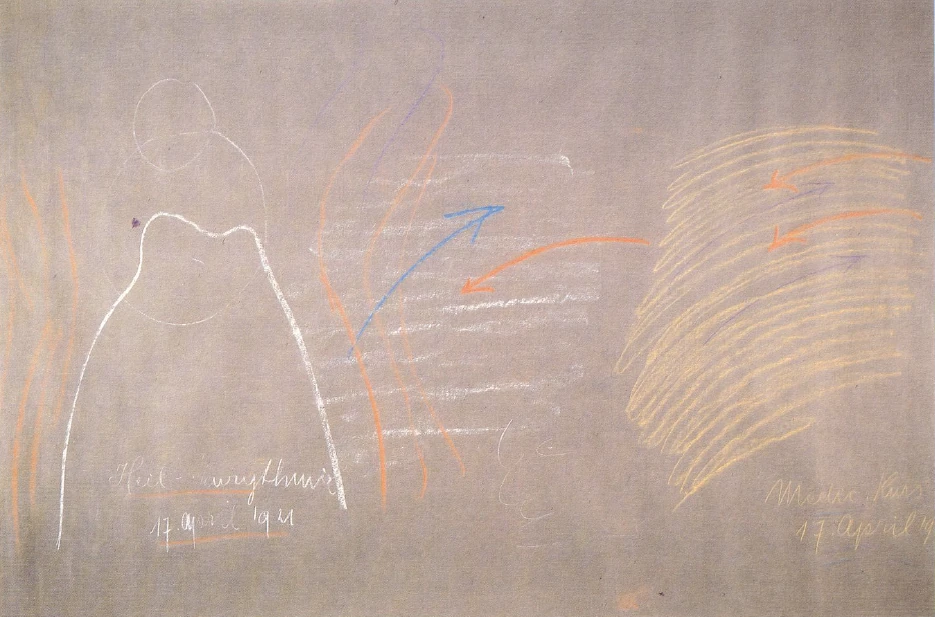
[ 14 ] Nun stellen Sie sich aber diesen ganzen Prozeß so vor, daß er auf dem Umwege durch die Äthertätigkeit in der Gewebeflüssigkeit vor sich geht (siehe Zeichnung, gelb). Ein Sinnesprozeß geht natürlich nicht unter normalen Verhältnissen in der Gewebeflüssigkeit vor sich, aber er kann durch so etwas hervorgerufen werden, wie ich es eben jetzt angedeutet habe. Dann entsteht eine Art Tendenz nach dem Zusammenziehen, nach dem Hinwirken nach dem Organismus, die ich eben so andeuten will wie hier die Aktion bei der Wahrnehmung. Aber es ist dieses (rot) ein Prozeß, der gewissermaßen anstürmt gegen die nach außen gerichtete Kraft (violett) in der Gewebeflüssigkeit. Die macht sich geltend und die wirkt dagegen. Man schiebt also einen Sinnesprozeß, eine Metamorphose des Sinnesprozesses in die Gewebeflüssigkeit hinein. Es ist außerordentlich interessant, das zu beobachten, wie man da hineinschiebt in die Gewebeflüssigkeit eine Metamorphose des äußeren Sinnesprozesses. Nun hat man Umschau zu halten, wo irgendwie im normalen Leben so etwas geschieht, daß also eine Art Metamorphose des Sinnesprozesses im Innern des Menschen, gewissermaßen ein verdichteter Sinnesprozeß in der Gewebeflüssigkeit entsteht. Und er entsteht, indem sich die Milchabsonderung bei der Frau bildet. Da hat man in der Tat eine nach innen übertragene, verdichtete Metamorphose des äußeren Sinnesprozesses: die Milchabsonderung der Frau. Nun nehmen wir an, wenn sie da sein sollte, ist sie mangelhaft, so haben wir alle Veranlassung, nun diesen nach innen gelegenen, in die Gewebeflüssigkeit hinein verdichteten Sinnesprozeß auszuführen. Und wir haben gerade in dem Auskochen des Samens des Kümmels dasjenige, was uns einen solchen Prozeß hervorruft, der die Milchabsonderung fördert.
[ 14 ] Now, however, imagine this entire process taking place indirectly through the activity of the ether in the interstitial fluid (see diagram, yellow). Of course, under normal circumstances, a sensory process does not take place in the interstitial fluid, but it can be triggered by something like what I have just described. This gives rise to a kind of tendency toward contraction, toward an effect directed toward the organism, which I would like to illustrate here in the same way as the action involved in perception. But this (red) is a process that, in a sense, surges against the outward-directed force (violet) in the interstitial fluid. That force asserts itself and acts against it. So one is pushing a sensory process—a metamorphosis of the sensory process—into the interstitial fluid. It is extraordinarily interesting to observe how a metamorphosis of the external sensory process is pushed into the interstitial fluid. Now one must look around to see where, in normal life, something like this occurs—that is, where a kind of metamorphosis of the sensory process arises within the human being, a condensed sensory process in the interstitial fluid, so to speak. And it arises through the formation of milk secretion in women. Here we indeed have a condensed metamorphosis of the external sensory process that has been transferred inward: the milk secretion in women. Now, let us assume that if this process is present but deficient, we have every reason to carry out this sensory process—which is situated inwardly and condensed into the tissue fluid. And it is precisely in the decoction of caraway seeds that we find what brings about such a process, one that promotes milk secretion.
[ 15 ] Es sind diese Dinge von mir eben als Beispiele angeführt worden, wie man das ganze Wirken und Weben dieses menschlichen Organismus und seinen Zusammenhang mit dem, was in der Außenwelt ist, ins Auge fassen kann. Betrachten Sie nur einmal dasjenige, was ich Ihnen hier vorgeführt habe. Betrachten Sie es, ich möchte sagen genau, indem Sie sich sagen: In der Auskochung des Kümmelsamens ist Harz, ist Wachs, also etwas, was durch seine Konsistenz besonders starke physische Wirkungen hervorruft. Dadurch wird dieses Harz, wird dieses Wachs außerordentlich ähnlich dem, nur verdichtet nach innen, was auf mich von außen auf die Sinne einen Eindruck macht.
[ 15 ] I have just cited these examples to illustrate how one can grasp the entire functioning and interplay of this human organism and its connection to what exists in the external world. Just consider for a moment what I have presented to you here. Consider it—and I would say, specifically, by telling yourself: The decoction of caraway seeds contains resin and wax—that is, substances whose consistency produces particularly strong physical effects. As a result, this resin and this wax become extraordinarily similar to—only condensed inward—what makes an impression on my senses from the outside.
[ 16 ] Und wiederum ist in diesem Samen drinnen ätherisches Öl und Schleimzucker. Das ist etwas, was die Reaktivität des Ich anregt. Sie haben da alles beisammen, was Sie haben im Sinnesprozeß: die Wirkung von außen, die Reaktion bis in das Ich von innen. Nun metamorphosieren Sie diesen Sinnesprozeß dadurch, daß Sie eben nicht eine sinnliche Wahrnehmung machen, sondern daß Sie diese Wechselwirkung ins Innere, in das Kräftesystem der Gewebeflüssigkeit verlegen, dann haben Sie dasjenige, was Ihnen einen inneren Sinnesprozeß hervorruft. Denn ein solcher ist der Milchabsonderungsprozeß. Sie werden sehen, wie da auf diese Weise die ganze Organisation durchschaut wird.
[ 16 ] And once again, this seed contains essential oil and mucilage. This is something that stimulates the reactivity of the “I.” You have everything there that you find in the sensory process: the external stimulus, the reaction extending inward to the “I.” Now, you transform this sensory process by not engaging in sensory perception, but rather by shifting this interaction inward, into the force system of the interstitial fluid; then you have what evokes an inner sensory process. For such a process is the secretion of milk. You will see how, in this way, the entire organism is revealed.
[ 17 ] Das sind die Betrachtungen, die man anstellen muß, wenn man dazu kommen will, das Äußere in seiner Stoffwirkung im Inneren zu beachten. Nehmen Sie also an, man versucht es mit mineralisch-metallischen Heilmitteln. Man wird dann dasjenige, was man schon an der Wirkung des Pflanzlichen gelernt hat, ganz besonders leicht durchschauen können. Aber man wird sich noch etwas sagen können. Man wird sich sagen können: Es ist etwas mit dem Mineralischen vor sich gegangen, indem das Mineralische in den Pflanzenprozeß hinein sich schon fortgesetzt hat. Und dasjenige, was da vor sich gegangen ist in der Mineralisierung und Durch-Vegetabilisierung, das ist ein Umformen der mineralischen Kräfte. Es beruht also etwas im Heilungsprozeß auf der Umformung der mineralischen Kräfte. Nehmen Sie also an, wir richten uns eine Krankenheilstätte ein, umgeben sie mit Land und düngen gewissermaßen das Land mit verschiedenen mineralischen Dingen und lassen nun einen Boden wirksam sein, von dem vor unserer Kenntnis offenliegt, was er eigentlich enthält, bauen dort verschiedene Pflanzen an, von denen wir uns sagen, wir verwenden Wurzel, Kraut, Frucht und so weiter, so haben wir den Prozeß selber in der Hand, der darinnen besteht, daß uns die Pflanze das Mineral zum Heilmittel umwandelt. Man kann das dann wiederum verstärken, indem man solche Pflanzen entstehen läßt, man kann sie schon als solche Pflanzen dann in der Weise behandeln, wie wir das eben jetzt besprochen haben. Das wollen wir in unserem Stuttgarter Institut auf der einen Seite tun; so muß es also auch eingerichtet sein. Man kann aber dann noch weiter gehen. Man kann nun dasjenige, was man da an der Pflanze selber nun schon gewonnen hat als ein Heilmittel, das kann man nun wiederum als eine Art Düngemittel verwenden und dann die Kraft noch verschärfen. Man wird da etwas bekommen, was die gewöhnliche physische Verreibung in einem wesentlichen Grade wirksamer macht, also in etwas verwandelt, was in einem wesentlichen Grade wirksam ist, indem man gewissermaßen die Formung, die Zubereitung der Natur selber und den in der Natur wirkenden Kräften dadurch übergibt. Man wird sich natürlich dann auch über Folgendes weiter klar sein müssen. Man wird sich zum Beispiel sagen: Wenn also ein mineralisch-metallisches Mittel wirken soll, wie muß es denn wirken? - Die Salze, die übrigens auch mineralische Mittel sind, erzeugen schon mehr die Wirkung nach dem Innern des Menschen. Die peripherischesten Tätigkeiten aber werden beeinflußt gerade von den mineralisch-metallischen Substanzen, die sozusagen am konsistentesten sind. Da werden wir eine Erwägung anzustellen haben, aber immer wie gesagt aus den Untergründen geisteswissenschaftlicher Erkenntnisse heraus, sonst zersplittern die Gedanken nach allen möglichen Irrwegen hin. Die geisteswissenschaftlichen Gedanken sind diejenigen, die ein solches Denken in die richtige Richtung bringen. Wir können, sagen wir, irgendein Metall haben; wir wissen, ein solches Metall ist sehr schwach angreifbar von dem Innern des menschlichen Organismus aus. Da muß schon die Ich-Tätigkeit sehr angeregt werden, denn das Ich ist es, das gewissermaßen hinuntergreift, hineingreift in das Innere der Substanz, das Innere der Substanz seinem Zwecke gemäß anordnet und dann in dem Organismus eben zur Ich-Tätigkeit aufruft, so daß wir — weil das Ich sich in dieser Tätigkeit verstärken lassen kann durch den astralischen Leib -, wenn wir Metalle anwenden, Mineralien anwenden, dann immer sehen müssen, daß wir die Ich-Tätigkeit oder die astralische Tätigkeit, die dann wieder zurückwirkt auf das Ich, oder die Wechselwirkung von astralischer Tätigkeit und Ich-Tätigkeit, anregen. Solch eine Anregung kann zum Beispiel in folgender Art geschehen: Wir machen eine Metallsalbe, streichen sie auf. Wir streichen sie auf, sagen wir, bei einem Hautausschlag. Wir regen damit peripherisch die Ich-Tätigkeit an. Diese Ich-Tätigkeit wird durch Reaktion im Innern des Menschen ebenso angeregt; es entsteht zunächst im Innern des Menschen verschärfte Nerven-Sinnestätigkeit in irgendeinem Organ, und von da aus verschärfte Atmungstätigkeit, indem das auf das Astralische übergeht. Und wir bekommen eine Wirkung derjenigen Kräfte im Innern heraus, die dem Hautausschlag entgegenwirken. Wir rufen den ganzen Körper auf, um dem Hautausschlag entgegenzuwirken.
[ 17 ] These are the considerations one must make if one wishes to observe the external in terms of its material effect on the internal. Suppose, then, that one tries using mineral-metallic remedies. One will then be able to understand very easily what one has already learned from the effects of plant remedies. But one will be able to say something more. One will be able to say: Something has taken place with the mineral realm, in that the mineral realm has already continued into the plant process. And what has taken place there in the process of mineralization and vegetation is a transformation of the mineral forces. Thus, something in the healing process is based on the transformation of the mineral forces. So suppose we set up a sanatorium, surround it with land, and, so to speak, fertilize the land with various mineral substances, and now allow a soil to take effect whose actual composition is known to us; we grow various plants there, about which we say to ourselves, we use the root, herb, fruit, and so on—then we have control over the process itself, which consists of the plant transforming the mineral into a remedy. One can then reinforce this by cultivating such plants; one can treat them—already as such plants—in the manner we have just discussed. That is what we intend to do at our Stuttgart Institute, on the one hand; so that is how it must be organized. But one can go even further. One can take what has already been extracted from the plant itself as a remedy and use it, in turn, as a kind of fertilizer, thereby further intensifying its potency. One will obtain something that makes the ordinary physical trituration significantly more effective—that is, transforms it into something that is significantly effective—by, so to speak, entrusting the shaping and preparation to nature itself and to the forces at work in nature. Naturally, one will then also need to be clear about the following. For example, one might ask: If a mineral-metallic remedy is to take effect, how must it act?—The salts, which are also mineral remedies, tend to produce an effect directed more toward the inner being of the human being. The most peripheral activities, however, are influenced precisely by the mineral-metallic substances, which are, so to speak, the most substantial. We will have to give this some thought, but always—as I have said—based on the foundations of Spiritual Science knowledge; otherwise, our thoughts will scatter in all sorts of wrong directions. It is Spiritual Science thought that guides such thinking in the right direction. Let us say we have a certain metal; we know that such a metal is very difficult for the inner human organism to influence. The activity of the “I” must be greatly stimulated here, for it is the “I” that, so to speak, reaches down, penetrates into the innermost core of the substance, organizes the innermost core of the substance according to its purpose, and then calls forth the activity of the “I” within the organism, so that we —because the “I” can be strengthened in this activity through the astral body—when we use metals or minerals, we must always ensure that we stimulate “I”-activity or astral activity, which in turn acts back upon the “I,” or the interaction between astral activity and “I”-activity. Such stimulation can occur, for example, in the following way: We make a metal ointment and apply it. We apply it, say, to a skin rash. In doing so, we stimulate ego activity peripherally. This ego activity is likewise stimulated by a reaction within the human being; initially, heightened nervous-sensory activity arises within the person in some organ, and from there, heightened respiratory activity, as this transitions into the astral realm. And we bring forth the effect of those inner forces that counteract the skin rash. We mobilize the entire body to counteract the skin rash.
[ 18 ] Nun kann man sagen, daß man daraufhin die verschiedenen Metall- und Mineralsubstanzen überhaupt studieren kann. Sie haben zum Beispiel in dem Blei etwas, was in außerordentlich starker Weise auf die Nerven-Sinnestätigkeit wirkt, und dann wiederum in Dependenz davon auf die innere Atmungstätigkeit, aber auch auf jene innere Atmungstätigkeit, die sich zum Beispiel in den äußeren peripherischen Organen abspielt. Wenn wir also Blei verwenden, können wir sehr viel wirken, wenn es nötig ist, so etwas, wie eben beschrieben worden ist, hervorzurufen, wenn wir das Blei als Salbe verwenden oder auch wenn wir es eben eingeben. Nur müssen wir uns natürlich klar sein, daß wir, wenn wir.es eingeben, so wirken, daß wir durch die Tätigkeit der Verdauungsorgane, die angeregt werden, die Reaktion des oberen Menschen hervorrufen. Wenn wir im oberen Menschen selbst irgendwelche vorsichtig zubereiteten Bleisalben verwenden, so wirken wir direkt auf dieses obere System. Und wir werden gerade, wenn wir Menschen haben, welche irgendwie an Kopfschwäche leiden, bei denen also der obere Mensch keine richtige Nerven-Sinnestätigkeit entwickelt und auch keine richtige Atmung entwickelt, mit solchen Bleikuren, wenn wir sie eben nur so weit treiben, daß sie zu keiner Vergiftung führen können, sehr viel ausrichten können. Bei allen diesen Dingen, die wir ja gewissermaßen ablesen können von dem, was uns die letzten Tage und auch der vorige Kursus gebracht haben, handelt es sich darum, daß wir uns über Folgendes klar sind.
[ 18 ] Now one could say that, based on this, one can study the various metallic and mineral substances in general. For example, lead contains something that has an extraordinarily strong effect on nervous and sensory activity, and consequently on internal respiratory activity—but also on the internal respiratory activity that takes place, for example, in the external peripheral organs. So when we use lead, we can have a significant effect if it is necessary to bring about something like what has just been described—whether we use lead as an ointment or administer it internally. Of course, we must be clear that when we administer it, we are acting in such a way that, through the activity of the digestive organs—which are stimulated—we elicit a reaction in the upper human being. When we use carefully prepared lead ointments on the upper human being itself, we act directly on this upper system. And especially when we have people who suffer in some way from mental weakness—that is, in whom the upper human being does not develop proper nervous-sensory activity or proper respiration—we can achieve a great deal with such lead treatments, provided we administer them only to the extent that they cannot lead to poisoning. In all these matters—which we can, in a sense, deduce from what the last few days and also the previous course have taught us—the point is that we are clear about the following:
[ 19 ] Da gibt es vor allen Dingen einen großen Gegensatz. Alles dasjenige, was mehr nach dem Silber hinübergeht, das verhält sich in gewissem Sinne als Metall polarisch zu all demjenigen, was mehr nach dem Blei hinübergeht. Nun haben wir natürlich in bezug auf diese Dinge außerordentlich mangelhafte Mineralsysteme. Unsere Mineralsysteme sind im Grunde genommen außerordentlich mangelhaft, denn bei einem naturgemäßen Mineralsystem würden diese Verwandtschaftsverhältnisse der Metalle berücksichtigt werden müssen, und wir würden sehen, daß bei einem solchen System gewissermaßen an dem einen Pole liegen die Bleiverbindungen, das Blei selber, daß an dem andern Pole das Silber liegt, daß in der Mitte zum Beispiel das Aurum, das Gold steht, und die anderen dann. entsprechend angeordnet sind. Polarisch, sage ich, sind Silber und Blei aus dem Grunde, weil das Silber unmittelbar auf den Gliedmaßen-Stoffwechsel wirkt, und zwar recht peripherisch, recht sehr auf dasjenige, was vom GliedmaßenStoffwechselorganismus nach außen gelagert ist; ebenso wirkt das Blei auf alles dasjenige, was vom Kopforganismus nach außen gelagert ist. Es wirkt also das Silber anregend auf die Nerven-Sinnestätigkeit im Stoffwechsel-Gliedmaßen-System und fördert von da aus dann die Tätigkeit, die den ganzen Körper durchdringt, und die eine Anregung der Atmung ist bei all dem, was ich gestern genannt habe Metamorphose des zentralen Herzorgans.
[ 19 ] Above all, there is a major contrast here. Everything that leans more toward silver behaves, in a certain sense, as a polar opposite to everything that leans more toward lead. Now, of course, our mineral systems are extremely deficient in this regard. Our mineral systems are, in essence, extremely deficient, for a natural mineral system would have to take these relationships among the metals into account, and we would see that in such a system, the lead compounds and lead itself would, so to speak, lie at one pole, silver at the other, with, for example, aurum—gold—in the middle, and the others arranged accordingly. arranged accordingly. Silver and lead are polar, I say, because silver acts directly on the metabolism of the limbs—and quite peripherally, very much on that which is situated on the outer periphery of the limb metabolic organism; likewise, lead acts on everything that is situated on the outer periphery of the head organism. Silver thus has a stimulating effect on nervous and sensory activity in the metabolic-limb system and, from there, promotes the activity that permeates the entire body—an activity that stimulates respiration in connection with what I referred to yesterday as the metamorphosis of the central heart organ.
[ 20 ] Dagegen wirkt alles dasjenige, was vom Blei ausgeht, auf die Nerven-Sinnestätigkeit des Kopfes, auf die Atmungstätigkeit, die von da aus angeregt wird. Dadurch wirkt es anregend auf alles dasjenige, was eben in der anderen Metamorphosierung besteht, in der Kopfgestaltung, der Lungengestaltung, der Lebergestaltung, also derjenigen Organe, die gewissermaßen die andere Organisation des Menschen so umschließen, wie die Lunge das Herz umschließt, und damit eigentlich die Urgestalt desjenigen aufzeigt, was in einer gewissen Beziehung als Zirkulationsmensch der ganze Mensch ist. Wir haben die Lunge, die das Herz umschließt, wir haben gewissermaßen die Lunge, umspannend, umgreifend mit dem Atmungswesen das Zirkulationswesen. Aber ebenso haben wir, wenn wir den Menschen betrachten in bezug auf seine Gehirngestaltung, auf Lungengestaltung und Lebergestaltung, also wenn wir den ganzen oberen hinteren Menschen betrachten, eine weitergehende Atmung, umspannend alles dasjenige, was Zirkulationsgefäße sind mit dem Herzen zusammen. Was dann Verdauungsorganisation und auch Sexualorganisation ist, das haben wir auf diese Weise dann von dem oberen und hinteren Menschen umschlossen. Die Organisation ist so, daß der obere und hintere Mensch den unteren und vorderen Menschen eigentlich umschließt. Wenn man das durchgreifend versteht und in dem Zusammensein, in dem Aufeinandersein des oberen und hinteren Menschen mit dem unteren und vorderen Menschen, was sich also hauptsächlich auslebt in der Wechselbeziehung zwischen Herz und Lunge, wenn wir das ordentlich betrachten und darinnen, in diesem Zusammenleben das Rhythmische studieren und dann die Nerven-Sinnestätigkeit an demjenigen studieren, was oben und hinten ist, was aber natürlich seinen anderen Pol in dem vorderen und unteren Menschen hat, und wenn wir dasjenige, was Stoffwechsel-Gliedmaßenvorgänge sind, an dem vorderen und unteren Menschen betrachten und wiederum in seiner anderen Ausbildung am oberen und hinteren Menschen studieren, dann haben wir den ganzen Menschen vor uns und können ihn auf diese Weise dann entsprechend auch in seinen anderen Prozessen beherrschen. |
[ 20 ] In contrast, everything that emanates from lead affects the nervous and sensory activity of the head, as well as the respiratory activity that is stimulated from there. Through this, it has a stimulating effect on everything that constitutes the other metamorphosis—namely, the formation of the head, the lungs, and the liver—that is, those organs that, in a sense, enclose the other human organism just as the lungs enclose the heart, and thus actually reveal the primordial form of what, in a certain sense, is the “circulatory human”—the whole human being. We have the lungs, which enclose the heart; we have, so to speak, the lungs encompassing and surrounding the circulatory system with the respiratory system. But just as we have—when we consider the human being in terms of the structure of the brain, the lungs, and the liver, that is, when we consider the entire upper and posterior human being—a more extensive respiratory system that encompasses all the circulatory vessels together with the heart. In this way, the digestive system and the reproductive system are thus enclosed by the upper and posterior parts of the human being. The structure is such that the upper and posterior parts of the human being actually enclose the lower and anterior parts. If one understands this thoroughly—and considers the coexistence, the interplay of the upper and posterior human with the lower and anterior human, which is primarily expressed in the interrelationship between the heart and the lungs—if we observe this carefully and study the rhythmic processes within this coexistence, and then study the nervous-sensory activity in that which which is located above and behind—but which, of course, has its opposite pole in the front and lower human being—and if we observe the metabolic and limb processes in the front and lower human being and, in turn, study them in their corresponding form in the upper and rear human being, then we have the whole human being before us and can, in this way, master him accordingly in his other processes as well. |
[ 21 ] Von da ausgehend wollen wir dann morgen übergehen zu der speziellen Besprechung unserer eigenen Heilmittel und dabei noch einige der Fragen, die gestellt worden sind, berücksichtigen, was sich naturgemäß wird ergeben können.
[ 21 ] Building on that, we will then move on tomorrow to a specific discussion of our own remedies, taking into account some of the questions that have been raised—whatever naturally may arise.