

Spiritual-Scientific Perspectives on Therapy
GA 313
18 April 1921, Dornach
Translated by Steiner Online Library
Ninth Lecture
[ 1 ] What I have to say to you today regarding eurythmy is this: it will certainly have to be understood in detail using the knowledge you have in physiology and other fields. How this is to be done, I would say, will become clear to you quite naturally. But precisely when we look into a spiritual-physical process such as the one that takes place during eurythmy, we cannot help but point out deeper spiritual-physical connections as well. And here I would like to draw your attention to the following.
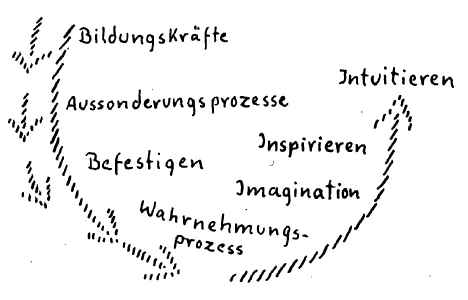
[ 2 ] We must first turn our attention to that extra-human world process which is usually observed only in terms of its details and not in terms of what is actually at work within it. Just consider that the formation of the Earth actually means this: a formative tendency is at work from the planetary sphere, and in addition, a formative process is taking place within the Earth from that which lies beyond the planetary sphere—continuous, radiant cosmic forces expressed in the individual force entities and radiating toward the Earth.
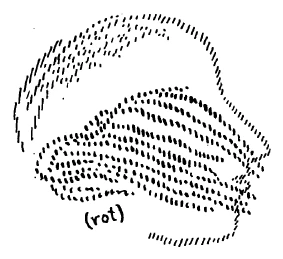
[ 3 ] In this context, we can now understand these cosmic forces—even though they may in turn encompass everything I have previously said about the rays—in such a way that we say they act toward the center and actually form, from the outside, that which is on and within the Earth. For one thing, it is true, for example, that the Earth’s entire metallic composition—all of its metals—is not essentially formed by any forces originating from within the Earth, but rather that they are truly brought into the Earth from the cosmos. We can now call these forces that act through the ether—not from the planets, for then they would again act centrally; the planets are there precisely to modify them—the planetary sphere is what does this—we can call these forces the formative forces, the formative forces acting from the outside. It is precisely in this context that I ask you to grasp this concept: formative forces. Opposing them are those forces which, in human beings and in the Earth, receive and consolidate these formative forces, gathering them, as it were, around a central point, so that the Earth itself can come into being. So we can call these consolidating forces the forces of consolidation (see drawing and diagram on p. 159). In the human being, they are present as forces that plastically form the organs, while the other forces—the formative forces—are those that, to a greater extent, push the organs from the spiritual-etheric world into the physical world. This is a process that is, in fact, palpable in the contrast between the pushing forces of magnesium and the fluorine forces that round off—I would say it is something you can almost grasp with your hands. But again, it is a process that manifests everywhere: in the teeth, it occurs from the bottom up, rounding off at the top, but it also occurs from front to back, from back to front, and from top to bottom, rounding off toward the bottom. And you can, for example, grasp this process—I would say, once again, quite tangibly—if you have a mental image of it, with the tendency to push a spherical form forward, from the outside in, something is formed, and that this is countered by a process of spherical formation (see drawing, red), from the bottom up. And between these two processes lies what acts as the mediating factor—that is, processes of separation, the absorption of what has been separated from others, and so on—what can be called, in the broadest sense, processes of separation; for ultimately, absorption, too, is based on an inward separation, which is in turn reabsorbed. So in between lies, once again, what can best be called processes of elimination.
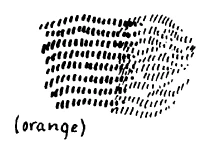
[ 4 ] You can really grasp such a separation process if you imagine that, on one side, there is that which constantly seeks to separate out the carbon (see diagram, orange), and that which, in turn, reabsorbs it in the formation of carbon dioxide (white) through respiration, starting from the beginning. Then this process of elimination continues further down. And if you go even further down into the metabolic processes of the limbs, you’ll find a process of fixation. But this process of fixation also occurs in the opposite direction. You can observe this where—I would say—you can almost touch it with your hands: when you consider the eye, it is formed from the outside in—as embryology already shows you—but it is consolidated from the inside out. The formation is internalized. This is, after all, the basis for the development of the eye. It is internalized (see drawing, orange), so that as we proceed toward the spiritual-soul aspect in the human being—that is, toward the organs of the spiritual-soul, toward the sense organs—this fixation process is spiritualizing itself, truly becoming soulful and spiritualizing itself in perception. This is, so to speak, the descending process that leads to organ formation (see drawing, p. 156, and diagram, p. 159). Then, at the very bottom, we find the process of perception, concrete perception (see ibid.). If this continues to develop, perception moves toward consolidation; when it becomes conscious of this consolidation, it becomes imagination. When imagination develops further and becomes conscious of the process of differentiation, it becomes inspiration. And when inspiration develops further toward the process of formation and, in doing so, consciously engages with the process of formation—that is, penetrates to the heart of formation—it becomes intuition (see ibid.). One can trace this sequence of stages in the life of the soul from concrete perception to imagination, to inspiration, to intuition.
Educational Forces: Intuition
Selection Processes: Inspiration
Consolidation: Imagination and Perceptions
[ 5 ] But this process that is unfolding in the soul is, after all, based on the process of becoming. It is, as you can see here, merely the reversal of the process of becoming. One moves toward what has already become and ascends once more into becoming in the opposite direction. Formation proceeds in a descending direction. One ascends in the opposite direction, moving toward becoming, so that what one develops as powers of perception and cognition in imagination, inspiration, and intuition always finds its counteraction in the creative forces expressed in the formative powers, in the processes of separation, and in the processes of consolidation.
[ 6 ] You will see from this that, in the human organism, the force that acts in the opposite direction—in creation, in becoming—is the one we enter into when we rise up in cognition. You will see from this that it is indeed true that what we attain in imagination are the very same forces that, without our awareness, make themselves felt in the phenomena of growth, in the plastic phenomena of growth. When we ascend to inspiration, we approach the forces that enter from the outside and inspire the human being through breathing, shaping the human being as they breathe—forces that, as it were, work their way through and take shape within the plastic forces. And when we ascend to intuition, we actually ascend to the agent that enters from the external world into our plastic forms as the substantial essence.
[ 7 ] So you see, we are considering the human being as a being that takes shape out of the cosmos, and when we now apply the knowledge we have acquired in one way or another through anatomy or physiology, and examine it in light of what has been given to us, then we begin to understand the organs and their functions. This, then, is a pointer toward understanding the organs and their functions, so that in what always works plastically in the human being—what makes the human being normal, I would say “permeated with form”—on the other hand—referring now to yesterday’s lecture—on the other hand, it lives in the consonant movements, which, as I said yesterday, evoke precisely unconscious powers of imagination, namely a kind of flow through the organism. So you can see here how consonant eurythmy takes hold of a person’s lacking formative powers—their lacking plastic powers—and transforms them into the proper plasticity.
[ 8 ] So let’s take a child and observe that there is a defect in the plasticity, that the plasticity is growing too rapidly. What does it mean for the plasticity to be growing too rapidly? It means that the plasticity acts centrifugally, making the head large through this centrifugal action, and—because the head becomes too large—prevents it from becoming properly imbued with imaginative forces. These must be introduced. Therefore, let the child practice eurythmy in a consonant manner.
[ 9 ] There is a case described here of “a two-year-old boy who is otherwise apparently healthy but has a large head, which is not, however, hydrocephalus.”
[ 10 ] In fact, properly applied eurythmy—with its emphasis on consonance—is the antidote to this. This is precisely where a thorough observation of the morphological, the deeper morphological, points directly to eurythmy as a treatment.
[ 11 ] Or: “A twelve-and-three-quarters-year-old boy whose height is noticeably stunted, with no organic findings, but who has worms; intelligent, but mentally prone to fatigue.” — An extraordinarily interesting complex of symptoms, all pointing to a lack of imaginative powers, to the unchecked proliferation of the plastic organ forces because there are insufficient inner plastic forces—psychic plastic forces. It is, after all, these psychic plastic forces that destroy the parasites. It is therefore no wonder that, when these forces are insufficient, the person is infested with worms. So let him receive eurythmy therapy that harmonizes his consonants, and the antidote will have been administered.
[ 12 ] These connections directly point out where you need to intervene with eurythmy. For if these symptoms appear—I would say—in a concealed manner, then even in such concealed cases, eurythmy can have an extraordinarily beneficial effect, especially if one also addresses the issue through material therapeutic means.
[ 13 ] For example, an interesting question has been brought to my attention. It is natural that I must answer this question in principle. If any complications arise, then these complications could be taken into special consideration in this particular case; but even if something else must be combined with the matter, the matter is nevertheless fully addressed from one perspective by what can be characterized there:
[ 14 ] “I have a five-year-old patient who lost a lot of blood from a gunshot wound during the riots; two years ago, he developed joint deformities. These are conditions that later lead to anemia and similar ailments in adults. How might this be treated?”
[ 15 ] There you have joint deformation. This is a outward-directed action of the plastic forces, which can no longer remain within; they are already radiating outward, so that they leave the person instead of acting from within. These forces are reflected back in the most profound sense precisely through the practice of consonant eurythmy. For in consonant eurythmy, you evoke precisely those effective—objectively effective—imaginations that counteract these deformations. In the future—as has already been quite correctly pointed out in the question—people will generally be prone to deformities in the most varied ways, because they will no longer be able to form a normalizing form with the forces that act involuntarily. Human beings will become free; they will even gradually become free with regard to the formation of their own form, but they must then be able to make use of that freedom. They must therefore transition to creating imaginations that always counteract deformation.
[ 16 ] Now, on the other hand, you see, here we are dealing with a lack of objective imagination; we may also be dealing with a lack of objective inspiration, which then manifests itself—if I may put it that way—as a distortion of the rhythmic system. This distortion of the rhythmic system is expressed quite particularly in the fact that the objective inspiration, which flows inward, does not correspond properly to the rhythm of circulation. And one can have a normalizing effect by applying vocalizing eurythmy. This vocalizing eurythmy acts just as effectively on internal irregularities—which are not accompanied by morphological changes—as consonant-based eurythmy acts on deformations or tendencies toward deformations.
[ 17 ] I said earlier that it may indeed be necessary to support such a process when it manifests in a particularly radical way, as in the case of joint deformities, which we have just been discussing. In such cases, it is necessary to provide therapeutic support for the process of consonant-based eurythmy, which works by stimulating—through this imagination—the inner respiration of the organs that extend from the outside inward and are located beyond the intestinal walls: the lungs, kidneys, liver, and so on. Indeed, when one performs consonant-based eurythmy, the back of the head, the lungs, the liver, and the kidneys in particular begin to sparkle and shower with sparks—a phenomenon that truly demonstrates the spiritual-psychic reaction to what is being done externally through consonant-based eurythmy. The whole human being becomes a luminous being within these organs, and the movements that are performed are always met by luminous movements within; and especially with certain consonant-based movements, I would say, a complete luminous representation of the kidney’s excretory process arises. In a sense, one gains a picture of the entire excretory process of the kidney in this luminous process that occurs through consonant-based eurythmy. And this then carries over into the unconscious imaginations, and the entire process in which this part begins to glow in this way is, after all, the very same process that I have specifically described as occurring under the influence of Cuprum; it is the same process. And this is also the point where one can point out to the physician that there are indeed people who suffer from certain forms of illness. Just yesterday, these forms of illness were once again—I might say, thrust upon me—when I was brought, from a certain quarter, drawings that are greatly admired: painted drawings about which it was asked whether they are particularly occult in nature. They are, of course, occult in a certain sense, but it is extremely difficult to talk to people about these things, for such phenomena—which are objectively recorded kidney luminescence—are objectively recorded processes of urination. In this process of urination, when it abnormally transforms into a process of glowing in certain people with a predisposition to illness—that is, when a certain stagnation of urine secretion occurs—in other words, a purely metabolic disease—the kidneys begin to glow; and when this particular, inward-turned clairvoyance sets in, people begin to draw wildly. The result is always beautiful—externally, in a formal sense, always beautiful. The applied colors always turn out beautifully. Of course, people aren’t satisfied when you tell them: “Yes, you’ve painted something very beautiful there; that is, in fact, your stagnant urine secretion.” — I can assure you that accumulated urine and repressed sexual desires—which, after all, also lead in a certain way to metabolic irregularities—are presented to one by particularly mystical individuals as deeply mystical drawings and paintings, and that much of what appears in the world in this manner is to be seen as symptoms of barely tolerable pathological abnormalities in human beings.
[ 18 ] You see, anthroposophically oriented Spiritual Science is not mysticism in the sense that many people understand it, for it harbors no illusions about the kinds of things that have just been described. On the contrary, it investigates precisely such things. But people hold that against me. They already hold it against me that I went so far in my public lectures as to suggest that, for example—even if these things were not depicted but expressed poetically—the beautiful poetry of Mechthild of Magdeburg or Saint Teresa are reflections, that is, inspirational echoes, of processes arising from repressed sexuality. Of course, people don’t like it when you describe to them a Mechthild of Magdeburg or a Saint Teresa: yes, these are indeed personalities with a strong sexuality, which they repressed precisely because it became too strong for them; this gives rise to certain metabolic and circulatory processes, and reactions occur in response to these that manifest in such a way that they are then fixed in very beautiful poetry. Yes, when viewed in a higher sense, this phenomenon leads extraordinarily deep into the mysteries of existence. But one must be able to rise to such a perspective. And that is why one must at least have some inkling of these peculiar processes that shine forth as inner processes when eurythmy is performed externally. And especially when that which is now inwardly enshrined in the poem is expressed through eurythmy—as I showed you yesterday—when a beautiful poem is read aloud, and is then eurythmized in a corresponding manner—as we saw yesterday, through consonantization or vocalization—then this intersects with the other; and in addition to what is being performed externally in movements, an inner, silent speech also arises within the eurythmist. And if this process is not indulged in through overly sentimental poetry, but rather if it simply unfolds as the accompanying, eurythmic process that complements beautiful poetry, then what takes place within the person is not merely a recording of the mystical, but rather a process that is thoroughly healing for the person, so that one can say: If one practices eurythmy in such a way that one always draws the patient’s attention to listening carefully, to bringing the heard sound and the heard sentence structure—according to which one performs the eurythmy—strongly into consciousness, then one will allow it to rise directly to the outer formative forces, to the objectively intuitive forces. And one would do well, if one wishes to influence all that which is found within the human being as a remnant of what no longer took place between birth and death—but which materialism calls heredity, though a large part of it is in fact brought over from the pre-existing spiritual-soul life—if, that is, one wishes to influence what one might call congenital defects, defects, and so on—then one would do well, especially during adolescence, to work through eurythmy again and again in such a way that one repeatedly urges the eurythmist: “Make perfectly clear to yourself what you hear externally.” This also dispels all those tendencies that seek to fix internally what might arise in something like mystical drawing or mystical poetry. It is precisely this that is connected to the beautiful external poem. It is the reverse process. A true mystic knows that whatever a person perceives as an abnormal form of beauty always has a questionable side. In contrast, when what is beautiful in the outer world is experienced inwardly, one cannot say that it presents itself as a particularly magnificent, beautiful form; on the contrary, it becomes schematized, it becomes abstract through this process—but abstract in the sense of a drawing, just as a drawing is abstract. But that is precisely what is healthy; that is what is desirable. And isn’t it true that this beautiful historical process would not have come about—but if, for example, Mechthild of Magdeburg had been prompted to perform eurythmy to good poems, then she would have been spared her entire mystical destiny. Of course, when one reaches this point, one can say: There one reaches a point where, in a sense, good and evil cease to exist in a certain way. There one enters the amoral Nietzschean sphere, the realm beyond good and evil, and one certainly cannot be so philistine as to say that all the Mechthilds of Magdeburg should be eradicated root and branch. But on the other hand, you can be certain that the supersensible worlds will see to it that, even if people do not exactly let this run rampant, the corresponding connections with the supersensible world will nevertheless remain.
[ 19 ] Now I would like to address a few points that might still shed some light on the matter, even though we are already quite far along. First, I would like to specifically address the following question:
[ 20 ] “Couldn’t therapeutic eurythmy exercises be supported by rational breathing exercises? It doesn’t necessarily have to be Hatha yoga.”
[ 21 ] Well, I have the following to say about this: Rational breathing exercises to support eurythmy exercises can be approached in our time—given the current direction in which human nature is increasingly moving—only in the following way. One will notice, in fact, that under the influence of vocal eurythmy in particular, a tendency toward a change in the breathing rhythm arises of its own accord. One will notice this. And now one faces the difficulty that one should not apply a one-size-fits-all approach here, nor make generalizations, but rather should first observe what needs to be done. In each individual case, one should observe the change in the breathing of a person whom, based on other findings, one intends to help through therapeutic vocal eurythmy, and then one should draw their attention to the fact that they should now consciously continue this tendency. For we are no longer people like the ancient Orientals, who could take the opposite path—influencing the whole person once again through prescribed breathing. This is something that, under any circumstances, if prescribed in one way or another, leads to inner shocks and should actually be avoided. We must simply learn to observe what eurythmy—specifically vocal eurythmy—teaches us about its own influence on the breathing process. And then we can consciously continue what occurs eurythmically in each individual case. For you will see there that this process—the breathing process—continues in a certain way that is individual, that is, different for different people.
[ 22 ] Well, my dear friends, those are roughly the questions that can still be answered. Due to time constraints, there is no real opportunity to address some of the other issues that have, admittedly, still been left unresolved. In closing, I would just like to say a few words to you, my dear friends: you must be prepared for the fact that your medical colleagues around the world will wage no less of a struggle as soon as they become keenly aware that something of our kind is making its presence felt, and that you will need the persuasive power capable of countering whatever opposition you face. Of course, one must never allow opposition to deter one from taking action, but we must also harbor absolutely no illusions about all those forces we are calling upon as antagonists.
[ 23 ] Once again, as this course draws to a close, I would like to state that I strictly adhere to the principle that—in order to make possible the movement that is now to be inaugurated in the medical field—I myself will not directly intervene in patients’ healing processes, but will instead limit myself to advising, discussing, and advising with the doctors themselves, so that you will always be in a position to reject anything that might suggest that I myself wish to intervene in the treatment in any way that is unwarranted. This is what I already said at the end of the last course. It is, after all—and this cannot be denied—made exceptionally difficult for one from the anthroposophical side, because people naturally come with all sorts of unreasonable demands in this regard. It is certainly also the case that among anthroposophists there is a tendency not to transcend egoism, but sometimes to become even more egotistical than ordinary people are; and then one may, under certain circumstances, become truly indifferent to extremely indifferent to the well-being of the movement—that the well-being of the movement depends not on carrying out, in individual cases, what the outside world calls “quackery,” but on allowing the healing process of medicine as a whole to take its course, and that this process should not be disrupted by the demands that an individual might sometimes make out of personal aspirations. This is very difficult, but it must be carried out in this direction, for we will only be able to succeed in this very area if we can counter the outside world with what is otherwise the case in our anthroposophical movement—insofar as it is pursued with understanding and is not distorted by the uninformed— we must be able—simply by knowing what is happening within the anthroposophical movement—to say: What is being said there is most certainly a lie; it is most certainly fabricated. - In certain cases, we simply must always be able to say that. But we can say that if we are inwardly, so to speak, initiated into all that constitutes the matters I have drawn attention to here—namely, that I do not intervene directly in healing processes, but that those who function as physicians within our anthroposophical movement are the ones who are there to heal the patients.
[ 24 ] Since I had to say this, I would like to add nothing more than this: May these insights—which, due to time constraints, often had to remain merely hints during this course—continue to take shape within you, and may they take effect in the appropriate way for the healing of humanity. We hope to have the opportunity to continue in some way what we have now begun twice, and we will at least strive to carry it forward in some way. With this hope, I conclude these reflections, my dear friends, and I hope that in all these respects our actions may correspond to our wishes. It was a very satisfying feeling to see you here. It will be a satisfying feeling to look back on the days you have chosen to spend here for the enrichment of medical science, and the thoughts that are meant to bind us together will accompany you, my dear friends, on the paths you will walk to put into practice what we have sought here to inspire, at least in thought.