

Therapeutic Eurythmy
GA 315
13 April 1921, Dornach
Translate the original German text into any language:
Versions Available:
Therapeutic Eurythmy, tr. SOL
Zweiter Vortrag
Second Lecture
[ 1 ] Ich habe vor, heute einiges über das vokalische Prinzip in der Eurythmie vor Ihnen zu besprechen. Wir brauchen uns nur zu vergegenwärtigen, wie aus der Geisteswissenschaft uns bekannt ist, daß Vokale eigentlich mehr aussprechen dasjenige, was im Inneren des Menschen lebt an Gefühlen, an Emotionen und so weiter. Konsonanten, die drücken mehr dasjenige aus, was das äußerlich Gegenständliche ist. Bleiben wir also innerhalb der Sprache, so gelten diese beiden Sätze: Vokale mehr Ausdruck, mehr Offenbarung für das Innere der Gefühle; wir offenbaren gewissermaßen uns im Vokal, also dasjenige, was wir über einen Gegenstand empfinden, was wir über einen Gegenstand fühlen. Konsonanten passen sich mit den Bewegungen, die Zunge, Lippen, Gaumen und so weiter ausführen, mehr plastisch an die äußere Form der Gegenstände an, die aber natürlich dann geistig empfunden werden, versuchen sie nachzubilden. Es sind so im Grunde alle Konsonanten eine Nachbildung mehr des äußerlichen Formseins der Dinge. Nun aber kann man so im Grunde genommen nur sprechen über Vokale und Konsonanten, wenn man im Auge hat einen früheren Zustand der Menschheitsentwickelung, einen Zustand, in dem eigentlich die Sprachentwickelung gegeben war, und in dem das Bewegen des ganzen [Leibes], also der Glieder des Leibes eine Selbstverständlichkeit war, in dem gewissermaßen die einzelnen Laute immer mit Bewegungen des Leibes verbunden waren. Diese Verbindung ist ja im Laufe der Menschheitsentwickelung gelockert worden. Die Sprache wurde mehr überhaupt nach dem Inneren genommen und die Bewegungsmöglichkeiten, die Bewegungsausdrücke hörten auf, und im gewöhnlichen Leben sprechen wir heute, ohne viel die Sprache mit den entsprechenden Bewegungen zu begleiten. In der Eurythmie holen wir nun wiederum dasjenige, was an Bewegungen die Vokale und Konsonanten begleitet hat, heran und bringen so den Körper wiederum in Bewegung. Nur müssen wir jetzt uns darauf besinnen, daß wir gewissermaßen bei dem Vokalsprechen die Bewegung weglassen und den ganzen Vokal, der gewissermaßen vorher in der äußeren Bewegung mitgelebt hat, daß wir diesen Vokal verinnerlichen. Wir nehmen ihm etwas weg auf seinem Wege nach innen. Wir nehmen ihm die Bewegung weg. Daher ist es beim Vokal so, daß wir dasjenige, was wir ihm auf dem Wege nach innen weggenommen haben, daß wir ihm das in der äußeren Bewegung wiederum geben. So daß beim Vokal alles so liegt, daß bei ihm außerordentlich viel auf die äußere Bewegung ankommt, wenn wir nun den Übergang suchen wollen von der Wirkung dieses Vokals, eurythmisch ausgedrückt, auf den ganzen Menschen. Das ist dasjenige, was wir dabei berücksichtigen müssen.
[ 1 ] Today I intend to discuss with you the principle of vowels in eurythmy. We need only recall, as we know from Spiritual Science, that vowels actually express more what lives within a person—feelings, emotions, and so on. Consonants, on the other hand, express more what is outwardly concrete. So if we remain within the realm of language, these two statements hold true: Vowels are more an expression, more a revelation of the inner world of feelings; in a sense, we reveal ourselves through the vowel—that is, what we perceive about an object, what we feel about an object. Consonants, through the movements performed by the tongue, lips, palate, and so on, adapt more vividly to the external form of objects—which, of course, are then perceived mentally—and attempt to reproduce them. Thus, fundamentally, all consonants are a reproduction of the external form of things. However, one can really only speak of vowels and consonants in this way if one keeps in mind an earlier stage of human development—a stage in which the development of language was actually taking place, and in which the movement of the entire [body], that is, of the body’s limbs, was a matter of course; a stage in which, so to speak, the individual sounds were always connected to bodily movements. This connection has, of course, become looser in the course of human development. Speech has generally become more inwardly oriented, and the possibilities for movement—the expressive movements—have ceased; and in everyday life today, we speak without accompanying our speech much with the corresponding movements. In eurythmy, we now bring back the movements that once accompanied the vowels and consonants, and in this way set the body in motion once more. However, we must now bear in mind that, when speaking vowels, we omit the movement, so to speak, and internalize the entire vowel—which, in a sense, previously lived along with the external movement. We take something away from it on its path inward. We take away its movement. Therefore, with the vowel, what we have taken away from it on its path inward, we must give back to it in the outward movement. Thus, with the vowel, the situation is such that its outward movement is of extraordinary importance if we now wish to seek the transition from the effect of this vowel—expressed eurythmically—to the whole human being. This is what we must take into account.
[ 2 ] Also indem wir heute vom Vokalischen sprechen, sprechen wir so rein von der Bedeutung desjenigen, was bewegungsmäßig, eurythmisch vokalisiert wird. Und es handelt sich da sehr darum, daß man sich eine Empfindung von dem erwirbt, was in die Bewegung gewissermaßen hineinfließt. Also daß man sich ein Anschauungsbewußstsein erwirbt, ob dasjenige, was mit dem entsprechenden Gliede des Menschen geschieht, ob das ein Strekken ist, ob es ein Runden ist und dergleichen. Man muß durchaus sich davon ein deutliches Bewußtsein erwerben. Das ist beim Vokalischen außerordentlich wichtig, daß man gewissermaßen die Bewegung oder die Haltung, die gemacht wird, fühlt. Das ist das Wichtige. Und von da ausgehend wollen wir jetzt einmal einzelne Vokale aus dem Eurythmischen ins Therapeutische herüberholen.
[ 2 ] So when we speak today of vocalization, we are speaking purely of the meaning of what is vocalized through movement, through eurythmy. And it is very much a matter of gaining a sense of what, so to speak, flows into the movement. In other words, to develop a visual awareness of what is happening with the corresponding part of the human body—whether it is a stretching, a rounding, or something similar. One must definitely acquire a clear awareness of this. This is extremely important in vocalization: that one, so to speak, feels the movement or posture being performed. That is what is important. And starting from there, let us now bring individual vowels from eurythmy into the therapeutic context.
[ 3 ] Praktisch vorgeführt (Frau Baumann): Ein deutliches I durch Strecken mit beiden Armen. Dieses Strecken, das müßte man nun so bewirken, daß man jetzt wiederum zurückgeht [in die Ausgangsstellung] 1Frühere Herausgeber-Hinweise «Ruhestellung» jetzt ersetzt durch «Ausgangsstellung», wie Rudolf Steiner selbst sagt bei den Anweisungen zur U-Übung. und jetzt dieselbe Bewegung etwas tiefer ausführt, wieder zurückgeht und beides horizontal macht. Jetzt gehen wir wieder zurück, und wenn Sie zuerst rechts vorne waren, so nehmen Sie jetzt, indem Sie nach unten gehen, rechts rückwärts, und nun nach vorn, jetzt etwas zurück und wiederum etwas tiefer. Nun will ich Sie nicht weiter plagen, aber wenn man nun das ausführen sollte, so könnte man es noch mehr komplizieren dadurch, daß man noch mehr Stellungen nimmt, daß man also geradezu von dem I ausgeht, zurückgeht, ein wenig weitermacht, wiederum zurückgeht, ein wenig weitermacht und so weiter, so daß man möglichst viele solche I-Stellungen hat, die man von oben bis nach unten macht mit immer wiederum Zurückgehen der Sache [in die Ausgangsstellung]. Wenn man diese Bewegungen ausführen läßt, dann ist das ein Ausdruck für die menschliche Person. Es drückt sich die ganze individuelle Person dadurch aus.
[ 3 ] Practical demonstration (Ms. Baumann): Form a clear “I” by stretching out both arms. This stretching should be performed in such a way that you then return [to the starting position] 1Previous editor’s notes referring to “resting position” have now been replaced with “starting position,” as Rudolf Steiner himself states in the instructions for the U-exercise. and then perform the same movement slightly lower, return again, and do both horizontally. Now we go back again, and if you were initially on the right in front, you now move downward to the right rear, then forward, then slightly back, and again slightly lower. Now I don’t want to bore you any further, but if you were to perform this, you could complicate it even more by taking even more positions—that is, by starting directly from the “I” position, moving back, going a little further, moving back again, going a little further, and so on—so that you have as many of these “I” positions as possible, which you perform from top to bottom, always returning [to the starting position]. If one were to perform these movements, they would represent the human person. The entire individual person is expressed through them.
[ 4 ] Nun können wir zum Beispiel die Bemerkung machen: Irgendein Kind oder meinetwillen auch ein erwachsener Mensch kann sich nicht ordentlich äußern als Person. Er ist irgendwie verhindert, als volle Individualität sich zu äußern. Er wäre also in gewissem Sinne vielleicht ein Träumer und dergleichen. Oder aber, wenn wir an ein physisches Übel denken bei einem Kinde, würden wir haben, sagen wir das physische Übel es lernt nicht ordentlich gehen, es geht ungeschickt, oder wir bemerken auch noch bei einem Erwachsenen, daß es wünschenswert ist, daß er aus gewissen hygienischen oder therapeutischen Gründen besser gehen lernt, dann wird diese Übung zunächst für diesen Zweck außerordentlich in Betracht kommen. Bei Erwachsenen bedeutet ja das, wenn sie einen, sagen wir zu wenig ausschreitenden Schritt haben, daß sie nicht ordentlich ausgreifen mit ihrem Schritt, das bedeutet eigentlich immer, daß darunter ihre Blutzirkulation leidet. Die Blutzirkulation leidet unter einem nicht genügend ausgreifenden Schritt. Also wenn die Leute so gehen (trippelnd), so hat das immer zur Folge, daß die Blutzirkulation in irgendeiner Weise langsamer wird, als sie für die betreffende Individualität werden soll. Dann muß man versuchen, daß diese Person weiter ausschreiten lernt, aber man wird ein sicheres Ziel erreichen, wenn man sie diese Übung machen läßt. Dann wird sie eben die größeren und durchgreifenderen Erfolge haben in bezug auf das ordentliche Gehenlernen. So daß man sagen kann, diese modifizierte I-Übung, die ist im wesentlichen fördernd für die Personen, die - nun, ich drücke es erwas radikal aus - nicht ordentlich gehen können. So kann man es ungefähr fassen für Personen, die nicht ordentlich gehen können.
[ 4 ] Now, for example, we might make the following observation: A child—or, for that matter, an adult—is unable to express themselves properly as a person. They are somehow prevented from expressing themselves as a fully developed individual. So, in a certain sense, they might be a dreamer or something of that sort. Or, if we consider a physical ailment in a child—let’s say the child cannot walk properly and walks clumsily—or if we observe in an adult that it would be desirable for them to learn to walk better for certain hygienic or therapeutic reasons, then this exercise will initially be of exceptional importance for that purpose. In adults, after all, if they have—let’s say—a stride that isn’t long enough, meaning they don’t take full strides, this actually always means that their blood circulation suffers as a result. Blood circulation suffers from a stride that is not wide enough. So when people walk like this (tripping along), it always results in blood circulation slowing down in some way more than it should for that particular individual. Then one must try to help this person learn to take longer strides, but one will achieve a sure result by having them do this exercise. Then they’ll simply have greater and more significant success in learning to walk properly. So one can say that this modified “I” exercise is essentially beneficial for people who—well, to put it somewhat radically—can’t walk properly. That’s roughly how one can describe it for people who can’t walk properly.
[ 5 ] Nun können Sie sie aber noch weiter ausführen, diese Übung, und sie wird ebenso nützlich sein, wenn Sie gewissermaßen das Resümee dessen, was jetzt Frau Baumann gemacht hat, noch hinzufügen. Jetzt versuchen Sie, diese ganze I-Übung, ohne Zurückbringen der Arme [in die Ausgangsstellung], so zu machen, daß Sie die letzte Stellung durch das bloße Drehen herauskriegen: Drehen in der Ebene, schnell, schneller, noch schneller. - Das würde also dasjenige sein, wodurch man diese I-Übung, die man zuerst so gemacht hat, wie wir es beschrieben haben, wodurch man diese dann steigert, und das würde zu dem Resultat führen, daß Personen dadurch gefördert würden, die nicht ordentlich gehen können. Es wird dann außerordentlich leicht sein, sie zum ordentlichen Gehen zu bringen. Man kann sie dabei noch ermahnen, daß sie ordentlich gehen sollen, und es wird außerdem dieses Anders-gehen-Lernen einen entsprechenden Erfolg haben.
[ 5 ] Now, however, you can take this exercise even further, and it will be just as useful if you add, so to speak, a summary of what Ms. Baumann has just done. Now try to do this entire “I” exercise—without bringing your arms back [to the starting position]—in such a way that you achieve the final position simply by rotating: rotating in the plane, quickly, faster, even faster. - So that would be the way to take this “I” exercise—which was first done as we described—and build upon it, and that would lead to the result of helping people who cannot walk properly. It will then be extremely easy to get them to walk properly. You can also remind them to walk properly, and this process of learning to walk differently will yield corresponding success.
[ 6 ] Nun wird Frau Baumann so gut sein, uns eine U-Übung vorzumachen. Recht hoch hinauf, zurück die Arme, in die Ausgangsstellung zurück, jetzt ein wenig tiefer, wieder zurück, ein wenig tiefer, jetzt horizontal, jetzt wieder zurück, jetzt nach unten, jetzt wieder zurück, weiter nach unten; das ist das Prinzip. Und jetzt machen Sie es gleich so, daß Sie es nach oben machen und gehen Sie jetzt also, indem Sie herunterbewegen, - lassen Sie das U sein - und gehen Sie auf und ab und machen Sie es jetzt immer schneller, so daß Sie zuletzt eine ziemliche Schnelligkeit haben.
[ 6 ] Now Ms. Baumann will be so kind as to demonstrate a U-exercise for us. Up quite high, arms back, return to the starting position, now a little lower, back again, a little lower, now horizontal, now back again, now down, now back again, further down; that’s the principle. And now do it this way: start at the top and, as you move down—let’s call it a “U”—move up and down, and do it faster and faster until you’re moving at a good pace by the end.
[ 7 ] Das würde ich bitten, jetzt als die Ausführung 2Im Stenogramm steht hier für «Ausführung»: «Ausbewegung», was aber eher ein Hörfehler sein könnte. der U-Bewegung ins Auge zu fassen. Und es ist dieses - wenn ich mich jetzt in derselben Weise zusammenfassen sollte, wie ich es früher gesagt habe — die Bewegung für Kinder oder erwachsene Menschen, die nicht stehen können. Beim I hatten wir: die nicht gehen können, beim U: die nicht stehen können.
[ 7 ] I would ask that we now consider this as the execution 2In the transcript, “Ausführung” is written here as “Ausbewegung,” but this could be a mishearing. of the U-movement. And this is—if I were to summarize it now in the same way I did earlier—the movement for children or adults who cannot stand. With the “I,” we had: those who cannot walk; with the “U”: those who cannot stand.
[ 8 ] Nun, nicht stehen können heißt: überhaupt schwach mit den Füßen bestellt sein und sehr leicht ermüden beim Stehen. Es heißt auch zum Beispiel, nicht ordentlich genügend lange Zeit auf den Fußspitzen stehen können oder nicht genügend lange Zeit, ohne daß man gleich ungeschickt ist, auf den Fersen stehen können. Diese Übungen müssen ja bei Menschen gemacht werden — auf den Fußspitzen stehen können und auf den Fersen stehen können, das sind keine eurythmischen Übungen -, aber sie müssen von Menschen gemacht werden, welche schwach auf den Beinen sind, welche beim Stehen leicht müde werden oder welche überhaupt nicht ordentlich stehen können. Nicht ordentlich stehen können heißt auch: beim Gehen müde werden. — Also ich bitte, das ist technisch zu unterscheiden: Es ist etwas anderes, ungeschickt gehen oder beim Gehen müde werden. Wenn man also beim Gehen müde wird, so handelt es sich um die U-Übung. Ungeschickt sein beim Gehen oder eben durch seine ganze Konstitution es hervorrufen, daß es wünschenswert ist, daß man mehr ausschreiten lernt, das heißt, nicht gehen können, technisch gesprochen. Aber müde werden beim Gehen, das heißt, technisch gesprochen, nicht stehen können. Und für solche Leute ist diese U-Übung ganz besonders dasjenige, um was es sich handelt. Es ist dieses mit Dingen zusammenhängend, die wir dann, wenn wir weitergekommen sind, noch auseinandersetzen wollen.
[ 8 ] Well, being unable to stand means having weak legs and tiring very easily while standing. It also means, for example, being unable to stand on one’s toes for a sufficiently long time, or being unable to stand on one’s heels for a sufficiently long time without immediately becoming unsteady. These exercises must, of course, be done by people—being able to stand on one’s tiptoes and on one’s heels are not eurythmy exercises—but they must be done by people who are unsteady on their feet, who tire easily while standing, or who cannot stand properly at all. Not being able to stand properly also means getting tired while walking. — So please, this must be distinguished technically: it is one thing to walk clumsily and another to get tired while walking. If one gets tired while walking, then this is the U-exercise. Being clumsy while walking—or, due to one’s entire constitution, finding it desirable to learn to take longer strides—means, technically speaking, not being able to walk. But getting tired while walking—that, technically speaking, means not being able to stand. And for such people, this U-exercise is precisely what is needed. This is related to matters that we will discuss in more detail once we have made further progress.
[ 9 ] Wenn Sie vielleicht so gut sind und jetzteineO-Bewegung machen, recht [weit] nach oben, und zurück [in die Ausgangsstellung] und jetzt etwas weiter nach unten, jetzt wieder zurück, wieder weiter nach unten und so fort. Aber jetzt machen Sie sie gleich so, daß Sie die O-Bewegung nach oben machen und jetzt aber richtig, also fühlen die Rundung der Arme in der Bewegung, indem Sie hinuntergleiten. Wenn Sie mit der O-Bewegung hinuntergleiten, so muß das O bleiben. Jetzt immer schneller und schneller.
[ 9 ] If you would be so kind as to do an “O” movement now—all the way up, back to the starting position, then a little further down, back again, further down, and so on. But now do it this way: make the “O” movement upward, but do it correctly—that is, feel the curve of your arms as you glide downward. As you glide downward with the “O” movement, the “O” shape must remain. Now go faster and faster.
[ 10 ] Nun, diese Bewegung, die würden Sie vollständig sehen, meine Freunde, in der glanzvollsten Anwendung, wenn Sie jetzt hier vor sich hätten eine richtig dickliche Person. Wenn also ein Kind unnatürlich dicklich wird oder auch eine erwachsene Person unnatürlich dicklich wird, dann wird diese Übung diejenige sein, die man dann anwenden muß. Es ist alles dasjenige, was im eurythmischen O, wenn es also dauernd gemacht wird, dadurch, daß man es so oft macht, und daß man es zuletzt gewissermaßen zu diesem faßförmigen Körper hier erweitert - denn es ist ja ein Faß, das man umschreibt, das man außer sich umschreibt -, dadurch wird tatsächlich dasjenige ausgeführt, was der Gegenpol ist zu denjenigen dynamischen Tendenzen, welche im Dicklichwerden der Menschen wirken. Es ist dasjenige, was also sehr gut hygienisch und therapeutisch angewendet werden kann, und Sie werden sich wohl überzeugen, daß, wenn Sie diese Bewegung bei solchen Menschen ausführen lassen, daß dann in der Tat eine Tendenz auftaucht, dünner zu werden, insbesondere wenn Sie noch andere Dinge ausführen lassen, die wir noch besprechen wollen. Aber es ist gleichzeitig dieses, daß die Bewegung - gerade bei dieser Bewegung ist das von besonderer Bedeutung - daß Sie die Bewegung so lange ausführen lassen, daß die Person nicht zu stark schwitzt, nicht zu warm wird. Also man muß schon versuchen, diese Bewegung so ausführen zu lassen, daß man immer wiederum ausruhen läßt inzwischen, wenn man das erreichen will, was erreicht werden soll.
[ 10 ] Well, you would see this movement in its most brilliant application, my friends, if you had a truly overweight person standing here before you right now. So if a child becomes unnaturally overweight—or even an adult—then this is the exercise that must be used. It is all part of the eurythmic “O”—when it is performed continuously, by doing it so often, and by ultimately expanding it, as it were, into this barrel-shaped form here—for it is, after all, a barrel that one traces, that one traces outside of oneself— this actually accomplishes the very opposite of those dynamic tendencies that cause people to gain weight. It is something that can therefore be applied very effectively for hygienic and therapeutic purposes, and you will likely find that when you have such people perform this movement, a tendency to become thinner does indeed emerge, especially if you also have them perform other exercises that we will discuss later. But at the same time, it is important—and this is particularly significant with this specific movement—that you have the person perform the movement for just long enough so that they do not sweat too heavily or become too warm. So you really must try to have them perform this movement in such a way that they are always allowed to rest in between, if you want to achieve the desired result.
[ 11 ] Nun wird Frau Baumann vielleicht so gut sein, uns eine E-Bewegung zu machen, recht hoch oben. Es ist erst eine E-Bewegung, wenn dieses drüber liegt, so daß es sich berührt. Nun gehen Sie zurück [in die Ausgangsstellung], etwas tiefer, Ihre rechte Hand über Ihren linken Arm, dann aber, damit das recht wirksam wird, machen wir es noch so, daß wir es mehr zurückliegend ausführen und jetzt wiederum von oben nach unten; denn das E muß gründlich gemacht werden. Und dann machen wir die eine Bewegung, indem wir das nach unten führen, die andere Bewegung, indem wir das nach unten führen, also weiter zurück, so lange, bis Sie sich da hinten die Ärmelnaht zerreißen. Nun, diese Bewegung ist diejenige, die fördernd sein wird insbesondere bei Schwächlingen, also bei Dünnlingen statt bei Dicklingen, bei solchen, bei denen das Schwachsein so recht von innen kommt, aber organisch bedingt ist. Es muß organisch bedingt sein.
[ 11 ] Now, perhaps Ms. Baumann would be so kind as to make an “E” motion for us, quite high up. It’s only an “E” movement when this is positioned over it so that they touch. Now go back [to the starting position], a little lower, your right hand over your left arm, but then—to make it really effective—we’ll do it so that we perform it with a more backward motion, and now again from top to bottom; because the “E” must be done thoroughly. And then we perform one movement by guiding it downward, and the other movement by guiding it downward—that is, further back—until you tear the sleeve seam at the back. Now, this movement is the one that will be particularly beneficial for the frail—that is, for the thin rather than the overweight—for those whose frailty truly comes from within but is organically caused. It must be organically caused.
[ 12 ] Nun die andere Übung, die mit dieser parallel betrachtet werden kann, muß man dann mit einiger Vorsicht anwenden, denn sie geht mehr auf das Seelische, und sie ist die folgende: Wenn Sie ein E nach rückwärts machen, so gut Sie es können, und jetzt so weit herein,3In früheren Auflagen «herauf», im Stenogramm aber deutlich «herein» als Sie können. Das tut ernstlich weh. Das ist eine Bewegung, die als solche ein bißchen weh tut, und das ist auch der Zweck. Und es ist dieses auszuführen bei denjenigen Kindern oder erwachsenen Personen, bei denen seelische Gründe für das Dünnwerden vorliegen, abgehärmt sein und dergleichen. Da es überhaupt so ist, daß man vorsichtig sein muß mit einem von außen an den Menschen Herangehen mit Heilungen, von außen herangehen mit solchen geistigen Mitteln, so muß natürlich dieses auch mit Vorsicht angewendet werden. Das heißt also, man muß versuchen, auch die moralischen Einflüsse auf ein verzagtes Kind oder auf ein deprimiertes, auf ein Depressionserscheinungen zeigendes Kind anzuwenden und so weiter, wenn man es diese Übungen machen läßt. Wenn man sich aber mit dem Kinde sonst beschäftigt, daß man es tröstet, indem man es auch seelisch behandelt, so kann man es auch diese Übungen machen lassen.
[ 12 ] Now, the other exercise—which can be considered in parallel with this one—must be practiced with some caution, since it focuses more on the psychological aspect, and it is as follows: When you trace an “E” backward as best you can, and now bring it in as far as3In earlier editions, “upward,” but in the shorthand notes it clearly says “inward” you can. That really hurts. It’s a movement that, in and of itself, hurts a little—and that’s the whole point. And this should be performed with those children or adults who have psychological reasons for becoming thin, emaciated, and the like. Since it is generally the case that one must be cautious about approaching people from the outside with healing methods—approaching them from the outside with such spiritual means—this, of course, must also be applied with caution. This means, then, that one must also try to apply moral influences to a despondent child or a depressed child—or one showing signs of depression—and so on, when having them perform these exercises. However, if one otherwise engages with the child by comforting them through emotional care, then one can also have them perform these exercises.
[ 13 ] Sie sehen daraus, daß es gewissermaßen bei allen diesen Dingen darauf ankommt, daß man dasjenige, was in der Eurythmie als Kunst zum Aus druck kommt, in einer gewissen Weise erweitert. Das gilt insbesondere für das Vokalische.
[ 13 ] You can see from this that, in a sense, all these things hinge on expanding, in a certain way, what is expressed in eurythmy as an art. This applies in particular to the vocal aspect.
[ 14 ] Nun ist es sehr wichtig, daß wir uns das Folgende klarmachen. Sie wissen also, das Vokalische kann in einer solchen Weise ausgebildet werden, und es ist im wesentlichen der Ausdruck für das Innere. Allein man muß eine gefühlsmäßige, anschauungsmäßige Auffassung desjenigen haben, was da geschieht. Also bei demjenigen, den man diese Sachen dann zu Heilzwecken ausführen läßt, bei dem muß man durchaus darauf bedacht sein, daß er die Dinge fühlt, also beim E richtig das Bedecken des einen Gliedes durch das andere fühlt. Beim O kommt aber noch etwas in Betracht. Beim O soll nicht nur gefühlt werden dieses Kreisschließen, sondern es soll auch die Biegung gefühlt werden. Man soll also fühlen, daß man einen Kreis bildet. Also man soll den Kreis, der da durchgeht, fühlen. Und wenn besonders wirksam gemacht werden soll das O, dann mache man denjenigen, der es macht, aufmerksam darauf, daß er fühlen soll außerdem so, wie wenn er selbst oder ein anderer ihm einen Strich längs des Brustbeines machen würde, so daß gewissermaßen das Ganze nach rückwärts geistig durch das Gefühl abgeschlossen ist; also, wie wenn man so etwas fühlte, wie wenn man selbst oder wenn ein anderer einem einen Strich machte am Brustbein.
[ 14 ] Now it is very important that we understand the following clearly. You know, then, that the vocal aspect can be developed in this way, and it is essentially an expression of the inner self. However, one must have an intuitive, visual understanding of what is happening there. So, with the person who is then asked to perform these exercises for healing purposes, one must be very careful to ensure that they feel the movements—that is, with the “E,” they must truly feel one limb covering the other. With the “O,” however, there is something else to consider. With the “O,” one should not only feel this closing of the circle but also feel the bending. One should therefore feel that one is forming a circle. In other words, one should feel the circle that passes through there. And if the © is to be made particularly effective, then one should draw the attention of the person performing it to the fact that they should also feel as if they themselves—or someone else—were making a stroke along their sternum, so that, in a sense, the whole movement is mentally completed backward through the sensation; that is, as if one were feeling something like this: as if one were making a stroke on one’s own sternum—or as if someone else were making a stroke on it.
[ 15 ] Nun wollen wir ein A machen: Jetzt gehen wir wieder zurück [in die Ausgangsstellung], jetzt machen wir ein A tiefer, gehen wieder zurück, machen ein A horizontal, zurück, machen ein A gesenkt, zurück, machen ein A ganz tief, zurück, dann nach rückwärts; das brauchen Sie nur einmal zu machen, aber zurückgehen [in die Ausgangsstellung] zuerst. Und jetzt machen Sie das A oben und fahren, ohne den Winkel zu verändern, nach unten, jetzt ohne daß Sie das Gefühl haben, den Winkel zu verändern, gehen Sie nach rückwärts.
[ 15 ] Now let's do an A: First, go back [to the starting position], then do a low A, go back, do a horizontal A, go back, do a lowered A, go back, do a very low A, go back, then move backward; you only need to do this once, but go back [to the starting position] first. And now make the A at the top and move down without changing the angle; now, without feeling like you’re changing the angle, move backward.
[ 16 ] Diese Übung, die kann auch wirksam werden dadurch eigentlich nur, daß man sie recht oft ausführen läßt. Also recht oft ausführen lassen. Und wenn man sie recht oft ausführen läßt, dann ist sie die Übung, die man anwenden soll bei Personen, die gierig sind, bei denen die Tiernatur besonders stark auftritt. Also wenn Sie so richtig in der Schule zum Beispiel haben ein Kind, das so richtig ein kleines Tierlein ist nach jeder Beziehung — und das organisch bedingt ist -, und Sie lassen es diese Übung ausführen, so werden Sie sehen, daß sie für dieses Kind eine ganz besondere Bedeutung hat.
[ 16 ] This exercise can actually only be effective if it is performed quite often. So have them perform it quite often. And if you have them perform it quite often, then it is the exercise you should use with people who are greedy, those in whom the animal nature is particularly strong. So, for example, if you have a child at school who is really just a little animal in every respect—and this is due to organic causes—and you have them perform this exercise, you will see that it has a very special significance for this child.
[ 17 ] Diese Übungen, Sie sehen wiederum an ihnen, daß ja, wenn sie schulmäßig eingeführt werden sollen, es notwendig ist, daß man die Kinder besonders dazu einteilt, und man wird sich auch überzeugen, daß die Kinder diese Übungen weit weniger gerne machen als die eurythmischen Übungen sonst. Zu den eurythmischen Übungen drängen sie sich, bei diesen Übungen wird man ihnen jedenfalls höchst wahrscheinlich sehr zureden müssen; denn sie werden sich zunächst so verhalten dazu, wie sich Kinder oftmals gegen das Einnehmen von Arzneien verhalten. Sie werden keine rechte Freude daran haben, aber das schadet eigentlich bei diesen Übungen allen nicht besonders, die sich auf das U, O, E und A beziehen; bei dem I schadet es etwas, wenn die Kinder keine Freude daran haben. Da muß man versuchen, das zu erreichen, daß diese I-Übung, wie wir sie gemacht haben, den Kindern Spaß macht. Bei den andern ist es so, daß, wenn sie es auf Autorität ausführen und wissen, sie sollen es pflichtgemäß tun, da schadet es nicht besonders, bei dem U, O, E, A. Bei dem I ist es aber wichtig, daß die Kinder Spaß haben dabei, weil das auf die ganze individuelle Person geht, wie ich schon gesagt habe.
[ 17 ] These exercises—as you can see from them—require that, if they are to be introduced in a school setting, the children be divided into special groups for this purpose; and you will also find that the children are far less eager to do these exercises than they are to do the usual eurythmy exercises. They eagerly participate in the eurythmy exercises, but with these exercises, you will most likely have to coax them quite a bit; for at first they will react to them much as children often react to taking medicine. They won’t really enjoy them, but that doesn’t actually do much harm for the exercises based on the letters U, O, E, and A; with the letter I, however, it does some harm if the children don’t enjoy it. So we must try to ensure that this I exercise, as we have done it, is fun for the children. With the others, if they perform them out of a sense of duty and know they are supposed to do them as required, it doesn’t really matter for the U, O, E, and A. With the I, however, it’s important that the children have fun doing it, because, as I’ve already said, this affects the whole individual person.
[ 18 ] Sie werden noch etwas davon haben, wenn Sie etwa das sich zurechtlegen: Das I offenbart den Menschen als Person, das U offenbart den Menschen als Mensch, das O offenbart den Menschen als Seele, das E fixiert das Ich im Ätherleib, es prägt sehr stark das Ich in den Ätherleib hinein, und das A wirkt der tierischen Natur im Menschen entgegen.
[ 18 ] You will benefit from this if you, for example, keep the following in mind: The “I” reveals the human being as a person, the “U” reveals the human being as a human being, the “O” reveals the human being as a soul, the “E” anchors the “I” in the etheric body—it imprints the “I” very strongly into the etheric body—and the “A” counteracts the animal nature within the human being.
[ 19 ] Nun handelt es sich darum, diese verschiedenen Wirkungen noch weiter zu verfolgen. Wenn Sie einen Menschen haben, der unregelmäßige Atmung hat, irgendwie durch seine Atmung belästigt wird und dergleichen, dann werden Sie gerade durch die Anwendung dieses Vokalisierens es erreichen, daß dieser Mensch eine gewisse Normalisierung des Atmens erreicht. Insbesondere aber werden Sie durch diese Übungen erreichen, daß zum Aussprechen, zum deutlichen Aussprechen des Konsonantischen, dieses Vokalisieren von großem Vorteil ist. Also wenn Kinder möglichst früh, wenn man sieht, es gelingt ihnen nicht, gewisse Konsonanten mit den Lippen oder mit der Zunge zu formen -für Gaumenlaute ist es weniger anwendbar, aber für Lippen- und Zungenlaute außerordentlich gut-, wenn man es versucht, Kinder, die Schwierigkeiten in dieser Bildung haben, solche Vokalübungen machen zu lassen, so ist das wiederum außerordentlich förderlich für sie.
[ 19 ] The task now is to explore these various effects even further. If you have a person who breathes irregularly, is somehow bothered by their breathing, and so on, then by applying this vocalization technique, you will help that person achieve a certain normalization of their breathing. In particular, however, through these exercises, you will find that this vocalization is of great benefit for the pronunciation—the clear pronunciation—of consonants. So if, as early as possible, you notice that children are unable to form certain consonants with their lips or tongue—it is less applicable to palatal sounds, but exceptionally effective for labial and lingual sounds—if you try to have children who have difficulty with this articulation perform such vowel exercises, this, in turn, is extremely beneficial for them.
[ 20 ] Man wird aber auch merken, daß, wenn Personen neigen zu chronischen Kopfschmerzen, migräneartigen Zuständen, daß man dadurch wesentliche Erleichterungen haben wird gerade durch dieses Vokalisieren. Also auch bei chronischem Kopfschmerz und bei chronischen Migräneerscheinungen, auch bei Eingenommenheit des Kopfes, werden sich diese Dinge ganz besonders gut anwenden lassen. Ebenso die Übungen, die wir heute gemacht haben, die ja bei gewissen Kindern - zum Beispiel, die gar nicht aufmerksam sein können, die verschlafen sind -—, wenn man sie bei diesen Kindern anwendet, so werden Sie diese Kinder in einem gewissen Sinne zum Gewecktwerden bringen. Also das ist eine hygienisch-didaktische Seite, die von einer gewissen Wichtigkeit ist. Aber auch bei erwachsenen Menschen wird sich das durchaus noch zeigen können, daß man, wenn sie Schlafmützen sind, daß man sie erwecken kann dadurch. Dann wird man merken, daß, wenn die Verdauung des Menschen schwach ist, träge ist, daß man gerade durch diese Übungen günstig eine zu träge Verdauung und dann natürlich auch alles das, was man als zusammenhängend betrachten muß mit einer zu trägen Verdauung, daß man das ganz besonders fördern kann nach der guten Seite hin.
[ 20 ] However, you will also notice that if people are prone to chronic headaches or migraine-like conditions, they will experience significant relief precisely through this vocalization. So even in cases of chronic headaches and chronic migraine symptoms, as well as a feeling of heaviness in the head, these techniques will be particularly effective. Likewise, the exercises we did today—which, when applied to certain children—for example, those who cannot concentrate at all or who are sleepy—will, in a sense, help to awaken these children. So this is a hygienic-didactic aspect that is of some importance. But even with adults, it may well prove possible that, if they are sleepyheads, they can be roused by these exercises. Then one will notice that if a person’s digestion is weak or sluggish, these exercises can effectively stimulate sluggish digestion—and, of course, all the associated issues—in a positive way.
[ 21 ] Es würde aber nun auch bei einer gewissen hygienischen Eurythmie gut sein, wenn man womöglich versuchen würde, die Bewegungen, die eigentlich für die Kunsteurythmie bloß mit den Armen ausgeführt werden, wenn man diese, allerdings schwächer - ich werde gleich darüber noch sprechen -, ausführen ließe in einer gewissen Weise mit den Beinen. Nun werden Sie sagen, wie kann man zum Beispiel I mit den Beinen machen? Das geht sehr leicht. Man braucht ja nur das Bein vorzustrecken und das Strecken drinnen haben. Das U würde einfach dieses sein, daß man sich mit vollem Bewußtsein auf beide Beine stellt, so daß man ein deutliches Streckegefühl in beiden Beinen hat. Das O aber sollte man lernen mit den Beinen. Das besteht darinnen- und man soll schon auch Leuten, bei denen man notwendig findet, in der Weise, wie ich es beschrieben habe, die O-Bewegung auszuführen, die sollte man schon auch gewöhnen, die O-Bewegung mit den Beinen zu machen - , in entsprechender Weise etwas nach Außen stellen, aber wenig, die Zehen, und dann versuchen, in dieser Weise sich zu stellen. Aber auf den Zehenspitzen dabei stehen und nach auswärts biegen, ein wenig stehenbleiben, zurückgehen in die Normalstellung, wiederum das bilden und so weiter.
[ 21 ] However, even in the context of a certain kind of hygienic eurythmy, it would be beneficial to try, if possible, to perform the movements—which in artistic eurythmy are actually carried out only with the arms—in a certain way with the legs as well, albeit more gently—I will speak more about this in a moment. Now you might ask, how can one make an “I” with the legs, for example? It’s very easy. All you need to do is extend the leg forward and feel the stretching within. The “U” would simply involve standing on both legs with full awareness, so that you have a distinct sensation of stretching in both legs. The “O,” however, should be learned using the legs. This consists of—and you should also teach people, if you deem it necessary, to perform the “O” movement in the way I have described—getting them accustomed to doing the “O” movement with their legs: turn the toes slightly outward—but only a little—and then try to stand in this manner. But stand on your tiptoes while doing this and bend outward slightly, hold the position for a moment, return to the normal stance, repeat the movement, and so on.
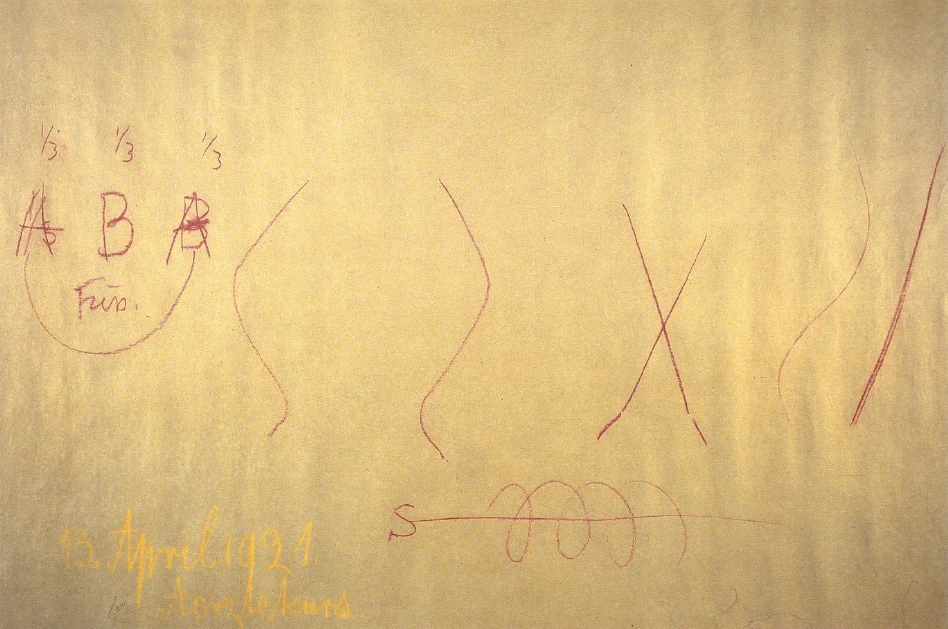
[ 22 ] Es ist notwendig, daß man dabei berücksichtigt das Verhältnis, das besteht zwischen der Bewegungsmöglichkeit, der inneren organisch bedingten Bewegungsmöglichkeit für den mittleren Menschen und den unteren Menschen. Die ist so, daß sich dasjenige, was man ausführt für den unteren Menschen, also solch eine Bewegung, daß sich 3Im Stenogramm «daß man dieses ...», hier wurde entsprechend dem Satzanfang geändert in «daß sich dieses». dieses nur in Drittelstärke ausführen läßt. Also so daß Sie, wenn Sie jemanden die O-Bewegung, wie wir sie gesehen haben, ausführen lassen, so müssen Sie dann das Gefühl haben, daß, was Sie etwa hinterher machen lassen für die Füße und Beine, daß das nur ein Drittel der Zeit nimmt, also ein Drittels-Kraftaufwand ist, möchte ich sagen. Besonders wirksam wird es aber sein, wenn Sie es in die Mitte hinein verlegen, so daß Sie ein Drittel, ein Drittel, ein Drittel haben, so daß Sie also haben, sagen wir A und dann noch einmal A, und in der Mitte B, die Fußbewegung hinein (siehe Schema) und Sie zusammen haben ein Drittel, ein Drittel, ein Drittel, das wird von besonderer Wirksamkeit sein.
[ 22 ] It is necessary to take into account the relationship that exists between the capacity for movement—the inner, organically determined capacity for movement—of the average human being and that of the lower human being. This relationship is such that what is performed for the lower human—that is, a movement such that 3In the stenographic transcript, “that one performs this …”; here, in accordance with the beginning of the sentence, it was changed to “that this.” this can only be performed at one-third strength. So that when you have someone perform the O-movement as we have seen it, you must then have the sense that whatever you have them do afterward for the feet and legs takes only one-third of the time—that is, requires one-third of the effort, I would say. However, it will be particularly effective if you place it in the middle, so that you have one-third, one-third, one-third—that is, let’s say A, then A again, and in the middle B, the foot movement (see diagram)—and together you have one-third, one-third, one-third; this will be especially effective.

[ 23 ] Von besonderer Wirksamkeit ist aber auch, dasselbe auszuführen im Zusammenhang mit der gezeigten E-Bewegung für die Füße, wo Sie die Füße richtig übereinanderlegen. Aber man muß auf den Zehenspitzen stehen und die Beine übereinanderlegen, so daß sich die Beine berühren. Wiederum ein Drittel und womöglich in die Mitte verlegen. Das ist etwas, was ganz besonders gut ausgeführt werden sollte bei Kindern und auch bei erwachsenen Personen, die Schwächlinge sind. Sie werden es natürlich um so weniger machen können, aber das ist gerade das, worauf es ankommt, daß sie es eben lernen zu machen. Und gerade bei diesen Dingen sieht man, daß für die verschiedenen Menschen dasjenige am wichtigsten ist zu lernen, was sie am allerwenigsten können. Das müssen sie dann lernen, weil es eben gerade zu ihrer Gesundung notwendig ist.
[ 23 ] It is also particularly effective to perform this exercise in conjunction with the E-movement shown for the feet, where you properly cross your feet over each other. But you must stand on your tiptoes and cross your legs so that they touch. Again, shift one-third of your weight—and if possible, shift it toward the center. This is something that should be practiced especially well with children and also with adults who are physically weak. Of course, they will find it all the more difficult to do, but that is precisely the point—that they learn to do it. And it is precisely with these things that one sees that, for different people, the most important thing to learn is what they are least able to do. They must learn this because it is precisely what is necessary for their recovery.

[ 24 ] Das A ist ebenfalls notwendig, das habe ich Ihnen schon gestern gezeigt. Das besteht eben darinnen, daß man, sich womöglich auf die Zehen stellend, diese gespreizte Stellung einnimmt. Das soll ebenfalls in die ABewegung eingeführt werden und wird da ganz besonders günstig wirken.
[ 24 ] A is also necessary; I already showed you that yesterday. It simply consists of assuming this spread-out position, standing on your toes if possible. This should also be incorporated into the A movement, where it will have a particularly beneficial effect.
[ 25 ] Nun kann man aber alle Bewegungen, die wir jetzt beschrieben haben, auch noch dadurch steigern, daß man sie im Gehen ausführen läßt. Und Sie werden zum Beispiel ganz besonders viel erreichen für ein Kind, das schwach ist, wenn Sie es anleiten, die E-Bewegung im Gehen auszuführen, wie wir sie jetzt gemacht haben, aber so, wie wir sie jetzt gemacht haben, im Gehen auszuführen, aber außerdem es so gehen lassen, daß es sich abwechselnd immer berührt. Indem es vorschreitet, nimmt es das [eine Bein] herüber, dann das [andere], so daß es immer ein Bein über das andere stellt, so daß es immer das Zurückliegende 4«Zurückliegende» unklar im Stenogramm, könnte auch als «Zurückgehende» gelesen werden. mit dem andern nach vorwärts berührt. Es wird natürlich nicht gut vorwärtskommen; aber es ist doch dasjenige, was gut ist, ausführen zu lassen, also dieselben Bewegungen im Gehen auszuführen. Sie werden sagen, es kommen komplizierte Bewegungen dabei zum Vorschein; aber es ist gut, wenn solche komplizierten Bewegungen zum Vorschein kommen.
[ 25 ] However, all the movements we have just described can be further enhanced by having the child perform them while walking. And, for example, you will achieve particularly good results with a child who is weak if you instruct them to perform the E-movement while walking, just as we have just done—but not only that—and also have them walk in such a way that they alternately touch the ground with each foot. As it moves forward, it brings [one leg] across, then the [other], so that it always places one leg over the other, so that it always touches the one behind 4“Behind” is unclear in the stenographic transcript; could also be read as “returning.” with the other one touching the ground in front. Of course, it won’t move forward very well; but it is still good to have them perform these movements—that is, to carry out the same movements while walking. You will say that complicated movements emerge in the process; but it is good when such complicated movements emerge.
[ 26 ] Nun möchte ich Sie noch darauf aufmerksam machen, daß dasjenige, was wir jetzt über das Vokalische gesagt haben, zunächst recht scharf gesondert werden soll von demjenigen, was wir morgen über das Konsonantische üben werden. Das Konsonantische, das ist im allgemeinen so, daß es das Äußere ausdrückt, wie wir schon gesagt haben. Der Konsonant wird ja auch in der Sprache so geformt, daß sich Lippen, Zunge namentlich, in einer solchen Weise formen, daß da eine Nachbildung, eine Imitation der äußeren Form vorliegt. Nun, das Konsonantische hat ja, wie wir morgen auch sehen werden, dann ganz besondere Arten von Bewegungen, und in diesen Bewegungsformen liegt es schon, daß der Konsonant in einer gewissen Weise wiederum verinnerlicht wird, indem er in eurythmischen Formen gegeben wird. Er wird verinnerlicht. Es wird dasjenige, was er in der Sprache auf dem Wege nach außen verloren hat, das wird ihm wiedergegeben, und beim Konsonanten, sowohl beim Anschauen, indem man Eurythmie als Kunst nimmt, wie namentlich wenn sie ausgeführt wird zum Zwecke der Person, wenn man sie ausführen läßt beim Konsonanten, ist es ganz besonders wichtig, daß man nun nicht etwa in derselben Weise wie beim Vokal ein Gefühl, also das Streckgefühl, das Biegegefühl, das Weitegefühl hat, sondern daß man beim Konsonanten gleichzeitig sich selbst in der Form vorstellt, die man ausführt, wenn man den Konsonanten macht, also wenn man sich gewissermaßen selber zuschaut.
[ 26 ] Now I would like to point out to you that what we have just said about vowels should, for the time being, be kept quite distinct from what we will be practicing tomorrow regarding consonants. Consonants, as is generally the case, express the external form, as we have already said. After all, consonants are formed in speech in such a way that the lips—and especially the tongue—are shaped to create a reproduction, an imitation, of the external form. Now, as we will also see tomorrow, the consonantal has very specific types of movements, and it is inherent in these forms of movement that the consonant is, in a certain sense, internalized once again as it is expressed in eurythmic forms. It is internalized. What it has lost on its way outward in speech is restored to it; and with the consonant—both when observing it, by taking eurythmy as an art, and especially when it is performed for the sake of the individual, when one has it performed for the consonant—it is particularly important not to have, as with the vowel, a sensation—that is, the sensation of stretching, the sense of bending, or the sense of expansiveness, but rather that, with the consonant, one simultaneously creates a mental image of oneself in the form one is performing when making the consonant—that is, when one, so to speak, watches oneself.
[ 27 ] Hier sehen Sie am allerdeutlichsten, daß man die Kunsteurythmisten ermahnen muß, nicht beide Dinge durcheinanderzuwerfen; denn die Kunsteurythmisten, die werden nicht gut tun, sich immer zuzuschauen, da werden sie sich die Unbefangenheit nehmen und so weiter. Dagegen, wenn Sie ein Kind oder eine erwachsene Person Konsonantisches ausführen lassen, so ist es wichtig, daß sie sich gewissermaßen mit dem Gedanken innerlich selbst abphotographiert; denn darinnen liegt das Wirksame, daß sie sich innerlich selbst abphotographiert, daß sie sich also gerade in der Stellung darinnen richtig innerlich sieht, die sie ausführt, und wenn das wirklich so ausgeführt wird, daß die Person eine innerliche Anschauung hat von dem, was sie ausführt.
[ 27 ] Here you can see most clearly that artistic eurythmists must be reminded not to confuse the two things; for artistic eurythmists would do well not to watch themselves all the time, as this would rob them of their naturalness, and so on. On the other hand, when you have a child or an adult perform a consonant movement, it is important that they, so to speak, take an inner “photograph” of themselves with their thoughts; for therein lies the effective power: that they mentally “photograph” themselves, that they thus truly see themselves inwardly in the very posture they are performing, and when this is truly done in such a way that the person has an inner vision of what they are performing.
[ 28 ] Also, wenn Sie noch so gut sind, vielleicht uns vorzuführen, sagen wir ein M konsonantisch zuerst mit der rechten Hand, jetzt mit der linken Hand, aber das zurücknehmend, jetzt die rechte Hand ganz zurücknehmend, mit der linken Hand ein M machen, jetzt mit beiden Händen - das kann natürlich wiederum vermannigfaltigt werden in vielfacher Weise. (Fräulein Wolfram): Nun ein M - gehen wir von diesem Beispiel aus, ein M, was ist es denn zunächst sprachlich? Sprachlich ist das M ein außerordentlich wichtiger Laut. Sie werden ihn sprachlich empfinden in seiner Wichtigkeit, auch sprachphysiologisch in seiner Wichtigkeit empfinden, wenn Sie ihn im Gegensatz betrachten zu dem S. Vielleicht macht uns Frau Baumann jetzt ein graziöses S, rechts, links, jetzt mit beiden Händen.
[ 28 ] So, if you’d be so kind as to demonstrate for us—let’s say an “M” as a consonant, first with your right hand, now with your left hand, but pulling it back—now pulling your right hand all the way back, making an “M” with your left hand, now with both hands—this, of course, can be varied in many different ways. (Miss Wolfram): Now, an “M”—let’s take this example: an “M.” What is it, first of all, from a linguistic perspective? Linguistically, the “M” is an extraordinarily important sound. You will perceive its importance linguistically, and also from a speech-physiological perspective, when you contrast it with the “S.” Perhaps Ms. Baumann will now demonstrate a graceful “S” for us—right, left, and now with both hands.
[ 29 ] Nun ist ja scheinbar zunächst das so, daß, wenn das $ ausgeführt wird, Sie das Gefühl haben werden oder haben müssen, daß Sie sich selbst mit etwas in Ihnen - es ist nämlich der Ätherleib - daß Sie sich mit etwas in Ihnen so bewegen (R. Steiner macht die Bewegung), eine Schlangenlinie haben. Diese Schlangenlinie, die darf bei einem besonders scharf ausgesprochenen S sich der Geraden sehr nähern und kann sogar als Gerade vorgestellt werden.
[ 29 ] Now, it seems that at first, when the $ is performed, you will have—or must have—the feeling that you yourself, together with something within you—namely, the etheric body—are moving in a serpentine line (R. Steiner demonstrates the movement). This serpentine line may, when the “S” is pronounced particularly sharply, come very close to a straight line and can even be imagined as a straight line in the form of a mental image.

[ 30 ] Dagegen, wenn Sie sich anschauen das M, welches eben ausgeführt worden ist, so müssen Sie das Gefühl haben, das ist eigentlich - wenn auch die organische Form, in der das ausgeführt wird, [ähnlich ist] - nicht genau dasselbe Element, nicht linienhaft dasselbe. Und so ist dann das M dasjenige, was sich, angelegt an die S-Richtung, sich entgegenlebt der S-Richtung, und das ist im Grunde genommen, sehen Sie, der große Gegensatz zwischen einem $ und einem M. Ein $ und ein M, das sind die zwei polarischen Laute.
[ 30 ] On the other hand, if you look at the M that has just been drawn, you must have the feeling that it is actually—even though the organic form in which it is drawn is [similar]—not exactly the same element, not linearly the same. And so the M is the one that, aligned with the S-direction, moves in opposition to the S-direction, and that is, you see, essentially the great contrast between a $ and an M. A $ and an M—these are the two polar sounds.
[ 31 ] Das S, das ist- wenn ich mich jetzt anthroposophisch ausdrücken darf — das S ist der eigentlich ahrimanische Laut, und das M ist dasjenige, was das Ahrimanische in seiner Eigenschaft mildert, abmildert, was ihm, wenn ich es so sagen darf, seine ahrimanische Stärke nimmt, das M. So daß, wenn wir unmittelbar einen Lautzusammenhang haben, in dem S und M sich finden, wie zum Beispiel wenn wir den Lautzusammenhang «Samen» haben oder gar «Summe», dann haben wir in diesem Lautzusammenhang zuerst das stark ahrimanische Wesen im S, aber dann ihm die Spitze genommen im M.
[ 31 ] The S—if I may express myself in anthroposophical terms—is the truly Ahrimanic sound, and the M is that which tempers and mitigates the Ahrimanic in its nature, which, if I may put it that way, robs it of its Ahrimanic strength, the M. So that when we have a direct sound combination in which S and M occur together—as, for example, in the word “Samen” (seed) or even “Summe” (sum)—we first have the strongly Ahrimanic essence in the S, but then the M takes the edge off it.

[ 32 ] Vielleicht machen Sie uns noch ein H (Fräulein Wolfram). Wenn Sie das H nun richtig anschauen, wenn Sie sich so recht drinnen fühlen in diesem H, dann werden Sie sich sagen: In diesem H liegt etwas, was unmittelbar luziferisch sich ausnimmt. Es ist also das Luziferische in dem H, das da zum Ausdrucke kommt. Und nun versuchen Sie selbst jetzt anzuschauen — hier kommt es weniger auf das Fühlen als auf das Anschauen an -, versuchen Sie selbst jetzt anzuschauen, wenn Frau Baumann uns das jetzt machen würde, wenn man das H macht und es gleich übergehen läßt jetzt in ein M. Machen Sie das H zuerst und lassen Sie es langsam übergehen in ein M. Nun sehen Sie das einmal an.
[ 32 ] Perhaps you could draw another H for us (Miss Wolfram). If you look closely at this H—if you really immerse yourself in it—you will say to yourself: There is something in this H that appears to be directly Luciferic. It is, therefore, the Luciferic element in the H that comes to expression here. And now try to look at it yourself—here it’s less about feeling than about looking—try to look at it yourself: if Ms. Baumann were to do this for us now, if you were to draw the H and let it gradually transition into an M. Draw the H first and let it slowly transition into an M. Now take a look at that.
[ 33 ] Da haben Sie die ganze Anschauung des Luziferischen abgemildert, ihm die Spitze genommen, in dieser Bewegung zum Ausdrucke gebracht. Diese Bewegung ist wirklich so, wie wenn man den Luzifer aufhalten würde. Es ist richtig so, wie wenn man den Luzifer aufhalten würde. Und es ist das ja für Sie auch hörbar, wenn Sie sich einfach darauf besinnen - der heutige Zivilisationsmensch kann sich eigentlich gar nicht mehr recht auf diese Dinge besinnen -, aber wenn Sie sich darauf besinnen: Wenn jemand zu etwas Luziferischem zustimmen will, aber das richtige Luziferische, das Eifrige des Zustimmens gleich herabmindert, so macht er «Hm, hm»; da haben Sie das H und das M eigentlich recht sehr aneinandergelegt, und da haben Sie die ganze Liebenswürdigkeit des herabstimmenden Luziferischen unmittelbar drinnen.
[ 33 ] There you have softened the entire image of the Luciferic, taken the edge off it, and brought it to expression in this movement. This movement is truly as if one were holding Lucifer back. It’s exactly as if you were holding Lucifer back. And you can actually hear it, too, if you just reflect on it—people in today’s civilization can’t really reflect on these things properly anymore—but if you do reflect on it: When someone wants to agree to something Luciferic, but immediately tones down the true Luciferic element—the eagerness of the agreement—they say, “Hm, hm”; there you have the ‘H’ and the ‘M’ placed quite close together, and there you have the entire amiability of the moderating Luciferic element right there within it.
[ 34 ] Daraus sehen Sie, daß, sobald man ins Konsonantische übergeht, man übergehen muß zugleich in das Anschauen der Form. Das ist das Wichtige, und davon wollen wir also morgen weiterreden.
[ 34 ] From this you can see that, as soon as one moves on to consonants, one must at the same time begin to observe their form. That is the important point, and so we will continue discussing it tomorrow.