

Therapeutic Eurythmy
GA 315
13 April 1921, Dornach
Translated by Steiner Online Library
Second Lecture
[ 1 ] Today I intend to discuss with you the principle of vowels in eurythmy. We need only recall, as we know from Spiritual Science, that vowels actually express more what lives within a person—feelings, emotions, and so on. Consonants, on the other hand, express more what is outwardly concrete. So if we remain within the realm of language, these two statements hold true: Vowels are more an expression, more a revelation of the inner world of feelings; in a sense, we reveal ourselves through the vowel—that is, what we perceive about an object, what we feel about an object. Consonants, through the movements performed by the tongue, lips, palate, and so on, adapt more vividly to the external form of objects—which, of course, are then perceived mentally—and attempt to reproduce them. Thus, fundamentally, all consonants are a reproduction of the external form of things. However, one can really only speak of vowels and consonants in this way if one keeps in mind an earlier stage of human development—a stage in which the development of language was actually taking place, and in which the movement of the entire [body], that is, of the body’s limbs, was a matter of course; a stage in which, so to speak, the individual sounds were always connected to bodily movements. This connection has, of course, become looser in the course of human development. Speech has generally become more inwardly oriented, and the possibilities for movement—the expressive movements—have ceased; and in everyday life today, we speak without accompanying our speech much with the corresponding movements. In eurythmy, we now bring back the movements that once accompanied the vowels and consonants, and in this way set the body in motion once more. However, we must now bear in mind that, when speaking vowels, we omit the movement, so to speak, and internalize the entire vowel—which, in a sense, previously lived along with the external movement. We take something away from it on its path inward. We take away its movement. Therefore, with the vowel, what we have taken away from it on its path inward, we must give back to it in the outward movement. Thus, with the vowel, the situation is such that its outward movement is of extraordinary importance if we now wish to seek the transition from the effect of this vowel—expressed eurythmically—to the whole human being. This is what we must take into account.
[ 2 ] So when we speak today of vocalization, we are speaking purely of the meaning of what is vocalized through movement, through eurythmy. And it is very much a matter of gaining a sense of what, so to speak, flows into the movement. In other words, to develop a visual awareness of what is happening with the corresponding part of the human body—whether it is a stretching, a rounding, or something similar. One must definitely acquire a clear awareness of this. This is extremely important in vocalization: that one, so to speak, feels the movement or posture being performed. That is what is important. And starting from there, let us now bring individual vowels from eurythmy into the therapeutic context.
[ 3 ] Practical demonstration (Ms. Baumann): Form a clear “I” by stretching out both arms. This stretching should be performed in such a way that you then return [to the starting position] 1Previous editor’s notes referring to “resting position” have now been replaced with “starting position,” as Rudolf Steiner himself states in the instructions for the U-exercise. and then perform the same movement slightly lower, return again, and do both horizontally. Now we go back again, and if you were initially on the right in front, you now move downward to the right rear, then forward, then slightly back, and again slightly lower. Now I don’t want to bore you any further, but if you were to perform this, you could complicate it even more by taking even more positions—that is, by starting directly from the “I” position, moving back, going a little further, moving back again, going a little further, and so on—so that you have as many of these “I” positions as possible, which you perform from top to bottom, always returning [to the starting position]. If one were to perform these movements, they would represent the human person. The entire individual person is expressed through them.
[ 4 ] Now, for example, we might make the following observation: A child—or, for that matter, an adult—is unable to express themselves properly as a person. They are somehow prevented from expressing themselves as a fully developed individual. So, in a certain sense, they might be a dreamer or something of that sort. Or, if we consider a physical ailment in a child—let’s say the child cannot walk properly and walks clumsily—or if we observe in an adult that it would be desirable for them to learn to walk better for certain hygienic or therapeutic reasons, then this exercise will initially be of exceptional importance for that purpose. In adults, after all, if they have—let’s say—a stride that isn’t long enough, meaning they don’t take full strides, this actually always means that their blood circulation suffers as a result. Blood circulation suffers from a stride that is not wide enough. So when people walk like this (tripping along), it always results in blood circulation slowing down in some way more than it should for that particular individual. Then one must try to help this person learn to take longer strides, but one will achieve a sure result by having them do this exercise. Then they’ll simply have greater and more significant success in learning to walk properly. So one can say that this modified “I” exercise is essentially beneficial for people who—well, to put it somewhat radically—can’t walk properly. That’s roughly how one can describe it for people who can’t walk properly.
[ 5 ] Now, however, you can take this exercise even further, and it will be just as useful if you add, so to speak, a summary of what Ms. Baumann has just done. Now try to do this entire “I” exercise—without bringing your arms back [to the starting position]—in such a way that you achieve the final position simply by rotating: rotating in the plane, quickly, faster, even faster. - So that would be the way to take this “I” exercise—which was first done as we described—and build upon it, and that would lead to the result of helping people who cannot walk properly. It will then be extremely easy to get them to walk properly. You can also remind them to walk properly, and this process of learning to walk differently will yield corresponding success.
[ 6 ] Now Ms. Baumann will be so kind as to demonstrate a U-exercise for us. Up quite high, arms back, return to the starting position, now a little lower, back again, a little lower, now horizontal, now back again, now down, now back again, further down; that’s the principle. And now do it this way: start at the top and, as you move down—let’s call it a “U”—move up and down, and do it faster and faster until you’re moving at a good pace by the end.
[ 7 ] I would ask that we now consider this as the execution 2In the transcript, “Ausführung” is written here as “Ausbewegung,” but this could be a mishearing. of the U-movement. And this is—if I were to summarize it now in the same way I did earlier—the movement for children or adults who cannot stand. With the “I,” we had: those who cannot walk; with the “U”: those who cannot stand.
[ 8 ] Well, being unable to stand means having weak legs and tiring very easily while standing. It also means, for example, being unable to stand on one’s toes for a sufficiently long time, or being unable to stand on one’s heels for a sufficiently long time without immediately becoming unsteady. These exercises must, of course, be done by people—being able to stand on one’s tiptoes and on one’s heels are not eurythmy exercises—but they must be done by people who are unsteady on their feet, who tire easily while standing, or who cannot stand properly at all. Not being able to stand properly also means getting tired while walking. — So please, this must be distinguished technically: it is one thing to walk clumsily and another to get tired while walking. If one gets tired while walking, then this is the U-exercise. Being clumsy while walking—or, due to one’s entire constitution, finding it desirable to learn to take longer strides—means, technically speaking, not being able to walk. But getting tired while walking—that, technically speaking, means not being able to stand. And for such people, this U-exercise is precisely what is needed. This is related to matters that we will discuss in more detail once we have made further progress.
[ 9 ] If you would be so kind as to do an “O” movement now—all the way up, back to the starting position, then a little further down, back again, further down, and so on. But now do it this way: make the “O” movement upward, but do it correctly—that is, feel the curve of your arms as you glide downward. As you glide downward with the “O” movement, the “O” shape must remain. Now go faster and faster.
[ 10 ] Well, you would see this movement in its most brilliant application, my friends, if you had a truly overweight person standing here before you right now. So if a child becomes unnaturally overweight—or even an adult—then this is the exercise that must be used. It is all part of the eurythmic “O”—when it is performed continuously, by doing it so often, and by ultimately expanding it, as it were, into this barrel-shaped form here—for it is, after all, a barrel that one traces, that one traces outside of oneself— this actually accomplishes the very opposite of those dynamic tendencies that cause people to gain weight. It is something that can therefore be applied very effectively for hygienic and therapeutic purposes, and you will likely find that when you have such people perform this movement, a tendency to become thinner does indeed emerge, especially if you also have them perform other exercises that we will discuss later. But at the same time, it is important—and this is particularly significant with this specific movement—that you have the person perform the movement for just long enough so that they do not sweat too heavily or become too warm. So you really must try to have them perform this movement in such a way that they are always allowed to rest in between, if you want to achieve the desired result.
[ 11 ] Now, perhaps Ms. Baumann would be so kind as to make an “E” motion for us, quite high up. It’s only an “E” movement when this is positioned over it so that they touch. Now go back [to the starting position], a little lower, your right hand over your left arm, but then—to make it really effective—we’ll do it so that we perform it with a more backward motion, and now again from top to bottom; because the “E” must be done thoroughly. And then we perform one movement by guiding it downward, and the other movement by guiding it downward—that is, further back—until you tear the sleeve seam at the back. Now, this movement is the one that will be particularly beneficial for the frail—that is, for the thin rather than the overweight—for those whose frailty truly comes from within but is organically caused. It must be organically caused.
[ 12 ] Now, the other exercise—which can be considered in parallel with this one—must be practiced with some caution, since it focuses more on the psychological aspect, and it is as follows: When you trace an “E” backward as best you can, and now bring it in as far as3In earlier editions, “upward,” but in the shorthand notes it clearly says “inward” you can. That really hurts. It’s a movement that, in and of itself, hurts a little—and that’s the whole point. And this should be performed with those children or adults who have psychological reasons for becoming thin, emaciated, and the like. Since it is generally the case that one must be cautious about approaching people from the outside with healing methods—approaching them from the outside with such spiritual means—this, of course, must also be applied with caution. This means, then, that one must also try to apply moral influences to a despondent child or a depressed child—or one showing signs of depression—and so on, when having them perform these exercises. However, if one otherwise engages with the child by comforting them through emotional care, then one can also have them perform these exercises.
[ 13 ] You can see from this that, in a sense, all these things hinge on expanding, in a certain way, what is expressed in eurythmy as an art. This applies in particular to the vocal aspect.
[ 14 ] Now it is very important that we understand the following clearly. You know, then, that the vocal aspect can be developed in this way, and it is essentially an expression of the inner self. However, one must have an intuitive, visual understanding of what is happening there. So, with the person who is then asked to perform these exercises for healing purposes, one must be very careful to ensure that they feel the movements—that is, with the “E,” they must truly feel one limb covering the other. With the “O,” however, there is something else to consider. With the “O,” one should not only feel this closing of the circle but also feel the bending. One should therefore feel that one is forming a circle. In other words, one should feel the circle that passes through there. And if the © is to be made particularly effective, then one should draw the attention of the person performing it to the fact that they should also feel as if they themselves—or someone else—were making a stroke along their sternum, so that, in a sense, the whole movement is mentally completed backward through the sensation; that is, as if one were feeling something like this: as if one were making a stroke on one’s own sternum—or as if someone else were making a stroke on it.
[ 15 ] Now let's do an A: First, go back [to the starting position], then do a low A, go back, do a horizontal A, go back, do a lowered A, go back, do a very low A, go back, then move backward; you only need to do this once, but go back [to the starting position] first. And now make the A at the top and move down without changing the angle; now, without feeling like you’re changing the angle, move backward.
[ 16 ] This exercise can actually only be effective if it is performed quite often. So have them perform it quite often. And if you have them perform it quite often, then it is the exercise you should use with people who are greedy, those in whom the animal nature is particularly strong. So, for example, if you have a child at school who is really just a little animal in every respect—and this is due to organic causes—and you have them perform this exercise, you will see that it has a very special significance for this child.
[ 17 ] These exercises—as you can see from them—require that, if they are to be introduced in a school setting, the children be divided into special groups for this purpose; and you will also find that the children are far less eager to do these exercises than they are to do the usual eurythmy exercises. They eagerly participate in the eurythmy exercises, but with these exercises, you will most likely have to coax them quite a bit; for at first they will react to them much as children often react to taking medicine. They won’t really enjoy them, but that doesn’t actually do much harm for the exercises based on the letters U, O, E, and A; with the letter I, however, it does some harm if the children don’t enjoy it. So we must try to ensure that this I exercise, as we have done it, is fun for the children. With the others, if they perform them out of a sense of duty and know they are supposed to do them as required, it doesn’t really matter for the U, O, E, and A. With the I, however, it’s important that the children have fun doing it, because, as I’ve already said, this affects the whole individual person.
[ 18 ] You will benefit from this if you, for example, keep the following in mind: The “I” reveals the human being as a person, the “U” reveals the human being as a human being, the “O” reveals the human being as a soul, the “E” anchors the “I” in the etheric body—it imprints the “I” very strongly into the etheric body—and the “A” counteracts the animal nature within the human being.
[ 19 ] The task now is to explore these various effects even further. If you have a person who breathes irregularly, is somehow bothered by their breathing, and so on, then by applying this vocalization technique, you will help that person achieve a certain normalization of their breathing. In particular, however, through these exercises, you will find that this vocalization is of great benefit for the pronunciation—the clear pronunciation—of consonants. So if, as early as possible, you notice that children are unable to form certain consonants with their lips or tongue—it is less applicable to palatal sounds, but exceptionally effective for labial and lingual sounds—if you try to have children who have difficulty with this articulation perform such vowel exercises, this, in turn, is extremely beneficial for them.
[ 20 ] However, you will also notice that if people are prone to chronic headaches or migraine-like conditions, they will experience significant relief precisely through this vocalization. So even in cases of chronic headaches and chronic migraine symptoms, as well as a feeling of heaviness in the head, these techniques will be particularly effective. Likewise, the exercises we did today—which, when applied to certain children—for example, those who cannot concentrate at all or who are sleepy—will, in a sense, help to awaken these children. So this is a hygienic-didactic aspect that is of some importance. But even with adults, it may well prove possible that, if they are sleepyheads, they can be roused by these exercises. Then one will notice that if a person’s digestion is weak or sluggish, these exercises can effectively stimulate sluggish digestion—and, of course, all the associated issues—in a positive way.
[ 21 ] However, even in the context of a certain kind of hygienic eurythmy, it would be beneficial to try, if possible, to perform the movements—which in artistic eurythmy are actually carried out only with the arms—in a certain way with the legs as well, albeit more gently—I will speak more about this in a moment. Now you might ask, how can one make an “I” with the legs, for example? It’s very easy. All you need to do is extend the leg forward and feel the stretching within. The “U” would simply involve standing on both legs with full awareness, so that you have a distinct sensation of stretching in both legs. The “O,” however, should be learned using the legs. This consists of—and you should also teach people, if you deem it necessary, to perform the “O” movement in the way I have described—getting them accustomed to doing the “O” movement with their legs: turn the toes slightly outward—but only a little—and then try to stand in this manner. But stand on your tiptoes while doing this and bend outward slightly, hold the position for a moment, return to the normal stance, repeat the movement, and so on.
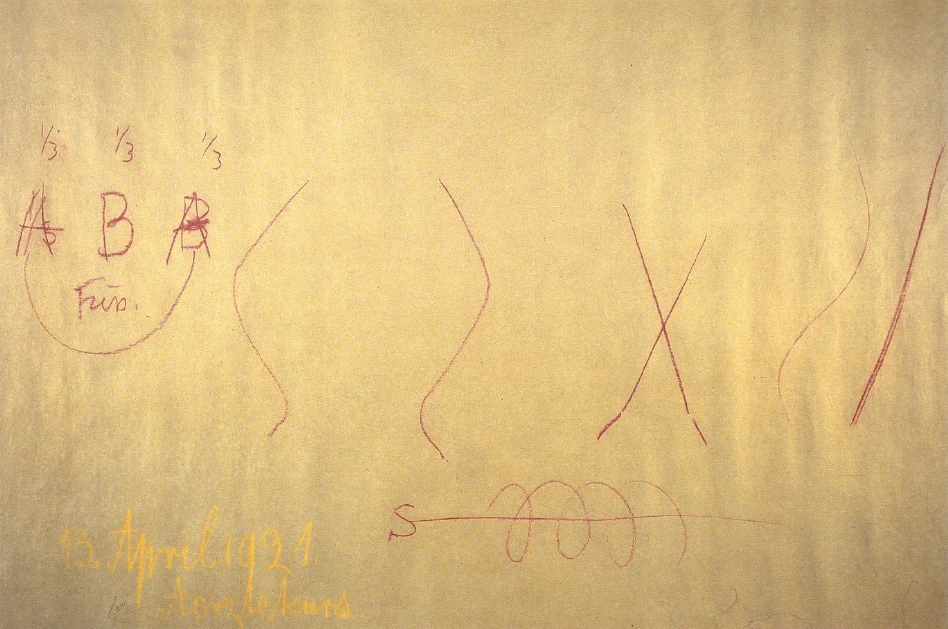
[ 22 ] It is necessary to take into account the relationship that exists between the capacity for movement—the inner, organically determined capacity for movement—of the average human being and that of the lower human being. This relationship is such that what is performed for the lower human—that is, a movement such that 3In the stenographic transcript, “that one performs this …”; here, in accordance with the beginning of the sentence, it was changed to “that this.” this can only be performed at one-third strength. So that when you have someone perform the O-movement as we have seen it, you must then have the sense that whatever you have them do afterward for the feet and legs takes only one-third of the time—that is, requires one-third of the effort, I would say. However, it will be particularly effective if you place it in the middle, so that you have one-third, one-third, one-third—that is, let’s say A, then A again, and in the middle B, the foot movement (see diagram)—and together you have one-third, one-third, one-third; this will be especially effective.

[ 23 ] It is also particularly effective to perform this exercise in conjunction with the E-movement shown for the feet, where you properly cross your feet over each other. But you must stand on your tiptoes and cross your legs so that they touch. Again, shift one-third of your weight—and if possible, shift it toward the center. This is something that should be practiced especially well with children and also with adults who are physically weak. Of course, they will find it all the more difficult to do, but that is precisely the point—that they learn to do it. And it is precisely with these things that one sees that, for different people, the most important thing to learn is what they are least able to do. They must learn this because it is precisely what is necessary for their recovery.

[ 24 ] A is also necessary; I already showed you that yesterday. It simply consists of assuming this spread-out position, standing on your toes if possible. This should also be incorporated into the A movement, where it will have a particularly beneficial effect.
[ 25 ] However, all the movements we have just described can be further enhanced by having the child perform them while walking. And, for example, you will achieve particularly good results with a child who is weak if you instruct them to perform the E-movement while walking, just as we have just done—but not only that—and also have them walk in such a way that they alternately touch the ground with each foot. As it moves forward, it brings [one leg] across, then the [other], so that it always places one leg over the other, so that it always touches the one behind 4“Behind” is unclear in the stenographic transcript; could also be read as “returning.” with the other one touching the ground in front. Of course, it won’t move forward very well; but it is still good to have them perform these movements—that is, to carry out the same movements while walking. You will say that complicated movements emerge in the process; but it is good when such complicated movements emerge.
[ 26 ] Now I would like to point out to you that what we have just said about vowels should, for the time being, be kept quite distinct from what we will be practicing tomorrow regarding consonants. Consonants, as is generally the case, express the external form, as we have already said. After all, consonants are formed in speech in such a way that the lips—and especially the tongue—are shaped to create a reproduction, an imitation, of the external form. Now, as we will also see tomorrow, the consonantal has very specific types of movements, and it is inherent in these forms of movement that the consonant is, in a certain sense, internalized once again as it is expressed in eurythmic forms. It is internalized. What it has lost on its way outward in speech is restored to it; and with the consonant—both when observing it, by taking eurythmy as an art, and especially when it is performed for the sake of the individual, when one has it performed for the consonant—it is particularly important not to have, as with the vowel, a sensation—that is, the sensation of stretching, the sense of bending, or the sense of expansiveness, but rather that, with the consonant, one simultaneously creates a mental image of oneself in the form one is performing when making the consonant—that is, when one, so to speak, watches oneself.
[ 27 ] Here you can see most clearly that artistic eurythmists must be reminded not to confuse the two things; for artistic eurythmists would do well not to watch themselves all the time, as this would rob them of their naturalness, and so on. On the other hand, when you have a child or an adult perform a consonant movement, it is important that they, so to speak, take an inner “photograph” of themselves with their thoughts; for therein lies the effective power: that they mentally “photograph” themselves, that they thus truly see themselves inwardly in the very posture they are performing, and when this is truly done in such a way that the person has an inner vision of what they are performing.
[ 28 ] So, if you’d be so kind as to demonstrate for us—let’s say an “M” as a consonant, first with your right hand, now with your left hand, but pulling it back—now pulling your right hand all the way back, making an “M” with your left hand, now with both hands—this, of course, can be varied in many different ways. (Miss Wolfram): Now, an “M”—let’s take this example: an “M.” What is it, first of all, from a linguistic perspective? Linguistically, the “M” is an extraordinarily important sound. You will perceive its importance linguistically, and also from a speech-physiological perspective, when you contrast it with the “S.” Perhaps Ms. Baumann will now demonstrate a graceful “S” for us—right, left, and now with both hands.
[ 29 ] Now, it seems that at first, when the $ is performed, you will have—or must have—the feeling that you yourself, together with something within you—namely, the etheric body—are moving in a serpentine line (R. Steiner demonstrates the movement). This serpentine line may, when the “S” is pronounced particularly sharply, come very close to a straight line and can even be imagined as a straight line in the form of a mental image.

[ 30 ] On the other hand, if you look at the M that has just been drawn, you must have the feeling that it is actually—even though the organic form in which it is drawn is [similar]—not exactly the same element, not linearly the same. And so the M is the one that, aligned with the S-direction, moves in opposition to the S-direction, and that is, you see, essentially the great contrast between a $ and an M. A $ and an M—these are the two polar sounds.
[ 31 ] The S—if I may express myself in anthroposophical terms—is the truly Ahrimanic sound, and the M is that which tempers and mitigates the Ahrimanic in its nature, which, if I may put it that way, robs it of its Ahrimanic strength, the M. So that when we have a direct sound combination in which S and M occur together—as, for example, in the word “Samen” (seed) or even “Summe” (sum)—we first have the strongly Ahrimanic essence in the S, but then the M takes the edge off it.

[ 32 ] Perhaps you could draw another H for us (Miss Wolfram). If you look closely at this H—if you really immerse yourself in it—you will say to yourself: There is something in this H that appears to be directly Luciferic. It is, therefore, the Luciferic element in the H that comes to expression here. And now try to look at it yourself—here it’s less about feeling than about looking—try to look at it yourself: if Ms. Baumann were to do this for us now, if you were to draw the H and let it gradually transition into an M. Draw the H first and let it slowly transition into an M. Now take a look at that.
[ 33 ] There you have softened the entire image of the Luciferic, taken the edge off it, and brought it to expression in this movement. This movement is truly as if one were holding Lucifer back. It’s exactly as if you were holding Lucifer back. And you can actually hear it, too, if you just reflect on it—people in today’s civilization can’t really reflect on these things properly anymore—but if you do reflect on it: When someone wants to agree to something Luciferic, but immediately tones down the true Luciferic element—the eagerness of the agreement—they say, “Hm, hm”; there you have the ‘H’ and the ‘M’ placed quite close together, and there you have the entire amiability of the moderating Luciferic element right there within it.
[ 34 ] From this you can see that, as soon as one moves on to consonants, one must at the same time begin to observe their form. That is the important point, and so we will continue discussing it tomorrow.