

Therapeutic Eurythmy
GA 315
14 April 1921, Dornach
Translated by Steiner Online Library
Third Lecture
[ 1 ] In order to make appropriate progress, we will now—building on the forms of consonant articulation—first lay the groundwork for some topics, so to speak, which we then intend to explore in greater depth from a physiological and psychological perspective tomorrow. Now, in what has been developed as a form of consonant articulation, full account is indeed taken of everything that comes into play when a person attempts to penetrate the external world through language. Anyone who wishes to observe language will see that a person’s engagement with the external world must consist in the fact that, in a certain sense, the person projects themselves very strongly outward into the external world, detaching themselves from their own being and living out into the external world. When vocalizing, they return to their own being; when vocalizing, they turn inward and unfold their activity there. When articulating consonants, they become, so to speak, one with the external world, but to varying degrees. And this becoming one with the external world to varying degrees is also clearly expressed in certain activities within speech. And, of course, in the training of eurythmic consonant articulation—especially in connection with this sensory-supersensory perception, of which I often speak in the introductions to eurythmic art performances—in this sensory -super-sensory vision—it must be carefully considered whether the person now completely objectifies themselves in order, so to speak, to grasp in the sound the spiritual that is outside in the things, or whether, despite this objectification, they remain more within and do not actually go out entirely, but rather still reproduce the external within themselves. There is a great difference here, and for this reason I would ask—perhaps Ms. Baumann would be so kind as to first demonstrate, let’s say, an “H” movement for us. And now, please, turn your gaze completely away from this “H” movement, and Ms. Baumann will now demonstrate an “F” movement. And now keep a close eye on what you can observe in these different movements—in these two distinct movements. You can observe there what you have within you, stemming from human instinct, in the act of pronouncing—or attempting to pronounce—the sound in question. Take the pronunciation of the H. In reality, you actually pronounce this H as “Ha”; in reality, you are pronouncing a vowel. After all, you cannot produce a consonant without it being tinged by a vowel. You are pronouncing an “A.” The pure consonant is vocalized. And if you now consider the “F,” you will see that, out of human speech instinct, an “E” is prefixed: “eF.” The opposite is done; an “E” is prefixed.
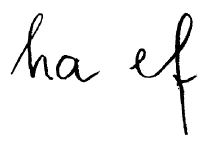
[ 2 ] From this you can see that when a person pronounces an “H,” they make a greater effort to seek out the spiritual through language in the external object outside; when they pronounce an “F,” they make a greater effort to sense the spiritual within. Therefore, the formation of consonants is quite different depending on whether one attempts to apply the vowel-like quality from the front or from the back—if I may put it that way in relation to consonant formation. And you will see this expressed in the form you have observed.
[ 3 ] Perhaps Miss Wolfram will go over the letter H again. So, H—here you have a strong reaching out into the outside world; one does not want to remain within oneself, but wants to go out to live in the external world. The F: You see the strong desire not to venture too eagerly into the outside world, but to remain within.
[ 4 ] Now, however, if one takes this into account, one will naturally begin to form a mental image—based on this—about certain elements that must already be incorporated into eurythmy; a mental image that was not yet necessary at first, as far as our practice of the art of eurythmy is concerned, but which will become necessary the more the art of eurythmy is extended to the various languages. For at the very moment when one says “Fi” instead of “eF,” at that very moment it is different; at that very moment one also attempts to encompass the outer world with this consonant, and this points to an important historical fact. In Greece—in ancient Greece—people sought to grasp the outer world even in such matters where modern man has already become inward-looking. You see how one can trace, all the way to the outermost reaches of human experience, what I have expressed, for example, in *The Riddles of Philosophy*—this reaching out of the human being and the grasping, in the external world, of that which modern people already experience entirely inwardly within the “I.” The reason why Spiritual Science is not accepted on the basis of such things is simply that people in our civilization are generally too lazy. They have to take too many things into account to arrive at the truth; they want to make it easier for themselves. But that simply isn’t possible. They would like to make it all easy for themselves; but that simply isn’t possible.
[ 5 ] Well, first of all, with regard to the one element that has been incorporated into the consonantization. Then there is something to consider if one wishes to grasp the consonantization as it relates to the field of eurythmy; there is something to consider that, I believe, is already given less attention in teaching today—and is also given less attention in physiology, particularly in the physiology of sound—than the third point, which we will come to shortly. To illustrate this, I ask you to make another comparison. The point here is to acquire a visual perception. Of course, one cannot go all the way to the end of what one does with that visual perception—into the concept itself.
[ 6 ] Perhaps Ms. Baumann would be so kind as to demonstrate the letter “H” for us again, and now, after letting that fade out, Ms. Baumann will demonstrate the letter “D.” You will need to pay attention to the following: When you look at the H, it has a movement that differs greatly from what initially occurs in speech; for, with regard to the quality I am now referring to, the eurythmic movement must be polar opposites to the actual process of speech. The process of speech—as you know, I demonstrated it the day before yesterday—is a reflection back from the larynx. The eurythmic process must express this outwardly. It expresses it through movement. In certain cases, one must definitely shift to a completely polarized approach. Now, what kind of sound is the H? The H is essentially a blowing sound. It is actually a blowing motion that produces the H. If one wants to express this through eurythmy—and the H is particularly characteristic in this regard; with the other consonants it must be toned down again, but with H and D, for example, it is especially characteristic—then where one must blow [when pronouncing it], there is a distinctly jerky effect in eurythmy. When you pronounce D, there is a jolting effect in the pronunciation. You must polarize this [in eurythmy] by transforming it into that distinctive movement that was present with the D. Thus, the jolting quality of speech is precisely dampened in the movements of the sound.
[ 7 ] So you see that, depending on whether you have blowing sounds or bursting sounds, it is precisely this characteristic that must be taken into special consideration. Now, sounds are not merely blowing sounds and bursting sounds. But what is it that makes sounds blowing sounds and bursting sounds? You see, when you have a pronounced blowing sound, the blowing expresses the fact that you want to push something out of yourself quite strongly; in the bursting sound, it expresses that it becomes difficult to let something go out of yourself, that you want to keep it inside. For this reason, the eurythmic interpretation of the sound must take place in the manner you have seen.
[ 8 ] But now there are also sounds that carefully connect the inner with the outer—sounds that are, physiologically speaking, such that one might say they bring to a standstill and halt that very activity in which one would actually like to engage, so that the inner immediately becomes the outer, so that one enters into the movement with one’s whole being. And this is particularly evident—in fact, clearly so in our language—in only a single sound, the R; but this is also why the R is the most comprehensive sound, because when one pronounces the R, one wants to follow along with every part—I would say—of the speech apparatus. With the R, one actually strives to bring this following motion to a rest. The lips want to follow through when they pronounce the lip R and bring that following motion to a rest; the tongue wants to follow through when it pronounces a tongue R; and finally, the palate wants to follow through when the palatal R sounds. These three Rs are clearly distinct from one another, yet they are also one, and they find expression in eurythmy (Ms. Baumann: R). So what is expressed is the setting in motion of that which is otherwise brought to a standstill. It is precisely this trailing-off of the sound movement that is expressed in this “R.” And if one wishes to express something else, one can distinguish the lip R by extending the movement further downward, the tongue R by making it more horizontal, and the palate R by directing it more upward. In this way, one can modify the R sound in eurythmic movement. But as you can see, its form comes about by allowing the trembling quality of the R to recede into the background and bringing its lingering quality more to the fore.
[ 9 ] A similar sound, but one in which the movement does not involve a tremor but rather a kind of wave, is the L (Miss Wolfram: L). So, as you can see, it contains something of the same movement as in the R, but it is a gentler coming to rest, a gentler grasping of the trailing sound; it is simply a wave, as opposed to a tremor, that is expressed here.
[ 10 ] That would be what relates internally—physiologically, I might say—to the vocalization of the consonantal sound and to the coloring—which is already shifting more toward the physical—that now involves emotion. Now, the most extreme classification of sounds, so to speak, is achieved by focusing on the organs, and there—by comparing the corresponding movements once again—we can develop, for the sake of illustration, what emerges as the most extreme classification principles, the most external classification principles. Namely, let’s take a B (Ms. Baumann: B) . That is a B, and now let’s immediately follow it with, say, a T. Well, you can see from the entire configuration—which must be taken into account as the third element and which also emerges quite clearly in sensory-supersensory perception—you can see from the entire configuration that in the B we are dealing with a labial sound, and in the T with a dental sound. (Miss Wolfram, please show us a K) K: It stems entirely from the position, and the main point lies in the movement. Here we are dealing with a palatal consonant, which is the calmest in pronunciation—in the articulation of the sound—but which must transition into movement, into its polar opposite in the external eurythmic expression. Now, the consonants overlap with regard to these characteristics; one classification extends into the other, and we can keep the following in mind as a kind of guide:
[ 11 ] Take the labial consonants; I’ll just list the most distinct ones, such as W, B, P, F, M. You can figure out to what extent vowel influence plays a role simply by pronouncing them. So I don’t need to specify that. Let’s now consider the dental consonants: D, T, S, Sch, L, to which we can also add the English Th and N. And let’s now consider the palatal consonants: G, K, Ch, and then this French one, such as Ng.
[ 12 ] And now we really ought to write the letter R everywhere, because it has its own nuance in every context [it is written on the blackboard]. 4Although the sounds were written on the board in lowercase letters, uppercase letters were used in the running text for better readability.
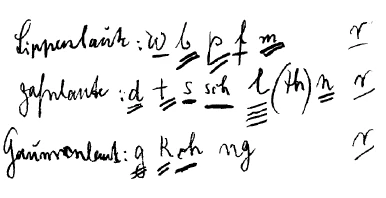
[ 13 ] Now, if you consider the other aspect of this classification, I will draw white lines underneath wherever we are dealing with a pronounced fricative: W, F, S, Sch, and perhaps also Ch. These would be pronounced fricatives. I’ll draw red lines underneath the ones where we’re dealing with pronounced plosive sounds: B, P, M, D, T, N—and since R is a vibrating sound, we could also include G and K. The vibrating sound is R; and as for a distinct wavy sound—which, in a certain sense, must be internal due to its smooth transition into movement—we are essentially dealing with only the L (yellow).
[ 14 ] These three principles of classification—vocalizing tinging, blowing, thrusting, trembling, undulating, and everything else that is in turn connected with this external classification [into dental, labial, and palatal sounds]—find expression in the forms used in eurythmy. Of course, you must be clear about how strongly these principles of classification, in turn, influence one another. So when we deal with the letter L, for example, we are dealing with a distinct dental sound, which must therefore possess all the characteristics of a dental sound; and then we are dealing with a gliding sound, a wavy sound, which must possess the characteristics of a wavy sound. But it is also very strongly connected to the inner self. So we are dealing—at least in our language—with a coloring from within. We do not say “Le,” but rather “eL,” and here, too, we see a transition from older forms, where—I would say—an external intervention was developed with great longing and thus came about very strongly, where one actually needed a word 2a word: lambda, the eleventh letter of the Greek alphabet. to express something like this, to truly convey this transition to the external realm. So, with the individual letters, we are indeed dealing with a representation of what is happening internally.
[ 15 ] Now, before we go through the individual consonants, let’s keep the following in mind: Yesterday, in connection with the letter A—and we have, after all, already studied its metamorphosis—we were able to point out that it is connected to all those forces within the human being that make him greedy, that orient him toward the animalistic. The “A” is, in fact, closest to the animal nature within the human being, and one can even say, in a certain sense, that when the “A” is pronounced, it resounds from the animal nature of the human being. And most certainly, the “A”—as confirmed by spiritual research—is a sound that appeared earliest in human beings, both in phylogenetic and ontogenetic development. In the latter—as you know, there is also such a thing as distorted development—in ontogenetic development, it is naturally somewhat concealed; but what first appeared in human evolution is the “A” sound, which still resonates entirely from the animal nature. And when we move from the “A” sound toward the consonants, we are still appealing to what constitutes the animal forces within human beings. As you saw yesterday, the entire sound is actually shaped around this. If we now use this sound therapeutically, just as it appeared before our souls yesterday, we are thereby combating that which turns children in particular—but also adults—into little animals, to a greater or lesser extent. And through such exercises aimed at liberating humanity from its animal nature, we can already, I would say, achieve quite a respectable result.
[ 16 ] And now let’s move on to the “u” sound, for example. As we said yesterday, this is the sound we use therapeutically when a person cannot stand. You saw this yesterday; it is the sound that, in a certain sense, already expresses this physiological-pathological relationship in its very formation—a relationship that is already expressed in its formation as a speech sound,1Literal transcription: ... which, already in its formation, expresses—and indeed, only as a speech sound in its formation—that ... that the “U” is indeed pronounced at the highest degree of closure of the mouth and the dental gaps, with the lips slightly protruding, but in such a way that the oral cavity is narrowed and the lips then vibrate. You can see from this that what is sought in the “U” is essentially an external movement during speech. The greatest effort is made to characterize the mobility involved in pronouncing the “U.” Therefore, in the eurythmic “U,” the physiological opposite occurs: the evocation of stability, which is then also present—at least to some extent—in the “U” 3According to the stenogram: in the artistic “U” in eurythmy. in artistic eurythmy.
[ 17 ] If you then consider the other vowels, you will see that we have a progressive internalization of the vowel. So when you consider the “O,” a pushing together—I would say—of the lips toward the front, a narrowing of the mouth opening, or at least an effort to narrow the mouth opening; this is counterbalanced by the encompassing quality inherent in the “O” movement during eurythmy. It is precisely in such things that one sees the natural connection of the matter. There are certainly certain forces at work in the linguistic use of the “O.” And in languages where the “O” is particularly prominent, people in those languages will have the greatest predisposition toward becoming stout. You can certainly regard this as a guideline for the study of linguistic-physiological processes.4Unclear in the stenographic transcript. Transcribed by Helene Finckh as “demands,” then crossed out with a question mark. Another possible reading would be “lecture studies.” If one were to develop a language consisting essentially only of modifications of the “O”—in which people would have to constantly perform the peculiar lip and mouth movements they make when pronouncing the “O”—then they would all become potbellied. If, on the one hand, we have this—I would say—tendency toward a potbelly when pronouncing the “O,” then it is easy to understand why the “O,” conversely, represents the counteraction of the potbelly when it is performed eurythmically and metamorphosed in the appropriate manner, as we did yesterday.
[ 18 ] The situation is different, for example, with E. A language that is particularly rich in E will produce frail people, weak individuals. And this, in turn, is connected to what I said yesterday about the treatment of frail individuals—that is, of weak people—in relation to the treatment of E. You will recall that I specifically said: in the case of frail individuals, the E movement, with its modification, must be applied in a very special way.
[ 19 ] There is, however, one thing to keep in mind regarding all these matters, namely this: If one looks at the forms from the outside, one will not arrive at the truth; one must grasp them internally in their process of becoming. One must therefore focus less on what is expressed outwardly and more on the tendency toward it. The tendency to become thick is what is counteracted by the “O,” and the tendency to remain thin is what is counteracted by the “E.” And one must draw attention to this precisely because, when eurythmy is used for healing purposes, one must focus more on the forces present in the upper human being that tend toward expansion, and on the forces present in the lower human being that tend more toward the linear. So I must say that when a person pronounces the “O,” they actually expand 5Stenogram is ambiguous: “expands” can also be read as “forms,” just as “the living” can be read as “the following.” the living.
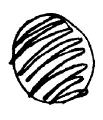
[ 20 ] You see, the human head—if I were to sketch it roughly—is, in a certain sense, a sphere, and from a perspective of Spiritual Science, it is also the true replica of the globe. It is a reflection of all the forces that are centralized in the globe, and in its development it is actually shaped by what lies in the lunar forces. But this shapes it in such a way that it becomes a kind of globe. This is, in fact, connected to cosmology and cosmogony. Just as the Earth phase emerged from the lunar phase, so too does the human head emerge from the moon-forming forces, which are so strongly active in the formation of the human head; the human head, which of course naturally strives to become a sphere, is modified in its spherical form only by the fact that the chest and the rest of the body are attached to it, thereby altering the spherical shape. If left to itself, the head would become a perfect sphere. But the fact that this is not the case stems from the fact that the other two members of human nature are connected to the head and influence its form.
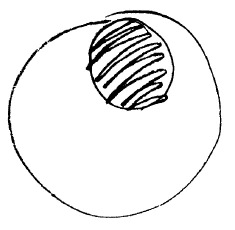
[ 21 ] When one pronounces “O,” one attempts to express throughout the entire etheric head that which finds expression in the spherical form of the head. And there one has the aspiration to form a second head. The person who pronounces “O” has the aspiration to actually form a second head [outer circle] (purple), and one can indeed say that in pronouncing “O,” the person swells up in the manner of a head; they swell up, they inflate themselves, and through this very act they awaken the forces that cause them to become plump at the other pole. These things should also be viewed figuratively. He is led to become thick-headed by inflating his own head. If one now wishes to counteract this tendency—if I may put it this way—to become, so to speak, an “ethereal thickhead”—that is, not a physically thick head, but to become an “ethereal thickhead,” meaning to become a “big head”—if one wishes to counteract this, one must try to round it out, to draw it back in on the other side. And that is the protest of the thickhead. It is therefore formed in an O-polar way. For the individual sounds all have a nuance of feeling that is, in turn, deeply rooted in the organism, since it lies in the unconscious, and hence the significance of the inner essence of the sounds. You see, the frog that would like to puff itself up into an ox—for those who view the matter in a truly supersensible way—is the one from whom, if it could realize itself, a cannon-like O-sound would constantly emanate. That is the peculiar thing: one simply must address such matters—I would say, to make them clear—if one wishes to understand these things inwardly.
[ 22 ] With E, it’s clearly the opposite. You see, with E, what’s actually at work is the human being’s desire to gather themselves inwardly, to draw themselves together inwardly. That’s why, in eurythmy, there’s this touching of oneself, this becoming aware of oneself: you simply perceive yourself when you place your right arm over your left. Just as when you perceive an object in the outside world—when you touch it—so you perceive yourself. This would be expressed even more clearly if you were to simply wrap your left hand around your right arm—in art, everything must be implied—but if you were to simply grasp it here, you would be touching yourself. This “touching oneself”—that is, the act of feeling oneself—is particularly expressed in the eurythmic letter E. And this “touching oneself,” this act of feeling oneself, is, after all, carried out throughout the entire human organism. And you can study this self-touching by simply examining the relationship where, on the human back, the nerve pathways manifest—those that are erroneously called “motor” in conventional physiology, and those called “sensory.” Where these motor pathways—which are, in essence, also sensory—meet the sensory pathways, a kind of embracing arises. The fact is that the nerve tracts actually form a continuous “E” along the human back, and that this formation of the “E” truly also constitutes the emergence of a person’s inner self-perception, which then becomes a reality only in the brain through differentiation. This formation of the “E,” which thus actually occurs on this plane—we attempted to recreate it yesterday. And you will see that what we tried to reenact yesterday directly suggests, in the external movement and in the posture, how the human being’s inner formation of the “E” actually culminates in the vertical. Just as the head puffs itself up, just as the head seeks to become a bubble-like angel, so this “E-becoming”—this gathering of the self into a point—summarizes itself in the vertical, in the line of height.
[ 23 ] But it is [a] continuous, successive contraction of superimposed E’s; and that truly expresses what becomes clearly evident when one observes weak individuals. They have a tendency to continually stretch their etheric body. They want to stretch it; they do not contract it into a single point, which would be the actual opposite of the activity of the head. That is not the case; rather, they try to stretch it, thereby carrying out the repetition of the point. And this stretching, which manifests itself precisely in people who are becoming weak—that is, not physical stretching, but stretching in the etheric body—it is this stretching that is counteracted by the formation of the E we spoke of yesterday.
[ 24 ] So, I think you can already see how there is an inner connection between what is present in eurythmy and human developmental tendencies, and how what is present within a person as developmental tendencies is truly drawn out of them. And it is indeed the case that these formative tendencies—which initially manifest in growth, in the shaping of the human being, in its physical development—specialize and localize themselves, in turn, in the development of the speech organism, this specific organism. There, in a sense, the formative tendencies—which are otherwise spread throughout the entire human being—are concentrated. In the training of eurythmy, we now move back again. We transition from the localized tendencies to the whole human being and thus, in contrast to the specialization of the human organization in the speech organism, introduce another specialization: the specialization in the will organism. For the whole human being—insofar as the whole human being is a metabolic organism and also a limb organism—one does, after all, move various parts of the head as well; thus, the head is also, in a certain sense, a limb organism. And this can even become evident in people who are somewhat more capable in this regard; isn’t that right? People who can move their ears and so on clearly demonstrate that the principle of movement—the principle of limb movement—can penetrate into the organization of the head—the whole human being, in this respect, is an expression of the volitional. We express this volitional aspect again when we move on to eurythmy. Now, before we continue tomorrow with the specific elaboration and development of the sounds, and subsequently with the combinations of sounds, I would like to mention one final historical point.
[ 25 ] You see, the development of human will and the development of human intellect are two aspects of human evolution that proceed at different speeds. In our time, the human intellect is developing rapidly, while the will is developing slowly. As a result, as participants in the overall development of humanity, we have already surpassed the will with our intellect. This is a general phenomenon of civilization: that with the development of our intellect, we have surpassed the development of the will. People today are very intellectually developed, which does not, however, prove that they know how to make good use of their intellect. They are indeed very intellectually developed, but they do not know how to make good use of it; that is why they know so little intellectually. Yet what they do know intellectually, they regard as if they were acting upon it with a certain degree of certainty. The will develops slowly. And eurythmy is, first and foremost—aside from everything else—an attempt to reintroduce the will into the entire development of humanity. And when eurythmy is applied therapeutically, we must point out the following. We must say: The overdevelopment of the intellect is also expressed particularly in the organic side effects of speech development. Our development of language is, in fact, already something in our modern civilization that becomes inhuman through its superhuman nature, in that we learn languages today in such a way that we have so little—or rather, no longer have—a feeling for, a living sense of, what lies within the words. Words are, after all, really just symbols. What sense do people still have of what lies within a word? I would like to know how many people go through the world and notice that, for example, specifically when learning the German language, the form of rounding—which I have just described—is present in the word “Kopf” (head), which is related to “Kohl” (cabbage), hence the term “Kohlkopf” (cabbage head), which is actually just a retouching; one undergoes a metamorphosis in connection with this rounding. That is expressed there. In Romance languages—“testa,” “testieren”—this is expressed more from within: the soul’s activity through the head. People no longer have a sense of this difference in what lies within the language; language has become abstract. When you walk, you walk on your feet. Why do we say “feet”? Well, you see, this is a metamorphosis of the word “furrow,” and it arose from the observation that walking implies the making of a furrow. The imagery inherent in language has been completely lost; and if one wishes to reintroduce this imagery into language, then one must turn to eurythmy.
[ 26 ] Now, every word is actually—I am now stating a fact that finds expression in the more subtle human organism; I am expressing it in crude terms, but we have only crude words at our disposal—every word that is experienced without imagery is actually an internal cause of illness. And one can say: Today’s civilized humanity suffers chronically from what the learning of abstract speech—the loss of a pictorial sense of words—brings about within it. — This goes very far; above all, it goes so far that this accompanying organic symptom manifests itself in a very strong tendency toward the loss of rhythm in the rhythmic system and a refusal of the forces of metabolism on the part of the person who has made their language abstract. And the fact is that one can indeed counteract what is being ruined in people today by language—by language, which is, after all, acquired in early childhood and which, when acquired in a non-imaginative way, truly gives rise to conditions that later manifest themselves in all manner of disease forms, conditions that can, however, be combated through therapeutic eurythmy. Thus, therapeutic eurythmy can be integrated quite organically into the therapeutic treatment as a whole.
[ 27 ] It is certainly true that anyone who understands that spiritual development is, in fact, always accompanied by a certain degree of “illness”—we must accept this fact: that illness is part of spiritual development—must also be mindful that this “illness” caused by civilization is not combated solely through external, physical studies, but also through external means. We infuse the movements of eurythmy with soul and spirit, and in this way we can counteract what, on the other hand, the soul and spirit do of their own accord—but often, in tender childhood, in such a way that the effect of their actions, when it persists into later life, is perceived as a cause of illness. That is what I wanted to say today.