

Therapeutic Eurythmy
GA 315
12 April 1921, Dornach
Translated by Steiner Online Library
First Lecture
[ 1 ] With these afternoon sessions, I would like to hint at—as it were—the first seeds of a kind of therapeutic eurythmy. We will begin with a sort of introduction today, and then, over the next few days, we will develop what we gain from this into specific forms. I would like to make a few fundamental remarks first. What has been practiced as eurythmy up to now is eurythmy as an art; and as an eurythmic art, it is at the same time what must also be accepted by pedagogy and didactics as eurythmy for children. For what has been developed as eurythmy up to now is derived entirely from the form of the healthy human being. And we shall see how certain points of reference will emerge for deriving a hygienic-therapeutic aspect from eurythmy, how certain artistic forms will undergo a metamorphosis in one direction or another to become precisely what one might call a kind of therapeutic eurythmy.
[ 2 ] It will, of course, be necessary in principle to emphasize that this artistic eurythmy—which is essentially an expression of what lies at the root of the human body’s form and movement tendencies—must be regarded as the right approach both for visual appreciation and for the development of the healthy human organism, for the soul-spiritual and physical development of the healthy human organism. But we can indeed work toward a therapeutic eurythmy that can go very far in the treatment of various chronic and even acute conditions; however, it will prove particularly appropriate and important when we endeavor to treat emerging illnesses and predispositions to illness, so to speak, prophylactically through eurythmy. Here, however, we have an area where the didactic-pedagogical aspect of eurythmy will have to gradually give way to the hygienic-therapeutic aspect.
[ 3 ] For those, however, who wish to practice artistic eurythmy, I would like to emphasize explicitly that, if they wish to practice the art of eurythmy, they must, in the most intensive way possible, forget what they are learning here during these lessons. For it is precisely in this field that one must, in the strictest sense, distinguish between what is pursued for hygienic-therapeutic purposes and what must be pursued in eurythmy as an artistic endeavor. And anyone who tries to confuse the two will, first of all, destroy their own eurythmic artistry and, secondly, will not be able to achieve anything significant with regard to the therapeutic-hygienic element. As the following lessons will show, it will in any case be necessary—in order to apply the hygienic-therapeutic element of eurythmy—to possess certain knowledge that translates into a kind of feeling for the development of the human organism; one must absolutely possess such physiological knowledge when applying it in practice.
[ 4 ] Now that I have made this preliminary remark, I would like—as I believe is appropriate, especially for the goals we are striving toward here—to go into a little more detail about what actually forms the basis of human eurythmy. If one wishes to understand what eurythmy is in its various aspects, one must first acquire a certain understanding of the human larynx. We will become acquainted with the other speech organs in connection with the human larynx as we proceed with our exercises. But the first thing we must acquire is a certain knowledge of the human larynx and its overall significance for the human organism as a whole. People are far too inclined to view a single human organ as a thing in and of itself. But that is not the case. It is not a human organ in the strict sense. Every human organ is a part of the overall organism and, at the same time, a metamorphic transformation of certain other organs. Essentially, every self-contained human organ is a metamorphosis of other self-contained human organs. However, the situation is such that certain human organs and groups of organs prove to embody—more precisely, I would say—the nature of metamorphosis to a greater extent, while others do so to a lesser extent. But one such example—where we can penetrate the essence of the human organism from a single organ only through a correctly understood metamorphosis—is the larynx. Just recall, from your knowledge of anatomy and physiology, how uniquely structured this organ, the human larynx, is.
[ 5 ] This is precisely what I mean to say—that it can be gained only through what I would call a “Goethean” contemplation of this human larynx. But if you make an effort to adopt this Goethean approach to the organs in question, to which we now wish to turn, you will see that it works. If you first consider the larynx as an upward extension of the trachea, you will find—when you study its forms—that it is a reversed segment of the human organism, turned from front to back; a segment of the human organism reversed from another location. Imagine the back of the human head, including the ear region; and create a mental image of what you are imagining there—the back of the human head, including the ear region, insofar as it is located in this part of the human body—excluding the forebrain for now, and continuing downward so that it merges into the human ribcage with its thoracic vertebrae, but with the base of the ribs, which at the front have the much softer sternum, which disappears entirely at the bottom. So, imagine this organ system, which is less precisely defined, that I have just described: the rear part of the head, including the ear region, extending downward to the chest.
[ 6 ] And now imagine this part somewhat transformed; imagine, in particular, that the diameter of the ribs has become very small. Imagine that the parts of the ribs and ribcage that are very wide have been transformed here into a tube, with the bony parts converted into cartilage. And imagine that the part I have set apart as the head has been replaced—imagine that what actually fills the head has been replaced with a liquid-solid mass. Imagine this filled in such a way that the less-filled parts of the head—the parts that have remained more porous—are filled in, leaving behind what is now filled with a slightly thicker tissue mass. Then, when you imagine this metamorphosis of this part of the human organism, you arrive at the laryngeal metamorphosis: an inverted occiput with a ribcage attached to it. The upward continuation into the larynx is truly a kind of occiput, metamorphosed. It is the case that the formative forces—the etheric formative forces for the larynx—actually undergo a reversal when we compare them to those that are the formative forces for the indicated part of the occiput with the ribcage attached to it. In a sense, when we view the matter from an etheric perspective, we carry within our chest—along with the larynx—a second human being who is, admittedly, atrophied in a certain way, but who nevertheless carries within himself the beginnings of that which, though atrophied, has nevertheless undergone a certain degree of development.

[ 7 ] If what I have described to you were to turn back again and appear at the back of the head, then—according to the forces of formation—the frontal parts of the brain would have to be positioned at the front. This tendency to position such structures is also present in the larynx. That is why the larynx is located near the thyroid gland. And what you encounter in modern physiology as the peculiar characteristics of the thyroid gland—you will understand this in terms of metamorphosis if you can see in the thyroid gland a kind of decadent forebrain that, in a sense, takes over functions from the forebrain in the speaking human being. The thyroid gland must work in cooperation with the forebrain. So if it is diseased in any way, you can easily form a mental image of what kinds of conditions must arise, because human beings, by virtue of having a thyroid gland, are simply organized to use it as a thinking organ that belongs more to the “chest-oriented human.”
[ 8 ] Now, what I have called the etheric formative forces—which are at work to bring about this second human being, who is thus implanted within us in a reversed manner—these etheric formative forces are, in fact, highly differentiated. And it is the case that when breathing takes place within us and finds its full expression in speaking or singing—that is, when this—from a certain point of view, one must certainly call it that—modified breathing in speaking and singing finds its full expression—then the entire system of human organs that I first described, at the back of the head and so on, all the way into the chest, is set in such an inner movement that this movement experiences its reflexes in the laryngeal structure. And we must then form a mental image of what is brought about by this entire system—which, together with the ear, is nothing other than a larynx, only metamorphosed, with a forebrain—that this entire system here produces certain effects that are reflected. So that our larynx eurythmizes backward as forces what we think, feel, and so on. This eurythmy is indeed present within us.
[ 9 ] Our larynx performs eurythmy, and our task is then to take what arises in the sensory-supersensory realm through this reflection of the larynx, to turn it around, and to transfer it into the visible realm, so that what is expressed through our arms is, in turn, what has been transferred back. We are thus indeed dealing here with something that is drawn directly from the human organism.
[ 10 ] One must now realize that this refers to the organ that is, so to speak, situated like a second head, with its extension reaching downward into the rhythmic organization. Our ordinary head—the more or less thinking head—has the peculiarity of calming down and transforming into stillness whatever rhythmic impulses rise up into it, particularly through the arachnoid space, which is a continuation of respiration. Thinking is conditioned by the fact that what is movement below in the rhythmic system is transformed into stillness—that is, a state of equilibrium arises; the static emerges from the dynamic, from that which mutually conditions one another in movement; the static thus arises in our head from the dynamic.
[ 11 ] And conversely, it is true that what we develop in the stillness of the head, in the static state of the head, has a reciprocal effect on the dynamics of the rhythmic human being—and, essentially, this effect is initially one of slowing down. It is indeed the case that unnatural exertion of the soul-spiritual through the head has a slowing effect on circulation. And a further consequence of this is that chaotic thinking, sloppy thinking, transforms rhythm into arrhythmia—it transforms the natural rhythm that is supposed to unfold in the human rhythmic system into something arrhythmic, and when it degenerates, even into something anti-rhythmic. And if one wishes to understand human beings, one must observe the connection between the circulatory and respiratory systems and sloppy, chaotic thinking—as well as logical thinking. For logical thinking, as such, has an inherent tendency to slow down the rhythm and make it sluggish. Logical thinking has a stubborn tendency to fall out of rhythm. Therefore, the inner life that seeks to return to rhythm will strive beyond mere logic and attempt to structure sentences and verses so that they flow not in the sense of syntax, but in the sense of rhythm. By moving away from prose—which is the enemy of rhythm unless it is itself rhythmic prose—and striving back toward rhythm in poetry, one attempts to become more human once again. I am not claiming that one develops toward the animal side through logic. After all, if you wish, you can create a mental image of one developing toward the angelic. But precisely when one strives back from the logical toward the human, the point is to reintroduce into the sequence of syllables, into the movement of syllables, into the movement of sounds, and into sentence structure—not what logic or syntax demands, but what rhythm demands. We must listen to the rhythmic human being if we want to return to poetry; we must listen to the intellectual human being if we want to move toward prose.
[ 12 ] This will give you an idea of how there is, in fact, a connection between the very obvious part of the human being that I have described to you and the part that lies somewhat hidden as a metamorphosis of that part. But within us is this eurythmist, who, as the etheric body of the larynx, performs a very distinct form of eurythmy—which, as you can gather from everything I have described to you, is now intimately connected with the normal development of our respiratory system, our entire circulatory system, and thus, of course, even indirectly through the circulatory system, with the metabolic system.
[ 13 ] The point is that there are all sorts of circumstances in which this highly complex mechanism—which I have pointed out to you here—this interlocking of a forward-striving system and a backward-striving 1“backward” is the standard term in Vienna for “behind.” system—that this mechanism can very easily fall apart. One could actually say that it is functioning properly in very few people in our present-day culture, and it will be necessary to develop a certain capacity for observation in this regard for the reason that, if, for example, during childhood the upper, or head, organization of the human being is handled in such a way that the transgression against the rhythmic organization becomes too great, then—because, in fact, as a result—within the human organization, I would say, small causes develop into large effects like an avalanche—and as a result, all sorts of problems can indeed arise in later life, simply due to an irregularity in the context of what I have just described.
[ 14 ] For example, it is of extraordinary importance to observe children to see to what extent their more unconscious, rhythm-based life predominates in their entire inner life over the calming element of mental organization. If this is the case—if the rhythmic system prevails and predominates—then one really must pay attention to whether something needs to be done in the child’s upbringing. If this gradually becomes a habitual pattern, then it is necessary that something be done; namely, it is necessary to work with the child who, due to the anomaly I have just alluded to, is becoming more and more agitated—if the child becomes increasingly restless, if one cannot get through to the child—then it is necessary to try to introduce something iambic into the child’s entire constitution. And this can be done by having the child walk in such a way that, with full awareness—they must be guided to do this—they first move their left arm and left hand forward, then their right arm, so that this becomes more conscious. But the child must be aware: this is the first one, and it was the first. Throughout the entire exercise, this awareness must prevail: that was the first and remains the first; it began with the left side. One can then support the whole process by simply letting it happen—letting the left leg step forward and the right leg follow—so that the hand exercise—which can, of course, be practiced here tomorrow in connection with something else—so that the hand and arm exercises do in fact follow the leg and foot exercises,2Previously: “... so that the hand and arm exercises are in fact followed by the leg and foot exercises ...”. which then serves only as a support. The essential point, what really matters, is the arm exercise. You can have the child practice in this “iambic” manner, as one might call it; then you will see, if you continue such exercises long enough, that they have a calming effect on a fidgety child, an agitated child, and the like.
[ 15 ] Based on your knowledge of eurythmy, you could say something like this: You have the child make a half “A” with the left arm and then complete this half “A” into a full “A” with the right arm, and so on, so that the child is in motion the whole time and the “A” does not come about all at once, but rather gradually, consisting of interconnected movements, one after the other.
[ 16 ] But if you have a child who is phlegmatic, who doesn’t seem to grasp anything—our Waldorf teachers know these children very well; they can sometimes drive you to despair quite quietly; they don’t really hear anything you say to them; it all goes right over their heads—then we would do well to treat this child in a trochaic manner, that is, in the opposite way. Of course, you can’t do everything right from the start; this is an element that will eventually be incorporated into Waldorf education as well. — You let the “A” take shape in such a way that the child knows: first the right arm, then the left arm, right arm, left arm, and then again: step forward with the right leg, bring the left leg up behind it—that is, let the arm movement, which forms the “A” but forms it sequentially, be supported by the leg and foot movements. Particular care must be taken to ensure that these exercises are performed in such a way that they remain vivid in the child’s consciousness—that is, so that the child truly retains the awareness that in one instance the left arm came first, and in another instance the right arm came first.
[ 17 ] You will find that these things become difficult to understand—and pose challenges to inner comprehension—if one is a physiologist in the modern sense of the term. If one is a physiologist in the modern sense and believes that all of a person’s soul life is mediated by the nervous system—that is, if one does not know that feeling is mediated by the rhythmic system and only mental images by the nervous-sensory system, and that volition is mediated by the metabolic system—if one does not know these things, then it is very difficult to bring oneself to form a mental image of the significance—for the entire soul-spiritual being and, on the other hand, also for the physical-bodily being of the human being—of what happens at any given point in the human body. Anyone who truly develops the power of observation in such a field knows that if a person is clumsy with one hand—if they are clumsy in their finger movements and the like—they also exhibit a very specific way of thinking that can be compared to what happens in the fingers. And it is truly very interesting to study the connection between the way someone masters the mechanics of the arm and the physiognomy of the fingers, and the way they think. For what a person experiences mentally and emotionally does not arise merely from the brain and its nervous system, but in fact from the whole person. And one must learn to understand: one does not think merely with the brain; one also thinks with one’s little finger and with one’s big toe. There is a certain significance in cultivating lightness, especially in the limbs; for this also brings lightness to one’s soul life. But these things—as we will see in the coming lessons—can, in essence, only be pursued if the school has the necessary resources to truly and fully implement school hygiene alongside instruction. It may well happen, for example, that a child exhibits the particular characteristic of, let’s say, being unable to grasp geometric figures. The child is unable to form a mental image of geometric figures through visual perception. You will be doing the child a great service if, as best you can, you encourage the child to place a small pencil between the big toe and the next toe, hold it there, and use it to write out the letters correctly. This is something that has a certain significance and that quite rightly points to a connection within the human being.
[ 18 ] Now, especially in the case of children, one may observe that the three parts of the human organism, so to speak, do not fit together properly. Indeed, a large portion of life’s anomalies actually stems from this failure to fit together properly. Above all: children suffer from headaches; at the same time, one notices that something is amiss with their digestion, and so on. A wide variety of conditions can arise in such cases. We will have more to say about this based on further exercises that will be demonstrated in the coming days. But when faced with a situation such as the one just described, one can already achieve a great deal with a child or with children by having them perform the following exercise: A eurythmic—as you already know—a eurythmic “I,” a eurythmic “A,” and a eurythmic “O,” but in such a way that the children form the “I” with their entire upper body. I would like to emphasize this point explicitly, so that our medical friends in particular are aware of it: What is essential in eurythmy—and what also brings about the essence of artistic eurythmy—is not merely the outward form of the limb being positioned, but rather what arises when the stretching or bending of the limb is felt within the limb itself. What is felt within the limb is what matters. Suppose, for example, you form an “I” with both arms; this “I” will not appear correct from the outside if you merely look at the outline, at the form itself, but you must at the same time—and you can see this in the person—have the sense that, while doing this, they are feeling the forces of extension. Similarly, when a person makes the “E,” for example, what matters is not merely that they do this (crossing the arms), but that they feel one limb pressing against the other. In the sensation of one stroke resting upon the other—that is where the “E” truly lies. And what one sees is precisely the expression of this sensation of one stroke through the other. For what you are doing there is nothing other than what you do when you look. You are constantly performing an “E” by crossing the right eye axis with the left in order to obtain a [...] 3Illegible passage in the stenographic transcript. Added by Helene Finckh in the transcription with a question mark: “... crossed line?” That is actually the primordial “E.” And what is being performed here is, in essence, an imitation of that process, but everything in the human being is metamorphosis, and the imitation carried out in this “E” is entirely justified; for when pronouncing the “E,” the larynx takes on exactly the same shape in the etheric body.
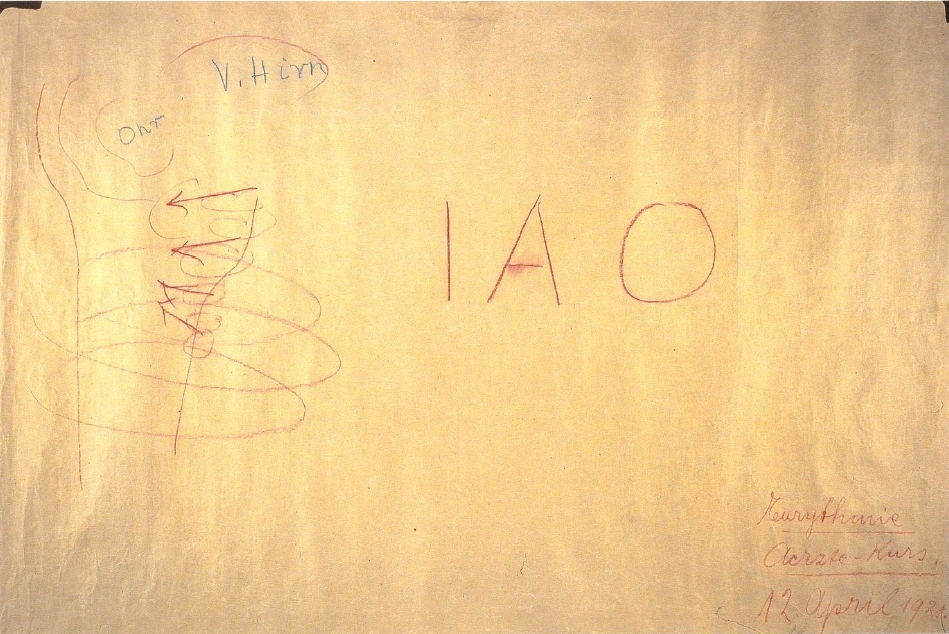
[ 19 ] So, I say, it is necessary that you then do the exercise with the child, letting the child form the letter “I” with their upper body—that is, the child begins to stretch their upper body. They feel their entire upper body stretched out. They form the “A” with their legs, and they form the “O” by moving their arms in this way. But have the child do these movements as quickly as possible one after the other: stretching the upper body vertically upward, spreading the legs apart, the “O” movement with the arms (in front), then down, up, down, up. And you can certainly do something like this in a group with the children. It should, of course, be noted that, fundamentally speaking, it would be necessary—in order to perform such exercises—not to conduct them in a classroom setting. Artistic eurythmy and the eurythmy we otherwise practice for pedagogical and didactic reasons should be practiced in a classroom setting. That is how it should be; children of the same age and so on belong together there. But in order to transition from ordinary classroom eurythmy to these activities that are already linked to hygienic-therapeutic eurythmy, one would have to select from the various classes those children whom, precisely because of their particular characteristics—which I described earlier—namely, the lack of harmony among the three members of the human being—one deems necessary to undergo such an exercise. One can then select them from a wide variety of classes and conduct this exercise with those who are particularly suited for it. But this would actually have to be done if one truly wished to practice hygienic eurythmy and therapeutic eurythmy in school. But even that, isn’t it true, actually sets us on the path which, when pursued further, is intended to lead us to study certain movements—which are merely metamorphoses of ordinary eurythmy—and to observe their effects on the human organism. You see, it is indeed the case that we have internal organs, and these organs have certain forms. Anomalies can lie within these forms. Every organ form is connected in a certain way to a possible form of movement in the outer human being, so that you can say: Let’s assume that some organ—the gallbladder, for example—tends to become deformed, to take on an anomalous form. There is a form of movement that counteracts this; and so it is for every organ.
[ 20 ] We will then proceed to shape the rest of the plan along these lines. I wanted to present this today as an introduction to get you started on this matter.