

Therapeutic Eurythmy
GA 315
16 April 1921, Dornach
Translated by Steiner Online Library
Fifth Lecture
[ 1 ] My dear friends, today we will move on to some eurythmy exercises that relate more to the workings of the soul. However, it must first be noted that it is commonly assumed that when a person expresses a will or forms a judgment, these expressions are connected solely to the human nervous system. This is by no means the case, however; rather, one must be clear that, for example, the judgments a person makes are indeed connected to their overall constitution—that a person forms a judgment from within their entire being. Therefore, when one performs the corresponding eurythmic movement for a judgment, the whole person is influenced in a certain way—meaning that it is not merely the head that is affected by what arises in a eurythmic judgment. For example, if you learn the corresponding movement for an affirmation, and now for a negation: (Ms. Baumann demonstrates). But of course, this can also be [applied therapeutically]. Naturally, when done as a therapeutic exercise, it often needs to be repeated several times in succession. Now, such an affirmation and negation is—in the overarching 1word—not unambiguously decipherable; originally rendered by Helene Finckh as “negative,” later corrected to “expressed.” After many comparisons with other passages in the stenographic record, “overarching” is the most plausible interpretation. In this sense, it is what one might call a judgment; when one affirms or denies something, one has, in fact, the very essence of judgment. When you utter such an affirmation or denial—and this is especially true when it is repeated frequently—you can, for example, have the affirmation repeated ten times in a row, followed by the denial. You can then follow that with affirmation, negation, affirmation, negation—ten times of each in succession—and such a movement, acting indirectly through the etheric body, has an extraordinarily strong effect on the respiratory system, and one can say: In this way, one can counteract existing shortness of breath, so that if this shortness of breath is, in turn, a symptom of some deeper-seated disease, one can—since the process occurs indirectly through the etheric body—actually work into the entire constitution of the organism. You really just need to consider now what it is that is being done here. What Ms. Baumann has just done could be interpreted roughly as follows—and this would also capture the essence of it—one could say: What she has brought into the world through this is a thought that has become fleeting, as it were, a thought that has taken flight and transformed into movement. When a judgment—whether an affirmation or a negation—is expressed through eurythmy, it is a thought riding on the movement. And because the thought rides on the movement, one actually brings a part of this essence to the fore; since the thought rides on the movement, one actually takes a part of it more deeply into oneself than is usually the case. That is to say, one makes a movement through which one actually becomes more alert than one otherwise is. Such movements are indeed awakening movements. But since one does not awaken with the “I” in the same way at the same time, the activity of the “I” is thereby toned down in a certain way. This dampening of ego activity, however, is not absolute but relative to the organism; this is precisely what one achieves, indirectly through the etheric body, as the first symptom in combating shortness of breath—and what then actually permeates the entire human constitution indirectly through the etheric body.
[ 2 ] Now, let’s express a state of mind—let’s say sympathy and antipathy: (Miss Wolfram demonstrates) Sympathy—now back again!—and antipathy. Now imagine that you actually make this movement very frequently in rapid succession: sympathy, antipathy, sympathy, antipathy, or even just one of the two. When you do this—it can, of course, only be observed by watching—when you do this, then in a certain sense it is a kind of bringing forth of something one carries within oneself. It is, in fact, a kind of falling asleep. It is, after all, a movement in which the observer—the other movement must be performed quickly, this one slowly—it is something that causes the observer to also experience the imagination of sleep; one falls asleep imaginatively, so to speak, with such a movement—at least one shouldn’t [in reality]! But since one does not actually fall asleep while performing this movement, the ego is more active in relation to the body than it normally is. So it is more active than usual, and such a movement essentially stimulates circulation and overall digestion—stimulating overall digestion to such an extent that, for example, a tendency to burp can be counteracted by such a movement.
[ 3 ] Now let’s try to express what one might call, say, the feeling of love for something (Ms. Baumann). Take a good look at that—the feeling of love for something. Imagine performing this ten times in a row, and imagine accompanying it in such a way—that is, performing it ten times in a row while always inserting a strong “E” movement between each one. So: Love—E, Love—E, and so on, performing this in succession. So: such a feeling—it could also be another feeling—that is, what you learn in eurythmy as a feeling-movement—always let it be accompanied by E-movements. This always produces a strong effect that emanates from the human etheric body to the astral body, and which essentially has, I would say, a warming effect on circulation. It is, therefore, something that actually has a beneficial effect on the circulatory system. One cannot say that it accelerates or slows it down, but it acts in a beneficial, warming way.
[ 4 ] Now there is also something that could be called a wish: hope (Miss Wolfram). Consider this, and imagine it: by repeatedly returning to the position of balance, then performing this “wish” movement again and again, imagine it alternating with a U-shaped movement—that is, accompanied by and alternating with it. This signifies a very strong influence of the astral upon the etheric, and one can say that this, in turn, exerts a beneficial, warming effect on the respiratory system. Of course, the point is that all these things we are discussing today take place indirectly through the etheric body, and therefore their effects can never manifest as early as the very next day, but rather only begin to show some effects after about two to three days; yet these effects are all the more certain as a result.
[ 5 ] Now imagine this: we’re doing a movement that involves bending and extending the legs, and at the same time we’re doing a distinct “B” movement (Ms. Baumann): what I just showed you, combined with a pronounced “B” movement at the same time. Now go all the way back [to the starting position], “B” with the bending—do this ten times in a row, then pause, then ten more times in a row. This is something that people who suffer very frequently from migraines or other headaches should do. They should do this when they don’t have a headache—not when they do, but when they don’t have one.
[ 6 ] Now, one particularly effective movement is this (Miss Wolfram): forward, backward, but at the same time accompanied by an R-movement—bending forward, bending backward with R—and repeating this quite often in succession. This has a very positive effect on the entire rhythmic system, on the rhythms of breathing and circulation. So if irregularities are found there, this exercise works exceptionally well under all circumstances.
[ 7 ] Now I ask you to observe another quite effective movement, which consists of the following: turning the head to the right and left while shaking it, and shaking the head to the right and left while performing the M-movement. If possible, the head should not be turned, but only tilted to the left and right, accompanied by the M-movement. This, in turn, is something that—when performed—has a very strong calming effect, via the etheric body, on all sorts of irregularities that may arise in the lower abdomen. Irregularities in the lower abdomen that manifest as pain can be alleviated by this. It is simply a matter of using this to combat a predisposition to such pain when the pain itself is not present. That is what matters. So while the pain is present, it is not advisable to perform this exercise; however, performing it when the pain is not present is what is particularly important.
[ 8 ] Note the following: Push off from the knee with the other foot; imagine this accompanied by an “E” arm movement. This bending of one leg, followed by a 2“strike”—found in Helene Finckh’s transcription, but illegible in the shorthand.—onto the other leg, accompanied by an “E” arm movement; it is a very beautiful movement. And it is an exercise that can be performed very well with children at school, and [it] should also be performed there, because when this movement is done frequently, it is indeed an effective remedy for a wide variety of clumsiness. The children are at least very effectively cured of their clumsiness when they do precisely this movement. And when the children come and say that their shoulders, in particular, hurt, and that all sorts of things hurt, then tell them: “That’s exactly what I wanted; you’ll be especially glad about it once you’re feeling better!”—For every pain produced in this way combats clumsiness. So it’s perfectly fine to be a bit firm with the children in this regard.
[ 9 ] Now let’s consider another type. Imagine any kind of E-movement that can be performed with the arms, projected onto the floor; this creates precisely this line, intersecting diagonally with this line.3The drawing from earlier editions cannot be found in either the shorthand notes or the transcription, so it is no longer reproduced. Now let’s imagine it this way: Let’s imagine that Mrs. Baumann stands here, Miss Wolfram here, and now you walk—accompanying the whole thing with an “E” movement of your arms—you walk like this, and you like that, past each other, taking care not to bump into one another. Keep going, keep going, being very careful not to bump into each other. So you trace an “E” on the floor and make an “E” with your arms, and you have to be careful not to bump into each other. And this being careful—this paying attention to one another and also to the movement—is what interacts with the [E] movement here. So this exercise can only ever be performed by two people. When performed by two people, it is essentially what one might call a strengthening of the heart—that is, everything related to the phenomena commonly referred to as a strengthening of the heart.
[ 10 ] [Interjection] Could this be performed by a healthy person and a sick person?
[ 11 ] It is possible to do that, but you may then need to encourage the healthy person not to join in the E-movement with their arms. Isn’t that right? This exercise is specifically designed—I would say—for sanatorium settings, where you naturally have the two patients whose heart strength you wish to improve; it’s certainly better if you can have both of them.
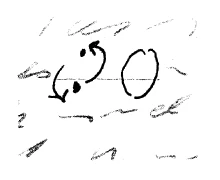
[ 12 ] Now let's imagine the movement like this: one of the ladies stands here, the other here, one behind the other. When you arrive [Ms. Baumann], Miss Wolfram performs this step, but in such a way that she always looks forward; then, as she continues moving, you perform this step here, and you add 4“anstückeln”: Austrian expression for “to begin,” “to add.” one movement after another, accompanied by the “O” position of the arms. Now, of course, you must encourage the people doing this to start at a certain pace; first more slowly, but then let them do it faster and faster, and then let it taper off again, gradually slowing down from the fast pace back to the slow one. This is a movement that can significantly strengthen the diaphragm and, consequently, the entire respiratory system. Here, too, if you omit the “O” movement with the arms, you can have a healthy person participate. But of course, it is best to have two people who need this healing participate.
[ 13 ] Now I’d like to ask you (Ms. Baumann) to demonstrate the H-movement for us one more time. This is an H-movement. And now I’d like you to perform this movement while keeping your arms completely still and using only your shoulders—as best you can—to imitate this movement. And now you have to get used to doing this movement with your shoulders while at the same time making an “A” with your arms—any kind of “A” with your arms—repeating it quite frequently in succession. You see, this is what one might call “eurythmic laughter.” This is how one laughs eurythmically. And when you laugh eurythmically like this, it truly intensifies to a very high degree the healing effect that laughter generally has. This healing effect of laughter is, of course, well known. But when laughter is practiced eurythmically, this healing effect is present to a particularly high degree. You can also do this in other ways.
[ 14 ] First of all, (Miss Wolfram), make any A-movement; and now try—but very slowly, as if you really wanted to do it very deliberately—to keep your arms like this and perform the same movement I mentioned earlier, that H-shoulder movement, and back again—in other words, to perform that H-shoulder movement within the A-movement of the arms. That is then what one might call: the entire organism attunes itself to the feeling of reverence, and it also encompasses everything that is essentially brought about in the organism by the feeling of reverence. When the feeling of reverence becomes habitual in a person, it has the effect on the organism of actually making it more enduring—that is, more stable; the organism itself becomes more stable. It becomes more resilient. People who are truly well-disposed to revere others properly become more resilient in their organism. Therefore: everything we teach children about reverence—whether in terms of a gift for it or the capacity to revere—makes them more resilient. And we can support this resilience precisely through the eurythmy exercise mentioned last.
[ 15 ] In general, it must be firmly established that what we today attribute to judgment, the expression of will, hope, and love—as well as what we have discussed regarding certain physical pains, and what we have discussed in relation to overcoming clumsiness and so on—that these things indeed approach the human being in such a way that the human being is grasped at the very core of their physical being and, indirectly through the etheric body, actually gains the ability to make this etheric body a useful vehicle at all.
[ 16 ] The etheric body is, in fact, something within the human being that becomes rigid in most people who spend their lives sitting around, who go through life without any interest in their surroundings. And it is simply not good—it is not good for the bodily functions either—when a person’s etheric body becomes rigid. If children are made to perform the movements we have described today in moderation, and if the appropriate patients are made to perform them quite energetically—one can see from the information provided which patients should be given these exercises—then the etheric body becomes supple and flexible, and this benefits both children and adults alike.
[ 17 ] These movements are such that one can certainly give them preference over ordinary gymnastic movements, because ordinary gymnastic movements are actually derived solely from physiology, that is, from the physical nature of the body, and essentially continually tear the physical body away from the etheric, so that the physical body then always performs its own movements, which do not correspondingly entail the movements of the etheric body. And as a result, ordinary, purely physiological gymnastics is, in essence, a school of materialism, in that materialistic thinking spills over into feeling; whereas eurythmy enables a person to truly develop the ability to recognize themselves within themselves and to master themselves. Therefore, such exercises have both a pedagogical-didactic value as well as a therapeutic and hygienic value. Essentially, the situation should be such that a genuine effort is made to ensure that such exercises—specifically those described today—are always performed in moderation by adults as well, and that they are adapted for use in sanatoriums for the benefit of the sick.
[ 18 ] I was asked another question that might lead to some insights, as well as a few other questions. Here is the question:
[ 19 ] Chinese people cannot pronounce the letter R; they use the letter L instead. For example, “Erdbeere” would be pronounced “Eldbeele.” Is this related to race?
[ 20 ] This is, of course, related to the organism’s structure, insofar as it is determined by race, and one can see precisely from this particular aptitude of a certain group of people for one sound or another how people are predisposed based on their racial characteristics. We ourselves cited such examples just a few hours ago.
[ 21 ] Now, questions have been raised here regarding exercises that might be performed in light of conditions such as lethargy, lack of responsiveness, diminished motor drive, and so on—conditions that are very often caused by insufficient thyroid function. It should also be noted here that Fließ, in his well-known book on the “Course of Life,” classifies these symptom complexes under the “sexual intermediate stage.” How could a contemporary writer fail to do the same! Naturally, he classifies everything about which he knows little under the “sexual intermediate stage.” Or, to put it another way, he places left-handed people, for example, in the same category. One might perhaps [...] clumsy [...] 4In the stenographic transcript, this sentence is fragmentary and was not transcribed by Helene Finckh. It is conceivable that a further remark about Fließ followed. See the note on this on p. 150. However, I expressly emphasize that I have not yet recommended eurythmy exercises with a special emphasis on the right or left side to anyone.
[ 22 ] (Please refer to the exercises [from the first lecture], which are to be started alternately on the right and left: iambic and trochaic.)
[ 23 ] This is not really meant to emphasize the right or left syllable in particular, but rather to evoke the sense of iambic or trochaic meter precisely in the forward movement. This is, of course, entirely justified. After all, it’s not so much about the long and short syllables as it is about this particular movement. It is certainly true that the point is simply this: when what lives in the respiratory system is transposed into the motor system, it is reversed. The upper human and the lower human are, after all, reversed. So every iamb that might be conceived of in the respiratory system—that is, produced through speech—must become a trochee in the movement of the legs, and vice versa. The entire art of eurythmy is built upon this principle. You can examine the whole of eurythmy in this light: when performed, the movement never corresponds merely from the standpoint of similarity, but rather corresponds according to the principle of polarity. Everything corresponds to the principle of polarity. This, of course, is a fundamental point to note. But I have never recommended to anyone that they should perform anything specifically on the left or right; that should be left entirely to feeling. So whether something is performed with the right or left hand should be determined solely by the other factors that come into play. I do not wish to give the impression that I have recommended a right-side emphasis through specific eurythmy exercises to people who are left-handed; that is not the case.
[ 24 ] Now, however, I would like to emphasize the following regarding this point: The issue is that when there is a lack of reaction or a deficient impulse to move, this more general term always falls under one of the categories I have already mentioned. “Deficient motor drive” is a general term, and it falls under one of the categories I have mentioned; the corresponding movements must then be performed.
[ 25 ] (Question) ... [not included in the stenographic record]
[ 26 ] These states of indolence, lack of urge to move, inattention, and so on—even laziness—are, in a sense, a preliminary stage of what is known in homeopathy as “typhoid” 5Translated by Helene Finckh as “diffuse,” though she was apparently unsure—she underlined the passage in the stenographic transcript and marked it with a cross. mental state [...] 6After “calls,” a large gap in the stenographic transcript is marked by a long dash. Well, as for what is—I would say—purely medical about this, I will answer that tomorrow. But since the question is essentially linked to the lecture on eurythmy, I would like to add the following: On the whole, one must view an exercise such as the one I have described here—with regard to judgment and the expression of will—in such a way that precisely these manifestations of indolence, a lack of impulse to move, and so on, are combated in a very special way through what I have described for expressions of will. And if one sees that these are not particularly effective, then one should alternate them with what I have described for judgment—but in such a way that one tries to experiment —this is a matter of experimentation—to see whether expressions of will are more effective than expressions of judgment in a ratio of three to two or two to three in terms of duration, that is, one longer and the other shorter. And it will certainly turn out—since these things work indirectly through the etheric body—that one must first begin by continuing the exercises for two to three days, and that under certain circumstances, if one sees that they are not working properly, one must then make a change on the third day. But in general, it can be said that both exercises will have a stimulating effect on the person in both directions. So it is precisely these exercises of will and judgment that are particularly worth considering.
[ 27 ] I would like to emphasize—so that there is no misunderstanding—that one must not, of course, come to believe that such exercises, performed for just two or three days, could already have a very significant effect. That would be a mistake. If such exercises are to have an effect, they must be performed for at least seven weeks. Seven weeks, then—that is a period of time which, without one having to be, as it were, mystically inclined to believe it—does indeed demonstrate the beneficial effects just described.
[ 28 ] That is what I wanted to tell you today about these matters, and I would like to ask if we might be able to schedule this class—this particular class—right after the other one tomorrow, following a short break. Tomorrow would then be the last eurythmy class, because on Monday we’ll need to hold two consecutive hours [as] purely medical sessions.