

Therapeutic Eurythmy
GA 315
17 April 1921, Dornach
Translated by Steiner Online Library
Sixth Lecture
[ 1 ] My dear friends, let us consider today—after all, there is so much that could be said about the relationship between hygiene and therapy and eurythmy—let us consider today, I would say, the physiological aspect that is primarily related to the spiritual, which becomes apparent to us when we look at eurythmic practice. Of course, what can be observed in artistic eurythmy in this regard will become even more apparent when we move from artistic eurythmy to what we have come to know in recent days as a certain intensified form of eurythmy. But the essential point at issue can already be observed in the performance of a purely artistic eurythmy, and then, in a sense, the physiology behind it can be sought. Now, to do this, let us first carry out the following.
[ 2 ] Perhaps Ms. Baumann would be so kind as to recite—alternating between vowels and consonants—the poem that you (Dr. Steiner) might recite: “Above all the peaks there is peace.”
[ 3 ] Now let’s clarify what is actually happening here; but let’s proceed with great precision. What is happening? A poem is being recited. So the person performing eurythmy—who, from a physiological standpoint, is now the focus of our attention—is listening. That is the first essential point to note: he is listening. He is not speaking himself; he is listening. That is the essential point. And he is listening to something that is essentially the meaningful word, the meaningful context of words. So they are listening to something in which thought activity and imagination are alive. What they perceive externally, then, is imaginative activity clothed in a context of sounds. Isn’t that something people often do in their waking daily life? What actually happens when people do this in their waking daily life? If you consider the process from a psychological and physiological perspective, you will easily notice that a gentle, partial falling asleep takes place while listening. The “I” and the astral body glide over into what they are taking in; they immerse themselves in what they are taking in. So, in a sense, a person gently steps out of themselves as they listen. As they listen, they slip into a state that is both sleep-like and yet not sleep-like. It is sleep-like in that their “I” and their astral body gently step out. It is not sleep-like in that this “I” and the astral body remain receptive, remain perceptive, and remain conscious. What takes place here, then, is extraordinarily similar to imagination. It is a gentle, conscious form of imagination—a conscious imagination that is still very strongly suppressed into the subconscious. That is the process.
[ 4 ] Well, there is a reaction on the part of the human being himself to every such process; we also take note of this reaction. So now let us look at what takes place within a person who is not reciting. What does he do when he listens? He sets his etheric body in motion. The etheric body reacts. The etheric body actually assumes the movements it performs, but much more weakly when a person sleeps and leaves their etheric body behind in the physical body. When a person sleeps and leaves their etheric body and physical body behind, this etheric body is, in fact, much more active than when the person is awake. Now, during this state of “paralyzed sleep” that occurs while listening, the movements of the etheric body are evoked to a greater degree. One can observe these movements of the etheric body. Thus, in the person who is listening, we have a person who exhibits, to a heightened degree, the very movements that a person otherwise displays in a weakened form while asleep. Thus, one can also study the etheric movements of a person during sleep by observing a person who is listening—indeed, by having them demonstrated right before one’s eyes. One does not need to study the person while they are asleep; one can study the etheric movements of the person while they are listening, and specifically the intensified sleep movements of the etheric body. One studies these movements and then has the physical body perform them—that is, one allows the physical body to glide into all the etheric movements that have been studied in the manner just described. Thus, in eurythmy, one performs what a person continually performs with their etheric body while listening. You see what is actually happening there.
[ 5 ] Now, once one has observed what is actually happening there, the effect will also become clear. The effect is this: one brings into consciousness—specifically, via the detour of physical movement—what would otherwise occur unconsciously. In this way, one stimulates the astral body and the “I” indirectly through the physical body, strengthening them. But what happens as a result? When the astral body and the “I” are strengthened in this way, their activity becomes similar to that which operates in the natural context of a child and a person still growing. One thus appeals to the human being’s growth forces. One works directly within the human being’s growth forces. If the person is still a child and is at risk of falling behind in growth, this stimulates their growth. If the person is no longer a child, if their growth forces have already diminished, or if the person is even in the second half of their life, then one appeals to the forces of youth, to the rejuvenating forces within them—forces which, however, because the human organism is already fully grown, cannot contribute to their physical growth. We can promote a child’s growth by having them practice eurythmy, [or] counteract abnormal growth.1In the shorthand transcript, this may also be read as “dampen.” In an adult, the inner organism offers too much resistance for us to make them grow any further. Nevertheless, we introduce these growth forces into the person. The result is that they collide with the organism’s resistance and are thereby transformed; that is to say, in this transformed state, they stimulate the plastic power of the internal organs. They have a stimulating effect on the plastic power of the internal organs, and through this, the internal organs learn to breathe better and digest more effectively. They are thus stimulated with regard to the entire necessary activity of the human organism. When artistic eurythmy is performed, it must of course not be regarded at the same time as therapeutic eurythmy, although it will also have a healing effect the moment a person begins to exhibit any kind of abnormality. But we have already considered examples where, by intensifying ordinary eurythmy, we have seen how the reaction that occurs must naturally be intensified as well, and we can now form a mental image of how this eurythmy acts upon the plasticity of the organism.
[ 6 ] You can understand that the regular practice of eurythmy first stimulates the plasticity of the organs—the plastic power of the organs—so that a person becomes a better breather internally and, with regard to internal digestion, becomes—if I may put it this way—a better human being. They become a person who is better able to bring their entire organism under their will. They become a person who is more skillful inwardly. And in fact, all artistry consists in making the inner human being flexible, plastic, and skillful. You can already see this, for example, when working in sculpture. You cannot truly work in sculpture unless you can merge, in your inner experience, with—let’s say, for example—the figure you are sculpting; unless you can bring to life within yourself the forces that form this figure and that seek to express themselves through it. But if one then regards the human organism itself as a tool and does the corresponding work within, then what is true of external artistic creation is true to an even greater degree; for then one cannot help but evoke within oneself the corresponding forces for the external movement.
[ 7 ] Now, if you would be so kind, let’s perform the poem once more—this time using only vowel sounds, that is, performing the eurythmy by emphasizing only the vowels. (Dr. Steiner recites; Miss Wolfram performs the eurythmy.)
[ 8 ] Here, what I just said about the physiology of eurythmy is applied in a specialized way. So when eurythmy is performed using only vowels, we have not fully expressed what I have just described. What I have just described applies to the case where one speaks while alternately making consonantal and vocal movements. For what we have just described, what I said is not entirely correct; rather, we must specify it ourselves. For here, very specific, differentiated movements are performed—movements that manifest as such in the etheric body and relate primarily to everything that lies within the rhythmic system itself. So we consider this system—the etheric system—which is particularly involved in speech. Let us consider this. When a person listens to vowel sounds—of course, this phenomenon exists in such a specialized form only in eurythmy, but it must be emphasized precisely because it is particularly important for therapeutic purposes—when a person listens to vowel sounds, that is, if one were to recite only a sequence of vowels to them, or if one were simply to have them perform such movements — in a sense, they are listening to such movements in a eurythmic way, which are forms of expression for vocalization — then, in the person listening to the vocalization, those movements of the etheric body corresponding to the rhythmic system are usually activated in the manner described earlier. And now one has the eurythmist perform those very movements, through which he glides with his physical body into the movements that would otherwise take place in the etheric body while listening to the vocalization. This, then, is the specific nature of the practice. Through this, however, the organs associated with the respiratory and internal digestive systems—the organs of the rhythmic system—are particularly stimulated. These organs are strengthened; in the still-growing child, the call is directed toward the growth forces, while in the adult, it is directed toward the plastic forces that find their resistance precisely in the body’s organization.
[ 9 ] This introduces you to the physiology of vocal eurythmy in particular. So if you use the elements of eurythmy that stem from vocalization for therapeutic purposes, you will have a particularly strong effect on the rhythmic organs.
[ 10 ] Now, perhaps I might ask you, Ms. Baumann, to recite the same poem once more, focusing on the consonants. Just by looking at it, you will immediately notice the radical difference between consonant-based recitation and vowel-based recitation. This difference is indeed a radical one. And if we wish to study what we have just seen, then we must be clear about how things stand in ordinary listening—that is, if we were to listen only to consonants. This is rarely the case for cultured people, but among less civilized tribes it does indeed happen that they must listen to a great deal of consonants. For among less cultured tribes, the language has a significantly richer consonantal system, and there is a strong transition from one consonant to another, unimpeded by the intervening vowel. You can even observe this as far as Europe. Take a look at words written in Czech, and you’ll see how they contain clusters of consonants. Now, of course, when they are pronounced, the vowel sounds are already present within these consonant clusters, but they permeate them only like a continuous, barely nuanced flow. And when you listen to Czech, you’ll simply have to admit: this perception of the consonantal is quite different from the perception of a language that is exceptionally vowel-rich.
[ 11 ] We are therefore dealing with an entirely different process here, and this process can best be characterized as follows: This process—which is essentially a normal listening process—involves a powerful evocation of those movements of the etheric body that are otherwise actually carried out during physical movements. These movements are held back. Thus, when listening to consonants, the person experiences a certain tension. Unconsciously, when listening to consonants, they would actually like to physically imitate or mimic these movements outwardly, but they hold back. This tension is present. It is essentially a state of calm, but one that is artificially induced—brought about by the power of the ego—in contrast to the movements that actually want to be carried out. It is, therefore, a will formed within oneself,2Translated this way by Helene Finckh; in later reviews, it was read more as “steeled.” In earlier editions, “pent up.” which comes to light when listening to consonants. You will therefore also find that listening to consonants strengthens one’s inner being extraordinarily and makes one strong. And one can already study—if one has an eye for it—one can already study how such peoples, such as the Czech people, appear within themselves, how the human being appears within himself, with these forces of tension, with. these aggressive forces—if one knows that this is shaped by the consonantal nature of the language, this constant holding back of that which actually seeks to become physical movement.
[ 12 ] Now, this is, once again, a process of the human being stepping out, a transition into the state of sleep, and this process of the human being stepping out, this transition into the state of sleep, is extraordinarily interesting. Look, let’s observe the human being schematically: head, rhythmic system, limbs and metabolic system.
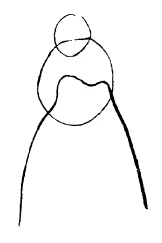
[ 13 ] It is primarily the metabolic system of the limbs that is engaged in consonant listening. The human being wants to move his limbs, wants to transition into movement, but the movement is held in tension. He enters, so to speak, a state of sleep that would not otherwise occur, for the ego and the astral body actually remain within the organism, as in 3Not clearly decipherable; possibly “during” instead of “as in.” ordinary sleep; they remain within the organism.4See the note on p. 151 regarding this statement. Now, in this case, one is even attempting to induce a kind of artificial sleep for the limb-metabolic system. But then a strong reaction becomes noticeable—this strong reaction that occurs when one, so to speak, falls asleep with one’s limb-metabolic self. This reaction consists in dreaming. But now, in turn, consciousness is not equipped for dreaming. Dreams, so to speak, arise in the person and surround them (orange).
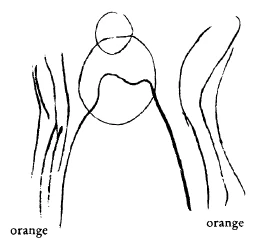
[ 14 ] He influences the outer astral realm and the outer ether. Such people, who listen to consonant sounds, create an amplification of the aura in their surroundings, and this amplification of the aura, in turn, manifests itself polaristically in that what remains in the subconscious now surrounds the head organism (violet) as polar content, as a factor of will and feeling, and enters the head organism
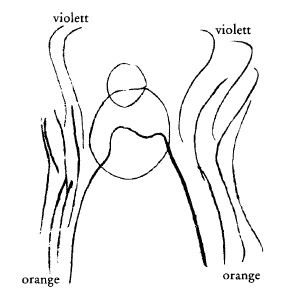
[ 15 ] You can therefore observe in such people, who are accustomed to consonantization, a strengthening of their obstinacy, a strengthening of their willfulness. These are dreams transformed into will that play out through the head organism—dreams transformed into will.
[ 16 ] What, from a physiological standpoint, are “dreams transformed into will”? If we consider their etheric-physical correlate—which is essentially what now exerts a formative influence on the head organization— So one focuses primarily on the formative influence on the head organization, and in this way one will be able to stimulate a head organization that has, so to speak, fallen behind in its development. If, then, one is dealing with a person with mental retardation—or with someone in whom one can otherwise physically observe that their head organization is not functioning properly— then have them practice eurythmy with consonant movements; in doing so, one intervenes in the force that otherwise acts as a dreamlike will throughout the rest of the body—in the limb and metabolic organization—and which stimulates that organization, keeping it active. One makes the mind of the person with intellectual disability and of those otherwise lagging behind in their head organization more active. Thus, this type of eurythmy can be used to evoke healing forces with regard to the organization of the head. This is especially true when we intensify what we have heard in recent days—namely, the intensification, the heightened metamorphosis of the consonants in eurythmy.
[ 17 ] It is, of course, only natural that if one wishes to consider the physiology of eurythmy, one must consider the moving, active human being—that is, one must, in a sense, actually engage in physiology. For with conventional physiology, one is not really practicing physiology at all; rather, even when conducting experiments on living beings, one essentially proceeds from a mechanical perspective, or one proceeds entirely from the cadaver and then infers what is actually physiological. So one has something that one has already deduced. What one has otherwise deduced must be gleaned from human activity if one wishes to apply it to the physiology of these processes, and one will be able to see that such a study can in turn breathe new life into the entire field of physiology. For just consider the following: What, when observed in a living human being, is the digestive process? It is a metabolic activity that tends toward the rhythmic, that unfolds in accordance with the rhythmic. Digestive activity is metabolism that is, so to speak, caught up in the rhythm of the circulatory organs. After all, a process is constantly taking place that is a synthesis of the metabolic activity in the tissue fluid. And what takes place as metabolic activity in the tissue fluid—as the rhythm sets in—5Possibly “surges,” according to the transcript. is itself carried along and swept up by this rhythm of the circulatory organs, and the more chaotic activity—the chaos that takes place in the movements of the interstitial fluid—transforms into the rhythm of the circulatory system. And in such a process, where the chaos of the interstitial fluid merges into the regular rhythmic activity of the circulatory system, what constitutes human volitional activity finds its physical expression. Volitional activity—which, in turn, must now be precisely distinguished from external action, even though it pours into this external action—consists in the fact that a continuous transition takes place between chaotic activity in the interstitial fluid and rhythmic, regular activity, indeed harmonizing activity, within the circulatory system. But because this takes place, the inner world of the human being—that which lies within the skin—harmonizes with the human being’s outer nature. The human being, so to speak, structures itself by bringing its “own being” down,6“own being” according to the stenographic transcript; previously “inner being.” into the essence of the external world. Therefore, by influencing this activity through eurythmy—as we have seen in the case of consonant articulation—we are in fact counteracting the tendency of the human being to become self-willed, to become selfish, but also, in an organic sense, the tendency of the human being to become selfish. For what does it actually mean for a human being to become selfish?—You see, for a human being to become selfish means, expressed in organic terms: the organs lose their plastic power and increase in terms of their rigid crystallizing power. In a sense, they no longer want to be plastic; they want to approach a state of crystallization. This is what we counteract through consonant-based eurythmy.
[ 18 ] This actually gives you a deep insight into human nature. Egoists are, in fact, always people whose stomachs, livers, and lungs are in danger of taking on a truly wedge-like shape. They want to become wedges; they want to transform into crystalline forms, whereas in people who are pathologically selfless, these organs spread out. They lack the power of crystallization; they possess plastic energy, and they take on a rounded form. This, too, is a pathological condition. It is always the swinging of the pendulum from one side to the other that one must take into account.
[ 19 ] Now consider the actual, spiritual activity in this way: When a person thinks and, through thinking, feels all that which in ordinary life is called activity—which is designated as “spiritual”—it is, after all, carried out by the most physical organization of the head; precisely because of this, it is the sublimating spiritual activity—the individualizing force on the one hand, the abstractly felt on the other—when a person carries out this spiritual activity, what happens then? You see, he then draws from his organism the very force that enables him to place himself, as a member of the outer world, within it. He also draws from his organism the very force that pathologically tempts him to dissipate. He literally becomes a crystallizer when he is engaged in spiritual activity. Certain peoples—particularly, as I believe, those located further north—have developed a strong instinctive awareness of these things. And although they still have no inclination today to structure eurythmy according to this instinctive awareness, they do make use of what is more outwardly physiological—Swedish gymnastics and so on— but they do make use of the unique interplay that exists between the activities children must perform when they are to engage in scientific work at school—that is, thinking and so on—and they alternate these activities with those that stimulate movement. They also insist that every teacher should essentially be a physical education teacher, and they in turn require the physical education teacher to be on the same intellectual level as the child. Such things must certainly be taken into account in an advanced civilization, and if I were to make a remark that might seem biting but is by no means meant that way—one intended only to clarify—I could say: It takes time to instinctively take these things into account. — This must therefore be carried out among peoples who otherwise participate less in the process of civilization, who live more for themselves, leading a self-contained life, and who can thus gradually and instinctively develop an understanding of the rhythm of mental and physical activity—such as the Swedes and Norwegians, who lead a sort of isolated existence; they are particularly well-suited to instinctively grasp such perspectives. Other peoples, who are more reliant on consciously carrying out such things—because they are otherwise more actively involved in the general world process—these peoples, who, for example, have had to concern themselves with warfare and the like, as has very much been the case in recent times, must then pay all the more conscious attention to these matters. And those who, precisely because they are right in the thick of the world’s movements and must truly put themselves in the midst of these matters—since, in a sense, the world revolves around them—will see what they leave behind if they do not consciously turn their attention to these matters, as they gradually become decadent. This is something Switzerland, in particular, ought to take to heart.
[ 20 ] These things, then, certainly also play a role in our consideration of general world conditions, for after all, my dear friends, general world conditions arise from human activity, and even today they arise much more from people’s unconscious activity than from their conscious activity. But it is our task to gradually bring people’s unconscious actions into the realm of the conscious.
[ 21 ] Now, how does this mental activity work in human beings? It works by awakening the forces of crystallization. In people with a weak sense of self, it therefore strengthens the ego; it makes them more selfish. But we do need to stimulate the forces of egoism in such people—who are organically depleted because they are not egoistic enough—not for the sake of the soul, but for the sake of the organism. We can also stimulate them through external means, and it will naturally follow that we advise such people, who are physically depleted, to consume sugary substances. But they sometimes have a certain aversion to this, which only serves to underscore the very fact.
[ 22 ] But anyway, that is precisely what interests us much less at this very moment. What interests us right now is that vocal eurythmy enables us to work in this direction in a very special way, and that, through vocal eurythmy, we can, so to speak, bring the person back to themselves organically. We can awaken those forces that bring them back to themselves organically. And this can be extraordinarily necessary for certain people, including, for example, those who are lethargic. But one will also see that the alternation between the two—vocalizing and consonantizing—has a beneficial effect in that it creates a living rhythm within the person, just as there should be a rhythm between devotion to the world and withdrawal into oneself. This is what is brought about by the alternating use of consonantal and vocalic eurythmy. It is, of course, particularly necessary when one wishes to use eurythmy for healing purposes to acquire this—I would say—physiological-psychological insight into what is actually taking place, so that one knows precisely: A person who performs consonantal eurythmy tends to evoke a kind of aura around themselves, which in turn acts back upon them and draws them out of the formless merging with the world. In the case of a person who is guided through vowel-based eurythmy, the effect is such that, in a sense, their own aura is drawn together—which is, after all, always the case during mental activity—so that their own aura is drawn together, condensed within itself, and thereby stimulates the internal organs to bring the person back to themselves.
[ 23 ] From a pedagogical and didactic standpoint, it is indeed true that by alternating between classes—such as those held in the morning, which require more mental effort, and those that involve more physical activity— —that is, where there is also a great deal of eurythmy—that one thereby evokes a rhythmic activity in the growing child which has an extraordinarily beneficial effect, in that all the damage that is bound to arise from excessive mental exertion is, in turn, counterbalanced by eurythmy. And that is why eurythmy also fits into the overall curriculum in an extraordinarily beneficial way.
[ 24 ] What I have to say specifically to the doctors about eurythmy, I will then incorporate into the communications addressed to the doctors. Let us conclude our actual eurythmy discussions here and hold two consecutive sessions for doctors tomorrow, during which the eurythmists will not be present—namely at 8:30 a.m. and, after a break, at 9:45 a.m.
[ 25 ] Acknowledgments by Dr. med. Friedrich Husemann
[ 26 ] Today we have reached the conclusion of this course, and we all certainly feel the need to look back on it once more. I believe we have sensed that this course in particular represents a certain culmination of what we have been privileged to receive so far from Dr. Steiner as inspiration for medicine. The fact that it was possible to hold a course here for physicians and artists seems to me, in a sense, a symbol of what we actually aim to achieve with our anthroposophical endeavors in medicine. The fact that this synthesis could come about is perhaps also a fulfillment of what Goethe once said, in a figurative way, in his *Wilhelm Meister*—that medical students should not so much be allowed to dissect as to synthesize. They should be taught to reassemble the human body from its individual muscles, bones, and organs, and from this sense of reassembly would also arise a healthy sense of healing.
[ 27 ] I believe that this course in particular sets before us the question of how this capacity for synthetic thinking and feeling can be reawakened within us, and that precisely such a course—which shows how the word, how the spiritual, passes into movement and into the body—should inspire us to act rather than to speak. That is, in fact, the underlying tendency of everything that is presented to us here.
[ 28 ] And therein lies, on the other hand, a small difficulty. For it is precisely when one feels inspired to act that one can end up doing too much, and it is so all too easy for all the suggestions given here to be applied quite extensively and in every situation. And so our association has specifically asked that we take very seriously once again what Dr. Steiner has repeatedly emphasized: that these therapeutic suggestions should indeed be regarded as therapeutic—that is, as ones that are to be applied under the supervision or with the cooperation of a physician—and that they should not be applied blindly, for that can, of course, lead to serious setbacks if it happens; and on the other hand, we must also bear in mind that anything presented to the public as the work of amateurs can ultimately have a seriously damaging effect on us and on our movement.
[ 29 ] That is why we would like to ask you to take these admonitions—which Dr. Steiner has just addressed to us in this regard—very seriously. What has been presented here must simply be processed by us. But this can only be done fruitfully if we work together just as we have been gathered here today. Therefore, I would like to conclude by saying that we should express our gratitude to Dr. Steiner precisely by truly working through this material—and not only by actively engaging in our movement, but also with understanding.