

Remedial Education Course
GA 317
25 June 1924, Dornach
Translated by Steiner Online Library
First Lecture
[ 1 ] Well, my dear friends, we do indeed have a number of children who need to be raised—or, as far as possible, healed—due to their incomplete development. We have some of these children here at the Clinical-Therapeutic Institute, and you have some at Lauenstein. We will structure our discussion here so that it is immediately applicable in practice. We will also be able to examine a few cases firsthand, thanks to Dr. Wegman making the children here—we can say this among ourselves—available to us for demonstration purposes.
[ 2 ] First of all, however, I would like to speak today about the nature of such children. It is, of course, essential that anyone who wishes to educate children with developmental delays first gain a deep, truly profound understanding of educational practices for healthy children. This is what everyone who wishes to educate such children must acquire. For one must be perfectly clear that everything that can actually occur in children with underdeveloped development—in children with pathological conditions—is also noticeable in a more subtle way in so-called normal psychological life; one need only be able to observe normal psychological life accordingly. One might say that, somewhere in a corner of every person’s psychological life, there is initially a so-called abnormality. Just something like, let’s say, a slight flight of thought or an inability to space out words correctly when speaking—so that one either rushes through one’s speech or the listener has time to take a walk between two words one utters—or similar irregularities that can also occur in the life of the will and the life of feeling; these are noticeable, at least in a slight form, in the vast majority of people. And we will have more to say about such irregularities later on, because they must be regarded as symptoms by those who wish to address the major irregularities specifically—whether through education or therapy. One must be able to conduct studies of these symptoms, just as a doctor, when dealing with cases of illness, speaks of symptoms by which he recognizes the diseases—and indeed speaks of the complex of symptoms through which he can grasp the pathological condition—but will never confuse what lies within the complex of symptoms with what is actually the substantive content of the disease.
[ 3 ] Similarly, in the case of a child whose psychological development is incomplete, one should not regard what one observes in the child’s inner life as anything other than symptoms. So-called psychography is, in fact, nothing more than a symptomatology. And if psychiatry today does nothing more than describe abnormal mental phenomena in terms of thinking, feeling, and willing, this means little more than that it has made progress in the precise description of symptom complexes; but since it cannot go beyond such psychography, it is absolutely incapable of penetrating to the essence of the illnesses. One must get to the heart of what it means to be ill. And here, a mental image may prove useful to you, which I ask you to keep in mind.
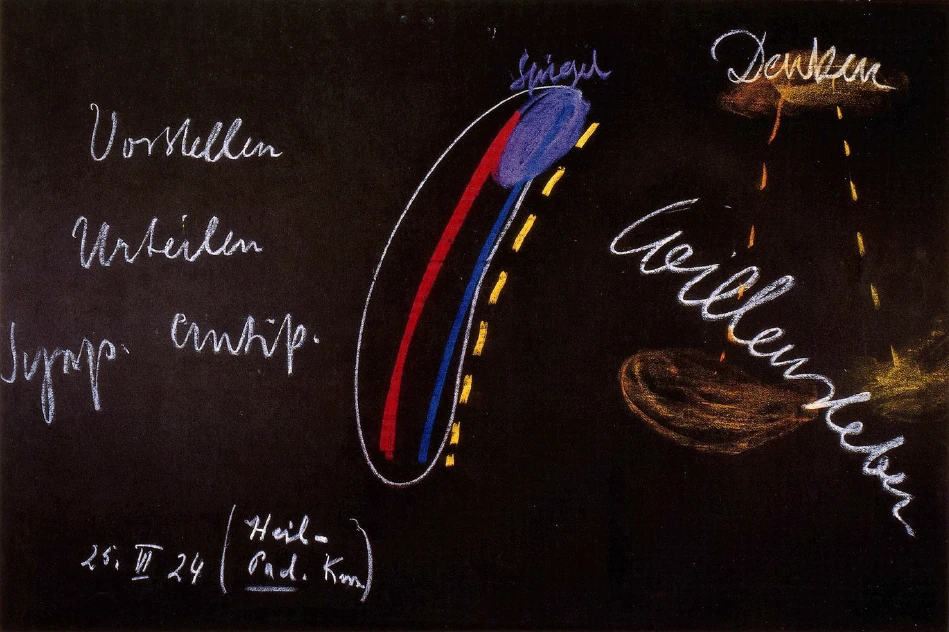
[ 4 ] Let us suppose we have here (see Plate 1, center) the physical body of a human being, as it appears to us in the growth of a small child. We then have, so to speak, the life of the soul rising up and emerging from this physical body. This soul life, which we can observe precisely as the expressions of the child’s soul, can be either normal or abnormal. Fundamentally, we have no greater right to speak of the normality or abnormality of a child’s soul life—or of human soul life in general—than by looking at what is, on average, “normal.” There is no other criterion than what is generally accepted by a community of philistines. And if this community regards anything as reasonable or sensible, then all “abnormal” soul life is that which, in the view of these philistines, is not “normal” soul life. There is, for the time being, no other criterion. That is why judgments are so extraordinarily confused: when one begins by identifying an abnormality and then does all sorts of things in an attempt to remedy it—only to end up driving out a spark of genius. Such an assessment is of little use at all, and the first thing that should happen is for the doctor and educator to reject such an assessment, to go beyond the statement: this or that is sensible or reasonable according to the habits of thought that one usually has. Precisely in this area, it is of the utmost necessity to refrain from criticism altogether and instead to view matters objectively. For what is actually present in human beings?
[ 5 ] If we now set aside this soul life entirely—which, in any case, only emerges gradually and in which sometimes highly dubious educators play a part—if we set this soul life aside, then we find, behind the physical body, another spiritual-soul aspect, a spiritual-soul aspect that descends from the spiritual worlds between conception and birth. That soul life is not the one that descends from the spiritual-soul worlds, but rather it is a different soul life that is initially not outwardly visible to earthly consciousness. I will sketch it schematically here (see Plate 1, yellow). This entire soul life that descends takes possession of the body, which is built up through heredity from the succession of generations. So if this soul life is of such a nature that it constitutes a diseased liver, if it takes hold of the liver tissue, or if it finds pathological conditions in the physical and etheric bodies through heredity and a sensation of illness arises as a result, then a disease is present. Likewise, any other organ or organ complex can be incorrectly linked to what descends from the soul-spiritual cosmos. And only when this connection is established—this connection between what descends and what is inherited, when this soul-physical entity has formed—does what constitutes our soul life, and what is usually observed as thinking, feeling, and willing (violet), arise—but only as a reflection. This thinking, feeling, and willing is present only as mirror images—truly like mirror images—and fades away when we fall asleep. The truly enduring soul life lies behind it, descending through repeated earthly lives and residing within the body’s organization. And how does it reside there?
[ 6 ] Let us first consider the human being in terms of its three components: the nervous system, the rhythmic system, and the limb-metabolic system. You see, the nervous-sensory system—let’s imagine it this way—we’ll understand each other—let’s imagine this nervous-sensory system as being located, for the most part, though only schematically, in the head; when we speak of the nervous-sensory system, we are speaking of the head system; we can do this all the more so in the case of a child, since the formative part of the nervous-sensory system originates in the head and exerts its influence throughout the entire organism. This system—the nervous-sensory system—is located in the head. It is a synthetic system.
[ 7 ] It is synthetic. What do I mean by that? It encompasses all the activities of the organism. You see, in a certain sense, the entire human being is actually contained within the head. When we speak of liver activity—and we should really speak only of liver activity; what I see as the liver is the fixed liver process—this liver activity is, of course, located entirely in the lower body. But every such functional connection corresponds to an activity in the human head. If I draw this schematically (see Plate 1, right), it looks like this: Here is liver activity. This liver activity corresponds to some activity in the human head or brain. Here in the lower abdomen, the liver is relatively isolated from the other organs—the kidneys, stomach, and so on. In the brain, everything flows into one another; here, liver activity merges with the other activities, so that the head serves as the great synthesizer of everything that takes place in the organism. This synthetic activity brings about a process of breakdown. The substantial element is extracted.
[ 8 ] Just as we have a synthetic process in the head, we have an analytical process in the rest of the organism, especially in the metabolic-limb system. There, everything is kept separate; in contrast to the head, everything is kept separate there. While in the head kidney activity proceeds together with intestinal activity, in contrast, in the rest of the organism everything is kept separate, so that we can say—if we continue to draw a schematic—that, for example, liver activity and stomach activity are separated from one another here; in the head, they flow into one another, everything flows together, and everything is synthesized there. Now this merging—occurring simultaneously with a continuous shedding of substance, as if it were raining—this synthetic activity of the head essentially underlies all thought activity. In order for a human being to think, in order for a human being to emerge and become active, that which comes from the spiritual-soul realm must be given the synthesizing function directed toward the head, thereby structuring the hereditary substance synthetically. Through this, a mirror can then be seen in the synthetically structured hereditary substance. So you have the following: when, as the process descends into the head, the head begins to organize synthetically, the head becomes a mirror, and the external world is reflected within it—and this gives rise to the thinking we usually observe. We must therefore distinguish between the two functions of thought: the one that lies behind the perceptible world, which the brain constructs—that is what remains—and the function of thought that is not real at all, that is merely reflected and is continually erased when falling asleep and fades away when one is not thinking.
[ 9 ] Another aspect of what descends from the spiritual-soul realm now analytically constructs the metabolic-limb system, forming the organs, which are distinct and have clearly distinguishable individual contours. If you now look at the entire body with its clearly distinguishable individual contours, you will find within it the liver, lungs, heart, and so on, to which the metabolic-limb system is also connected; the rhythmic system is not visible; everything filled with physical substance belongs to the metabolic-limb system, and even what is visible in the brain is metabolism. Now, what these individual, analytically structured organs are lies at the foundation of the human being’s entire life of will, just as synthetic activity lies at the foundation of thinking. Thus, all that exists in terms of organs lies at the foundation of the life of will.
[ 10 ] Now let us consider the following: Let us imagine a person who is already quite grown up. What has happened to this fairly grown-up person during the course of his earthly life? He may have turned seven years old; he may have gotten his permanent teeth; he may have turned fourteen and reached sexual maturity; they turned twenty-one and thereby achieved the consolidation of their soul life. If we are to understand childhood development at all, we must now make a clear distinction between the body of a person who has gone through the process of losing their baby teeth and the body of a child who has not yet gone through that process. What is illustrated here with particularly striking examples occurs continuously. The body is renewed every year. We are constantly shedding matter from our body outward; there is a continuous centrifugal flow outward that expels matter from the body. This results in the body being completely renewed every seven to eight years.
[ 11 ] Now, you see, this renewal is particularly important around the time of tooth replacement, around the age of seven. Why? Well, the body that a person carries from birth until tooth replacement is, in a sense, merely a model that we adopt from the outside—from our parents—and it contains the hereditary forces upon which our ancestors build. Now we shed this body over the course of the first seven years. And what happens? A completely new body emerges; what a person carries within themselves after the change of teeth is no longer built up by hereditary forces, but is built entirely from the spiritual-soul elements that descend, so that a person carries their hereditary body substantively only until the change of teeth, and while shedding it, builds a new one out of their individuality. We actually only have our own body after the change of teeth. However, what happens is that the hereditary body is used as a model, and depending on whether the spiritual-soul life is strong or weak, this spiritual-soul life will be more or less able to act more individually in relation to what exists as the hereditary form, or it will be subject to the hereditary form; it must shape the second body in the same way that the first was shaped by the parents.
[ 12 ] So what is usually put forward in the theory of heredity is, in fact, nonsense. In what is usually put forward there, one simply extends the laws of growth beyond the change of teeth into later life. But the fact is that what is considered heredity applies only up to the change of teeth; at that point, the individual appropriates it and develops the second body.
[ 13 ] We must therefore distinguish, especially in the case of the child, between the hereditary body and that which manifests in the individual body as a consequence of the hereditary body. The individual body gradually takes shape—the body that can truly be called the human personality body. And you see, it is now, so to speak, between the ages of seven and fourteen that the individuality is capable of its most intense activity: either the individuality triumphs over the hereditary forces—in which case the person, as they go through the process of losing their baby teeth, demonstrates that they are working their way out of the hereditary forces—or else—and this we can observe very clearly and must therefore take into account as educators—the individuality succumbs completely to the hereditary forces, to what is contained in the template. Then this hereditary resemblance to the parents simply continues beyond the age of seven. This depends on the individuality and not on the hereditary forces. Just as one cannot say—if, as a painter, someone presents me with something to imitate, but I alter it significantly—just as I cannot say in that case that my painting was created by the one who presented it to me, so too can we not say: “What we carry within us from the seventh year onward, what we possess after the seventh year, we have inherited.”—And one must, so to speak, grasp this intellectually and know how strongly individuality acts in one case or another.
[ 14 ] Between the ages of seven and fourteen, a person undergoes a process of growth and development that expresses as strongly as possible the individuality they have brought with them. As a result, during this time, the person is relatively closed off from the outside world. It is precisely during this time that one has the opportunity to observe the marvelous unfolding of the individual powers. And if a person were to continue this development later on—and were to enter later life with only this unfolding—they would be a terribly aloof being; they would be indifferent to the outside world. But during this period, they are already building up their third body, which emerges with sexual maturity. This body, in turn, is built up in consideration of the forces in the earthly environment. What appears as the relationship between the sexes is not the whole picture; overestimating this relationship is merely a consequence of our materialistic views. In reality, all relationships with the outside world that arise with sexual maturity are, at their core, of the same nature. One should therefore speak, in essence, of “earthly maturity,” not “sexual maturity,” and should include under earthly maturity sensory maturity and respiratory maturity, with sexual maturity constituting a subcategory. This is how things truly are. This is when a person becomes earth-ripe; this is when a person once again takes the external world into themselves; this is when they attain the ability not to be insensitive to their surroundings. They become receptive to their surroundings. Before this, they are not receptive to the opposite sex, nor to the rest of their environment. This is when a person develops their third body, which remains active until the early twenties.
[ 15 ] That which has descended from the spiritual world has already come to an end with the change of teeth; it has exerted its influence during the first seven years, up to the change of teeth, and up to the age of twenty. It has already taken shape in the organs that are present at that time, and it has brought the individual to maturity and made them ready for life on earth. If, however, any abnormality in the soul life—one that is reflected in the structure of the organs and is conditioned by the entire course of development—occurs, then a soul abnormality is indeed present. But if, after a person has passed the age of twenty-one, an abnormality occurs in the liver or another organ, that organ has already become so independent and separate that the soul aspect of the will can remain independent of it. The further back one goes in a child’s age, the less likely this is to be the case. In adults, because the organs already have a certain direction, the soul life becomes relatively independent, and an organ disease does not affect the soul life as strongly and can be treated as an organ disease. In children, everything still works together; a diseased organ still exerts a very effective influence right down into the soul life.
[ 16 ] You see, the diseases of today—those commonly diagnosed in modern pathology—are the more gross diseases. The more subtle diseases are not actually accessible to histology; they lie in the fluid that permeates an organ—such as the liver—in the movement of that fluid, or even in the movement of the gaseous substance that permeates the liver. The warming of such an organ is also of very special significance for the life of the soul.
[ 17 ] In the child's organism, therefore, when dealing with a defect of the will, the primary question to ask is: To which organ, which organ degeneration, or which organ disease is such a defect of the will related? — That is the more important question.
[ 18 ] It is not the defect in thinking that is of such immense importance. Most defects are actually defects of the will; for even if you have a defect in thinking, you must examine carefully to what extent that defect in thinking is a defect of the will. For if you think too quickly or too slowly, your thoughts may be entirely correct; the issue is simply that the will, which is at work in the interplay of thoughts, has a defect. One must examine to what degree the will is involved in this. You can actually only identify a defect in thinking if distortions of thought—sensory illusions—occur independently of the will. In one’s attitude toward the external world, they occur entirely unconsciously; there, the mental image itself becomes distorted. Or we may have something like obsessive thoughts, and the very fact that they are obsessive thoughts removes them from the realm of the will. But one must be particularly attentive to whether one is dealing with a defect of the will or a defect of thought. Defects of thought usually fall within the realm of specialized therapy. Defects of will are most commonly encountered in the education of children with incomplete development.
[ 19 ] Now, however, consider how the entire nature of the human being plays a role in his or her development. You can gauge this from what has been stated regarding human development. Take, for example, the first seven years of life: hereditary defects may be present, and these hereditary defects are a significant factor to consider. Well, such a hereditary defect should not be viewed in the horrifying way that modern science views it; after all, it does not befall us by chance, but rather as a karmic necessity. We choose the body that is defective according to the generational sequence—albeit out of ignorance—in the spiritual world. Where defective hereditary forces are present, there was a lack of knowledge regarding the human organism prior to conception. For one must know the human organism very precisely before descending to Earth; otherwise, one cannot properly enter into it during the first seven years nor properly transform it. And so the knowledge one acquires regarding the inner organization between death and a new birth is something utterly immeasurable compared to the mere scrap of knowledge that physiology or histology acquires today from the outside. The latter is, after all, nothing. But this knowledge that we possess—which then sinks into the body and is therefore forgotten because it sinks in—does not turn toward the outer world through the senses. This knowledge is something immeasurably great. However, this knowledge is impaired if, during an earthly life, we fail to develop an interest in our surroundings, or if we have been prevented from doing so. Imagine if some age of civilization were to lock people away in rooms, keeping them there from morning to night in such a way that they could have no interest in the outside world. What effect would such a civilization have? It would cut people off from knowledge of the outside world. And if a person passes through death in this state of isolation and brings few prerequisites into the spiritual world—prerequisites necessary to come to know and assimilate the human organism in this spiritual world, where everything is contained—then such a person, when descending to Earth, comes down with less knowledge than one who has acquired a free view of their surroundings.
[ 20 ] The other secret is this: You walk through the world. Now you believe that when you walk through the world like this—for example, for a day—you think it is something trivial: it is indeed a trivial matter for ordinary consciousness, but it is by no means trivial for that which, within ordinary consciousness, constitutes the subconscious. For if you simply walk through the world for a single day and observe it more closely, that alone is already the prerequisite for understanding the inner life of the human being. The outer world in earthly life is the spiritual inner world in extraterrestrial life. And we will speak of what our civilization brings about and why, as a result, inferior children are born. Those people who today live in isolation from the world will all one day descend with a lack of knowledge about the human organism, and they will choose as their ancestors those who would otherwise remain infertile. It is precisely those people who would otherwise produce poor bodies who will then be chosen, while those who would produce good bodies will remain sterile. How a lineage rebuilds itself during the descent actually depends on the entire development of an age. And when we look at a child, we must see what from the previous earthly life still lives within that child. One must understand why it chooses organs that are pathological according to hereditary forces, and why it works its way into this body through an incompletely developed individuality.
[ 21 ] Just imagine the possibilities that exist for the child up until the time of tooth replacement, because what comes down isn’t always entirely adequate for what is actually present. There is the possibility, for example, that a child has a good model that is well-formed in the liver. But because the individual is unable to understand what lies within it, it is incompletely reproduced in the second stage of life, and this results in a very significant defect of the will. Precisely when we have the example of the liver being incompletely replicated in this way according to the liver model, a defect of the will arises that manifests itself in the fact that the child wants something, but does not proceed to carry out that will; the desire remains stuck in thought. The child also immediately begins to want something else once it has started something, and the act of willing stalls; the will gets stuck. For the crux of the matter is that the liver is not merely the organ in humans described by modern physiology; it is, in the most eminent sense, the organ that gives a person the courage to transform a conceived action into one that is actually carried out. So if it happens that I’m the kind of person who, when a tram pulls away, knows I’m supposed to go to Basel—there are people like that—I’m already there: at the last moment, I can’t get on; something is holding me back; I just can’t bring myself to get on! — You see, something like this sometimes reveals itself in a strange way when a stagnation of the will occurs. But when something like this happens, there is always a subtle liver dysfunction. The liver always mediates the transformation of conceived ideas into actions carried out by the limbs. Thus, every organ is there to mediate something.
[ 22 ] You see, I was told that a certain young man actually had this illness—that when he was standing near a streetcar, he would suddenly stop and not get on. No one knew why he didn’t get on. He didn’t know why either. He just stopped. His will faltered. Well, what was going on there? A very complicated matter. The young man’s father was a philosopher who, in a peculiar way, classified the faculties of the soul into mental images, judgment, and the powers of sympathy and antipathy—and did not count the will among the powers of the soul. The will was left out of the list of powers of the soul. He never included the will when he enumerated the powers of the soul. But he wanted to be honest. He wanted to present only what appeared in his consciousness. By then, he had reached the point where it was entirely natural for him not to have any mental image of the will. Then, at a relatively late age, he had a son. He, the father, had—by perpetually failing to think of the will of the liver—implanted the predisposition not to translate subjective intentions into action. In the son, this manifested as an illness. And there you can see why this son’s individuality chose precisely this father: because it did not know what to do with the inner organization of the liver. So it had chosen a constitution in which it did not have to exert itself regarding the liver. For the liver was precisely without this function, which the individual in question had not brought with him. So you see: in a very peculiar way, one must also look into karma if one wants to understand the child.
[ 23 ] That's what I wanted to say for now today, and we'll continue tomorrow at the same time.