

Remedial Education Course
GA 317
26 June 1924, Dornach
Translated by Steiner Online Library
Second Lecture
[ 1 ] Yesterday I pointed out—let us try to work our way up from the very foundations, so to speak, before turning to the practical aspects—that ordinary, superficial mental life can only be understood as a complex of symptoms. If one wishes to get to the actual facts underlying any so-called mental illness or so-called mental deficiency in any child, one sees that all psychological approaches today suffer from the fact that superficial mental states are simply described, and then the transition to what lies deeper— that is, to the realm where the actual life of the soul, as we saw yesterday, is at work, cannot be found. Now, we cannot go into detail here about how one should behave toward mentally ill adults, although there is always something problematic about any such behavior. But whatever is possible to do with children must be brought fully before our souls in these lessons. To illustrate just how little the superficial life of the soul matters here—and by “superficial” I do not mean detrimental, but merely localized—and just how misleading the observation of the superficial life of the soul can be, I would like to present a striking example by way of introduction, one that will be of particular significance for your task.
[ 2 ] You see, there is a former public prosecutor named Wulffen today. From the perspective of criminal psychology, he has studied all sorts of mental abnormalities and written thick books on this subject. How does such a person—who does not initially come from a medical background—arrive at his conclusions? He naturally became familiar with a wide range of abnormal psychological states during his tenure as a prosecutor; then, presumably in later life, he began to explore various medical topics, combining what he had experienced in his profession with what he later read about in this way, and from this he formed a theory that today simply must arise from the so-called scientific premises. For either one takes the whole matter seriously—in which case the result is something like what Wulffen produces—or one does not take it seriously, in which case one is compelled to proceed from anthroposophical perspectives. A true middle ground is always a very questionable compromise.
[ 3 ] Now, this prosecutor, Wulffen, recently gave a lecture in Zurich on the subject of criminal psychology, in which he spoke about abnormal mental states. It is important to consider such matters, for you are, after all, exposed to them at every moment. When you reflect today on what you have learned, when you pick up a scientific book, when you pick up any book written from a scientific perspective, you will find everywhere the patterns of thought and the way of thinking that are expressed here by this district attorney only in a particularly radical manner; thus, one must understand where modern science is inevitably headed, particularly in the field of so-called abnormal mental life. Before I read the newspaper clipping to you, I’d like to point out that the prosecutor is still a far greater authority—that Wulffen is more correct than the journalist writing about it. The journalist can only mock it because, thank God, he still has the public on his side against psychiatry and criminal psychology. Of course, it’s true that in this case, the tone of the report shouldn’t mean anything to you, because the journalist is, after all, far less competent than Wulffen; he can only make fun of the matter, but he has no idea that the mockery is directed at modern science and not at Wulffen. For in fact, the science in which Wulffen is immersed and from which he draws his inspiration would have to speak in this manner everywhere if it were sincere and honest. Well, since this concerns us, let us now take a closer look at this very newspaper clipping. It is headlined: “Schiller Under the Psychoanalysis of the District Attorney.” It should actually be titled: “Friedrich Schiller Under the Psychoanalysis of Contemporary Psychology or Psychopedagogy.”
[ 4 ] “With Fritz Schiller—a man of modest means, of Swabian origin, a former professor of history in Jena, and the author of various revolutionary plays—Dr. E. W. Wulffen, the Dresden public prosecutor known and respected far beyond his professional circles, took to the stand last Friday, February 29, 1924, Wulffen, in a brilliantly structured speech on “Criminal Psychology in Friedrich Schiller,” and achieved all the more lasting success before the large audience of the Zurich Lawyers’ Association because the “defendant” was unable to attend the gathering due to his death and perhaps only pointed, with an invisible hand, to what he had written during his lifetime.
[ 5 ] Prosecutor Wulffen, for his part, presented a well-structured case; the presentation of evidence proceeded without a hitch; the prosecutor had even confiscated—or rather, read—Schiller’s private correspondence, and lo and behold: with Dr. Wulffen’s assistance, the scales fell from the assembly’s eyes: the love our people have for Schiller, and that of the youth for him, is laid bare in all its ugly roots: Schiller is popular because of his innate cruelty, which particularly inclines him to revel in the gloomy splendor of the terrible and drives him to write ballads such as “The Child Murderess,” “The Cranes of Ibycus,” “The Diver,” “The Glove,” and “The March to the Iron Hammer,” where, for example, in the scornful lines: “He’s taken care of and out of the way! The count will praise his servants!” the cruelty constantly fueled by Schiller’s struggle with his ailing body comes to the fore in a significant way. And Schiller’s tragedies, in which the audience is filled with fear and pity—why are they so effective on stage? Because they appeal to the audience’s latent criminal tendencies and allow for a harmless release of dangerous instincts.
[ 6 ] Prosecutor Wulffen says all this and, in the end, reveals himself to be a devoted admirer of Schiller; he even concludes with Goethe’s epilogue to *The Bell*: “May God protect us from our friends!”
[ 7 ] Admittedly, Prosecutor Wulffen grants Schiller mitigating circumstances despite the overwhelming weight of evidence: his sense of freedom, which flares up abruptly in *The Robbers*—stemming from early oppression and likely following an inferiority complex—and gradually purifies itself, ultimately glorifying a revolution grounded in order in *Tell*. - Incidentally, Schiller’s attitude toward good and evil was essentially shaped by aesthetic considerations, and, as already mentioned, the arteries that nourish Schiller’s poetry are quickly identified and defined by Dr. Wulffen: cruelty and the thirst for freedom. “The struggle with these impulses, which he had lived out in his poetry, led Schiller to perfection.” Here you have the inferiority complex—from his childhood, of course.
[ 8 ] Well, isn’t it true that we must be clear about one thing: what would happen if today’s science were to be incorporated into pedagogy, and if educators, guided by this science, were to teach in those schools where someone like Schiller might be sitting. We must create a clear mental image of this in our minds.
[ 9 ] Now, if you take everything I said yesterday and put it all together, you would see that, as I said, just as in other cases of illness one can only infer the actual state of affairs from other orientational symptoms, so too can one infer—or rather, look back—at the actual state of affairs from what the inner life presents: thinking, feeling, and willing. And we have seen, after all, in the example of the liver, how the origin of a psychological abnormality—namely, that the patient in question cannot move from the intention to do something to the actual act—must be sought in some finer abnormality of the liver, and that treatment—both educational and therapeutic—must be approached from that point.
[ 10 ] Now, before we go into the specific practical details, we must once again look back at the child’s inner life. We have seen, on the one hand, how the body in the first seven years of life serves as a model according to which the individuality shapes the second body—the one that performs the functions between the change of teeth and sexual maturity. If the individuality is stronger than what is contained in the hereditary traits, then during the process of tooth replacement the child will more or less overcome those hereditary traits and, as an individuality, will also appear physically in its entire soul constitution. If, however, the child’s individuality is weak, it will be suppressed by the inherited traits; it will interpret the model in such a way that a slavish replica of the model appears physically. And one will be able to speak of inherited traits in the true sense of the word. For between the change of teeth and sexual maturity, everything is as it emerges from the individuality. The inherited traits come to the fore because the individuality was too weak to overcome them and work according to its own karma. Therefore, the actual karmic impulse appears drowned out by what emerges as inherited traits.
[ 11 ] Well, you see, my dear friends, we must now, as it were, also consider—as a kind of general symptomatology—how thinking, in its development, relates to the development of the will in the child. You already saw yesterday in what sense this can be regarded only as symptomatic. You have seen that thinking, as it manifests in the superficial life of the soul, is based on a synthetic activity that lies in the building up and organization of the brain, and that the expression of the will is based on an analytical activity—a distinguishing activity—that underlies the organs, namely the metabolic and limb systems of the human being.
[ 12 ] Let us first consider thinking in relation to the underlying synthetic activity of the brain. We must therefore be clear about what thoughts actually are. For thoughts do, after all, enter the child’s organism bit by bit. Even the adult has, to a greater or lesser extent, the fragments of what a human being is capable of thinking at all. One person has a greater abundance of thoughts, another a lesser one. But what, in fact, are thoughts? The contemporary view—which then degenerates into Wulffenianism—sees in thoughts something that arises in human beings gradually, in accordance with their development. And even if a person comes to have thoughts that are of use in the world, one says: He has simply developed these thoughts from within himself. - Now, if one truly examines human beings from an anthroposophical perspective, one will not discover anything within them from which thoughts arise. All investigations aimed at determining where thoughts might arise from are, from the perspective of Spiritual Science, like someone who every morning were to be given a filled milk jug from somewhere—a jug of milk (see Plate 2, right)— and one day, out of sheer cleverness, began to ponder how the clay from which the milk jug is formed produces the milk every morning. One will never find anything in the clay from which the milk jug is formed that could be the source of the milk. Now let’s create a mental image of some maid—no, let’s say a modern housewife who has risen from the ranks of governesses—even though that’s almost impossible—isn’t it? But it could happen that someone had never noticed how the milk gets into the milk jug: one would consider such a person foolish for pondering how milk seeps out of the clay, how that is accomplished. Yes, it is truly a hypothesis that reduces itself to absurdity if one assumes that, with regard to the milk jug, someone might arrive at this view. The science of thinking arrives at this hypothesis. It is so foolish—it is undoubtedly so foolish. For when one approaches the investigation with all the means offered by the Spiritual Science—which have been discussed for more than twenty years now—when one approaches it with these means, one finds nothing in the entire human organism that could produce thoughts. It simply does not exist. Just as milk must be poured into the milk jug for it to be inside, so thoughts must enter into human beings for them to be there.
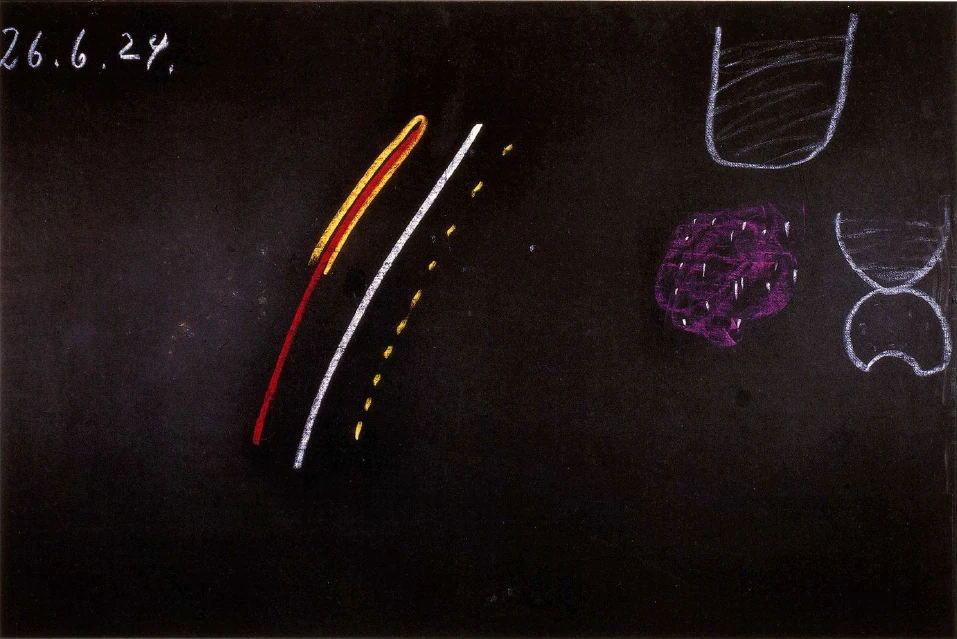
[ 13 ] And where do they come from in the life that first comes into consideration between birth and death? Where are they? Just as the production of milk can be studied, so you must discover where the thoughts are. Where are these thoughts? Now you see, we are surrounded by the physical world. But we are also surrounded by the etheric world, from which the human etheric body is drawn immediately before we descend into our physical incarnation. The human etheric body is, after all, drawn from the universal world ether, which is present everywhere. Now, this world ether, my dear friends, is in reality the bearer of thoughts. This universal ether, which we all share, is the carrier of thoughts; the thoughts are contained within it—those very living thoughts of which I have always spoken to you, even in anthroposophical lectures, and of which the human being partakes in pre-earthly life before descending to Earth. Everything that exists in the form of such thoughts is present in a living state within the world ether and is never drawn from the world ether during the life between birth and death, never; rather, everything that a human being contains within themselves as a store of living thought is received at the very moment they descend from the spiritual world—that is, when they leave their own living element of thought behind—as they descend and form their etheric body. The living thoughts are still present within what forms and organizes the human being.
[ 14 ] So if I repeat yesterday’s diagram (see Plate 2, center)—if you see the human being here, if we have the symptomatic life of the soul—thinking, feeling, willing—here, and if we have the life of the soul, the real life of the soul, behind it—then we have a part of the real life of the soul in our thoughts. — And these thoughts, which we draw from the general world ether, are primarily shaped by our brain and, in a broader sense, by our nervous-sensory system. This is living thought; it shapes our brain into a processing organ—the organ that, in a sense, treats matter in the following way.
[ 15 ] When we look out at our surroundings, we see the substance of the earthly world all around us, in its various processes and modes of action. These processes, which exist in nature, are gradually broken down by the activity of living thought, so that here (see Plate 2) a continuous process of breakdown takes place—that is, the natural processes are halted. Thus, in the brain, the process begins with the halting of natural processes and the continuous shedding of matter. The shed matter—that is, the matter that has been excreted and has become useless—is the nerves. And these nerves, by being processed in this way by living thought—by being continually “killed off”—acquire a capacity similar to the capacity for reflection. Through this, they gain the ability to reflect the thoughts of the surrounding ether, and this gives rise to subjective thinking—superficial thinking that consists solely of mirror images—which we carry within us between birth and death. Thus, by carrying living thought within us as an active force, we are enabled to set our sensory and nervous systems against the world, to produce the impressions that live in the surrounding ether as mirror images, and to project them into our consciousness. So this thinking and formation of mental images of the superficial life of the soul is nothing other than the reflection of the thoughts living in the world ether.
[ 16 ] Now, if you compare yourself to your reflection in the mirror, you will realize that you are something other than that reflection. In the same way, you can compare thoughts to their reflections and thereby perceive that thinking is lifeless, just as the reflection is lifeless in comparison to you, who stand before it as a living being. A distorted, illogical, or crazy thought can never exist in the world ether. But the thoughts that make up ordinary, superficial soul life are, after all, merely the reflections of thoughts in the world ether. Where, then, can a crazy or stubborn thought come from? It is because the mirror—that is, everything that has arisen in the structure of the brain—is not in order. So the point is that we must find our way back, in the right way, from the distorted thoughts to what is actually at work in the human brain or in the sensory-nervous system—what the human being has built up out of a real, living life of thought. From this you can see that it will actually be of immense importance that we proceed from consciousness: we cannot approach the content of thought itself, the actual thoughts, because they exist in the world ether in their absolute correctness.
[ 17 ] We must now do everything we can to ensure that the pupil entrusted to our care can approach this world ether in the proper way. We will never succeed in this unless, as educators, we are truly and deeply imbued with the conviction that the all-pervading vitality of thought is contained within the world ether. Without this cosmic, religious attitude, it will be impossible for us to develop the right attitude toward the child. And this attitude is what matters most. And I want to prove to you why this attitude is what matters.
[ 18 ] What is it, then, that influences the child, that lives within the child, when distorted thoughts arise, and what is it that the educator can do in such a case to influence the child? You see, from what I have said, you can deduce that the etheric body has not been formed properly if something like this is at the root of the matter. Even when a human being descends from pre-earthly existence, there are, of course, only right thoughts in the world ether, but these right thoughts must be absorbed by the one who clothes himself in his etheric body.
[ 19 ] Now let’s return once more to our milk jug. We cannot say that the milk is somehow misshapen: it simply takes on the shape that its container allows it to have. If we have a suitable container, then we have properly accommodated the milk within it. Let’s suppose a contrarian—a truly stubborn one—were to come up with the idea of shaping a milk container like this (see Plate 2, right), and now he pours the milk into it; it can’t flow out. But then he does the math, and when he calculates the cubic volume, he includes—the lower part. That is the most extreme case. You can design the milk jug to be clumsy in every possible way. For example, you could make it so that it tips over, and because the bottom was designed clumsily, the milk would spill out on twenty-seven out of thirty days of the month. So the point is that the milk in the vessel will be just as the vessel itself is. The etheric body, with all its vitality, is present in the human being just as the human being arrives from pre-earthly existence with his karma and is able to take the etheric body into himself. We must be aware of this.
[ 20 ] Well, it is not at all impossible that a person, through his karma, might arrive with something that looks quite similar to this milk jug. If, for example, a person arrives in such a way that, in accordance with their karma, they cannot properly permeate the metabolic limb system, then this system is poorly supplied to the etheric body; and the person then has a properly developed etheric body in the head region, but a poorly developed one in the abdominal and limb regions. He lacks the formative thoughts in these areas. So we must first and foremost be clear that we are dealing with an inadequately developed etheric body in numerous children with inferior mental faculties. And we must ask ourselves: What influences an etheric body that is present during the developmental years of children? What influences an etheric body?
[ 21 ] Here we encounter a pedagogical law that appears in all pedagogy. It is this: whatever the origin, the next higher level is what acts upon any given level of the human being, and it is only through this that effective development takes place. Development toward the physical body can be influenced by a being living in the etheric body, a being living within an etheric body. Only that which lives in an astral body can have an effect on the development of an etheric body. Only that which lives in an “I” can have an effect on the development of an astral body. And only that which lives in a Spirit-Self can have an effect on an “I.” I could continue even further beyond the Spirit-Self, but then we would already be entering into the teaching of the esoteric.
[ 22 ] What does this mean? If you become aware that a child’s etheric body is underdeveloped in any way, you must shape your own astral body so that it can have a corrective effect on the child’s etheric body. We can even say, with reference to the educational framework, that the following can be written here:
| Child: | Teacher: |
|---|---|
| physical body | etheric body |
| etheric body | astral body |
| Astral Body | I |
| I | Spirit-Self |
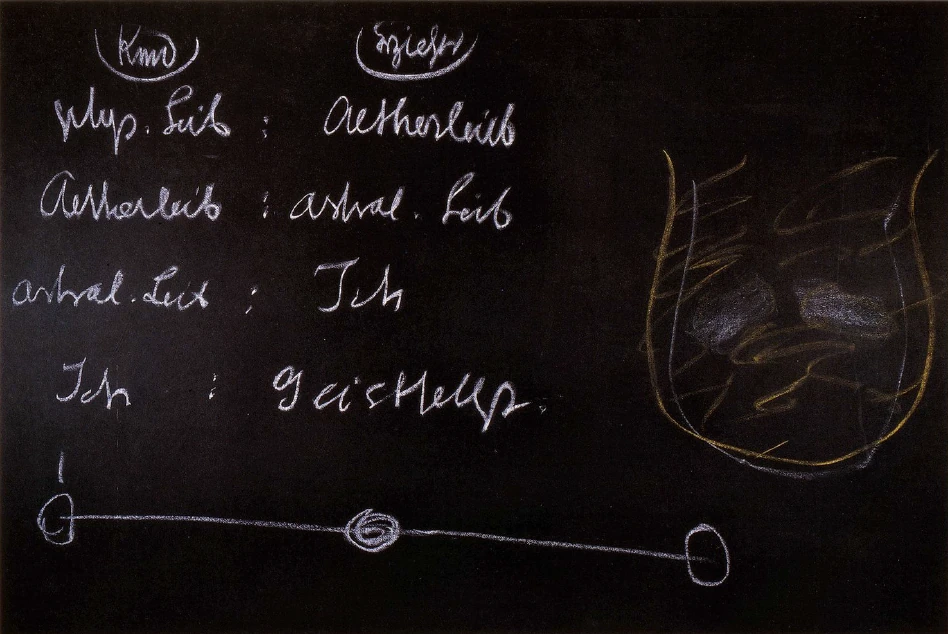
[ 23 ] The educator’s own etheric body must—and this must be achieved through his or her training in seminary—be able to influence the child’s physical body. The educator’s own astral body must be able to act upon the child’s etheric body. The educator’s own “I” must be able to act upon the child’s astral body. And now you will even be startled inwardly, for here stands the educator’s Spirit-Self, which you will believe to be undeveloped. This must act upon the child’s “I.” But that is the law. And I will show you to what extent—not merely in the ideal educator, but often even in the very worst educator—the educator’s Spirit-Self, of which he himself is completely unaware, acts upon the child’s “I.” The art of education is indeed shrouded in a series of mysteries.
[ 24 ] But now it dawns on us that the educator’s healing astral body must act upon the child’s atrophied etheric body. And consider: how can the educator’s astral body be developed—or self-developed—with due regard for precisely these matters, as is still necessary today? For anthroposophy today can only provide inspiration; it cannot establish seminars for everything. The educator’s own astral body must be such that it possesses an instinctive understanding of the atrophies in the child’s etheric body.
[ 25 ] Let us assume that the child’s etheric body has atrophied in the area of the liver. This causes the child to find himself in a situation where he is full of intentions—he always wants to do something—but this desire always stops him just before he acts. If the educator can now empathize deeply with this situation—that one must use one’s will to push through to action—if one can feel this blocking and at the same time develop, out of one’s own energy, a deep compassion for what the child is experiencing internally, then one cultivates an understanding within one’s own astral body for the child’s situation, and one will gradually come to eradicate within themselves every trace of sympathy or antipathy toward this manifestation in the child. By eradicating sympathy and antipathy within themselves, the educator exerts an educational influence on their own astral body. As long as one deals with a characteristic of the child—such as the child wanting to walk but being unable to do so—which can extend into pathological conditions, which can develop into conspicuous conditions; it always escalates into pathological conditions—even, I would say, into quite conspicuous pathological conditions, which are described as the child being unable to learn to walk—as long as one feels sympathy or antipathy toward it when it occurs to a mild degree, as long as one can become agitated by it, one cannot yet educate effectively. Only when one has reached the point where such a phenomenon becomes an objective picture—where one regards it with a certain composure as an objective picture and feels nothing but compassion for it—only then is the soul state present in the astral body that properly places the educator alongside the child. And then the educator will handle everything else more or less correctly. For, my dear friends, you have no idea how indifferent it really is, on the surface, what one says or does not say as an educator, and how crucial it is what kind of person one is as an educator.
[ 26 ] But how does one arrive at such an understanding? One arrives at such an understanding precisely by developing a greater and ever-greater interest in the mystery of human organization as a whole. This mystery—this interest in human organization as a whole—is completely absent from today’s civilization. That is why today’s civilization does not know one thing. Today’s civilization looks upon, let’s say, a person who is severely mentally ill [gap in the text]. Of course, things cannot be any other way; they can only unfold within civilization. Therefore, the things we are meant to comprehend cannot be carried out by us in every single case in the very way we conceive of them. That is why it is of the utmost importance that there be no fanatics among you—no people who are fanatical from the outset and who fail to grasp the full significance of a truth as it relates to matters that are meant to be applied esoterically to practical life. Consequently, the circles within which such matters are communicated cannot be made narrow enough today, because people in today’s civilization cannot grasp why it is necessary, in numerous cases, not to follow the guiding principle. But one must know this and then strive for rationality, applying it where it is indeed to be applied, and—as will be the case in education, with children of limited capacity—applying it within the appropriate limits. You cannot apply it to adults with mental illness, because something irrational intervenes there: the police. The moment one is dealing with impulses in such a matter that differ from those arising from the matter itself—when one is dealing with legislation—the matter becomes unworkable. For legislation is a general principle and cannot be applied to the individual; it can only be general. In all cases, jurisprudence is a veritable poison when it comes to dealing with abnormal people. But that is precisely what you are facing. You cannot apply these principles fanatically; you must allow them to flow into life in whatever way is feasible, as far as possible.
[ 27 ] Suppose, for example, you have a person who is said to be severely mentally ill, and you can describe him—as is customary today—psychographically, that is, in terms of his symptoms: He does the craziest things—according to the view that simply must exist. Yes, but people in today’s civilization don’t even think about what’s actually going on here; they don’t give it any thought. You see, what we’re dealing with here is this: this person, who today behaves as if he were completely insane, may under certain circumstances have been a very significant incarnation in earlier times, having once lived out his genius in a brilliant way. But let’s say this brilliant expression of life took place in a second past incarnation (see Plate 3, below). Then another incarnation would have followed, in which the person in question was imprisoned at a relatively early age, so that he never came into contact with the world at all. Then he passed through death and lived on. Then he reappeared as a madman. Precisely because what he had absorbed during that incarnation remained completely outside the realm of experience of the physical and etheric bodies, he had no opportunity to process it; and so he comes into incarnation in complete ignorance of the inner workings of the human body. He cannot enter the physical and etheric bodies but remains outside them, and because he cannot make use of the physical body, he is, in fact, insane. He expresses himself in such a way that we only see what he truly is when we look entirely beyond his physical and etheric bodies, when we look at his astral body and his “I.”
[ 28 ] Imagine, then, that we have such a person before us as a child. Here we have this constant striving within the child’s being to enter the physical body and the etheric body, and then, in turn, this repulsion. Well, we may well have a situation where—let’s say, schematically, the physical body and the etheric body are here (see Plate 3, right)—there are certain organs that, due to certain preconditions, are not in proper order; the astral body and the “I” want to enter them. They can enter everywhere else, but there (see Plate 3) they cannot enter properly; they have to make an effort each time. Let’s say the astral body and the ego must make an effort each time they are to penetrate the liver and stomach. This effort now has a peculiar effect: something like an abnormal rhythm arises; the effort causes the ego to strengthen at certain moments and then weaken again. And we see, alternately, a strong liver-stomach sensation in the child, and before that has even entered consciousness, a weakened liver-stomach sensation takes its place. And the child constantly oscillates back and forth between this strong liver-stomach sensation and the weakened liver-stomach sensation. As a result, the child is unable to use its body in what is considered the “normal” way. For the body can only be used when this rhythm does not occur—when it ceases—and the astral body and the “I” calmly take possession of the individual organs.
[ 29 ] Yes, but how does one come to understand something like that? One comes to understand something like that precisely when one looks at the whole process something like this.
[ 30 ] Let’s suppose we have a very, very smart person in front of us who, however, is not a watchmaker. But he is forced to repair his watch—which has stopped—by himself. What happens is that, instead of fixing the watch, he completely ruins it. That doesn’t mean he isn’t very intelligent. It’s just that, to a certain extent, his intelligence has failed him due to a lack of mastery over the possibilities—not due to a lack of intelligence. Thus, under certain circumstances, during the descent from pre-earthly existence into earthly existence, genius in general may fail—only that this failure does not occur in such a short time, but rather over the course of one’s entire earthly life.
[ 31 ] But this calls on us all the more to look at what is descending, to look lovingly at what is playing itself out in so-called madness, to look at all the details that play themselves out in madness, and to move beyond the mere symptomatology of the soul’s life—which can lead to psychography— and to look more closely at the karmic connections into which this “mad” person enters, to look more closely at their connection to the outside world, at the life situations they find themselves in—for these life situations are incredibly interesting—to view this more objectively, and then to find this madness extraordinarily interesting and to regard it as a distorted reflection of the highest wisdom, as a door being opened by the spiritual world, which enters precisely only through distorted means; to immerse oneself more and more in finding this interesting—not in a sensational way, but in a deeply inner way—finding the abnormalities interesting. For once an abnormality actually seizes the physical and etheric bodies, what I have hinted at to you occurs: a rhythm arises through the intense unfolding of astral-ego activity, and the physical and etheric bodies are strongly seized, then overcome, then grow weak again; and if one approaches this by meeting it head-on, if one approaches it in such a way that one can observe what occurs at the moment of intense grip, at the moment of weak grip, and if one approaches it oneself with full capacity for love, then what may emerge from this rhythm is that later, when the rhythm has been overcome—precisely in a more intense way than is usually the case— the liver and stomach are affected, a genius of action, of doing, may still emerge from it, whereas otherwise it is left to the course of life between death and new birth to balance these things out. Just think about it for a moment: one must be aware that when raising children with disabilities, one is intervening in what, in the natural course of things, would otherwise take place without intervention—or, in the case of improper intervention, would only take place once the child has passed through the gate of death and is reborn in the next life—thereby deeply interfering with karma. Every time a child with developmental challenges is treated, karma is affected—and, of course, intervention is necessary. It is a proper intervention in karma; certain obstacles must be overcome.
[ 32 ] A few of those who are here and who were in Breslau recently witnessed an example of how certain things can be overcome, which I would like to share with you here so that you may develop the right way of thinking about such matters. During the agricultural course in Breslau, I outlined guidelines for approaching agriculture in the right way. Now, there was also an older farmer attending this Breslau course who is a long-standing member of the Society. Throughout the entire course, he could not shake a certain feeling, and this feeling kept resurfacing in the discussions. He kept saying: “Yes, but if you do that, you’re using occult means to carry out practical tasks. Doesn’t that affect human morality in too intense a way? Couldn’t that also be exploited in an immoral way?”—He simply couldn’t get past this scruples; he sensed black magic in the application of such things. Of course, this becomes black magic if one does not treat it as it must be treated. That is why I once stated quite clearly: “Yes, morality must be present in all these things.” That is why I assume that those who participated in this course did so with the full moral intention of serving humanity and helping agriculture. That is why the Agricultural Ring should also be regarded as a moral ring, whose mission is to ensure that these things are applied correctly. The gods use magic, but the difference between white and black magic lies solely in the fact that in white magic one intervenes in a moral, selfless way, whereas in black magic one intervenes in an immoral, selfish way. There is no other difference. And so, of course, since all talk about the education of children with special needs is mere talk that leads nowhere, this education can only be effective through means that may also cross over into immoral application. Above all, the strengthening of the sense of responsibility comes into play.
[ 33 ] Now I must confess to you frankly, my dear friends, that if we could count on a stronger sense of responsibility in our present time, we could accomplish a great deal. But today, precisely because a strong sense of conscientiousness is not well developed in our time, many things must be kept silent. When people hear, “You can do this, and you can do that,” they want to do it. For they have the desire to do something. But as soon as it comes to actual action—not merely the continuation of past impulses—as soon as it becomes a matter of drawing new impulses from the spiritual world—and these must be drawn—then the primary concern is that a sense of responsibility and conscientiousness must be fostered. This is fostered only when one knows what is at stake. And so one must know that this involves a profound intervention in the karmic processes that would otherwise take place between death and the next birth. In the upbringing of children with special needs, what one does here intervenes in the work of the gods that would otherwise take place later. If one does not merely view this as a theory, but allows it to take firm hold on one’s spirit, one will naturally always be faced with the choice of either doing what is meant to happen or refraining from doing it. But we must not forget: every step taken from within the spiritual world leads a person to look to the left or to the right and to constantly bring about a new decision through the inner courage of life. Ordinary life between birth and death spares a person from the necessity of this inner courage. There, they can continually do what they are accustomed to, what they have grown used to. There, they go about following what lies within them; there, they always regard their own views as the correct ones and have no need to adopt new ones. It is good for a life that unfolds solely in the physical world to remain in that state. But when one comes to act from the spiritual realm, one must feel confronted with decisions daily, hourly; with every action, one must face the possibility of being able to do it, to refrain from doing it, or to remain completely neutral. And these decisions require courage—inner courage. That is the very first condition if one wishes to do anything in such a field. And it awakens only when one constantly keeps the grandeur of these things before one’s eyes: you are doing something that the gods otherwise do in the life between death and the next birth. Knowing this is of the utmost importance. Take this in through meditation. Being able to contemplate this has great significance. If we bring this to mind every day through meditation—just as we pray a daily prayer—and keep it before our soul each day, then this creates within us the state of the astral body that we need in order to face the underdeveloped child in the right way. Only when we believe that we ourselves must prepare ourselves in this way can we speak of further matters. Therefore, let us regard these things as an introduction and give them serious consideration. It all comes down to the right state of mind when one wishes to approach tasks such as those we are discussing here.