

Cooperation Between Doctors and Pastoral Caregivers
Pastoral Medicine Course
GA 318
8 September 1924, Dornach
Translated by Steiner Online Library
First Lecture
[ 1 ] My dear friends! In this course, we have brought together for the first time the members of two spiritual circles, and this union is something quite special. Therefore, even today it will be necessary for us to reach an understanding about the meaning of this union, starting with what is to constitute the content of this course. To begin with, I would simply like to point out that this course will perhaps, more than any other, serve as an example of how, through the unique shaping of spiritual life in our time, old traditions and customs must be renewed; for what has been cultivated under the name of “pastoral medicine” has, in essence, lost its substance. We will see this as our reflections unfold. In contrast, a particularly significant task will emerge precisely from the underlying currents of our time—one that, when synthesized, may already bear the name “pastoral medicine” in a broader context. We have taken great care to ensure that this course essentially brings together genuine theologians and individuals who are, or will become, genuine physicians—physicians in the sense that we can justify this title for them in accordance with the mission of the Medical Section of the Goetheanum. How this concept is to be shaped will be the subject of discussion in this very course. We have, of course, allowed for a few exceptions—but only a few—and these are well-founded within the convictions of the Medical Section of the Goetheanum. Above all, the aim will be for you, dear friends, to gain a clear understanding—from both the theological and the medical perspectives—of precisely what, in the sense of a new pastoral medicine, makes collaboration between theologians and physicians possible. Such collaboration has, of course, been discussed frequently, and it has also been pointed out that the anthroposophical movement, in particular, must count on such collaboration. Yet certain issues have come to light that will need to be clarified within the framework of this course. The collaboration that has been referred to, my dear friends, must by no means be understood as if it meant one side dabbling in the other’s field. It is certainly not a matter of theologians becoming healers, or of healers somehow becoming theologians. Of course, both—insofar as they are healers or theologians. What is at stake is collaboration, working hand in hand. On the other hand, this course in particular will have to place great emphasis on ensuring that everything is not distorted into chaos simply because—I don’t even know what—the theologian tries to dabble in all sorts of medical matters that simply cannot be part of his path. Conversely, the physician, in our view, must become aware of the position he is to take vis-à-vis theologians. An extraordinary amount will depend on this being fully understood on both sides—theological and medical. Well, it has become apparent that, for example, it has also been suggested: Yes, the theologian must, after all, acquire medical knowledge. — One can always acquire knowledge in any field; indeed, it is always good to acquire knowledge. But what is at stake here is that it be clearly and unambiguously understood: according to human thought, feeling, and will, the physician—the healer—requires specific medical training, and no one should believe that they can intervene in the world with medical knowledge if they lack this specific medical training, even if they are a theologian. Conversely, the physician must develop a very special understanding of his profession and will have to learn through pastoral medicine that there is a profound truth in the saying: “To the priest belongs the sacrificial flame; to the physician, the caduceus.” And only through the interplay of the sacrificial flame and the caduceus is fruitful work possible. One should not seek to heal with the sacrificial flame or to celebrate worship with the caduceus. But one must recognize that both are acts of worship. And the more one recognizes that both are acts of worship, the better the collaboration will be—provided the physician remains a physician and the priest remains a priest—as they intervene in the world in a healing manner appropriate to their respective roles. Our anthroposophical movement must not become a breeding ground where everything is thrown into chaotic disarray, for this would undermine the seriousness—the very seriousness that we should be cultivating so strongly within the anthroposophical movement. To use a drastic example, one can certainly have a general understanding of what roughly happens when foot surgery is performed; but one should not believe that one can immediately perform foot surgery oneself. The same principle should apply to all matters of medicine. Above all, anthroposophy must not, in any way, become a form of propaganda for quackery. Nor must it become so by, for example, “theologians becoming quacks.” This very point must be made absolutely clear; and thus what emanates from the Medical Section at the Goetheanum will, with the utmost seriousness, address the question of who can present themselves to the world as healers in the anthroposophical sense—but this must also become a concrete institution, and it will be necessary for the status of any physician who wishes to work in the spirit of the Medical Section at the Goetheanum to be unambiguously defined in relation to this Section. There is no other way but for this institution to become a very real one, so that it may well come to pass that, in a certain sense, a physician in the future will be one who is precisely a physician in the tradition of the Medical Section at the Goetheanum. Well, my dear friends, this will also justify the fact that we have avoided admitting healers who are not physicians to this course. Thus, those sitting here today as physicians can certainly claim to be part of the medical profession in the eyes of the world—essentially, with few exceptions.
[ 2 ] So, my dear friends, we may have reached an understanding on this one point. But since I have discussed it—at first only in passing and in more of an administrative sense—this point, in terms of its justification, will certainly be a subject of pastoral medicine itself. When, some time ago, a suggestion came from the theological side to offer something medical to theologians, I could not help but respond to this suggestion by saying: Well, I will give a course on pastoral medicine, and theologians are welcome to participate. And so this course on pastoral medicine is being organized by the Medical Section of the Goetheanum, and theologians are taking part in it. We must be fully clear about the entire structure of this institution here.
[ 3 ] Well, my dear friends, pastoral medicine was not actually a discipline within the medical school until recently, but rather within the theological school; and this pastoral medicine, which was taught in the theological schools, did not actually contain anything specifically medical. Or let me ask: Has any of the academically trained physicians here been able to study pastoral medicine as part of their degree program in the medical school? Please raise your hand if you have. It does not appear in the medical school’s course catalog, whereas it does play a role in Catholic theological faculties. It hardly plays a role anymore in Protestant faculties, but within the Catholic theological faculty, pastoral medicine does play a role—and for good reason. However, it contains nothing medical. Essentially, it consists of the following: First, what the pastoral caregiver needs in the course of pastoral care to be able to provide pastoral support—not only to those who, as healthy individuals, are entrusted to his care, but also to those who, as the sick, are entrusted to his care. But he must minister; and there is a subtle difference between ministering to a sick person—especially one who is seriously ill—and ministering to a healthy person. The question is how to conduct pastoral care for the sick, possibly those who are seriously ill, and how one should conduct oneself in such situations. In contrast, I have not, in fact, come across a single book on pastoral medicine that does not explicitly and repeatedly state that one of the pastor’s primary duties is to provide advice and assistance in finding the right doctor, but that he must refrain from any medical intervention. I am reporting on this case.
[ 4 ] A second essential aspect of pastoral medicine is that it addresses questions related to the hygienic aspects of religious and ritual practices. For example, the health benefits or harms of ceremonially prescribed fasting have been discussed for the layperson, as well as what medical science has to say—for instance, regarding the practice of circumcision or similar matters. For the priest himself—since we are dealing primarily with Catholic faculties—the hygienic and medical aspects of asceticism have been explained. There is a great deal to be said on this subject.
[ 5 ] Another topic concerns certain measures that must be taken within, say, a parish where there are both a priest and a doctor, in connection with healing and sacramentalism. If a religious community proceeds from the reality of the sacramental effect—we will discuss this further in a moment—this in fact implies something that intersects with the interventions carried out through medical treatments, and in such contexts—such as the sacrament of the Anointing of the Sick, for example—we have a role for the priest to fulfill alongside the doctor at the patient’s bedside. In this area, we must answer the question—or rather, pastoral medicine has answered it thus far—regarding the significance of receiving the Sacrament of the Lord’s Supper after recovering from an illness and the like. When spiritual matters come into play, the interaction between the sacrament and the healing process in human beings certainly comes into consideration.
[ 6 ] Another chapter—and this is a very detailed chapter within pastoral medicine—deals with how the pastor should act in coordination with the physician when dealing with psychopaths, mentally deficient individuals, or those with mental abnormalities. Pastoral care is adapted for such psychopathic individuals. This has essentially been the task that pastoral medicine has set for itself to date, and it has been addressed in considerable detail over the centuries, with constant reference to the relevant passages from the Church Fathers.
[ 7 ] This is an area that, for us who are engaged in a renewal of spiritual life, cannot be viewed in the same light. However, it is precisely from the fundamental anthroposophical views that important—very important—tasks for a new pastoral medicine arise. And to what extent such tasks arise, my dear friends, we can explore by considering the matter from two perspectives. Let us first consider it from the medical perspective.
[ 8 ] What are we dealing with in therapy? When we allow the remedy or the healing process to take effect in a sick person, we are always dealing with the fact that the effect to be produced by a substance or a process—whether physical, mental, or emotional—goes beyond what is known as the normal interaction of the human being with the environment. No matter what therapy we use, we always go beyond what a person does in everyday life—whether in eating, in exposure to light and air, or in exposure to psychological influences—we always go beyond that in therapy. We take even a small step beyond what a person adheres to in their everyday interaction with the environment simply by prescribing a diet. We allow the remedies to take effect on the person. If the remedy is a physical substance, then as a result of its action, a different process takes place than occurs with mere food intake. The same is true, however, for the other therapeutic interventions. However, with a therapeutic measure, we always intervene in the human being in a different way than life initially intervenes in him. For how does life intervene in the human being, or how does he intervene himself? My dear friends, with regard to what initiates processes in the human being in life—or can initiate them—we must distinguish three things: First, that which acts within the human being in the same way as the physical-chemical forces do in the external natural world; second, that which acts within the human being not in a physical-chemical way, but in a vitalistic way. We must consider that which acts in life, but third, we must also consider that which intervenes directly in the realm of consciousness.
1. Physical and Chemical
2. Life
3. Consciousness
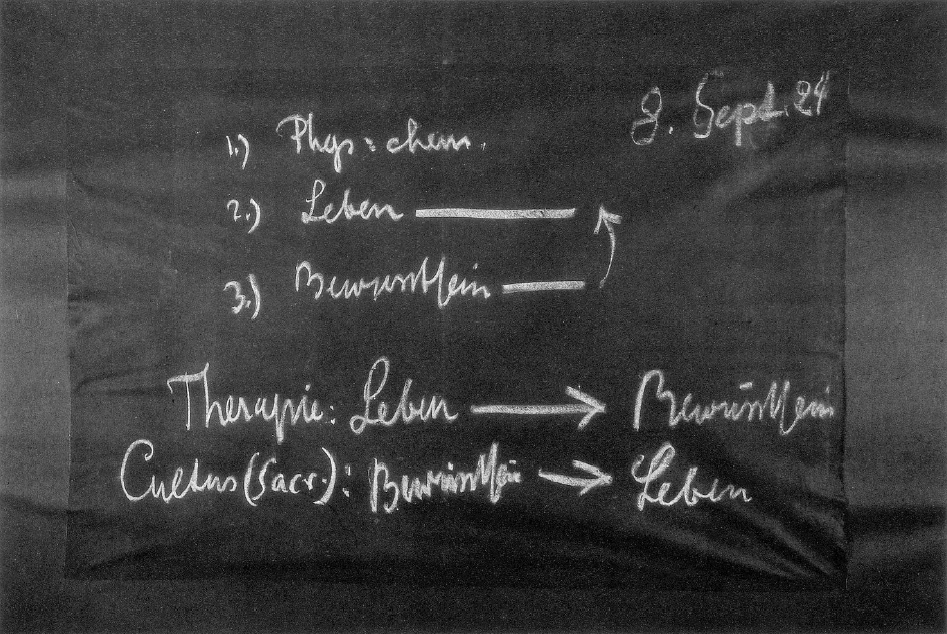
[ 9 ] Here we must define an important concept. In everyday life, we experience the three states of consciousness: waking, dreaming, and sleeping. The moment we apply a truly therapeutic intervention, we intervene in consciousness. We intervene to a greater or lesser extent, depending on the nature of the therapeutic intervention. But this intervention never occurs in such a direct way in the so-called normal course of life. If a person is merely eating—simply engaging in the ordinary act of eating—then, as long as it is merely ordinary eating, their waking, dreaming, and sleeping proceed in the normal way; at most, one might intervene in some way through diet—though the boundary here is already flexible—to influence the organism in order to bring about healthier sleep than currently exists. But that is where the therapeutic aspect begins.
[ 10 ] It is quite a different matter when, for example, a person has a fever due to certain circumstances and you intervene therapeutically. If you were to use the same remedy with which you intervene therapeutically in a case of fever on a healthy person, you would alter that person’s state of consciousness. As a doctor, you must therefore work with what essentially has to do with states of consciousness. Whereas in the ordinary interaction between human beings and their environment one deals with life itself, in medicine one deals with intervening in states of consciousness. You can see this in every therapeutic measure, and it is the specific nature of a therapeutic measure that it intervenes in that which has something to do with the variability of states of consciousness. Nor is there any other effective remedy than one that intervenes so deeply into the human being that it reaches down into the very sources from which states of consciousness arise. In doing so, however, you, as a physician or therapist, place yourself directly within the spiritual order of the world. For a change in states of consciousness means that you place yourself within the spiritual world order. And whenever you achieve a truly effective healing, you always draw the soul into the therapeutic process precisely through this penetration into the states of consciousness—even if it is in the subconscious. You do not remain in the physical realm. Ordinary food intake, ordinary breathing, and other processes remain within the physical realm, and the higher aspects of the human being act indirectly through the physical. They, too, are at work and act through the physical; in contrast, you draw in the soul directly when you act as a physician, when you act therapeutically. Thus we can say: when the physician truly understands his profession, he approaches the spiritual realm directly. It is only an illusion that therapeutic measures appear to us as merely physical or biological processes. If they are truly therapeutic measures—otherwise they never are—they always draw upon the soul, even if this remains unconscious to ordinary consciousness at first. But just once, my dear friends, consider what is actually happening within a person when, for example, a fever is directly reduced through a therapeutic process. The process works its way into the very depths of the person’s being, just as, conversely, the disease process works its way into the very depths of the being, taking the processes within the person beyond the merely physical and biological. That is one aspect. We see how, in an essential sense, the practice of medicine—healing—leads from the physical into the spiritual through one’s own being.
[ 11 ] Let us take the priestly vocation just as seriously. If the priestly vocation is not merely a teaching profession, but if it is lived out in priestly ministry, then it is connected to worship, and worship inherently includes sacramentalism. But sacramentalism is not symbolism. Sacramentalism—what is it? It consists in the occurrence of external processes. These external processes that take place contain within them something that is not reducible to the chemical or biological phenomena occurring there, but rather encompasses orientations and directions that are incorporated into the physical and biological realms and have their origin in the spiritual and mental realms. Sensory processes are carried out into which the spiritual flows as they unfold. The spiritual essence manifests itself in worship in a way perceptible to the senses. And what takes place before the believers unfolds, first and foremost, before their consciousness, and nothing else may take place other than what unfolds before their consciousness. Otherwise, it is not a cult, not a sacrament, but suggestion. Sacramentalism—the cult in the true sense—must never contain any element of suggestion, but it contains all the more of the spiritual. It takes place before consciousness, yet it works its way into life.
[ 12 ] A person does not merely consume the substance offered to him during the Lord’s Supper; if that were the case, it would not be a sacrament. Nor is it a symbol; rather, it is something that intervenes in one’s life, because the sacrament is performed and celebrated in accordance with the orientation of the spiritual world, so that one can say: Therapy brings life into consciousness. The ritual, through sacramentalism, brings consciousness into life.
Therapy: Life —— Consciousness
Worship (Sacrament): Consciousness — Life
[ 13 ] This gives you the two polar activities: therapeutic work and celebration; both are, in fact, polar in nature. In therapeutic work, one works from life into consciousness, and consciousness becomes a collaborator—albeit one that remains unconscious to ordinary consciousness—in the therapeutic process. In celebration, life is made a collaborator in what takes place before consciousness. Both of these, my dear friends—not merely in the schematic way they are now presented to you, but deeply and inwardly grasped spiritually—generally require the whole person when they become a vocation. And only because, within our civilization, we have strayed in therapy from the spiritual and in theology from the concrete—because, within our civilization, we have lost our way in therapy into materialism and in theology into abstraction—is the true relationship today completely obscured. But this true relationship must be rediscovered; it must become effective once more. It must once again become apparent that, just as the physician needs a trained eye even for diagnosis—one that allows a biological or even physical process in the human organism to appear in the light of spiritual processes (for all processes in the human organism are spiritual)—so the physician needs this trained eye not only for diagnosis but even more so in therapy, so that the spiritual may shine through the physical.
[ 14 ] The priest needs a trained eye to perceive the physical manifestation of a spiritual process. Once again, the polar. But polarities must always interact in the world; these two polarities, too, must interact. And how they must interact—that will be precisely the task to be explored within anthroposophy, a task that is also actually carried out within anthroposophy; so that it is conceivable, my dear friends, that from this collaboration within the course on pastoral medicine, the anthroposophical physician of the future can indeed be formed—one who, through his relationship to the spiritual world, can enter into the right relationship with the priest, who in turn is emerging from the movement for Christian renewal. Something quite special will emerge for the physician and for the priest, and from this, the right kind of collaboration can then arise.
[ 15 ] For what, my dear friends, could “collaboration” possibly mean in this case? Collaboration cannot mean that the priest practices medicine as an amateur and the doctor performs priestly duties as an amateur. It cannot mean that. For if “working together” were to consist of the priest knowing a little something about medicine and the doctor participating a bit in the priestly liturgy, then I would like to know why they should work together at all. For why should a doctor, who is trained, be interested in priestly-medical amateurism? There is absolutely no reason for it. And why should the priest take any interest in anything priestly within the medical profession, other than when the doctor needs a spiritual counselor? On the other hand, if the doctor is a competent doctor, well-versed in medicine, and the priest is a true priest, then they can work together. After all, working together means that each contributes what they are competent in, not that one encroaches on the other’s sphere.
[ 16 ] But precisely because such collaboration takes place, precisely because of this, something of the utmost importance for culture will emerge: namely, that it is through this mutual interaction that a true understanding of the doctor by the priest and of the priest by the doctor first arises, so that the priest knows as much about the doctor as he needs to, and the doctor knows as much about the priest’s vocation and mission as he, in turn, needs to know. It will then become clear later to what extent both the doctor and the priest, in collaboration with the educator, can bring about something healing for humanity. But that, in turn, will be a special task. There, too, there will be collaboration—precisely there in the most diverse ways—because, in fact, pedagogy is something that must be viewed from a different perspective. The priest cannot become a doctor, nor can the doctor become a priest, insofar as they are doctors or priests. Both, however, can be educators in a certain sense, but one must understand all forms of this collaboration in a very concrete way. That is why, among the truths that pastoral medicine is meant to convey, I would like to ask you today, first and foremost, to include this one: the warning against chaotic confusion, and the insistence that everything be developed on the basis of genuine, objective, and professional principles. The priest will be a true helper to the actual physician when he works to ensure that medical dilettantism is rejected. This will be part of his duties. And the physician will be able to do many things, especially at the bedside, to give the priest’s ministry its proper place precisely where it must often intervene in life in the most real way: at the bedside.
[ 17 ] We will continue these reflections tomorrow.