

Cooperation Between Doctors and Pastoral Caregivers
Pastoral Medicine Course
GA 318
10 September 1924, Dornach
Translated by Steiner Online Library
Third Lecture
[ 1 ] My dear friends! One gains a deep insight into the entire nature of the human being when one continues a little further with reflections such as those we engaged in yesterday. In particular, one sees the significance of the transition from health to illness precisely in such phenomena. That is why I would like to explain to you in a little more detail the phenomenon that lies between certain pathological paths taken in human development and a kind of natural initiation—a developmental current that lies right in the middle between the pathological currents of human nature and the current of initiation, and is related to both. I would like to elaborate a bit further on this development of the human being.
[ 2 ] Typical of such developments are personalities such as Saint Teresa, whom I mentioned yesterday. One can observe other aspects as well, beyond what I mentioned yesterday, when examining the developmental path of such personalities. In their case, a kind of entry of the spiritual world into the human horizon of perception takes place. Of course, it would be difficult to describe this, because the words we use in everyday language do not actually exist in a form that precisely characterizes these extraordinary states. But what I have to say to you will surely be understandable. What enters their field of vision is described by such individuals in the first stage as “entering the first dwelling of God.” In the first stage, this feels like a mere “presence.” Such individuals find that they do not have precise visions of what they experience as the presence of some spiritual being, but rather—especially as the experience comes to an end—they have a distinct sense that the being in question was there, was with them. This sense of togetherness, taken in a very general sense, is the first stage; and as long as these individuals remain at this stage of their development, they even become resentful when others tell them about visions and revelations, because they believe their own experience is far more profound, far more intimate, and far more genuine. They are so deeply immersed in this experience that they feel: the supernatural must not manifest itself as a vision, but must simply remain a general experience of presence. That is the first point.
[ 3 ] But then these individuals enter the second stage. At this point, they begin to describe truly vivid perceptions of the spiritual beings present. Specifically, they first speak of sensations of touch, of spiritual laying on of hands, or even of a touch on the forehead and the like, without any vision reminiscent of visual perception being present at first. But these states then intensify until they reach a vision reminiscent of visual perception. They can intensify to such an extent that such an individual, for example, sees Jesus standing before them as if he were a real person. This is generally the second stage. What is peculiar is that when such individuals transition from the first to the second stage, they do not have a strong sense that, when someone else had previously told them about this second stage, they had become resentful. This sharp, memory-based connection between the two stages is absent. The individuals experience each individual stage with great intensity.
[ 4 ] The third stage that such individuals then experience is remarkable. In the accounts of these people, this third stage is, in fact, vividly described in every respect. These individuals describe how, when the experience occurs, they go through something immensely painful. So painful, in fact, that when these individuals can be observed during this experience, the experience of pain manifests itself in the same way—through groaning and so on—as pain that has its causes in the physical and etheric bodies does in everyday life. But what is peculiar is that these individuals, so to speak, come to desire this pain and regard it as something they want, because they consider it natural to attain the experience in the proper way by passing through the pain.
[ 5 ] Then they work themselves up to the point where they transform the pain internally. This is the particularly interesting stage: by remaining exactly as it is, the pain is heightened into a sensation of pleasure, even a feeling of bliss. The experience unfolds as follows: the pain sets in, its objective reality remains the same, but the process now continues in the spiritual realm. If the person were immediately brought back out of the spiritual realm, she would feel the pain just as a sick person does; she does so, too, when she returns from the highest stage of the experience. But in the highest stage of the experience, where they no longer have the feeling that the spiritual being is coming to them, but rather have risen into the spiritual world—in this stage, the pain is transformed—one might say “subjectively,” though the terms are not entirely accurate—into a feeling of bliss. And then the objectification—the symbolic objectification of the pain—sets in. So that such a person, when she returns from the experience and has the memory—and especially with this peak experience, there is usually a clear memory; it is not a state of amnesia, but rather, in most cases, a very clear memory—so that such a person describes: A seraphim or a cherubim stood at her side, holding a sword, which he thrust into her entrails, causing terrible pain; and as he pulled it out, he pulled her entrails out with it, and immediately after that had happened—this pulling out of the entrails—the most blissful experience in the presence of God took place.
[ 6 ] You see, these are generally the successive stages. We can now trace these successive stages quite precisely through what is known as anthroposophical knowledge. For, you see, the first stage consists in the ego-organization, once the preliminary stage I described yesterday has passed—that is, once the second stage has begun in yesterday’s sequence of drawings—the “I” organization draws the astral body toward itself and experiences it together with it, without this connection between the “I” organization and the astral body normally penetrating deeply into the physical body and the etheric body. So that what can never occur in ordinary consciousness actually takes place in such individuals—in a half-awake, quarter-awake, or three-quarters-awake state—as an experience that exists in its own right and unfolds within the “I”-organization and the astral body, while the experience of the etheric and physical bodies proceeds alongside it with a certain degree of independence. Thus, experiences run parallel: a spiritual experience that takes place within the “I”-organization and the astral body, and which is merely accompanied by the experience of the etheric body and the physical body. This is never the case in normal consciousness, because in normal consciousness all four members of the human being are very intensely connected, so that there are no such parallel experiences. Everything is interconnected there. In this experience, in the most eminent sense, the nature of the sensation—the entire nature of the experience—is such that the person knows themselves to be one with what they are experiencing. First and foremost, they experience this oneness as their primary experience; for when the astral body is drawn toward the “I”-organization and experiences spiritual entities, it experiences them as a presence—they are simply there. One experiences it roughly the same way one experiences one’s own body. One does not differentiate in perception; one does not experience it as something external; one experiences oneself as one—that is the first thing. This is the “experience of presence.”
[ 7 ] Now let us move on to the second stage. This becomes interesting because the individual in question first experiences all sorts of tactile sensations that can very easily—and quite naturally—be confused in ordinary pathology with what is also known in psychiatry, but which are not quite the same thing. These sensations then intensify into actual visions. This is the stage where the ego-organization and the astral organization also take on the etheric body, so that a parallel experience occurs in which the ego-organization, the astral organization, and the etheric body experience things together, somewhat detached from the physical body, while the physical body carries out its own processes in parallel. This gives rise to something special. When we look with our eyes in ordinary life, the process is such that we are stimulated from the outside by light, and we take this stimulus further inward. The stimulus then reaches the etheric body, and from the etheric body it creates the experience of consciousness. This is also the case with the eye, for example. When you see, the first stimulus—the external stimulus—is first aroused in the “I,” penetrates the astral body, reaches the etheric body, and it is the etheric body that then conveys the entire experience of consciousness to the person by, so to speak, pushing in all directions against the physical organism. The experience of consciousness lies in this interaction. That is the exact process. The process in the eye, depicted schematically, would be something like this (see drawing): the stimulus is applied, acts first in the “I,” passes into the astral body, into the etheric body; what acts in the etheric body pushes in all directions into the physical body; the physical body pushes back; and the pushback from the physical body is the actual visual experience. It is a continuous interplay between the etheric body and the choroid and retina. What the etheric body does in the choroid and retina is precisely what appears in ordinary consciousness as the visual experience. The same is true of every sensory perception. For those who see through these things, every description found in contemporary psychology—or even in theories of knowledge—is a terrible childishness.

[ 8 ] Now you see, in the case of such personalities as I have described to you, the etheric body is directly affected by the experience. The experience is situated in the “I,” in the astral body, in the etheric body; it does not now impinge upon the senses, but rather impinges from within upon what constitutes the nervous-sensory system—actually, it first impinges upon the endocrine system, then upon the nervous system, and only from there does it radiate into the senses, so that the senses are affected in a manner that is polar opposites to how they are in ordinary life. Instead of the experience of consciousness being aroused through the senses, it is colored, intensified, and made vivid by radiating from within toward the senses. As a result of this radiation, sensations of touch arise in the sensory nerves. This intensifies until it becomes a vision. You now see the entire inner process.
[ 9 ] As development continues, it simply follows its course; then the ego-organization, the astral body, and the etheric body will seek to take hold of the physical body from an entirely different direction than is usually the case—a body that is not accustomed to being influenced from within, but rather from without. It is now to be taken hold of from within. The same process is to take place in the midst of life—a process that normally occurs only when the human being’s spiritual-soul organization descends from the spiritual-soul world into the physical body three weeks after conception. This process cannot otherwise take place in ordinary life because the etheric body is connected to the physical body. Now the etheric body is lifted out of the “I” organism and taken hold of by the astral body. It is like at birth, when one takes possession of the physical body, and now the process continues, and one seeks to approach this physical body from an entirely different angle. This causes pain. For in fact, even in cases of illness, every pain consists in the body being approached in a different direction than in the usual way. But this happens at the very moment the third stage is reached. Now, it should come as no surprise to you that this third stage objectifies itself, that it penetrates the physical body, which resists it—a body that cannot be grasped in this way without proper initiation, and which, in the absence of proper initiation, inevitably resists and thus causes pain. Through pain, it repels what it experiences. This is the first stage of experience that exists in relation to this third stage. The physical body offers resistance; this resistance manifests itself as pain. What penetrates through the pain? Through the pain, the true spiritual world penetrates. It comes through the pain. The spiritual world comes precisely from the other side. On the side of ordinary sensory perception and ordinary thinking lies the apprehension of the physical world. The spiritual world is apprehended in the opposite way. The path to it leads through pain. But at the very moment when the physical body offers resistance, intense pain is indeed present; yet at the moment when the pain is embraced by the spiritual world—when the spiritual world penetrates it—the pain is transformed into a feeling of bliss. It is indeed so. At first, the pain is present in the organism, but the spiritual world penetrates the pain, flows through it: a cherubim or seraphim appears—so the imagination suggests—thrusts its sword into it, draws it out—which means that one becomes independent of the physical body, as one usually experiences it—by drawing the intestines along with it. One no longer experiences within the intestines but has passed over to experiencing the spiritual. Physical pain is transformed into bliss. People speak of the presence of God, or, if they differentiate, of the presence of the spiritual world.
[ 10 ] This final stage is experienced by those individuals whose etheric bodies are strong enough to endure the entire process. It occurs in these individuals precisely because it is rooted in their karma. Take, for example, a personality such as Saint Teresa. She comes from a previous incarnation in which her soul became particularly strong—very strong indeed. She incarnates as Saint Teresa. Before taking on the physical body at the time of incarnation, she takes on the etheric body in an intense manner. It becomes stronger and, in terms of inner quality, more intense than in ordinary people. She carries this inwardly strengthened, qualitatively enhanced etheric body within herself. This qualitatively enhanced etheric body protrudes correspondingly from the physical body; it binds itself strongly to the astral body and to the “I,” because these, too, are strong in themselves as a result of a previous incarnation. And that is, in fact, the reason why illnesses—at least a certain kind of illness—arise: because the etheric body does not remain attached to the organs when the vitalizing nourishing forces are present within the etheric body. However, what happens to such people at the very moment they have these experiences—from the perspective of physical human observation—when the experience enters the third stage, is that they actually become ill, But at the same time, the etheric body is strong and still manages, in the nascent stage of becoming ill, to overcome the illness again, so that the process taking place here is one in which the illness arises in its nascent stage, but at the same time, self-healing therapy emanates inwardly from the strong etheric body. The entire process is a latent process of becoming ill and healing. This is one of the most fascinating aspects of human development.
[ 11 ] Especially in the case of a personality such as Saint Teresa, you can see, in the final stage of her development, a continuous cycle of illness—always in the making—and continuous healing. This interplay, this pendulum swing—this wondrous pendulum swing between falling ill and healing—does not, of course, take place in the physical world, for it is not meant for that world; rather, it takes place in the spiritual world. Isn’t it true that when the etheric body is formed before earthly incarnation, it takes on its shape? A personality such as Saint Teresa is transported back to that moment. But by evoking the pathological state in the “status nascendi,” she ascends into the world where she was before birth—that is, into the spiritual world. The swing of the pendulum is the descent into the physical body and the ascent into the spiritual world. Spiritual world—physical world, spiritual world—physical world, but experiencing the physical world in polar opposition to how one otherwise experiences it—just as one otherwise experiences it only upon entering incarnation. This inner healing process, this therapeutic process unfolding from the universe itself, is so intense that it can indeed have a contagious effect on sick people in the vicinity of such personalities, provided their illness lies to some extent in the direction in which the whole process is taking place, so that the most miraculous healings can indeed occur in the presence of such personalities.
[ 12 ] Yes, this can go much further, and in the older, better times of the Church, these things—which later degenerated into a superstitious veneration of relics and magical practices—were used in a subtle, esoteric way. For it is indeed true that in the better times of religious development, vivid biographies—so vivid as to reach into the realm of imaginative description—of such personalities were presented to the faithful, so that they could immerse themselves in the full imagery of these figures. And it could happen—I do not mean to say that it always happened, but it could happen—that when a wise guide was present in such a matter, he would simply place this intensely imaginative biography into the hands of a person living an ordinary life whose illness was progressing in a certain direction, perhaps reinforced by his own words. And through this, healing processes could also take place, so that even the act of directing the mindset of such individuals toward the life of such a saint has therapeutic significance.
[ 13 ] You see, it is precisely these reflections—which penetrate so deeply into the human being—that always lead from a healthy state into a diseased state, but into the state of supersensory experience. That is why, if you ever advise someone to do exercises in order to enter the supersensible world in some way, then these exercises must be oriented in such a way that they strengthen and invigorate the ego-organization, the astral body, and the etheric body, so that a process such as the one I have described—one that is simply determined by the karma of the individual in question—can indeed unfold in the proper manner. What actually takes place in initiation can already be studied by examining processes that border closely on the pathological. Therefore, it is by no means of minor importance for the physician to take the time to study the lives of such individuals, for it is precisely in the lives of such individuals that he finds what can really only be expressed through a paradox. In the lives of such individuals, the physician finds the healthy counterpart to a pathological symptom complex that occurs here and there, and for the physician, there is nothing more fruitful than observing the healthy counterpart to a pathological process. This is what, from an inner, esoteric perspective, provides the deepest insight into the practice of therapy. Add to this the recognition, for example, of the material-substantial, which can act as a remedy through its kinship and affinity with certain forces of the etheric body that become active in self-regulation in such abnormal personalities; one thus comes to understand how the etheric body of Saint Teresa developed forces when the disease arises in its nascent stage, and when one becomes acquainted with the healing forces alongside the petty forces acting in antimony, then one has read the therapeutic process directly from nature itself.
[ 14 ] One might say that what is remarkable and paradoxical about contemplating such experiences is that one learns to view the illness from the other side—from the perspective from which spiritual beings manage illnesses, not the human being. For one way of dealing with illness is the one that people develop in response to it; that is one way. That is the approach from the earthly perspective. It consists in restoring, through therapy, the balance that eliminates the illness. The spiritual beings who deal with human beings handle illnesses differently. They weave the illness into the web of karma. That is their business. Admittedly, it is a business that does not link things as closely as they are connected through pathology here on Earth. Here, one cannot heal a person who falls ill at seventeen by the time they are forty-five. But with regard to the shaping of karma, it is indeed the case that whatever unfolds as a disease process in any given incarnation—whether it is healed or not—is woven into karma, though perhaps in three thousand years, for time has entirely different scales within the spiritual world. But one learns a great deal from those processes in which what, from a spiritual point of view, can already occur in the spiritual world, can then also radiate down into the physical world.
[ 15 ] You see, take a process such as the one I have just described to you, one that might unfold over the course of three thousand years in the ordinary course of evolution. I want to use this line to indicate that whatever is happening to human beings today is shaped by the spiritual beings in such a way that the corresponding counterbalancing factor will occur in three thousand years. That is the normal process. But you see, in everyday life, our understanding of time is very imprecise. How do we imagine time in everyday life? As a line running from past infinity through the present into the future. That is roughly the mental image of time—though it is a thick line, not a line but a thick rope, for it contains everything one perceives in the world, all at once in every single moment of the present. That is how one forms a mental image of it, if one forms a mental image at all. Most people do not form a mental image of it at all. From a spiritual perspective, things are not like that. And it is difficult to gain an understanding of spiritual processes—which are, after all, contained within all physical processes—if one can only form a mental image of time in this way.
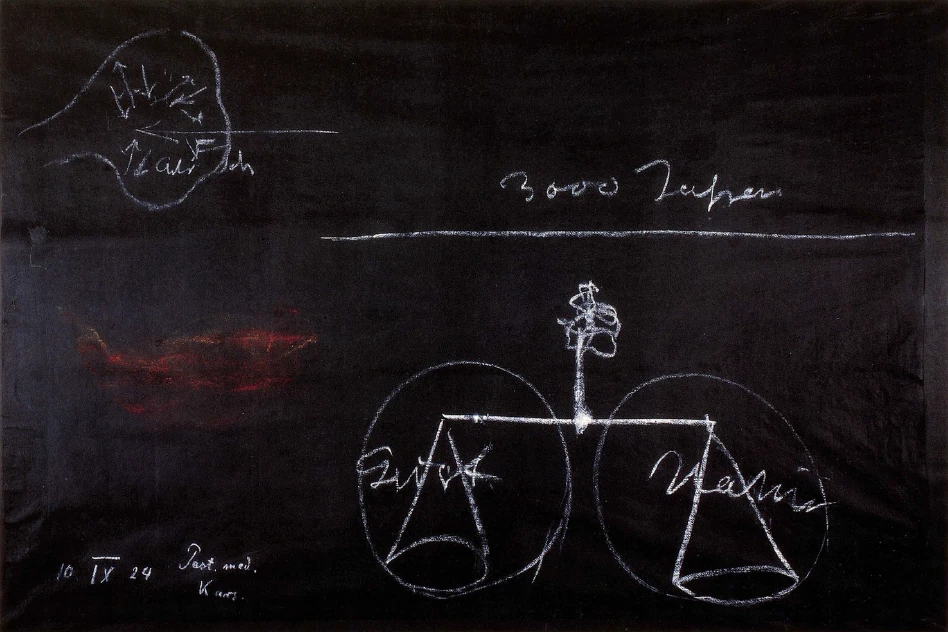
[ 16 ] But time isn’t really like that; rather, the entire thread I drew on the board can become tangled into a ball. The entire timeline is contained within this ball—three thousand years are contained in a single ball. Time can become tangled, and when it becomes tangled—this time—for the sake of some kind of evolution, then that tangle can live within a human being. In the case of Saint Teresa, a tangled time lived within her earthly life. That is actually the mystery: that things which would otherwise be far apart in karma are brought together. (See drawing.)
[ 17 ] Here, then, you can see how, when approaching such a phenomenon, the inner, spiritual, karmic perspective is linked to the outer, pathological-therapeutic perspective. But here you see how the priestly treatment of the human being—who must, after all, maintain a perspective on karmic connections and on the spiritual—can intersect with that which can be understood solely from a medical standpoint. For understanding such things requires not only theoretical knowledge but also living within them. The physician is to live within these things from the perspective that opens up from the pathological-physiological realm. The priest is to live within these things from the perspective that arises from the theological-karmic standpoint. And through their cooperation, harmony will then arise—this must always be kept in mind—not through an amateurish mixing of the two.
[ 18 ] You see, there is something else connected to these matters, particularly in our time. You know, my dear friends, how frustrating it is for a person to grasp an idea that is actually self-evident to the unbiased mind—and which is denied because the philosophers’ intellect cannot grasp it: the idea of free will. I said this about sensory perceptions: the things written in works of physiology and psychology seem childish to those who see through them. But the drivel spouted about the idea of free will is even more so. For you must bear in mind that the act of free will at every moment is an effect of the entire human being—the entire human being, as it lives out its existence—whether healthy, sick, half-sick, or super-healthy—in the impulse of free will. The entire human being is contained within the impulse of free will, but with everything that can be seen through in the whole human being, with all its complexities, it is contained within it. One only comes to know human nature when one learns to recognize it within this complexity. And you see, what takes on an abnormal hue in one direction or another in abnormal personalities is suspended and united in harmony within every human being. It is a trite saying, but it is true: just as a person is open to the cherubim, so too is he open to the devil. And we will also study these processes in which a person is open to the devil. But all of this is present in the ordinary person as well; it is just that the opposing forces cancel each other out because they develop with equal strength in a wide variety of directions. If there is an angel in everyone, then there is also a devil in everyone. But when the angel and the devil are equally strong in any given matter, they cancel each other out.

[ 19 ] Now look at this balance (see diagram). There is a point—this one here. You can place weights here, and the whole thing can start moving. This part, the hypomochlion, always remains at rest; it is not affected by what you place on the left or on the right. But the mechanism must be designed so that it does not need to be touched. A similar spiritual hypomochlion is brought about in human beings by opposing forces. You can therefore study human nature. You will find no reason anywhere to characterize human beings as free beings, for in human nature, everything is causally determined. Study human nature with a materialistic mindset: you will not arrive at the idea of freedom; you will arrive at causal determination. But you can also study human beings spiritually. You will arrive at the determination of the will by the Deity or spiritual beings, but you will not arrive at free will. You can be a crude materialist who denies freedom and studies the natural causality of the will; you can be a subtle thinker like Leibniz who focuses on the spiritual: in either case, you will arrive at determinism. Of course, as long as you study the weighing pan with the balance beam here, you arrive only at motion; as long as you study the weighing pan with the balance beam here, you also arrive only at motion. So it is when you study human beings according to nature, and so it is when you study human beings according to the spirit. You do not arrive at freedom. It lies right in the middle, at the point of equilibrium between the two.
[ 20 ] That is the theory. But in practice, when you are faced with a person standing before you in a difficult life situation, you must decide whether you can hold him responsible for his actions. This raises the practical question of whether he is capable of exercising his free will or not. How can you determine this? By being able to assess whether their mental and physical constitution are in balance. In both cases, both the doctor and the priest may be called upon. Therefore, the training of both the doctor and the priest must include an understanding of the state in which a person is either in balance between mind and nature, or in which this balance is disrupted.
[ 21 ] No judgment regarding a human being’s sense of responsibility can ever be made without a profound understanding of human nature. The question of freedom, in connection with the question of responsibility, is indeed one of the deepest conceivable.
[ 22 ] We’ll pick up where we left off tomorrow and continue from there. We’ll see what leads toward health on the one hand and toward pathology on the other.