

Cooperation Between Doctors and Pastoral Caregivers
Pastoral Medicine Course
GA 318
10 September 1924, Dornach
Translate the original German text into any language:
Versions Available:
Pastoral Medicine Course, tr. SOL
Dritter Vortrag
Third Lecture
[ 1 ] Meine lieben Freunde! Man sieht in die ganze Wesenheit des Menschen dann tief hinein, wenn man solche Betrachtungen, wie wir sie gestern angestellt haben, noch ein wenig fortsetzt. Insbesondere sieht man das Bedeutungsvolle des Überganges von Gesundheit zur Krankheit gerade an solchen Erscheinungen. Deshalb möchte ich Ihnen die Erscheinung, die da steht zwischen gewissen pathologischen Wegen, die in der menschlichen Entwickelung eingeschlagen werden, und zwischen einer Art naturgemäßer Einweihung als Entwickelungsströmung, die zwischen pathologischen Strömungen der menschlichen Natur und zwischen der Einweihungsströmung mitten drinnen liegt, und sowohl mit dem einen wie mit dem anderen verwandt ist, solche Entwickelung der menschlichen Wesenheit möchte ich Ihnen noch etwas auseinandersetzen.
[ 1 ] My dear friends! One gains a deep insight into the entire nature of the human being when one continues a little further with reflections such as those we engaged in yesterday. In particular, one sees the significance of the transition from health to illness precisely in such phenomena. That is why I would like to explain to you in a little more detail the phenomenon that lies between certain pathological paths taken in human development and a kind of natural initiation—a developmental current that lies right in the middle between the pathological currents of human nature and the current of initiation, and is related to both. I would like to elaborate a bit further on this development of the human being.
[ 2 ] Typisch für solche Entwickelungen sind solche Persönlichkeiten, wie eben gerade die gestern erwähnte heilige Theresia. Man kann noch anderes beobachten, als ich gestern erwähnt habe, wenn man den Entwickelungsweg solcher Persönlichkeiten beobachtet. Bei ihnen findet statt eine Art Hereintreten der geistigen Welt in den Wahrnehmungshorizont des Menschen. Natürlich wäre die Schilderung schwierig, weil man die Worte, die man gebraucht, nicht eigentlich so hat in der gewöhnlichen Sprache, daß sie diese abnormen Zustände ganz genau charakterisieren. Aber es wird ja verständlich sein dasjenige, was ich Ihnen zu sagen habe. Das, was hereintritt in den Gesichtskreis, wird in dem ersten Stadium von solchen Persönlichkeiten genannt: der Eintritt in die erste Wohnung Gottes. In dem ersten Stadium wirkt das wie eine bloße «Anwesenheit». Solche Personen finden, daß sie keine genauen Gesichte etwa haben von demjenigen, was sie als Anwesenheit irgendeiner geistigen Wesenheit erleben, sondern sie haben, namentlich wenn das Erlebnis zu Ende geht, ein deutliches Empfinden davon, daß die betreffende Wesenheit da war, mit ihnen zusammen war. Das Zusammensein ganz im Allgemeinen gehalten, das ist das erste, und solange die betreffenden Persönlichkeiten in diesem Stadium ihrer Entwickelung sind, werden sie sogar unwillig, wenn ihnen ein anderer von Visionen und Gesichten erzählt, weil sie die Meinung haben: ihr Erlebnis ist ein viel innigeres, ein viel intimeres und wahreres. Sie sind in diesem Erlebnis so darinnen, daß sie die Empfindung haben: Das Übersinnliche darf nicht bis zum Gesicht kommen, sondern es muß bloß wie ein allgemeines Erlebnis der Anwesenheit dastehen. Das ist das erste.
[ 2 ] Typical of such developments are personalities such as Saint Teresa, whom I mentioned yesterday. One can observe other aspects as well, beyond what I mentioned yesterday, when examining the developmental path of such personalities. In their case, a kind of entry of the spiritual world into the human horizon of perception takes place. Of course, it would be difficult to describe this, because the words we use in everyday language do not actually exist in a form that precisely characterizes these extraordinary states. But what I have to say to you will surely be understandable. What enters their field of vision is described by such individuals in the first stage as “entering the first dwelling of God.” In the first stage, this feels like a mere “presence.” Such individuals find that they do not have precise visions of what they experience as the presence of some spiritual being, but rather—especially as the experience comes to an end—they have a distinct sense that the being in question was there, was with them. This sense of togetherness, taken in a very general sense, is the first stage; and as long as these individuals remain at this stage of their development, they even become resentful when others tell them about visions and revelations, because they believe their own experience is far more profound, far more intimate, and far more genuine. They are so deeply immersed in this experience that they feel: the supernatural must not manifest itself as a vision, but must simply remain a general experience of presence. That is the first point.
[ 3 ] Dann aber treten diese Persönlichkeiten in das zweite Stadium ein. Da erzählen sie nun schon von wirklich bildhaften Wahrnehmungen der anwesenden geistigen Wesenheiten. Namentlich erzählen sie zunächst von Berührungsempfindungen, von geistiger Handauflegung oder selbst Stirnberührung und dergleichen, ohne daß zunächst eine an die Augenwahrnehmung erinnernde Vision da ist. Aber die Zustände steigern sich dann bis zu dieser an Augenwahrnehmung erinnernden Vision. Sie können sich so steigern, daß eine solche Persönlichkeit zum Beispiel Jesus wie in wirklicher Person vor sich sieht. Das ist in der Regel das zweite Stadium. Es ist das Eigentümliche, daß solche Persönlichkeiten, wenn sie aus dem ersten in das zweite Stadium eintreten, keine starke Empfindung davon haben, daß, wenn ihnen ein anderer von diesem zweiten Stadium erzählt hat, sie früher unwillig geworden sind. Diese scharfe erinnerungsgemäße Verbindung der zwei Stadien ist nicht da. Die Persönlichkeiten leben ganz intensiv in den jeweiligen einzelnen Stadien.
[ 3 ] But then these individuals enter the second stage. At this point, they begin to describe truly vivid perceptions of the spiritual beings present. Specifically, they first speak of sensations of touch, of spiritual laying on of hands, or even of a touch on the forehead and the like, without any vision reminiscent of visual perception being present at first. But these states then intensify until they reach a vision reminiscent of visual perception. They can intensify to such an extent that such an individual, for example, sees Jesus standing before them as if he were a real person. This is generally the second stage. What is peculiar is that when such individuals transition from the first to the second stage, they do not have a strong sense that, when someone else had previously told them about this second stage, they had become resentful. This sharp, memory-based connection between the two stages is absent. The individuals experience each individual stage with great intensity.
[ 4 ] Bemerkenswert ist das dritte Stadium, das dann solche Persönlichkeiten erleben. Dieses dritte Stadium erfährt tatsächlich in der Schilderung solcher Personen etwas nach allen Richtungen hin scharf Koloriertes. Diese Persönlichkeiten erzählen davon, wie sie, wenn das Erlebnis kommt, ungeheuer Schmerzvolles durchmachen. So Schmerzvolles, daß ja in der Tat, wenn diese Persönlichkeiten beobachtet werden können während dieses Erlebnisses, das Schmerzerlebnis sich in derselben Weise auslebt als Stöhnen und so weiter, wie sich Schmerzen, die im physischen Leib und ätherischen Leib ihre Ursachen haben, eben im Leben aussprechen. Aber das Eigentümliche ist, daß diese Persönlichkeiten, sagen wir, dazu kommen, sich diesen Schmerz zu wünschen und ihn als etwas betrachten, das sie haben wollen, weil sie als naturgemäß ansehen, das Erlebnis in der richtigen Weise zu erlangen im Durchgang durch den Schmerz.
[ 4 ] The third stage that such individuals then experience is remarkable. In the accounts of these people, this third stage is, in fact, vividly described in every respect. These individuals describe how, when the experience occurs, they go through something immensely painful. So painful, in fact, that when these individuals can be observed during this experience, the experience of pain manifests itself in the same way—through groaning and so on—as pain that has its causes in the physical and etheric bodies does in everyday life. But what is peculiar is that these individuals, so to speak, come to desire this pain and regard it as something they want, because they consider it natural to attain the experience in the proper way by passing through the pain.
[ 5 ] Dann steigern sie sich dazu, daß sie den Schmerz innerlich verwandeln. Das ist das ganz besonders interessante Stadium: es wird der Schmerz, indem er genau in der Tatsache so bleibt, wie er ist, zum Lustgefühl, bis zum Wonnegefühl gesteigert. Das Erlebnis geht also so, daß der Schmerz eintritt, der objektive Bestand derselbe bleibt, aber jetzt geht es im Geistigen weiter. Würde man die Person gleich wieder herausversetzen aus dem Geistigen, würde sie den Schmerz so spüren wie ein Kranker das tut; sie tut das auch, wenn sie wieder zurückkommt aus dem Höchststadium des Erlebnisses. Aber in dem Höchststadium des Erlebnisses, wo sie nicht mehr das Gefühl hat: die geistige Wesenheit kommt zu ihr, sondern sie hat sich erhoben in die geistige Welt, in diesem Stadium verwandelt sich - man würde sagen: subjektiv, aber die Ausdrücke stimmen nicht ganz — der Schmerz bis ins Wonnegefühl hinein. Und dann tritt die Verobjektivierung, die symbolische Verobjektivierung des Schmerzes ein. So daß eine solche Persönlichkeit dann, wenn sie wieder zurückkommt aus dem Erlebnis und die Erinnerung hat — und gerade bei diesem Höchsterlebnis ist zumeist eine deutliche Erinnerung vorhanden; es ist nicht eine Erinnerungslosigkeit, sondern zumeist eine sehr deutliche Erinnerung vorhanden -, so daß eine solche Persönlichkeit schildert: Ein Seraphim oder ein Cherubim stand an der Seite von ihr, hatte ein Schwert, das stieß er ihr in die Eingeweide, das verursachte einen furchtbaren Schmerz; und indem er es herauszog, zog er die Eingeweide mit heraus, und gerade nachdem das eingetreten wäre, dieses Herausziehen der Eingeweide, wäre das höchst wonnevolle Erleben in der Gegenwart des Gottes erfolgt.
[ 5 ] Then they work themselves up to the point where they transform the pain internally. This is the particularly interesting stage: by remaining exactly as it is, the pain is heightened into a sensation of pleasure, even a feeling of bliss. The experience unfolds as follows: the pain sets in, its objective reality remains the same, but the process now continues in the spiritual realm. If the person were immediately brought back out of the spiritual realm, she would feel the pain just as a sick person does; she does so, too, when she returns from the highest stage of the experience. But in the highest stage of the experience, where they no longer have the feeling that the spiritual being is coming to them, but rather have risen into the spiritual world—in this stage, the pain is transformed—one might say “subjectively,” though the terms are not entirely accurate—into a feeling of bliss. And then the objectification—the symbolic objectification of the pain—sets in. So that such a person, when she returns from the experience and has the memory—and especially with this peak experience, there is usually a clear memory; it is not a state of amnesia, but rather, in most cases, a very clear memory—so that such a person describes: A seraphim or a cherubim stood at her side, holding a sword, which he thrust into her entrails, causing terrible pain; and as he pulled it out, he pulled her entrails out with it, and immediately after that had happened—this pulling out of the entrails—the most blissful experience in the presence of God took place.
[ 6 ] Sehen Sie, so sind in der Regel die aufeinanderfolgenden Stadien. Wir können nun diese aufeinanderfolgenden Stadien recht genau verfolgen mit demjenigen, was anthroposophische Erkenntnis ist. Denn, sehen Sie, das erste Stadium besteht ja darin, daß die Ich-Organisation, nachdem das Vorstadium, das ich gestern beschrieben habe, vorüber ist, in der gestrigen Aufeinanderfolge der Zeichnungen also das zweite Stadium begonnen hat, daß die Ich-Organisation den astralischen Leib an sich zieht und mit ihm zusammen erlebt, ohne daß diese Verbindung von Ich-Organisation und astralischem Leib normal tief eingreift in den physischen Leib und in den Ätherleib. So daß, was im gewöhnlichen Bewußtsein nie vorkommen kann, eigentlich bei solchen Personen in einem halbwachen oder viertelswachen oder dreiviertelswachen Zustande ein Erleben da ist, das für sich besteht, und in der Ich-Organisation und im Astralleib verläuft, während nebenhergeht in einer gewissen Selbständigkeit das Erleben des ätherischen und des physischen Leibes. Es gehen also parallel Erlebnisse: ein geistiges Erlebnis, das in der Ich-Organisation und im astralischen Leibe abläuft, und das nur begleitet wird vom Erleben des ätherischen Leibes und des physischen Leibes. Das ist im normalen Bewußtsein nie der Fall, weil im normalen Bewußtsein sehr intensiv alle vier Glieder der menschlichen Wesenheit verbunden sind, so daß es keine solche parallel ablaufenden Erlebnisse gibt. Da steht alles miteinander in Verbindung. In diesem Erleben ist im eminentesten Sinne die Art der Empfindung, die ganze Art des Erlebens so, daß der Mensch mit dem, was er erlebt, sich eins weiß. Er weiß zunächst als hauptsächlichstes Erlebnis das Einssein, denn der astralische Leib, wenn er an die Ich-Organisation herangezogen wird und geistige Entitäten erlebt, dann erlebt er sie als Anwesenheit, es ist da. Ungefähr so erlebt man es, wie man den eigenen Leib erlebt. Man differenziert nicht in der Wahrnehmung, man erlebt ihn nicht als etwas Außenstehendes, man erlebt sich eins, das ist das erste. Das ist das «Erlebnis der Anwesenheit».
[ 6 ] You see, these are generally the successive stages. We can now trace these successive stages quite precisely through what is known as anthroposophical knowledge. For, you see, the first stage consists in the ego-organization, once the preliminary stage I described yesterday has passed—that is, once the second stage has begun in yesterday’s sequence of drawings—the “I” organization draws the astral body toward itself and experiences it together with it, without this connection between the “I” organization and the astral body normally penetrating deeply into the physical body and the etheric body. So that what can never occur in ordinary consciousness actually takes place in such individuals—in a half-awake, quarter-awake, or three-quarters-awake state—as an experience that exists in its own right and unfolds within the “I”-organization and the astral body, while the experience of the etheric and physical bodies proceeds alongside it with a certain degree of independence. Thus, experiences run parallel: a spiritual experience that takes place within the “I”-organization and the astral body, and which is merely accompanied by the experience of the etheric body and the physical body. This is never the case in normal consciousness, because in normal consciousness all four members of the human being are very intensely connected, so that there are no such parallel experiences. Everything is interconnected there. In this experience, in the most eminent sense, the nature of the sensation—the entire nature of the experience—is such that the person knows themselves to be one with what they are experiencing. First and foremost, they experience this oneness as their primary experience; for when the astral body is drawn toward the “I”-organization and experiences spiritual entities, it experiences them as a presence—they are simply there. One experiences it roughly the same way one experiences one’s own body. One does not differentiate in perception; one does not experience it as something external; one experiences oneself as one—that is the first thing. This is the “experience of presence.”
[ 7 ] Nun gehen wir zum zweiten Stadium. Das wird dadurch interessant, daß die betreffende Persönlichkeit zuerst allerlei Berührungsvorstellungen hat, die sehr leicht natürlich von der gewöhnlichen Pathologie verwechselt werden können mit dem, was man da auch in der Psychiatrie kennt, aber doch nicht dasselbe sind. Dann steigern sie sich zu wirklichen Visionen. Es ist das dasjenige Stadium, wo nun IchOrganisation und astralische Organisation auch noch den Ätherleib nehmen, so daß ein Parallelerlebnis so ist, daß Ich-Organiisation, astralische Organisation und Ätherleib etwas herausgehoben aus dem physischen Leib miteinander erleben, und parallel gehend der physische Leib seine Prozesse abspielen hat. Dadurch tritt etwas Besonderes ein. Wenn wir mit den Augen schauen im gewöhnlichen Leben, ist der Vorgang so, daß wir von außen, vom Licht gereizt werden, daß wir den Reiz weiter aufnehmen nach innen. Er geht dann bis zum ätherischen Leib, der Reiz, und vom ätherischen Leib aus schafft er das Bewußtseinserlebnis. So ist es zum Beispiel beim Auge auch. Wenn Sie sehen, wird der erste Reiz ausgeübt, der äußere Reiz, der zunächst im Ich erregt wird, in den astralischen Leib eindringt, bis zum Ätherleib dringt, und der Ätherleib ist es dann, der das ganze Bewußtseinserlebnis dem Menschen mitteilt, indem er gewissermaßen nach allen Seiten stößt an die physische Organisation. In diesem Stoßen liegt das Bewußtseinserlebnis. Das ist der genaue Vorgang. Der Vorgang beim Auge, schematisch dargestellt, würde etwa dieser sein (siehe Zeichnung): der Reiz wird ausgeübt, wirkt zunächst im Ich, geht über in den astralischen Leib, in den Ätherleib, das, was im Ätherleib wirkt, stößt nach allen Seiten in das Physische hinein, das Physische stößt zurück, und der Rückstoß vom Physischen ist das eigentliche Augenerlebnis. Es ist ein fortwährendes Spiel zwischen dem Ätherleib und der Aderhaut, der Netzhaut. Dasjenige, was der Ätherleib in der Aderhaut und in der Netzhaut tut, ist dasjenige, was im gewöhnlichen Bewußtsein als Augenerlebnis eben erscheint. Ähnlich ist es bei jedem Sinneswahrnehmen. Für den, der die Dinge durchschaut, ist jede Schilderung, die in den heutigen Psychologien steht oder gar in den Erkenntnistheorien, eine furchtbare Kinderei.
[ 7 ] Now let us move on to the second stage. This becomes interesting because the individual in question first experiences all sorts of tactile sensations that can very easily—and quite naturally—be confused in ordinary pathology with what is also known in psychiatry, but which are not quite the same thing. These sensations then intensify into actual visions. This is the stage where the ego-organization and the astral organization also take on the etheric body, so that a parallel experience occurs in which the ego-organization, the astral organization, and the etheric body experience things together, somewhat detached from the physical body, while the physical body carries out its own processes in parallel. This gives rise to something special. When we look with our eyes in ordinary life, the process is such that we are stimulated from the outside by light, and we take this stimulus further inward. The stimulus then reaches the etheric body, and from the etheric body it creates the experience of consciousness. This is also the case with the eye, for example. When you see, the first stimulus—the external stimulus—is first aroused in the “I,” penetrates the astral body, reaches the etheric body, and it is the etheric body that then conveys the entire experience of consciousness to the person by, so to speak, pushing in all directions against the physical organism. The experience of consciousness lies in this interaction. That is the exact process. The process in the eye, depicted schematically, would be something like this (see drawing): the stimulus is applied, acts first in the “I,” passes into the astral body, into the etheric body; what acts in the etheric body pushes in all directions into the physical body; the physical body pushes back; and the pushback from the physical body is the actual visual experience. It is a continuous interplay between the etheric body and the choroid and retina. What the etheric body does in the choroid and retina is precisely what appears in ordinary consciousness as the visual experience. The same is true of every sensory perception. For those who see through these things, every description found in contemporary psychology—or even in theories of knowledge—is a terrible childishness.

[ 8 ] Nun sehen Sie, bei solchen Persönlichkeiten, wie ich sie Ihnen geschildert habe, wird ja der Ätherleib unmittelbar ergriffen von dem Erlebnis. Das Erlebnis sitzt im Ich, im astralischen Leib, im Ätherleib, stößt jetzt nicht an die Sinne, sondern stößt von innen an dasjenige, was Nerven-Sinnessystem ist, stößt eigentlich zuerst an das Drüsensystem, dann an das Nervensystem und von da aus strahlt es erst in die Sinne ein, so daß die Sinne ganz in polarisch entgegengesetzter Weise ergriffen werden wie sonst im gewöhnlichen Leben. Statt daß durch die Sinne das Bewußtseinserlebnis erregt wird, wird das Bewußtseinserlebnis koloriert, intensiviert, bildhaft gemacht, indem es von innen gegen die Sinne hin zustrahlt. Dadurch entstehen, indem gestrahlt wird, in den Empfindungsnerven Berührungsvorstellungen. Das steigert sich bis zur Vision. Sie sehen jetzt den ganzen inneren Vorgang.
[ 8 ] Now you see, in the case of such personalities as I have described to you, the etheric body is directly affected by the experience. The experience is situated in the “I,” in the astral body, in the etheric body; it does not now impinge upon the senses, but rather impinges from within upon what constitutes the nervous-sensory system—actually, it first impinges upon the endocrine system, then upon the nervous system, and only from there does it radiate into the senses, so that the senses are affected in a manner that is polar opposites to how they are in ordinary life. Instead of the experience of consciousness being aroused through the senses, it is colored, intensified, and made vivid by radiating from within toward the senses. As a result of this radiation, sensations of touch arise in the sensory nerves. This intensifies until it becomes a vision. You now see the entire inner process.
[ 9 ] Wenn die Entwickelung weitergeht, dann nimmt sie eben ihre Richtung weiter, dann will von einer ganz anderen Seite, als es sonst der Fall ist, Ich-Organisation, astralischer Leib und Ätherleib den physischen Leib ergreifen, der nicht gewohnt ist, von innen heraus ergriffen zu werden, sondern der gewohnt ist, von außen her ergriffen zu werden. Er soll jetzt von innen ergriffen werden. Es soll derselbe Vorgang sich vollziehen mitten im Leben, der sich eigentlich nur vollzieht, wenn die geistig-seelische Organisation des Menschen aus der geistig-seelischen Welt heruntersteigt in den physischen Leib drei Wochen nach der Empfängnis. Dieser Vorgang, der kann sich ja sonst nicht vollziehen im gewöhnlichen Leben, weil der Ätherleib verbunden ist mit dem physischen Leib. Jetzt ist der Ätherleib herausgehoben von dem Ich-Organismus und vom astralischen Leib ergriffen. Man ist wie bei der Geburt, wo man von dem physischen Leib Besitz ergreift, und nun geht es weiter und man will diesen physischen Leib von einer ganz anderen Seite anfassen. Das tut weh. Denn eigentlich besteht auch in Krankheitsfällen jeder Schmerz darin, daß in einer anderen Richtung angefaßt wird der Körper als in der gewohnten Weise. Das aber geschieht in dem Augenblick, wo das dritte Stadium erreicht wird. Nun braucht es Sie nicht zu überraschen, daß dieses dritte Stadium sich verobjektiviert, daß es in den physischen Leib eindringt, der ihm Widerstand leistet, der ohne die regelrechte Initiation nicht so ergriffen werden kann, der durchaus, wenn nicht eine regelrechte Initiation da ist, eben Widerstand leistet und daher Schmerz verursacht. Er stößt im Schmerz zurück dasjenige, was er erlebt. Das ist das erste Stadium des Erlebens, das da ist wiederum für dieses dritte Stadium. Der physische Leib leistet Widerstand, der Widerstand lebt sich aus im Schmerz. Was dringt durch den Schmerz ein? Durch den Schmerz dringt die wirkliche geistige Welt ein. Die kommt durch den Schmerz. Die geistige Welt kommt eben von der anderen Seite. Auf der Seite der gewöhnlichen Sinneswahrnehmung, des gewöhnlichen Denkens liegt das Ergreifen der physischen Welt. Die geistige Welt wird in der entgegengesetzten Weise ergriffen. Der Weg zu ihr führt durch den Schmerz. Aber in dem Augenblick, wo der physische Leib Widerstand leistet, ist allerdings der intensive Schmerz da, aber in dem Augenblick, wo der Schmerz ergriffen wird von der geistigen Welt, wo die geistige Welt eindringt, da verwandelt sich der Schmerz bis zu dem Wonnegefühl. Es ist schon so. Zunächst ist im Organismus der Schmerz da, aber in den Schmerz dringt die geistige Welt ein, durchströmt den Schmerz: ein Cherubim oder Seraphim erscheint — so ergibt sich die Imagination -, stößt sein Schwert hinein, zieht es heraus — das bedeutet, daß man unabhängig wird vom physischen Leibe, so wie man ihn gewöhnlich hat -, indem er die Gedärme mitzieht. Man erlebt nicht in den Gedärmen, sondern ist übergegangen zum Erleben des Geistigen. Der physische Schmerz verwandelt sich in Wonne. Die Leute sprechen von der Gegenwart Gottes, oder wenn sie differenzieren, von der Gegenwart der geistigen Welt.
[ 9 ] As development continues, it simply follows its course; then the ego-organization, the astral body, and the etheric body will seek to take hold of the physical body from an entirely different direction than is usually the case—a body that is not accustomed to being influenced from within, but rather from without. It is now to be taken hold of from within. The same process is to take place in the midst of life—a process that normally occurs only when the human being’s spiritual-soul organization descends from the spiritual-soul world into the physical body three weeks after conception. This process cannot otherwise take place in ordinary life because the etheric body is connected to the physical body. Now the etheric body is lifted out of the “I” organism and taken hold of by the astral body. It is like at birth, when one takes possession of the physical body, and now the process continues, and one seeks to approach this physical body from an entirely different angle. This causes pain. For in fact, even in cases of illness, every pain consists in the body being approached in a different direction than in the usual way. But this happens at the very moment the third stage is reached. Now, it should come as no surprise to you that this third stage objectifies itself, that it penetrates the physical body, which resists it—a body that cannot be grasped in this way without proper initiation, and which, in the absence of proper initiation, inevitably resists and thus causes pain. Through pain, it repels what it experiences. This is the first stage of experience that exists in relation to this third stage. The physical body offers resistance; this resistance manifests itself as pain. What penetrates through the pain? Through the pain, the true spiritual world penetrates. It comes through the pain. The spiritual world comes precisely from the other side. On the side of ordinary sensory perception and ordinary thinking lies the apprehension of the physical world. The spiritual world is apprehended in the opposite way. The path to it leads through pain. But at the very moment when the physical body offers resistance, intense pain is indeed present; yet at the moment when the pain is embraced by the spiritual world—when the spiritual world penetrates it—the pain is transformed into a feeling of bliss. It is indeed so. At first, the pain is present in the organism, but the spiritual world penetrates the pain, flows through it: a cherubim or seraphim appears—so the imagination suggests—thrusts its sword into it, draws it out—which means that one becomes independent of the physical body, as one usually experiences it—by drawing the intestines along with it. One no longer experiences within the intestines but has passed over to experiencing the spiritual. Physical pain is transformed into bliss. People speak of the presence of God, or, if they differentiate, of the presence of the spiritual world.
[ 10 ] Dieses letzte Stadium wird erlebt von solchen Persönlichkeiten, welche in ihrem Ätherleib stark genug sind, um den ganzen Vorgang ertragen zu können. Es kommt bei diesen Persönlichkeiten die Sache eben deshalb, weil sie in ihrem Karma begründet ist. Nehmen Sie zum Beispiel eine solche Persönlichkeit wie die heilige Theresia. Sie kommt aus einer früheren Inkarnation, in der ihre Seele ganz besonders stark geworden ist, sehr stark geworden ist. Sie verkörpert sich als heilige Theresia. Sie ergreift, bevor sie den physischen Leib ergreift bei der Inkarnation, in intensiver Weise den ätherischen Leib. Der wird stärker, innerlich qualitativ intensiver als bei gewöhnlichen Menschen. Diesen innerlich verstärkten, innerlich qualitativ verstärkten ätherischen Leib trägt sie an sich. Dieser qualitativ verstärkte ätherische Leib, der tritt entsprechend aus dem physischen Leib heraus, er bindet sich stark an den astralischen Leib und an das Ich, weil die an sich auch wieder stark sind aus einer früheren Inkarnation her. Und das ist ja der Grund, warum Krankheiten, wenigstens eine gewisse Sorte von Krankheiten entstehen, daß der ätherische Leib sich nicht hält an den Organen, wenn da die vitalisierenden Ernährungskräfte drinnen sind in dem ätherischen Leib, Es geschieht aber solchen Leuten in dem Augenblick, wo sie solche Erlebnisse haben vom Aspekt der physischen Menschenbeobachtung aus, wenn das Erleben in das dritte Stadium eintritt, daß sie richtig krank werden, Aber der ätherische Leib ist zur gleichen Zeit stark und bringt es noch zuwege, im Stadium nascendi des Krankwerdens die Krankheit wieder zu überwinden, so daß der Prozeß, der sich da abspielt, ein Prozeß ist, wo im Status nascendi die Krankheit auftritt, aber zu gleicher Zeit die selbstwirkende Therapie innerlich von dem starken ätherischen Leibe ausgeht. Der ganze Prozeß ist ein latentes Krankwerden und Heilen. Das ist etwas, was zum Interessantesten im Bereiche der Menschheitsentwickelung gehört.
[ 10 ] This final stage is experienced by those individuals whose etheric bodies are strong enough to endure the entire process. It occurs in these individuals precisely because it is rooted in their karma. Take, for example, a personality such as Saint Teresa. She comes from a previous incarnation in which her soul became particularly strong—very strong indeed. She incarnates as Saint Teresa. Before taking on the physical body at the time of incarnation, she takes on the etheric body in an intense manner. It becomes stronger and, in terms of inner quality, more intense than in ordinary people. She carries this inwardly strengthened, qualitatively enhanced etheric body within herself. This qualitatively enhanced etheric body protrudes correspondingly from the physical body; it binds itself strongly to the astral body and to the “I,” because these, too, are strong in themselves as a result of a previous incarnation. And that is, in fact, the reason why illnesses—at least a certain kind of illness—arise: because the etheric body does not remain attached to the organs when the vitalizing nourishing forces are present within the etheric body. However, what happens to such people at the very moment they have these experiences—from the perspective of physical human observation—when the experience enters the third stage, is that they actually become ill, But at the same time, the etheric body is strong and still manages, in the nascent stage of becoming ill, to overcome the illness again, so that the process taking place here is one in which the illness arises in its nascent stage, but at the same time, self-healing therapy emanates inwardly from the strong etheric body. The entire process is a latent process of becoming ill and healing. This is one of the most fascinating aspects of human development.
[ 11 ] Gerade bei einer solchen Persönlichkeit wie der heiligen Theresia sehen Sie im Endstadium ihrer Entwickelung ein fortwährendes im Status nascendi eintretendes Kranksein und ein fortwährendes Ausheilen. Diese Wechselwirkung, dieser Pendelschlag, dieser wunderbare Pendelschlag zwischen Krankwerden und Ausheilen, der spielt sich natürlich nicht in der physischen Welt ab, denn für die ist er nicht geschaffen, sondern er spielt sich in der geistigen Welt ab. Nicht wahr, wenn der Ätherleib geformt wird vor der Erdeninkarnation, dann bekommt er seine Gestalt. In diesen Moment zurückversetzt wird eine solche Persönlichkeit wie die heilige Theresia. Aber indem sie hervorruft im Status nascendi den pathologischen Zustand, schwingt sie hinauf in die Welt, in der sie vor der Geburt war, also in die geistige Welt hinein. Der Pendelschlag ist das Untertauchen in den physischen Leib, das Hinaufschlagen in die geistige Welt. Geistige Welt — physische Welt, geistige Welt - physische Welt, aber die physische Welt im polarischen Gegensatz erlebend, wie man sie sonst erlebt, so wie man sie sonst nur erlebt beim Eintreten in die Inkarnation. Dieser innerliche Gesundungsprozeß, dieser vom Weltenall heraus sich vollziehende therapeutische Prozeß, der ist so etwas Intensives, daß er in der Tat ansteckend wirken kann auf Kranke in der Nähe von solchen Persönlichkeiten, wenn ihre Krankheit einigermaßen in der Richtung liegt, in der sich die ganze Sache abspielt, so daß in der Tat die wunderbarsten Heilungen in der Nähe solcher Persönlichkeiten geschehen können.
[ 11 ] Especially in the case of a personality such as Saint Teresa, you can see, in the final stage of her development, a continuous cycle of illness—always in the making—and continuous healing. This interplay, this pendulum swing—this wondrous pendulum swing between falling ill and healing—does not, of course, take place in the physical world, for it is not meant for that world; rather, it takes place in the spiritual world. Isn’t it true that when the etheric body is formed before earthly incarnation, it takes on its shape? A personality such as Saint Teresa is transported back to that moment. But by evoking the pathological state in the “status nascendi,” she ascends into the world where she was before birth—that is, into the spiritual world. The swing of the pendulum is the descent into the physical body and the ascent into the spiritual world. Spiritual world—physical world, spiritual world—physical world, but experiencing the physical world in polar opposition to how one otherwise experiences it—just as one otherwise experiences it only upon entering incarnation. This inner healing process, this therapeutic process unfolding from the universe itself, is so intense that it can indeed have a contagious effect on sick people in the vicinity of such personalities, provided their illness lies to some extent in the direction in which the whole process is taking place, so that the most miraculous healings can indeed occur in the presence of such personalities.
[ 12 ] Ja, die Sache kann viel weitergehen, und in den älteren, besseren Zeiten der Kirche wurden diese Dinge, die später ausgeartet sind in einen abergläubischen Reliquiendienst, Zauberdienst, in einer feinsinnigen esoterischen Weise benützt. Denn es ist schon so, daß in den besseren Zeiten der religiösen Entwickelung anschauliche, bis in das imaginative Schildern hinein anschauliche Biographien von solchen Persönlichkeiten gegeben worden sind, an die Gläubigen herangebracht worden sind, so daß sie sich erfüllen konnten mit dem ganzen Bildhaften solcher Persönlichkeiten. Und da konnte es schon geschehen, ich will nicht sagen, daß es immer geschehen ist, aber es konnte geschehen, daß, wenn ein verständiger Führer in einer solchen Angelegenheit da war, er einfach einer Persönlichkeit des gewöhnlichen Lebens, deren Krankheit sich nach einer gewissen Richtung hin entwikkelte, diese intensiv imaginativ geschriebene Biographie in die Hand gab, vielleicht verstärkt durch sein eigenes Wort. Und dadurch konnten auch Heilungsprozesse sich vollziehen, so daß schon die Hinlenkung von der Mentalität solcher Persönlichkeiten zum Leben eines solchen Heiligen therapeutische Bedeutung hat.
[ 12 ] Yes, this can go much further, and in the older, better times of the Church, these things—which later degenerated into a superstitious veneration of relics and magical practices—were used in a subtle, esoteric way. For it is indeed true that in the better times of religious development, vivid biographies—so vivid as to reach into the realm of imaginative description—of such personalities were presented to the faithful, so that they could immerse themselves in the full imagery of these figures. And it could happen—I do not mean to say that it always happened, but it could happen—that when a wise guide was present in such a matter, he would simply place this intensely imaginative biography into the hands of a person living an ordinary life whose illness was progressing in a certain direction, perhaps reinforced by his own words. And through this, healing processes could also take place, so that even the act of directing the mindset of such individuals toward the life of such a saint has therapeutic significance.
[ 13 ] Sehen Sie, es führen eben die Betrachtungen, die so tief in die menschliche Wesenheit hineingehen, immer aus dem gesunden Zustand in den kranken Zustand hinüber, aber in den Zustand des übersinnlichen Erlebens. Deshalb ist es ja so, daß wenn Sie irgendwie jemandem raten, Übungen zu machen, um irgendwie in die übersinnliche Welt hineinzukommen, so müssen diese Übungen in der Richtung orientiert sein, daß sie die Ich-Organisation, den astralischen Leib und den ätherischen Leib verstärken, erkräftigen, damit in der Tat solch ein Prozeß, wie ich ihn geschildert habe als einen einfach durch das Karma der betreffenden Persönlichkeit gegebenen, damit ein solcher Prozeß in der richtigen Weise sich vollziehen kann. Dasjenige, was eigentlich in der Initiation sich vollzieht, man kann es schon studieren, indem man solche hart an das Pathologische heranstreifende Prozesse studiert. Daher ist es für den Arzt nicht von geringer Bedeutung, wenn er sich dazu herbeiläßt, das Leben solcher Persönlichkeiten zu studieren, denn er findet gerade in dem Leben solcher Persönlichkeiten dasjenige, was man eigentlich nur durch ein Paradoxon ausdrücken kann. Er findet in dem Leben solcher Persönlichkeiten das gesunde Gegenbild eines da oder dort auftretenden pathologischen Symptomkomplexes, und das ist für den Arzt das Allerfruchtbarste, zu schauen das gesunde Gegenbild eines pathologischen Prozesses. Das ist dasjenige, was innerlich esoterisch am allermeisten hineinführt in die Handhabung des Therapeutischen. Kommt dann noch dazu die Erkenntnis etwa des MateriellSubstantiellen, das als Heilmittel auftreten kann in seiner Verwandtschaft, in seiner Affinität mit irgendwelchen Kräften des Ätherleibes, die bei solchen abnormen Persönlichkeiten in Selbstregulation tätig werden, lernt man also kennen, in welcher Weise der Ätherleib der heiligen Theresia Kräfte entwickelte, wenn im Status nascendi die Krankheit auftritt, und lernt man die gesundenden Kräfte mit den spießigen im Antimon wirkenden Kräften kennen, dann hat man von der Natur selber abgelesen den therapeutischen Prozeß.
[ 13 ] You see, it is precisely these reflections—which penetrate so deeply into the human being—that always lead from a healthy state into a diseased state, but into the state of supersensory experience. That is why, if you ever advise someone to do exercises in order to enter the supersensible world in some way, then these exercises must be oriented in such a way that they strengthen and invigorate the ego-organization, the astral body, and the etheric body, so that a process such as the one I have described—one that is simply determined by the karma of the individual in question—can indeed unfold in the proper manner. What actually takes place in initiation can already be studied by examining processes that border closely on the pathological. Therefore, it is by no means of minor importance for the physician to take the time to study the lives of such individuals, for it is precisely in the lives of such individuals that he finds what can really only be expressed through a paradox. In the lives of such individuals, the physician finds the healthy counterpart to a pathological symptom complex that occurs here and there, and for the physician, there is nothing more fruitful than observing the healthy counterpart to a pathological process. This is what, from an inner, esoteric perspective, provides the deepest insight into the practice of therapy. Add to this the recognition, for example, of the material-substantial, which can act as a remedy through its kinship and affinity with certain forces of the etheric body that become active in self-regulation in such abnormal personalities; one thus comes to understand how the etheric body of Saint Teresa developed forces when the disease arises in its nascent stage, and when one becomes acquainted with the healing forces alongside the petty forces acting in antimony, then one has read the therapeutic process directly from nature itself.
[ 14 ] Man möchte sagen, in der Betrachtung solcher Erlebnisse liegt das Merkwürdige, das Paradoxe, daß man lernt die Krankheit anschauen von der anderen Seite, von der Seite, von der aus die Krankheiten die geistigen Wesenheiten handhaben, nicht der Mensch. Denn eine Handhabung ist diejenige, welche die Menschen der Krankheit gegenüber entwickeln; das ist die eine Handhabung. Das ist die von dem Aspekt der Erde aus. Sie besteht darin, daß wir wieder jenes Verhältnis herbeiführen durch die Therapie, welche die Krankheit aufhebt. Die geistigen Wesenheiten, die es mit dem Menschen zu tun haben, handhaben die Krankheiten anders. Sie arbeiten die Krankheit in das Netz des Karma hinein. Das ist ihr Geschäft. Allerdings ein Geschäft, welches nicht so nahe die Dinge aneinander fügt, wie sie durch Pathologie hier auf Erden verbunden sind. Hier kann man nicht einen Menschen, der mit siebzehn Jahren krank wird, mit fünfundvierzig Jahren heilen. Aber mit Bezug auf die Karmagestaltung ist es allerdings so, daß das, was in irgendeiner Inkarnation als Krankheitsprozeß verläuft — ob er geheilt wird oder nicht -, ins Karma verwoben wird, aber vielleicht in dreitausend Jahren, denn die Zeit hat ganz andere Maßstäbe innerhalb der geistigen Welt. Aber man lernt sehr viel an denjenigen Prozessen, wo das eintritt, was vom geistigen Gesichtspunkt aus gesehen in der geistigen Welt schon eintreten kann, dann aber auch herunterstrahlen kann in die physische Welt.
[ 14 ] One might say that what is remarkable and paradoxical about contemplating such experiences is that one learns to view the illness from the other side—from the perspective from which spiritual beings manage illnesses, not the human being. For one way of dealing with illness is the one that people develop in response to it; that is one way. That is the approach from the earthly perspective. It consists in restoring, through therapy, the balance that eliminates the illness. The spiritual beings who deal with human beings handle illnesses differently. They weave the illness into the web of karma. That is their business. Admittedly, it is a business that does not link things as closely as they are connected through pathology here on Earth. Here, one cannot heal a person who falls ill at seventeen by the time they are forty-five. But with regard to the shaping of karma, it is indeed the case that whatever unfolds as a disease process in any given incarnation—whether it is healed or not—is woven into karma, though perhaps in three thousand years, for time has entirely different scales within the spiritual world. But one learns a great deal from those processes in which what, from a spiritual point of view, can already occur in the spiritual world, can then also radiate down into the physical world.
[ 15 ] Sehen Sie, nehmen Sie einen solchen Prozeß, wie ich ihn Ihnen eben angedeutet habe, der sich vielleicht in dem gewöhnlichen Verlauf der Evolution in dreitausend Jahren vollzieht. Ich will durch diesen Strich andeuten, daß irgend etwas, was heute mit dem Menschen geschieht, von den geistigen Wesen so ausgestaltet wird, daß das andere, was als Ausgleichendes dazugehört, in dreitausend Jahren eintritt. Das ist der normale Prozeß. Aber sehen Sie, im gewöhnlichen Leben kennt man ja die Zeit nur sehr ungenau. Wie stellt man sich im gewöhnlichen Leben die Zeit vor? Wie eine von der vergangenen Unendlichkeit durch die Gegenwart in die Zukunft hineinlaufende Linie. So ungefähr stellt man sich die Zeit vor, allerdings eine dicke Linie, nicht eine Linie, sondern ein dickes Seil, denn sie enthält alles, was man überhaupt wahrnimmt in der Welt, zugleich in jedem einzelnen Augenblick der Gegenwart. Man stellt sie sich so vor, wenn man überhaupt sich etwas vorstellt. Die meisten Menschen stellen sich das überhaupt gar. nicht vor. Geistig angesehen, ist die Sache nicht so. Und man lernt schwer Verständnis finden für geistige Verläufe, die ja in allen physischen Verläufen drinnen sind, wenn man sich die Zeit nur so vorstellen kann.
[ 15 ] You see, take a process such as the one I have just described to you, one that might unfold over the course of three thousand years in the ordinary course of evolution. I want to use this line to indicate that whatever is happening to human beings today is shaped by the spiritual beings in such a way that the corresponding counterbalancing factor will occur in three thousand years. That is the normal process. But you see, in everyday life, our understanding of time is very imprecise. How do we imagine time in everyday life? As a line running from past infinity through the present into the future. That is roughly the mental image of time—though it is a thick line, not a line but a thick rope, for it contains everything one perceives in the world, all at once in every single moment of the present. That is how one forms a mental image of it, if one forms a mental image at all. Most people do not form a mental image of it at all. From a spiritual perspective, things are not like that. And it is difficult to gain an understanding of spiritual processes—which are, after all, contained within all physical processes—if one can only form a mental image of time in this way.
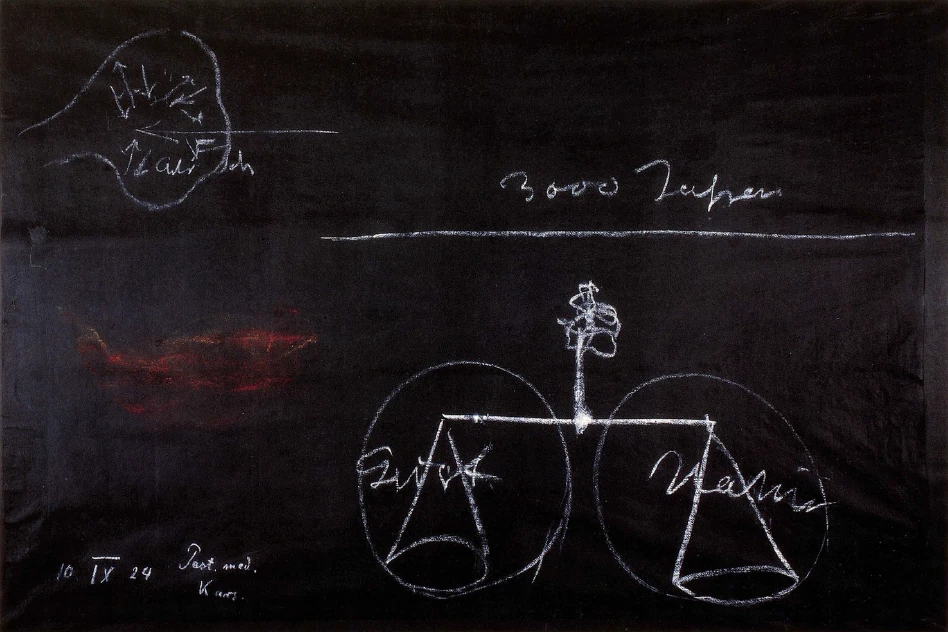
[ 16 ] Aber die Zeit ist in der Realität nicht so, sondern der ganze Faden, den ich da an die Tafel gezeichnet habe, der kann verwickelt zu einem Knäuel werden. In diesem Knäuel ist die ganze Zeitlinie drinnen, die dreitausend Jahre sind in einem Knäuel. Die Zeit kann sich verknäueln, und wenn sie sich für irgendeine Evolution verknäuelt, diese Zeit, dann kann der Knäuel eben in einem Menschen leben. Bei der heiligen Theresia lebte eine verknäuelte Zeit in dem irdischen Leben. Das ist eigentlich das Mysterium, daß Dinge, die sonst in dem Karma weit auseinanderrücken, zusammengeschoben werden. (Siehe Zeichnung.)
[ 16 ] But time isn’t really like that; rather, the entire thread I drew on the board can become tangled into a ball. The entire timeline is contained within this ball—three thousand years are contained in a single ball. Time can become tangled, and when it becomes tangled—this time—for the sake of some kind of evolution, then that tangle can live within a human being. In the case of Saint Teresa, a tangled time lived within her earthly life. That is actually the mystery: that things which would otherwise be far apart in karma are brought together. (See drawing.)
[ 17 ] Hier also sehen Sie, wenn man an eine solche Erscheinung herantritt, wie die innere geistige karmische Betrachtung an die äußere pathologisch-therapeutische Betrachtung sich anschließt. Da aber sehen Sie, wie nun die priesterliche Behandlung des Menschen, der ja seinen Ausblick halten muß nach den karmischen Zusammenhängen, nach dem Geistigen, wie die sich berühren kann mit demjenigen, was nur vom medizinischen Standpunkt aus über-diese Dinge allein durchschaut werden kann. Denn es gehört ja zum Durchschauen von solchen Dingen nicht nur theoretisches Wissen, sondern Darinnenleben in den Dingen. Darinnenleben von der Seite, die sich eröffnet von dem Pathologisch-Physiologischen aus, soll der Arzt. Darinnenleben in den Dingen von der Seite, die sich vom theologisch-karmischen Standpunkt aus ergibt, soll der Priester. Und im Zusammenwirken wird sich dann Harmonie ergeben — das muß immer wieder beachtet werden -, nicht im dilettantischen Ineinandermischen.
[ 17 ] Here, then, you can see how, when approaching such a phenomenon, the inner, spiritual, karmic perspective is linked to the outer, pathological-therapeutic perspective. But here you see how the priestly treatment of the human being—who must, after all, maintain a perspective on karmic connections and on the spiritual—can intersect with that which can be understood solely from a medical standpoint. For understanding such things requires not only theoretical knowledge but also living within them. The physician is to live within these things from the perspective that opens up from the pathological-physiological realm. The priest is to live within these things from the perspective that arises from the theological-karmic standpoint. And through their cooperation, harmony will then arise—this must always be kept in mind—not through an amateurish mixing of the two.
[ 18 ] Sehen Sie, nun hängt mit diesen Dingen noch etwas anderes zusammen, namentlich für unsere Zeit. Sie wissen ja, meine lieben Freunde, wie sauer es wird einem Menschen, eine Idee zu begreifen, die eigentlich für den unbefangenen Menschen selbstverständlich ist und welche geleugnet wird, weil der Inteliekt von den Philosophen nicht heran kann: die Idee des freien Willens. Ich sagte über die Sinnesempfindungen: die Dinge, die in den Physiologien und in den Psychologien stehen, nehmen sich dem gegenüber, der die Dinge durchschaut, kindisch aus. Aber was über die Idee des freien Willens geschwätzt wird, erst recht. Denn Sie müssen bedenken, daß der freie Willensentschluß in jedem Augenblick ein Effekt der ganzen menschlichen Wesenheit ist; derganzen menschlichen Wesenheit, wie sie sich gesund oder krank oder halbkrank oder übergesund darlebt, in dem freien Willensimpetus. Im freien Willensimpetus liegt der ganze Mensch darinnen, aber mit alledem, was man am ganzen Menschen durchschauen kann, mit allen Komplikationen liegt er darinnen. Die menschliche Natur lernt man erst kennen, wenn man sie in dieser Komplikation erkennen lernt. Und sehen Sie, das, was bei abnormen Persönlichkeiten nach der einen oder anderen Seite hin eine abnorme Schattierung annimmt, ist aufgehoben, zur Harmonie vereinigt in jedem Menschen. Es ist ein trivialer Ausspruch, aber er ist wahr: so wie der Mensch zugänglich ist für den Cherubim, so ist er auch zugänglich für den Teufel. Und auch diese Prozesse, wo der Mensch zugänglich ist für den Teufel - wir werden sie noch studieren. Aber das alles ist auch im gewöhnlichen Menschen, nur daß die entgegengesetzten Tätigkeiten sich aufheben, weil sie sich nach den verschiedensten Richtungen gleich stark entwickeln. Wenn in jedem ein Engel ist, so ist auch in jedem ein Teufel. Aber wenn der Engel und Teufel gleich stark sind für irgend etwas, dann heben sie sich auf.
[ 18 ] You see, there is something else connected to these matters, particularly in our time. You know, my dear friends, how frustrating it is for a person to grasp an idea that is actually self-evident to the unbiased mind—and which is denied because the philosophers’ intellect cannot grasp it: the idea of free will. I said this about sensory perceptions: the things written in works of physiology and psychology seem childish to those who see through them. But the drivel spouted about the idea of free will is even more so. For you must bear in mind that the act of free will at every moment is an effect of the entire human being—the entire human being, as it lives out its existence—whether healthy, sick, half-sick, or super-healthy—in the impulse of free will. The entire human being is contained within the impulse of free will, but with everything that can be seen through in the whole human being, with all its complexities, it is contained within it. One only comes to know human nature when one learns to recognize it within this complexity. And you see, what takes on an abnormal hue in one direction or another in abnormal personalities is suspended and united in harmony within every human being. It is a trite saying, but it is true: just as a person is open to the cherubim, so too is he open to the devil. And we will also study these processes in which a person is open to the devil. But all of this is present in the ordinary person as well; it is just that the opposing forces cancel each other out because they develop with equal strength in a wide variety of directions. If there is an angel in everyone, then there is also a devil in everyone. But when the angel and the devil are equally strong in any given matter, they cancel each other out.

[ 19 ] Nun betrachten Sie diese Waage (siehe Zeichnung). Es gibt einen Punkt, es ist dieser. Sie können hier Gewichte auflegen, das kann alles in Bewegung geraten. Das bleibt immer in Ruhe, das Hypomochlion, es wird nicht berührt von dem, was Sie links, von dem, was Sie rechts auflegen. Aber es muß die Einrichtung getroffen werden, daß es nicht berührt zu werden braucht. Ein ähnliches geistiges Hypomochlion wird im Menschen bewirkt von den entgegengesetzten Kräften. Sie können daher studieren des Menschen Natur. Sie werden nirgends eine Veranlassung haben, den Menschen als freies Wesen zu statuieren, denn in der Natur des Menschen ist alles kausal bedingt. Studieren Sie mit materialistischer Gesinnung die Natur des Menschen: Sie kommen nicht zur Freiheitsidee, Sie kommen zur kausalen Bedingung. Sie können aber auch den Menschen geistig studieren. Sie kommen zur Determination des Willens durch die Gottheit oder die geistigen Wesenheiten, aber Sie kommen nicht zur Freiheit des Willens. Sie können ein grobklotziger Materialist sein und die Freiheit leugnen und die Naturkausalität des Willens studieren, Sie können ein feinsinniger Kopf sein wie Leibniz und auf das Geistige sehen: Sie kommen zum Determinismus. Natürlich, solange Sie die Waagschale mit dem Waagbalken hier studieren, kommen Sie nur zur Bewegung; solange Sie die Waagschale mit dem Waagbalken hier studieren, kommen Sie auch nur zur Bewegung. So ist es, wenn Sie den Menschen studieren nach der Natur, so ist es, wenn Sie den Menschen studieren nach dem Geist. Sie kommen nicht zur Freiheit. Sie liegt mitten drinnen im Gleichgewichtspunkt zwischen beiden.
[ 19 ] Now look at this balance (see diagram). There is a point—this one here. You can place weights here, and the whole thing can start moving. This part, the hypomochlion, always remains at rest; it is not affected by what you place on the left or on the right. But the mechanism must be designed so that it does not need to be touched. A similar spiritual hypomochlion is brought about in human beings by opposing forces. You can therefore study human nature. You will find no reason anywhere to characterize human beings as free beings, for in human nature, everything is causally determined. Study human nature with a materialistic mindset: you will not arrive at the idea of freedom; you will arrive at causal determination. But you can also study human beings spiritually. You will arrive at the determination of the will by the Deity or spiritual beings, but you will not arrive at free will. You can be a crude materialist who denies freedom and studies the natural causality of the will; you can be a subtle thinker like Leibniz who focuses on the spiritual: in either case, you will arrive at determinism. Of course, as long as you study the weighing pan with the balance beam here, you arrive only at motion; as long as you study the weighing pan with the balance beam here, you also arrive only at motion. So it is when you study human beings according to nature, and so it is when you study human beings according to the spirit. You do not arrive at freedom. It lies right in the middle, at the point of equilibrium between the two.
[ 20 ] Das ist die Theorie. Aber die Praxis ist so, daß Sie zu entscheiden haben bei einem Menschen, der vor Ihnen steht in einer schwierigen Lebenslage, ob Sie ihn verantwortlich machen können für seine Tat. Da wird die Frage praktisch, ob er seinen freien Willen handhaben kann oder nicht. Woran können Sie das entscheiden? Dadurch, daß Sie zu beurteilen vermögen, ob seine geistige und physische Konstitution sich das Gleichgewicht halten. In beide Fälle kann sowohl der Arzt wie der Priester kommen. Daher muß zur Schulung des Arztes wie des Priesters gehören ein Durchschauen jenes Zustandes, in dem der Mensch entweder im Gleichgewicht zwischen Geist und Natur ist, oder in dem dieses Gleichgewicht verschoben ist.
[ 20 ] That is the theory. But in practice, when you are faced with a person standing before you in a difficult life situation, you must decide whether you can hold him responsible for his actions. This raises the practical question of whether he is capable of exercising his free will or not. How can you determine this? By being able to assess whether their mental and physical constitution are in balance. In both cases, both the doctor and the priest may be called upon. Therefore, the training of both the doctor and the priest must include an understanding of the state in which a person is either in balance between mind and nature, or in which this balance is disrupted.
[ 21 ] Niemals kann über das Verantwortungsgefühl einer menschlichen Persönlichkeit anders entschieden werden als nach einer tiefen Erkenntnis der menschlichen Wesenheit. Die Freiheitsfrage in Verbindung mit der Verantwortungsfrage ist eben eine denkbar tiefste.
[ 21 ] No judgment regarding a human being’s sense of responsibility can ever be made without a profound understanding of human nature. The question of freedom, in connection with the question of responsibility, is indeed one of the deepest conceivable.
[ 22 ] Daran wollen wir morgen anknüpfen und weiter fortsetzen. Wir werden sehen, was von der einen Seite ins Gesunde und von der anderen Seite ins Pathologische hineinführt.
[ 22 ] We’ll pick up where we left off tomorrow and continue from there. We’ll see what leads toward health on the one hand and toward pathology on the other.