

Cooperation Between Doctors and Pastoral Caregivers
Pastoral Medicine Course
GA 318
11 September 1924, Dornach
Translated by Steiner Online Library
Fourth Lecture
[ 1 ] My dear friends! In today’s reflection, we will include a chapter on anthroposophy that normally does not need to be discussed in such detail for laypeople, but which we will need if we are to continue our examination of the distinction between healthy responsibility and pathological irresponsibility—a distinction that is important for both the physician and the priest to recognize.
[ 2 ] Above all, it is of particular importance to examine the question: What in a human being is actually inherited, what stems from the hereditary line, and what is not inherited but must be introduced into the human being in some other way? — The ability to distinguish between these two—one might say—ingredients of the human being is of immense importance in assessing healthy and sick people. When a human being enters the sensory world from the spiritual and supersensory realms—that is, when the integration takes place of what is given to them through heredity, and they combine this with what they bring with them from previous earthly lives and from the interval between death and rebirth—then we see how the human being, initially as a child, develops day by day, week by week. But as long as one does not consider the fourfold human being—comprising the physical body, the etheric body, the astral body, and the ego organization—one is unable to understand this development, because one cannot see through to the extent to which the individual members of the human being—which are, after all, of entirely different origins and come from different worlds—are involved in this development.
[ 3 ] Human beings first and foremost have their physical organism. The most striking feature of this physical organism is that, during the first stage of life—up until the change of teeth—it has its first set of teeth, which are replaced when the teeth change. Now, the replacement of the teeth is, I would say, merely the most extreme example of what is replaced in human beings. For in truth, human beings carry with them—in material terms—what they receive as a physical body in childhood, what they received at birth, only until the teeth are replaced. We are constantly shedding physical matter from our form. The process is, however, more complicated than one might simply imagine—if one wants to be precise—by saying: “Over the course of seven to eight years, a person sheds all of their physical matter and renews it.”—There is certainly some truth to this, but one need only look at the process of tooth replacement itself to realize that one must create a mental image of it in a somewhat modified way. For if this were true in such an abstract sense, we would have to get new teeth every seven years. But that is not the case. We get them only once. Yet teeth belong precisely to that category of things which, after a single replacement, do not undergo renewal. They belong to this category in the most extreme sense. But the course of human development on Earth is such that, as one grows older, one retains more and more of the old physical matter within oneself, so to speak. A replacement of the vast majority of physical matter does indeed take place at intervals of seven to eight years, but we must distinguish in human beings between what remains behind; by the age of seven, it is only the teeth that come in and then remain, but after further rhythmic repetitions of such transitional periods, parts of the material substance also remain in the human being that are not replaced, even though the majority of the human being does indeed replace its material substance over the course of seven to eight years. So it must be said, in very general terms, that for the first seven years of life or so, the human being sheds all the physical matter it possesses at birth, and retains nothing of it, but only retains the active and essential forces within them, which the entirely newly acquired matter appropriates for the first seven years of life in such a way that the human being undergoes the renewal of his physical body—right down to the teeth—precisely through the process of teething. But this, my dear friends, also makes it clear that the actual principle of heredity, as modern science has formed its mental image of it, applies only to the first seven years of life. Only during these first seven years of life is it the case that a person inherits the characteristics they carry within themselves from their parents and ancestors. During these first seven years, the physical body serves, so to speak, as a kind of model according to which the artist working within the human being—who during these years consists of the etheric body, the astral body, and the I—crafts a new physical body. We can see precisely how these elements—what a person brings with them from the spiritual worlds: their individuality, their essence—and what they inherit work together, or, I would say, enter into an artistic interplay. If a person has a strong inner individuality—if they bring with them an intensely developed astral nature and sense of self, which in turn strengthen the etheric body—then we will see a person emerge who, from within, adheres only loosely to the model, conforming to it only in general terms. For those who have an eye for true forms, it will then become evident that, naturally, because the general human model must be adhered to—and because there is already an affinity for the human form that is inherited —traces of which remain even after the change of teeth—, but upon closer observation, it is quite evident how, in the case of inwardly strong individuals, significant changes occur after the change of teeth, stemming from the fact that the strong individuality adheres only slightly to the model handed down to it through heredity.
[ 4 ] If we examine a personality such as Saint Teresa, who has been mentioned here frequently, we would find—precisely because of the strong individuality already mentioned yesterday—that such natures, while very much like their parents during the first seven years of life, take on forms in their ninth and tenth years that are surprising, because it is only then that their true individuality begins to emerge. Thus, heredity applies only to the first stage of life in the strict sense of the word, and what later appears to be heredity is not heredity in reality—this must be recognized—but rather work based on the model that has been inherited. To a greater or lesser extent, the resulting work will resemble the model. But it is not heredity; it is modeled after the inherited characteristics. The mere natural scientist believes that the usual principle of heredity continues to apply. The one who looks into the essence of the human being knows that something qualitatively quite different occurs regarding the resemblance to the parents after the change of teeth than before the change of teeth. Before the change of teeth, it is truly the forces of heredity at work. After the change of teeth, it is the forces that work according to the model. For an accurate understanding, one cannot say that a person has inherited what they carry within themselves between the ages of seven and fourteen, that is, between the change of teeth and puberty, is inherited—just as one cannot say of someone sitting in a gallery painting a portrait of the Sistine Madonna that his portrait painting has acquired its character through inheritance from the Madonna hanging in the gallery. Yet this is precisely what is almost believed.
[ 5 ] Now you can see what kind of work the etheric body is primarily engaged in—what its task is—for during these years leading up to the change of teeth, the astral body and the “I” organization are still only minimally involved in this work. It is forming a new physical human body according to the model. Why does it do this? The question is, of course, strangely phrased, because one cannot ask such “why” questions of nature. It is meant to be merely a rhetorical question. Why does it do this? It does so because—just as the human being in his or her entirety during the first seven years of life—it is not yet predisposed to receive any other kind of impressions from the external world than a very specific kind of impression. And here we encounter a very important mystery of human development—a mystery that answers the question: What does the child actually perceive? —The answer to these questions lies far removed from current mental images. But you will understand what is meant when I present the matter in the following way.
[ 6 ] Human beings live, so to speak, between death and a new birth—or rather, a new conception—in the spiritual world (Plate 5, top). In this spiritual world, they are surrounded by realities entirely different from those found here in the physical world. It is a completely different world. They step out of this world—whose laws we wish to indicate with this line (white)—and enter the physical world (yellow), continuing their life in the physical world with a physical body they receive; but in this physical world, the same forces that are shown here (red) continue to be at work, albeit hidden from human sensory perception. When you look at a tree, my dear friends, the same spiritual forces are at work within it as those you encounter between death and a new birth; they are simply concealed, veiled by the tree’s physical matter. Everywhere in the physical world in which we live between birth and death, these spiritual forces are also at work behind the scenes of the physical entities perceived by the senses. Thus we can conceive of the activity of the spiritual world as continuing into the world we experience between birth and death. Now, during the first seven years of life, a child can, in truth, unite nothing else with its full being except this spiritual aspect—in all its colors, in all its forms, in all its warmth, and in all its cold. The child fully perceives a continuation of these spiritual influences when it enters the physical world, and then in increasingly weaker degrees until the change of teeth. A sensory perception—though we often overlook this—is something entirely different for a child than for an adult. A sensory perception is something entirely spiritual for a child. That is why, when the child—as I say in my work on pedagogy—has a quick-tempered father beside them, they do not consciously perceive the quick-tempered gesture, but rather the moral element within the gesture, which passes into their body. So that during the time when the child is working with its forces to develop its physical body—which is now its own—according to the model, the child is, in essence, entirely oriented toward the spiritual foundations and works from a spiritual perspective. But what does that mean? What is actually at work there when the spiritual aspect is at work? On the surface, colors, forms, warmth, cold, roughness, and smoothness seem to be at work in the sensory perceptions. But what is actually at work? In truth, only that which has something to do, in some way, with an “I”-nature is at work. The only things that make an impression on the child are hidden spiritual beings that have something to do with an “I”-nature—that is, above all, spiritual beings of the higher hierarchies from the human level upward, but also the group souls of animals and the group souls of the elemental beings. All of this truly influences the child, and out of these spiritual forces, out of this magnificent spiritual dynamism, the child forms its second body from the model—a body that gradually develops and, as the teeth are replaced, comes into being as the second body. This is the very body that the human being builds up after birth as his or her own first body, and which is formed as a physical body from the spiritual world.
[ 7 ] You see, at this stage of life we have a very special kind of lawfulness in everything that is at work within the child—in all the clumsiness, in all the disorientation with which the child acts psychologically and moves—which stem from the fact that a constant process of adaptation to the physical world must take place, since the world in which the child is actually still immersed—the spiritual world—still surrounds the child in a half-unconscious, dreamlike state. One day, when medicine has attained its true spirituality, we will see in this mutual seeking between the spiritual and physical worlds during the first seven years of life the true, deeper causes of childhood illnesses, and we will gain much insight into what, especially today—if one examines medical works—is actually explained only in verbal terms. These are merely verbal explanations, formal explanations, which, however, do not actually lead to any reality.
[ 8 ] The etheric body is fully engaged in this process during the first seven years of life; it therefore calmly develops the abilities it possesses during the second seven years—the independent abilities of the etheric body, namely the memory faculties that are more oriented toward the intellect. Anyone with an eye for such things can see the greatest transformation in the life of the soul when the first seven-year period of life transitions into the second. The etheric body is relieved of the work it had to perform—in the fullest sense of the word—in the formation of the second body. It is relieved; and one can only truly grasp how it is relieved when one realizes that a person does not grow new teeth at the age of fourteen, but that the teeth one has remain—and that other things, too, remain in the physical-material realm. What remains there—yet must also be replaced in the early years of life—relieves the etheric body, becoming free within it. Quantitatively, it is a small thing, but qualitatively it is something immensely important. This is what then becomes immensely effective as soul qualities. What a person saves by not having to acquire a third set of teeth, and by not having to regenerate certain other things that are treated by evolution in the same way as teeth—through this, something remains of the etheric body. What remains—having flowed into physical development during the first seven years of life—now remains from physical development and acts purely as a soul force, in accordance with its very nature. By the time children have acquired the abilities you, as teachers, draw upon and cultivate in school, they have already undergone the great transformation from baby teeth to permanent teeth, as well as many other processes. With the energies the child saves—since it does not have to form a third set of teeth—it begins to develop the faculties of the soul. This takes place in the depths of human nature, so that, during the first seven years of life, the soul is entirely embedded within physical development, which we must understand as being just as much spiritual-soul as it is physical-bodily. We see a spiritual force at work within the body during the first seven years of a person’s life, in the fullest sense of the word.
[ 9 ] Well, how does this compare to the general evolution of the world? You see, within the cosmos, the forces with which the soul works during the first seven years of life are the forces of the Sun. Not only do the physical-etheric rays of the sun shine down from the sun, but forces also shine down from the sun within these physical-etheric rays that are identical to those with which our etheric body renews itself during the first seven years: it is the solar entity that is at work here. Look at the child as it builds its second physical body according to this model! These are all forces absorbed from the sunlight. One must understand how the human being positions itself within the cosmos. And when, in the way I have described, a person releases certain etheric forces during the change of teeth—forces that then in turn affect the astral and “I” organizations—the person becomes receptive in the second epoch of life to what he was not at all in the first epoch; he becomes receptive to the lunar forces.
[ 10 ] The solar forces are etheric forces during the first seven years of life; the lunar forces, to which the child becomes receptive upon losing his baby teeth, are identical to the forces of his astral body. Thus, with the change of teeth, the human being enters from the solar sphere—in which he remains, for it continues to be active—into the lunar sphere, and now, between the change of teeth and sexual maturity, he works on himself with the lunar forces. With the lunar forces, he now forms his second, or third, physical body, in which not as much is renewed as in the first epoch of life, but still a great deal is renewed. Once again, however, forces remain behind, now of an astral nature. These transform the soul just as the soul transforms around the time of sexual maturity. They are freed from the work on the body, so that when a person enters sexual maturity—a phase of life in which they freely reveal in their soul what they still have to work on within their physical body between the change of teeth and sexual maturity—
[ 11 ] Thus, in the first stage of life, we work exclusively with what comes to us from the sun, and when we have the child in school—between the change of teeth and puberty—it is the solar forces that have been set free for the soul. This is indeed the great and powerful aspect of understanding human development: that when shaping a child’s soul between the loss of baby teeth and puberty, one is dealing entirely with solar powers. The child’s soul is so closely connected to that which lives in the sunshine that one’s heart can be lifted by such a realization—a realization that truly sheds light on what takes place between the human being and the cosmos.
[ 12 ] The lunar forces, which in this second epoch of life are still directed toward the physical body, have not yet been liberated for the soul. They become free with sexual maturity; then they begin to work upon the soul, and the transformation that now occurs in the soul with sexual maturity stems from the fact that the lunar forces permeate the soul, so that what a person does in their actions after sexual maturity is a collaboration between the solar and lunar forces.
[ 13 ] This allows us to look into the depths of human development and to wean ourselves from speaking of heredity in the sense that crude natural science does, while also looking at the other side—what lives in children’s human actions. The sun lives in children’s human actions and in children’s human thinking. It is, after all, the sun that shines back at us from the stone, for the stone has no light of its own; it merely reflects the sunlight to us. The natural scientist admits this, but that is the very least, the most abstract aspect of it, my dear friends. The child, too, reflects the sun’s forces back to us between the ages of seven and fourteen. Just as we can describe the light from a stone as the reflected light of the sun, so may we describe what the child does in its second stage of life as the sun. The sun is not merely where it appears concentrated. This physical view—that the sun is merely there (Plate 5, left)—resembles that of a person who sees soup in a pot, notices a pool of fat in the middle, and thinks that only the pool of fat is the soup. Yes, our physical views are often very childish, and when they are exposed for what they are, people laugh. One can only wish that people would laugh more at reality. For what is regarded as science today is truly very ridiculous. To mistake the film of fat for the soup is the same as looking at the sun up there as the film of fat that is the sunshine, while it, as the soup, fills the entire world.
[ 14 ] This, in turn, opens up insights into the connection between the lunar forces and the reproductive forces. For the reproductive forces now gradually form this second body of their own, which develops between the ages of seven and fourteen and is complete when sexual maturity is reached. Thus, what a person incorporates as reproductive forces during this time is precisely the influence of the Moon. The reproductive forces are thoroughly connected to the influences of the Moon; they are the results of those influences.
[ 15 ] Now, from puberty through the early twenties, a person begins to form their third body—the fourth when considered from an external perspective. In later years, these stages are no longer as strictly defined as those of tooth replacement and puberty. More and more of the substance remains, solidifies within the person, and becomes a permanent framework. Indeed, a great deal of this permanent framework gradually accumulates within the person. As a person grows older, less and less matter is shed from the bones and renewed. In the rest of the organism, too, certain parts take longer to shed matter than others, and it is evident that with regard to teeth, the following simply applies: Once you have received them a second time, whether you still have them later depends on how long they last once they are fully formed—just as you depend on a knife you own for how long it lasts. The knife cannot renew its material. Teeth, too, cannot essentially renew themselves. Certainly, everything is in a state of flux; renewal is already taking place, but it is entering the stage of non-renewal, and so we have them as that which, in essence, carries out the life process much more slowly than the rest of the human body—much more slowly in terms of intensity— and therefore, inversely, they deteriorate rapidly in terms of the quality of their longevity—that is, they become damaged before the other parts of human nature, which can constantly renew themselves, have a chance to deteriorate. But if teeth were subject to the same laws as many other parts of human nature, then there could be no dentists. But if the other parts of human nature were subject to the same laws as the teeth, we would all die quite young in our modern civilization. And probably this part of Switzerland, where it is said that dentists are very busy because teeth become damaged so easily, would not be so densely populated, for it would be considered a place of early mortality. That is how things are connected.
[ 16 ] Now you see, during the first seven years of life, the human being works inwardly with the forces of the Sun, and during the second seven years, with the forces of the Moon. The solar force remains, but the lunar forces are added to it. During the third seven-year period, from puberty into one’s twenties, the much finer forces of the other planets in the solar system are absorbed into the human being. This is when the other planetary forces come into play in the human being’s growth process; and because these forces act more weakly—much more weakly—on the human being than the Sun and Moon do, the things the human being then absorbs are also much less visible outwardly. We no longer perceive as strongly as we did in the early twenties—while the planetary forces are still at work in the human body between the ages of fourteen and twenty-one—how these forces begin to take effect in the soul-spiritual realm at the start of the twenties. It is the planetary forces that begin to work in the soul and spirit, and the person who has insight looks at the human being in such a way that, in this remarkable transformation the human being undergoes in the early twenties, he or she realizes: up to this point, only the Sun and the Moon have spoken through human activity; now the planetary forces are modifying these solar and lunar influences. People’s superficial approach and cursory observation have very little sense of this transformation, yet it is there.
[ 17 ] Now you see, it is indeed true that for anyone who observes human beings in terms of health and illness, an understanding of these connections is necessary. For what do we actually know about a human being—say, at the age of eleven or twelve—if we do not know that the forces of the moon are at work within them?
[ 18 ] But now the question will arise within: What happens next? Even later on—even though the parts that need to be renewed will become fewer and fewer—a person must still renew these things. Now, you see, up until the age of twenty-one or twenty-two, the Sun, the Moon, and the planetary system successively influence human growth. Then, up until the age of twenty-eight, the constellations of the fixed stars continue to exert their influence; this, however, is already largely beyond observation. Only through the wisdom of the Mysteries can one perceive the interplay of the entire fixed-star sky within the human being between the beginning and the end of their twenties. Then the world becomes hard. It no longer seeks to work its way into the human being; the world becomes hard. Modern science knows almost nothing about this peculiar relationship between the human being and the world during their twenty-eighth and twenty-ninth years of life—that the world becomes hard. Aristotle still taught this to Alexander, telling him: “Then, as a human being, one comes up against the crystalline heaven; it is hard.” - Thus the crystal heaven, which lies outside the sphere of the fixed stars, gains its significance and reality for human perception. Thus one begins to realize that, by the end of one’s twenties, a person can no longer find the forces in the universe necessary for renewal. Why, then, do we not die at the age of twenty-eight? This world that surrounds us actually causes us to die at the age of twenty-eight. It is true that whoever sees the connection between the human being and the world now looks out into the world with the awareness: “O world, you actually sustain me only until the end of my twenties!” — But it is precisely by realizing this that one begins to truly understand human beings in their essence.
[ 19 ] For what happens to him now, when the world withdraws from him with regard to the formative forces he develops? What happens now? The following occurs at that peculiar moment when, upon reaching the age of twenty-eight, a person begins to show clearly that the old growth forces have now completely faded. Some people begin to wither away even then; others retain their lingering growth forces a little longer. But even Goethe was already shrinking—as was measured more precisely—when he began to resume work on the second part of his *Faust*. At that time, however, he was measured. But he had already begun to wither away earlier. You see, from the moment the world begins to leave us, we must bring about our own renewal from the forces we have absorbed up to that point. Since the parts to be renewed become fewer and fewer, we cannot, of course, work on our new embodiment on the same grand scale as a child does—right down to the teeth—when it forms its first body according to the model. But we have accumulated within us a great many forces from the sun, moon, and stars—forces we need and carry within us—since, beginning at the age of twenty-eight, we start to renew our physical, material body. At that point, in terms of human existence, we become the human being who stands on his own on Earth. But with this—the human being who is entirely self-reliant on Earth—as he hastens toward this point in time and in turn moves beyond it, the human being has a point in time toward which he strives, beyond which he grows; a point to which I already drew your attention yesterday from an entirely different perspective (Plate 5, center). If I may illustrate it this way, from childhood onward—when the human being absorbs many cosmic forces—he strives more and more toward such a point, which lies at the end of his twenties, where he ceases to derive his growth from cosmic forces. Whatever he does from that point onward, he accomplishes through the forces of his own body. Here in the center is a point where the human being ceases to process cosmic forces within themselves and begins to develop these forces from within their own body. However, in real life, this distinction is not as sharp as it appears in this schematic representation.
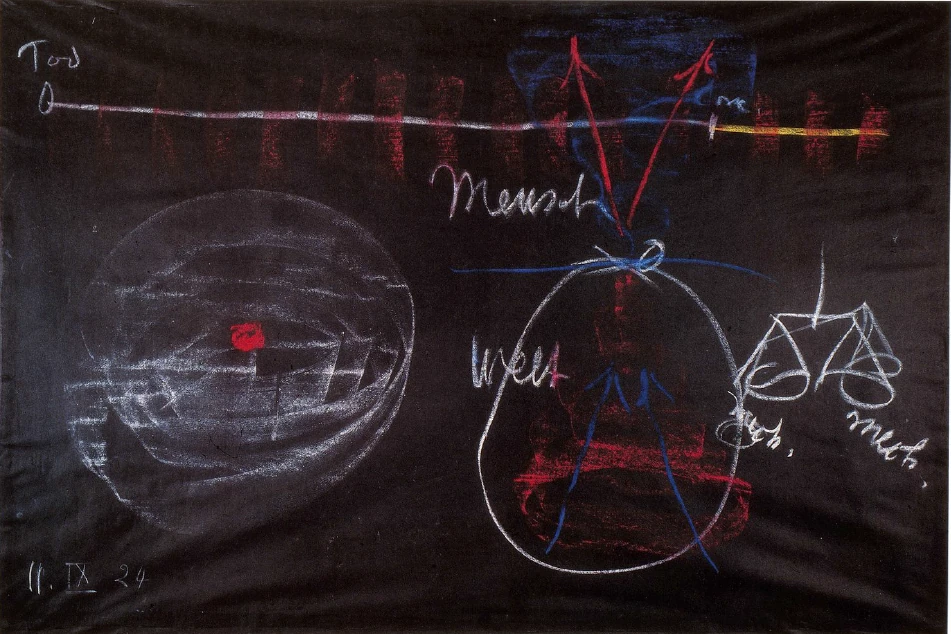
[ 20 ] In life, effects that are, so to speak, predetermined are often already present in one’s own body as early as childhood. We notice this in the child’s pathological symptoms, in the brittleness of the bones, but especially in the early accumulation of fat in children; yet this connection lies behind it all. At every moment of their life, human beings either strive toward this point or away from it. You can easily see that this is a kind of zero point, a kind of hypomochlion, a kind of zero point where we stand in time between ourselves and the world. In our inner dynamics, we are always either striving toward something or moving away from it. What takes place within a human being as they strive toward this zero point or away from it is, after all, a striving toward a zero or away from a zero. It is something we do in the direction of nothingness. We strive toward that in which the world no longer exerts its influence, in which the human being does not yet exert its influence. Between the two lies a kind of zero. We have something within us that is oriented toward nothingness. This is what makes us free beings, endowed with responsibility. This is so grounded in the human constitution that we are responsible, free beings, because in the transition from the world to ourselves we pass through a zero point, just as the beam of a balance scale moves from right to left and from left to right through a zero point that does not follow the laws to which the rest of the scale is subject. You can imagine, if you have a balance (Figure 5, right), that the mechanical laws you learn apply here—these mechanical laws govern the balance and give it a specific configuration, either with the top up, the bottom down, or vice versa. These are the laws of the balance, of the lever. But if you take this point—you can move the scale around; its overall configuration, determined by mechanical forces, remains the same no matter where you move it—this point is free; you can move it around as if it were not connected to the scale at all, and the scale remains completely unaffected by it. So, when a person engages with their inner experience at the point toward which they previously strived but from which they subsequently strive to move away, the world is the active force beforehand, and afterward it is the person themselves. Nothing is at work here. But in the tendency toward or away from it, that which in the human being is not determined by nature or by the world can play itself out; where a hypomochlion is situated, there lies the point of origin of his freedom. There one grasps the concept of responsibility.
[ 21 ] So, if one wants to determine, for example, the degree of responsibility of a thirty-five-year-old person objectively—and not merely in a layman’s manner or out of dilettantism—one must ask oneself: Does too much of what developed abnormally up to the end of one’s late twenties come across? Is this point oriented more or less toward youth, or more toward old age? — A person bears full responsibility if this point is normal, if one can assess the person’s entire life based on their life expression in such a way that this point is normal. If this point lies too far back toward youth—that is, if the world ceases to influence the person too early—then this person must be examined to determine whether they might be prone, even if only to a slight degree, to obsessive thoughts, or whether they might be easily psychologically conditioned, such that they cannot be held fully responsible for their actions.
[ 22 ] If this point is raised too late, one will have to ask whether human beings are not hindered by their inner nature from developing the full freedom of the soul, whether they are not too strongly determined by physical factors, and whether, for that reason, they cannot be held fully responsible.
[ 23 ] But those truly called to judge in the finer sense are the physician and the priest, who must know that one can assess a person’s development in such a way that, based on his stature, one can roughly —- we will discuss this further, because pastoral medicine also involves a deep understanding of physiognomy — one can tell from a person’s stature whether they are living in balance, whether one can say that their “life hypomochlion” is in the right place—that is, at the right time—or whether it is too early or too late.
[ 24 ] These are things that were considered very important in the ancient wisdom of the mysteries when assessing life; these are things that have been forgotten but must be reintroduced into the study of humanity if that study is to have a comprehensive influence and achieve its true medical and pastoral purpose.
[ 25 ] More on that tomorrow.