

Cooperation Between Doctors and Pastoral Caregivers
Pastoral Medicine Course
GA 318
13 September 1924, Dornach
Translated by Steiner Online Library
Sixth Lecture
[ 1 ] My dear friends! We have considered human beings in their essence, although we have also shed light on the extent to which, in their earthly lives, they develop—in one direction or another—away from what might be called the “normal” toward the pathological, or toward that aspect which brings them into a relationship with the real spiritual world.
[ 2 ] Today we will try to look beyond the individual human life—beyond human life insofar as it constitutes a single earthly existence—in order to see, first of all, using a more or less manageable example, how even in such states, which, I would say, are caught in the polar opposition between reaching into the spiritual world and reaching down into the physical, into the natural, to see how that which runs through repeated earthly lives relates to such processes. For it is indeed true: if a doctor is to practice his profession—not merely in an external or intellectual way, but with his whole heart, with his entire being—he needs to be immersed in the spiritual world, to view the world from the perspective of the spiritual. But since the human being does in fact extend through successive earthly lives, and since the causes of one earthly life pass over in a spiritual sense into the next and take effect within the human being, karma must not remain a mere phrase for us; rather, we must also gradually come to understand how we are to approach karma in a healing way. To do this, we must above all understand its effects in relation to the pathological and in relation to the visionary.
[ 3 ] If the priest wishes to respond appropriately to the events of life, to care for the souls entrusted to him, and to be a true spiritual guide, he must also gain insight into the significance of the spiritual in relation to what one encounters in physical life on earth. Only then will he be able to treat people on earth properly from a spiritual perspective.
[ 4 ] Something immediately strikes us, my dear friends, something that today, from a superior, Enlightenment-era perspective, one might view with a certain degree of contempt—but if we were to do so, our descendants in centuries to come would make us pay for it. For they would treat us just as the person who today lives within so-called scientific education treats his ancestors. You will see right away what I mean.
[ 5 ] Over the course of human development, there has been a complete shift in the view of diseases, and this shift was particularly striking at the end of the 19th and the beginning of the 20th centuries. If you go back a few millennia in human development, to the earlier times of the Old Testament, you will find the conviction everywhere: illness comes from sin; illness has its spiritual cause, ultimately, in sin. This was taken very seriously. There had to be a spiritual aberration or transgression somewhere as the actual cause whenever a physical illness arose. And this view went further. It held that since a person in whom some spiritual transgression or aberration lies at the root—causing the manifestation of illness within them—contains something spiritually elemental that does not belong there, they are, in a sense, possessed. — Every illness was, after all, understood as a possession by a spiritual entity resulting from a spiritual aberration or transgression in earlier times, and the therapy was structured accordingly. It was designed to devise ways to expel from the person whatever foreign elemental spiritual substance had entered them as a result of the spiritual transgression. This view was radical: that one cannot understand an illness unless one knows its pathological cause,
[ 6 ] Well, take what has emerged as a completely logical development—more or less in recent times, before psychoanalysis and analytical psychology intervened in such a terrible way, amateurishly asserting the exact opposite of what had been the prevailing view: that every sin has its cause in illness. - People were convinced of this; if there was a criminal or a sinner somewhere—whereby the concept of sin was defined rather superficially according to the state code—if there was a criminal or a sinner somewhere, it was understood that one could only gain access to his brain in some way after death, obtain his skull somehow, and examine his physical constitution. One would surely find the defects, the characteristics. They have indeed been found in many respects, and considerable progress has been made in this regard. Competent, scientifically trained people have come to the conclusion that if a human being is perfectly developed organically, he does not sin. He sins because there is a physical defect somewhere: sin arises from illness. This is how evolution proceeds. It does not follow a straight line; it moves through polar opposites; and precisely those people who have now arrived at the latter view—not everyone admits it today, but it often lies at the root even among those who outwardly do not stand firmly on solid ground—these people look back with utter contempt upon those times when it was said: “Illness comes from sin.” —For they know—in their opinion, this is correct—that sin arises from illness. Likewise, they know that there is some material process at work within the sick person that must be combated, eliminated, and expelled, just as one formerly sought to expel a spiritual elemental world. For those who view the matter from a broad perspective, there is no fundamental difference here—just as, when viewed from within, there is no very significant difference between many healing sources that materialistic medicine considers valid and Lourdes. One is sanctified by religious faith, the other by materialistic belief. These things must simply be viewed impartially.
[ 7 ] But when one operates within such—I would say—short-sighted mental images, one simply cannot grasp the real interrelationships. That is why I would like to tell you today—and one should really always speak of concrete examples when discussing such matters—about a specific case that can shed light on the higher interrelationships within the human health system. You see, there was a person who lived during the 19th century. We will get to know him later, just as he was in the 19th century. First, I would like to take you back to one of his earlier incarnations—I wouldn’t say the one immediately preceding it—which was decisive for his incarnation in the 19th century and from which that 19th-century incarnation derived its most significant consequences. There he was, this person, incarnated in a region of the southern Orient, in Asia, living in a human environment where people were extraordinarily fond of animals. You know that there is something tremendously sincere in the Oriental teachings regarding love for animals; they extend what they call love for human beings and for things specifically to animals. In earlier times, in particular, it was absolutely natural for certain people in such regions to love animals immensely and to treat certain animals very well. This person I am referring to, who in a previous incarnation lived in an environment where people related to the animal world in this way, was not an animal lover. He was—likely as a result of earlier incarnations, which we will not examine here—now, in the midst of an animal-loving population, a person who treated certain animals exceptionally badly. He tormented them even as a boy, treated them badly, and later tormented them by subjecting domestic animals to all manner of cruelty; in short, he became, in the broadest sense, an animal abuser. This aroused the strongest indignation in the community where he lived. And he actually experienced many conflicts between his longing to torment animals—which he could not shake off, and which was within him like an inner compulsion—we would say today, with a materialistic slant: a perversion of the will—; yet at the same time—and this was his peculiarity back then—he embraced the spiritual teachings held by the people in his community with remarkable receptivity
[ 8 ] Well, he was able to identify completely with them and had a keen sense for everything that religion taught in those regions. But he found himself in the most terrible conflicts precisely with the most religious people around him, precisely because he tormented the animals. In particular, he tormented the animals he kept in his own home—first those belonging to his relatives, and later as he himself became a sort of farmer. The animals, which were the beings closest to him—and which Easterners treat particularly well, as if they were part of the family—he tormented them terribly.
[ 9 ] Well, as I said, we won’t dwell on an intermediate incarnation that might come into consideration; it doesn’t have much significance for this person’s subsequent life. He lived again in our era, in the 19th century, in the first half of the 19th century. In this incarnation, which thus belongs to our time in a broader sense, he was born as an extraordinarily fearful person who, because of his fearfulness, felt compelled to chain animals to himself—namely, dogs. One could even say there was a pathological aspect to this, in turn, not entirely normal inclination toward animals that he now developed. All of this took on a pathological character because he did not actually develop a particular love for the dogs, but rather a feeling that he simply had to have them. One can see, precisely in the way he interacted with dogs, first of all something fantastical—as we shall see in a moment—but secondly, something in which an inner karmic compulsion is evident from the very beginning. At the same time, the person in this incarnation becomes an extraordinarily gifted individual who carries over from that former incarnation everything he experienced among the Eastern people in terms of spiritual teachings and spiritual religiosity. For him, this becomes not merely a matter of feeling and sensation, but a way of life. In the course of his life, he not only develops imaginative conceptions of the spiritual, but he also gains the ability to poetically shape—through true, vision-like imaginations that arise in him with elemental naturalness—that which is physically present in human life, and into which spiritual, elemental beings continually interplay. That is one aspect. So we see that he is a poet, an excellent poet. He is not only an excellent poet, but one might even say that, particularly in the realm of drama, he is the poet on the continent whom we would most readily compare to Shakespeare. It is Ferdinand Raimund—Raimund with his extravagant traits and his immense talent—who writes dramatic works that demonstrate he has brought with him from earlier incarnations the ability to shape the spiritual and to incorporate it into human life. One need only look at *The King of the Alps and the Misanthrope* and so on, and one may even compare him to Shakespeare in that he is also a significant actor—a fact that stems from his inner impetus to shape both the trivial and the non-trivial on stage out of the spiritual realm. He is an incomparable actor, full of humor on stage, yet in life entirely under the influence of others—a trait stemming from the cruelty to animals he has committed. Here, the pathological and the genius are so uniformly intertwined: the genius that drives him, on the one hand, to create with truly Shakespearean power and intensity and spiritual-psychological drama—and to embody that on stage as well; and the pathological, on the other hand, that drives him to carry the fantastical into his outward life. Now we must examine a particular trait of Ferdinand Raimund’s unique personality.
[ 10 ] You see, in the cruelty to animals—which was a need for him back then in one of his incarnations—he felt a kind of pleasure; he enjoyed doing it; he tormented the animals out of inner delight. That is why, during his earthly life, he did not come to realize that this was something bad. But after he had passed through the gate of death, that is when he came to realize it. Now, what one experiences when passing through the gate of death and then moving on from death to a new birth is expressed, in a broader sense, in the organization of the head. That is where the essential element lies—what one brings with oneself as a gift. He brought plenty of that with him. But something also unfolds there that manifests itself in the rhythmic system—and specifically in the upper rhythmic system, the respiratory system. For the human being is constructed in such a way—if you have a mental image of the human being (see drawing)—that there is the metabolic-limb system, the rhythmic system, and the nervous-sensory system. Then what comes from earlier earthly lives acts upon the nervous-sensory system; what lies between death and a new birth acts upon the rhythmic system; and what is on Earth acts solely and exclusively upon the metabolic-limb system.

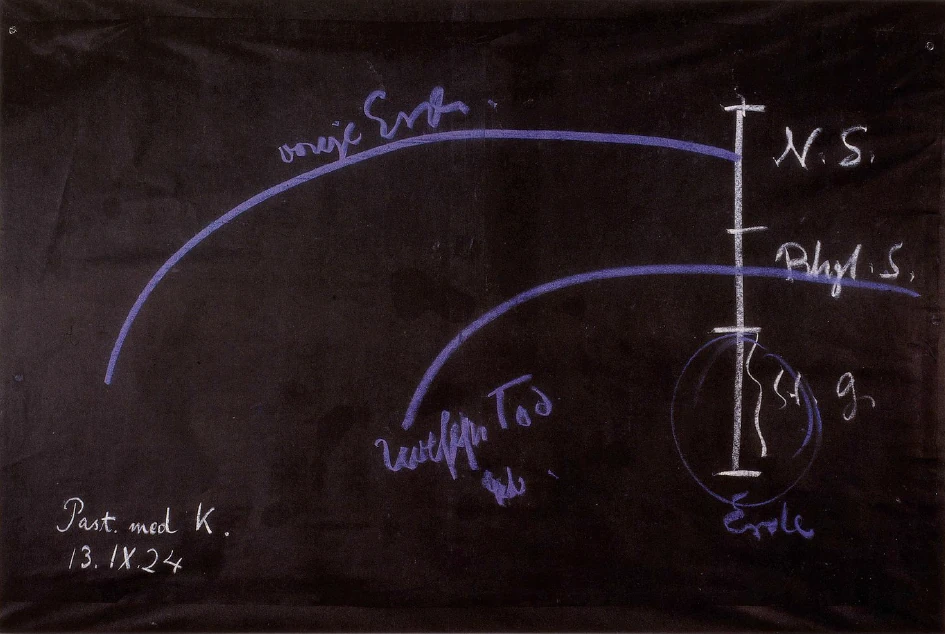
[ 11 ] Well, everything that this individuality—who is now Ferdinand Raimund—was able to experience in terms of bitter remorse and enlightening, deeply shattering insight after death in that earlier incarnation regarding his craving for cruelty toward animals—all of that always had an effect on the states between death and a new birth and influenced the rhythmic system. This was expressed in the rhythmic system in such a way that it extended into the physical realm. For in the physical structure of the head we find the aftereffects of the previous earthly life, and in the physical structure of the rhythmic system we find the aftereffects of the life between death and a new birth.
[ 12 ] In embryology, this truth is within your grasp, even externally, in a physical and sensory way. In the individuality of Ferdinand Raimund, we see—particularly in his respiratory system, in the upper rhythmic system—how all the remorse and bitter realizations that come upon him as he steps through the gate of death from his previous, defining earthly life work their way into him. And this causes him to develop what leads to a kind of respiratory irregularity—insufficient oxygen intake and excessive carbon dioxide accumulation—respiratory irregularities that, from a physical standpoint, in and of themselves induce all kinds of anxiety, but which can also serve as vessels for elemental beings of fear. Everything that thrives on irregular breathing—that which prevents the proper balance of oxygen and carbon dioxide in the respiratory process—attracts elemental beings of fear. You can see this clearly in *The Alpine King and the Enemy of Mankind*. This was particularly well developed in Ferdinand Raimund; he was, so to speak, “predisposed”—to use the scholarly term—to make his respiratory system a host for elemental beings of fear.
[ 13 ] Such elemental beings of fear, however, are not merely elemental beings of fear; rather, if one also brings with oneself—at the same time—the psychic and spiritual insights that Ferdinand Raimund had in his mind from earlier earthly lives, which are what make his dramas so interesting, then one sees how, through the influence of these demons of fear—who come in this way—karma flows in a very specific direction. One can literally see how these demons of fear drive toward an effect, toward a pathological effect in the sense of karma. They pour themselves—I might say—into the imaginative visions that extend into the visionary realm—for Raimund’s dramas are founded on the visionary—they pour themselves into the visionary and thereby cause the person to develop something fantastical even in life. And in this way, a current breaks through in karma—an immensely brilliant gift that finds its full expression. In a particular form of spiritual creation, one current expresses itself fully, while the other current exists in parallel within a kind of fantasy of life—one that does not express itself outwardly, but looks inward, because it lies within the rhythmic system, which is, after all, the semi-inner realm; yet in its lower organs it expresses itself in such a way that it extends into outer life, but also rebounds inward, whereby its brilliant individuality was accompanied by a truly pathological trait. And this trait, this pathological trait, which played itself out in demons of fear, became the vehicle for the working out of karma.
[ 14 ] You can see Ferdinand Raimund’s karma right away. Raimund is compelled to keep a dog. He’s a dreamer. He does what other people don’t do. One can understand this, and one can certainly feel sympathy for it. For one can certainly say, my dear friends, that I have more sympathy for this than for the food served to some bourgeois appointed as a commercial councilor at the royal table, when I observe that Raimund, on a whimsical whim, sits down next to his dog and takes a bit of the dog’s meal to eat it himself. That is what Raimund does. Look at how the karma of animal cruelty from a previous incarnation comes into play. See how simply this fact—transformed from remorse after death and the animal cruelty of the past—unfolds as a fantastical atonement; yet this fantastical atonement takes place in an even harsher manner. Immediately afterward, the demons of fear arrive and play a part in the fulfillment of karma. Ferdinand Raimund is overcome by the thought: The dog is rabid; I ate with him; I’ve been infected with rabies! — Now you see how Raimund is completely devastated. Even as he may be performing the most brilliant act on stage—at the very moment he has withdrawn from life and is overcome by obsessive thoughts—there is a feeling that he has been infected with rabies.
[ 15 ] Then, for example, he goes on a trip with a friend. They’re traveling from Vienna to Salzburg when this idea suddenly strikes him: that he’s been infected with rabies and must return to Vienna immediately to seek a cure. It’s an agonizing journey for him and for his friend, if you follow their journey. Everywhere you look, the pathological seems to follow the genius on its heels. Well, Ferdinand Raimund is treated very well, because people are exceptionally fond of him. Gradually, he begins to let go of this idea. There really is something akin to a healing through life itself, through joy, through all the goodness he receives from various sources—which he is reluctant to accept because he is and remains a hypochondriac, because the demons of fear, when they aren’t tormenting him with one thing, torment him with another. So he’s always swinging back and forth between the humorous Raimund and the hypochondriac. But at least he managed to shake off that idea that he was angry. That idea had lasted for years. But he remains attached to animals. Once again, he has a dog after ten years, and lo and behold, while he’s playing with the dog, it actually bites him. The idea resurfaces—curiously, it was also established that the dog had rabies, though it was quite insignificant—Raimund stood there, bitten by the dog, which had rabies! Raimund travels to Pottenstein, shoots himself in the head; the bullet travels up into the posterior cranial fossa and lodges deep inside. It cannot be surgically removed; Raimund dies from the gunshot wound after about three days. You see, he managed to shake off the first “delusion,” so to speak, but karma continued to take its toll.
[ 16 ] This is a rare case in which karma plays out in a clear-cut manner; just consider the following: Subjectively speaking, it is not entirely a suicide, because Raimund does not bear full responsibility—subjectively, it is not a complete suicide. Objectively, it is also not a complete suicide, for if surgery had been possible at that very spot back then, Raimund would have been saved. But at that time, surgery could not be performed at that spot; the bullet had to be left inside, and that led to his death after three days. It is not a pure suicide, neither subjectively nor objectively. So one cannot say that anything follows from this in terms of karmic consequences related to suicide. The karma does not continue; it ran its course with what he experienced in this life up to its conclusion, up to the way in which the suicidal intent was carried out. But one can literally see it coming to the fore, clearly recognizable—the karma from the previous life—and see it manifest in such a way that one can now say, “We have seen the following.”
[ 17 ] We have seen that there are people—who are here due to a special karmic predisposition, which we have considered only in relation to earthly life—who are predisposed such that their “I,” their astral body, and their etheric body are structured, either immediately or gradually, in stages, in such a way that they break into the spiritual world through visions: Saint Teresa, Mechtild of Magdeburg, and many others. We have such personalities who, in one direction—the direction toward the spiritual—exhibit an abnormality. In the case of those who exhibit such an abnormality in one direction, there is no need to go into the details of karma. Of course, it is karmically determined. But we need not go into the details of karma. For one can understand the case within a single earthly life.
[ 18 ] The same is true on the other side, which we examined yesterday. We see how people develop abnormally within their physical-etheric organism and thus become more and more immersed in the physical body, eventually becoming pathological—as I showed you yesterday—in three stages. The pathological condition is predetermined by karma. But one need only go back to the general principle that, in personalities such as Saint Teresa, individuality became particularly strong in earlier earthly lives, whereas in the psychopaths or pathological personalities we are considering here, it developed particularly weakly; hence, the higher is drawn in through the lower members. Once again, one need only consider the general characteristic of individuality, rather than examining karma in detail.
[ 19 ] But Ferdinand Raimund is a peculiar personality. He did not develop solely along the lines of the visionary; rather, the other aspect of his development is present at the same time. These are two polar opposites that are constantly clashing within his life. Both are present in his personality; the pathological and the genius interact within him—on the one hand wonderfully, on the other hand with a sense of dread. Here we must then address the concrete nature of karma. One must understand how karma works to bring both poles into being, to keep them distinct, and at times to allow them to interact. You will find numerous passages in Ferdinand Raimund’s plays where you can say to yourself: “Here, his spiritual insight is at work at the same time, but what comes from the demons of fear is also at work within it.” You can see this at times in the dramatic composition.
[ 20 ] You see, when we examine human characters in this way, we naturally arrive at karmic considerations, and from this we must recognize how one-sided it actually is to take, on the one hand, the abstract doctrine that existed within certain civilizational currents of antiquity: “Illness comes from sin”—it is only the abnormal spirituality within the human being that is at work. In this abstract framework, such claims can naturally be made, yet they remain mere theories even when people are treated according to them. The opposite view is also an abstract one-sidedness when one says: “Sin comes from illness”—and that it is physical substances and physical processes in human life that must be combated. One must address the concrete—first, the concrete nature of the human organism, how the higher bodies relate to one another, whether they are drawn toward one another or whether they move away from the lower ones—and one must be able to perceive, in a corresponding way, the workings of karma within such an interplay of genius and pathology, as is the case with Raimund. For when one acquires an understanding of such things, one will already find in life the opportunity to add to what one accomplishes in the physical healing process the word that is needed to complement it. One will certainly come to the point where, free from prejudice, one does not see the physical healing process as the be-all and end-all, but rather knows how, in some cases, it is necessary to add the moral aspect to the healing. This need not consist in becoming a philistine comforter who approaches the sick with all sorts of philistine platitudes. As a rule, these have little effect, for the sick have little patience for such “tea-party” platitudes and good-natured, old-fashioned consolations; they really don’t have much patience for that. But they have an extraordinary amount of patience for what lies in natural behavior—in the “how” of what is said, not in the “what.” One finds oneself drawn to this quite instinctively, however, if one is inclined to present one’s worldview, outlook on life, and perspective on life in a light that is as compatible with spiritual contexts as it can be—provided one can truly take examples such as the one cited completely seriously.
[ 21 ] My dear friends, one cannot view spiritual activity solely in terms of tirades, or merely as speech arising from religious tirades; rather, spiritual life must be developed through concrete actions. For when spiritual life is grasped through concrete actions, only then can that understanding be applied to the necessary treatment of human beings. Then it can be applied to both healthy and sick people. In particular, one develops an instinct for assessing the nature of any illness that arises in one form or another. We will see that this also applies to physical illnesses, but we must first pave the way to recognize these things in physical illnesses as well. You see, you’ll already come to realize this if you study such things—which, of course, could be illustrated with numerous examples. From this perspective, it is interesting to study the lives of many people who were truly brilliant minds, rather than from the standpoint of a die-hard philistine, as Lombroso was. What is repulsive about Lombroso’s theory is not his great genius—which is certainly there—but the fact that he is an arch-philistine, that on every page one reads a philistine judgment. It is indeed true that science has truly encountered the arch-philistine here. If you truly do not approach things from the perspective of the arch-philistine, but rather from the perspective of seeing through the world—that is, of sensuous-spiritual life—then, when you need comfort in your inner calling, you will bring the comfort of religion or the sacrament to the sick person, offering this sacrament with the proper spiritual aura. But not without the underlying understanding. Whether one administers Holy Communion in the proper way to the sick person—so that they may recover and so that their recovery does not cause them spiritual harm—depends on having an understanding of such matters.
[ 22 ] You see, there is a reason—we will discuss this later—why, for certain people, Holy Communion is necessary as a complement to the physical healing process once they have recovered, so that what has been thrown into disorder in their karma may be set right. But if one does not know this, one cannot carry it into the aura of the sacrament. On the other hand, the physician who understands these things—who sees the karma at work in the illness and who intervenes in the healing process as a matter of duty—will be able to approach it in the right way if he comprehends these matters in accordance with his worldview and in relation to the whole person. But then something objective will take hold of the doctor, of the healer, when the doctor knows with his whole soul that he is actively engaged in the karmic processes within the human being. Then his healing mission will take on the other aspect of worship, a religious character, and he will learn to see himself as the priest’s companion, as the one who stands alongside the priesthood and performs the other aspect of worship; and healing will become worship. Through a proper anthroposophical understanding, those things that the materialistic worldview has introduced into the service of nature—that is, dancing around the golden calf, to use the Hebrew expression—can be transformed once again into worship. Transforming everything in life, art, and religion into worship—that is what can ultimately be the task of the most comprehensive pastoral medicine that can be pursued within the anthroposophical movement. But the first step must be taken by first outlining this pastoral medicine, at least in broad strokes, here for those from whom the work for both sides of true worship must emerge from the spiritual depths.
[ 23 ] For this reason, pastoral medicine is initially presented to priests and physicians within the anthroposophical movement, and they will then find ways to pursue it further using their knowledge of nature and the spirit, but also to apply it specifically to those areas of life that fall within their mission.
[ 24 ] Let's talk more about that tomorrow.