

Cooperation Between Doctors and Pastoral Caregivers
Pastoral Medicine Course
GA 318
14 September 1924, Dornach
Translated by Steiner Online Library
Seventh Lecture
[ 1 ] My dear friends! If one relies solely on the means provided by modern science—against which, of course, no objection should be raised with regard to its own achievements or the achievements of this science, for as far as its methods can reach, it does indeed penetrate in an excellent way into whatever lies along its path—if one relies solely on these means, then one cannot truly arrive at an understanding of the human being. One cannot arrive at this understanding because, in human life as it actually exists, the physical-bodily and the soul-spiritual are interwoven. The earthly processes—the earthly processes of the present—extend into the physical-bodily realm. We then use today’s science—which works relatively well, especially for the non-human realm—to track the physical-chemical processes of external, non-human nature, and we easily succumb to a mental image that: Just as these chemical processes unfold in the physics lab, or when observing that part of the world that is the immediate earthly environment, or in the chemistry lab—that is roughly how we imagine these processes continuing within the human being as well. Externally, combustion is described as the combination of a substance with oxygen; then, when speaking of internal human activity, we extend the ideas we have gained in this way into the human being and speak of “combustion” within the human body as well—even though we should know that this is entirely impossible. For just as a living being relates to a dead one, so does the process that can be described as similar to combustion within the human being relate to external combustion. External combustion is inorganic; external combustion is lifeless. Internally, we are dealing with a living combustion, with a combustion that has become alive. This also has major consequences—significant consequences—for the rest of science. For you see, external combustion is subject, with regard to the substance it affects, to very specific—let us say—thermal conditions. Based on our scientific understanding, we can only create a mental image of a certain ignition temperature arising and of combustion heat being present under these external conditions. This is by no means something that continues in the same way within the human organism. At certain temperatures, any substance can combine with oxygen externally, and combustion occurs. This does not necessarily have to occur at the same temperature internally; different laws apply there. I say that this has a certain significance for external science, for in external science one formulates hypotheses that appear quite plausible. One infers past conditions from the conditions that currently exist on Earth. The famous Jena physiologist Preyer did something like this. He found the standard Kant-Laplace theory too simplistic, so he turned to certain living fire processes from which evolution is said to have originated. Indeed, he created a mental image of these processes occurring at the same temperatures at which corresponding fire processes must occur today. That need not be the case. One can start by moving from today’s inorganic fire processes to processes similar to those found in the human organism today, where the same phenomena occur at a significantly lower temperature. Then, even for a hypothetical mental image of Earth’s primordial state, one would arrive at something entirely different.
[ 2 ] So you see, the mental images that become commonplace have a very specific significance for our overall understanding of the world. In short, the tools provided by modern science are insufficient for understanding even the external world in its unfolding and the immediate present derived from it. This, of course, immediately gives rise to difficulties when a certain tendency emerges. I can truly speak of these difficulties because I have personally experienced them in an extraordinarily intense way.
[ 3 ] You see, you may believe me when I say that throughout my entire development there was a thread that can only be described—as you can see from the description of my “life’s journey”—as the utmost respect for contemporary natural science! This respect was always there. Nowhere, on any point, could I bring myself to level a dismissive criticism—in the trivial sense, as so often happens—against what is regarded as natural science, whether in the realm of external chemistry, mechanics, and physics, or in the realm of medicine. But at the same time, evolution was also present before my eyes as a spiritual image. Now there was an effort to bring what opens up spiritually—let us say, for something like the Atlantean era or the Lemurian era, or even further back or forward—into harmony with what natural science provides. This works reasonably well for what natural science says about the immediate present. The moment natural science begins to run wild and put forward hypotheses that extend beyond the present into a time far in the past, one encounters the most severe conflicts when trying to reconcile what is spiritually perceived with what natural science says. This is why conflicts arise, precisely when one wants to live in harmony with natural science—a natural science against which Spiritual Science never intends to take a stand; for one would not be so unreasonable as to object to facts. But this leads all the more to conflict with their views. As soon as the natural scientist speaks—fine—but as soon as he begins to write, he actually becomes quite frenzied, and then one can no longer keep up. This is the very thing that presents itself as a serious conflict, one that must also be recognized by anyone who comes into contact in any way with what modern science has to offer.
[ 4 ] For you see, this science simply cannot reach human beings, because human beings are placed in the world with a spiritual and soul-life as well, and in their inner processes, it is not only what is externally investigated—up to the phenomena of aerodynamics, aeromechanics, or thermodynamics—that manifests, but also, for example, what enters their karma from previous earthly lives. We saw yesterday that this was practically tangible in a person like Ferdinand Raimund. There is no possibility of transition to this if one considers only the methods of modern natural science. But now you see, one must rise to the point where what manifests externally in a human being as processes is, so to speak, intercepted by the spiritual and integrated into the spiritual. Then one can indeed make good progress, especially when one is firmly grounded in the physiology of the respiratory process and the physiology of the circulatory process—in relation to what can already be known through the methods of modern natural science—and when one attempts, precisely on the basis of the respiratory and circulatory processes, to understand how physical life is connected to the spiritual.
[ 5 ] For you see, if we first consider the process of human inhalation: this process of inhalation in humans consists in the human being taking in external air. However, this external air-like substance is not merely a passive entity that is taken in by the fully formed human nature and processed within it in such a way that the oxygen uptake process is transformed into a carbon dioxide-forming process, and inhalation simply gives way to exhalation; but rather this process of inhalation actually manifests itself as a continuous generator of human being. It continually contributes to the building up of the human being from the outside in. From the world around us, the human being is continually built up through the process of inhalation, and the human being does not merely take in amorphous oxygen; rather, in the oxygen that he mistakenly regards as amorphous, he takes in formative forces that correspond to his own being. When we experience shortness of breath, there is indeed a foreign elemental entity sitting within the respiratory tract. But this occurs in the abnormally structured breathing process. In the normally structured breathing process, my dear friends, a human being in the process of becoming is constantly present. Continuously, a human birth in the making—an air-human birth—flows from the macrocosm into the human being. The entire process taking place there is governed by the activity of the astral body, so that one must create a mental image of it as follows (Plate 8): We inhale; the act of inhalation is activated by the astral body. The entire process taking place here—which is a continuous becoming of the human being—unfolds in the element of air; it unfolds in all that works within the human being in an air-like form, so that we have a continuous becoming of the human being in the process of inhalation within the element of the air-like.
[ 6 ] But you see, now we exhale again. We exhale, and essentially we’re exhaling carbon dioxide. Following other organic processes, the carbon is, so to speak, gathered together for exhalation. One can imagine this, in turn, as a kind of passive reaction process or something similar. We have absolutely no clear mental image of these things. We simply investigate what we can examine in this regard using physical means, but we do not form any clear mental images. Now, you see, this exhalation is, however, activated again; it contains not merely a passive process with regard to the human being, but there is activity within it—an activity that is, in fact, the activity of the etheric body. All of this takes place in the element of the liquid, in that element which used to be called water, when everything liquid was considered water. We can continue to use that term. This takes place in the element of water.
[ 7 ] Now an important question arises that must, of course, be on all of your minds. The question is: Yes, what actually happens during sleep? For during sleep, the etheric body is still inside us, so we have no qualms about exhaling. But how can we breathe in while we sleep, since the astral body is outside? — Well, you see, the fact is that during sleep only the microcosmic part of the astral body leaves the body, and the astral aspect of the macrocosm becomes all the more active during sleep. The entire astral nature of the macrocosm enters during sleep; the act of breathing—which is, in fact, somewhat different from the act of breathing while awake—is regulated by the activity of the macrocosm. So you can see here a significant difference between inhalation while awake and inhalation during sleep. Inhalation during sleep is regulated from outside the human being. In the waking state, the human being regulates inhalation from within using his astral body, whereas the astral nature of the cosmos enters into him during sleep. Here you already have a significant point of reference for gaining insight into pathology. The cosmos has the peculiarity that, in relation to earthly conditions—as soon as we go a certain distance beyond the Earth—it is healthy. Near the Earth, there are all kinds of processes—manifested through climatic and other factors—that can render the astral nature of the cosmos abnormal. Similarly, the human being’s inner astral nature can be abnormal due to other processes that we will yet come to know. Here we have the source of pathology in a specific area, but we see the source of pathology extending all the way into the spiritual-soul realm, and that is the essential point.
[ 8 ] Now let’s move on. You see, the process of breathing is, relatively speaking, a rather coarse one. We inhale air and exhale air. The entire breathing process has a certain coarseness to it when we compare it to all the processes that flow both within us and in the outer macrocosm, when we compare it to the processes involved in the fluctuation of heat, in the thermal elements both inside and outside the human being. There are, after all, thermal differentiations within the human being, and there are thermal differentiations outside. We can set aside air, water, and earth; we can focus solely on these thermal differences. For the physicist, this makes no sense, because he regards thermal differences merely as states of matter. Spiritual Science knows that, when it comes to heat, we are dealing with an element. We may therefore speak of an element—and address what is contained within the heat element as independent and active. Now, underlying the entire human life, in contrast to the respiratory process, is a more subtle process of absorption through the heat process. And we can say: If we ascend to the region of the human lungs—but please take what I am saying in rough, external terms quite deeply to heart—if we ascend to the lung structure, we are dealing with the gross respiratory process in the air. But if we ascend to the regions that are primarily regulated by the head—though they are present in a diminished form throughout the entire human being—we encounter a refined respiratory process that takes place not in the element of air but in the element of heat. So we can say: We ascend to a refined process that consists of an extraordinarily subtle absorption of warmth from the macrocosm—inhaling warmth and exhaling warmth. — But the situation is this: when we observe the gross inhalation and exhalation, the human being interacts with the external world: inhalation-exhalation, inhalation-exhalation, in-out, in-out—that is the process. Here it is not like that; here there is indeed an “in,” but not an “out” in the same sense as in ordinary breathing; rather, the exhalation goes into the human being itself, becoming an inner process. That which is now exhaled by the nervous-sensory system joins the process of inhalation—the inhalation mediated by the lungs. Thus, with regard to the sensory-nervous system, we have a process that we can describe as a refined respiratory process, and whose inhalation is truly a reception from the outside; but what enters there is not expelled back out again; rather, it is transferred to the coarser respiratory process, passes into inhalation, and continues along the inhalation pathway into the organism.
[ 9 ] But now you can say this: The warmth of the macrocosm enters the human organism in this way through breathing, but not merely the warmth—the warmth carries with it light, macrocosmic chemistry, macrocosmic vitality, and macrocosmic life. — The light ether, the chemical ether of the macrocosm, and the life ether of the macrocosm are carried in through the inhalation of warmth and pass into the human organism. The element of warmth carries the light—anchored within it—carries the chemical element, and carries the vital element into the human being, transferring them to the process of inhalation. The whole realm that lies above the respiratory process—which manifests as a refined respiratory process, but also as a metamorphosed respiratory process—is not studied in the strict sense today; it falls entirely outside the scope of physiology. Yet as a result, something enters into physiology that then acts within it like a foreign body. This is a point where one is completely at a loss if one proceeds, on the one hand, from the spiritual and, on the other, from nature. Sensory physiology—which unfolds as differentiated processes of seeing, hearing, and the sensation of warmth—falls into this like a foreign body. These are like limbs, external tendrils of this process, which is initially the absorption of warmth, imbued with light, chemistry, and vitality. This differentiates itself outward through the sensory process. But in the sensory process, human beings are aware only of the peripheral aspects, not the central ones; therefore, sensory physiology is something of a complete foreign element to them. The physiologist dabbles in the individual senses, and then the psychologist dabbles as well. Hypothesis after hypothesis is formulated. Of course, this is inevitable, because one is faced with the individual, highly specific processes of seeing and hearing, but cannot grasp their convergence, their confluence toward the inner self. One does not see how it all converges in the absorption of warmth, which carries within itself light, chemistry, and vitality from the macrocosm; this leads one to respiration, and only then will there be a true physiology of the senses when the sensory physiologist will be able to say: Ah, I start with the processes—the physiological and physical processes of the eye—move into the nerves that carry this inward, and gradually enter the respiratory pathways, proceeding from the sensory pathways and the pathways of the intellect into respiration. - Then one will understand that yoga was able to arise in earthly life if one disregards, to some extent, the sensory life that takes place at the periphery. One enters into the practice of yoga at the point where the entire process merges into the process of inhalation, projecting what lies behind it into sensory perception, and thus enters into the practice of yoga. You can see that, practically and instinctively, such things were known in earlier worldviews. But modern science must face mysteries everywhere, because it cannot perceive the facts and cannot perceive the connections. It wants to speculate wildly. It observes the eye and the ear; then it begins to speculate wildly about what is actually going on inside. And when it realizes that it is reaching a dead end—that what it speculates about in the eye and ear, when traced inward, leads to a dead end because it refuses to accept the refined breathing process I have described as a fact—then it says: Well, what’s happening on the inside is simply parallel to what’s happening on the outside. Parallelism! — The processes occur simultaneously; that, of course, is the most convenient way out.
[ 10 ] You see, this is also what will give both the priest and the doctor a firm place within the entire structure of modern intellectual life, for they will no longer need to reject this intellectual life. Sensory physiology brings immense treasures from all sides, but the situation with these treasures is as if one were bringing the most wonderful building materials from all directions to construct a beautiful house. These materials are excellent. Now one brings them in, piles them up into a great mound, but one cannot build a house. It is impossible to build the house. One gathers everything that takes place in the senses, piles it up into a great mound, and fails to put it to use; for this use would lie in working together, within the human being, what has been externally investigated—in tracing this process of finer respiration as it extends into the etheric and astral realms; that is where one would begin to build the house. Of course, one would be a fool if, now that one could build the house, one were to say: one must begin by clearing away this mound of the finest building materials that has been brought here. One would not do that, would one? Once it is there, one will begin to build the house.
[ 11 ] Likewise, it would be nonsensical to do what many people do today—those who approach things in an amateurish way—when they criticize and reject the natural sciences outright. It need not be rejected; one should use its building blocks piece by piece—they are very useful—and one can achieve something very beautiful by utilizing what is available today in sensory physiology, which in itself serves as a bulwark. And so you can say: We look up from what appears in breathing as the continually present formation of the human being to the refined breathing process that takes place in the element of warmth, but into which the entire etheric world of the macrocosm plays a part. There we look up as we come to the higher human being.
[ 12 ] But we can also look down at the lower human being, starting from the process of inhalation. Just as we move upward toward a refinement in relation to the inhalation process, so do we move downward toward a greater coarsening in relation to the exhalation process, and we gradually transition from the process taking place internally in the formation of carbon dioxide downward to the process taking place in digestion. Just as we must connect the inhalation process upward with this subtle nerve-sensory process that transitions into the spiritual realm, we must connect the exhalation process downward with the process of digestion, where human activity gradually transitions into the physical realm, so that we descend into that realm where metabolic activity is carried out through the physical body, modified exhalation. In a sense, the activity that exhalation leaves behind within the body constitutes metabolism, just as that which respiration takes up from the nervous-sensory-spiritual activity transitions into inner activity; so what remains of the exhalation’s activity within the human being is the sum of the forces that shape metabolism, which now takes place in the element formerly called earth in all that within the human organism is related to solidity (Plate 8).
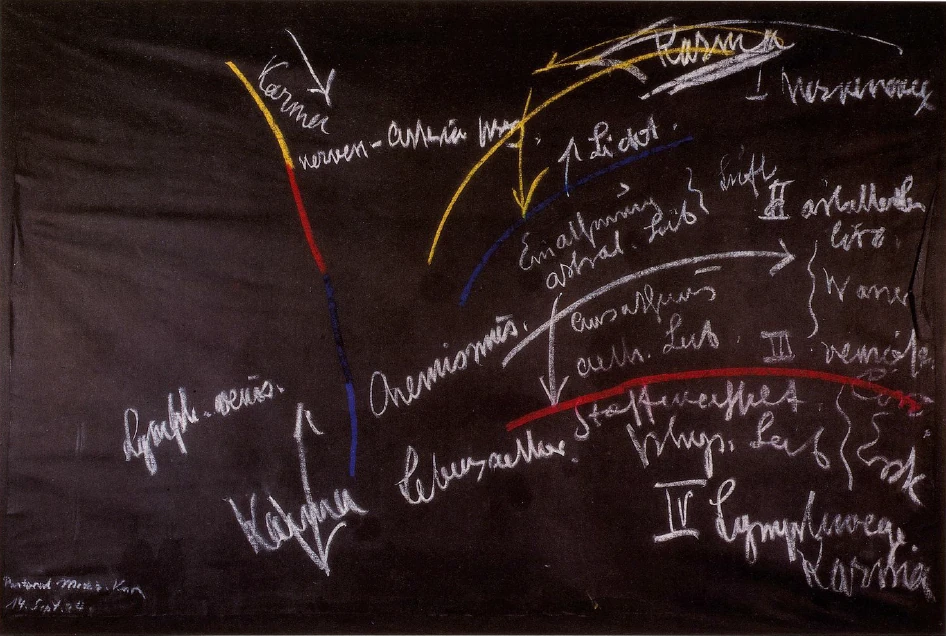
[ 13 ] Well, you see, if we examine the entire process in a bit more detail, we actually find a fourfold process within the human being. We have the process we were able to characterize above, about which we can say that its exhalation actually enters the human being. If we now consider the externally observable process of inhalation, we must see in the inhalation, at the same time, a connection between what is inhaled and what comes down from above. Here we must state the polar opposite. Here, exhalation leaves behind the forces for metabolism. Nothing is taken in from exhalation; rather, something is given off. We thus have inner exhalation and, in addition, inner inhalation, and then the connection of this inner inhalation with what the physical body does, as the actual metabolic-digestive process.
[ 14 ] Well, you see, when you consider this fourfold differentiation, a light dawns on you regarding human beings; for, in addition, the following becomes apparent (Plate 8): Here, along this path, the heat element—which carries light, chemistry, and vitality—enters, connects with the breath, but does not transfer the light to the breath; it retains it. It transfers only the chemistry and vitality to the breath. The light thus remains here and, as an inner light, fills the human being, becoming thought activity.
[ 15 ] As this inhalation and exhalation continues, the macrocosmic chemism is released and becomes inner chemism within the human being, replacing the external laboratory chemistry found in the processes we observe in the external laboratory. Within the human being, macrocosmic chemism is deposited as this inner respiratory process continues, so that we can say: Here, chemism is deposited. — And right into this interaction between exhalation and metabolism, the life ether enters and is absorbed by the human being. So that when you trace the process from top to bottom, you have: light entering along the pathways of the warmth ether—stop! Where breathing begins, the light stops; the light spreads out; it is no longer absorbed by the human organism and can spread as light. We carry within us a light organism—a pure light organism—that thinks. We trace the process to the point where inhalation meets exhalation; up to that point, the chemism carried in through the nerve-sense process continues. Now, chemism—stop! Inner chemism—a chemical organism within us that feels.
[ 16 ] Now we continue downward, to where exhalation leaves behind the digestive process—the metabolic process. This does not extend all the way to the external metabolic process involved in food intake, but only as far as the internal processes of metabolism. Here the life ether ends. The life ether once again forms a human organism that wills. This is how thinking, feeling, and willing come about.
[ 17 ] We can now trace the entire process in its physical manifestation. Let’s take everything that is up there: internally, it manifests itself in thought. But that is very subtle. Behind it lies everything I have just described to you. All of this takes place via the nerve pathways. The nerve pathways are the external physical conduits for all of this.
[ 18 ] Now move on to the next process. In the next process, you have: the absorption of this highest process into the human being through the respiratory process, and this takes place as a physical-sensory projection within the arterial circulatory process. The arterial circulatory pathways are the second pathways.
[ 19 ] We now come to the third process, which takes place between exhalation and digestion/metabolism. This process, too, has its own pathways—the venous circulation pathways. We now come to the third—the venous circulation pathways.
[ 20 ] And we continue. We delve even deeper into the human being and must seek out where the pathways lie—how the process, which has now been deprived of its vitality from the very source of its entry, must draw its own vitality from outside, from below, from the outside. We find its physical projection in the lymphatic process and in the lymphatic pathways (Plate 8).
[ 21 ] You see, my dear friends, now you understand the relationship between the outer and the inner. There is much behind what is the process of sensory inhalation—in the act of taking in—it lies there in the background. But within what lies in the background, there are many forces at work that remain unknown to people today. Karma from previous earthly lives is at work there. It radiates in, yet remains hidden from perception. Karma radiates in. Anyone who examines the nerve pathways with the spiritual eye—as they form along the sensory pathways—will find karma along these pathways. It flows in there. Likewise, however, on the other side, in the formation of lymph, one finds not merely a physical process; rather, as the lymph enters the organism via the lymphatic pathways, one sees—as Johannes Müller, the famous physiologist, has already said: “What is lymph? Blood without red blood cells”—blood is lymph with red blood cells. This is a generalization, but it contains a certain truth; we see how lymph enters the blood and thereby nourishes the present human being. But in the lymph we see everything that has not yet become blood; we also see the weaving and life of karma in the making. There, within the lymphatic process, karma is formed once again. The lymphatic pathways are at the same time the beginnings of the karmic pathways for the future (Plate 8, right).
[ 22 ] This is how you enter into human beings from the spiritual realm—where you sense that light, chemistry, vitality of the macrocosm are drawing in—there you sense this more and more as you move out from the light toward the vital pathways and then see the general life of the worlds flowing in; there you sense the inflow of karma, which now plays out in human earthly life between birth and death. But it plays itself out by passing through the nerves—and even through the weakened arterial process—and is held back by the venous process. And when it approaches the venous process, the misty waves of karma also push their way in. And as the human being forms venous blood, he simultaneously takes in these accumulations of karma and acts in accordance with karma.
[ 23 ] A change in the blood can only indicate anger. What builds up there—because the past is not allowed to flow into the venous process—leads to action, which in turn shapes karma.
[ 24 ] That which is not allowed to rise by the lymph, that which does not pass into the blood, accumulates deep in the subconscious; it forms a core deep in the subconscious; and when a person sheds the material process, they carry this core out through the gate of death. This is karma in the making.
[ 25 ] Above the inhalation, one observes the karma that comes from the past; below the exhalation, with the circulation below the exhalation—where the lymph has not yet become blood—one observes the karma in the making. It is contained there, and so one can say: Karma (Plate 8, left, yellow) flows into the arterial process and remains within the human being; the venous process forms, and karma arises once again. Here at the top is the boundary where karma begins to accumulate in the nervous-sensory-arterial process.
[ 26 ] Here below, in accordance with the process that transitions from the lymphatic to the venous: here we have the incoming karma, and here we have the outgoing karma, when we observe the lymph—which has not yet become blood—with the spiritual eye. Thus we have the union of the physical and the spiritual. Above, the human being qualitatively borders on the spiritual. We see him bordering on his karma. In between, the present life accumulates. Below, when we observe the lymph that has not yet become blood, we see the karma that is emerging. Between past karma and emerging karma, right in the middle, stands the human earthly life, which, viewed from this perspective, represents a congestion between the two. But we can trace the matter all the way down to the physical process.
[ 27 ] We’ll continue discussing this tomorrow. As you can see, we are increasingly able to perceive the spiritual within the physical, but it is only this that will make the practical application complete.