

Cooperation Between Doctors and Pastoral Caregivers
Pastoral Medicine Course
GA 318
16 September 1924, Dornach
Translated by Steiner Online Library
Ninth Lecture
[ 1 ] My dear friends! You have seen how necessary it is to relate illness to a person’s spiritual life and experience, and the understanding that should be applied to illness—particularly from the two perspectives that are of primary concern to pastoral medicine—can really only arise from such a consideration. Therefore, let us today once again consider illness itself in connection with spiritual life from the perspective that can shed the most light on the very nature of illness.
[ 2 ] As human beings, we alternate between the two states of waking and sleeping. You all know what can generally be said about these things as part of our worldview.
[ 3 ] Today we want to take a close look at what actually takes place within a human being during sleep. We have the physical body and the etheric body existing independently of one another. We also have the astral body and the “I,” which exist separately. If we turn our attention first to the physical and etheric bodies, we know that within them—by virtue of what they are—certain processes take place, processes that, from the moment we fall asleep until we wake up, are independent of the effects of the astral body and the “I.” In an organism such as the human one, we are dealing with processes that, in the way they must unfold there, are actually not at all adapted to the human organism. In the physical body, we are dealing with physical processes. Physical processes take place out in the mineral kingdom; they are adapted to it. They are not adapted to the entire human form as a physical body. And yet, the human physical body is, so to speak, subject to these physical processes from the moment of falling asleep until waking up, just as the mineral kingdom is subject to physical processes. We must pay attention to this contradiction, which is present in human beings specifically during sleep. It is supposed to be a world of physically active forces and substances, yet it cannot actually be so. This is precisely the reason why, during sleep, processes take place in the human physical body that—if they are not balanced out again—are disease-causing processes.
[ 4 ] When we make general statements such as “sleep is healthy,” these statements are, of course, entirely correct in a certain sense, but they are true only under certain conditions and must not prevent us from observing what is, with an open mind. The physical processes in the human physical body can only be beneficial to the human being if the “I” and the astral organization are immersed within this physical body—which, of course, happens again upon waking and must be such that it is constantly interrupted by the state of sleep, because this state of sleep initiates the processes of breakdown in the physical human being—processes that are constantly present and must be there so that the soul life and the spiritual life can unfold within the human being at all. For no spiritual life is connected to the processes of building up; it is connected only to the processes of breakdown. Sleep must therefore ensure that enough breakdown processes take place so that the waking state can unfold within this quantity of breakdown processes—from waking up until falling asleep. If more breakdown processes occur due to unhealthy sleep, then a residue of breakdown processes remains in the human organism. Then we have, in this breakdown process, the inner cause of illness.
[ 5 ] If we extend our consideration to the etheric body, we find that during sleep it can carry out only those processes that otherwise take place in the plant kingdom. When the astral body and the “I” have withdrawn into this etheric body, these processes are always raised to a higher level. But as they unfold from the moment of falling asleep until waking, they proceed as they do in the plant kingdom; thus, they are once again not adapted to the human organism but require a balancing influence from the astral body and the “I.” If a residue remains that is not utilized, then causes of illness arise once more. Thus we can say: Sleep can teach us how the causes of illness actually arise in the human organism; for these causes of illness are, in essence, the normal processes of sleep, which at the same time form the foundation for the human being’s spiritual and soul life. — And this is the mystery of the world: that wherever one enters into reality, things take two paths. On the one hand, the state of sleep of the physical and etheric bodies provides the foundation for human spiritual development; on the other hand, through precisely the same processes, it provides the foundation for the onset of illness. Thus, the onset of illness is directly linked to spiritual development, and we can say: When we study what is at work in the human physical and etheric bodies, it is, in essence, the basis of pathology during sleep.
[ 6 ] Now, from this perspective, let us consider a person who does not sufficiently immerse themselves in their physical and etheric bodies while awake—a condition we have observed in the mentally deficient and in psychopaths. Then the soul-spiritual aspect of such a person becomes immersed in disease processes, lives in harmony with them—and particular emphasis must be placed on this insight: that psychopaths and so-called mentally ill individuals actually spend their inner existence in communion with the causes that bring about disease. You see, one must look closely at such things.
[ 7 ] But let us now turn our attention to the external world. If we take the human physical body in a very schematic way (Plate 10, left) and consider the corresponding mineral external world—again, in a very schematic way—then during sleep there are processes taking place within the human physical body from which the “I” is absent. They proceed without any actual inner driving force. Yet this “I” is present within all of these mineral processes. For what we might call the “world-I” is present there. So on the one hand, in the processes of the human physical body, we have something devoid of the “I”—a sum of “I”-less processes that lack the “I.” Outside, in the environment, we have the sum of mineral processes and mineral substances that are interwoven with the “I”—that is, with all the hierarchies that are identical with the “I.” The “I” possesses this mineral substance.
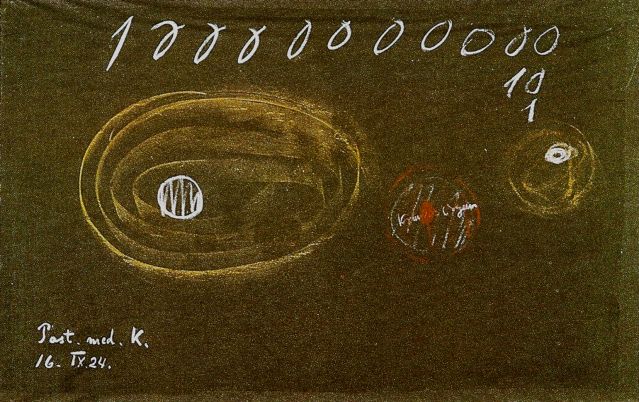
[ 8 ] Let us therefore assume that we observe a process in the human physical body that should not be there—a pathological process. It lacks the “I.” How can we address it if we want to heal it? If we look for that aspect of the “I” that the person lacks—which is an excess of sleep within them, such that even while awake, they are still in a state of continuous sleep—and seek it outside in the mineral realm, we will find the remedy. When we administer this to the person, there is an affinity with the affected organ; what the diseased organ lacks—the “I” force—is thereby restored to it. You see, this is the process that underlies all our search for remedies for the physical body of the sick person within the inorganic natural environment. There we must find the corresponding substance that possesses the “I” force; then it has a healing effect. The transition from pathology to therapy is thus based on a precise understanding of the connections between the processes of the physical human body and the inorganic external world on the one hand, but also between the etheric human body and the external world—which is active in the vegetative realm, in plants. The situation is exactly the same there. If we notice that something is proliferating within the etheric body, we find that the etheric body lacks the corresponding influence of the astral body; we must then look somewhere in the plant kingdom and find the appropriate remedy. This is the guiding principle.
[ 9 ] From this you can see that one must understand the spirit of nature—the spirit present in the mineral and plant kingdoms—across the entire expanse of the universe. It is the spirit, not the substance, that one must understand, because in reality, it is the spirit of mineral and plant nature that must be used to heal human beings. The substance exists only in a state where it is not properly governed by the spirit, yet it possesses the spirit. And anyone who wishes to heal without knowing the spirit of stones and plants can, in truth, only grope in the dark based on traditional methods; they can try to see if one thing or another helps, but they will never come to understand why it helps, because they will never know where the spirit resides in any given mineral, or how it resides there—so that being a true healer presupposes, from the very beginning, a spiritual worldview, and the greatest anomaly of our time is probably that this terrible disease of materialism prevails precisely in medicine. For in medicine, materialism is a real disease. This blindness leads to complacency and generates harmful psychological substances within science—and it really ought to be cured. One might even say: the sickest person of our time is not the one who was considered such by the European population in the 19th century—the Turk—but rather the sickest being of our time is the physician. This is a truth that doctors should know, and at most theologians, but the esoteric nature of it lies in the fact that it remains within the circle to which it is entrusted.
[ 10 ] Well, let’s take a closer look at this. There are people who are not psychopaths or madmen in the sense that one is justified in speaking of psychopathy and madness, but who, according to the discussions of the past few days, sink so deeply into their physical and etheric bodies that they enter into a certain connection—a perceptible connection—with the pathological states and processes within them. This brings us to those somnambulists whose existence is not a matter of superstition—a phenomenon that has often been described in the world and is well known to every initiate—we come to those somnambulists who, in their somnambulistic state, provide descriptions of their illnesses. They sink down into their physical and etheric bodies. Whereas the ordinary, normal person connects with the physical and etheric bodies in such a way that—if we wish to speak in a pedantically scientific manner—we can say: “I and the astral body enter into a connection with the physical and etheric bodies while awake, which, in terms of the quality of that connection, is a saturated connection”—in the case of such a sick person, we can say: It is simply not the case, in a figurative sense based on atomic weight, that the “I” and the astral body merge completely into the etheric and physical bodies; a remnant of the astral body and the “I” remains that does not submerge entirely but instead perceives. Only that which remains of the “I” and the astral body—which does not submerge into the etheric and physical bodies—perceives. When such a remnant of the astral body and the “I” is present internally, it is perceived inwardly. Somnambulists describe their condition. But how, exactly? There is, after all, another state—which I have also described to you—in certain cases where the normal state is interrupted on the side of sleep. Then, when the “I” and the astral body are outside the physical and etheric bodies, and when things occur within this “I” and astral body that do not belong to this spiritual-soul realm, just as the other phenomena I have described to you do not belong in the physical-etheric realm—when too much of the spiritual is experienced by the “I” and the astral body during sleep, just as, conversely, too much of the physical and etheric body can be experienced by nature—then that form of clairvoyance bordering on the pathological arises. The person then carries into sleep a certain power to perceive the spiritual. They carry memories of this spiritual perception back into the waking state, but above all, this spiritual perception—which is present in an abnormal way between falling asleep and waking up—flows into the dreams. It appears in vivid dreams, and there we again notice what every initiate knows well: these dreams, when viewed correctly, are filled with the following.
[ 11 ] Suppose that the sick person—the physically ill person—is constituted as I have described. He plunges with his spiritual-soul aspect down into his physical and etheric bodies. He then experiences the illness in such a way that he describes it while in a somnambulistic state. He experiences what is taking place in the physical and etheric bodies as an excessively intense process of decay; he experiences a kind of reverse natural process in his physical and etheric bodies. Now let us assume that he is outside with his astral body and I. There he experiences the spiritual aspect of external nature. Now let us assume that one experiences here within a diseased organ (Plate 10, center), which is diseased because it expresses some external process in a pathological manner. This is experienced in the somnambulistic state. The inner process is described there. When a person is in the polar state, somnambulism affects their ego and astral body—especially when these are more outside the physical and etheric bodies; when what is experienced there—among the elemental-spiritual processes of nature—enters into dreams, the person experiences what is spiritual in the minerals; they experience the corresponding spirit of the mineral; and what does he dream of? He dreams of his remedy. You see, here you have the context for many a somnambulistic life. The somnambulist alternates between two states that I have described. In one state, he dreams of his illness; in the other, he dreams of his remedy; and before us lies the very way in which pathology and therapy were sought in the ancient mysteries.
[ 12 ] Experiments were not conducted as they are today. Back then, the sick were brought to the temple and induced into a kind of somnambulistic state by temple priests who were thoroughly trained for this purpose, and this somnambulistic state was taken to the point where the patient described the course of their illness. Then polar somnambulism was induced, and the temple priest experienced the dream that contained the therapy. This was the investigative process in the most ancient mysteries, leading from pathology to therapy. This is how medicine was practiced in ancient times—by seeking an understanding of human nature through the study of human beings using the ancient forms of investigative methods.
[ 13 ] We must not resort to these methods, but rather to those methods in which, through imaginative experience, we are immediately able to follow the course of the illness, and in which, through the intuitive method—which leads us out of, rather than into, the human being—we experience the process of healing. What used to be a kind of experiment will, in this very field, have to become a penetrating observation. You can see where the orientation actually lies. External physical science, which in earlier times was purely observational, has shifted toward experimentation, increasingly replacing pure observation with experimentation. In that, it is right. But medical science has imitated it, and in doing so, it was not right. In the past, it conducted experiments on human beings through the temple research. From this experimentation, we must find the transition to a carefully spiritualized, scientifically informed observation of life. For whoever observes life can intercept illness at every turn. In the simplest manifestation of everyday life—one that deviates only slightly from what is called “normal”—there may lie something that, when properly observed, can lead to an understanding of complex disease processes, provided one sees things in their proper context.
[ 14 ] However, this means that the physician must, in fact, increasingly become the true practitioner—which is, in turn, the opposite direction from the path that development has taken in recent times under the influence of materialism. The physician has gradually become nothing but a scientist, and that makes no sense. A doctor’s work only makes sense if he can always apply the laws of nature with lively, active engagement—not if he merely recognizes them in an abstract sense. Merely recognizing them in the abstract sense of the word does not lead to the application of the laws of nature. You have looked at the matter from one side. Now look at it from the other side.
[ 15 ] Look at them from the other side—the perspective from which the priest must view them—while telling yourself that the priest’s calling is to guide people in all those instances where their ego and astral body are to immerse themselves in the spiritual world in some way; that is, where human beings are to participate in the spiritual world. If it is necessary for the physician to look into the human being’s essence in a spiritual way and to perceive pathological processes spiritually—what, then, must the priest seek? The priest will have to look for—in what leads the human being into the spiritual world, in the disposition toward the spiritual world, in the love for the spiritual world, in the permeation by the spiritual world, as these already exist in normal life—everything that the human soul presents in both normal and abnormal manifestations in this realm. Let us now trace for him the reverse process that we had to trace in the case of the physician. With the physician, we said: Well, when he has the somnambulist describe the diseased organ, well, she describes the remedy from within the dream.
[ 16 ] Let us now consider the priest once again, as he was in the ancient mysteries. He was certainly not interested solely in the discovery of the remedy, although—since he was, first and foremost, a philanthropist—he was primarily interested in healing. But he did not stop at healing; something else interested him as well. What interested him was the following: He saw that the somnambulist observes the remedy in her dream while standing within the spiritual world with her “I” and her astral body. Now, in his contemplation, he grasped this presence within the spiritual world—this soul’s presence within the spiritual world—and traced it back into the body. What did he find there? He found himself returning to the diseased organs, of course, but he now knew, from what he had perceived out there, how the astral body and the “I” function in that organ when it is healthy. By returning to the diseased organ, he knew how they function in a healthy state. The result was that he now perceived how, in the normal course of things, the astral body or the “I” intervene in the human organism from within the divine-spiritual powers, and how they are situated within it. Through dreams, he came to know them in their healthy state within the spiritual essence of the world and gained insight into how they behave again when they withdraw. He came to understand the inner relationship between the human being and the spiritual world.
[ 17 ] This is what, as the priest’s attitude, can accompany the sacrament, through which he conveys the spiritual world, for the spiritual world is bound to the sacrament through the structure of the cult. The ritual connects the spiritual with physical substance precisely by virtue of the inner insights into how the spiritual is related to matter. A physical being imbued with the spiritual is brought back into the human being, and a connection is established within the human being that links his astral body—within the physical and etheric bodies—and his “I”—within the physical and etheric bodies—to the divine-spiritual existence of the world. In this regard, everything depends on the priesthood observing sacramentalism with such a mindset. Everything depends on our imbuing ourselves with such things as the connection between experience within the body and experience outside the body, the mysteries of pathology through observation of the abandoned body, the mystery of therapy through observation of abnormal life, life in the spiritual world, and normal perception in the spiritual world. What was explored in ancient times by outstanding somnambulists within the temple mysteries must be explored anew by human beings developing spiritual insights within themselves and observing these connections once more. Experimentation in this field must be integrated into observation.
[ 18 ] Now, it is indeed important that those doctors and priests who are part of the anthroposophical movement be united in their knowledge of such facts. That is what truly binds us together, what imbues us with a different kind of insight than others possess. In contrast, any decision to form an alliance, an association, or a group is merely an abstraction. What truly unites us is the possession of a certain knowledge. Those who possess this knowledge simply belong together and should feel a sense of belonging. The external connection should be an expression of this inner connection, which is created through this knowledge. Our time suffers greatly in this regard.
[ 19 ] Just consider this: when one speaks today—often with the very, very best of intentions—at, say, a youth gathering, even though I fully acknowledge their aspirations—it is extraordinarily difficult, because right from the start, instead of the concrete reality that should fill the soul, one is immediately confronted with the statement: “The first and most important thing is to unite!” — But in recent decades, everything has become infinitely “united.” People have united, but they have never realized that when you arrange things like this: 00000000 and so on, nothing comes of it. A consciousness that is initially unfulfilled, linked to a consciousness that is again unfulfilled, linked to a third consciousness that is again unfulfilled—that yields nothing. In contrast, one need only presuppose fulfillment—that which underlies all the zeros, that which has a One (1)—and then you have something. It need not be a human being, but rather fulfillment—then it is something. Curiously enough, however, this presupposes that this “something” already exists—indeed, even that which is not a human being—but rather that knowledge in itself is essential. These things should be borne in mind in our time, when people are often far too complacent to seek the concrete and therefore always want to reduce everything to the abstract. Synthesizing is good, but it happens all on its own when the concrete is present.
[ 20 ] This, too, is something that perhaps those who work as doctors and priests among humanity today should understand first and foremost. For it can certainly be said that these two things can be observed everywhere today. Despite being in a state of wakefulness, my astral body and that of human beings do not, in essence, properly connect with the physical body and the etheric body. It is true that for those who see through the world as it is becoming, the views of materialism do not actually cause such terrible pain. Let the monists and all sorts of people argue among themselves. That is certainly an impossible thing, but in reality it is not the fundamental harm in the process of human development. Therefore, when one sees through this process of development, one does not readily participate in these discussions of worldviews. After all, whether one person believes this or another believes that: opinions are, after all, terribly flimsy things in the human soul; they do not have a very strong effect on reality. Opinions are froth within reality. And whether one soap bubble bursts against another—one splattering, the other growing a little thicker from the impact—it does no harm. But one must bear in mind that no one who is properly centered with their ego and astral body within their physical and etheric bodies actually becomes a materialist. Thus, being a materialist in the finer sense means being sick. And one must let this realization sink in: to be a materialist is to be sick. It is therefore no wonder that when the others—who are properly situated within their physical and etheric bodies—come into contact with these sick materialists, they develop the opposite pole: all manner of ambiguities of spiritualism.
[ 21 ] And here we enter a realm where—because events do not unfold in those parts of the world that are still connected to one another, but rather in those parts of the world where the world has already been thrown into chaos and its blocks lie side by side—we arrive at the realm where one is no longer the healing revelation of the other, but rather the two drift apart. For as long as the sick person speaks of the processes taking place in his internal organs, his dreams remain connected to the healing forces in the external world that correspond to the diseased organs. But just as the human being, through the disease of materialism, does not describe his internal organs from within, but rather breaks through the organism to the other side and seeks to describe the external world—as happens in materialism—then the opposite of dreams, false spiritualism, no longer acts as a remedy but, on the contrary, as something that causes even greater illness.
[ 22 ] And so we see today, in our own time, that when we compare all medicine pertaining to human beings with that which can rightly be compared to it—cultural pathology and cultural therapy—we find, for example, that spiritualism by no means constitutes a remedy, but rather corresponds to a dream state for materialism, which in turn corresponds to a somnambulistic description of the internal organs. When a process—and this is precisely the case—that should actually affect the inner being manifests itself in a person’s external world—we can observe such pathological processes in skin rashes, where the phenomenon corresponds exactly to what I have told you—then what is observed internally appears to the observer not as something healthy, but as a pathological deviation. Therefore, the physician should actually know that materialism is the root cause of illness, and this is how materialism should be viewed from a medical perspective.
[ 23 ] Then, through such a medical perspective, a bridge is formed to the priestly perspective, which originates from the opposite side—the priestly perspective that looks into the pathological manifestations of the human soul, which the person forms out of his or her need and emotion. This is also the case with spiritualism. And one then comes to recognize that a pathological life, in the broadest sense, seeks to immerse itself in the universe—just as everything in a worldview that is pathological in and of itself, insofar as it is based on the will and thus actually manifests itself in action—must have an effect on the inner being of the human being, leading to a truly pathological state.
[ 24 ] Now, when considering the current epoch of human development, one will not be able to see—as was clearly seen in earlier times due to the different conditions of human nature—what exists in terms of a wrong orientation of the will, a wrong worldview, and a wrong outlook on life, which in the old sense was referred to as “sin,” one will not immediately see how this translates into the organism’s disease process, because it does not do so directly in that way. We pay attention to this only in the rarest of cases—only in cases that stand as intermediate stages between what are actually to be understood as illnesses and sin. These, in turn, merge into states that merely border on the pathological. But sin and actual illness stand so far apart in today’s epoch of development that they are separated by two incarnations. It used to be the case that, in earlier epochs of human development, sin and illness could sometimes be linked as cause and effect within a single incarnation; however, due to the advanced process of human development, they are now separated by incarnations: sin and illness. Sin in one incarnation, illness in the other.
[ 25 ] This is where the priest’s domain begins. Thus, if the priest merely adheres to the traditions of ancient times, he may no longer say that sin is the cause of illness. But if he embraces the understanding of repeated earthly lives, then he may speak of it, for then he is once again speaking the truth. Consequently, much of what is said today in the wider world by priests regarding these matters is no longer true, because it no longer corresponds to the facts. These teachings stem from ancient times, and today there is no willingness to adapt them in accordance with the demands of our time. We must come to terms with all of this, and then it will be possible to make these reflections on pastoral medicine fruitful for both sides.
[ 26 ] I am still planning—since it does indeed seem desirable that my friends be able to make arrangements—to give two lectures on pastoral medicine tomorrow and the day after tomorrow.