

Cooperation Between Doctors and Pastoral Caregivers
Pastoral Medicine Course
GA 318
17 September 1924, Dornach
Translated by Steiner Online Library
Tenth Lecture
[ 1 ] My dear friends! What is always overlooked in our time when it comes to genuine activity and the desire to act from the spiritual world is that all spiritual activity involves the possibility of activity and creativity within the thoughts and feelings that a person has. What actually underlies this has been completely forgotten in the age of materialistic thinking and is, in essence, entirely unconscious to humanity today. That is why, in this very field, all sorts of nonsense is being perpetrated—nonsense that is actually quite widespread among us in human civilization today. As you know, all manner of instructions are issued to people from all sorts of “central authorities” or similar institutions, as they are called, on how to develop the power of thought and how thoughts can become powerful. One might say: The seeds of what was formerly called “black magic” in spiritual life—and is still called that today—are thereby scattered far and wide. It is precisely such things—which are simultaneously causes of both psychological and physical illness—that both the physician and the priest must take into account in light of their impact on culture and the development of civilization. For by paying attention to precisely such things, one accomplishes what is significant both for the prevention and for a better understanding of illness and the symptoms of illness in human soul life. The intention behind such instructions is, after all, to give people a power they would not otherwise possess, and this is often used for the most dishonest purposes. There are already all kinds of instructions along these lines today, such as how sales agents can close deals and the like. An enormous amount of nonsense is being perpetrated in this area today.
[ 2 ] But look, what is the underlying cause of this? These things will only get worse if a true understanding—particularly in the fields of medicine and theology—does not take hold in this direction. For the thinking of people in modern times—especially scientific thinking—has developed to an extraordinary degree under the influence of materialism. Even though many today express satisfaction that materialism is on the decline in science, and that everywhere people are striving to create something that goes beyond materialism—yes, my dear friends—this actually makes a much more unpleasant impression on those who see through these things. These scientists who wish to overcome materialism in today’s way, as well as those theologians who wish to overcome materialism in today’s way—in the eyes of one who sees through these things, they are actually far worse than the rigid materialists, who, little by little, render their cause untenable through the absurdity of their own position. But these windbags who prattle on about spiritualism, idealism, and the like are throwing sand in people’s eyes—and in their own as well.
[ 3 ] For what, then—whether in Driesch’s manner or in some other way—is being done to be able to represent anything beyond material events? Exactly the same ideas that have been used for centuries to think merely of the material—and which have no other option but to think of the material—are being used to think of something supposedly spiritual. These ideas are simply incapable of doing that! That is possible only when one enters into true Spiritual Science. That is why such strange things emerge, things that go completely unnoticed today. For example, Driesch—who is officially recognized by the outside world but is in reality a terrible dilettante—speaks of the need to assume the existence of “psychoids.” Yes, my dear friends, if you want to ascribe a resemblance to any thing, that thing must exist somewhere. You cannot speak of ape-like beings if there is never an ape present. You can never speak of “psychoids” if the soul is never acknowledged in human beings! Such nonsense is regarded today as genuine science, even as science striving toward something better. This must be seen through. And then those within the anthroposophical movement who possess a scientific education will be of value to the development of civilization—not if they allow themselves to be blinded by the flickering will-o’-the-wisp, but if they look very closely at what is truly necessary and what is needed in opposition to materialism.
[ 4 ] Therefore, we must ask: How is it possible for today’s passivity of thought to be transformed back into activity and creativity? How must the clergy and the medical profession work to ensure that creativity flows into the work of human beings—work that is guided by the spirit and seeks to be guided by it? Thoughts—especially those that develop in connection with material processes—leave the creative aspect out in the material world, while remaining entirely passive themselves. This is the distinctive feature of today’s world of thought, as it is applied throughout science: that it is entirely passive, idle, and inactive. The fact that there is absolutely nothing creative in these thoughts is connected to our education, which is completely immersed in today’s passive science. People are educated and trained in such a way that they are prevented from ever arriving at a creative thought, for there is an immediate fear that if they were to arrive at a creative thought, they would not merely ascertain objective reality but would actually do something about it. These are the things that must be grasped. But now, how can one arrive at creative thoughts? You see, one can only arrive at creative thoughts if one truly develops an understanding of the human being; for the human being cannot be understood in a non-creative way, because by nature he is creative. One must recreate if one wishes to understand. With passive thinking today, one can grasp only the periphery of the human being; one must leave their inner being aside. One must truly grasp the human being’s place within the world. Therefore, let us today, so to speak, set before our souls something like a goal that lies at the end of a broad perspective—one that can make our thoughts creative and truly embodies the mystery of making thoughts creative—and in doing so, let us incorporate into our reflections many things that you already know from the general anthroposophical lectures.
[ 5 ] Let us imagine, my dear friends, the evolving universe schematically in the form of, well, a circle (Ta—Plate ii, fig. 11). We may do this schematically because, in fact, the evolving universe represents a kind of rhythmic repetition over time—albeit in an ascending line, or in a descending line with regard to certain phenomena—but everywhere in the universe we find something like the rhythm of day and night, other rhythms, and larger rhythms that extend from one ice age to the next, and so on. If we first focus on the rhythm that, for human perception, has the longest intervals, we arrive at the so-called Platonic year, which, back when views of the world were still more refined, always played a major role in these conceptions and human perspectives on the world.

[ 6 ] This Platonic year is determined by observing the point where the sun rises in the morning on the day spring begins, March 21 of the year. The sun rises at a specific point in the sky. You can see this point in the constellation; in fact, this point has been recorded throughout history, since it shifts slightly each year. If, say, you observed the vernal equinox last year exactly at its position in the sky relative to the other stars, that is, if you observed it in 1923 and observed it again in 1924, then this year’s point where the sun rises is not in the same place; rather, it has shifted in the direction that can be drawn by connecting the constellation of Taurus with the constellation of Pisces. The vernal equinox shifts in this direction along the zodiac. Thus, it shifts a little bit every year. This indicates that, within the entire constellation of the starry world, a shift occurs every year that can be recorded in this way. If one now examines the cumulative effect of these shifts—you can see it, of course, when a shift occurs—it is here in this year, there in that year, and so on. Sometimes the shift goes this far, sometimes that far, until it returns to the same point. This means that after a certain period of time, the vernal equinox must return to the same position in the sky. Thus, a complete revolution of the entire solar path with respect to the morning sunrise has taken place. If one calculates this, it occurs on average every 25,920 years. In this way, we have identified a rhythm that encompasses the greatest interval initially accessible to human perception: the Platonic cosmic year, which lasts approximately 25,920 of our years.
[ 7 ] There we looked out into the vastness of the universe, and there, in a sense, our thoughts come up against something from which the numbers we develop bounce off. We come up against something—like a wall—with our thinking. Thinking cannot go beyond that at first. That is where clairvoyance must come in, reaching out into the distance. But thinking cannot go beyond that at first. All development takes place within what is enclosed by these 25,920 years, and we can quite easily, if we wish, create a mental image of this expanse—which is enclosed not by space but by space-time—as a kind of cosmic uterine wall. So we imagine it as that which surrounds us in the vastest expanse of the cosmos (Plate 11, red-yellow). And now we move from this—which surrounds us in the vastest expanse of the cosmos as the rhythm that carries within itself the greatest intervals we have—to that which initially appears to us in the human being as a smaller interval: the breath.
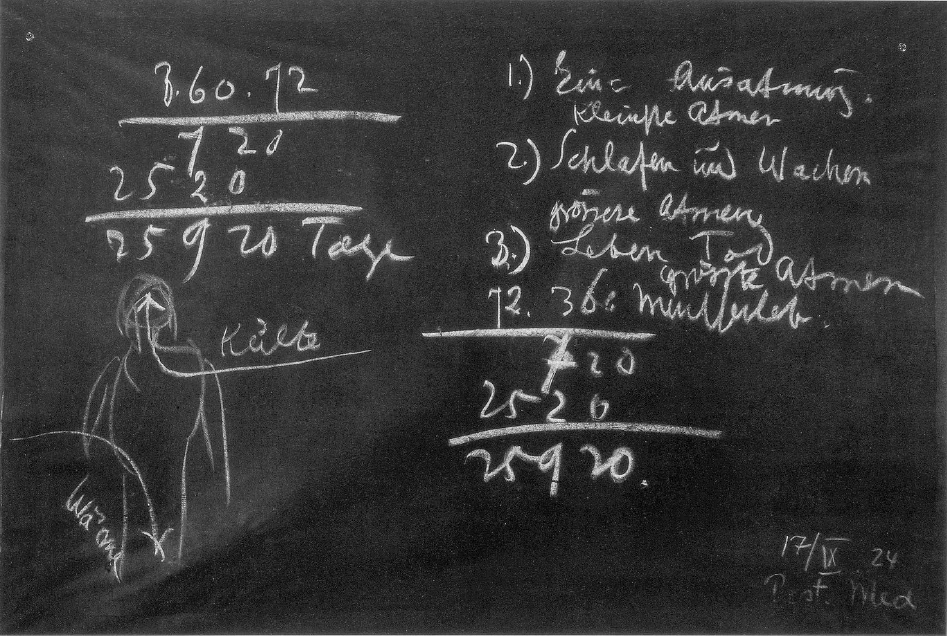
[ 8 ] You see, of course, we have to use approximate figures again when it comes to breathing: eighteen breaths per minute; and if we calculate how many breaths that amounts to in a day, we get 25,920 breaths per day for a human being.
[ 9 ] We have the same rhythm that we find outside, with its large intervals, within the human being—within the microcosm—with its minute intervals. Thus, the human being lives in a universe that he replicates in the very rhythm that is the rhythm of the universe itself. This applies only to human beings, not to animals, for it is precisely in these finer insights that the difference between human beings and animals becomes all the more apparent. For human beings, the compactness and essential nature of their physical body can only be recognized by tracing it back to the Platonic cosmic year. 25,920 years—the essence of our physical body is rooted in this. Take a look at my *Outline of Esoteric Science* to see what vast time periods—initially determined by something other than space-time—and what elements, through the metamorphoses of the Sun, Moon, and Earth, had to be brought together—not in a purely quantitative, numerical sense—in order to understand the human physical body, as it is today, from its very elements.
[ 10 ] If we then move into the center, where we have the 25,920 breaths (Plate 11), which, so to speak, place the human being at the center of the world’s womb, we approach the “I.” For in these breaths—together with what I have said about breathing, which follows the higher human being and refines itself into what is called spiritual life—it is in breathing that the character of the individual human life on Earth is expressed. So here we have the “I.” Just as we must grasp the connection between our physical body and the great periods of time—the Platonic world year—so too must we consider the connection between our “I”—which we can indeed sense in every irregularity of the breath—and our breathing rhythm.
[ 11 ] You see, human life on earth lies between these two things; human life lies between a single breath and a world year. Everything that is significant for the “I” is regulated by the breaths. The life of our physical body lies within those colossal processes governed by the rhythm of 25,920 years. The laws governing what takes place within the physical body are connected to the great rhythm of the Platonic world year in the same way that our “I”-activity is connected to the rhythm of our breathing. Between these two lies human life, which in turn is enclosed for us between the physical body, the etheric body, the astral body, and the “I.” From a certain point of view, we can say that human life on Earth lies between the physical body, the etheric body, the astral body, and the “I”; and from another point of view, we can say that human life, viewed from a divine-cosmic perspective, lies between the breathing of a single day and the Platonic world year. The breathing of a single day is thus a whole in itself. The breath of a day is thus inseparable from what human life is.
[ 12 ] Now, however, let us consider from this cosmic perspective what lies between human breathing—that is, between the weaving and essence of the “I”—and the unfolding of a Platonic world year—that is, the life and activity out there in the macrocosm—and what lies in between. You see, with regard to what seeks to work within our respiratory organism, it is the case that with the twenty-four-hour breathing cycle of the day—with what lies within between this breathing and what we experience in this cycle as a complete respiratory rhythm— we encounter time and again that rhythm which exists as the day-and-night rhythm and is connected to the solar being as it relates to the earthly being. In the daily rising and setting of the sun, in the sun’s journey across the vault of heaven, in the sun’s being obscured by the Earth—in this daily movement of the sun lies that which we encounter through our breathing rhythm.
[ 13 ] But this brings us to the day—the twenty-four-hour day; we arrive at the human day of twenty-four hours. And now let’s continue our calculations, as we work our way into the world, so to speak, through our breathing. Let’s work this out: how we work our way into what we now encounter in the daily cycle of the macrocosm, how we initially stand within it. You see, we can calculate this: We have a day; let’s take a year of, say, three hundred sixty days—things can be approximate, after all—so we have three hundred sixty days. Now let’s estimate a human lifespan at seventy-two years—the patriarchal age that has been assumed—and we get 25,920 days. We have a human lifespan that, in seventy-two years, constitutes a whole; it represents a rhythm in which it positions itself within the world, a rhythm that is the same as that of the Platonic solar year.
[ 14 ] We attune ourselves to our entire human life through our breathing rhythm in such a way that we regulate it according to the rhythm of 25,920. We arrive at that which is contained within this human life, just as the breath cycle is contained within the day. Now, what is contained within those seventy-two years—those 25,920 days—just as the inhalation and exhalation are contained within the breathing cycle? What is contained within them? First, we have inhalation and exhalation—the first phase of the rhythm. Second, during the day, as we immerse ourselves in life, we experience something 25,920 times. What is it? Sleeping and waking. We come to the second: sleeping and waking. This repeats itself—the alternating state of sleeping and waking over the course of a human life—25,920 times, just as inhalation and exhalation repeat 25,920 times over the course of a day, during one revolution of the sun. But consider this: what, then, is falling asleep and waking up—falling asleep, waking up, falling asleep, waking up? Every time we fall asleep, we do not merely exhale carbon dioxide; rather, as physical human beings, we exhale our astral body and our “I.” Upon waking, we inhale them again. This is a longer breath that lasts twenty-four hours—one day. This is a second breath that moves in the same rhythm. So we have the smallest breath, which consists of ordinary inhalation and exhalation. We have the greater breath, through which the human being grows out into the world—the one that plays out in sleeping and waking.
[ 15 ] Let’s continue. Let’s now try to see how a human life of seventy-two years, on average, fits into the Platonic world year. Let’s calculate these seventy-two years as if they were part of a single year—a whole year consisting of days that make up a human life. So let’s calculate a great cosmic year, whose individual days are human lifetimes, and let’s also count this cosmic year as 360 days—that is, 360 human lifetimes; we get: 72 times 360 human lifetimes = 25,920 years, which is precisely the Platonic year.
[ 16 ] But what do we actually do as we go through this Platonic year? We begin life and die. What do we do as we die? As we die, we exhale more than just our astral body and “I” in relation to our earthly form. We exhale the etheric body into the cosmos. I have often described how the etheric body is exhaled into the cosmos, how it spreads out into the cosmos. When we return, we inhale an etheric body once more. This is a gigantic breath. An inhalation and exhalation of the ether. In the morning, we inhale the astral. With every breath, we inhale oxygen, but with every earthly death, we exhale the ether, and with every earthly life, we inhale the ether.
[ 17 ] So here we have the third: life and death. If we understand life as life on Earth, and death as the life between death and rebirth, we arrive at the Platonic world year by first adding the greater breath to the smallest breath, and then the greatest breath to the greater breath.
1. Inhalation and exhalation: the smallest breath
2. Sleep and wakefulness: the larger breath
3. Life and death: the greatest breath
[ 18 ] And so, I would say, we find ourselves initially in the world of the stars. On the one hand, we rest inwardly on our breathing; on the other hand, we rest outwardly on the Platonic year of the world. Our human life unfolds in between, but within this human life itself, the same rhythm reveals itself once again.
[ 19 ] But what, then, fills this space—the space between the Platonic year of the world and our breath? Let’s try to take what we’ve discovered, based on rhythm, in a sense numerically—like a painter who prepares the ground before painting on it—and, having prepared this ground, let’s try to paint on it. There we find that—in relation to both the Platonic cosmic year and smaller temporal rhythms, but most clearly in relation to the annual rhythm—a constant change takes place in the external world, which we also perceive, and which we perceive most easily when we first consider it in terms of the qualities of warm and cold. We need only think of the fact that winter is cold and summer is warm; thus, what appears in the background as numbers, we experience qualitatively as warmth and cold; and human beings, with their lives, are situated within this alternation of warmth and cold. Yes, you see, out there there may be a seasonal alternation between warmth and cold—and indeed there is—and for so-called nature, as it alternates between warmth and cold, this seasonal change is also quite beneficial. Human beings must not do this. They must, so to speak, preserve within themselves a normal warmth and a normal cold—depending on how one views it relatively. He must therefore develop inner forces through which he stores up the summer warmth for the winter and the winter cold for the summer. He must achieve balance within himself—true inner balance—and continually work within the human organism in such a way that it maintains equilibrium between warmth and cold, just as this occurs outside in nature.
[ 20 ] These are effects within the human organism that we do not even notice. Internally, the organism carries summer into winter and winter into summer. When it is summer, we carry within us what our organism experienced during the winter. We carry winter with us through the vernal equinox and into St. John’s Day, and then it balances out. As autumn approaches, we begin to carry summer with us as well, carrying it until Christmas, until December 21, and then it balances out again. So we constantly carry this alternation of warmth and cold within us, balancing it out. But what are we doing there?
[ 21 ] You see, if one now examines what to do with this, one arrives at an extraordinarily interesting result. If one views human beings in this way (Figure), one comes to recognize—even through a superficial observation—that everything that manifests as cold within the human being tends to be directed toward the sensory-nervous aspect of the person. Thus, we can demonstrate today that everything that acts as cold—everything winter-like—is involved in the formation of the human head, in the sensory-nervous organization. Everything that is summer-like, everything that contains warmth, is involved in the human metabolic-limb system. If we look at our metabolic-limb being, we actually carry within our organization everything that is summer-like. If we look at our nervous-sensory functions, we actually carry within them everything winter-like that we take in from the universe. Thus, with our head we live through all the winters, with our metabolic-limb organism through all the summers, and through the rhythmic organism we create balance within, drawing warmth and cold back and forth—warmth and cold between the metabolic system and the head system—and arrive at that which regulates everything else. The warmth of matter is, after all, merely a consequence of thermal processes, and the coldness of matter is merely a consequence of cold processes. We arrive at an interplay of the world’s rhythm within the human organism. We come to say to ourselves: Winter in the macrocosm is the creative force within the human head—or rather, the nervous-sensory system. Summer in the macrocosm is the creative force within the human metabolic-limb system.

[ 22 ] You see, when one looks into the human organism in this way, one finds yet another point of reference for that initiatory medicine I have been speaking of—which begins, as it were, with the book that Dr. Wegman and I worked out together. We have a starting point for what must increasingly make a real impact on science.
[ 23 ] Let us now climb up onto the rocks where the winter plants grow—where the soil is such that winter plants can grow—and we arrive at that aspect of the external world which is connected to the organization of the human head. Let us suppose we are now a collector of remedies in the world and we want to ensure that those mental forces which arise in connection with a disease rooted in the nervous-sensory system are healed by the spirit in the outer world; let us climb up into the high mountains, gather the minerals and plants there, and bring back from there the remedies for diseases of the head. We proceed from our creative thinking. It sets our legs in motion toward those things in the earth where we must find what corresponds to our needs. The right thoughts, which originate in the cosmos, must inspire human action right down into the concrete realm. Unconsciously, they do this when the person working in an office—who, after all, also has thoughts, at least sometimes—is driven by instinct to go on all sorts of excursions. But people are unaware of the connection behind this. It isn’t really that important, either. It only becomes important when one observes it in a medical or spiritual context. Yet a close observation of the world also provides inspiration for what one must do in each specific case.
[ 24 ] And again, when we observe diseases in the metabolic-limb system, we delve deeper into the earthly-plant-like and the earthly-mineral aspects; we look for what settles, not for what grows upward in a crystalline manner, and thus obtain the mineral and plant remedies. And so it is indeed the case that viewing the processes in the macrocosm in conjunction with those within the human being truly leads us from pathology into therapy.
[ 25 ] You see, these things simply need to be understood very clearly once again. In the old days, people recognized such connections well. Hippocrates is actually something of a latecomer when it comes to ancient medicine. But if you read a bit of his alleged writings—which, at least, are still in keeping with his spirit—you will definitely sense this perspective throughout. There is something of that in everything—something specific and concrete that ties in with this broad perspective one can gain through such things. Then came later times, when such things were no longer present in human perception, when people became more and more immersed in purely abstract, intellectualistic thinking and in the external observation of nature, which then led to mere experimentation. We must find our way back to what was once the perception of the connection between human beings and the world.
[ 26 ] So you see, we live as human beings on Earth by living between our “I” and our physical body; between a breath and a world year—the Platonic world year—we live within that, and our breath borders on the day. What does our physical body border on? The Platonic world year? — There we border on the outermost chains and interconnections in climatic change within the great natural processes, transforming our form—the human form—within these great natural processes, so that successive races emerge, and so on. But we also border on everything that occurs in shorter, external qualitative changes; we border on what the successive years bring us, what the days bring us—in short, we develop as human beings between these two extreme boundaries, yet we emancipate ourselves in the middle, because in the middle, even within the macrocosm, a remarkable element intervenes.
[ 27 ] One can indeed be overcome with wonder when one allows this rhythm—which has been roughly ordered over the course of 25,920 years—to take hold. It is precisely what unfolds between the universe and humankind that gives rise to this truly awe-inspiring sense of wonder. And when one immerses oneself completely in it, the entire world—including humanity—appears to be ordered according to measure, number, and weight. Everything is, I would say, wonderfully ordered; yet it is, nevertheless, a human calculation. That is why, at the crucial points—when we examine them more closely, even though it holds true, even though it is inherent within it—we must always insert the peculiar word “approximate” at those crucial points. It never quite adds up. Rationality is there within it; it is there, it exists, it lives, it works: everything I have described is alive. Now something intervenes—something entirely irrational in the universe—which means that no matter how deeply we immerse ourselves, no matter how admiringly we lose ourselves in it—even as initiates, for all I care—when we set out on any journey for a few hours, we still take an umbrella with us, even as initiates. We take an umbrella because something is now entering that embodies irrationalism—where that which cannot be fully accounted for in numbers reveals itself in reality, requiring leap years, leap months, and all manner of adjustments. After all, this has always been necessary for determining time. That which advanced astronomy—the kind that has delved into astrology and astrosophy —for one can conceive of it in this way—what it offers is all destroyed again for immediate life by meteorology, which does not attain the status of a rational science; a science that is already somewhat permeated by observation, increasingly permeated by deeper observation, but which takes a completely different path, living within what remains of the others. And especially when we consider today’s astronomy—it truly lives in names; it is really nothing more than the naming of stars, and nothing else. That is why “Serenissimi”’s understanding stopped at the naming of the stars. He visited his country’s observatory, had various things shown to him—distant stars through the telescopes—and then, after seeing all that, he said: “I understand all of this.” But as you know, what that star is called—the one so far out there—I don’t understand that. —You see, there is, of course, the point of view you’re taking at this very moment, in which you’re laughing at “Serenissimus.” There’s also another perspective, namely that one might just as well laugh at the astronomer. I’d rather laugh at the astronomer, for there is something very peculiar about the workings of the universe.
[ 28 ] If you are researching the ancient names—Saturn and so on—you’ll need to recall a bit of our language course, which most of you are taking, in order to understand this; you must remember that the ancient names were given based on the auditory impressions that astrologers and astrosophers had when encountering a particular star. And we can say of all the ancient star names: they are divinely given; they are spiritually given. They were asked what the stars were called, because people perceived the tone of the star and always named it accordingly. Yes, now you’ve reached a certain limit in astrosophical and astrological development. They had to draw the names down from the heavens. Move into more recent times, when the great discoveries were made regarding the small celestial bodies, for example—yes, there everything is jumbled up. One is called Andromeda, another has a different Greek name; everything is jumbled up arbitrarily. One cannot conceive of Neptune or Uranus being named in the same way as Saturn. All of this is human arbitrariness, and Serenissimus made only one mistake: he believed that astronomers had continued in the same vein as the ancient astrosophers. They did not. It is simply human narrow-mindedness at work here, whereas the knowledge of the astrosophers of ancient times—the astrologers of earlier eras—arose from humanity’s interaction with the gods. But precisely when one moves back today from astronomy to astrology, to astrosophy, and thereby lives in something like a macrocosm where reason prevails everywhere, one reaches as far as Sophia. Then, on the other hand, one finds that within this rationality and Sophia, in the things that do not fit into calculations, there lives meteoronomy, meteorology, and meteorosophy—which one can actually only ever consult according to their own free will. That is a different lady. Outwardly, in ordinary physical life, she is called capricious. But the meteorological realm is quite capricious, from daily rain all the way up to comets. Yet as one ascends further and further from meteorology to meteorosophy, one also discovers the better qualities of this ruler of the world—those qualities that do not stem merely from caprice or cosmic emotion, but, I would say, from this lady’s inner warmth. But there is simply no other way, my dear friends, than to counterbalance calculation, thinking, and everything that can be pursued rationally with direct acquaintance with the beings of the worlds—to get to know them as they are. There they reveal themselves; they are there. At first they are somewhat aloof; they are not intrusive. Through calculation, one does indeed come closer and closer—that is true—but one drifts further and further away from the actual being of the world. One enters only into residual effects.
[ 29 ] When one moves from ordinary, crude calculation to rhythmic calculation—as astrology did for the harmony of the spheres—one then moves from rhythmic calculation to perceiving the organization of the worlds through figures and numbers, as found in astrosophy. But one arrives on the other side—I would say in such a way that even the ruling world beings prove somewhat aloof. They are not immediately present. At first, they show one only a kind of Akashic photograph, though one does not really know where it is being cast one’s way. There one has the world, but only as photographs etched everywhere in the world-ether. But one does not know where they come from.
[ 30 ] Then inspiration sets in. That is when the essence begins to reveal itself through the image. We begin by moving from the nomie to the logie. Only when we penetrate fully to intuition does the essence itself follow inspiration, and we arrive at Sophia. But this is a personal path of development that engages the whole person—one who must also become acquainted with such a lady who hides behind meteorology, in wind and weather, in moon and sun, insofar as they intervene in the elements. It is not only the head that must be engaged, as with Logie, but the whole person.
[ 31 ] Now, however, you can see from this that there is indeed a possibility of going astray in this regard, for even in anthroposophy—by moving from anthropometry, which is actually the sole dominant science today, to anthropology—you can approach anthroposophy with your head. Then you have only reason, but reason is not alive. It merely traces the paths of life where it does not matter whether one takes the details into account. But life lives precisely in the details, in the irrational. There you must bring down what the mind has grasped into the whole human being, and then, with the whole human being, ascend from nomia to logia, to Sophia.
[ 32 ] This is what we must feel if we wish to breathe new life into theology on the one hand and medicine on the other through that which can truly revitalize both: pastoral medicine. This is what we intend to conclude tomorrow through a few specific reflections. But the main point is this: as we take our first steps into pastoral medicine, we must first become familiar with the paths along which pastoral medicine must move in its view of the world.