

Cooperation Between Doctors and Pastoral Caregivers
Pastoral Medicine Course
GA 318
18 September 1924, Dornach
Translated by Steiner Online Library
Eleventh Lecture
[ 1 ] My dear friends! Pastoral medicine, as conceived here, can essentially be viewed only as something that is derived from spiritual insight and spiritual research—and that regains its meaning only when humanity becomes aware, if at all, that the spiritual realm contains positively effective forces. For in the era that developed and shaped materialism, it is inconceivable that one would have approached the spiritual in such a way as to have seen in it anything worthy of treatment. This, however—looking toward the spiritual, seeking precisely within the spiritual those possibilities that lead to healing—was present in the most eminent sense within the ancient mystery knowledge; and what we will yet have to discuss to round out our considerations may be linked today to a kind of connection between the medical movement—which is now to emanate from the Goetheanum—and the ancient mystery traditions.
[ 2 ] It is indeed most accurate to view the matter in its historical context, when what is intended here is considered in connection with research methods—admittedly of a completely different nature—but nonetheless research methods and the artistic healing practices of the ancient mystery cults. Now, of course, my dear friends, you will have to regard what this short course on pastoral medicine has offered merely as a starting point, so to speak, in the first chapter, and as the beginning of the development of a pastoral medicine that will continue to expand further and further through the work that Dr. Wegman and I are to carry out here.
[ 3 ] Now, my dear friends, I would first like to draw your attention to how the initiates of the ancient mysteries described the path of their initiation—that path which was followed especially where the mysteries merged with the healing mysteries. Essentially, all mysteries were connected to healing mysteries, though some more so than others. They were all connected to them because healing was viewed as being related to the entire development of human civilization. There are deeper reasons for this. People in ancient times said to themselves: When the human individuality descends from the spiritual worlds into the physical world of the Earth through conception and birth, then the spiritual-soul aspect undergoes that transformation through which it can physically shape a human body. We have described how this shaping takes place for the first time through the individuality during the first seven years of life, whereas the human body is initially received through heredity—the very body that is completely shed over the course of seven to eight years.
[ 4 ] Thus, in the ancient mysteries, the entry of the human being from the spiritual worlds into the physical-sensory realm was conceived in a rather strict sense. But there was a widespread awareness that human beings do not unite with their physical bodies in this way—that from the very beginning they do not unite with their physical bodies as was actually, in the very beginning—if I may use that expression—intended by the spiritual powers that govern that part of the world to which humanity belongs. In particular, it has always been attributed to that part of the forces within the human being that enter through heredity that, due to an anomaly in the overall development, they in a certain sense overwhelm the forces that the human being brings with them through their individuality from previous earthly lives. No true harmony was seen in this; it was explicitly stated: If there were a complete harmony between the spiritual-soul aspects and the physical-bodily aspects in the earthly human being, then, first of all, death would not take the form it does, and secondly, illness would not occur in the way it does. Illness and death were regarded as symptoms indicating that human beings are, in fact, more closely connected to the physical earthly world than was originally intended for them. Although this idea can no longer be fully understood today, it is nonetheless an extraordinarily profound concept containing a great deal of truth. For it is truly the case that the moment a person ascends even slightly to a higher level of consciousness, they immediately realize: death, for example, takes on a completely different form. It appears more like a metamorphosis than the end of a phase of life, and so on.
[ 5 ] As a result, however, for the entire ancient consciousness, the education of human beings was closely linked to healing, and the entire educational process was, in fact, understood in the very early stages of human development as a form of general healing. Consequently, what one human being had to do for another was, from the very beginning, conceived in a certain sense as a medical act; and linked to this was the consciousness that, in the ancient mysteries, was associated with the professions of physician and priest—both of which were meant to be concerned with the healing of human beings on earth. In ancient times, doctors and priests were, after all, usually united in a single person—a phenomenon that could only exist within the ancient, instinctive consciousness and cannot exist today, at least not as a regular institution. This awareness of the significance of healing—which also had to be present in everyday life for every human being—was linked to the belief that, following the metamorphosis that human beings undergo through death—that is, primarily in the life between death and a new birth—those souls who had been doctors or priests on earth were guided onto the path to the Sun. The first guidance for finding the path to the Sun after death—which everyone must find, because part of what must be accomplished between death and a new birth takes place there—the first steps—as it was depicted in ancient times—had to be shown to the person who had passed through the gate of death by the physician or the priest. All of this, however, was steeped in the deepest mystery wisdom. Mystery wisdom that we must simply view differently today, because the old methods are no longer suitable for us, but which is certainly capable of renewal at this present time—the very renewal that is to be attempted here.
[ 6 ] Well, my dear friends, when an ancient initiate described his initiation, he said: After crossing the threshold, he was first introduced to the effects of the elements—and in ancient times, the term “elements” referred to what we would today call states of matter: the solid, which was called earth; everything liquid, which was called water; everything air-like, which was called air and included everything gaseous; and everything heat-like, which was attributed to the heat ether—these were designated as elements. This is something about which the modern physicist says: “That doesn’t exist at all.”—For him, these four elements do not exist. For him, there are between seventy and eighty elements, each with its own properties. Under certain conditions in the world, one is liquid, another solid, or gaseous. The state of heat is common to all of them. But what was described as “elements” in ancient times does not exist today. These are merely properties of realities; they are not realities in and of themselves. Well, yes, but what we call elements today are actually only realities within the very coarse physical world, and what was called elements in ancient times was understood in such a way that it did not lead one into matter itself, but rather into the weaving and life of matter.
[ 7 ] You see, it mattered less to an old doctor whether a substance was one thing or another, with this or that external name. Of course, it has its importance, but that only becomes apparent when one considers the other importance—the one concerning the weaving and life of the material world. And so one can take any substance from the outdoors, from a place where it is undergoing weathering. The old doctor actually attached great importance to the fact that, within the entire earthly process, the substance he took from there was exposed to the process of weathering; or rather, he was particularly careful not to simply extract a substance from the mineral kingdom if it could also be obtained from the plant kingdom. He thus looked everywhere at the role that the substantial plays in the world process through living activity. If one wants to understand this, however, one needs this classification according to the four elements, for then what is most important about a substance is at what temperature it becomes earth—that is, at what temperature it becomes solid, or liquid, or water, or air. That was what mattered in ancient times: to look at what must take place in the world process so that a particular substance might take on a particular form. That was the first step. Only then did one assess the substance itself. Today we start with the substance; back then, we started with the process. And every substance is, after all, merely a process frozen in time—a process frozen at some stage. Above all, one was permeated by the entire weaving and life within the material realm. And so the initiate described how he was first introduced to that vision through which he could perceive the weaving and life of the substantial in such a way that it appeared to him as a fabric of the four elements. That was the first thing.
[ 8 ] But the second thing everyone described—and which represented the second stage for them—was that they said they were led to a place where they could get to know the “upper and lower gods.” — What does it mean to be led to a place where one can come to know the upper and lower gods? Well, you see, my dear friends, we have actually already described this, only we described it in a modern form. I told you that when the spiritual-soul aspect descends so deeply into the physical body and the etheric body that the physical body and the etheric body overwhelm the spiritual-soul aspect, then something pathological arises—something pathological resulting from a deviation of the spiritual-soul aspect into the physical-bodily realm. That is when something pathological arises. The moment this happens, the human being descends deeper into themselves than they should during ordinary waking, deeper than they should into their physical organism while awake, and they encounter subhuman, subnatural forces. For only when we maintain a normal relationship between our spiritual-soul and physical-bodily organizations do we live within the natural order. The moment we delve deeper, more intensely into our physical body, we come into contact with the subnatural. There we come into contact with that in which elemental beings and beings of higher hierarchies, at various stages of their development, interact within the human being. And that is simply a fact: one comes into contact with the gods who unfold their activity beneath the forces of nature.
[ 9 ] So how might an ancient initiate have put it, had he used a more neutral expression that veiled the matter—since no one but other initiates understood him—how might he have said: “I was led down to the lower gods”? — He could have said: “I have come to know the nature of human illnesses, for that leads to the lower gods.”
[ 10 ] Let us consider the other aspect, which—as I have also shown at the boundary between the pathological and the normal—can lead into the life of the sacred, where the spiritual-psychic emerges, emerges more than it should, animating, so to speak, the state of sleep. The ancient initiate described this experience as his communion with the higher gods. Thus, schematically speaking, we have what corresponds to the truth: nature, sub-nature, and super-nature (see diagram). The visionary, contemplative life—the life that introduces the human being into the spiritual world—is what the initiate called communion with the higher gods.

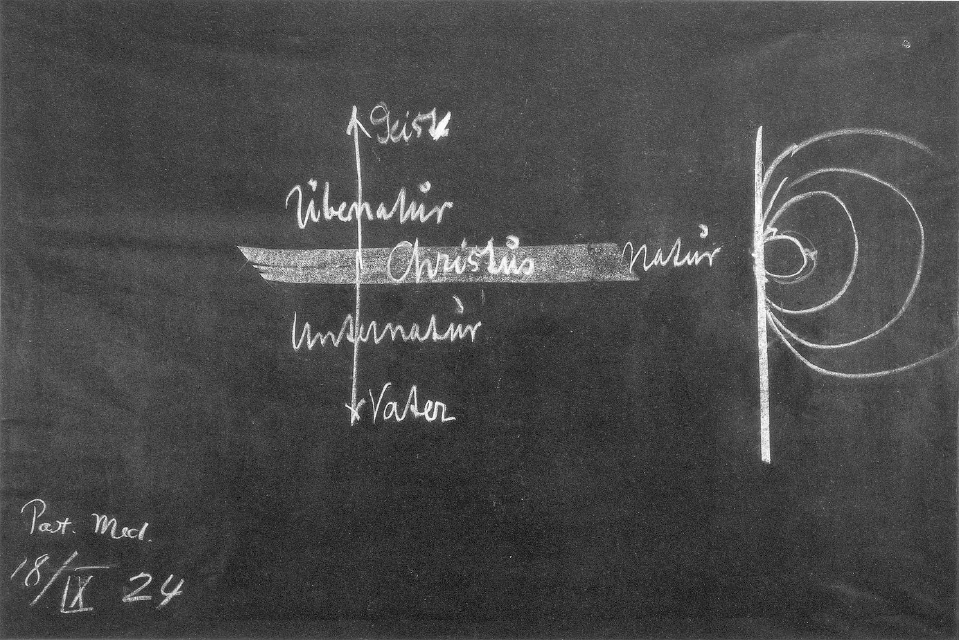
[ 11 ] Now, my dear friends, when people speak in this way about the higher and lower gods, it is very easy to get a wrong mental image of the hierarchy. You see, you have to create a mental image of it this way. If I simply say: nature, sub-nature, super-nature, illness, visionary life—then I am tempted to view the lower gods as subordinate as well. But you see, that is not how it is. In reality, it is like this: Let’s imagine we have nature here, and it leads upward to a circle and downward to a circle (see drawing), and what we find up here unites with what is below on the other side. If we draw the circle larger, we get this; if we draw it even larger, we get this; even larger, we get this; and if we keep making it larger and larger, we eventually end up with a straight line. Here is a segment of a circle that extends outward, but after it has gone into infinity, it returns from the other side. This demonstrates that the terms “lower” and “upper” gods should not be understood as denoting a hierarchy, but only as the different ways in which they approach human beings; they are to be conceived as acting together on an entirely equal footing and converging at the infinite vanishing point. That is why everything related to illness and seership was held in such high regard in ancient times that, when a person penetrates to the heart of these phenomena, they gaze into the spiritual world. One way to penetrate the spiritual world is this: to become truly acquainted with illness and seership. Understanding this gives us, at the same time, the opportunity to incorporate into the modern era what was present in people’s consciousness in ancient times. For let us ask ourselves within the context of modern consciousness: What in our modern consciousness can be identified with the realm of the lower gods? — You see, that which we call the Father when we create a mental image of the divine Trinity is that which, in the most eminent sense, belongs to the lower nature. The Father belongs to the lower nature, and how are we to position ourselves in our understanding toward this Father-God in the sense of a true spiritual conception?
[ 12 ] Now, my dear friends, we look at human beings; we observe them in their waking state, we observe them in their sleeping state, and we compare these two states. When we observe a human being in a fully awake state, we can see that he is then integrated into the order of the physical world just as he is in that world. For just as the Earth once emerged from its earlier stages and is now on the path toward further evolution, so must he be understood in relation to Saturn, the Sun, and the Moon. In the waking state, in this respect, he belongs to the Earth; he is naturally situated within the Earth. In the waking state, he stands on the level of nature.
[ 13 ] This is not the case when a person is asleep. When a person is asleep, my dear friends, the physical body and the etheric body lie in bed; apart from the physical body and the etheric body, there are the astral body and the “I.” But let us look at the physical body and the etheric body. What, then, does this part of the human being—lying there in the physical and etheric bodies—possess? It possesses, albeit in a more advanced state, what it received during the ancient Saturn evolution and the ancient Sun evolution. This has progressed further. But now, during sleep, the human being undergoes the further development of the Saturn and Sun stages of existence; the Lunar stage of existence is not at all present in what lies there in the bed. It is not present there at all. So we must say: as nature has progressed, it has moved from the Lunar to the Earthly stage of existence. But because human beings need the state of sleep, nature preserves within the sleeping human being a “sub-nature”—a nature that actually existed only during the Saturn and Sun eras. This is the sub-nature. It underlies all beings by virtue of the existence of the human race. The human being truly plunges into the sub-nature during the state of sleep, and from this plunge—as I have already shown you in the past few days of this course—illnesses emerge again. There lies the realm of the Father God. While sleeping, we plunge into the realm of the Father God; we plunge into the sub-nature, into the realm of the Father.
[ 14 ] If we consider human clairvoyance, it actually represents a penetration into those parts of the human being that, during sleep, are outside the physical and etheric bodies: the “I” and the astral body. When a person becomes conscious within this state, it is the opposite of illness—the other pole of illness. And the person is immersed in the realm of the spirit with their astral body and “I.”
[ 15 ] Thus we see that human beings, in their earthly constitution, can break away from nature in two directions: toward the sub-natural, toward the Father, and toward the super-natural, toward the Spirit, and since the Mystery of Golgotha, Christ has been the mediator between these two worlds, the one who spiritualizes natural existence, the one who spiritualizes normal human existence, who must always bring about harmony between the sub-natural and the super-natural. The sub-natural is, after all, constantly balanced out in the normal course of sleep and wakefulness. The supernatural is balanced in those seers who always have the ability to return to ordinary human life at will. If, upon waking, a person is unable to balance what they have experienced in the subnatural realm, illness arises, manifesting itself in the physical and etheric bodies. If a person is unable to bring what they can experience through vision in the realm of the spirit into the full waking state—into the natural course of their earthly life—then soul or mental illnesses arise, and thus the other pole.
[ 16 ] Now let us consider physical illness. What happens when the healing process begins? The human being is led from the experience of the lower nature to the experience of nature, from the Father to Christ, for Christ is the spiritual life within nature. From the Father to Christ—and this is essentially what the physician does. Essentially, it is the physician’s task to recognize how a person afflicted by sub-nature is brought back to Christ after the Father—to put it figuratively—has handed over dominion to Christ, the Son. This is precisely what the wisdom of the Mysteries would express in more modern language. One might say: once the initiate has attained true Christ-consciousness here on earth, he is guided, on the one hand, toward the Father, and on the other, toward the Spirit. And coming from the Father—as he becomes aware of the path by which one must be guided from the Father to Christ—all healing processes lie along this path.
[ 17 ] And this is where the modern mystery begins, my dear friends—the mystery that serves as the great test for true medical science. And I must point this out at the end of this course on pastoral medicine, so that what is to flow from it may first take root in the physician as healing. Let us suppose that the physician, as we have indicated in this course, gradually learns these individual healing processes by becoming acquainted with the diseased organs and with that which acts in the realm of nature in correspondence to the organs, imbued with the spirit, so that we introduce the spirit into the human body as the healer. He learns how to proceed in this case and how to proceed in that case. All of this coalesces within him into a comprehensive body of knowledge. But advancing through true knowledge is different from advancing through today’s knowledge. If you pick up a textbook on pathological anatomy or pharmacology today and study it thoroughly, in the end you are only further along than at the beginning insofar as you have the whole thing within you—if you have it within you—but you have not advanced in your overall human attitude with each chapter. But that is the essence of comprehensive knowledge: that one advances with one’s entire human attitude.
[ 18 ] If you approach medicine in this spirit—as intended in this course on pastoral medicine—you will make progress step by step. And what ultimately emerges as a result for you, my dear friends, is nothing less than this: Now that I have all this medical knowledge behind me, I can see everything that took place in the Mystery of Golgotha, right up to the moment when Christ passed through the gate of death on Golgotha. You understand Christ’s journey from the Father toward the death on Golgotha. That is the Mystery. At first one does not believe that one thing is connected to the other, but it is connected. It is so connected that it is precisely by looking into the healing process that you truly grasp what happened in the cosmos—that the Father sent the Son so that He might pass through death on Golgotha; and in what happened in the death on Golgotha, my dear friends, you then see not a death, but a interplay of everything that took place in that death—which is not death, but the overcoming of death, the healing of the entire human being. This is the path of the Healer from the Father to the Son, until the Son dies on Golgotha. Each individual insight into healing takes one a little further toward ultimately comprehending this.
[ 19 ] Pastoral medicine is not merely what the pastor and the physician are to practice together; it is not limited to that alone. Rather, pastoral medicine is what must first be brought together so that, through the physician, one aspect of the Mystery of Golgotha can truly be understood. This is the pinnacle, the culmination of medicine: to comprehend all human illness so that one can recognize the Mystery of Golgotha, right up to death, as the great healing process. The pathology of evolving humanity, the therapy: dying on the cross—these will be viewed in context when true medicine is present.
[ 20 ] The priest must explore everything that a person experiences when he leaves the body and enters the other world, which is the world of the Spirit. Through this, the priest becomes increasingly familiar with the relationship between the human being and the Spirit, the Holy Spirit, the utterly Holy Spirit. And his path is to serve as a mediator between the Spirit and the Son, Christ, to develop theology within this context, and to find the path from Christ to the Spirit, and from the Spirit to Christ. Once again, one can acquire a wealth of insights and meaning in life through this path, along which one must lead people from the Spirit to Christ, and from Christ to the Spirit. And this path must culminate in the individual stages of theology making it clear to people what Christ’s path for humanity was after His passage through death on Golgotha—which was the great healing process. Thus the question now arises: What capacity is created within the human being through this healing process, enabling him to enter the spiritual world? — Through this, everything that theology is meant to be culminates in the comprehension of what happens to the Christ Individuality after it has passed through death on Golgotha.
[ 21 ] Christ’s path to Golgotha: the highest culmination of the path of the physician. Christ’s path beyond Golgotha: the highest culmination of the path of the priest.
[ 22 ] Once again, it seems—particularly to many modern theologians—as if these two things do not belong together at all. For there are theologians today who want to know absolutely nothing about the risen Spirit and the Christ who continues to work. But when we speak in terms of a renewal of the mysteries, then the event of Golgotha—the mystery of Golgotha—comes into play, and then we can say that the old formula which the initiate used for his path of initiation—which went: “I have been guided through the elements, and then to the lower and upper gods”—this formula must now read for the modern initiate: “I have been guided through that which dissolves the elements into their processes—the elements are now the chemical elements, the eighty; they dissolve into processes—and I am led onward as I go downward to the Father and upward to the Spirit, perceiving the activity of Christ on both paths.”
[ 23 ] And if, for the sake of your esoteric study, my dear friends, you wish to take with you a summary of this course in pastoral medicine, then take with you these words, which read as follows:
I will walk the path,
That dissolves the elements into action
And leads me downward to the Father
Who sends illness to balance karma
And leads me upward to the Spirit
Who guides the soul through error toward the attainment of freedom
Christ leads downward and upward
Harmoniously bringing forth the Spirit-Man within earthly humans.

[ 24 ] If you allow yourself to be fully imbued with what lies in this meditative sketch, then you will have taken to heart, in spirit, what I sought to convey in this course on pastoral medicine.
[ 25 ] Address to the Medical Professionals (without the presence of priests)
[ 26 ] My dear friends! By participating here in this course together with the theologians, it has indeed been possible to develop what should resonate harmoniously in the consciousness of humanity today among theologians and physicians. Precisely when one fully internalizes in one’s consciousness the spirit of this course, there is undoubtedly a certain consequence for this consciousness, my dear friends—the consequence that, in working for human healing, the physician and the priest must be in harmony. Under no circumstances should there be a relationship in which the physician is subordinate to the priest, rather than fully coordinated with him. The physician must develop this awareness more and more. And this is part of what he must understand as the path of initiation into the new medical esotericism. Only when the physician knows himself to be on a fully equal footing with the priest will he also be able to relate to the spiritual world as he ought to. Therefore, what should follow for you, my dear friends, from this course is that you should visualize the following in your minds: for the priest, the chalice of sacrifice; for the physician, the caduceus. And the esoteric physician must learn to feel himself once again in possession of the caduceus. This is something he alone, alongside the priest, must know. For only through the full realization of this can that noble enthusiasm arise in the physician’s soul which is necessary if the physician truly wishes to be a practicing physician, a healer in the world. Yes, my dear friends, this alone gives you the opportunity to work toward the position that you are to attain through the anthroposophical movement—I am speaking now mainly to practicing physicians. This is to become your consciousness. From this perspective of consciousness, you should work to bring about—following what, on the part of the Section, the Medical Section, can only serve as a stimulus—you should work toward what can bring about a true medical profession that works from within anthroposophy, just as the priesthood works from within anthroposophy. But you must be aware—especially when you consider the relationship of coordination—that it is still much more difficult today to be an anthroposophical physician than to be an anthroposophical priest. For just consider this: the anthroposophical priest steps out into the world without remaining in any way dependent on any external priestly authorities. The physician who wishes to be a practicing physician must be recognized; he must have completed a course of study recognized by the outside world. He is therefore, from the outset, unable to present himself to the world as our priests do within a priestly community—that is, within a medical community. Nevertheless, this community is possible. This community must be cultivated in the hearts of those who sincerely wish to align themselves with the healing practice of the Goetheanum. It must, in essence, be far more inner than the cohesion found within the priesthood. It must, with a very specific awareness, connect those who wish to work as physicians in the spirit of anthroposophy to the source of this efficacy here at the Goetheanum. To strive for such a source of effectiveness here at the Goetheanum for the field of medicine—that is the intention and aim of the collaboration between Dr. Wegman and myself. And only in connecting with that which is to be the source here, only in the awareness of belonging, can the true meaning lie in what healers take away from the Medical Course at the Medical Section of the Goetheanum: A genuine sense of belonging to that which is to emanate from the center I have indicated. And so, in conclusion, I may well say to you, my dear friends: Seek the path that, in this sense, represents the unification of the practicing medical profession. Seek the path to this unification. You will find it. And it will be our concern here at the Goetheanum to ensure that you find it.
[ 27 ] Since this represents a first step, Dr. Wegman and I have taken the initiative to to provide an initial esoteric impetus by creating an esoteric core that is certainly expandable—one which, as mentioned, is certainly expandable, but which, for good reasons, initially consists only of a number of practicing physicians who, for their part, have taken the oath necessary for esoteric-medical practice. This core consists of the following practicing physicians: Dr. Walter, Dr. Bockholt, Dr. Zeylmans, Dr. Glas, Dr. Schickler, Dr. Knauer, and Dr. Kolisko. Two other individuals are still being considered; they are not here at the moment. - However, since the association was to be a genuine union—not merely a matter of appointment—this association could initially take place only among these seven individuals, who will dedicate all their human endeavors to the service of the medical ideas that will emanate from here in the future and who will thereby initiate that esoteric-medical movement that is to gradually emanate from the Goetheanum.
[ 28 ] My dear friends, esoteric measures are rooted in certain underlying principles. No one need feel left out, for the circle can be expanded, and anyone who belongs to the Medical Section is considered to be on the path to joining this circle, provided they are a practicing physician. However, the leadership of the Medical Section—which now also serves as the leadership of this medical circle—must reserve the right to specify, for each individual member of the Section, the appropriate time at which an expansion of this circle can take place through them. This circle was initially formed in full agreement between Dr. Wegman and myself and includes the following individuals: Dr. Walter, Dr. Bockholt, Dr. Glas, Dr. Zeylmans, Dr. Schickler, Dr. Knauer, Dr. Kolisko.
[ 29 ] Let us hope that everything develops in such a way that this circle can be expanded more and more. For the fulfillment of those intentions—which are connected to everything taking place here in the field of medicine and which, above all, permeate what I, my dear friends, sought to convey to you in this course on pastoral medicine—will lie in the leadership of this circle. The course has naturally taken such a form that it has been conducted more for physicians than for priests, even though the priesthood initially provided the external impetus for it. But this structure arose precisely because it is the medical profession—working from a foundation of anthroposophy—that first has the means and
[ 30 ] Ways must be found to lead them toward a union that is difficult to achieve, whereas it was relatively easy within the priesthood. Within the priesthood, it is easier for even the weakest members to be sustained by individual personalities. Within the medical profession, this would be impossible for the simple reason that, in a much greater sense than is the case with a priest, the physician relies on his own personality. The true priest is sustained by the religious rite. The rite presents him to the world. And he is what he is, fundamentally speaking, because the Spirit present in the rite works through his personality. The physician must be in relationship with people. He must be able to respond to everything human from his own person. He must feel within himself the powerful force—the work of the gods, for it is the work of the gods that finds its fulfillment in human health—and carry this work of the gods into the world. He must commit himself entirely, as a person, to his mission. His entire medical practice, his entire healing ministry, is a form of worship that is modified and individualized in every single case. And, my dear friends, to know in the highest sense that medical practice is divine service—this will provide the basis, the foundation, for what will enable you to find the path to truly bring into the world, with the right attitude, what is being strived for here from the Goetheanum.
[ 31 ] May what I have sought to convey in this course on pastoral medicine be received by your hearts. May it be received with favor, so that those who have been able to unite here initially as members of the esoteric core may continue to work further and further in this spirit. Then what I sought to plant as a seed in this course on pastoral medicine will also take effect in the world through your hearts, through your minds, and through your spirits.
[ 32 ] That is precisely what can best come out of the Goetheanum: finding people out in the world who are active in the most diverse fields of human endeavor, and whose intentions are always an echo of what is said and intended to be accomplished here at the Goetheanum. If you do this in your own field, then a bond of togetherness—the Goethean spirit—will unite your hearts and souls, and we will continually see fruits of human salvation arise whenever you find your way here to the Goetheanum again and again. For everything that is done here is, after all, always only a fragment, always only a part, always, at first, a beginning chapter. The more we can hope that this serves as an inspiration, so that each individual takes more and more of it with them, the more it will achieve its goal. This is what I ask you to take with you on your journey—as the message I wish to convey to you. And with that, I would like to bring this course on pastoral medicine to a close with a heartfelt greeting to all of you.