

First Science Course
Light, Color, Sound, Mass, Electricity, Magnetism
GA 320
23 December 1919, Stuttgart
Translated by Steiner Online Library
First Lecture
[ 1 ] My dear friends!
[ 2 ] Following the words just read aloud—some of which are, after all, over thirty years old—I would like to note that, naturally, I can only offer a brief overview of natural existence in the short time we have available. For one thing, we will have to be brief, especially since there won’t be much time—though I think we’ll be able to continue what we’ve started here in the not-too-distant future—and secondly, I wasn’t informed of the plan for such a course until after I had already arrived here. And so what we will be able to cover over the next few days will be something quite, quite episodic.
[ 3 ] On the one hand, I would like to offer something that may be useful to educators—not so much in the sense that they will be able to directly incorporate the content I present here into their lessons, but rather in the sense that it might permeate their teaching as a certain fundamental scientific orientation. On the other hand, it will always be of particular importance for educators, in light of the various deviations that the natural sciences in particular have undergone in recent times, to at least have the correct principles in the background; and from this perspective as well, I would like to offer you some specific points of reference.
[ 4 ] I would like to add another remark to the words that Dr. Stein has just kindly recalled—one that I had to make in the early 1890s, when I was invited by the Frankfurter Freies Hochstift to give a lecture on Goethe’s natural science. In my introduction at that time—it was in the 1890s—I said that I would have to limit myself to speaking more about Goethe’s relationship to organic natural science. For to incorporate Goethe’s worldview today into, say, the physical and chemical worldview is virtually impossible, because physicists and chemists today are simply condemned, by everything that is alive in physics and chemistry, to regard what emanates from Goethe as nothing short of nonsense—as something they cannot conceive of. And I believed at the time that we would have to wait until physics and chemistry were, as it were, led by their own research to recognize how the very foundation of their scientific endeavors reduces itself to absurdity. Then the time will have come when Goethe’s views can also take root in the fields of physics and chemistry.
[ 5 ] Now I will endeavor to establish a harmony between what might be called experimental natural science and the insight that can be gained from the results of experimentation. Today, by way of introduction and—as is often said—theoretically, I would like to offer a few thoughts to facilitate understanding. My aim today is specifically to work toward a genuine understanding of the contrast between conventional, everyday natural science and what can be gained as a scientific perspective from Goethe’s general worldview. To this end, however, we will have to address the premises of scientific thinking today—as is often said—in a theoretical manner. Anyone who thinks about nature today in the conventional sense usually does not have a clear idea of what their actual field of research is. Nature, I would say, has become a rather vague concept. We shall therefore not start, for example, from the view people have today of the essence of what nature is, but rather from how scientific research is usually conducted. This method of work, as I shall characterize it, is in fact undergoing a transformation, and there are many signs that can be interpreted as the dawn of a new worldview. But on the whole, what prevails is precisely what I would like to characterize for you today by way of introduction.
[ 6 ] Today, researchers seek to understand nature from three starting points. The first is that he attempts to observe nature in such a way that he arrives at concepts of species and genera based on natural beings and natural phenomena. He attempts to classify natural phenomena and entities. You need only recall how these are presented to human beings in external, sensory experience— that is to say, individual wolves, individual hyenas, individual phenomena of heat, individual phenomena of electricity—and how he then attempts to summarize such individual phenomena and group them into species and genera; how he speaks of the species “wolf,” the species “hyena,” and so on; how he also speaks of certain species in the case of natural phenomena; how, in short, he summarizes what is given in the particular. One might say: This important initial activity carried out in the study of nature is already being carried out somewhat surreptitiously. One does not realize that one should actually investigate how this general principle—which one arrives at when classifying and organizing—relates to the particular.
[ 7 ] The second thing one does today when engaged in the field of natural science is to attempt—either through the preliminary experiment or through the conceptual analysis of its results that follows—to arrive at what are called the causes of phenomena. When speaking of these, one often refers to forces or substances—one speaks of the force of electricity, the force of magnetism, the force of heat, and so on—but one also often refers to something more comprehensive. People speak of there being something like the unknown ether behind light phenomena or even behind electrical phenomena. One attempts to deduce the properties of this ether from the results of the experiments. As you know, everything that is said about this ether is extremely controversial. But one point should be brought to attention right away: In attempting, as they say, to ascend to the causes of the phenomena—that is, to move from the known into a kind of unknown—people do not ask themselves very much about what justification actually exists for moving from the known into the unknown. For example, little consideration is given to what right we actually have to say that when we perceive any phenomenon of light or color, what we subjectively describe as a quality of color—the effect on us, on our psyche, on our nervous system—is the effect of an objective process taking place in the world-ether as a wave motion. So we would actually have to distinguish between the subjective and the objective process—which consists of a wave motion in the ether or an interaction between the ether and the processes in ponderable matter—meaning that we would actually have this duality.
[ 8 ] This perspective, which has now been somewhat shaken, was the one that dominated the nineteenth century and can still be found everywhere today in the way people talk about phenomena; it still permeates our scientific literature and shapes the way we talk about things.
[ 9 ] But there is a third way in which the so-called naturalist seeks to approach the configuration of nature. This is that he observes phenomena. Let us take a simple phenomenon: the fact that every stone, when we let it go, falls toward the earth, or, if we tie it to a string and let it hang, it moves in a vertical direction toward the earth. Such phenomena are summarized, and from these phenomena one arrives at what is called a law of nature. Thus, it is considered a simple law of nature to say: Every celestial body attracts the bodies located on it. The force at work here is called gravity, and such a force is expressed in specific laws. A prime example of such laws is Kepler’s three laws.
[ 10 ] Well, these are the three ways in which so-called natural science attempts to approach nature. I would now like to immediately contrast this with how Goethe’s view of nature actually strives for the opposite of all three. First, when Goethe began to study natural phenomena, he immediately found the classification of both natural beings and natural facts into species and genera to be highly problematic. He refused to accept the reduction of individual concrete beings and concrete facts to certain rigid concepts of species and genera; rather, he sought to trace the gradual transition from one phenomenon to another, and to trace the transition from one form of a being to another form of a being. What concerned him was not classification by species and genus, but rather metamorphosis—both of natural phenomena and of individual entities in nature.
[ 11 ] But even in the sense that all post-Goethean natural research has continued to do—that is, to focus on so-called natural causes—this, too, was not strictly in accordance with Goethe’s way of thinking; and it is precisely on this point that it is of great importance to familiarize oneself with the fundamental difference that exists between the nature of contemporary natural research and the way Goethe approaches nature.
[ 12 ] Modern natural science conducts experiments. It thus observes phenomena, then attempts to analyze them conceptually, and seeks to form ideas about what lies behind the phenomena—the so-called causes—for example, the objective wave motion in the ether behind the subjective phenomena of light and color.
[ 13 ] Goethe does not apply scientific thinking in this manner. In his study of nature, he does not proceed from the so-called “known” into the so-called “unknown”; rather, he always seeks to remain within the known, without first concerning himself with whether the known is merely subjective—that is, an effect on our senses, our nerves, or our soul—or whether it is objective. Goethe does not even conceive of concepts such as those of subjective color phenomena and objective wave movements out there in space; rather, what he sees spread out in space and unfolding in time is, for him, a thoroughly unified whole, in which he does not distinguish between subjectivity and objectivity. He does not at all employ the kind of thinking and methods used in the natural sciences to infer the unknown from the known; rather, he uses all his thinking and all his methods to arrange the phenomena and appearances themselves in such a way that, through this arrangement of phenomena and appearances, one ultimately arrives at phenomena that he calls “primordial phenomena,” which in turn—without regard to subjectivity or objectivity—express what he intends to make the foundation of his view of the world and nature. Thus, Goethe remains within the sequence of phenomena, merely simplifies them, and then regards that which can be grasped as simple phenomena as the primordial phenomenon.
[ 14 ] Goethe thus regards the whole of what might be called the scientific method merely as a tool for grouping phenomena within the sphere of phenomena itself in such a way that they themselves reveal their secrets. Nowhere does Goethe attempt to use a so-called known fact to infer anything unknown. Therefore, for Goethe, there is no such thing as what one might call a law of nature.
[ 15 ] You see a law of nature when I say: As they orbit the sun, the planets make certain movements that trace these and those paths. For Goethe, the point was not to arrive at such laws; rather, what he articulates as the foundation of his research are facts—for example, the fact of how light and matter placed in the path of light interact. He expresses in words how they interact; this is not a law, but a fact. And he seeks to base his observation of nature on such facts. He does not wish to ascend from the known to the unknown, nor does he wish to establish laws; fundamentally, he seeks a kind of rational description of nature. However, for him there is a distinction between the description of the phenomenon—which is immediate and complex—and the other, which has been stripped down to its simplest elements; this, too, is used by Goethe as the basis for his observation of nature, just as the unknown or the purely conceptual, law-governed relationship would otherwise be.
[ 16 ] Now there is something else that can truly shed light on what seeks to enter our observation of nature in Goetheanism, and on what is already there. It is the remarkable fact that hardly anyone had such clear insights into the relationships between natural phenomena and mathematical analysis as Goethe. This is, of course, usually disputed. Simply because Goethe himself was not a trained mathematician, it is disputed that he had a clear understanding [of the relationships] between natural phenomena and mathematical formulations—formulations that have become increasingly popular and that, in essence, represent the bedrock of contemporary observations of nature. The point is that in recent times, this mathematical approach to natural phenomena—that is, it would be wrong to say “mathematical observation of nature”—this examination of natural phenomena through mathematical formulations has increasingly become the defining factor in how we conceive of nature itself.
[ 17 ] Now we must gain clarity on these matters. You see, in what I would call the customary approach to nature, we actually have three elements to begin with. These three elements are applied by human beings before they actually engage with nature. The first is ordinary arithmetic. We do an extraordinary amount of calculating in the study of nature today; we calculate and count. Now, we must be clear that arithmetic is something humans grasp entirely on their own. It makes no difference what we count when we count. By internalizing arithmetic, we take in something that initially has no connection whatsoever to the external world. Therefore, we can count peas just as easily as we can count electrons. The way in which we recognize that our methods of counting and calculating are correct is something entirely different from what arises for us in the process to which we apply arithmetic.
[ 18 ] The second is still something we engage in before we actually approach nature. It is the subject matter of geometry. What a cube is, what an octahedron is, what their angles are—we determine these things without extending our observation to nature; it is something we construct from within ourselves. The fact that we draw these things is merely a matter of convenience. We could just as easily simply imagine everything we illustrate through drawing, and it is even useful to simply imagine some things rather than relying so heavily on the means of illustration. It follows from this that what we have to say about geometric form is drawn from a realm that is, at first, remote from external nature. What we have to say about a cube, we know without having to derive it from a cube of rock salt. But it must also be found in the latter. We thus create something far removed from nature and then apply it to nature.
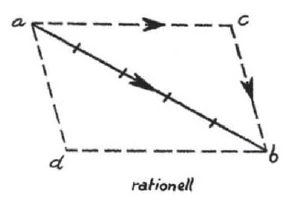
[ 19 ] A third thing that still does not bring us any closer to nature is what we do in so-called phoronomy, the study of motion. Now, it is of some importance that you realize how even this phoronomy is, in essence, still far removed from what is called a “real” natural phenomenon, You see, if I imagine—I am not looking at a moving object, but rather imagining—that an object is moving from—let’s say—point \(a\) to point \(b\). I even say that point \(a\) is moving toward point \(b\). That is what I imagine. Now, I can always imagine that this motion from \(a\) to \(b\), which I have indicated with the arrow, is composed of two motions. Namely, just imagine: Point \(a\) is supposed to reach \(b\), but it would not immediately take the direction toward \(b\); rather, it would first move in that direction as far as \(c\). If it then moves from \(c\) to \(b\), it will also arrive at \(b\). So I can also imagine the motion from \(a\) to \(b\) not as occurring along the line \(a-b\), but along the line—or the two lines—\(a-c-b\). This means I can imagine that the motion \(a-b\) is composed of the motions \(a-c\) and \(c-b\), that is, of two other motions. You don’t need to observe a natural process at all; instead, you can imagine that the motion \(a-b\) is composed of the other two motions—that is, that instead of this one motion, the other two motions could be performed with the same result. When I imagine this, this mental image is purely a figment of my imagination. For instead of drawing it, I could have given you instructions on how to visualize the concept, and that would have to be a valid mental image for you.
[ 20 ] But if there really is such a thing as a point \(a\) in nature—a small grain of shot, for example—and it moves from \(a\) to \(b\) one time, and another time from \(a\) to \(c\) and from \(c\) to \(b\), then what I have imagined actually happens. That is to say, in the study of motion, I imagine the movements, but this mental image must be applicable to natural phenomena and must be validated by them.
[ 21 ] Thus, we can say: Arithmetic, geometry, and phoronomy are the three preliminary stages of the study of nature. The concepts we derive from them we develop entirely on our own; yet they are decisive for what occurs in nature.
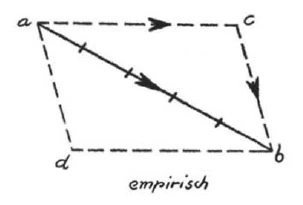
[ 22 ] Yes, now I’d like to ask you to take a brief trip down memory lane back to your physics studies—whether they were a while ago or not—and recall that you once encountered something known as the “parallelogram of forces,” which means that if a force acts on a point \(a\), that force can pull point \(a\) toward point \(b\). By the point \(a\), I mean something material—let’s say, again, a small grain. I pull this grain from \(a\) to \(b\) using a force. Please note the difference between how I’m speaking now and how I spoke earlier. Earlier, I was talking about motion; now I’m talking about a force pulling \(a\) toward \(b\). If you express the magnitude of the force pulling from \(a\) to \(b\) —let’s say five grams — in increments: one gram, two grams, three grams, four grams, five grams, then you can say: I’m pulling \(a\) toward \(b\) with a force of five grams.
[ 23 ] I could also arrange the whole process differently; I could use a certain force to move \(a\) to \(c\) first. To move \(a\) to \(c\), I need a different force than I would need to move it directly from \(a\) to \(b\). But if I drag it from \(a\) to \(c\) — that is, instead of dragging it this way [toward \(b\)], I drag it this way [toward \(c\)]—then I can make a second move. I can pull in the same direction indicated here by the line connecting \(c\) to \(b\), and I must then pull with a force that corresponds to this line. So if I pull here [at \(a\)] with a force of five grams, I would have to calculate from this figure how large the pull from \(a\) to \(c\) must be and how large the pull from \(c\) to \(b\) must be. And if I pull simultaneously from \(a\) to \(c\) and from \(a\) to \(d\), I pull \(a\) in such a way that it eventually reaches \(b\), and I can calculate how strongly I must pull toward \(c\) and how strongly I must pull toward \(d\).
[ 24 ] I can’t calculate this in the same way I can calculate the motion in the example above. What I find here regarding the motion, I can calculate in my mind. As soon as a real force—that is, an actual force—is exerted, I have to measure that force somehow. To do so, I must turn to nature itself; I must move from the realm of the mind into the world of facts. And the more clearly you grasp this difference between the parallelogram of motion—it does indeed become a parallelogram when you add this [first figure, \(d\)]—between the parallelogram of motion and the parallelogram of forces, the more clearly and precisely you have expressed the difference between everything that can be established within the realm of thought and that which lies where thoughts end.
[ 25 ] You can conceive of movements in your imagination, but not of forces. You must measure those in the external world. And you can only conclude that \(a\) is pulled toward \(b\) according to the laws of the parallelogram of forces—when two forces are exerted, one from \(a\) to \(c\) and one from \(a\) to \(d\)—if you determine this experimentally in the external world. There is no proof based on imagination, as in the example above. This must be measured externally.
[ 26 ] Therefore, one can say: The parallelogram of motion is derived purely from reason. The parallelogram of forces must be derived empirically through external experience. And by distinguishing between the parallelogram of motion and the parallelogram of forces, you have before you, by a hair’s breadth, the difference between phoronomy and mechanics. Mechanics, which already deals with forces—and no longer merely with motions—is already a natural science. Arithmetic and geometry are true natural sciences, whereas phoronomy is not yet one. Only mechanics deals with the effects of forces in space and time. But one must go beyond the realm of the imagination if one wishes to advance to this first natural science, to mechanics.
[ 27 ] Well, even on this point, our contemporaries do not think clearly enough. For, you see, I want to use an example to illustrate just how enormous the leap is from phoronomy into mechanics. Phoronomic phenomena can take place entirely within the realm of the mind; but at first, we will only be able to examine mechanical phenomena in the external world. Yet people are so unclear about this that they actually always confuse what can still be understood mathematically with that which already involves the entities of the external world. For what must be present when we speak of the parallelogram of forces? As long as we are talking about the parallelogram of motion, nothing needs to be there other than an imaginary body. But in the case of the parallelogram of forces, there must already be a mass—a mass that, for example, has weight. Yes, one must be clear about this: There must be a mass in a. Now one probably feels compelled to ask: What exactly is a mass?
[ 28 ] Yes, in a sense one would have to say: This is where I’m already stalling. Because it turns out, in a sense, that when one leaves behind what can be so firmly established in the world of ideas as applying to nature—that [when] one enters that realm, one finds oneself on rather uncertain ground. You know, in order to [get by]—so to speak—with arithmetic, geometry, and phoronomy, and with what one then draws a bit from mechanics, one equips oneself by attempting—by breaking down what is called matter into molecules and atoms—to use the mechanics of molecules and atoms to conceptualize the natural phenomena that are initially regarded as subjective experiences.
[ 29 ] Let’s take any warm object. The natural scientist tells us: What you call heat is an effect on your heat-sensing nerves. Objectively speaking, what exists is the motion of molecules and atoms. You can study these according to the laws of mechanics. And so one studies the laws of mechanics—[the mechanics of] atoms and molecules—and for a long time it was believed that by studying the mechanics [of] atoms and so on, one could explain all natural phenomena. Today, that belief is already beginning to waver. But even then, even if one proceeds mentally down to the level of the atom, one must, through all sorts of experiments, come to ask oneself: “Well, how does force manifest itself there? How does mass act?” When one penetrates down to the atom, one must ask about the mass of the atom, and when one asks about this, one must [also] ask: “How can one recognize it?” In a sense, one can recognize mass only by its effect.
[ 30 ] Well, we have become accustomed to recognizing the smallest entity that acts as a carrier of mechanical force by its effect, such that we have answered the question: If such a smallest part sets another small part—let’s say a small portion of matter weighing one gram—into motion, then a force must be exerted by this matter that sets the other into motion. If this mass sets the other mass—which weighs one gram—in motion such that this other mass travels one centimeter in one second, then the first mass has exerted a force. Thus, if a force is exerted such that one gram travels one centimeter in one second, then the first mass has exerted a force; we have become accustomed to regarding this as a kind of universal unit. And if one can say: “A certain force is so many times greater than the force required to move one gram one centimeter in one second,” then one knows how this application of force relates to a certain unit of measurement. This unit of measurement, if expressed in terms of weight, is 0.001019 grams. So one could say: Such an atomistic body—the application of force to which we do not trace back any further in nature—is capable of imparting such an impulse to any body weighing one gram that it flies one centimeter in one second.
[ 31 ] But how can one possibly express what this force entails? Well, if you step on a scale: This force is equal to the pressure that registers as 0.001019 grams when you weigh yourself. So, I must express myself through something very external and real when I want to approach what is called mass in the world. I can express what I conceive of as mass by introducing something—a weight—that I come to know through external means. I express mass solely through a weight. Even when I delve into the atomization of mass, I express myself through a weight.
[ 32 ] With this, I would like to clearly highlight the point where we, so to speak, move from what is established a priori into what is natural. And I would like to draw your attention to how necessary it is to understand to what extent what we establish outside of all nature—in arithmetic, geometry, phoronomy—is applicable, to what extent it can serve as a guide for what actually confronts us from an entirely different angle, what confronts us for the first time in mechanics, and what can actually constitute the content of what we call a natural phenomenon.
[ 33 ] You see, Goethe was well aware that we can only begin to speak of natural phenomena at the very moment we move from phoronomy to mechanics. And because he knew this, it was so clear to him what relationship mathematics—which is so idolized in the natural sciences—can have to these sciences.
[ 34 ] Let me illustrate this with an example: Just as we can say that the simplest element in the action of natural forces would be some atomistic body capable of propelling one gram one centimeter in one second—just as we can say that—so, ultimately, we can speak of all force actions in terms of a force emanating from some point and acting toward some other point. Therefore, we can get into the habit—and this practice is, after all, common in the natural sciences—of seeking out, as it were, the points from which the forces emanate for natural phenomena everywhere. We will see in numerous cases that we will, so to speak, have fields of phenomena, and from these we trace back to the points from which the forces emanate that govern the phenomena. That is why, when speaking of such forces for which we seek the points from which they emanate so that they govern the fields of phenomena, we speak of central forces, because they always emanate from centers. We could also say: We are justified in speaking of central forces when we identify a point from which very specific forces emanate that govern a field of phenomena. However, this interplay of forces does not always have to actually take place; rather, it may be the case that at the central point there is, so to speak, only the potential for this interplay to occur, and that it is only when certain conditions arise in the surrounding sphere that these forces become active.
[ 35 ] Over the course of the next few days, we will see how forces are concentrated, as it were, at certain points, forces that are not yet active. Only when we fulfill certain conditions do they give rise to phenomena in their surroundings. But we must recognize that forces are concentrated at this point or in this space that can act upon their surroundings. That is, in fact, what we are always seeking when we speak of the world in physical terms. All physical research consists in tracing central forces back to their centers, in attempting to penetrate to the points from which effects can emanate. Therefore, we must assume that for such natural effects there are centers that are, so to speak, charged with the potential to exert effects in certain directions. We can, however, measure these potential effects through various processes, and we can also express, in terms of magnitude, how strongly such a point can act. Generally speaking, when forces capable of acting are concentrated at such a point—provided certain conditions are met—we refer to the magnitude of these concentrated forces as the potential, or the force potential. Therefore, we can also say: When we study natural forces, we aim to trace central forces according to their potentials. We focus on certain central points in order to study these central points as the starting points of potential forces.
[ 36 ] You see, this is essentially the direction taken by that school of thought in the natural sciences that seeks to reduce everything to mechanics. It seeks the central forces, or rather, the potentials of the central forces.
[ 37 ] The point here is to bring to light, as it were, through an important step in nature itself: You cannot possibly understand a phenomenon in which life plays a role if you proceed solely according to this method, if you seek only the potentials for central forces. If you were to study, say, the interplay of forces in an animal embryo or a plant embryo using this method, you would never make headway. After all, it is an ideal of modern natural science to study organic phenomena through potentials as well—through central forces of some sort. The dawn of a new worldview in this field will come when we realize: It is not possible to study phenomena in which life is at work by tracing such central forces. Why not? Well, let’s imagine schematically that we set out to study natural processes [physically]. We go to centers and study the possible effects that can emanate from such centers. There we find the effect. So, if I calculate the potentials of the three points \(a\), \(b\), \(c\), I find that \(a\) can act on \(α\), \(β\), \(γ\), just as \(c\) can act on \(α'\), \(β'\), \(γ'\), and so on. I would then gain an insight into how the effect of a certain sphere unfolds under the influence of the potentials of certain central forces.
[ 38 ] I will never be able to explain, in this way, anything in which living forces play a role. Why? Because the forces that come into play for living beings have no potential and are not central forces; so if you were to try here to look for physical effects in \(d\) under the influence of \(a\), \(b\), \(c\), you would be able to trace them back to central forces; if you [in \(d\)] want to study life effects, you can never say that. Why? Because there are no centers \(a\), \(b\), \(c\) for the life effects; rather, you can only make sense of it by saying: Well, I have living phenomena in \(d\); now I’m looking for the forces that act upon life. I cannot find them in \(a\), \(b\), \(c\), nor even if I go further; rather, in a sense, only if I go to the end of the worlds—specifically, to the entire circumference of the end of the worlds. That is to say, starting from \(d\), I would have to go all the way to the end of the worlds and imagine that forces were acting in from the spherical sphere everywhere, interacting in such a way that they converge in \(d\).
[ 39 ] So it is the exact opposite of central forces, which have a potential. How could I possibly calculate a potential for that which comes in from all sides due to the infinity of space! The calculation would have to go like this: I would have to divide the forces; I would have to break down a total force into ever smaller parts, and then I would get closer and closer to the edge of the world, and then the force would fragment. Any calculation would also shatter, because it is not central forces but universal forces without potential that are at work here. This is where calculation ends. You see, this is once again the leap from the inanimate natural to the living natural.
[ 40 ] One can only truly come to terms with nature if, on the one hand, one understands the leap from phoronomy to mechanics and, on the other hand, the leap from external nature to that which can no longer be reached through calculation—because every calculation fragments, because every potential dissolves. It is through this second leap that one enters from external, inorganic nature into living nature. But one must be clear about how all calculation ceases in order to comprehend what the living is.
[ 41 ] Now I have neatly broken down for you everything that can be traced back to potential and central forces and everything that leads to universal forces. But out in nature, things aren’t so neatly separated. You might ask: Where do we find situations where only central forces act according to potentials, and where do we find the opposite—situations where universal forces act that cannot be calculated based on potentials? An answer can be given, but it immediately reveals the key considerations one must take into account. One can say: In everything that humans manufacture in the form of machines—which is combined from the elements of nature—one finds, in a purely abstract sense, central forces acting according to their potential. However, whatever exists in nature—including inanimate objects—cannot be observed entirely in terms of central forces. That does not exist; it does not hold true. Rather, the point is that wherever one is dealing with something not artificially produced by humans, there is a convergence between the effects of central forces and the effects of universal forces. Throughout the entire realm of so-called nature, one finds nothing that is inanimate in the true sense of the word, except for what humans artificially produce—their machines, their mechanical devices.
[ 42 ] And that was, I would say, something that—in Goethe’s deep instinct for nature—was at once clear and unclear to him, because for him it was a natural instinct, yet upon which he based his entire view of nature. And the contrast between Goethe and the natural scientist—as represented by Newton—actually lies in the fact that natural scientists in more recent times have [only] focused on observing external nature strictly in terms of reducing it to central forces, effectively eliminating from it everything that cannot be determined by central forces and potentials. Goethe would not accept such an approach, because for him, what is called “nature” under the influence of this approach is merely an insubstantial abstraction. For him, the truly real is only that in which both central forces and peripheral [forces]—as universal forces—play a role. And, fundamentally speaking, his entire theory of colors is also built upon this contrast. Well, we will be discussing this in detail over the next few days.
[ 43 ] You see, particularly in light of what I had planned for today, I felt compelled to offer this introduction to you as a way of clarifying what the relationship between human beings and the observation of nature actually is. In our time, it is all the more necessary to turn our attention to such a contemplation as we have practiced today, for the reason that the time has truly come when—I would say—the impossibility of today’s view of nature [and] various insights into the fact that things must change are beginning to emerge subconsciously. People still often laugh today when others suggest that the old view is no longer viable. But a time will come—and it is not far off—when this laughter will fade from people’s lips, a time when we will be able to speak in a physical sense, in the spirit of Goethe. People may speak of colors in the sense of Goethe once another stronghold has been stormed—one that is considered even more impregnable and which, in fact, has already begun to waver today. That is the stronghold of the theory of gravity. In this very field, views emerge almost every year that challenge Newton’s ideas about gravity, pointing out how impossible it actually is to make sense of these Newtonian concepts of gravity, which are based purely on the notion that the mere mechanism of central forces is the sole factor at play.
[ 44 ] I believe that today, more than ever, teachers of young people—as well as anyone who wishes to play a role in cultural development—must form a clear understanding of how human beings should relate to nature.