

First Science Course
Light, Color, Sound, Mass, Electricity, Magnetism
GA 320
24 December 1919, Stuttgart
Translated by Steiner Online Library
Second Lecture
[ 1 ] My dear friends!
[ 2 ] I spoke to you yesterday about how, on the one hand, there is the purely phoronomic aspect of the observation of nature—which we can gain simply by forming the concepts we wish to form about all that occurs in physical processes through countable quantities, spatial relationships, and motion—by deriving these concepts from our own imaginative life. We can, so to speak, spin this phoronomic aspect out of our imaginative life. But as significant as it is that what we derive—for example, through mathematical formulas—regarding everything related to the countable, to space, and to motion also applies to natural processes themselves, it is equally significant, on the other hand, that we must turn to external experience the moment we proceed from the countable, the purely spatial, and motion—for example—to mass alone. We made this clear to ourselves yesterday, and we may also have seen from this that, for contemporary physics, the leap from the inner construction of natural phenomena through phoronomy into external physical empiricism must be made, even though this leap cannot actually be understood. You see, unless we take steps toward understanding this leap, it will be impossible to ever form any concept of what is to be called the “ether” in physics.
[ 3 ] As I already hinted to you yesterday, when it comes to phenomena of light and color, for example, contemporary physics—even though these ideas have already begun to waver—still often asserts: An effect of light and color is exerted upon us—upon us as sensory beings, as nervous beings, or even as spiritual beings. But this effect is said to be subjective. What takes place out there in space and time is said to be objective movement in the ether. But if you look in today’s physics literature—or in what is commonly referred to as the “world of physics”—at the concepts people have formed about this ether, which is supposed to cause light phenomena, you will find that these concepts are contradictory and confused, and even with the tools available to modern physics, it is impossible to arrive at truly accurate conceptions of what is supposed to be called “ether.”
[ 4 ] Let us try to set out on the path that can truly bridge the gap between phoronomy and even just mechanics; for mechanics, of course, deals with forces and masses. Although what is expressed by this formula may come up again later—so that even those of you who may no longer remember this formula from your school days can catch up on what is necessary for understanding—today I want to present it merely as a [theorem]. I will put the elements together so that you can get a better sense of this formula.
[ 5 ] You see, if we assume—in the sense of phoronomy—that a point—we must always say “a point” here—that a point is moving, moving in this direction, then such a point—we are now considering only the motion, not its causes—such a point moves either faster or slower. We can therefore say: The point moves at a greater or lesser speed. And I will call this speed v. This speed is thus either greater or lesser. As long as we consider nothing other than the fact that such a point moves at a certain speed, we remain within the realm of phoronomy. But that would not allow us to approach nature—not even mere mechanical nature. If we wish to approach nature, we must take into account what causes the point to move and the fact that a purely imaginary point cannot move—that is, the point must be something in external space if it is to move. In short, we must assume that a force acts on this point. I will call \(v\) the velocity, and \(p\) the force acting on this point. Let us assume that this force does not merely push on this point once, so to speak, and set it in motion—which would cause it to fly off at a certain velocity if it encountered no obstacle—but rather, let us start from the assumption that this force acts continuously, so that the force acts on this point throughout the entire path. And I will call the path along which this force acts on the point \(s\). That would therefore be the distance over which the force acts on the point.
[ 6 ] Then we must also take into account that a point must be something in space, and this “something” can be larger or smaller. Depending on whether this “something” is larger or smaller, we can say: The point has more or less mass. We initially express mass in terms of weight. We can weigh the object that is moved by the force and express it in terms of weight; so I’ll call \(m\) the mass. But if a force \(p\) acts on the mass \(m\), a certain effect must naturally result. This effect manifests itself in that the mass no longer moves at a constant speed, but moves faster and faster, so that its velocity becomes greater and greater. This means we must take into account that we are dealing with an increasing velocity. There will be a certain rate at which the velocity increases. If a smaller force acts on the same mass, it will cause the motion to become less and less rapid; and if a larger force acts on the same mass, it will cause the motion to become more and more rapid. I will call this rate at which the velocity increases “acceleration” and denote it by \(γ\).
[ 7 ] But what interests us most of all right now is the following. And here I’d like to remind you of a formula that you’re probably familiar with—I just want you to recall it. If you calculate the product of the force acting on the mass and the distance traveled, this product is equal to—that is, it can also be expressed as—the mass multiplied by the square of the velocity [and] divided by 2; that is, it is \(ps = \frac{mv^2}{2}\). If you consider the right-hand side of the formula—as I see it—you’ll see that it contains the mass. You can see from the equation that the greater the mass, the greater the force must be. But what interests us now is that on the right-hand side of the equation we have the mass—that is, the very thing we can in no way attain phoronomically. Now the question is this: Should we simply admit that everything that lies outside the phoronomic realm must always remain unattainable—that we are, so to speak, meant to know it only by gazing at it, by observing it—or is there, after all, that bridge—which modern physics cannot find—between the phoronomic and the mechanical? You see, modern physics cannot find this transition today—and the consequences of this are immense—for the reason that it lacks a true understanding of human nature, a true physiology, because we do not actually know human beings. You see, if I write \(v^2\), then I have something that is purely reducible to the countable and to motion. In this respect, the formula is, in a sense, a phoronomic one. If I write down \(m\), I must ask myself: Is there anything within myself that corresponds to this? That corresponds in a similar way to how my conception of the countable and the spatial corresponds to what I write down with \(v\), for example? So what corresponds to \(m\)? What am I actually doing? The physicist is usually unaware, when writing down \(m\), of what he is doing there—what am I doing there?
[ 8 ] Now you see, this question boils down to the following: Can I even grasp what lies within \(m\) in a similar way to how I can phoronomically grasp what lies within \(v\)? You can, if you bring the following to mind: When you press your finger against something, you are, in a sense, becoming acquainted with the simplest form of pressure. Mass reveals itself—as I’ve told you: You can perceive it by weighing it—and at first, mass makes itself known through nothing other than its ability to exert pressure. You can familiarize yourself with this kind of pressure by pressing your finger against something. But now you must ask yourself: Does something similar happen within us when we press our finger against something—that is, when we experience pressure—as when, for example, we observe a moving object? Yes, something does happen; you can understand what is happening by making the pressure stronger and stronger. Try it once—or perhaps you’d better not—apply pressure to a part of your body and increase it more and more, making it stronger and stronger! What will happen? Well, if you make it strong enough, you’ll lose consciousness—that is, you’ll lose your awareness. From this, however, you can conclude that this phenomenon of losing consciousness also occurs, so to speak, on a smaller scale when you apply pressure that is still bearable. It’s just that you don’t lose any of the power of consciousness—you can still endure it. But what I have described to you as the loss of consciousness under such intense pressure that it can no longer be endured is also present, to some extent, on a smaller scale whenever we come into contact with a pressure effect—an effect emanating from a mass.
[ 9 ] And now you need only follow this line of thought further, and you will be very close to understanding what is denoted by the letter \(m\). While everything phoronomic is, in a sense, neutrally united with our consciousness, we are not in this position with regard to what we denote by \(m\); rather, our consciousness is immediately dampened there. We can still endure small degrees of this dampening of consciousness, but not large ones. Yet what underlies it all is the same. By writing down \(m\), we record in nature that which, when it unites with our consciousness, suspends that consciousness—that is, partially lulls us to sleep. Thus, we enter into a relationship with nature, but one that partially lulls our consciousness to sleep. You can see why this cannot be pursued phoronomically. Everything phoronomic lies neutrally within our consciousness. When we go beyond that, we enter the realms that are opposed to our consciousness and that nullify it. So, when we write down the formula \(ps = \frac{mv^2}{2}\), we must tell ourselves: Our human experience contains the \(m\) just as much as it contains the \(v\), but our ordinary consciousness is simply not sufficient to encompass this \(m\). This \(m\) immediately drains the power of our consciousness. Now you have a real relationship with humanity. A very real relationship to human beings. You see, states of consciousness must be called upon if we are to conceal what is natural. Without this assistance, it is not possible to even progress from the phoronomic to the mechanical.
[ 10 ] Now, even if we cannot live with our consciousness within all that can be designated, for example, by \(m\), we do live within it with our whole being. Specifically, we live within it with our will, and we live within it very strongly with our will. I would like to illustrate how we live within nature through our will using an example.
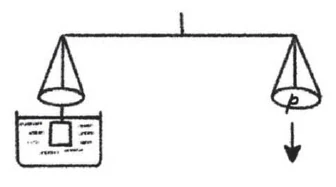
[ 11 ] But for this, I’ll have to start with something you’ll need to recall from your school days. I want to remind you of something—something you became very familiar with during your school days. You know that if we have a balance here, and we place a counterweight on it—an object of equal weight, which I’ll just attach here now (drawing)—to bring the balance beams into equilibrium, we can weigh this object and determine its weight. The moment we take a container of water—filled up to here (drawing)—and submerge the object in it, the balance beam shoots up. Because the object is submerged in water, it becomes lighter; it loses some of its weight. And when we check how much lighter it has become, when we note how much we need to subtract to bring the scale back into balance, we find that the object is now that much lighter than the weight of the water it has displaced. So, if we weigh this volume of water, that gives us the loss in weight. As you know, this is called the law of buoyancy, and it states: Every object in a liquid becomes as much lighter as the weight of the liquid it displaces. So you see, when a body is in a liquid, it tends to rise; in a sense, it escapes the downward pressure—the weight. What can be observed objectively in physics has a very important significance in the constitution of the human being.
[ 12 ] You see, our brain weighs an average of 1,250 grams. If this brain, as we carry it within us, really weighed 1,250 grams, it would press so hard on the blood vessels beneath it that the brain could not be properly supplied with blood. It would exert such intense pressure that it would immediately cloud our consciousness. In reality, the brain does not press down on the base of the skull with its full 1,250 grams, but only with about 20 grams. This is because the brain floats in cerebrospinal fluid. Just as the body floats here in water, so does the brain float in cerebrospinal fluid. And the weight of the cerebrospinal fluid displaced by the brain is precisely about 1,230 grams. The brain is lighter by this amount and weighs only 20 grams. This means that if we now also—and we are quite justified in doing so—regard the brain as the instrument of our intelligence and our inner life, or at least a part of our inner life, then we must not merely take into account the weighable brain—for it is not there alone—but because buoyancy is present, the brain actually strives upward, striving against its own weight. This means that with our intelligence, we do not live within downward-pulling forces, but rather within upward-striving forces. We live with our intelligence within an upward thrust.
[ 13 ] Now, what I have explained to you, however, applies only to our brain. The other parts of our organism—that is, from the base of the skull downward—are in the same position only to a very small extent—only the spinal cord. But as a whole, the other parts of the organism tend downward. So we live within this downward pull. In the brain, we live in an upward lift, and elsewhere in the downward pull. Our will lives entirely within this downward pull. It must unite with the downward pressure. But as a result, it is deprived of consciousness. Consequently, it sleeps continuously. This is precisely the essence of the manifestation of the will: that it is extinguished as a conscious phenomenon, precisely because the will unites with the downward-directed force of gravity. And our intelligence becomes luminous through our ability to unite with the upward thrust, so that our brain works against the force of gravity.
[ 14 ] You see, the various ways in which human life is united with the underlying material world result, on the one hand, in the will being subsumed into matter and, on the other hand, in the will being elevated to intelligence. Intelligence could never arise if our soul were bound to matter that strives only downward.
[ 15 ] Now consider that we truly experience—truly experience—when we do not view human beings through today’s abstract lens, but rather as they truly are, so that the spiritual and the physical come together—the spiritual must simply be conceived of with such intensity that it can also encompass physical knowledge— then, on the one hand, through a special union with material life—namely, with the upward impulse in material life—we experience a brightening of the intellect; and on the other hand, we experience a lulling, when we must, so to speak, allow the will to be absorbed by the downward pressure, so that the will acts in accordance with this downward pressure. It acts in this way. Only a small part of it filters through up to the twenty-gram pressure, enters the intellect—which is why the intellect is somewhat permeated by the will—enters the intellect; but essentially, in the intellect we are dealing with that which is opposed to ponderable matter. We always want to rise above our heads by thinking.
[ 16 ] Here you can see how physical perception must indeed be united with that which lives within the human being. If we remain within the phoronomic realm, we are dealing with the abstractions that are so popular today, and we cannot build a bridge between these popular abstractions and what constitutes the external reality of nature. We need a form of knowledge with such a strong spiritual content that this spiritual content can truly immerse itself in natural phenomena and, for example, comprehend how physical weight and buoyancy act within the human being himself.
[ 17 ] Now I have shown you how human beings internally grapple with downward pressure and upward buoyancy—that is, how they immerse themselves in the relationship between the phoronomic and the material. But as you can see, this requires a new, deeper scientific approach. It cannot be achieved with the old scientific mindset. That mindset invents wave motions or emissions—but these, too, are purely abstract. It seeks the path into matter almost entirely through speculation, and naturally cannot find it that way. A truly spiritual science seeks the path into matter by attempting to truly immerse itself in matter—that is, by tracing the life of the soul, with its will and intelligence, all the way into the phenomena of pressure and buoyancy. Therein lies true monism. It can arise only from spiritual science. Not that verbal monism that is so strongly driven by ignorance today. But it is precisely necessary that physics—if I may use the expression—get a little sense into its head, so that it takes such phenomena into account by connecting them, on the other hand, with the physiological phenomenon of the brain floating in cerebrospinal fluid. Once you have that connection, you know: This is how it must be, for the Archimedean principle cannot cease to apply to the brain floating in cerebrospinal fluid.
[ 18 ] But now, what happens as a result of the fact that—with the exception of the 20 grams, in which the unconscious will plays a role—we actually live, through our brain, in the sphere of the intelligent? As a result, insofar as we use the brain as a tool, our intelligence is relieved of the downward pull of the material realm. This is eliminated to such a high degree that a weight of 1,230 grams is lost. Matter is neutralized to such a high degree. Because it is [neutralized] to such a high degree, we are able to allow our etheric body to be particularly effective for our brain. It can do whatever it wants because it is not hindered by the heaviness of matter. In the rest of the organism, the ether is overwhelmed by the heaviness of matter. This provides a structure of the human being in which, for everything that serves intelligence, the ether is, so to speak, set free; for everything else, the ether is bound to physical matter. Thus, for our brain, the etheric organism predominates over the physical organism, and for the rest of the body, the structure and forces of our physical organism predominate over those of the etheric organism.
[ 19 ] Well, I have previously drawn your attention to the relationship you enter into with the outside world when you subject yourself to pressure. There is a kind of numbing effect at work there. But there are also other relationships, and I want to address one of them today: the relationship with the outside world that arises when we open our eyes and find ourselves in a room filled with light. Here, a completely different relationship with the outside world apparently takes place than when we encounter matter and become acquainted with pressure. When we expose ourselves to light—indeed, not only is nothing lost from our consciousness, but, provided the light acts solely as light, anyone who so desires can sense that their consciousness engages with the outside world through this exposure to light, becoming, so to speak, more fully awake. The forces of consciousness unite in a certain way—we will discuss this in more detail later? —unite, so to speak, with that which meets us in the light. But in the light and through the light, colors also meet us. Light is actually something about which we cannot say that we can see it. With the help of light, we see colors, but we cannot actually say that we see the light itself. Why we “see” so-called white light—we will speak of that later.
[ 20 ] The point is that everything that appears to us as color actually appears to us in a polarized manner, just as, say, magnetism appears to us in a polarized way: positive magnetism, negative magnetism. Thus, whatever appears to us as color also appears to us in a polarized way. On one side of the pole is everything we might call yellow and, related to yellow, orange and reddish hues. On the other side of the pole is blue and everything we might call related to blue—indigo and even lighter shades of green and violet. Why do I say that color confronts us in a polarized way? You see, the polarity of color—which, I would say, is one of the most significant phenomena in all of nature—must simply be studied properly. If you wish to proceed directly to what Goethe calls the “primordial phenomenon” in the sense I explained to you yesterday, you can approach this primordial phenomenon of color, first of all, by seeking out color in relation to light.
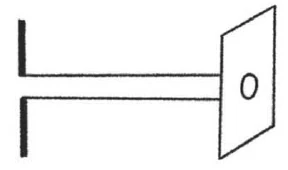
[ 21 ] Now, as a first experiment today, let’s try to explore the color in light as best we can. I’ll start by explaining the experiment to you. We can do this as follows: You see, light can be let in through a narrow slit—let’s assume it’s circular for now—cut into an otherwise opaque wall. So we’ll let this light flood in through the slit. If we let this light flood in and place a screen opposite the wall through which the light is entering, an illuminated circular area appears due to the incoming light. The best way to conduct this experiment is to cut a hole in [the shutter] and let the light flood in.
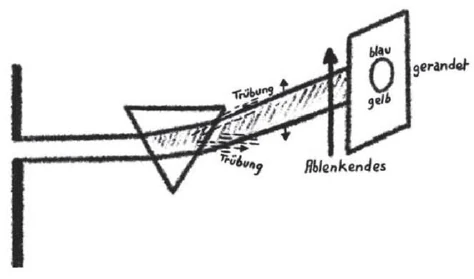
[ 22 ] You can set up a screen there and capture the image that is created. We can’t do that here, but we can do it with the help of this projection apparatus by removing the shutter. As you can see, this gives us a luminous circular area. So this luminous circular area is, at first, nothing other than the image created when a cylinder of light—which propagates in this direction—is reflected by the opposite wall.
[ 23 ] Now, one can place a so-called prism in the path of this cylinder of light as it enters. Then the light is forced not simply to travel toward the opposite wall and form a circle there, but rather to deviate from its path. We achieve this by using a prism—formed by arranging flat glass plates in a wedge-shaped pattern to create a hollow prism—which is then filled with water. We allow the cylinder of light that has been created here to pass through this water prism. So when you look at the wall now, you see that the image is no longer at the spot where that pane used to be down there; instead, you see that it has been shifted upward and appears in a different location. But you’ll also notice something else peculiar. At the top, you’ll see the edge bathed in a bluish-greenish light, with a bluish-greenish border—a bluish border. At the bottom, you’ll see the edge as reddish-yellow. Here we have, first of all, what we call a phenomenon—an optical effect. Let’s focus on this phenomenon for now. So we must draw it this way—let’s sketch out the facts: The light somehow deviates from its path as it passes through the prism. It forms a circle up there. If we were to measure it, we would find that it is not a perfect circle, but is slightly elongated at the top and bottom and has a bluish rim at the top and a yellowish rim at the bottom. So you see, when we allow such a cylinder of light to pass through the prism-shaped water—setting aside the changes caused by the glass plates—color phenomena appear at the edges.
[ 24 ] I’m now going to repeat the experiment using a light cylinder that’s much narrower. You’ll now see a much smaller disk down there. — When we do the experiment next time, we’ll cut it better, and then it’ll be whiter, too. — Now let’s deflect this small disk through the prism; as you can see up here—shifted upward again—you see the spot of light, the circle of light; but now you can see that this circle of light is quite thoroughly permeated with colors. You see, if I were to draw what you have here now, you’d see that the shifted image up there appears as violet, blue, green, yellow, and red. Yes, if we could track all of that precisely, it would be arranged in the full spectrum of rainbow colors. Please, let’s focus purely on the fact, and I now ask all of you who learned in school about all those beautiful drawings of light rays, incident rays, and so on to forget them and stick to the pure phenomenon, to stick to the pure fact. We see colors emerging from the light, and we can ask ourselves: Why is it that such colors emerge from the light?
[ 25 ] Now, if I turn on the large circle again, we have a cylinder of light traveling through space that strikes the screen there and forms an image. If we place the prism in the path of this light cylinder again, we get a shift in this light image and, in addition, colored phenomena at the edges.
[ 26 ] But now I ask you to observe the following. We’ll stick strictly to the facts. Please observe: If you were to look around a bit, as the light passes through the glass prism, you would see the luminous cylinder of water right there inside. The cylinder of light—and this is a pure fact—passes through the water prism, and thus a fusion of light and water takes place. Please pay close attention to this now. As the cylinder of light passes through the water prism, a fusion of light and water takes place. This interpenetration of light and water is by no means ineffective for the [surrounding] environment; rather, we must say: There goes the cylinder of light, which—as I said, we are sticking to the facts—somehow has the power to penetrate through the prism to the other side. But it is deflected by the prism. It would travel [straight ahead] like this; but this cylinder of light is lifted upward, is deflected, so that we must conclude: There is something here that deflects the cylinder of light. If I were to indicate with an arrow what deflects the cylinder of light, I would have to do so with this arrow. Now we can say—as I said, sticking strictly to the facts, not speculating—now we can say: Through such a prism, the light cylinder is deflected upward, and we can specify the direction of deflection.
[ 27 ] Now I ask you to consider the following in addition to all of this, which, again, is based solely on facts. If you allow light to pass through a cloudy sheet of frosted glass or simply through a liquid that is somehow cloudy—that is, through a cloudy substance—this light is naturally dimmed. You can see this by observing light through clear water; you see it in its full brightness. With cloudy water, you see it dimmed. You can observe this in countless instances: that light is dimmed by cloudy media, by cloudy substances. This is something that must first be stated as a fact. In some respect, however slight, every material medium—including what stands here as a prism—is a cloudy medium. It always dims the light; that is to say, with regard to the light that is inside the prism, we are dealing with a dimmed light. Over there [on the left], we are dealing with radiant light. Over there [on the right], we are dealing with the light that has made its way through the medium. Here, however, inside the prism, we are dealing with the interaction of matter with light, with the formation of a cloudiness. But you can easily see that this cloudiness has an effect simply by the fact that, when you look at light through a cloudy medium, you can still see something. So a cloudiness has an effect—it is perceptible.
[ 28 ] What results from the opacity? So we are not merely dealing with the advancing and diverging cone of light, but also with what appears within it as an opacity of the light, caused by matter. So we can imagine: Here in this space beyond the prism, not only does the light shine in, but what exists as a cloudiness within the prism also shines in—it radiates into the light. That radiates in there. And how does it radiate in there? Well, you see, it naturally spreads out there after the light has passed through the prism. The opacity radiates into the brightness. And if you just think it through properly, you can say to yourself: The opacity shines upward, and when the brightness is deflected, the opacity is also deflected upward. That is, the opacity is deflected upward, here in the same direction in which the brightness is deflected. In a sense, the brightness that is deflected upward is followed by the murkiness. So the brightness cannot simply spread upward there. The opacity is sent into it. And we are dealing with two interacting forces: the deflected brightness and the opacity being sent into this brightness—except that the deflection of the opacity occurs in the same direction as that of the brightness. You can see the result: Because the glow of the opacity radiates upward into the brightness, this creates the dark colors, the bluish colors.
[ 29 ] And down below—what is it like there? Of course, the haze also extends downward. But as you can see, while here [above] there is a portion of the radiating light where the haze travels in the same direction [upward] as the light passing through with force, here [below] we have a spread of what arises as haze, so that it seems to shine in that direction and there is a space for which the light cylinder is generally deflected upward. But into this upward-deflected beam of light, the haze radiates [here below]. And here [below] we have a section where, through the [narrower] sections of the prism, the haze travels downward. As a result, we have a section here where the haze is deflected in the opposite direction to the deflection of the brightness.
[ 30 ] We can say: Here [below] we have the opacity that seeks to penetrate the brightness; but in the lower part, the brightness is such that it exerts an opposing effect in its deflection—the deflection of the opacity. The result of this is that, while at the top the deflection of the darkness occurs in the same direction as that of the light—and they thus, in a sense, act together, with the darkness, so to speak, intruding like a parasite [and gaining the upper hand]— here below [by contrast], the opacity radiates back into the brightness but is overwhelmed by the brightness, suppressed, so to speak, so that here the brightness prevails—it also [prevails] in the struggle between brightness and opacity, and the consequences of this struggle between light and opacity—the consequences of this confrontation and of the “opacity being illuminated by the light”—are, downward, the red or yellow colors. So one [can] say, my dear friends: Toward the top, opacity flows into brightness, [overpowers it], and blue nuances arise; toward the bottom, brightness overpowers the opacity or darkness flowing into it, and yellow-red nuances arise.
[ 31 ] So you see here, my dear friends, that simply because the prism deflects—on one side it deflects the full, bright beam of light, and on the other side it deflects the haze—we are dealing with darkness and haze interacting differently with the light on both sides. We have an interplay of darkness and light that does not blend together into a gray, but rather remains effective independently, remaining effective only toward one pole in such a way that the darkness can, so to speak, act in relation to the light—that is, in a way that allows it to come into its own within the light, but precisely as darkness. On the other hand, the haze resists the brightness, remaining present as an independent element, yet is overshadowed by the brightness. This is where the light colors, the yellowish tones, emerge.
[ 32 ] Thus, by sticking strictly to the facts—by taking what is there as it is—you have the opportunity, based purely on observation, to understand why, on the one hand, the yellowish-reddish colors appear and, on the other, the bluish ones, and at the same time you see from this that the material prism plays a very significant role in the formation of these colors, since it is through the prism that, on one side, the opacity is deflected in the same way as the beam of light, but also because the prism allows its darkness to radiate toward the other side. Even where the light has already been refracted, the light that continues to radiate and the refracted light intersect. This causes the [opacity] to be refracted downward, and the darkness and brightness interact differently downward than they do upward. Colors thus arise where darkness and brightness interact.
[ 33 ] That is precisely what I wanted to make particularly clear to you today. If you now want to consider—I would say—from which perspective this can best be understood, you need only think, for example, that your etheric body is activated differently in the muscle than in the eye: In the muscle, it is integrated in such a way that it connects with the muscle’s functions; in the eye, it is integrated in such a way that—because the eye is very isolated—the etheric body is not integrated into the physical apparatus, [but] is relatively independent. As a result, the astral body can form an intimate connection with the etheric body component in the eye. Our astral body is far more independent within the eye than within the rest of our physical organism.
[ 34 ] Suppose that [there] were a part of the physical organization in a muscle, and that [here] were the physical organization of the eye [it is illustrated; cf. the drawing of the eye at the end of the third lecture]. When we describe this, we must say: Our astral body is active both there [in the muscle] and there [in the eye]; but there is a considerable difference. There [in the muscle], it is active in such a way that it moves through the same space as the physical body, but not independently. Here, too, it is active—in the eye—but there it acts independently. Both fill the space in the same way; but in one case [in the eye], the constituents act independently, while in the other [in the muscle], they do not act independently. Therefore, it is only half true to say: Our astral body is inside the physical body. We must ask how it is inside. For it is inside the eye in one way and inside the muscle in another. In the eye, it is relatively independent, even though it is inside just as it is in the muscle.
[ 35 ] From this you can see that ingredients can interpenetrate one another and yet remain independent. For example, you can combine light and darkness to form gray; in this case, they interpenetrate each other just as the astral body and the muscles do. Or they can interpenetrate in such a way that they remain independent; in this case, they interpenetrate just as our astral body and the physical structure of the eye do. In one case, gray results; in the other, color. When they interpenetrate like the astral body and muscles, gray results; and when they interpenetrate like our astral body and our eye, color results, because they remain relatively independent even though they are in the same space.