

First Science Course
Light, Color, Sound, Mass, Electricity, Magnetism
GA 320
25 December 1919, Stuttgart
Translated by Steiner Online Library
Third Lecture
[ 1 ] My dear friends!
[ 2 ] I have been told that the very topic on which we had to conclude yesterday’s discussion—the phenomenon observed through the prism—has presented difficulties for many in understanding it, and I ask you to rest assured. This understanding will come gradually. We will now examine the phenomena of light and color in a little more detail, so that this true pièce de résistance—for it is indeed one for the rest of physics as well—may provide us with a solid foundation. Don’t you agree that our immediate concern must be for me to tell you some of what you cannot find in books and what is not the subject of ordinary scientific inquiry—things that, so to speak, we can only address here. We will then discuss in the final lectures how what we are considering here can also be applied in the classroom.
[ 3 ] You see, what I was trying to explain yesterday is essentially a particular kind of interplay between brightness and darkness. And I wanted to show that through this distinct interaction of brightness and darkness—which occurs particularly when a beam of light passes through a prism—the color phenomena that are polar opposites to one another arise. First of all, I ask you to accept this bitter pill: the difficulty in understanding this matter lies in the fact that you—and this applies to those who find it difficult to understand—actually want the theory of light and color to be structured in a phoronomic way. Through our peculiar education, people have now become accustomed to indulging only in such concepts that, with regard to external nature, are more or less phoronomic—that is, concerned only with the countable, the spatial-formal, and the movable. Now you are to strive to think in terms of qualities, and you can truly say, in a certain sense: “Here I’m already stuck.” — But please attribute this entirely to the unnatural course that scientific development has taken and undergone in recent times—a course that you yourselves will, in a certain sense, go through with your students—I am referring now to the teachers at the Waldorf School and other teachers. For it will, of course, not be possible to immediately introduce sound concepts into today’s schools; rather, we will have to create transitional phases.
[ 4 ] Now let’s approach—I might say—the phenomena of light and color from the other end of the spectrum. I’d like to preface today’s discussion with a much-contested remark by Goethe. You can read it in Goethe’s works—as he became known in the 1780s for all sorts of assertions about the appearance of colors in light, that is, about the phenomena we began discussing yesterday. He was told that the general view among physicists was that when colorless light is passed through a prism, this colorless light is split, or decomposed. The phenomena were interpreted roughly as follows: if we capture a cylinder of colorless light, it initially presents us with a colorless image. If we place the prism in the path of this cylinder of light, we obtain the sequence of colors: red, orange, yellow, green, blue—light blue, dark blue—and violet. Now, this is something that came to Goethe’s attention, and he learned that: “This phenomenon is explained by the idea that colorless light actually already contains within itself—though this is, of course, difficult to conceive, but that is what was said—these seven colors. When light is passed through the prism, the prism does nothing other than fan out what is already present within the light, breaking the light down into the seven colors.”
[ 5 ] Well, Goethe wanted to get to the bottom of the matter and borrowed all sorts of instruments—just as we have been trying to gather them together these past few days—in order to determine for himself how things really are. He had these instruments sent from Jena to Weimar by Court Councilor Büttner, stacked them up, and planned to test them at a convenient time to see how things stood. Court Councilor Büttner grew impatient and demanded the instruments back, even though Goethe hadn’t done anything yet. He had to pack up the instruments—after all, with some things, we don’t always get around to them right away. He quickly grabbed the prism and said: “So, the prism splits the light.” “I’ll take a look at it on the wall.”—And now he expected the light to appear in a beautiful spectrum of seven colors. But something colored only appeared where there was an edge or a speck of dirt, so that the dirt and the haze collided with the brightness. There, when you looked through it, you saw colors. But where there was uniform white, you saw nothing. That made Goethe suspicious; he began to doubt this whole theory. And now he saw no point in sending the instruments back. He kept them and pursued the matter further. And it turned out that things aren’t actually the way they’re usually described, but rather that when we let light pass through the space of a room, we get a white circle on a screen.
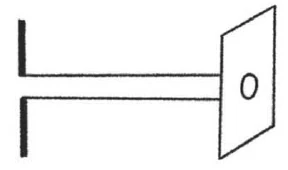
[ 6 ] Here you can see a very beautiful circle; we cut it very neatly, which is why we ended up with such a beautiful circle. — Now, if you place the prism in the path of this beam of light as it passes through, the light beam is deflected. But at first, the seven successive colors do not appear at all; instead, only a reddish hue appears at the lower edge, which transitions into a yellowish hue, and a bluish hue at the upper edge, which transitions into a greenish hue. In the middle, it remains white.
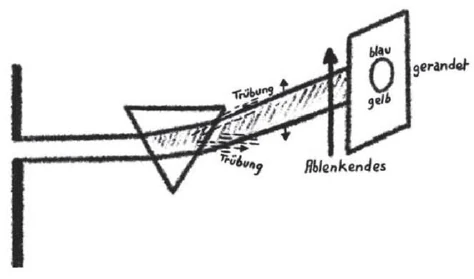
[ 7 ] So what did Goethe tell himself? He told himself: It doesn’t matter at all whether anything is split off from the light; rather, I am actually creating an image. This image is merely a representation of this section here. The section has edges, and the colors do not appear because they are, so to speak, extracted from the light—as if the light were splitting into them—but because I am creating the image, and the image as such has edges; so that here, too, I am dealing with nothing other than the fact that where light and darkness meet — for outside this circle of light here, the surroundings are dark, and inside it is light —, the colors appear at the edges. At first, the colors appear only as edge phenomena, and by showing the colors as edge phenomena, we essentially have the original phenomenon before us. We do not have the original phenomenon before us at all when we now reduce the size of the circle and obtain a continuous color image. The continuous color image arises solely because, whereas in the large circle the edge colors remain merely edge colors, in the small circle the colors extend from the edge inward toward the center, overlap in the center, and form what is called a continuous spectrum. Thus, the original phenomenon is that colors appear at the edges, where light and darkness converge.
[ 8 ] As you can see, the point is that we should not let theories interfere with the facts, but rather remain strictly focused on studying the bare facts, the mere facts. Now, the point is that what occurs here is not only what we see in the colors, but as you have seen: there is also a shift of the entire light cone, a lateral deflection of the entire light cone. If you want to trace this lateral deflection schematically, you could do so in roughly the following way.
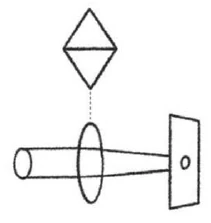
[ 9 ] Suppose you join two prisms [at their base faces] so that the lower prism—which, however, forms a single unit with the upper one—stands as I sketched for you yesterday. The upper prism is positioned opposite the lower one. If I were to pass a beam of light through this double prism, I would naturally have to obtain something similar to what I showed you yesterday. I would have to observe a deflection—once downward, once upward.” If I had such a double prism here, I would obtain a light figure that is even more elongated, but at the same time it would turn out that this even more elongated light figure is very indistinct and dim. This would become clear to me because if I were to capture the figure here with a screen, I would obtain an image formed by this circle of light overlapping. But I could also move the screen closer. I would again obtain an image. That is to say, there would be a range—and this is all within the realm of fact—a range within which I would always have the possibility of obtaining an image. You can see from this that the double prism manipulates the light. One thing I always find is that I always get a red edge here on the outside—both at the top and bottom—and violet in the middle, so that I now get an image like this: violet in the middle and a red edge toward the outside. Whereas normally I just get an image ranging from red to violet, I now get red outer edges, violet in the center, and the other colors in between.
[ 10 ] Now, one can get around the fact that images are encountered over a certain distance here. If I move the screen, I get [different] images. So, I could use a double prism like this to create the possibility of such a figure appearing, but I would also get it if I moved the screen in that direction. So I have a certain range over which there is the possibility of an image forming that is colored at the edges, but is also colored in the center and has all kinds of transitional colors.
[ 11 ] Now, one can [avoid] the situation where, if I move the screen up and down, I have to [cover] such a wide area in which it is possible to create such images. But as you can probably guess, this [other] possibility [of creating images] could only be achieved if I were to constantly alter the prism’s [geometric] configuration—for example, because with a prism whose angle is larger here, the image is projected at a different point; if I were to make the angle smaller, the image would be projected at a different point, and I would reduce this distance.
[ 12 ] I can transform the whole thing by not using flat surfaces for a prism here, but by using curved surfaces from the outset. This greatly simplifies what is still extremely difficult to study in the case of a prism. And this gives us the following option: First, we let the light cylinder pass through space, and now we place the lens—which is essentially nothing more than a double prism, but with curved surfaces—in its path. Instead of the double prism, we place the lens in the path. You see, when I place the lens in the path, the image is initially significantly reduced in size. So, what actually happened here? The entire light cylinder has been compressed. This [on the left side] is the original cross-section of the cylinder. By placing the lens in the path, I cause the entire light cylinder to be compressed and narrowed. Here we have a new interaction between the material—the material in the lens, in the glass—and the light traveling through space. This lens acts on the light in such a way that it contracts the light cylinder.
[ 13 ] Let’s sketch out the whole thing schematically: If I have a light cylinder here, drawn from the side, and I let its light pass through the lens—let’s treat this quite —pass through the lens, whereas, for example, if I were to place an ordinary glass plate in front of it, the light cylinder—or if I were to place a water plate in front of it—the light cylinder would simply pass through, and an image of the light cylinder would appear on the screen. That is not the case when I have not a glass plate or a water plate, but a lens. If I simply trace what has happened, I must say: What has resulted is a reduction in the size of the image. Thus, the light cylinder has been compressed.
[ 14 ] There is another possibility. It involves replicating the arrangement not with a double prism like the one I drew there, but with a double prism designed such that—on average, or in cross-section—the prisms abut each other along this edge here. In that case, however, I would end up with the same description I gave, but with a significantly enlarged circle. Again, by moving the screen up and down over a certain distance, I would be able to obtain the image—more or less indistinctly. In this case, I would have violet and bluish tones at the top, violet and blue at the bottom, and red in the middle. There, it was the other way around. And in between, the intermediate colors.”
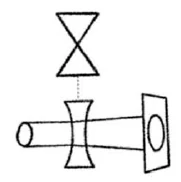
[ 15 ] I can, in turn, substitute a lens with the following cross-section for this double prism:

[ 16 ] While this lens [in the previous arrangement] appears thick in the center and thin at the edges when viewed in cross-section, this one [here] appears thin in the center and thick at the edges. In this case, I also obtain an image through this lens that is significantly larger than the usual cross-section that would result from the light cylinder. I obtain an enlarged image, but one that also exhibits this gradation of color toward the edges and toward the center. So if I wish to analyze the phenomena here, I must say: The light cylinder has been expanded; it has essentially been driven apart. That is the simple fact.
[ 17 ] Now, what do we see from these phenomena? We see from these phenomena that there is a relationship between the material—which initially appears to us as transparent material in the lenses or prisms—and that which is revealed by the light. And we also see, in a certain sense, a specific kind of this interaction. For if we consider what we would observe here through such a lens—one that is thick at the edges and thin in the center—what must we conclude when we have such a lens before us? We must conclude: The entire cylinder of light has been pushed apart; it has been expanded. And we also see how this widening is possible. This widening occurs because the material through which the light has passed is thin here [in the center] and thicker here [at the edge]. Thus, the light must pass through more material here than in the center, where it passes through less material. What happens to the light now? Well, as we’ve said, it is widened; it is pushed apart. It is driven apart in the direction of these two arrows. By what means can it be driven apart? Well, simply by the fact that the light has less matter to pass through in the center and more at the edges. Now consider this: In the center, the light has less material to pass through, so it passes through more easily; therefore, once it has passed through, it still has more energy. So, it has more energy here, where it passes through less matter, than here, where it passes through more matter. This greater energy in the center—which is caused by the light passing through less matter—pushes the light cylinder apart. This is something you can, so to speak, deduce directly from the facts.
[ 18 ] I ask that you be absolutely clear that what we are dealing with here is the correct application of the method, the correct guidance of thought. You must realize that when you trace what appears through the light with lines, you are actually just drawing something that has nothing to do with the light itself. When I draw these lines here, I am merely drawing the boundaries of the cylinder of light. This cylinder of light is created by this opening. So I am not drawing anything that has to do with the light itself, but only something that is brought about by the light passing through the [circular] slit. And when I say here, “The light moves in this direction,” that, too, has nothing to do with the light itself; for if I were to move the light source upward, the light—as it passes through the slit—would move in precisely that way, and I would have to draw this arrow in that direction. None of this has anything to do with the light as such. People have become accustomed to drawing lines into the light, and through this they have gradually come to speak of light rays. One is not dealing with light rays at all; one is dealing with a cone of light produced by a [circular] slit through which the light is allowed to pass. What we are dealing with is a widening of the cone of light—one must say: Somehow, the widening of the cone of light must be related to the shorter path the light takes here in the center than here at the edge. Because of the shorter path here in the center, it retains more energy; because of the longer path at the edge, more energy is lost. The weaker light at the edge is pushed aside by the stronger light in the center, and the light cone widens. That is what you can observe.
[ 19 ] Now you see: While we are really only dealing with images, in physics people talk about all sorts of things—light rays and the like. These light rays have actually become the very foundation for materialistic thinking in this field.
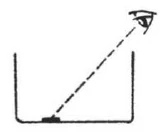
[ 20 ] To make what I just explained a little clearer, let’s consider something else. Let’s assume we have a basin here, a small container. In this small vessel, we have a liquid—let’s say water, for example—and at the bottom lies some object, say a coin or something similar. If I have an “eye” here, I can perform the following experiment: First, I can drain the water and look at this object with the “eye.” In this way, I will see the object in that direction. What is the factual situation? I have an object lying at the bottom of a vessel. I look at it and see this object in a certain direction. That is the simple factual situation. If I now start to suggest: A ray of light emanates from this object, is directed toward the eye, and affects the eye—then, my dear friends, I am already imagining all sorts of things.
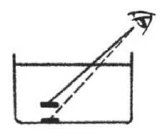
[ 21 ] Now I fill the vessel with water or some other liquid up to this point. Now something quite remarkable happens. I look in the same direction in which I previously looked at the object—from my eye toward the object—I look, look in the direction in which I previously looked.” I might expect to see the same thing, but I don’t; instead, something highly peculiar happens: I see the object slightly raised. I see it as if its entire base were lifted upward. We can discuss later how this can be determined—I mean, measured. I just want to state the principle here. What could this possibly be based on, if I answer the question based on the pure facts? Well, I expect that if I used to see it that way, I would find the object again in that direction. I direct my gaze toward it, but I don’t see it in that direction; I see it in the other direction. Yes, before, when there was no water in the trough, I could look straight down to the bottom, and there was only air between my eye and the bottom. Now my line of sight encounters the water here. It does not let my vision pass through as easily as air does, but offers it stronger resistance, and I must retreat in the face of this stronger resistance. From here on, I must retreat in the face of this greater resistance. This retreat is expressed by the fact that I do not see all the way to the bottom, but rather that the whole scene appears raised. In a sense, I find it harder to see through the water than through the air; I find it harder to overcome the resistance of the water than that of the air. Therefore, I must shorten the force, and so I pull the object upward myself. I reduce the force by encountering the greater resistance. If I were able to lower the bottom of the vessel [so that I could see] and [accordingly] fill it with a gas that is less dense than air, then the object would sink here because I would now encounter less resistance. I would therefore push the object downward.
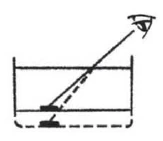
[ 22 ] The physicist does not simply state this fact, but says: Well, a beam of light is directed toward the surface of the water. This beam of light is refracted here, and because there is a transition between a denser medium and a less dense one, the beam of light is refracted from the line of incidence and enters the eye here. And now he says something highly curious: But the eye, having received the information via the beam of light, now extends the path outward and projects the object onto this spot.
[ 23 ] In other words: One finds all sorts of concepts, but one does not take into account what is actually there—the resistance that the eye’s focusing power itself encounters in the denser substance it must penetrate. One would like, so to speak, to leave everything out and attribute everything to the light itself, just as one says here about the prism: “Oh, the prism doesn’t do anything at all; the seven colors are already inside the light. The prism merely provides the impetus for them to line up neatly next to one another like soldiers—the seven colors; but inside there, those seven mischievous boys are already gathered together, forced to stand apart. The prism has nothing to do with any of that.”
[ 24 ] We have seen that it is precisely what is created in the prism—this diffused wedge—that produces the colors. The colors themselves have absolutely nothing to do with the light itself. And here you see again—while we are here [with the vessel filled with water]—that we must be clear that we are performing an active action: we aim with our eyes and encounter greater resistance in the water, which forces us to shorten the line of sight due to that greater resistance. [Then] the physicist says: Light rays are cast there, they are refracted, and so on. And then the most beautiful part, right at this point, my dear friends! You see, the physicist—the physicist of today—says: So first the light reaches the eye via a refracted path, then the eye projects the image outward. — What does that mean? In the end, he does say: “The eye projects.” He simply substitutes a phoronomic concept—a concept abandoned by all realities, a pure act of fantasy—for what presents itself directly: the resistance of the denser water against the eye’s line-of-sight force.
[ 25 ] It is precisely at such points that you notice most clearly how everything in our physics is abstracted, how everything is to be reduced to phoronomy, and how there is a reluctance to delve into qualities. On the one hand, then, the eye is stripped of all activity—light rays emanate from objects and enter the eye—but on the other hand, the eye projects outward what it receives as a stimulus. What is necessary, however, is to start from the very beginning with the activity of the eye, to be clear that the eye is an active organism.
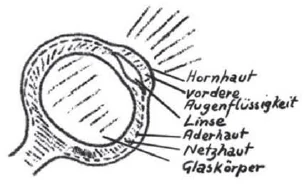
[ 26 ] Now, as you can see, here we have a model of the eye, and today we’ll begin by taking a brief look at the nature of the human eye. The eye—the human eye—is, after all, a kind of sphere, only slightly compressed from front to back; a sphere that sits here inside the eye socket in such a way that a series of membranes first surrounds the interior of the eye. If I want to draw a cross-section, I would have to draw it like this—I’ll sketch the eye for you now. You see, when you look at an eye like your neighbor’s, you’re looking into the pupil; but I’m drawing the eye from the side. It’s the same thing, by the way. I want to draw the cross-section. What I’m drawing now would be the right eye, and it would have to be positioned just like that. The outermost layer you’d find first if you were to dissect the eye out of the skull, for example, would be connective tissue and fat. But then you come to the eye’s actual first layer, the so-called sclera and cornea. The outermost layer is fibrous, bony, and cartilaginous. I’ve drawn it here. It becomes transparent toward the front. As you can see here, it becomes transparent toward the front, allowing light to enter the eye from this direction. A second layer lining the interior here is the so-called choroid. It contains the blood vessels. We’d find it roughly here. And third, we have the innermost layer, the so-called retina, which then continues toward the skull as the optic nerve. So here, the optic nerve would extend inward, forming the retina. And with that, we have listed the three layers of the eye.
[ 27 ] Now, behind this cornea, embedded here in the ciliary muscle, is a kind of lens. It is held in place here by a muscle called the ciliary muscle. Toward the front is the transparent cornea, and between the lens and the cornea is what is called the aqueous humor, so that when light enters the eye, it first passes through the transparent cornea, then through the aqueous humor, and then through this lens, which is movable by muscles. But then the light travels further from this lens into what now fills the entire eye cavity and is commonly called the vitreous humor. So the light passes through the transparent cornea, the aqueous humor, the lens itself, the vitreous humor, and from there to the retina, which is a branch of the optic nerve that then extends into the brain. These are, for now, a schematic representation—we want to focus first on the fundamental principles—a schematic illustration of the parts that make up this eye, which is embedded in a cavity of the skull.
[ 28 ] But this eye exhibits extraordinarily remarkable features. First of all, when we examine the fluid that lies between the lens and the cornea—through which light must pass—we find that, in terms of its composition, this fluid is almost a true fluid, almost an external fluid. In the area where a person has their ocular fluid—between the lens and the outer cornea—the human body is, in a sense, just like a part of the external world. It is almost as if this fluid, located at the outermost periphery of the eye, hardly differs from a liquid that I might pour onto my hand here. And what is the lens here—this lens—is also something very, very objective, very, very lifeless. If, on the other hand, I turn to the vitreous body, which fills the interior of the eye and borders the retina, I cannot in any way regard this vitreous body as something that is almost like an external fluid or an external body. There is vitality in there, there is life in there, so that the further back we go into the eye, the closer we come to life. Here we have a fluid that is almost entirely objectively external; the lens is also external; but with the vitreous body, we are already within a structure that possesses vitality in itself.
[ 29 ] This difference between everything that is out there and what is inside is also evident in something else. This, too, could already be studied scientifically today. For if one traces the development of the eye comparatively, starting from the lower animal kingdom, one finds that the outer aqueous humor and the lens do not grow from the inside out, but rather form as cells attach themselves to the surrounding cells. So, I would have to imagine the formation of the lens in such a way that the lens tissue—and also the anterior chamber fluid—arises from the neighboring organs and not from within, whereas in the interior, the vitreous body grows toward the exterior. You see, here lies the curious aspect: the nature of external light acts here and brings about that transformation which produces the aqueous humor and the lens. The being reacts to this from within and responds with something more alive, more vital—the vitreous body. It is precisely in the eye that the formations stimulated from the outside and those stimulated from within come together in a most remarkable way. This is the next peculiarity of the eye.
[ 30 ] There is another one. There is a peculiarity of the eye, which consists in the fact that this spreading retina is actually the spreading optic nerve. Now, the peculiarity is precisely this—I will try to demonstrate an experiment tomorrow that confirms this—the peculiarity that here, where the optic nerve enters, the eye is insensitive. It is blind there. The optic nerve then extends, and at a point that, for the right eye, lies slightly to the right of the point of entry, the retina is most sensitive. One might say: The nerve is what perceives light. But it does not perceive light precisely where it enters. One might think that if the nerve were truly what perceives light, it would perceive it most strongly right where it enters. But it does not. Please keep that in mind for now.
[ 31 ] Well, you can gather from the following that this structure of the eye is an extraordinary one—I would say, one imbued with the wisdom of nature: When you look at the objects around you during the day, you’ll find that—provided your eyes are healthy—they appear more or less sharp, but in such a way that the sharpness and clarity are sufficient for your orientation. But when you wake up in the morning, you sometimes see the edges of objects very blurrily; they appear as if shrouded in a light mist. If it is a circle, you see something blurry around it when you have just woken up in the morning. What is the reason for this? It is because we have three components in our eye: first, the vitreous humor—though let’s consider just two for now—the vitreous humor and the lens. As we have seen, they have very different origins. The lens is formed more from the outside, the vitreous body more from the inside; the lens is more inanimate, while the vitreous body is permeated with vitality. The moment we wake up, the two have not yet adjusted to one another. The vitreous body still wants to project objects as best it can, and the lens in its own way. And we must first wait until they have adjusted to one another. From this you can see how internally flexible the organic is, and how the functioning of the organic is based on the fact that activity is first differentiated into the lens and the vitreous body, and then the activity is in turn recomposed from these differentiated parts. One must then adapt to the other.
[ 32 ] Based on all these points, we will try to gradually arrive at an understanding of how the colorful world arises from the interaction between the eye and the external world. To this end—so that we can continue tomorrow with reflections on this relationship between the eye and the external world—let us consider the following experiment.
[ 33 ] Look, I’ve painted this disc here using the colors we just saw as the colors of the rainbow: violet, indigo, blue, green, yellow, orange, and red. If you look at this wheel here, you’ll see these seven colors—I’ve done the best job possible with these colors. Now we’ll start by spinning the disc. You can still see the seven colors, just in motion, and I can spin it pretty fast, and you’ll see the seven colors as it moves. But now I’m going to make the disc spin quite quickly. You’ll see that when it spins fast enough, you no longer see the colors; instead, you see—I believe—a uniform gray. Isn’t that right? Or did you see something else? (“Purple,” “Reddish.”) Yes, that’s only because the red is a bit too strong compared to the other colors. I did try to balance out the intensity across the space,” but if the arrangement were completely correct, you would actually see a solid gray. We must then ask ourselves: Why do these seven colors appear to us as a solid gray? We’ll answer that question tomorrow. Today, we’ll just note what modern physics says. It says—and this was already said in Goethe’s time: Here I have the colors of the rainbow: red, orange, yellow, green, blue, indigo, and violet. Now I set the disc in rotation. As a result, the impression of light does not come into full effect in the eye; rather, just as I have seen the red here, the rapid rotation means that the orange is already there, and once I have seen the orange, the yellow is already there, and so on. And then, while I still perceive the remaining colors, the red is already back. As a result, I perceive all the colors at the same time. The impression of red has not yet faded when violet appears. This combines the seven colors for the eye, and that, in turn, must result in white.
[ 34 ] This was also the prevailing theory in Goethe’s time. Goethe accepted this as a scientific principle: If you make a color wheel and spin it rapidly, the seven colors—which have been so well-behaved as to separate from the cylinder of light—will reunite within the eye itself. But Goethe never saw white; instead, he said, “Nothing other than gray ever results.” Admittedly, more recent physics textbooks also conclude that only gray results. But to make the story “white” after all, they advise placing a black contrast circle in the center, so that the gray will appear white by contrast. So, as you can see, this is done in a clever way. Some people do it with “fortune”; physicists do it with “nature.” That’s how nature is corrected. This happens with a number of the most fundamental facts—that nature is corrected.
[ 35 ] As you can see, I’m trying to proceed in a way that lays the groundwork. It is precisely by establishing a solid foundation that we will be able to make progress in all other areas.