

First Science Course
Light, Color, Sound, Mass, Electricity, Magnetism
GA 320
26 December 1919, Stuttgart
Translated by Steiner Online Library
Fourth Lecture
[ 1 ] My dear friends!
[ 2 ] Unfortunately, we haven't made enough progress yet in putting together the experimental materials. Therefore, we will have to postpone some of the things we had planned for today until tomorrow, and I will have to adjust today’s lecture so that I can still present to you some of the material that will be useful to us in the coming days—with a slight change in my original plans, so to speak.
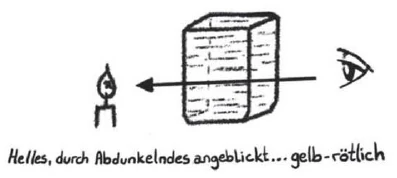
[ 3 ] I would like to begin by simply presenting to you what one might call the primordial phenomenon of color theory. You will gradually find this primordial phenomenon of color theory confirmed and corroborated by the phenomena you can observe across the entire scope of what is known as optics or color theory. Of course, the phenomena become more complex, and this simple phenomenon does not always reveal itself so readily in the external world. But if one takes the trouble, one finds it everywhere. This simple phenomenon, initially expressed in the manner of Goethe, is this: If one views a brighter object through darkness, then the bright object appears through the darkness in the sense of a bright [color], in the sense of yellowish or reddish; in other words: For example, if I look at any bright, so-called whitish light through a sufficiently thick plate that is somehow opaque, then what I would otherwise see as whitish when looking at it directly appears to me as yellowish or yellow-reddish. Brightness through darkness appears yellow or yellowish-reddish. That is one pole: brightness through darkness appears yellow or yellowish-reddish.
[ 4 ] Conversely, if you have, say, just a black surface here, and you look directly at it, then you simply see the black surface. But suppose I have a trough of water here, and I shine light through it so that it’s illuminated. So, I have an illuminated liquid here. Then I see the dark as dark against the light, against the illuminated surface. Blue or violet appears—that is, blue-red—which is the other pole of color.
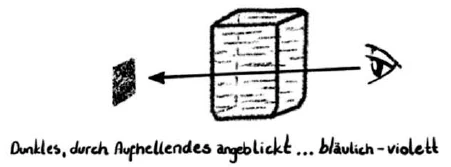
[ 5 ] This is the fundamental phenomenon: light through darkness — yellow; darkness through light — blue. You see, this simple phenomenon can be observed everywhere, if one simply gets used to thinking in concrete terms rather than abstractly, as modern science does.
[ 6 ] Now, from this perspective, recall the experiment we’ve already conducted, in which we passed a light cylinder through a prism and, as the light cylinder passed through the prism, obtained a true spectrum of colors—which we captured—ranging from violet to red. I have already described this phenomenon to you. We were able to say: When we have the prism here and the light cylinder here, the light passes through the prism in some way and is deflected upward. And we said: What is happening here is not merely a deflection. A [mere] deflection would occur if a transparent object with parallel surfaces were placed in the path of the light. But [here] it is the prism, which has converging surfaces, that is placed in the path of the light. As a result, as the light passes through the prism, it is dimmed. So at the moment we send the light through the prism, we are dealing with two things: first, the simple, streaming bright light; and second, the opacity placed in the path of the light. But this opacity that stands in the path of the light—as we have said—stands in the path of the light in such a way that, while the light is primarily deflected upward, the opacity that arises as it radiates upward will have its rays directed in the direction of the deflection. That is to say, it radiates darkness into the deflected light. Darkness, so to speak, lives within the deflected light. This is what gives rise to the bluish, violet hue here [above]. But the darkness also radiates downward. While the cylinder of light is deflected upward in this way, the darkness radiates downward; it acts in opposition to the deflected light, cannot prevail against it, and we can say: Here, the deflected bright light overpowers the darkness, and we obtain [below] the yellowish or yellowish-reddish colors.
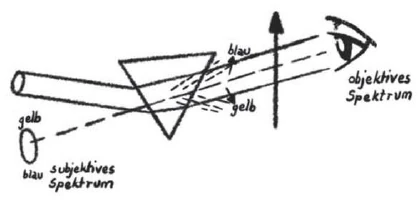
[ 7 ] If we take a sufficiently thin cylinder of light, then when we look in the direction of this cylinder of light [toward the prism]—since we can see through the prism with our eyes—instead of viewing the image projected onto a screen from the outside, we can place our eye at the location of that image. Then, when we look through the prism, we see what is here a section—through which the cylinder of light is formed for us—and we see it shifted. So here again, if we stick to the facts, we have the phenomenon before us: When I look here, what would otherwise come directly [straight ahead] toward me, I see shifted downward through the prism. But I also see it in color. You see it in color everywhere.
[ 8 ] What do you actually see here? If you bring to mind what you see here and clearly articulate what you see in connection with what we have just established, then what you really see—even down to the smallest detail—will become immediately clear to you. You just have to stick to what you see. Isn’t that right? When you look at the cylinder of light like this—because it’s coming toward you, that bright cylinder of light—you see something bright, but you see that brightness—well, isn’t that right? Clear proof that you have a darkened area up here is that the blue color appears—so, you see a bright spot through the darkened area, through the blue color—a bright spot through a dark area. So here you must see yellow or yellow-reddish—that is, yellow and red. And down below, the red color is likewise proof to you that you have a brightened area. — I’ve already told you that the light overpowers the darkness. So when you look at it, you see: no matter how bright the cylinder of light may be, you still see it through a lightened area. So it appears dark in contrast to the lightened area. You’re seeing a dark area through a lightened area, and you must see it as blue or blue-red at the bottom.
[ 9 ] You need only name the phenomenon, and then you have what you can see. What presents itself to the eye is what you otherwise see—that is, the blue through which you are looking. Thus, the light appears reddish. At the lower edge, you have the illuminated area. No matter how bright the cylinder of light may be, you see it through an illuminated area. So you see a darker area through an illuminated area, and you see it as red. That is what matters; it comes down to the polar aspect.
[ 10 ] If one wants to be scholarly, one can call the former the objective colors—those on the screen. The other thing one sees when looking through the prism can be called the subjective spectrum. The subjective spectrum appears as the inverse of the objective spectrum. When we speak this way, we have spoken in a thoroughly scholarly manner.
[ 11 ] Well, my dear friends, these apparitions have been the subject of much speculation, especially in recent times. Not only have people examined the phenomena—as we have just attempted to do—and described them precisely, but they have also pondered these matters; and this deep contemplation began, in fact, when the famous Newton reflected on light because this spectrum of colors first presented itself to him. Newton, however, [with his objective experiments using the narrow slit] made the so-called explanation—for that is all it ever is—relatively easy for himself. He said: Well, if we have the prism, let’s shine white light through it. The colors are already contained within it; the prism draws them out, and then they appear in sequence. I simply decomposed the white light. Now Newton imagined: Each type of color corresponds to a specific substance, so that, in terms of matter, seven colors are contained in the whole. In a sense, for him, this passage of light through the prism is a kind of chemical decomposition of light into seven individual substances. He even formed ideas about which substances emit larger corpuscles—small spheres—and which emit smaller ones. So, in this sense, the situation is as follows: the sun sends us light; we let the light enter through the circular slit, and there [at the prism] it strikes as a cylinder of light. But this light consists entirely of tiny corpuscles, tiny particles, which strike here, are then deflected from their original direction, and then bombard the screen, where the little cannonballs strike. The small ones fly upward, the large ones downward; the small ones are the violet ones, the large ones are the red ones, aren’t they? And so the large ones separate from the small ones.
[ 12 ] This view—that a particle or various particles fly through the world—was very soon challenged by other physicists, such as Huygens, Young, and others, and eventually people came to the conclusion: It can’t be that these little particles originate from somewhere and are simply propelled through the medium—or perhaps not propelled through a medium at all—and either land on a screen, producing an image, or enter the eye to cause us to perceive the color red and so on. That simply doesn’t work. And I would like to say: Ultimately, people were driven to prove to themselves that it couldn’t work that way through an experiment—one that had, admittedly, already been prepared, even by the Jesuit Grimaldi, as well as by others. This entire view was fundamentally shaken by the experiment conducted by Fresnel*?
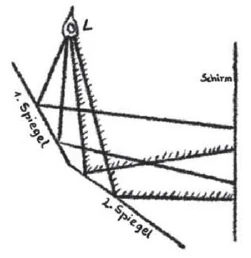
[ 13 ] These experiments by Fresnel are extremely interesting. But we need to get a clear understanding of what is actually happening in the setup Fresnel used for his experiments. I ask you, please, to pay very close attention to the facts now, because the point is that we are studying a phenomenon with great precision. — Look, suppose I have two mirrors and a light source here—that is, I’m shining a flame from there—so that when I place a screen here, I get images from this [first] mirror and images from the other [second] mirror. So suppose—I’ll sketch this roughly—two mirrors inclined very slightly toward each other. Here I have a light source—I’ll call it \(L\)—[and] a screen; the light is reflected as it strikes here [on the first mirror], so that I can illuminate the screen here with the reflected light. If I let the light strike here [on the first mirror], I can illuminate the screen here through the mirror, so that it is brighter here in the center than in the surrounding area. Now, however, I have a second mirror here, through which the light is reflected somewhat differently, and, in a sense, part of what is reflected from down here—from my light cone—is directed [lower or second] mirror [toward the screen]—this falls into the upper portion [of what is reflected by the first mirror], so that, due to the inclination, what the upper mirror reflects is, so to speak, projected as brightness onto the screen; what is reflected by the lower mirror is also projected as brightness onto it. One could say that, for this screen, cs is as if it were illuminated from two locations.
[ 14 ] Now suppose there was a physicist who observed this. This physicist, upon observing this, would think in Newtonian terms. Then he would say to himself: There is the light source, which first strikes the first mirror, which then reflects its particles this way. These bounce off [the first mirror], hit the screen, and illuminate it. But the particles also bounce off the lower mirror. Many particles arrive there. It must be much brighter when the two mirrors are there than when there is only one mirror. If I set things up so that I remove the second mirror, then [the screen] should be less illuminated by the light reflected toward it than when I have both mirrors.
[ 15 ] However, a thought—you see—might occur to this physicist that would be truly disastrous. For these corpuscles, these tiny particles, must travel this path [upward from the second mirror], while the others are coming down [from the first mirror]. Why exactly those coming down don’t collide with these [particles coming from below, from the second mirror] and knock them away is extremely difficult to understand. — In general, you can find very elegant descriptions of wave theory in our physics textbooks. But while the calculations are very elegant, one must always bear in mind that we never actually calculate what happens when one such wave rushes through another—it always happens completely unnoticed. Let’s try to grasp, in reality, what is actually happening here.
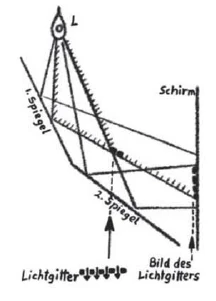
[ 16 ] You see, of course, the light falls down here, is reflected over here [toward the screen], and also falls on the second mirror, where it is reflected over here. So the light is on its way to the mirror, is reflected over here—that is always the path of light. But what actually happens? Well, let’s assume we have a light path like this here. Now it’s being reflected over here. But now the other light path comes along and intersects it. This is a phenomenon that cannot be denied. We have this light path here; but there comes the other one, which intersects it there. The two interfere with each other. One wants to zoom right through, while the other gets in the way. The result is this: When one beam tries to race through, it first extinguishes the light coming from the other direction; it extinguishes it. As it races through, it extinguishes the light. But because of this, we don’t get any brightness here [on the screen] at all; instead, darkness is actually reflected over here, so that we end up with darkness here [on the screen]. But the whole process isn’t static; it’s in constant motion. What has been disrupted here continues onward. So, as it were, a hole has been created in the light. After all, the light has rushed through, creating a hole. This appears dark. But as a result, the next light source will pass through all the more easily, and you’ll have an even brighter spot next to the darkness. The next thing that happens, in turn, is that as this process continues, another small cylinder of light from above strikes a patch of brightness, extinguishing it once more and creating darkness again. As this darkness moves on, the light can pass through even more easily. We are dealing with a progressive lattice of this kind, where the light coming from above can always pass through and, by extinguishing the light below, creates darkness, which, however, continues to advance. So here we must alternately obtain brightness and darkness as the upper light passes through the lower light, creating such a lattice.
[ 17 ] That is exactly what I asked you to think about. Because you need to understand how a light grid is formed. You get alternating areas of light and darkness when light rushes into light. When light rushes into light, that light is simply canceled out; it is transformed into darkness. We must therefore explain the formation of such a light grid by the arrangement we have created with these mirrors. You will always observe this phenomenon when you have a light source here whose speed of light is not a factor at all. With regard to the speed of light—and indeed, the variations in the speed of light that occur here—it is of no great significance. What I would like to demonstrate here is this: what occurs within the light itself, with the aid of the apparatus, is that the grid is reflected: bright, dark, bright, dark.
[ 18 ] But that physicist—it was Fresnel himself—who said to himself: If light is the emission of particles, then it goes without saying that when more particles are emitted, it must become brighter; otherwise, one particle would consume the other. So the simple emission theory cannot explain why brightness and darkness alternate. We have just seen how this can be explained. But now you see, it did not occur to the physicists to accept the phenomenon as it actually must be; rather, in connection with certain other phenomena, they sought an explanation in the spirit of materialism. The theory of bombarding particles of matter no longer held up. Therefore, it was said: Let us assume that light is not a flow of fine particles, but merely a movement within a fine substance—the ether—a movement in the ether. And at first, people imagined—Euler, for example—that light propagated through this ether much like sound does through the air. When I generate a sound, it propagates through the air, but in such a way that, initially, when the sound is generated here, the surrounding air is compressed. This creates a region of compressed air. The compressed air that forms here, in turn, exerts pressure on the surrounding area. It expands. As a result, however, it sporadically creates a region of rarefied air in the immediate vicinity. It is through such compressions and rarefactions—which are called waves—that we conceive of sound propagating. And so it was assumed that such waves were also generated in the ether. But certain phenomena did not fit this model, and so people concluded: Light is indeed a wave motion, but it does not oscillate in the same way as sound does. With sound, there is a compression here, followed by a rarefaction, and so on. These are longitudinal waves. So, the rarefaction follows the compression, and a body moving within it travels back and forth in the direction of propagation. This could not be imagined in the same way for light. In the case of light, when it propagates, the ether particles move perpendicular to the direction of propagation; so that when what is called a ray of light races through the air—a ray of light does indeed race at a speed of 300,000 kilometers—if we have the direction in which the light is racing, then the tiny particles are always oscillating perpendicular to it. When this oscillation reaches our eye, we perceive it.
[ 19 ] If you apply this to Fresnel’s experiment—as you can see here—when the light propagates in this way, it continues to oscillate there, like this, so that the motion of the light is actually a vertical oscillation relative to the direction in which the light propagates. Yes, this ray here, which is heading toward the lower mirror, would thus oscillate like this, continue on like this, and strike here. Now, as I said, this interference of the wave trains—you can look past that. They do not interfere with each other in the sense that these physicists think. But here [at the screen], they either interfere with each other immediately or reinforce each other. For what is supposed to happen here? Yes, isn’t it true that here [at the screen] it could be the case that, when this wave packet arrives here, the [one] tiniest particle here—which is oscillating vertically—just happens to be oscillating downward at the very moment the [other] one there is oscillating upward. Then they cancel each other out, and darkness would result. But if here [at the screen] this [one particle] is just swinging upward, and the other here is swinging [upward as well], and [if] the [one] particle here is just oscillating downward when the other is oscillating downward, or is oscillating upward when the other is oscillating upward, then brightness should result, so that the oscillations of the tiniest particles explain the same phenomenon here that we have explained from the light itself. I have said that here we have alternating bright and dark spots, but the modern so-called undulation theory explains them by the fact that light is a vibration of the ether; that here, when the smallest particles oscillate in such a way that they reinforce one another, a brighter spot arises, and when they oscillate in the opposite direction, a darker spot arises.
[ 20 ] You need only consider the difference between the pure perception of the phenomenon, remaining within the phenomena, following the phenomena, and presenting the phenomena—and [the act of] adding to the phenomena something that one has merely invented. For this entire motion of the ether is, after all, merely an invention. Of course, one can calculate something that one has invented. But the fact that one can calculate it is no proof that the thing actually exists. For what is merely phoronomic is simply a figment of the imagination, and what is calculable is also merely a figment of the imagination. You can see from this that, according to our fundamental way of thinking, we are dependent on explaining phenomena in such a way that they present themselves to us as explanations—that they contain the explanation within themselves—and I ask that you attach the greatest importance to this—that we must discard what is mere speculation. One can explain anything by adding something about which no one knows anything. These waves, for example, could of course be there, and it could be that when one oscillates downward and the other upward, they cancel each other out—but they were invented. What is definitely there, however, is this grid here, and we see this grid faithfully reflected here. One must look at the light if one wants to arrive at what is an unadulterated explanation.
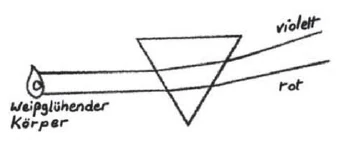
[ 21 ] A Body Glowing with Tears Now I have told you: When one light passes through another—when it enters into any kind of relationship with it at all—then, under certain circumstances, one light may have a dimming effect on the other, or even extinguish it, just as the prism itself has a dimming effect. This becomes particularly evident when one—and we will actually conduct this experiment—performs the following experiment. Look, I want to describe what this is all about: Let’s assume we have what I showed you yesterday; we actually have such a spectrum, produced directly by the sun; we have obtained such a spectrum ranging from violet to red. We could also produce such a spectrum not by allowing the sun’s light to pass through such a [circular] slit, but by placing a solid body here and heating it to incandescence. Then, as it gradually reaches white heat, we would also have the possibility of obtaining such a spectrum. It makes no difference whether a solar spectrum is present or whether the spectrum comes from a white-hot body.
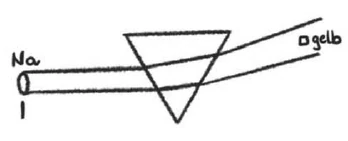
[ 22 ] But we can also produce a spectrum in a slightly modified way. Let’s assume we have a prism here and a sodium flame here—that is, a vaporizing metal: sodium. The gas becomes sodium. The gas burns, vaporizes, and we produce a spectrum from this vaporizing sodium. Something very peculiar happens here. If we produce the spectrum not from the sun or from a solid incandescent body, but from an incandescent gas, then a single line in the spectrum is very strongly pronounced, and specifically, sodium light takes on a particularly yellow hue. Here we have, don’t we, red, orange, and yellow. The yellow part is particularly pronounced in sodium. The rest of the spectrum is attenuated in metallic sodium—almost nonexistent. So, everything from violet to yellow and from yellow to red is attenuated. As a result, we appear to see a very narrow yellow band—what is called a yellow line. This arises because it is part of an entire spectrum. The rest of the spectrum is simply attenuated. In this way, one can find such spectra from a wide variety of substances—which are not actually spectra at all, but merely luminous lines. From this, you can see that, conversely, if you don’t know what’s actually in a flame and you produce such a spectrum, then if you get a yellow spectrum, there must be sodium in the flame. You can determine which metal you’re dealing with.
[ 23 ] But the peculiar thing that happens when you combine these two experiments—so that you create this cylinder of light here and the spectrum here, and at the same time introduce the sodium flame so that the incandescent sodium combines with the cylinder of light—is something very similar to what I showed you earlier in the Fresnel experiment. One might expect the yellow to appear particularly strongly here, because the yellow is already present; then the yellow from the sodium is added to it. But that is not the case; instead, the yellow from the sodium cancels out the other yellow, and a dark spot appears here. So, where one would expect a brighter spot to appear, a dark spot appears! Why is that? It depends solely on the force that is generated. Suppose the sodium light produced there were so selfless that it simply allowed the related yellow light to pass right through it; then it would have to cancel itself out completely. But it does not do that; instead, it stands in the way precisely at the spot where the yellow light should come through—it stands in the way. It is there, and even though it is yellow, it does not have a reinforcing effect, but rather an extinguishing one—even though it is yellow—because it simply stands in the way as a force, regardless of whether what stands in the way is something else or not. That makes no difference. The yellow part of the spectrum is extinguished. A black spot appears there.
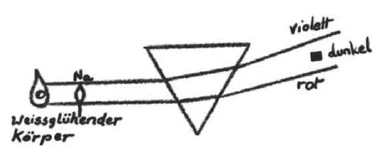
[ 24 ] As you can see, all one needs to do is consider what is actually there. The explanation reveals itself from the flooding light itself. These are precisely the things I would like to point out to you. You see, a physicist who explains things in the Newtonian sense would naturally have to say: If I have something white here—that is, a luminous strip—and I look through the prism at this luminous strip, it appears to me in such a way that I get a spectrum: red, orange, yellow, green, blue, dark blue, violet.
[ 25 ] Well, you see, Goethe said: Yes, I suppose it’s still possible, if need be. If nature really is such that it has composed light, then one could indeed assume that this light is actually broken down into its parts by the prism. Fine, but at the same time, the very same people who say that light consists of these seven colors as its parts also claim that darkness is nothing at all, merely the absence of light. Yes, but if I leave a black stripe here between the white—I have completely white paper and a black stripe here—and I look through the prism, I also get a rainbow, only its colors are arranged differently. There, violet [-purple] is in the middle and shifts toward the [bluish] on one side and toward the [yellowish-] greenish on the other. Then I get a spectrum arranged differently. But I would have to say, in the sense of the theory of decomposition: Black, too, is decomposable. So, I would have to admit that darkness is not merely the [absence] of light. Darkness must also be decomposable. But it must also consist of seven colors. That is what led Goethe astray—that he also saw the black stripe as seven-colored, just in a different arrangement. So that is what, in turn, compels us to simply accept the phenomena as they are.
[ 26 ] Well, we'll see if we'll be able to demonstrate to you tomorrow at 11:30 a.m. what I was unfortunately only able to explain to you in theory today.