

First Science Course
Light, Color, Sound, Mass, Electricity, Magnetism
GA 320
27 December 1919, Stuttgart
Translated by Steiner Online Library
Fifth Lecture
[ 1 ] My dear friends!
[ 2 ] Today we will begin by demonstrating to you, as best we can given our limited resources, the experiment we discussed yesterday. You probably remember: I said that when an incandescent solid emits light and we pass this light through a prism, we obtain a spectrum—a light pattern—similar to that of the sun. However, we also obtain [a spectrum] when we allow an incandescent gas to produce diffused light; but in this case, we obtain a light pattern that shows actual spectral lines or small bands of light only at one point—or, for certain substances, at several points. The rest of the spectrum is then diminished.
[ 3 ] If one were to undertake precise experiments, one would quickly notice that, in fact, every luminous object has a complete spectrum—that is, a spectrum extending from red into violet, so to speak. For example, if we produce a spectrum using glowing sodium gas, we obtain a very, very faint spectrum with a [stronger] yellow line at one point, which, due to its contrasting effect, also masks everything else. That is why it is said: Sodium produces only this yellow line.
[ 4 ] Now, the peculiar thing is that—essentially, this fact, although it had already been widely known earlier, was confirmed anew by the Kirchhoff-Bunsen experiment in 1859—it is peculiar that, if one allows, so to speak, the light source that produces the continuous spectrum to act simultaneously and that light source from which something like the sodium line originates, to act simultaneously, so to speak, that this sodium line then simply acts like an opaque body, directly opposing the color that would be present at that point—in this case, yellow—and extinguishing it, so that instead of yellow, one has a black line there. So, what one can say, if one sticks to the facts, is that for the yellow in the spectrum, another yellow—which must be at least equal in intensity to the intensity currently developing at that point—acts like an opaque body. You will see that the elements we are putting together will already provide a basis for understanding. For now, we must simply stick to the facts.
[ 5 ] Well, we’ll do our best to show you that this black line is indeed present in the spectrum when we turn on the glowing sodium. However, we can’t conduct the experiment by capturing the spectrum; instead, we’ll observe the spectrum by looking at it with our eyes. You can also see the spectrum this way, but instead of being shifted upward, it’s shifted downward, and the colors are reversed. We’ve already discussed why these colors appear this way when I simply look through the prism. We generate the light cylinder from this apparatus, let it pass through here, and look at it here [the refracted light cylinder]; so, at the same time as we look at it, we see the black sodium line. I hope it will become clear to you; but you [must] approach it and look inside in the strictest military order—which shouldn’t be too difficult in Germany these days. (The experiment is demonstrated to each individual.)
[ 6 ] Well, my dear friends, let us make the most of the little time we have left. We must now turn to examining the relationship between colors and what are called “bodies.” Don’t you think that, in order to address the problem of exploring the relationships between colors and these so-called “bodies,” I should show you the following? You can now see the complete spectrum projected onto the screen. I will now place a small trough containing carbon disulfide—in which some iodine has been dissolved—in the path of the light cylinder, and I ask you to observe the resulting change in the spectrum—well, you see, I only wanted it to let a little light through at the edges [of the spectrum]; in any case, what you see is that you have a clear spectrum here, and when I place the iodine solution in carbon disulfide in the path of the light cylinder, it completely blocks the light. Now you can clearly see the spectrum split into its two parts because the middle part has been blocked. So, you see only the violet on one side and the reddish-yellow on the other. In this way, by passing the light through the solution of iodine in carbon disulfide, you see the complete spectrum split into two parts, and you see only the two extremes.
[ 7 ] However, I’ve now lost a lot of time, and I’ll only be able to tell you a few general points. Isn’t it true that the main question regarding the relationship of colors to the objects we see around us—and all objects are, in a certain sense, colored—must be to explain how it is that the objects around us appear colored to us, that is, that they have a certain relationship to light on their part, developing a relationship to light, so to speak, through their material existence. One object appears red, another blue, and so on. Of course, the simplest way to explain this is to say: When colorless sunlight—which physicists understand to be a combination of all colors—falls on an object that appears red, this is because that object absorbs all other colors except red and reflects only that red. It is also easy to explain how an object is blue. It simply absorbs all other colors and reflects only blue. The task now is to rule out such a speculative principle of explanation altogether and to approach the apparently somewhat complicated fact of seeing so-called colored objects by stringing together one fact after another, in order to capture what presents itself as the most complex phenomenon.
[ 8 ] Now, the following leads us on our way. We recall that as early as the seventeenth century, when people were still deeply involved in alchemy, there was talk of the so-called phosphors, the bearers of light. At that time, “phosphors” were understood to mean the following. For example, a shoemaker in Bologna conducted alchemical experiments with a type of barite, the so-called Bolognese stone. He exposed it to light, and a curious phenomenon occurred: when he exposed this stone to light, it subsequently glowed for a time in a certain color. So, the Bolognese stone had developed a relationship with light, and this relationship was expressed by the fact that, after being exposed to light—and even after the light had been removed—it continued to glow. That is why such stones, which had been studied in various ways in this context, were called “phosphors.” So if you come across the term “phosphorus” in the literature of that time, you should not understand it to mean what is understood by it today, but rather such phosphorescent bodies, bearers of light—phosphors. Now, however, this phenomenon of afterglow, of phosphorescence, is actually no longer the simplest one; rather, the simplest phenomenon is a different one.
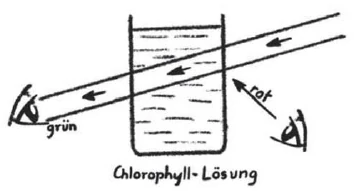
[ 9 ] If you take ordinary kerosene and look through it at a light source, the kerosene appears faintly yellow. But if you position yourself so that you let the light pass through the kerosene and look at it from behind, the kerosene appears to glow bluish—but only as long as the light falls on it. You can perform this experiment with various other substances. It becomes particularly interesting when you dissolve chlorophyll, the green pigment in plants. If you look through such a solution into the light, it appears green; but if you position yourself, so to speak, from behind—so that the solution is here and the passing light is here—and you now look from behind at the spot where the light passes through, then the chlorophyll glows back with a reddish, red hue, just as the kerosene glows blue. There are now a wide variety of substances that demonstrate in this way that they glow differently when they, so to speak, reflect light back from themselves—that is, when they have entered into a relationship with the light that has been altered by their own nature—as opposed to when light passes through them as it would through a transparent substance. When we look at chlorophyll from behind [against a dark background], we see, so to speak, what the light has brought about in the chlorophyll—the relationship between the light and the chlorophyll. This phenomenon of a substance glowing with a light while being illuminated by that light is called fluorescence. And we can say: What exactly is phosphorescence? It is simply fluorescence that persists. Fluorescence consists in the fact that, for example, chlorophyll appears reddish as long as light acts upon it; with phosphorescence, we can remove the light, and, for example, barite continues to glow for a little while. So, it retains this property of colored luminescence, whereas with chlorophyll, the property of colored luminescence is not retained. Now you have two stages: one is fluorescence—we make a substance glow as long as we illuminate it—and the second stage is phosphorescence—we make a substance continue to glow for a certain time afterward. And now there is a third stage: the object appears to be permanently colored by whatever effect the light has on it—fluorescence, phosphorescence, or the object’s inherent color!
[ 10 ] So, in a sense, we have placed these phenomena side by side. The only thing left to do now is to approach these phenomena in an appropriate way using our concepts. To do this, it is necessary for you to take in a certain concept today, which we will then process together with everything else in the next class.
[ 11 ] Look—but I ask you now, once again, to think only about what I am presenting to you, and to think as precisely and accurately as possible—I remind you—we have already mentioned it—of the formula [for] \(v\), the velocity. Any velocity—whatever moves quickly—is expressed, as you know, by \(s\), the distance traveled by the moving object, divided by time [\(t\)], so that the formula is: \(v=\frac{s}{t}\). Now, the view is that somewhere in nature there is a distance \(s\) traveled, a time during which that distance was traveled, and then one divides the actual spatial distance \(s\) by the actual time to obtain the velocity, which is actually regarded not as something very real, but rather as a function [of space and time], as something that is obtained as a result of a calculation.
[ 12 ] That is not how it is in nature. Of these three quantities—speed, space, and time—speed is the only truly real one, the only actual one. That which exists outside of us is speed; the others, \(s\) and \(t\), we obtain only by, so to speak, dividing the unified \(v\) into two abstract entities that we construct on the basis of existing speed. We proceed, so to speak, as follows: We see a so-called body flying through space at a certain speed. The fact that it has this speed is the only thing that is real. But now, instead of considering this totality of speed—the rapidly flying body—we think in terms of two abstractions; we divide what is a unity into two abstractions. Because a velocity exists, a certain path exists. We consider this first. Then, as a separate second step, we consider the time during which this path is traversed, and through our process of perception we have extracted space and time from the velocity, which is the only thing that actually exists. But this space exists in no other way than as created by the velocity, and time is no different. Space and time, in relation to this reality to which we attribute v, are not realities; they are abstractions that we form precisely from the velocity. And we can only come to terms, my dear friends, with external reality if we are clear that we have created this duality—space and time—in our process of perception; that, apart from ourselves, the only thing that is real is speed; and that we have created space and time for our own sake through the two abstractions into which speed can be broken down.
[ 13 ] We can separate ourselves from speed, but we cannot separate ourselves from space and time; they are inherent in our perception, in our act of perceiving—we are one with space and time! What I am saying now has far-reaching implications: We are one with space and time! Consider this! We are not one with external speed, but with space and time. Yes, that with which we are one—we should not simply attribute it to external bodies, but rather use it only to arrive at a conception of external bodies in an appropriate way. We should say: Through space and time, with which we are intimately connected, we learn to recognize speed, but we should not say: “The body travels a distance,” but only: “The body has a speed.” Nor should we say: “The body takes a certain amount of time,” but only: “The body has a speed.” We measure velocity through space and time. Space and time are our instruments, and they are bound to us—and that is what is important. Here, once again, you can see a sharp distinction between what is called the “subjective”—namely, space and time—and the “objective,” which is velocity. It will be very helpful, my dear friends, if you make this point very, very clear to yourselves, for then something will dawn on you inwardly, it will become clear to you that v is not merely the quotient of s and t, but that, numerically speaking, v is indeed expressed by the quotient of \(s\) and \(t\); yet what I am expressing numerically here is, in its essence, a real entity whose nature consists in having a velocity. What I have shown you here regarding space and time—that they are not at all separable from us, that we must not separate ourselves from them—now applies to something else as well.
[ 14 ] My dear friends, there is still a great deal of “Königsbergism” in people—by which I mean Kantianism. This “Königsbergism” must be completely eradicated. For someone might believe that I myself have now spoken in this way, in the spirit of “Königsbergism.” That would imply: Space and time are within us. But I do not say: Space and time are within us; rather: In perceiving the objective—velocity—we use space and time for perception. Space and time are simultaneously within us and outside of us, but we connect with space and time, whereas we do not connect with velocity. It races past us. So, this is something fundamentally different from the Kantian-Königsbergian view.
[ 15 ] Now, the same applies to something else I said about space and time. Just as we are connected to objectivity through space and time—though we must first seek out this speed—so too are we immersed in an element along with the so-called bodies, in that we see them through light. We may speak of an “objectivity” of light just as little as we may speak of an “objectivity” of space and time. We swim in space and time just as bodies swim within them at a certain speed. We swim in light just as bodies swim in light. Light is a common element between us and that which exists outside of us as so-called bodies. Yes, so you can imagine: When you have gradually illuminated the darkness with light, space fills with something—let’s call it x for the sake of argument—something in which you are contained, and in which that which is outside of you is also contained. A shared element in which you and the elements swim. We must now ask ourselves: How do we actually manage to float there in the light? We cannot float within it with our so-called physical body, but we do in fact float within it with our etheric body. No true understanding of light can be achieved unless one turns to the realities. We swim within the light with our etheric body—call it “light ether” if you like; that’s not the point. So, we swim within the light with our etheric body.
[ 16 ] Over time, we have seen how colors arise in the light in a wide variety of ways. Colors arise in the light in a wide variety of ways, and in turn, colors arise in—or exist within—what are called “bodies.” In a sense, we see the ghostly colors that arise and fade in the light. When I cast just a spectrum, it is like ghosts; it flits about in space, so to speak. We see such colors in the light. Yes, my dear friends, what is it like there? We float within the light with our etheric bodies. How do we relate to the colors that flit about there? It is no different than when we are there inside with our astral body; there we are connected to the colors through our astral body. My dear friends, you have no choice but to be clear about this: wherever you see colors, you are connected to them through your astral nature. To arrive at a true understanding, you have no other option but to tell yourselves: While light actually remains invisible, we are immersed in it. Just as space and time should not be called “objectivities” because we are immersed in them, so too should we regard light as a shared element, but colors only as something that can emerge solely through our astral body’s interaction with what the light is doing there.
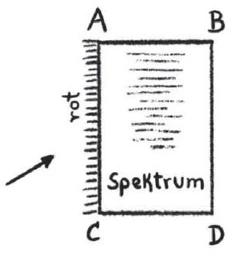
[ 17 ] But now suppose you have somehow produced some kind of color phenomenon—a spectrum or something similar—in this space here, \(A-B-C-D\), but a phenomenon that occurs only in the light. In that case, you must resort to an astral relationship to the light. But you could also, for example, have colored this surface here, so that, in a sense, \(A-C\) appears to you as a solid—let’s say—red. We say: \(A-C\) is red. There you look toward the surface of the solid and initially imagine, roughly speaking: Beneath the surface of the solid, it is red all the way through. You see, that is something different. Here, too, you have an astral relationship, but you are separated from this astral relationship—which you enter into with the color—by the surface of the body. Please take this to heart! You see colors in the light—spectral colors—and you have astral relationships of a direct nature; nothing stands between you and these colors. You see the colors of the body; something stands between you and your astral body, and through this “something” you nevertheless enter into astral relationships with the colors of the body. I ask you to take these things deeply to heart and think them through carefully; for these are important fundamental concepts that we will be working through. And through this alone will we acquire the fundamental concepts for a true physics.
[ 18 ] I’d just like to mention one last thing: You see, I’m not trying to lecture you here on things you can easily find out for yourself by buying any textbook. Nor do I intend to present to you what you can read in Goethe’s *Theory of Colors*, but rather what you cannot find in either of them—and yet through which both can lead you spiritually in their own way. Even if we are not followers of physics, we certainly do not need to become followers of Goethe either; for Goethe died in 1832, and we do not profess a Goetheanism from the year 1832, but rather one from the year 1919—that is, a further-developed Goetheanism. I would ask you to give special thought to what I have told you today about the astral relationship.