

First Science Course
Light, Color, Sound, Mass, Electricity, Magnetism
GA 320
29 December 1919, Stuttgart
Translated by Steiner Online Library
Sixth Lecture
[ 1 ] My dear friends!
[ 2 ] Today I would like to continue exploring the fundamental principles we began discussing the day before yesterday, because, if we proceed from the insights gained from light, we will be able to further observe and understand the phenomena that may arise in the other natural phenomena we still intend to examine. I will therefore include a more fundamental discussion today and postpone the experimental part until tomorrow, because we still need to determine more precisely the manner in which we intend to proceed methodically. The point is really to ensure that we accurately capture what is factually present in natural phenomena. And to pursue this, light actually provides the most clues.
[ 3 ] Historically speaking, it was only relatively late that people began to study light phenomena. In fact, the entire way of thinking about physics, as it is taught in our schools today, dates back barely beyond the sixteenth century. The way of thinking about physical phenomena was, in fact, radically different before the sixteenth century. Today, however, this way of thinking is so strongly instilled in schools that it becomes, in turn, extraordinarily difficult for anyone who has gone through a certain kind of physics education to return to what is purely factual. One must first get used to feeling and sensing the purely factual—I would like to say, and I ask that you not take this expression merely at face value—the purely factual. That is what one must actually get used to first. Therefore, I would like to begin by comparing the familiar academic way of thinking in a specific case with what one can actually gain through a proper pursuit of reality. I will start with a single case.
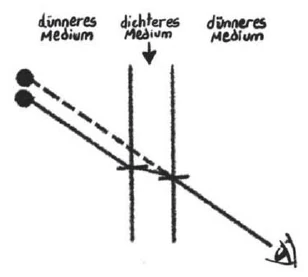
[ 4 ] Suppose you had a cross-section of some glass plate here. Through this glass plate, you would observe something luminous here. I’ll draw a schematic diagram of this; instead of this light source, let’s just draw, say, a luminous circle here. Now, if you think back to your school days, you’ll recall what you actually learned about observing this point through the eye—about this phenomenon. You were told that rays, so to speak, emanated from this light source. Let’s consider a specific direction of the eye. Rays emanated from this light source; that is, in the direction of this ray, the light—as they say—passes from a less dense medium into a denser one. One can observe—by simply looking through the plate and then comparing what appears after looking through it with what is there initially—that the luminous object is shifted and appears in a different location than it does when viewed without the plate. Now it is said that this is due to the fact that the light is refracted. It is said: As the light enters from a less dense medium into a more dense one, in order to determine the direction in which the light is refracted, one must draw a so-called incident perpendicular; and then, if the light were to continue on its path otherwise, without being obstructed by such a more dense medium, it would indeed travel in this [dashed] direction; but the light is refracted [upon entering the denser medium], as they say, and in this case refracted relative to the incident perpendicular—that is, the vertical line drawn at the point of incidence. And when the light emerges again—that is, if one traces the path of the light ray as it passes through the denser medium—one would again have to say: Here, too, a line of incidence must be drawn; here, the ray would travel in this direction if it were to continue on its path; but now it is refracted again, in this case away from the line of incidence, and to such an extent that its direction is now parallel to the previous one. If the eye now looks in this way, it extends the last direction and shifts the luminous object a certain distance higher up, so that, when looking through it in this manner, one must assume: Here the light enters, is refracted twice—once toward the line of incidence, the other time away from it—and because the eye possesses the inner capacity—or the soul, or some demon, as one might say— the light is displaced out into space, and specifically to a different point in space than it would appear if one were not viewing it through a refracting medium, as they say.
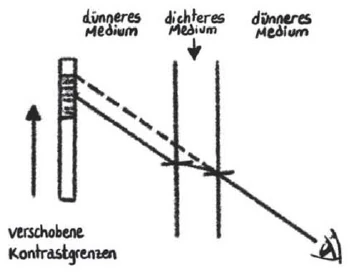
[ 5 ] Now, however, the point is to note the following. You see, if one tries the following—if one tries to make a slight distinction between a somewhat, shall we say, lighter area and a somewhat darker area—and views this through the same denser medium, one will not merely find the lighter area shifted upward, but one will also find the somewhat darker area shifted upward. You will find that the entire complex you see here has been shifted. Please take careful note of this. Here we see a darker area—bounded by a lighter one—that has been shifted; we see the darker area shifted upward, and because it has a lighter end, we see that end shifted upward as well. You see, when you present such a complex—a darker area and a lighter one—you must say: In reality, only the lighter area is shifted as the upper boundary. However, when one abstracts a bright spot, one often speaks as if only this bright spot were being shifted. But that is nonsense. Moreover, even when I look at this bright spot here, it is not true that only it is being shifted; in reality, what I call “nothingness” down below is also being shifted upward.
[ 6 ] What is displaced is never anything that I can define in such abstract terms. So when I conduct the experiment that Newton did—when I allow a beam of light to pass through a prism and it is deflected—it is not true that only the beam of light is displaced; rather, that which is bounded by the beam of light from top to bottom is also displaced along with it. I should never speak of any light rays or the like, but rather of displaced light images or light spaces. And if I want to speak of an isolated light somewhere, I cannot speak of it in such a way that I relate anything in theory to this isolated light; rather, I must speak in such a way that I simultaneously relate what I say to what adjoins it.
[ 7 ] Only by thinking this way can one truly sense what is actually happening when faced with the emergence of color phenomena. Otherwise, one’s way of thinking simply gives the impression that colors somehow arise from the light. One has already convinced oneself that one is dealing only with light. In reality, one is not dealing with light, but with something bright that is bordered on one side or the other by darkness. And just as this brightness is displaced as spatial light, so too is the darkness displaced. But what is this darkness, what is it actually? You see, this darkness must also be grasped as something entirely real. And everything that has found its way into modern physics since about the sixteenth century could only do so because people never observed things spiritually at the same time; because they always observed things solely according to their outward sensory appearance and then devised all sorts of theories to explain this sensory appearance.
[ 8 ] You certainly cannot deny that when you look at light, sometimes it is brighter and sometimes it is dimmer. There is such a thing as brighter and dimmer light. The question now is to understand how this light—which can be brighter or dimmer—actually relates to darkness. The average physicist today thinks that there is stronger and weaker light—all possible degrees of light intensity—but only one kind of darkness, which simply exists when the light is not there. So black is all the same. Just as there is not just one kind of brightness, there is not just one kind of darkness either, and to speak of there being only one kind of darkness is as one-sided as saying: I know four people. One of them has a fortune of five hundred marks, the other a fortune of one thousand marks. So one has a larger fortune than the other. The third, however, has five hundred marks in debt, and the fourth has a thousand marks in debt. But why should I worry any further about this difference? After all, it amounts to the same thing. Both are simply in debt. I want to distinguish between degrees of wealth, but I don’t want to distinguish between degrees of debt—debt is simply debt. In this case, the difference is obvious because the impact of five hundred marks in debt is less than that of a thousand marks in debt. When it comes to darkness, however, people think this way: light has different degrees of brightness, but darkness is simply darkness. It is precisely this failure to advance to qualitative thinking that so greatly hinders us from finding the bridge between the soul-spiritual [on the one hand] and the physical on the other. If a room is filled with light, it is filled with light of a certain intensity; if a room is filled with darkness, it is filled with darkness of a certain intensity; and we must move from the merely abstract room to the room that is not abstract, but is positively filled in some way by light or negatively filled by darkness. One can thus stand before a space filled with light and describe it as qualitatively positive. One can stand before a space filled with dark serenity and find it to be qualitatively negative with respect to the lighting conditions. Both, however, can be described in terms of a specific degree of intensity, a specific strength.
[ 9 ] But now, if one asks: Yes, how does this positive filling of space differ, as far as our perception is concerned, from the negative filling of space? — This positive filling of space—we need only recall what it is like when we wake up, surrounded by light, uniting our subjective experience with that which floods us as light— we need only compare this sensation with what we feel when we are surrounded by darkness, and we will find—I ask you now to take this very carefully into account, both visually and intellectually— we will have to realize that, purely in terms of sensation, there is a difference between surrendering to a space filled with light and surrendering to a space filled with dark serenity. Now, one can only approach these things through comparisons.
[ 10 ] You see, one can compare that sensation one has when one finds oneself in a room filled with light; one can compare it to a kind of absorption of the light by our spiritual being. We do, after all, feel enriched when we are in a room filled with light. It is a kind of absorption of light. But what about darkness? There, the sensation is exactly the opposite. Darkness draws us in; it drains us; we must surrender to it; we must give something of ourselves to it. So that we can say: The effect of light on us is one of communication; the effect of darkness on us is actually one of absorption. And so we must also distinguish between light and dark colors. The lighter colors have something that radiates toward us, that communicates with us; the darker colors have something that draws us in, to which we must surrender. This leads us to say: Something from the outside world communicates with us through the effect of light; something is taken from us—we are drained—through the effect of darkness.
[ 11 ] As I have already pointed out to you in the lectures, in a certain sense we are also, in other ways, drained of our consciousness when we fall asleep. That is where our consciousness ceases. It is a very similar phenomenon of the cessation of our consciousness when we move from the ever-brighter colors toward the darker colors, toward blue and violet. And if you recall what I have told you in recent days about the relationship between our soul and matter, if you recall this sinking into matter, this absorption of consciousness by matter, then you will experience something similar through the absorption of consciousness by darkness, and you will discover the inner kinship between the darkness of space and that other fullness of space which is called matter and which manifests as mass—that is to say, we will have to seek the path from the light phenomena directly to the phenomena of material existence, and we have already paved the way by first seeking out, as it were, the fleeting light phenomena of phosphorescence and fluorescence, and then the stable light phenomena. In the stable light phenomena, we find enduring colors. We cannot consider these things individually; let us first set the entire complex of things before us.
[ 12 ] Now we must consider the following. You see, when one is in a room filled with light, one becomes, in a certain sense, one with that light-filled room. One could say: Something within us floats out into this light-filled space and unites with it. But one need only reflect a little on what is [truly] substantial, and one will find a great difference between this unity with the immediate, light-flooded surroundings and the other kind of unity that we as human beings also experience—namely, our unity with the thermal state of our surroundings. We participate in this thermal state of our surroundings; we participate in it by also perceiving something like a polarity within this thermal state—the warm and the cold. Yet we cannot help but perceive a difference between how we feel within the thermal state of our surroundings and how we feel within the luminous state of our surroundings. Not only has this distinction been completely lost in modern physics since the sixteenth century—one might say that not only has the impartiality in distinguishing between the experience of light and the experience of heat been lost—but efforts have been made to blur such distinctions in one way or another. Anyone who truly takes this difference into account—which is, in fact, quite simply given—between the experience of the thermal state and the experience of the light state of the environment, will ultimately have no choice but to distinguish that we participate in the thermal state with our physical body and in the light state precisely with our etheric body.
[ 13 ] The confusion between what we perceive through our etheric body and what we perceive through our physical body has become a particularly serious problem for modern physics since the sixteenth century, and as a result, everything has gradually become blurred. For you see, people have forgotten—especially since physics gradually came under Newton’s influence, which is actually still effective today—how to state facts directly. Individual people have, of course, tried once again to point to the immediacy of the facts: Goethe on a grand scale, and people such as Kirchhoff, for example, in a more theoretical way. But on the whole, we have actually forgotten how to focus our attention purely on the facts themselves. And so, for example, in the spirit of Newton, we have interpreted the fact that material bodies located near other material bodies fall toward those other material bodies under certain conditions. This was attributed to a force emanating from one body and acting upon the other—gravity. But no matter how much you think about it, you will never be able to classify what is understood by the term “gravity” as a factual occurrence. When a stone falls toward the Earth, the fact is simply that it is approaching the Earth. You see it in one place, then in a second place, in a third place, and so on. When you say, “The Earth attracts the stone,” you are adding something to the fact; you are no longer describing the phenomenon purely. People have increasingly lost the habit of describing the phenomenon purely; but it is essential to describe the phenomenon purely. For, you see, if one does not describe the phenomena purely but instead resorts to imagined explanations, then one can find a wide variety of imagined explanations that often explain the same thing.

[ 14 ] So suppose you have two—for the sake of argument—celestial bodies; you can say: These two celestial bodies attract each other; they emit something unknown, like a force, into space and attract each other. But you don’t need to say: “These bodies attract each other,” but rather you must tell yourself: “Here is one body, here is the other body, here are many other tiny bodies—let’s say even ether particles—in between as well; these ether particles are in motion, bombarding the two celestial bodies—some flying this way, some that way—and whatever is in between flies back and forth and bombards them as well.”
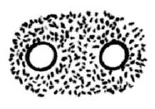
[ 15 ] Now, the target area here [out there] is larger than the one there [in between] inside. Therefore, there is less bombing inside and more bombing outside. The result of this is that the celestial bodies are drawing closer to one another; they are being pushed against each other by the difference between the number of impacts occurring inside and the number of impacts occurring outside.
[ 16 ] There have been people who explained gravity by saying: “There is a force acting at a distance that attracts bodies”—and there have been people who said: “That’s nonsense. It is completely unthinkable to assume that a force can act at a distance.” So, let’s assume that space is filled with ether, and let’s add this bombardment to the picture—then the masses are jostled against one another. In addition to these explanations, there are all sorts of other explanations. This is just a prime example of how, today, people do not look at the actual phenomenon, but instead conjure up all kinds of explanations. But what actually underlies this? Well, you see, this act of imagining all sorts of unknown agents—illusory energies that do all sorts of things—saves one some trouble. Of course, what is theorized here as “impulses” is just as much a figment of the imagination as what is theorized as “remote forces.” But this act of imagining spares one from having to accept an assumption that is terribly uncomfortable for people today. For you see, it is always the case that one must ask: if there are two independent celestial bodies approaching one another—which demonstrate that approaching one another is part of their very nature—then there must be something underlying that causes the approach. There must be some reason for the approach.
[ 17 ] It is simpler to assume the existence of forces than to tell oneself that there is another way—namely, the way of not conceiving the celestial bodies as independent of one another. For example, when I place my hand on my forehead, it would not occur to me to say, “My forehead attracts my hand,” but rather I would say, “This is an inner act carried out by what underlies it psychologically and spiritually.” My hand is simply not independent of my forehead; the hand and the forehead are not actually two separate things. I can only come to view the matter correctly when I consider myself as a whole. I am not really observing reality if I were to go around saying: “There is a head, there are two arms with hands attached to them, there is a torso, there are two legs.” No, that is not a complete view; rather, a complete view is when I describe to Dr. Steiner his unified organism, when I describe things in such a way that they fit together—that is to say, my task is not merely to describe what I see, but to reflect on the reality of what I see. The mere fact that I see something does not make it real.
[ 18 ] Since I have often alluded to such things in other lectures as well, I have repeatedly said the following: Take a cube of rock salt. In a certain sense, it is a whole—everything is, in a certain sense, a whole. It can exist through the complex of what it is within its six faces. But when you look at a rose that you have cut off, that rose is not a whole; for it cannot exist in the same way through the totality of what is within it as the rock salt cube does, but the rose can only exist by being on the rosebush. Therefore, the cut rose—even though you perceive it just as clearly as the rock salt cube—is a real abstraction; it is something that cannot be regarded as reality in and of itself. From this follows something extraordinarily significant, my dear friends; it follows that we must examine every phenomenon to determine to what extent it is a reality or to what extent it is merely something cut out from a whole. If you consider the sun and the moon, or the sun and the earth, in isolation, you can of course just as easily invent a gravitational force as you can invent a gravitational force that causes my forehead to attract my right hand. But when you consider the sun, the earth, and the moon, you are considering things that are not a whole in themselves, but rather the components of the entire planetary system.
[ 19 ] You see, the most important thing is to observe to what extent something is a whole or has been cut out of a whole. Countless errors—which are actually entirely mistaken—arise from regarding what is merely a partial manifestation within another as a whole. But you see, by focusing on these partial manifestations and by inventing energies, people have spared themselves the task of observing the life of the planetary system. In other words, they have sought to regard that which is a part of nature as a whole, and then to allow all the resulting effects to arise simply through theories.
[ 20 ] I would like to summarize for you what is actually at issue here with the following. You see, it is essential that, with regard to everything we encounter in nature, we ask ourselves: To what whole does it belong, or is it itself a whole? — And ultimately, we will find wholes only in a certain sense, for even a cube of rock salt is a whole only in a certain sense; it, too, cannot exist without a certain temperature or other conditions being present. At a different temperature, it could not exist. In fact, we are constantly faced with the need not to view nature in such a fragmented way as is commonly done.
[ 21 ] Well, you see, it is precisely by viewing nature in such a fragmented way that, since the sixteenth century, we have come to construct that strange concept known as universal, inorganic, lifeless nature. This inorganic, lifeless nature does not actually exist any more than your skeletal system exists without your—let’s say—circulatory system. Just as the skeletal system emerges only from the rest of your organism, so there is no such thing as so-called inorganic nature without the underlying whole of nature, without the soul and spirit. This lifeless nature is the isolated skeletal system of the whole of nature, and it is impossible to consider inorganic nature in and of itself, as one has begun to do since the sixteenth century in Newtonian physics. But this Newtonian physics set out to isolate this so-called inorganic nature in such a pure form. This exists as inorganic nature only when we ourselves build machines, when we ourselves assemble something from the parts of nature. But this is radically different from how the so-called inorganic exists within nature itself. There is only one truly inorganic thing: our machines—and that is only insofar as we assemble them by combining the forces of nature. In fact, only the assembled part of it is inorganic. Any other form of the inorganic exists only as an abstraction. Yet modern physics arose from this abstraction. It is nothing more than an abstraction that regards what it has abstracted as reality, and that then seeks to explain everything that presents itself to it in accordance with its theoretical assumptions.
[ 22 ] Now, you see, in reality, one really has no choice but to form one’s concepts and ideas based on what is given externally in the sensory world. Now, for one area of phenomena—I would say—there is an extremely convenient fact: If you ring a bell and bring some light, movable device near the bell, you can use it to demonstrate that this bell, which is ringing, also vibrates in its parts. If one takes the sound of a bell or a whistle tube, one can demonstrate that the air within the tube vibrates, and from the movement of the air or bell particles, one can establish a connection—for the phenomena of sound—between the vibrations produced by a body or by the air and the perception of the sound. In this field of phenomena, it is, so to speak, self-evident that we are dealing with vibrations in our surroundings when we hear sounds. We can say to ourselves: Without the air in our surroundings vibrating, we would not hear any sounds. There is therefore a connection—which we will discuss further tomorrow—between the vibrations of the air and the sounds.
[ 23 ] Now, if we take a completely abstract approach, we can say: We perceive sound through the organs of hearing. Air vibrations strike the organs of hearing. When they strike, we perceive the sound. And now, since the eye is also a sensory organ, we can perceive colors through the eye and say: There must be something similar at work here, so something vibrating must also be striking the eye. But it cannot be the air; that becomes clear very quickly. So it must be the ether. So, one forms—I would say—the concept through a pure exercise in analogy: When the air strikes our ear and we perceive a sound, there is a connection between the vibrating air and the perception of sound. When the hypothetical ether strikes our eye with its vibrations, a perception of light is conveyed in a similar way through this vibrating ether. How this ether vibrates is what we seek to determine through phenomena such as those we have come to know experimentally in these lectures. That is to say, we conceive of an etheric world and calculate how things should proceed within this sea of ether. We calculate something that relates to some entity which, of course, we cannot perceive, but can only assume theoretically.
[ 24 ] Now, as you have already seen from the minor details we have gone through experimentally, what takes place within the world of light is something extraordinarily complex, and up until certain periods in the recent development of physics, it was assumed that behind all of this—or rather, within all of this, one might say—what manifests itself as the world of light, as the world of colors, there is a vibrating ether, a fine, elastic substance. Since the laws governing how elastic bodies collide with and repel one another are easily understood, one can calculate what these tiny vibrating sprites are doing in the ether by simply regarding them as small elastic bodies, by conceiving of the ether, so to speak, as something inherently elastic. This approach can lead to explanations of the phenomena we demonstrated when we produced a spectrum. It is simply a matter of separating out different types of ether vibrations, which then appear to us as different colors. Through certain calculations, one can also come to understand—for example—the extinction of the sodium line that we demonstrated the day before yesterday as arising from the elasticity of the ether. Recently, however, other phenomena have been added to these. One can construct a light spectrum, extinguish or produce the sodium line within it—as you wish—produce the black line, and then, having created this entire complex, one can also allow the electromagnet to act upon the light cylinder in a certain way, and lo and behold, the electromagnet exerts an effect on the light phenomenon. The sodium line is extinguished in its place, and two others, for example, arise—purely through the action of electricity, which is always linked to magnetic effects. Thus, there is an effect of what we have been taught to describe as electrical forces on those processes that are observed as light phenomena and behind which one conceives of the mere [mechanically conceived] elastic ether. The fact that the effect of electricity on these light phenomena had been observed led to the assumption of a relationship between light phenomena and magneto-electric phenomena. This has caused a bit of a stir in recent times. In the past, one could rest easy because this interaction had not yet been observed. But now one had to admit: The one must have something to do with the other. — This has led to a large number of physicists currently seeing an electromagnetic effect in what propagates as light—that what actually travels through space are electromagnetic rays.
[ 25 ] Now imagine what happened there. Here’s what happened: It used to be assumed that we knew what lay behind the phenomena of light and color: vibrations, undulations in the [mechanically conceived] elastic ether. Now, as a result of our understanding of the interactions between light and electricity, we have come to the conclusion that what is actually oscillating must be regarded as electricity—as radiating electricity. Please understand this point very clearly!
[ 26 ] People wanted to explain light and colors. These were attributed to oscillations in the ether. Something was moving through space. At that time, people believed they knew what light actually was—oscillations of the elastic ether. Now it became necessary to say: But what these vibrations of the elastic ether are, are electromagnetism. Now we know even more precisely than before what light is. It consists of electromagnetism; only we do not know what this electromagnetism is. So we have taken the elegant path of adopting a hypothesis to explain the sensible world through the unknown supersensible realm of the undulating ether. Little by little, one has been forced to trace this “super-sensible” back to something “sensible,” while at the same time admitting that one does not know what that actually is. It is indeed a highly interesting path that has been taken—from a hypothetical search for the unknown to the explanation of this unknown through another unknown. The physicist Kirchhoff actually exclaimed in horror: If these recent phenomena make it impossible to continue believing in the ether and its vibrations, then that is no benefit to physics; and Helmholtz, for example, when he became acquainted with these phenomena, said: “Well, of course one cannot avoid regarding light as a kind of electromagnetic radiation, and then one must simply trace this back to the vibrations of the elastic ether.” Ultimately, that is how it will turn out. — The essential point is that a genuine undulatory phenomenon—the oscillation of the air when we perceive sounds—has been transferred, purely by analogy, into a realm where the entire assumption is, in fact, entirely hypothetical.
[ 27 ] I had to present this discussion of principles to you so that we can now quickly go through the most important aspects of the phenomena we intend to examine. In the remaining sessions, now that we have established this foundation, I plan to discuss with you the phenomena of sound, heat, and electromagnetism, as well as how these phenomena, in turn, point back to the optical phenomena.