

First Science Course
Light, Color, Sound, Mass, Electricity, Magnetism
GA 320
30 December 1919, Stuttgart
Translated by Steiner Online Library
Seventh Lecture
[ 1 ] My dear friends!
[ 2 ] Today we’d like to begin with an experiment that is intended to build on our previous reflections on the theory of colors. As I said, it is entirely possible that I will present you with improvised, aphoristic remarks in these lectures. For this reason, I must also avoid the usual categories that you find in physics textbooks. I do not mean to say that it would be better if I could adhere to these categories; rather, I would like to ultimately guide you toward a specific scientific insight, and you should regard everything I present beforehand as a kind of preparation—not one that proceeds in a straight line, as is usually the case, but one in which we gather the phenomena we need, create a circle, so to speak, and then move toward the center.
[ 3 ] You have seen that when colors arise, we are dealing with an interplay of light and darkness. The task now is to observe as many real phenomena as possible before forming a conception of what actually underlies this interplay of light and darkness. And so today I would like to begin by demonstrating to you this phenomenon of so-called colored shadows.
[ 4 ] Using these two light sources—represented by these little candles here—I will cast shadows on the screen in front of you using this rod. You will see two shadows that do not have a distinct color. You need only look closely at what is here, and you will have to conclude: The shadow you see here on the right is, of course, the shadow cast by this light source [on the left], which is created when the light from this source is blocked by the rod. And the shadow [on the left] is the one created when the light from our right-hand light source is blocked. So, essentially, we are dealing here only with the creation of certain dark spaces. What lies in the shadow is simply dark space. Now you can also see: If you look at the surface of the screen outside the two shadow bands, you will say to yourself: It [is] illuminated by the two light sources. So we are dealing with light here.
[ 5 ] I will now color one [left] of the lights; that is, I will let it pass through a colored glass plate so that one of the lights is colored. We know what happens here: one of the lights is dimmed. There! But now you can see that, as a result of this dimming, the shadow [on the right]—which is cast by the rod from my left light source, whose light I am currently dimming and turning reddish—becomes green. It turns green just as—for example, if you look intently at a small red area, then turn your gaze away from that red area and simply direct it straight toward a white area—you’ll see [how green] what you previously saw as red becomes, without anything actually being there; rather, the green color [of] itself onto the surface. Just as you see there [in the afterimage] the green area as a temporary afterimage of the red area that you actually saw earlier by exposing your eye to the red—so here [with the colored shadow], by dimming the [left] light source to red, you see its [right] shadow [as green]. So, what was previously [before inserting the colored glass plate] mere darkness, you now see as green. If I dim the same light source with green, observe what happens then! You see, the shadow then appears red. If I dim the same light source with blue, you’ll see that the shadow then appears yellowish [-orange]; if I were to dim the light source with violet, the result would be orange [-yellow].
[ 6 ] Now I ask you to consider the following—this phenomenon in particular is of great importance. If you—and I’m mentioning this again for that reason—if you have, for example, something lying around, let’s say a pillow, a pillow with a white cover pulled over a red cover, and it’s crocheted in such a way that it has [omitted] red rhombuses, and you look first at these red rhombuses and then from there at the white [surface], then you will see the same grid pattern on the white in green. Of course, it isn’t actually there, but your eye produces an aftereffect, and this, as you focus on the white, generates the green—as they say—subjective images.
[ 7 ] Well, Goethe was familiar with this latter phenomenon I mentioned to you, and he was also aware of this phenomenon of colored shadows. He thought to himself: If I dim this [single] light source [using a red color filter], I get green, and he then describes this in the following way. He says: “If I dim the light source here, the entire white screen is covered with a red glow, and I am not actually seeing the white screen, but rather a red glow; I see the screen as reddish.” In this way, as with the pillow, I produce the contrasting color green with my eye, so that there is no actual green here, but it is merely perceived incidentally because the screen is tinged with red. But this Goethean view is incorrect. You can easily convince yourself that it is incorrect, for if you take a small tube and look through it so that, after dimming the light [with a red color filter], you look only at this green stripe, you will see it as green. You will then not see what is in the surrounding area, but you will see only the green that is objectively present at that spot. You can thus convince yourself that the green is objective, that the area is darkened here, and that you are then looking at the green. It remains green; therefore, it cannot be a phenomenon of contrast, but is an objective phenomenon. We cannot do this now in such a way that everyone sees it individually: “But by the testimony of two witnesses, every truth is made known.”*' I will induce the phenomenon, and you must look through it in such a way that you focus on the green band. It remains green, doesn’t it? And similarly, if I were to produce red through green, the other color would remain red. In this case, Goethe has incorporated into his Theory of Colors the error to which he was so strongly attached, and this must, of course, be thoroughly corrected.
[ 8 ] First of all, my dear friends, I ask nothing more than that, amid the various phenomena, you also retain the purely factual aspect that we have just demonstrated—namely, that a gray, that is, a dark tone—which otherwise arises as a mere shadow—appears when we, so to speak, saturate the shadow itself with color, so that light and darkness interact in a different way than if I did not saturate the shadow with color. And let us note that here, by darkening the light with red, the objective appearance of green is brought about. Now I have drawn your attention to what appears subjectively there [in the afterimage]—as one says, subjectively. With the colored shadow, we have what is called an objective phenomenon—the green that, so to speak, remains on the screen, even if it is not fixed, as long as we have created the conditions for it; and here [with the afterimage], we have something that is, so to speak, subjective, dependent solely on our eye. Goethe calls the green color that appears when I have exposed my eye to the color for a while the “required color,” the “required afterimage,” which is brought about by the counteraction itself.
[ 9 ] Now, there is one point that must be strictly noted. The distinction between the subjective and the objective—between the color temporarily fixed here [in the colored shadow] and the color that the eye seemingly perceives only as an afterimage—this distinction has no justification whatsoever in any objective reality. I am dealing with it [the afterimage] by seeing the red here through my eye, simply using all the physical apparatus I have described to you: the vitreous body, the lens, and the fluid between the lens and the cornea. I am dealing with a highly sophisticated physical apparatus. This physical apparatus, which mixes light and darkness in the most varied ways, stands in no different relationship to the objectively existing ether than the apparatus I have set up here—the screen, the rod, and so on. In one case—[with the afterimage]—the entire apparatus, the entire machinery, is simply my eye, and I see an objective phenomenon through my eye—exactly the same objective phenomenon that I see here [with the colored shadow]—except that here the phenomenon remains. But if I adjust my eye through seeing in such a way that it subsequently perceives the so-called required color, the eye restores itself to its neutral state. Yet the process by which I see green is by no means a different process when I see [in the afterimage] so-called subjectively through the eye than when I objectively fix the color here [in the colored shadow].
[ 10 ] That is why I said: You do not experience your subjectivity in such a way that the ether outside produces vibrations and the effect of these vibrations is expressed as color; rather, you are immersed in the ether, are one with it, and it is merely a different process whether you become one with the ether here through the apparatus or through something that takes place within your own eye. There is [no] real, essential difference between the spatially produced green image created by the red obscuration and the green afterimage, which appears only temporally; objectively speaking, there is no tangible difference—only that in one case the process is spatial, and in the other, temporal. That is the only essential difference.
[ 11 ] A logical examination of such matters leads you to view the opposition between the so-called subjective and the objective not in the mistaken way in which it is constantly viewed by modern natural science, but to see the matter as it is: namely, that in one instance we have a device through which we produce colors, while our eye remains neutral, that is, renders itself neutral with respect to the emergence of color, and can thus unite with what is actually there. At other times, it acts as a physical apparatus in its own right. But whether this physical apparatus is here (outside) or inside your frontal lobe makes no difference. We are not outside of things, projecting phenomena into space; rather, we are thoroughly present within things with our very being, and we are all the more within them as we ascend from certain physical phenomena to other physical phenomena. No impartial observer who investigates color phenomena can help but say to himself: We are not present within them with our ordinary physical being, but with our etheric being—and thereby with our astral being.
[ 12 ] If we move from light down to heat—which we also perceive as a state of our environment that takes on meaning for us when we are exposed to it—we will soon see that there is a significant difference between the perception of light and the perception of heat. As for the perception of light, you can pinpoint this perception precisely within the physical apparatus of the eye, whose objective significance I have just described. As for heat, what must you tell yourself? If you truly ask yourself: How can I compare the relationship I have to light with the relationship I have to heat? Well, you must answer this question as follows: My relationship to light is such that it is, so to speak, localized through my eye to a specific part of my body. But this is not the case with heat. For heat, I am, so to speak, the entire sensory organ. I am to it exactly what the eye is to light. So we can say: We cannot speak of the perception of warmth in the same localized sense as we do of the perception of light. But precisely by focusing our attention on something like this, we can arrive at something else.
[ 13 ] What do we actually perceive when we enter into a relationship with the thermal state of our surroundings? Yes, we actually perceive this sensation of floating within the thermal element of our surroundings very clearly. But: What is it that’s floating? Please answer this question for yourself: What is it that’s actually floating when you’re floating in the warmth of your surroundings? Try the following experiment. Try filling a trough with a moderately warm liquid—moderately warm water—water that you perceive as lukewarm when you put both hands in it—don’t keep them in there long; just give it a try. Then do the following: First, put your left hand in water that’s as warm as you can just barely tolerate, then your right hand in water that’s as cold as you can just barely tolerate, and then quickly put both your left and right hands into the lukewarm water. You’ll see that the lukewarm water feels very warm to your right hand and very cold to your left. The left hand, which has become warm, perceives as cold what the right hand—which has become cold—perceives as warmth. Before that, you felt a uniform lukewarmness. What is that, actually? Your own body heat, which floats [in the warmth of your surroundings], and your own body heat is what causes you to feel the difference between it and your surroundings. That part of you that floats in the warmth of your surroundings—what is it? It is your own state of warmth, brought about by your organic processes; it is not something unconscious—your consciousness lives within it. You live within your skin in warmth, and depending on [what] that warmth is like, you interact with the warmth of your surroundings. Your own body heat floats within it. Your warmth organism floats in the environment.
[ 14 ] If you think these things through, you will come much closer to understanding real natural processes than you can through what modern physics—which has become entirely abstract and detached from all reality—has to offer.
[ 15 ] But now let’s go even further down. We have seen that when we experience our own state of warmth, we can say that we experience it by “floating” with it in our thermal environment—that is, either we are warmer than our surroundings and feel as if they are draining us—when the surroundings are cold—or, if we are colder, we feel as if the surroundings are giving us something. [But] things are quite different when we live in a different element.
[ 16 ] You see, we can therefore live within what underlies the light. We swim in the element of light. We have now demonstrated how we swim in the element of heat. But we can also swim in the element of air, which we actually possess within us at all times. After all, we are only a solid body to a very small degree; as human beings, we are actually only a few percent solid—we are actually more than ninety percent a column of water, and water is, especially within us, merely an intermediate state between the gaseous and solid states. We can certainly experience ourselves within the airy element, just as we experience ourselves within the warm element—that is, our consciousness effectively descends into the airy element. Just as it ascends into the light element and the warmth element, so does it ascend into the air element. But by ascending into the air element, it can in turn engage with what is happening in the airy environment, and this engagement is what manifests itself in the phenomenon of sound.
[ 17 ] As you can see, we must distinguish between certain layers of our consciousness. We live in a completely different layer of our consciousness within the element of light by participating in it ourselves; we live in another layer of our consciousness within the element of warmth by participating in it ourselves; and we live in yet another layer of our consciousness within the element of air by participating in it ourselves. We live because our consciousness is capable of diving down into the gaseous, air-like element; we live within the air-like element of our surroundings and can thereby enable ourselves to perceive sound phenomena and tones. Just as we ourselves must participate with our consciousness in the phenomena of light so that we can “swim” in the light phenomena of our surroundings, and just as we must participate in the element of heat so that we can “swim” in it, so too must we participate in the airy element; we must ourselves possess something airy within us in a differentiated form so that we can perceive the external airy element—differentiated, for example, through a flute, a drum, or a violin.
[ 18 ] In this regard, my dear friends, our body presents something extraordinarily interesting. We exhale air—after all, our breathing process consists of exhaling air and inhaling it again. As we exhale, we push our diaphragm upward. This, however, is connected to a release of pressure in our entire organic system below the diaphragm. In a sense, because we raise the diaphragm as we exhale and relieve the pressure on our organic system below the diaphragm, the cerebrospinal fluid in which the brain floats is driven downward—this cerebrospinal fluid, which is nothing other than a somewhat condensed form, I would say, of air; for in truth, it is the exhaled air that causes this. When I inhale again, the cerebrospinal fluid is driven upward into the cavity of the spinal cord—which is a sac—and is driven back up once more; and I live continuously, through my breathing, within this oscillation of the cerebrospinal fluid that moves from top to bottom and from bottom to top, which is a clear reflection of my entire breathing process. If I live with my consciousness through my organism’s participation in these oscillations of the respiratory process, then this constitutes an inner differentiation in the experience of perceiving air, and through this process—which I have described only in broad terms—I am in fact continuously immersed in a rhythm of life that, in its origin and course, consists of the differentiation of air.
[ 19 ] That which arises within you, my dear friends—not, of course, in such a crude way, but in a manifold and differentiated manner, so that this rising and falling of the rhythmic forces I have described is itself something like a complex, constantly emerging and passing vibrating organism—this inner vibrating organism [we experience]: We bring this into our ears to clash with what sounds to us from the outside—for example, let’s say when a string is plucked. And just as you perceive the temperature of your own hand when you dip it into lukewarm water through the difference between the warmth of your hand and the warmth of the water, so you perceive the corresponding tone or sound through the interaction of your inner, so wonderfully constructed musical instrument with that which appears externally in the air as tones, as sound. The ear is, in a sense, merely the bridge through which your inner lyre of Apollo finds balance in relation to the differentiated air movements that approach you from the outside.
[ 20 ] You see, the actual process—if I describe it as it really is—the actual process of hearing, namely the hearing of the differentiated sound, the tone, is far removed from that abstraction of which one says: Out there, something is at work that affects my ear. The effect on the ear is perceived as an impact on my subjective being, which in turn—well, whatever [terminology] one uses—is described, or rather, not described. Yes, one gets nowhere if one tries to think through clearly what is actually always taken as the underlying idea here. One cannot think certain things—which are usually brought up—through to their conclusion, because this physics is far removed from simply addressing the facts.
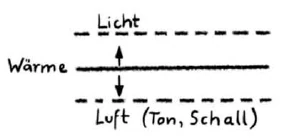
[ 21 ] There are, in fact, three stages in human relationships with the outside world: I would say, the stage of light, the stage of heat, and the stage of sound. But you see, there is something very peculiar that lies ahead. If you observe your relationship—that is, your swimming in the element of light—with an open mind, then you must tell yourself: You yourself can only live as an etheric organism within what is happening out there in the world. By living in the element of warmth, you live with your entire organism within the warmth of your surroundings. Now, if you direct your gaze from this inner life down to the inner life within the tone and sound elements, then you are actually living—by becoming an air organism yourself—within the differentiated outer air. That is to say, you are no longer living in the ether, but are in fact already living within the outer physical matter, within the air.
[ 22 ] Therefore, life in the element of warmth is a very significant threshold. In a sense, the element of warmth—and the life within it—represents a level for your consciousness. You can also perceive this level very clearly because, after all, you can hardly distinguish between external and internal warmth in pure sensation. But life in the element of light lies above this level. In a sense, you ascend into a higher ethereal sphere to live within it with your consciousness. And you descend below that level—where you come into balance with the external world in a relatively simple way—by engaging with the air as an “air being” through your perceptions of sound.
[ 23 ] The eye cannot be understood as anything other than a kind of physical apparatus. If you consider everything I have just shown, together with what I have said about anatomy and physiology, you cannot help but view the eye as a physical apparatus. The further outward you go, the more physical the eye appears; the further inward, the more it is permeated by vitality. We therefore have an organ located within us that allows us to rise above a certain level. We then live on a certain level, on equal footing with our surroundings, by countering them with our warmth and perceiving the difference somewhere. There, we do not have an organ as specialized as the eye; there, we ourselves become, in a certain sense, a sensory organ. Now let us descend below this level. Where we become “air beings,” where we engage with the differentiated outer air, this engagement is again localized—it is localized between what is happening within us, this lyre of Apollo, this rhythmic structuring of our organism, which is merely reflected in the rhythmic structuring of the cerebrospinal fluid, [and the differentiated outer air]. What is happening there is connected by a bridge. So there is, once again, such a localization, but now below the level, just as we have such a localization above the level in the eye.
[ 24 ] You see, our psychology is actually in an even worse state than our physiology and our physics, and one really can’t hold it against physicists that they express themselves so unrealistically about what exists in the external world, because they aren’t supported at all by psychologists. Psychologists have been conditioned by the churches, which have claimed all knowledge of the soul and the spirit. Consequently, this conditioning that psychologists have accepted has led them to view the human being as nothing more than the external body, while the soul and the spirit exist for them only in the sound of words, in phrases. Our psychology is really just a collection of words. For there is actually nothing to go on regarding what people are supposed to imagine when they think of the soul and the spirit, and so it happens that it seems to physicists that when light acts from the outside, it affects the eye; the eye either exerts a counteraction or receives an impression, and that is an inner, subjective experience. This is where a whole tangle of ambiguities begins. And in much the same way, according to physicists, this is the case with the other sense organs. If you read a psychology textbook today, you will find a theory of the senses within it. People speak of “sense,” of “general sense,” as if such a thing existed. Just try to study the eye. It is something entirely different from the ear. I have pointed this out to you—the difference between what lies below and above the level. The eye and the ear are entirely different kinds of internally formed organs, and this is something that must be taken into account in a significant way.
[ 25 ] Let’s pause here for a moment; think about this, and tomorrow we’ll use this as a starting point to discuss the theory of sound and the theory of tone, so that you can then go on to explore the other areas of physics.
[ 26 ] There is just one more thing I would like to demonstrate to you today. This is what, in a certain sense, can be called the crowning achievement of modern physics—and in a certain sense, it truly is a crowning achievement. You see, if you simply run your finger across a surface—that is, apply pressure through your own effort—the surface becomes warm. By applying pressure, you generate heat. Conversely—or rather, along the same lines—by inducing objective mechanical processes—which are distinctly mechanical processes—one can in turn generate heat, and we have improvised this apparatus as a further basis for what we intend to examine further tomorrow. If you were to check the thermometer reading in this apparatus now, you would find it at 16 degrees and a little more. Now, in this vessel—inside it, we have water, and within this body of water we have a flywheel, a drum, which we set in rapid rotation so that it performs mechanical work, thoroughly stirs up the water, and churns it up—and after some time, we will look at the thermometer again. So after some time, you can look at the thermometer and you’ll see that the reading has risen—meaning that through mechanical work alone, the water has gained heat; in other words, heat is produced by mechanical work. This was then analyzed, initially mathematically, after Julius Mayer in particular had drawn attention to it. Julius Mayer himself developed this into what is known as the mechanical heat equivalent. Had this been developed further in his spirit, it would have meant nothing more than that a certain number expresses what can be measured in heat through mechanical work—and vice versa. However, this was then interpreted in a supernatural, metaphysical way, with the claim that: “If there is a constant ratio between the work performed and heat, then this is simply converted work—converted!”—while [in reality] one was initially dealing with nothing more than the numerical expression of the relationship between mechanical work and heat.