

First Science Course
Light, Color, Sound, Mass, Electricity, Magnetism
GA 320
26 December 1919, Stuttgart
Translate the original German text into any language:
Versions Available:
First Science Course, tr. SOL
Vierter Vortrag
Fourth Lecture
[ 1 ] Meine lieben Freunde!
[ 1 ] My dear friends!
[ 2 ] Wir sind leider mit dem Zusammenstellen des Experimentier-Materials noch nicht weit genug gediehen. Daher werden wir manche Dinge, die wir heute machen wollten, erst morgen machen, und ich werde müssen den Vortrag heute mehr so einrichten, dass ich einiges, was uns nützlich sein wird in den nächsten Tagen, Ihnen noch zur Darstellung bringe, gewissermaßen mit einer kleinen Änderung meiner Absichten.
[ 2 ] Unfortunately, we haven't made enough progress yet in putting together the experimental materials. Therefore, we will have to postpone some of the things we had planned for today until tomorrow, and I will have to adjust today’s lecture so that I can still present to you some of the material that will be useful to us in the coming days—with a slight change in my original plans, so to speak.
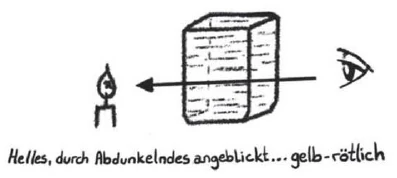
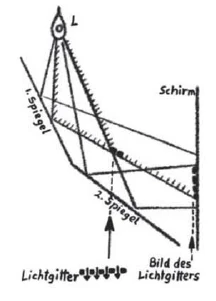
[ 3 ] Ich möchte zunächst einfach vor Sie hinstellen dasjenige, was man nennen könnte das Urphänomen der Farbenlehre. Es wird sich darum handeln, dass Sie nach und nach dieses Urphänomen der Farbenlehre bewahrheitet, bekräftigt finden an den Erscheinungen, die Sie im ganzen Umfang der sogenannten Optik oder Farbenlehre beobachten können. Natürlich komplizieren sich die Erscheinungen, und das einfache Phänomen tritt nicht überall gleich so bequem in die äußere Offenbarung. Aber wenn man sich die Mühe gibt, finder man es überall. Dieses einfache Phänomen, zunächst in Goethe’scher Art ausgesprochen, ist das: Sicht man ein Helleres durch Dunkelheit, dann wird das Helle durch die Dunkelheit in dem Sinn der hellen [Farbe erscheinen], in dem Sinn des Gelblichen oder Rötlichen, mit anderen Worten: Sehe ich zum Beispiel irgendein leuchtendes, sogenanntes weißlich scheinendes Licht durch eine genügend dicke Platte, die irgendwie abgetrübt ist, so erscheint mir dasjenige, was ich sonst, indem ich es direkt anschaue, weißlich sehe, das erscheint mir gelblich, gelb-rötlich. Hell durch Dunkelheit erscheint gelb oder gelblich-rötlich. Das ist der eine Pol: Hell durch Dunkel erscheint gelb oder gelb-rötlich.
[ 3 ] I would like to begin by simply presenting to you what one might call the primordial phenomenon of color theory. You will gradually find this primordial phenomenon of color theory confirmed and corroborated by the phenomena you can observe across the entire scope of what is known as optics or color theory. Of course, the phenomena become more complex, and this simple phenomenon does not always reveal itself so readily in the external world. But if one takes the trouble, one finds it everywhere. This simple phenomenon, initially expressed in the manner of Goethe, is this: If one views a brighter object through darkness, then the bright object appears through the darkness in the sense of a bright [color], in the sense of yellowish or reddish; in other words: For example, if I look at any bright, so-called whitish light through a sufficiently thick plate that is somehow opaque, then what I would otherwise see as whitish when looking at it directly appears to me as yellowish or yellow-reddish. Brightness through darkness appears yellow or yellowish-reddish. That is one pole: brightness through darkness appears yellow or yellowish-reddish.
[ 4 ] Umgekehrt, wenn Sie hier, ich will sagen, einfach eine schwarze Fläche haben, Sie schauen sie direkt an, dann sehen Sie eben die schwarze Fläche. Nehmen Sie aber an, ich habe hier einen Wassertrog, durch diesen Wassertrog jage ich Helligkeit durch, sodass er aufgehellt ist. Also, ich habe hier eine erhellte Flüssigkeit. Dann sehe ich das Dunkle dunkel durch Hell, durch Erhelltes. Da erscheint Blau oder Violett, das heißt Blaurot, das heißt der andere Pol der Farbe.
[ 4 ] Conversely, if you have, say, just a black surface here, and you look directly at it, then you simply see the black surface. But suppose I have a trough of water here, and I shine light through it so that it’s illuminated. So, I have an illuminated liquid here. Then I see the dark as dark against the light, against the illuminated surface. Blue or violet appears—that is, blue-red—which is the other pole of color.
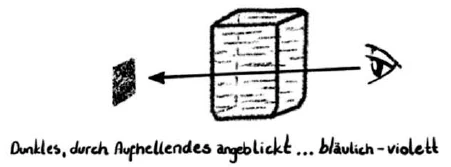
[ 5 ] Das ist das Urphänomen: Hell durch Dunkel — Gelb; Dunkel durch Hell — Blau. Sehen Sie, dieses einfache Phänomen kann eben überall gesehen werden, wenn man sich nur gewöhnt, real zu denken, nicht abstrakt zu denken, wie eben die heutige Wissenschaft denkt.
[ 5 ] This is the fundamental phenomenon: light through darkness — yellow; darkness through light — blue. You see, this simple phenomenon can be observed everywhere, if one simply gets used to thinking in concrete terms rather than abstractly, as modern science does.
[ 6 ] Nun erinnern Sie sich von diesem Gesichtspunkt aus an den Versuch, den wir schon gemacht haben, wo wir haben einen Lichtzylinder durchgehen lassen durch ein Prisma und haben bekommen, indem der Lichtzylinder durch das Prisma durchging, eine wirkliche Farbenskala, die wir aufgefangen haben, vom Violett bis zum Rot. Dieses Phänomen, ich habe es Ihnen ja schon aufgezeichnet. Wir konnten sagen: Wenn wir hier das Prisma haben, wir haben hier den Lichtzylinder, dann geht das Licht in irgendeiner Weise durch das Prisma hindurch, wird nach oben abgelenkt. Und wir haben gesagt: Hier findet nicht nur eine Ablenkung statt. Eine [bloße] Ablenkung würde stattfinden, wenn ein Gegenstand, ein durchsichtiger Gegenstand dem Lichte in den Weg gestellt würde, der parallele Flächen hat. Aber es wird [hier] das Prisma, das zusammengehende Flächen hat, dem Lichte in den Weg gestellt. Dadurch bekommen wir im Durchgang durch das Prisma eine Verdunkelung des Lichtes. Wir haben also in dem Augenblicke, wo wir das Licht durch das Prisma hindurchjagen, es zu tun mit zweierlei, erstens mit dem einfachen, fortströmenden hellen Licht, dann aber mit dem dem Licht in den Weg gestellten Trüben. Aber dieses Trübe, das sich dem Licht in den Weg stellt, das, haben wir gesagt, stellt sich so dem Lichte in den Weg, dass, während das Licht in der Hauptsache nach oben abgelenkt wird, wird dasjenige, was als Trübung entsteht, indem es nach oben strahlt, mit seinen Strahlen in der Richtung der Ablenkung sein. Das heißt, es strahlt Dunkelheit in das abgelenkte Licht hinein. Dunkelheit lebt gewissermaßen im abgelenkten Licht. Dadurch entsteht hier [oben] das Bläuliche, Violette. Aber die Dunkelheit strahlt auch nach unten. Da strahlt sie, während der Lichtzylinder so [nach oben] abgelenkt wird, nach unten, und sie wirkt entgegengesetzt dem abgelenkten Licht, kommt gegen dieses nicht auf und wir können sagen: Da übertönt das abgelenkte helle Licht die Dunkelheit, und wir bekommen [unten] die gelblichen oder gelblich-rötlichen Farben.
[ 6 ] Now, from this perspective, recall the experiment we’ve already conducted, in which we passed a light cylinder through a prism and, as the light cylinder passed through the prism, obtained a true spectrum of colors—which we captured—ranging from violet to red. I have already described this phenomenon to you. We were able to say: When we have the prism here and the light cylinder here, the light passes through the prism in some way and is deflected upward. And we said: What is happening here is not merely a deflection. A [mere] deflection would occur if a transparent object with parallel surfaces were placed in the path of the light. But [here] it is the prism, which has converging surfaces, that is placed in the path of the light. As a result, as the light passes through the prism, it is dimmed. So at the moment we send the light through the prism, we are dealing with two things: first, the simple, streaming bright light; and second, the opacity placed in the path of the light. But this opacity that stands in the path of the light—as we have said—stands in the path of the light in such a way that, while the light is primarily deflected upward, the opacity that arises as it radiates upward will have its rays directed in the direction of the deflection. That is to say, it radiates darkness into the deflected light. Darkness, so to speak, lives within the deflected light. This is what gives rise to the bluish, violet hue here [above]. But the darkness also radiates downward. While the cylinder of light is deflected upward in this way, the darkness radiates downward; it acts in opposition to the deflected light, cannot prevail against it, and we can say: Here, the deflected bright light overpowers the darkness, and we obtain [below] the yellowish or yellowish-reddish colors.
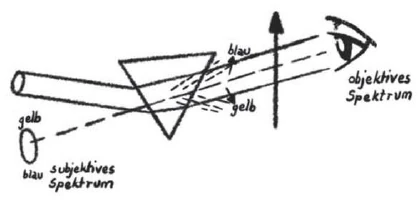
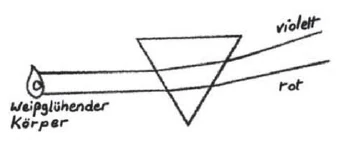
[ 7 ] Nehmen wir einen genügend dünnen Lichtzylinder, so können wir, wenn wir in der Richtung dieses Lichtzylinders [zum Prisma hin] schauen — mit unseren Augen können wir ja durch das Prisma hindurchsehen —, statt dass wir von außen auf einem Schirm anschauen das Bild, das entworfen wird, wir können unser Auge an die Stelle dieses Bildes stellen. Dann sehen wir, wenn wir durch das Prisma hindurchsehen, dasjenige, was hier ein Ausschnitt ist, durch den uns der Lichtzylinder entsteht, das sehen wir verschoben. Wir haben also hier wiederum, wenn wir innerhalb der Fakten stehen bleiben, das Phänomen vor uns: Wenn ich hier hinschaue, so sehe ich dasjenige, was mir sonst direkt [geradeaus] zukommen würde, sehe ich durch das Prisma nach unten verschoben. Aber ich sehe es außerdem farbig. Sie sehen es überall farbig.
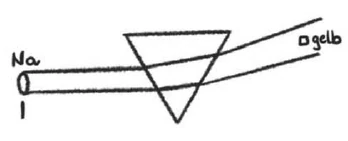
[ 7 ] If we take a sufficiently thin cylinder of light, then when we look in the direction of this cylinder of light [toward the prism]—since we can see through the prism with our eyes—instead of viewing the image projected onto a screen from the outside, we can place our eye at the location of that image. Then, when we look through the prism, we see what is here a section—through which the cylinder of light is formed for us—and we see it shifted. So here again, if we stick to the facts, we have the phenomenon before us: When I look here, what would otherwise come directly [straight ahead] toward me, I see shifted downward through the prism. But I also see it in color. You see it in color everywhere.
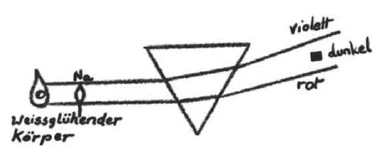
[ 8 ] Was sehen Sie da eigentlich hier? Wenn Sie sich vergegenwärtigen, was Sie hier sehen, und rein aussprechen, was Sie sehen im Zusammenhang mit demjenigen, was wir eben festgestellt haben, dann ergibt sich Ihnen dasjenige, was Sie wirklich sehen, auch für die Einzelheit, unmittelbar. Sie müssen sich nur an das Gesehene halten. Nicht wahr, wenn Sie so hinschauen auf den Lichtzylinder — weil er Ihnen entgegenkommt, der helle Lichtzylinder —, also ein Helles sehen Sie, aber Sie sehen das Helle — no, nicht wahr, ein deutlicher Beweis, dass Sie hier oben ein Abgedunkeltes haben, ist, dass die blaue Farbe entsteht — also, Sie sehen durch das Abgedunkelte, durch die blaue Farbe, ein Helles, durch ein Dunkles ein Helles. Also müssen Sie hier Gelb oder Gelb-rötlich sehen, also Gelb und Rot. Und unten ist Ihnen die rote Farbe ebenso ein Beweis, dass Sie ein Aufgehelltes haben. — Ich habe Ihnen ja gesagt, das Hell übertönt die Dunkelheit. Also sehen Sie, indem Sie hinschauen: Wie hell auch sein mag der Lichtzylinder, Sie sehen ihn noch durch ein Aufgehelltes. Also, er ist dunkel gegenüber dem Aufgehellten. Sie sehen also ein Dunkles durch ein Erhelltes, und Sie müssen es unten blau sehen oder blaurot.
[ 8 ] What do you actually see here? If you bring to mind what you see here and clearly articulate what you see in connection with what we have just established, then what you really see—even down to the smallest detail—will become immediately clear to you. You just have to stick to what you see. Isn’t that right? When you look at the cylinder of light like this—because it’s coming toward you, that bright cylinder of light—you see something bright, but you see that brightness—well, isn’t that right? Clear proof that you have a darkened area up here is that the blue color appears—so, you see a bright spot through the darkened area, through the blue color—a bright spot through a dark area. So here you must see yellow or yellow-reddish—that is, yellow and red. And down below, the red color is likewise proof to you that you have a brightened area. — I’ve already told you that the light overpowers the darkness. So when you look at it, you see: no matter how bright the cylinder of light may be, you still see it through a lightened area. So it appears dark in contrast to the lightened area. You’re seeing a dark area through a lightened area, and you must see it as blue or blue-red at the bottom.
[ 9 ] Sie brauchen bloß das Phänomen auszusprechen, dann haben Sie auch dasjenige, was Sie sehen können. Das, was sich dem Auge darbietet, ist, was Sie sonst sehen, das ist das, das Blau, durch das Sie hindurchschauen. Also erscheint das Hell rötlich. Am unteren Rand haben Sie die Erhelltheit. Wie hell auch der Lichtzylinder sein mag, Sie sehen ihn durch ein Erhelltes. Also sehen Sie ein Dunkleres durch ein Erhelltes und Sie sehen es rot. Darauf kommt es an, es kommt auf das Polarische an.
[ 9 ] You need only name the phenomenon, and then you have what you can see. What presents itself to the eye is what you otherwise see—that is, the blue through which you are looking. Thus, the light appears reddish. At the lower edge, you have the illuminated area. No matter how bright the cylinder of light may be, you see it through an illuminated area. So you see a darker area through an illuminated area, and you see it as red. That is what matters; it comes down to the polar aspect.
[ 10 ] Das Erstere kann man, wenn man gelehrt sein will, die objektiven Farben nennen, das am Schirm. Das andere, was man sieht, wenn man durch das Prisma schaut, kann man nennen das subjektive Spektrum. Das subjektive Spektrum erscheint in Umkehrung des objektiven Spektrums. Wenn wir so sprechen, dann haben wir ganz gelehrt gesprochen.
[ 10 ] If one wants to be scholarly, one can call the former the objective colors—those on the screen. The other thing one sees when looking through the prism can be called the subjective spectrum. The subjective spectrum appears as the inverse of the objective spectrum. When we speak this way, we have spoken in a thoroughly scholarly manner.
[ 11 ] Nun, über diese Erscheinungen, meine lieben Freunde, ist ja sehr viel, namentlich im Laufe der neueren Zeit, gegrübelt worden. Nicht nur, dass man hat so, wie wir es jetzt versucht haben, die Erscheinungen angesehen und sie reinlich ausgesprochen, sondern man hat über die Dinge gegrübelt, und das äußerste Grübeln ist ja schon angegangen, als der berühmte Newton über das Licht deshalb nachgedacht hat, weil ihm zuerst dieses Farbenspektrum sich dargeboten hat. Newton hat sich allerdings [mit seinen objektiven Versuchen mit dem schmalen Spalt] die sogenannte Erklärung — eine solche ist es immer nur — verhältnismäßig leicht gemacht. Er hat gesagt: Nun, wenn wir eben das Prisma haben, so lassen wir weißes Licht hinein. Da drinnen sind schon die Farben enthalten, das Prisma lockt sie hervor, und dann marschieren sie der Reihe nach auf. Ich habe einfach das weiße Licht zerlegt. Nun hat sich Newton vorgestellt: Jeder Farbenart entspricht ein bestimmter Stoff, sodass also in dem Gesamten stofflich sieben Farben enthalten sind. Gewissermaßen ist für ihn dieses Durchlassen des Lichtes durch das Prisma eine Art chemischer Zerlegung des Lichtes in sieben einzelne Stoffe. Er hat sich sogar Vorstellungen gemacht, welche Stoffe größere Korpuskeln, Kügelchen, aussenden und welche Stoffe kleinere. Nun also liegt in diesem Sinne die Sache so, dass die Sonne uns Licht sendet; wir lassen das Licht ein durch den kreisförmigen Spalt, da [beim Prisma] fällt es auf als ein Lichtzylinder. Aber dieses Licht besteht in lauter kleinen Korpuskeln, kleinen Körperchen, die hier aufstoßen, dann werden sie von ihrer Richtung abgelenkt, und dann bombardieren sie den Schirm und da fallen die kleinen Kanonenkügelchen auf. Die kleinen fliegen nach oben, die großen nach unten, die kleinen sind die violetten, die großen sind die roten, nicht wahr? Und so sondern sich die großen von den kleinen ab.
[ 11 ] Well, my dear friends, these apparitions have been the subject of much speculation, especially in recent times. Not only have people examined the phenomena—as we have just attempted to do—and described them precisely, but they have also pondered these matters; and this deep contemplation began, in fact, when the famous Newton reflected on light because this spectrum of colors first presented itself to him. Newton, however, [with his objective experiments using the narrow slit] made the so-called explanation—for that is all it ever is—relatively easy for himself. He said: Well, if we have the prism, let’s shine white light through it. The colors are already contained within it; the prism draws them out, and then they appear in sequence. I simply decomposed the white light. Now Newton imagined: Each type of color corresponds to a specific substance, so that, in terms of matter, seven colors are contained in the whole. In a sense, for him, this passage of light through the prism is a kind of chemical decomposition of light into seven individual substances. He even formed ideas about which substances emit larger corpuscles—small spheres—and which emit smaller ones. So, in this sense, the situation is as follows: the sun sends us light; we let the light enter through the circular slit, and there [at the prism] it strikes as a cylinder of light. But this light consists entirely of tiny corpuscles, tiny particles, which strike here, are then deflected from their original direction, and then bombard the screen, where the little cannonballs strike. The small ones fly upward, the large ones downward; the small ones are the violet ones, the large ones are the red ones, aren’t they? And so the large ones separate from the small ones.
[ 12 ] Diese Anschauung, dass da ein Stoff oder verschiedene Stoffe durch die Welt fliegen, die wurde sehr bald erschüttert von anderen Physikern, Huygens und Young und anderen, und es ist endlich dazu gekommen, dass man sich gesagt hat: So geht es doch nicht, dass da diese kleinen Kügelchen von irgendwo ausgehen und einfach durch das Medium getrieben werden oder auch nicht durch ein Medium getrieben werden und entweder auf einem Schirm ankommen, ein Bild erzeugen, oder in das Auge gelangen, um bei uns die Erscheinung des Rot und so weiter hervorzurufen. Damit geht es doch nicht. Und ich möchte sagen: Zuletzt wurden die Menschen dazu getrieben, sich zu beweisen, dass cs so nicht gehe, durch einen Versuch, der ja allerdings auch schon vorbereitet war, sogar bei dem Jesuiten Grimaldi, auch durch andere. Es wurde diese ganze Anschauung wesentlich erschüttert durch dasjenige, was durch Fresnel*? als Versuch angestellt worden ist.
[ 12 ] This view—that a particle or various particles fly through the world—was very soon challenged by other physicists, such as Huygens, Young, and others, and eventually people came to the conclusion: It can’t be that these little particles originate from somewhere and are simply propelled through the medium—or perhaps not propelled through a medium at all—and either land on a screen, producing an image, or enter the eye to cause us to perceive the color red and so on. That simply doesn’t work. And I would like to say: Ultimately, people were driven to prove to themselves that it couldn’t work that way through an experiment—one that had, admittedly, already been prepared, even by the Jesuit Grimaldi, as well as by others. This entire view was fundamentally shaken by the experiment conducted by Fresnel*?
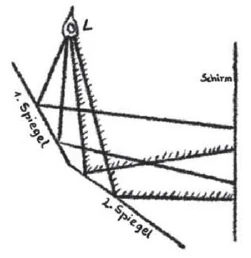
[ 13 ] Diese Fresnel’schen Versuche sind außerordentlich interessant. Aber man muss sich einmal klar werden, was da eigentlich geschieht in der Anordnung, die Fresnel seinen Versuchen gegeben hat. Aber ich bitte Sie, jetzt wirklich auf die Tatsachen recht sehr achtzugeben, denn es handelt sich darum, dass wir wirklich ganz genau ein Phänomen studieren. — Sehen Sie, nehmen Sie an, ich hätte zwei Spiegel und habe hier eine Lichtquelle, das heißt, mit einer Flamme leuchte ich von da aus, sodass ich, wenn ich hier einen Schirm aufstelle, Bilder bekomme durch diesen [ersten] Spiegel und Bilder bekomme von dem anderen [zweiten] Spiegel. Nehmen Sie also an — ich werde das zeichnen im Durchschnitt — zwei sehr wenig gegeneinander geneigte Spiegel. Hier habe ich eine Lichtquelle-ich will sie \(L\) nennen — [und] einen Schirm, so spiegelt sich mir das Licht, indem es hier [auf den ersten Spiegel] auffällt, sodass ich in der Lage sein kann, hier durch das reflektierte Licht den Schirm zu beleuchten. Ich werde — wenn ich das Licht hier [auf den ersten Spiegel] auffallen lasse, so kann ich durch den Spiegel den Schirm hier beleuchten, sodass er hier in der Mitte heller ist als in der Umgebung. Nun habe ich aber hier einen zweiten Spiegel, durch den wird das Licht etwas anders reflektiert, und es wird gewissermaßen noch ein Teil desjenigen, was von hier unten [gespiegelt wird], von meinem Lichtkegel, nach dem [unteren oder zweiten] Spiegel [zum Schirm] hin dirigiert wird — das fällt noch hinein in das Obere [des durch den ersten Spiegel Gespiegelte], sodass durch die Neigung wird gewissermaßen, was der obere Spiegel spiegelt, wird als Helligkeit auf den Schirm geworfen; was vom unteren Spiegel gespiegelt wird, wird auch als Helligkeit darauf geworfen. Man kann sagen, dass cs für diesen Schirm so ist, wie wenn er von zwei Orten aus erhellt würde.
[ 13 ] These experiments by Fresnel are extremely interesting. But we need to get a clear understanding of what is actually happening in the setup Fresnel used for his experiments. I ask you, please, to pay very close attention to the facts now, because the point is that we are studying a phenomenon with great precision. — Look, suppose I have two mirrors and a light source here—that is, I’m shining a flame from there—so that when I place a screen here, I get images from this [first] mirror and images from the other [second] mirror. So suppose—I’ll sketch this roughly—two mirrors inclined very slightly toward each other. Here I have a light source—I’ll call it \(L\)—[and] a screen; the light is reflected as it strikes here [on the first mirror], so that I can illuminate the screen here with the reflected light. If I let the light strike here [on the first mirror], I can illuminate the screen here through the mirror, so that it is brighter here in the center than in the surrounding area. Now, however, I have a second mirror here, through which the light is reflected somewhat differently, and, in a sense, part of what is reflected from down here—from my light cone—is directed [lower or second] mirror [toward the screen]—this falls into the upper portion [of what is reflected by the first mirror], so that, due to the inclination, what the upper mirror reflects is, so to speak, projected as brightness onto the screen; what is reflected by the lower mirror is also projected as brightness onto it. One could say that, for this screen, cs is as if it were illuminated from two locations.
[ 14 ] Nehmen Sie nun an, es habe einen Physiker gegeben, der das sieht. Dieser Physiker, der das sieht, dächte newtonisch. Dann wird er sich sagen: Da ist die Lichtquelle, die bombardiert zuerst den ersten Spiegel, der schmeißt ihre Kügelchen hierher. Diese prallen [vom ersten Spiegel] ab, kommen auf den Schirm und erhellen ihn. Aber auch von dem unteren Spiegel prallen die Kügelchen ab. Da kommen viele Kügelchen an. Es muss viel heller sein, wenn die zwei Spiegel da sind, als wenn nur der eine Spiegel da ist. Richte ich die Sache so ein, dass ich den zweiten Spiegel wegmache, so müsste [der Schirm] durch das hergeworfene Licht weniger erhellt sein, als wenn ich die zwei Spiegel habe.
[ 14 ] Now suppose there was a physicist who observed this. This physicist, upon observing this, would think in Newtonian terms. Then he would say to himself: There is the light source, which first strikes the first mirror, which then reflects its particles this way. These bounce off [the first mirror], hit the screen, and illuminate it. But the particles also bounce off the lower mirror. Many particles arrive there. It must be much brighter when the two mirrors are there than when there is only one mirror. If I set things up so that I remove the second mirror, then [the screen] should be less illuminated by the light reflected toward it than when I have both mirrors.
[ 15 ] Allerdings, ein Gedanke, sehen Sie, könnte diesem Physiker kommen, der richtig fatal wäre. Denn diese Korpuskeln, diese Körperchen, die müssen diesen Weg [vom zweiten Spiegel nach oben] machen, da kommen die anderen [vom ersten Spiegel] herunter. Warum just nun diejenigen, die da herunterkommen, gar nicht auf diese [von unten, vom zweiten Spiegel kommenden Körperchen] stoßen und sie wegschleudern, das ist außerordentlich schwer einzusehen. — Überhaupt, Sie können in unseren Physikbüchern sehr schöne Erzählungen über die Wellentheorie finden. Aber während die Dinge sehr schön berechnet werden, muss man immer den Gedanken haben, dass man niemals berechnet, wenn so eine Welle durch die andere durchsaust — das geht immer so ganz unbemerkt ab. Wollen wir einmal in Wirklichkeit auffassen, was hier eben eigentlich geschieht.
[ 15 ] However, a thought—you see—might occur to this physicist that would be truly disastrous. For these corpuscles, these tiny particles, must travel this path [upward from the second mirror], while the others are coming down [from the first mirror]. Why exactly those coming down don’t collide with these [particles coming from below, from the second mirror] and knock them away is extremely difficult to understand. — In general, you can find very elegant descriptions of wave theory in our physics textbooks. But while the calculations are very elegant, one must always bear in mind that we never actually calculate what happens when one such wave rushes through another—it always happens completely unnoticed. Let’s try to grasp, in reality, what is actually happening here.
[ 16 ] Sehen Sie, gewiss, das Licht fällt hier herunter, wird hierher [zum Schirm] herübergeworfen, fällt auch auf den zweiten Spiegel, wird hierher geworfen. Das Licht ist also auf dem Weg zum Spiegel, wird hier herübergeworfen — das ist immer der Weg des Lichts. Was geschieht nun aber eigentlich? Nun, nehmen wir an, wir hätten hier so einen Lichtgang. Jetzt wird er hier herübergeworfen. Jetzt kommt aber hier der andere Lichtgang, der trifft auf. Das ist ein Phänomen, das nicht zu leugnen ist. Wir haben hier den Lichtgang; aber da kommt der andere, der trifft da auf. Die beiden stören sich gegenseitig. Der will da durchsausen, der andere stellt sich in den Weg. Die Folge davon ist: Wenn er da durchsausen will, dass er das von da kommende Licht zunächst auslöscht; er löscht es aus. Indem er durchsaust, löscht er das Licht aus. Dadurch aber bekommen wir überhaupt hier [beim Schirm] nicht eine Helligkeit, sondern es spiegelt sich hier in Wahrheit die Dunkelheit herüber, sodass wir also hier [beim Schirm] eine Dunkelheit kriegen. Nun ist aber die ganze Geschichte nicht in Ruhe, sondern das ist in fortwährender Bewegung. Dieses, was hier gestört worden ist, das geht weiter. Da ist also gleichsam ein Loch im Licht entstanden. Nicht wahr, es ist ja das Licht durchgesaust, es ist ein Loch entstanden. Dieses erscheint dunkel. Aber dadurch wird der nächste Lichtkörper umso leichter durchgehen und Sie werden neben der Dunkelheit einen umso helleren Fleck haben. Das Nächste wiederum, was geschieht, ist das, dass, indem das hier weiterschreitet, wiederum ein solcher kleiner Lichtzylinder von oben aufstößt auf eine Helligkeit, sie wiederum auslöscht, wiederum eine Dunkelheit hervorruft. Dadurch, dass diese weiterschreitet, kann das Licht wiederum leichter durch. Wir haben es zu tun mit einem solchen fortschreitenden Gitter, wo das Licht, das von oben kommt, immer durch kann und, indem es auslöscht, wiederum Dunkelheit bringt, die aber fortschreitet. Wir müssen also hier abwechselnd Helligkeit und Dunkelheit bekommen dadurch, dass das obere Licht durch das untere durchgeht und so ein Gitter macht.
[ 16 ] You see, of course, the light falls down here, is reflected over here [toward the screen], and also falls on the second mirror, where it is reflected over here. So the light is on its way to the mirror, is reflected over here—that is always the path of light. But what actually happens? Well, let’s assume we have a light path like this here. Now it’s being reflected over here. But now the other light path comes along and intersects it. This is a phenomenon that cannot be denied. We have this light path here; but there comes the other one, which intersects it there. The two interfere with each other. One wants to zoom right through, while the other gets in the way. The result is this: When one beam tries to race through, it first extinguishes the light coming from the other direction; it extinguishes it. As it races through, it extinguishes the light. But because of this, we don’t get any brightness here [on the screen] at all; instead, darkness is actually reflected over here, so that we end up with darkness here [on the screen]. But the whole process isn’t static; it’s in constant motion. What has been disrupted here continues onward. So, as it were, a hole has been created in the light. After all, the light has rushed through, creating a hole. This appears dark. But as a result, the next light source will pass through all the more easily, and you’ll have an even brighter spot next to the darkness. The next thing that happens, in turn, is that as this process continues, another small cylinder of light from above strikes a patch of brightness, extinguishing it once more and creating darkness again. As this darkness moves on, the light can pass through even more easily. We are dealing with a progressive lattice of this kind, where the light coming from above can always pass through and, by extinguishing the light below, creates darkness, which, however, continues to advance. So here we must alternately obtain brightness and darkness as the upper light passes through the lower light, creating such a lattice.
[ 17 ] Das ist, was ich Sie gebeten habe, genau zu denken. Denn Sie müssen verfolgen, wie ein Gitter entsteht. Sie haben Helligkeiten und Dunkelheiten dadurch abwechselnd, dass Licht ins Licht hineinsaust. Wenn Licht in Licht hineinsaust, so wird das Licht eben aufgehoben, wird das Licht in Dunkelheit verwandelt. Die Entstehung eines solchen Lichtgitters müssen wir also dadurch erklären, dass wir die Anordnung getroffen haben durch diese Spiegel. Sie werden das Phänomen immer so bekommen, wenn Sie hier eine Lichtquelle haben, deren Lichtgeschwindigkeit gar nicht in Betracht kommt. Im Hinblick auf die Geschwindigkeit des Lichtes, überhaupt dasjenige, was an Verschiedenheiten der Lichtgeschwindigkeit hier auftritt, hat keine große Bedeutung. Was ich zeigen möchte, ist hier dasjenige: Was innerhalb des Lichtes selbst auftritt mithilfe des Apparates, ist hier [dasjenige], dass sich das Gitter abspiegelt: hell, dunkel, hell, dunkel.
[ 17 ] That is exactly what I asked you to think about. Because you need to understand how a light grid is formed. You get alternating areas of light and darkness when light rushes into light. When light rushes into light, that light is simply canceled out; it is transformed into darkness. We must therefore explain the formation of such a light grid by the arrangement we have created with these mirrors. You will always observe this phenomenon when you have a light source here whose speed of light is not a factor at all. With regard to the speed of light—and indeed, the variations in the speed of light that occur here—it is of no great significance. What I would like to demonstrate here is this: what occurs within the light itself, with the aid of the apparatus, is that the grid is reflected: bright, dark, bright, dark.
[ 18 ] Aber jener Physiker— es war Fresnel selber —, der sagte sich: Wenn das Licht die Ausströmung von Körperchen ist, so ist es selbstverständlich, dass, wenn mehr Körperchen hingeschleudert werden, dann muss es heller werden, sonst müsste ein Körperchen das andere aufzehren. Also nach der bloßen Ausstrahlungstheorie kann nicht erklärt werden, dass Helligkeit und Dunkelheit miteinander abwechseln. Wie es zu erklären ist, wir haben es eben gesehen. Aber nun sehen Sie, das Phänomen so zu nehmen, wie es eigentlich sein muss, das fiel nun gerade wiederum den Physikern nicht ein, sondern im Zusammenhang mit gewissen anderen Erscheinungen versuchten sie eine Erklärung im Sinne des Materialismus. Mit den hinbombardierenden Stoffkügelchen ging es nicht mehr. Deshalb sagte man: Nehmen wir an, das Licht ist nicht ein Hinströmen von feinen Stoffen, sondern nur eine Bewegung in einem feinen Stoff, in dem Äther, Bewegung im Äther. Und zuerst stellte man sich vor — zum Beispiel tat das Euler —, das Licht pflanze sich in diesem Äther etwa so fort wie der Schall in der Luft. Wenn ich einen Schall errege, so pflanzt sich der ja durch die Luft fort, aber so, dass zunächst, wenn hier der Schall erregt wird, die Luft in der Umgebung zusammengedrückt wird. Dadurch entsteht verdichtete Luft. Die verdichtete Luft, die hier entsteht, die drückt wiederum auf die Umgebung. Sie dehnt sich aus. Dadurch aber ruft sie sporadisch gerade in der Nähe eine verdünnte Luftschicht hervor. Durch solche Verdickungen und Verdünnungen, die man Wellen nennt, stellt man sich vor, dass der Schall sich ausbreitet. Und so nahm man an, dass solche Wellen auch im Äther erregt werden. Aber mit gewissen Erscheinungen stimmte die Sache nicht, und so sagte man sich: Eine Wellenbewegung ist das Licht wohl, aber es schwingt nicht so, wie es beim Schall ist. Beim Schall ist es so, dass hier eine Verdichtung ist, dann kommt eine Verdünnung, und das schreitet so fort. Das sind Längswellen. Also, es folgt die Verdünnung auf die Verdichtung, und ein Körper, der bewegt sich darinnen in der Richtung der Fortpflanzung so hin und zurück. Das konnte man sich beim Lichte nicht so vorstellen. Da ist es so, dass, wenn sich das Licht so fortpflanzt, dann bewegen sich die Ätherteilchen senkrecht zur Richtung der Fortpflanzung; sodass wir also, wenn dasjenige, was man einen Lichtstrahl nennt, da durch die Luft saust — es saust ja so ein Lichtstrahl mit 300000 Kilometer Geschwindigkeit —, wenn man da die Richtung hat, in der das Licht dahinsaust, dann schwingen da die kleinen Teilchen immer senkrecht darauf. Wenn dann dieses Schwingen in unser Auge kommt, dann nehmen wir das wahr.
[ 18 ] But that physicist—it was Fresnel himself—who said to himself: If light is the emission of particles, then it goes without saying that when more particles are emitted, it must become brighter; otherwise, one particle would consume the other. So the simple emission theory cannot explain why brightness and darkness alternate. We have just seen how this can be explained. But now you see, it did not occur to the physicists to accept the phenomenon as it actually must be; rather, in connection with certain other phenomena, they sought an explanation in the spirit of materialism. The theory of bombarding particles of matter no longer held up. Therefore, it was said: Let us assume that light is not a flow of fine particles, but merely a movement within a fine substance—the ether—a movement in the ether. And at first, people imagined—Euler, for example—that light propagated through this ether much like sound does through the air. When I generate a sound, it propagates through the air, but in such a way that, initially, when the sound is generated here, the surrounding air is compressed. This creates a region of compressed air. The compressed air that forms here, in turn, exerts pressure on the surrounding area. It expands. As a result, however, it sporadically creates a region of rarefied air in the immediate vicinity. It is through such compressions and rarefactions—which are called waves—that we conceive of sound propagating. And so it was assumed that such waves were also generated in the ether. But certain phenomena did not fit this model, and so people concluded: Light is indeed a wave motion, but it does not oscillate in the same way as sound does. With sound, there is a compression here, followed by a rarefaction, and so on. These are longitudinal waves. So, the rarefaction follows the compression, and a body moving within it travels back and forth in the direction of propagation. This could not be imagined in the same way for light. In the case of light, when it propagates, the ether particles move perpendicular to the direction of propagation; so that when what is called a ray of light races through the air—a ray of light does indeed race at a speed of 300,000 kilometers—if we have the direction in which the light is racing, then the tiny particles are always oscillating perpendicular to it. When this oscillation reaches our eye, we perceive it.
[ 19 ] Wenn man das auf den Fresnel’schen Versuch anwendet, sehen Sie hier, dann, wenn sich das Licht so fortpflanzt, dann schwingt es jetzt da weiter, so, schwingt es so weiter, sodass eigentlich die Bewegung des Lichtes ein senkrechtes Schwingen ist auf die Richtung, in der sich das Licht fortpflanzt. Ja, dieser Strahl hier, der auf den unteren Spiegel geht, würde also so schwingen, setzt sich so fort, stößt hier auf. Nun, wie gesagt, dieses Durcheinandergehen der Wellenzüge, über das sieht man da hinweg. Die stören sich da nicht im Sinne dieser so denkenden Physiker. Aber hier [beim Schirm] stören sie sich sogleich, oder aber sie unterstützen sich. Denn was soll nun hier geschehen? Ja, nicht wahr, hier [beim Schirm] kann es nun so sein, dass, wenn dieser Wellenzug hier ankommt, das [eine] kleinste Teilchen hier, das senkrecht schwingt, just hinunterschwingt, wenn das [andere] da just hinaufschwingt. Dann heben sie sich auf, dann müsste Dunkelheit entstehen. Wenn aber hier [beim Schirm] das [eine Teilchen gerade] aufschwingt, und das andere hier so [ebenfalls auf-] schwingt, und [wenn] das [eine] Teilchen hier gerade hinunterschwingt, wenn das andere hinunterschwingt, oder hinaufschwingt, wenn das andere hinaufschwingt, dann müsste die Helligkeit entstehen, sodass man also hier aus den Schwingungen der kleinsten Teilchen dasselbe erklärt, was wir aus dem Lichte selber erklärt haben. Ich habe gesagt, dass man hier abwechselnd helle und dunkle Stellen hat, aber die moderne sogenannte Undulations-Theorie erklärt sie dadurch, dass das Licht eine Schwingung des Äthers ist, dass hier, wenn die kleinsten Teilchen so schwingen, dass sie einander unterstützen, dann entsteht ein hellerer Fleck, wenn sie im entgegengesetzten Sinne schwingen, dann entsteht ein dunklerer Fleck.
[ 19 ] If you apply this to Fresnel’s experiment—as you can see here—when the light propagates in this way, it continues to oscillate there, like this, so that the motion of the light is actually a vertical oscillation relative to the direction in which the light propagates. Yes, this ray here, which is heading toward the lower mirror, would thus oscillate like this, continue on like this, and strike here. Now, as I said, this interference of the wave trains—you can look past that. They do not interfere with each other in the sense that these physicists think. But here [at the screen], they either interfere with each other immediately or reinforce each other. For what is supposed to happen here? Yes, isn’t it true that here [at the screen] it could be the case that, when this wave packet arrives here, the [one] tiniest particle here—which is oscillating vertically—just happens to be oscillating downward at the very moment the [other] one there is oscillating upward. Then they cancel each other out, and darkness would result. But if here [at the screen] this [one particle] is just swinging upward, and the other here is swinging [upward as well], and [if] the [one] particle here is just oscillating downward when the other is oscillating downward, or is oscillating upward when the other is oscillating upward, then brightness should result, so that the oscillations of the tiniest particles explain the same phenomenon here that we have explained from the light itself. I have said that here we have alternating bright and dark spots, but the modern so-called undulation theory explains them by the fact that light is a vibration of the ether; that here, when the smallest particles oscillate in such a way that they reinforce one another, a brighter spot arises, and when they oscillate in the opposite direction, a darker spot arises.
[ 20 ] Sie müssen jetzt nur ins Auge fassen, welcher Unterschied besteht zwischen der reinen Auffassung des Phänomens, dem Stehenbleiben innerhalb der Phänomene, dem Verfolgen der Phänomene und dem Hinstellen der Phänomene und [dem] Hinzuerfinden zu den Phänomenen [von] etwas, was man eben nur hinzuerfunden hat. Denn diese ganze Bewegung des Äthers ist ja nur hinzuerfunden. Man kann natürlich so etwas, was man erfunden hat, berechnen. Aber das, dass man darüber rechnen kann, ist ja kein Beweis dafür, dass die Sache auch da ist. Denn das bloß Phoronomische ist eben ein bloß Gedachtes, und das Rechnerische ist auch bloß ein Gedachtes. Sie sehen daraus, dass wir darauf angewiesen sind, nach unserer Grunddenkweise die Phänomene so zu erklären, dass sie sich uns selber als Erklärung ergeben, dass sie die Erklärung in sich selber enthalten darauf bitte ich den größten Wert zu legen —, dass hinausgeworfen werden muss, was bloße Spintisiererei ist. Alles kann man erklären, wenn man hinzufügt etwas, wovon kein Mensch etwas weiß. Diese Wellen zum Beispiel könnten natürlich da sein, und es könnte sein, wenn eine herunterschwingt und die andere hinaufschwingt, dass sie sich dann aufheben — aber man hat sie erfunden. Aber was unbedingt da ist, ist dieses Gitter hier, und dieses Gitter sehen wir sich hier treulich spiegeln. Man muss schon auf das Licht schauen, wenn man zu dem kommen will, was unverfälschte Erklärung ist.
[ 20 ] You need only consider the difference between the pure perception of the phenomenon, remaining within the phenomena, following the phenomena, and presenting the phenomena—and [the act of] adding to the phenomena something that one has merely invented. For this entire motion of the ether is, after all, merely an invention. Of course, one can calculate something that one has invented. But the fact that one can calculate it is no proof that the thing actually exists. For what is merely phoronomic is simply a figment of the imagination, and what is calculable is also merely a figment of the imagination. You can see from this that, according to our fundamental way of thinking, we are dependent on explaining phenomena in such a way that they present themselves to us as explanations—that they contain the explanation within themselves—and I ask that you attach the greatest importance to this—that we must discard what is mere speculation. One can explain anything by adding something about which no one knows anything. These waves, for example, could of course be there, and it could be that when one oscillates downward and the other upward, they cancel each other out—but they were invented. What is definitely there, however, is this grid here, and we see this grid faithfully reflected here. One must look at the light if one wants to arrive at what is an unadulterated explanation.
[ 21 ] Weipglühender Körper Nun habe ich Ihnen gesagt: Wenn das eine Licht durch das andere durchgeht, mit ihm überhaupt in irgendeine Beziehung tritt, dann wirkt unter Umständen das eine Licht trübend auf das andere Licht, auslöschend auf das andere Licht, wie das Prisma selber trübend wirkt. Das stellt sich ganz besonders dadurch heraus, dass man — wir werden den Versuch wirklich machen —, dass man den folgenden Versuch macht. Sehen Sie, ich will das, um was es sich dabei handelt, aufzeichnen: Nehmen wir an, wir haben dasjenige, was ich Ihnen gestern zeigte, wir haben wirklich ein solches Spektrum, und zwar direkt durch die Sonne erzeugt; wir haben ein solches Spektrum bekommen vom Violett bis zum Rot. Wir könnten ein solches Spektrum auch erzeugen, indem wir nicht die Sonne durch einen solchen [kreisförmigen] Spalt durchscheinen ließen, sondern dadurch, dass wir an diese Stelle hier einen festen Körper herbrächten, den wir glühend machten. Dann würden wir auch allmählich, wenn er bis zur Weißglut kommt, die Möglichkeit haben, ein solches Spektrum zu haben. Es ist gleichgültig, ob ein Sonnenspektrum [vorliegt] oder ob das Spektrum von einem weiß glühenden Körper kommt.
[ 21 ] A Body Glowing with Tears Now I have told you: When one light passes through another—when it enters into any kind of relationship with it at all—then, under certain circumstances, one light may have a dimming effect on the other, or even extinguish it, just as the prism itself has a dimming effect. This becomes particularly evident when one—and we will actually conduct this experiment—performs the following experiment. Look, I want to describe what this is all about: Let’s assume we have what I showed you yesterday; we actually have such a spectrum, produced directly by the sun; we have obtained such a spectrum ranging from violet to red. We could also produce such a spectrum not by allowing the sun’s light to pass through such a [circular] slit, but by placing a solid body here and heating it to incandescence. Then, as it gradually reaches white heat, we would also have the possibility of obtaining such a spectrum. It makes no difference whether a solar spectrum is present or whether the spectrum comes from a white-hot body.
[ 22 ] Nun können wir aber auch noch auf eine etwas modifizierte Art ein Spektrum erzeugen. Nehmen wir an, wir haben hier ein Prisma und wir haben hier eine Natriumflamme, das heißt ein sich verflüchtigendes Metall: Natrium. Gas wird Natrium da. Das Gas brennt, verflüchtigt sich, und wir erzeugen ein Spektrum von diesem sich verflüchtigenden Natrium. So tritt etwas sehr Eigentümliches auf. Wenn wir das Spektrum erzeugen nicht von der Sonne oder nicht von einem festen glühenden Körper, sondern von einem glühenden Gas, dann ist eine einzige Stelle im Spektrum sehr stark ausgebildet, und zwar bekommt Natriumlicht besonders das Gelb. Wir haben hier, nicht wahr, Rot, Orange, Gelb. Der gelbe Teil, der ist beim Natrium besonders stark ausgebildet. Das übrige Spektrum ist beim Natriummetall verkümmert, fast gar nicht vorhanden. Also, alles vom Violett bis zum Gelb herein und vom Gelben bis zum Rot ist verkümmert. Wir bekommen daher scheinbar einen ganz schmalen gelben Streifen, man sagt eine gelbe Linie. Die entsteht dadurch, dass sie der Teil eines ganzen Spektrums ist. Das andere des Spektrums ist nur verkümmert. So kann man von den verschiedensten Körpern solche Spektren finden, die eigentlich keine Spektren sind, sondern nur leuchtende Linien. Daraus ersehen Sie, dass man umgekehrt, wenn man nicht weiß, was da eigentlich in einer Flamme drinnen ist, und man ein solches Spektrum erzeugt, dass dann, wenn man ein gelbes Spektrum kriegt, in der Flamme Natrium sein muss. Man kann erkennen, mit welchem Metall man es zu tun hat.
[ 22 ] But we can also produce a spectrum in a slightly modified way. Let’s assume we have a prism here and a sodium flame here—that is, a vaporizing metal: sodium. The gas becomes sodium. The gas burns, vaporizes, and we produce a spectrum from this vaporizing sodium. Something very peculiar happens here. If we produce the spectrum not from the sun or from a solid incandescent body, but from an incandescent gas, then a single line in the spectrum is very strongly pronounced, and specifically, sodium light takes on a particularly yellow hue. Here we have, don’t we, red, orange, and yellow. The yellow part is particularly pronounced in sodium. The rest of the spectrum is attenuated in metallic sodium—almost nonexistent. So, everything from violet to yellow and from yellow to red is attenuated. As a result, we appear to see a very narrow yellow band—what is called a yellow line. This arises because it is part of an entire spectrum. The rest of the spectrum is simply attenuated. In this way, one can find such spectra from a wide variety of substances—which are not actually spectra at all, but merely luminous lines. From this, you can see that, conversely, if you don’t know what’s actually in a flame and you produce such a spectrum, then if you get a yellow spectrum, there must be sodium in the flame. You can determine which metal you’re dealing with.
[ 23 ] Das Eigentümliche aber, was entsteht, wenn man nun diese zwei Versuche kombiniert, sodass man erzeugt diesen Lichtzylinder hier, und das Spektrum erzeugt hier, zu gleicher Zeit die Natriumflamme hineintut, sodass das glühende Natrium sich vereinigt mit dem Lichtzylinder — was da geschieht, ist etwas ganz Ähnliches, als was ich Ihnen vorhin beim Fresnel’schen Versuch gezeigt habe. Man könnte erwarten, dass hier besonders stark das Gelb auftreten würde, weil das Gelb schon drinnen ist; dann kommt noch das Gelb vom Natrium dazu. Aber das ist nicht der Fall, sondern das Gelbe vom Natrium löscht das andere Gelb aus, und es entsteht hier eine dunkle Stelle. Also, wo man erwarten würde, dass Helleres entsteht, [entsteht] eine dunkle Stelle! Warum denn? Das hängt lediglich ab von der Kraft, die entwickelt wird. Nehmen Sie an, es wäre das Natriumlicht, das da entsteht, so selbstlos, dass es das verwandte gelbe Licht einfach durch sich hindurchließe, dann müsste es sich ganz auslöschen. Das tut es aber nicht, sondern stellt sich in den Weg gerade an der Stelle, wo das Gelb herüberkommen sollte, stellt sich in den Weg. Es ist da, und trotzdem es gelb ist, wirkt es nicht etwa verstärkend, sondern wirkt auslöschend, trotzdem es gelb ist, weil es sich einfach als eine Kraft in den Weg stellt, gleichgültig, ob das, was sich da in den Weg stellt, etwas anderes ist oder nicht. Das ist einerlei. Der gelbe Teil des Spektrums wird ausgelöscht. Es entsteht dort eine schwarze Stelle.
[ 23 ] But the peculiar thing that happens when you combine these two experiments—so that you create this cylinder of light here and the spectrum here, and at the same time introduce the sodium flame so that the incandescent sodium combines with the cylinder of light—is something very similar to what I showed you earlier in the Fresnel experiment. One might expect the yellow to appear particularly strongly here, because the yellow is already present; then the yellow from the sodium is added to it. But that is not the case; instead, the yellow from the sodium cancels out the other yellow, and a dark spot appears here. So, where one would expect a brighter spot to appear, a dark spot appears! Why is that? It depends solely on the force that is generated. Suppose the sodium light produced there were so selfless that it simply allowed the related yellow light to pass right through it; then it would have to cancel itself out completely. But it does not do that; instead, it stands in the way precisely at the spot where the yellow light should come through—it stands in the way. It is there, and even though it is yellow, it does not have a reinforcing effect, but rather an extinguishing one—even though it is yellow—because it simply stands in the way as a force, regardless of whether what stands in the way is something else or not. That makes no difference. The yellow part of the spectrum is extinguished. A black spot appears there.
[ 24 ] Sie sehen daraus, dass man bloß wiederum das zu bedenken braucht, was da ist. Da stellt sich einem aus dem flutenden Licht selbst heraus die Erklärung dar. Das sind eben die Dinge, auf die ich Sie hinweisen möchte. sehen Sie, der Physiker, der im Sinne Newtons erklärt, der müsste natürlich sagen: Wenn ich hier ein Weißes habe, also einen leuchtenden Streifen, und ich gucke mit dem Prisma durch nach diesem leuchtenden Streifen, so erscheint er mir so, dass ich ein Spektrum bekomme: Rot, Orange, Gelb, Grün, Blau, Dunkelblau, Violett.
[ 24 ] As you can see, all one needs to do is consider what is actually there. The explanation reveals itself from the flooding light itself. These are precisely the things I would like to point out to you. You see, a physicist who explains things in the Newtonian sense would naturally have to say: If I have something white here—that is, a luminous strip—and I look through the prism at this luminous strip, it appears to me in such a way that I get a spectrum: red, orange, yellow, green, blue, dark blue, violet.
[ 25 ] Nun, sehen Sie, Goethe sagte: Ja, zur Not geht’s ja noch. Wenn die Natur wirklich so ist, dass sie das Licht zusammengesetzt gemacht hat, so könnte man ja annehmen, dass dieses Licht durch das Prisma wirklich in seine Teile zerlegt wird. Schön, aber dabei behaupten ja dieselben Menschen, die das sagen, dass das Licht aus diesen sieben Farben als seinen Teilen besteht, zu gleicher Zeit, dass die Dunkelheit gar nichts ist, nur die Abwesenheit des Lichtes ist. Ja, aber wenn ich hier einen schwarzen Streifen lasse zwischen Weiß — ganz weißes Papier habe und hier einen schwarzen Streifen —, und ich gucke durch das Prisma durch, so bekomme ich auch einen Regenbogen, nur sind seine Farben anders angeordnet. Da ist er in der Mitte Violett [-Purpur] und geht nach der einen Seite ins [Bläuliche und nach der anderen Seite ins Gelblich-] Grünliche. Da bekomme ich ein anders angeordnetes Band. Aber ich müsste sagen, im Sinne der Zerlegungstheorie: Das Schwarze ist auch zerlegbar. Also, ich müsste zugeben, dass die Dunkelheit nicht bloß die [Abwesenheit] des Lichtes ist. Die Dunkelheit müsste auch zerlegbar sein. Sie müsste aber auch aus sieben Farben bestehen. Das ist es, was Goethe irre gemacht hat, dass er auch den schwarzen Streifen siebenfarbig sah, nur in anderer Anordnung. Das ist also dasjenige, was wiederum nötigt, einfach die Phänomene so zu nehmen, wie sie sind.
[ 25 ] Well, you see, Goethe said: Yes, I suppose it’s still possible, if need be. If nature really is such that it has composed light, then one could indeed assume that this light is actually broken down into its parts by the prism. Fine, but at the same time, the very same people who say that light consists of these seven colors as its parts also claim that darkness is nothing at all, merely the absence of light. Yes, but if I leave a black stripe here between the white—I have completely white paper and a black stripe here—and I look through the prism, I also get a rainbow, only its colors are arranged differently. There, violet [-purple] is in the middle and shifts toward the [bluish] on one side and toward the [yellowish-] greenish on the other. Then I get a spectrum arranged differently. But I would have to say, in the sense of the theory of decomposition: Black, too, is decomposable. So, I would have to admit that darkness is not merely the [absence] of light. Darkness must also be decomposable. But it must also consist of seven colors. That is what led Goethe astray—that he also saw the black stripe as seven-colored, just in a different arrangement. So that is what, in turn, compels us to simply accept the phenomena as they are.
[ 26 ] Nun, wir werden sehen, dass wir morgen wiederum um halb zwölf Uhr in der Lage sind, Ihnen das, was ich Ihnen heute leider nur theoretisch auseinandersetzen konnte, vorzuführen.
[ 26 ] Well, we'll see if we'll be able to demonstrate to you tomorrow at 11:30 a.m. what I was unfortunately only able to explain to you in theory today.