

First Science Course
Light, Color, Sound, Mass, Electricity, Magnetism
GA 320
2 January 1920, Stuttgart
Translated by Steiner Online Library
Ninth Lecture
[ 1 ] My dear friends!
[ 2 ] I am truly sorry that these discussions are so improvised and must remain aphoristic, but there is simply no other way than to present you with a number of perspectives these days and then, when I return here in due course, to continue the discussion, so that over time you will be able to derive something well-rounded from these discussions. However, in order to present the few points of view that I will elaborate on tomorrow—and which, in turn, will allow us to shed some light on the educational application of scientific findings— I must direct your attention today to the development of electrical phenomena—the phenomena of electricity—and I will build upon concepts that are actually familiar to you from your school days, because starting from there, we intend to characterize the entire field of physics tomorrow by taking a broad overview.
[ 3 ] You do know the basics of electricity, don't you? You know that there is what is called static electricity, that one can induce a charge in a glass rod by rubbing it with some kind of rubbing material, as it is called, or in a resin rod, and that as a result, the glass rod or resin rod, as they say, becomes electrified—that is, it attracts small objects, such as scraps of paper. You also know that observation of these phenomena has gradually revealed that the two forces—one emanating from the rubbed glass rod in one case, and the other from the rubbed resin rod or sealing wax rod in the other—differ in their manifestation: When the rod has been caused to attract small pieces of paper, that which is, as it were, electrically imbued by the glass rod in a certain way is electrically imbued in the opposite way by the resin rod’s electricity; and one therefore distinguishes—by focusing more on the qualitative aspect— glass electricity and resin electricity; or, to put it more generally, positive electricity and negative electricity. Glass electricity would be the positive, and resin electricity the negative.
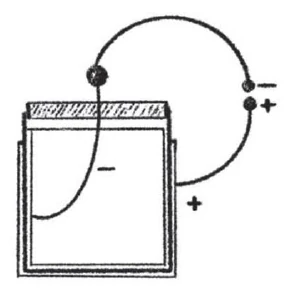
[ 4 ] Now, the peculiar thing is that positive electricity always attracts negative electricity in a certain way. You can observe this phenomenon in the so-called Leyden jar—that is, in that vessel which is coated on the outside with an electrifiable material, which is then insulated [within this coating], and which is then [entirely] lined on the inside with another [electrifiable] material that extends into a metal rod with a metal tip. Now, if one has electrified a [glass rod] and transfers this electricity—which is possible—to the outer coating, the outer coating becomes positively charged and exhibits the phenomena of positive electricity. As a result, however, the inner coating becomes negatively charged. And as you know, we can then—by connecting the coating charged with positive electricity to the coating charged with negative electricity—bring about a combination of positive and negative electrical forces, provided we position them such that one charge can extend this far and come into contact with the other. They face each other with a certain voltage and seek to balance each other out. A spark jumps from one to the other. We see, then, that electric forces facing each other in this way possess a certain voltage and strive for equilibrium. This experiment has likely been performed many times before you.
[ 5 ] Here you can see the Leyden jar. But we still need a [discharge] fork. I’ll try charging it here. It’s still too weak. The plates [of the electroscope] are repelling each other slightly. So, if we were to charge this sufficiently, the positive electricity would induce the negative, and if we had both facing each other, we could cause a spark to jump across using a discharge fork. But you also know that this way of becoming electrified is precisely what is referred to as “friction electricity,” because we are dealing with a force of some kind produced by friction—that is what I would like to say for now.
[ 6 ] Now, as I hardly need to remind you, it was not until the turn of the eighteenth and nineteenth centuries that this form of frictional electricity was actually discovered—namely, what is known as static electricity. And this opened up a field for modern physics that has proven to be exceptionally fruitful for the materialist development of physics. Here, too, I need only remind you of the principle. Galvani observed a frog’s leg connected to metal plates that began to twitch, and in doing so had, one might say, discovered something extraordinarily significant—he had discovered two things at once that merely needed to be separated from one another and that even today have not been properly distinguished, to the detriment of scientific inquiry. Galvani had discovered what Volta would, a short time later, describe as “contact electricity.” He had discovered the fact that when two different metals come into contact—with their contact mediated by appropriate liquids—an interaction arises that can manifest itself in the form of an electric current flowing from one metal to the other.
[ 7 ] Thus we have the electric current, which apparently flows solely within the realm of inorganic life, but by looking at what Galvani actually uncovered, we also have what can, in a sense, be called physiological electricity—a state of electrical potential that actually always exists between muscle and nerve and that can be stimulated when electric currents are passed through the muscle and nerve. So, in fact, what Galvani observed at that time comprised two aspects: that which can be simply replicated in the inorganic realm by causing metals to generate electric currents through the mediation of liquids. He also observed what is present in every organism—and is particularly evident in certain electric fish and other animals—as a state of tension between muscle and nerve, which, to the naked eye, resembles flowing electricity and its effects in its equilibrium. With this, however, everything had been discovered that subsequently led, on the one hand, to tremendous scientific advances in the materialistic realm and, on the other hand, laid such immense, epoch-making foundations for technology.
[ 8 ] The point is that the nineteenth century was largely dominated by the view that one had to discover something that, as an abstract, unified principle, underlies all the forces of nature—as they are called. It was in this vein that the discovery I have already mentioned to you—the one brought to light in the 1840s by Julius Robert Mayer, the well-known and brilliant physician from Heilbronn—was interpreted. We have demonstrated what he brought to light: We generated mechanical energy by setting a flywheel in motion, thereby setting the water in motion mechanically. As a result, however, the water became warmer. We were able to demonstrate this heating, and one can say that this generation of heat is an effect of the mechanical energy, the mechanical work, that was present.
[ 9 ] These concepts were interpreted in such a way that they were applied to a wide variety of natural phenomena, which, within certain limits, was indeed quite easy to do. It was possible to bring about the release of chemical forces, to observe how heat is generated from the release of chemical forces, and, conversely, to use heat—as indeed happens in the steam engine in the broadest sense—to produce mechanical work. Particular attention was focused on this so-called transformation of natural forces, and this was prompted by the ongoing development—which began with Julius Robert Mayer—of the ability to calculate numerically how much heat is required to produce a specific, measurable amount of work, and conversely, how much mechanical work is required to produce a specific, measurable quantity of heat. It was imagined—although there was no basis for this—that the mechanical work performed by setting the paddle wheels in the water in motion had simply been converted into heat. It was assumed that when we apply heat to a steam engine, this heat is converted into what then manifests as mechanical power. This line of thought characterized physical speculation in the nineteenth century, and consequently, it sought to find relationships between the various so-called forces of nature—relationships that were intended to show that there is indeed something abstractly similar underlying all these different forces of nature.
[ 10 ] This endeavor reached a certain culmination when, at the end of the nineteenth century or toward the end of the nineteenth century, the physicist Hertz, with a certain degree of genius, discovered the so-called electric waves—so here, too, waves! —, which provided some justification for conceiving of what propagates as electricity as related to what propagates as light, which was, after all, also thought of as a wave-like motion of the ether. The fact that what was referred to as electricity—particularly in the form of electric current [in wires]—cannot be so easily grasped using primitive mechanical concepts, but actually necessitates broadening physics’ perspective to include qualitative aspects: This could already have been demonstrated by the existence of what are called induction currents, where—to put it very roughly here—an electric current moving through a wire induces a current in a nearby wire simply because one wire is in the vicinity of the other. Thus, effects of electricity occur across space—one might say.
[ 11 ] Hertz had now succeeded in arriving at a very interesting conclusion: that the propagation of electrical agents does, in fact, share something in common with everything that propagates in a wave-like manner or can be conceived of in that way. Thus, Hertz had discovered that if, for example, one were to generate an electric spark in the same way that it is generated here [with the Leyden jar]—that is, if one were to generate the electric spark here by applying a voltage—then one could achieve the following: Suppose we had this jumping spark here. We would always have the possibility, at a corresponding location—somewhere else—to place two such devices—one might call them small inductors—opposite one another. They need only be placed opposite one another at a specific [other] location. And at a certain appropriate distance, a spark could also occur here, which would be nothing other than a phenomenon similar to the one where, for example, there is a light source here, a mirror here that reflects the [cone of light], which is then collected by another mirror here, and the image then appears here. One can speak of the propagation of light and of an effect that takes place at a distance. Thus, Hertz was also able to speak of the propagation of electricity, the effect of which is perceptible at a corresponding distance, and had thereby—according to his own and others’ views—achieved what would constitute proof that something corresponding to a wave-like motion is indeed propagated by electricity, just as one generally conceives of wave-like motions in their propagation.
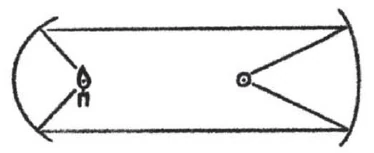
[ 12 ] Just as light propagates through space and produces effects at a distance when it strikes other bodies and, so to speak, unfolds there, so too can electric waves propagate and unfold again at a distance. This, as you know, forms the basis of so-called [wireless] telegraphy, as you know, and so we are dealing with a certain fulfillment of the favorite idea of nineteenth-century physicists—that what we conceive of as wave trains in the case of sound and as wave trains in the case of light, and what we have begun to conceive of—because thermal phenomena exhibit similar characteristics—as wave motion in the case of propagating heat, and this could also be imagined in the case of electricity, where one simply has to imagine very long waves. This could also be imagined in the case of electricity. In a sense, this provided something that irrefutably proved that the way of thinking in nineteenth-century physics is fully justified.
[ 13 ] And yet, there is something about Hertz’s experiments that suggests they actually marked the end of the old era. You see, everything that takes place in certain fields can, after all, only be properly assessed within those specific fields. When we have experienced revolutions, they appear to us as tremendous upheavals in social life precisely because we focus our attention specifically on those areas. Anyone who looks at what has happened in the field of physics during the 1890s of the last century and the past decade and a half of this century must acknowledge that a revolution has in fact taken place there—one that is far more profound within its own field than the external revolution is in its own. For one need say no more and no less than that, in the field of physics, we are essentially in the midst of a complete dissolution of the old physical concepts, and that physicists are merely resisting the idea of truly acknowledging this dissolution.
[ 14 ] “While what Hertz brought to light is still very much the twilight of the old era—because it actually served to reinforce the old wave theory—what came later, which was already present in Hertz’s time and, in a sense, had already been laid the groundwork for, has become of revolutionary significance for physics.” And this consists in the fact that the electric current, which can be generated and transmitted, is now conducted through tubes from which the air has been evacuated to a certain degree, so that the electric current is thus conducted through air that is extremely thinly diluted. You can see here [in the gas discharge tube] the state of electrical tension is simply caused by the fact that the ends, at which the electricity can discharge, are separated by a distance equal to the length of the tube here, so that what one might call a tip—through which the positive electricity discharges—the positive pole, is on one side, and the negative pole is on the other side. Electricity discharges between these two points, and the colored line you see here is the path the electricity takes. So one can say: What normally flows through the wires takes on this form—which you see here—as it propagates through the rarefied air. This effect is even stronger in more rarefied air. You can already see here that, in a sense, a kind of movement takes place from one side to the other, as the phenomenon changes significantly.
[ 15 ] So we have the opportunity, in a sense, to treat what flows through the wire as electricity in such a way—along part of its path—that it reveals something of its inner nature in interaction with something else. It reveals itself as it is because it cannot hide itself within the wire. Look at the green light on the glass! That is fluorescent light.
[ 16 ] I'm sorry I can't discuss these matters in more detail, but I wouldn't be able to achieve what I want to achieve if I didn't speak in such general terms.
[ 17 ] You can see what’s passing through there, in a very diffuse state, in the highly diluted air of the tube. Well, the phenomena that manifested themselves in this way in tubes with diluted air or gas simply need to be studied—a wide variety of scholars have participated in this study, including Crookes, among others. And the point is to observe how the phenomena actually behave inside the tube, and to attempt to conduct experiments using the phenomena that arise there. Well, certain experiments—which Crookes, for example, also conducted—demonstrated that what manifests itself there, I would say, as the inner nature of electricity once we have laid it bare, indicated that we cannot be dealing with anything that propagates in the way one might imagine light to propagate through wave motions of the ether. For what shoots through the tube has peculiar properties—properties that strongly resemble those of what is simply material. If you have a [permanent] magnet or an electromagnet—I must rely here on what you already know, since we cannot cover everything today—you can attract material objects with the magnet. This same property of being attracted by the magnet is also possessed by this light body that passes through, this modified electricity. It behaves toward a magnet exactly as matter behaves toward a magnet. The magnetic field modifies what is passing through it.
[ 18 ] Such experiments and others like them led Crookes and others to imagine that what is inside is not what one might call, in the old sense, a propagating wave motion, but rather that there are material particles shooting through space that, as material particles, are attracted by the magnetic force. Crookes therefore called what shoots through the tube—whatever might at least somehow be considered to be present there—“radiant matter,” and he imagined that, through the process of rarefaction, the matter inside the tube had gradually reached a state in which it is not merely a gas, but something that goes beyond the gaseous state—namely, radiant matter, matter whose individual parts radiate through space—in other words, finely divided dust, whose particles, by virtue of their electric charge, possess the property of shooting through space. These particles themselves would now be attracted by the electromagnetic force. The fact that they would be attracted proves precisely that we are dealing with the last remnants of real matter, not merely with a movement of the kind conceived of in the old sense as the movement of the ether.
[ 19 ] These experiments could be conducted, in particular, with the emissions—which were found to emanate from the negative electric pole, the so-called cathode—and researchers studied these emissions from the cathode and called them cathode rays. This, I would say, marked the first breach in the old physical conception. In Hittorf’s tubes—Hittorf was the first to construct such tubes, followed by Geissler—a process was observed that proved that one was actually dealing with a material substance traveling through space, a material substance shooting through space, albeit in a very finely dispersed state. What exactly was contained in what was called “matter” was not yet determined, but it certainly pointed to something that had to be identified with the material.
[ 20 ] It was thus clear to Crookes that he was dealing with material particles traveling through space. This view shook the foundations of the old wave theory. On the other hand, however, other experiments were subsequently conducted that did not support Crookes’s view. Thus, in 1893, Lenard succeeded in diverting these so-called [cathode or electron] rays, which emanate from this [negative] pole—for they can indeed be diverted—and he was able to direct them outward; he was able to insert an aluminum wall and guide the rays through it.” This immediately raised the question: Can it really be that simple—that material particles can pass through a material wall just like that? —So the question had to be raised once again: Are these, then, material particles that are flying through space? Or is it, after all, something else that is flying through space?
[ 21 ] Well, you see, this gradually led to the realization that neither the old concept of vibration nor the old concept of matter would get us anywhere in this field. Through Hittorf’s tubes, we were, so to speak, able to trace electricity along its hidden paths. There were hopes of finding wave motions; they could not be found. People had consoled themselves with the thought: So it is matter shooting through space. That, too, did not quite work out, and so in the end—based on a wide variety of experiments, of which I have been able to cite only a few characteristic examples here—it was concluded: There are no oscillations present, nor is there such atomized matter present; rather, there is moving, flowing electricity. Electricity itself flows, but as it flows, it exhibits certain properties through which it behaves toward other things—let’s say, a magnet—just like matter. Of course, if you shoot a [metal] ball through space and let it pass by a magnet, it will be deflected from its path. Electricity behaves the same way. This suggests that it is something material. But since it passes right through an aluminum plate without any difficulty, it does not prove to be matter after all. Matter, for example, makes a hole when it passes through other matter. So people said: flowing electricity.
[ 22 ] This flowing electricity now revealed the most remarkable things, and I would say: Based on the direction that emerged from observation, one could make the most remarkable discoveries. Thus, one could gradually observe how currents also emanate from the other pole, which intersect with the cathode rays. This [other] end is called the anode, and it emitted rays known as channel rays. Consequently, it was believed that such a tube contained two intersecting beams.
[ 23 ] Something particularly interesting occurred in the 1890s, when Röntgen directed—or, one might say, captured—the cathode rays onto a kind of screen that he placed in the path of the cathode rays. When Röntgen allowed these rays to pass through the screen—which is made of a substance called barium-platinum cyanide based on certain chemical theories—that is, when cathode rays are allowed to pass through a screen of barium-platinum cyanide, they undergo a modification. The rays continue on in their modified state, and one obtains rays that have an electrifying effect on certain bodies and that also interact with certain magnetic and electric forces. One obtains what we have come to call X-rays. This discovery has led to further findings. As you know, these X-rays have the property of being able to pass through the body without causing any perceptible disturbance; they pass through flesh and bone in various ways, and as a result, they have become of great importance to physiology and anatomy.
[ 24 ] Now a phenomenon arose that calls for further consideration. It was observed that when these cathode rays or their modifications strike glass or other materials, a certain type of fluorescence is produced—that is, these materials become luminous as a result. People then concluded that these rays must have been further modified. We are thus dealing with a whole range of different types of rays. The rays that came directly from the negative pole proved to be modifiable by all sorts of other factors. Attempts were then made to find substances believed to be capable of inducing this modification very strongly—that is, to transform the emitted rays very effectively into something else, such as fluorescent rays. And in this way, it was discovered that there are substances—such as uranium salts—that do not need to be irradiated under any circumstances, but which, under certain conditions, emit these rays themselves; they thus possess the intrinsic property of emitting such rays. And among these substances were, in particular, those known as radium-containing substances. Certain of these substances possess highly peculiar properties. They emit, so to speak, certain lines of force that can be manipulated in remarkable ways.
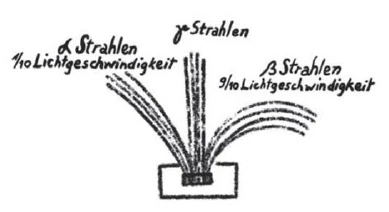
[ 25 ] When we have such radiation emanating from a body containing radium—[the body is] inside a small lead container here, and we have the radiation coming out here [at the opening]—we can examine this radiation using a magnet. We then find that something separates from this radiation, which we can strongly direct here [to the right] using the magnet, and this then takes on this shape. Something else remains rigid and continues in this direction [straight upward]; something else is deflected in the opposite direction [to the left], which means there is a threefold nature to it. Eventually, there simply weren’t enough names left to describe it. That is why the rays that can be deflected to the right were called \(γ\)-rays, those traveling in a straight line were called y-rays, and those deflected in the opposite direction were also called \(γ\)-rays. If you perform certain calculations, you can study the deflection—and thus the speed—by bringing a magnet alongside the source of radiation. And it turned out—interestingly—that the \(γ\)-rays move at about \(\frac{9}{10}\) the speed of light, while the a-rays move at about \(\frac{1}{10}\) the speed of light. So, in a sense, we have these bursts of energy that we’ve separated and analyzed, and they show us how they differ significantly in speed.
[ 26 ] I would like to remind you at this point that, at the beginning of these reflections, we attempted to grasp the formula purely intellectually: \(v=\frac{s}{t}\), and we said that what is real in space is velocity, and that it is velocity that determines what justifies us speaking of the real here. Here you can see how that which, I might say, explodes out is characterized primarily by the fact that we are dealing with velocities acting upon one another with varying intensities. Just imagine for a moment what it means that within the very same force cylinder radiating outward from here, there is something inside that wants to move nine times as fast as the other—that is, a propelling force that wants to lag behind asserts itself against the other, which wants to move nine times as fast.
[ 27 ] Now I ask you to consider for a moment that which only anthroposophists have the right not to regard as madness today. I ask you to recall how often we have had to point out that, in the greatest events in the world that we can comprehend, differences in speed are the essential factor. How, then, do the most important phenomena come into play in our present time? Through the interplay—at different speeds—of the normal, the Luciferic, and the Ahrimanic forces, and through the differences in speed within the spiritual currents to which the structure of the world is subject. The path that has recently opened up for physics compels it to address differences in speed in a very similar sense—for the time being, quite unconsciously—just as spiritual science must take them into account for the most comprehensive forces in the world.
[ 28 ] However, this does not exhaust everything that radiates from this body of radium; rather, it radiates something else as well, which in turn can be demonstrated through its effects and which, in these effects, manifests as something that radiates like an emanation from the radium matter, but which gradually ceases to appear as radium and instead appears, for example, as helium—which is an entirely different substance. This radium, then, not only emits what is within it as active agents, but it also gives of itself and thereby becomes something else. This has little to do with the constancy of matter, but rather with a metamorphosis of matter.
[ 29 ] Today I have presented to you phenomena that all fall within a realm that could be called the electrical realm. These phenomena all have one thing in common: namely, that they relate to us quite differently than, for example, phenomena involving sound, light, and even heat. With light, sound, and heat, we are, so to speak, immersed in them, as we described in the previous discussions. We cannot say the same about electrical phenomena so readily. For we do not perceive electricity as something as specific as light. Even when electricity is compelled to reveal itself to us, we perceive it through a light phenomenon. This has long led to the common assertion that electricity has no sense in human beings. Light has the eye as its sense in human beings, sound has the ear; a kind of sense of warmth has been postulated for heat; but for electricity, it is said, nothing similar exists. We perceive it indirectly. But we simply cannot go beyond this characteristic of indirect perception unless we advance to a scientific approach such as the one we have at least begun to outline here. When we expose ourselves to light, we do so in such a way that we swim within the light elements and participate in it ourselves—[at least] partially—with our consciousness; the same is true of heat, sound, and tone. We cannot say the same of electricity.
[ 30 ] But now I ask you to recall how I have always shown you what we human beings are really like—we human beings are, roughly speaking, dual beings, or rather, in reality, threefold beings: beings of thought, beings of feeling, beings of will—and I have always been able to show you that we are actually awake only in our thinking, that we dream in our feelings, and that in our volitional processes—even when we are awake—we are asleep. We do not experience volitional processes directly; we sleep through that which is essentially will, and in these reflections I have pointed out to you how, when we deal with physical formulas—where we write “m” for mass—and move beyond the merely countable, beyond motion, time, and space, to something that is not merely phoronomic, we must be clear that this corresponds to a transition of our consciousness into a state of sleep. If you consider this structure of the human being with an open mind, you can say to yourself: The experience of light, sound, and warmth falls, to a certain degree—indeed, to a very high degree—within the realm encompassed by our sensory-imaginative life, with light phenomena being particularly prominent—so that this becomes evident simply by impartially studying human beings, and so that all of this reveals itself as related to our conscious soul forces. As we move toward what is truly massive, toward the material, we approach that which is related to the forces that develop within us when we sleep.
[ 31 ] We follow exactly the same path, my dear friends, when we descend from the realm of light, sound, and heat into the realm of electrical phenomena. We do not experience our manifestations of will directly, but rather what we can conceive of them; we do not experience the electrical phenomena of nature directly, but rather what they bring forth into the realm of light, sound, heat, and so on. For, as far as the external world is concerned, I would say we enter the same Orcus when we sleep as we do within ourselves when we descend from our imaginative, conscious life into our life of will. While everything that is light, sound, and heat is related to our conscious life, everything that takes place in the realm of electricity and magnetism is intimately related to our unconscious life of the will. And the occurrence of physiological electricity in certain lower animals is merely a symptom—a symptom manifesting itself at a specific point in nature—of an otherwise imperceptible but universal phenomenon: wherever the will acts through metabolism, a process similar to external electrical and magnetic phenomena is at work. And in fact, by descending along the complex paths—which we have been able to sketch only roughly today—into the realm of electrical phenomena, one descends into the very same realm into which one must descend if one is to reach the mass at all.
[ 32 ] What do you do when you study electricity and magnetism? You study matter in concrete terms. Delve down into matter by studying electricity and magnetism! And it is true, quite true, what an English philosopher once said: In the past, people believed in various ways that electricity was the basis of matter. Now one must assume that what is believed to be matter is actually nothing other than liquid electricity. In the past, matter was atomized. Now people think: The electrons move through space and have properties similar to those of matter in the past. We have taken the first step—though we do not yet admit it—toward transcending matter, and the first step toward recognizing that we are descending into the realm of nature by moving from phenomena of light, sound, and heat to electrical phenomena, that we are descending to that which relates to these [light, sound, and heat] phenomena as our will relates to our life of imagination. I would like to impress this upon you as a conclusion to today’s reflection. My main aim is to tell you what you will not find in books. As for what is presented there, I would like to mention it only as something that serves to ground the other.