

First Science Course
Light, Color, Sound, Mass, Electricity, Magnetism
GA 320
3 January 1920, Stuttgart
Translated by Steiner Online Library
Tenth Lecture
[ 1 ] My dear friends!
[ 2 ] As a preliminary conclusion to these few impromptu lectures, which included scientific observations, I would like to offer you today some guidelines that may be useful to you in forming your own observations of nature based on characteristic facts that can be demonstrated through experimentation. After all, in the field of natural science today—especially for educators—it is of the utmost importance to develop the correct way of thinking and approach to what nature presents. And yesterday, precisely with regard to what I have just said, I endeavored to show you how the course of physical science has developed since the 1890s, such that, in a sense, materialism has been overturned by physics, and it is on this point that you should actually place the greatest emphasis.
[ 3 ] We have seen that the era which believed it already possessed the most compelling evidence for the universality of the vibrational principle was followed by an era that could no longer possibly adhere to the old vibrational or undulatory hypothesis—an era that, in a sense, has been as revolutionary in physics over the past three decades as anything conceivable can be in its field. For physics has lost nothing less, under the pressure of the facts that have presented themselves, than the concept of matter in its old form as such.
[ 4 ] We have seen that optical phenomena were [initially] linked, as [a consequence] of the old way of thinking, to electromagnetic phenomena, and that [then] the phenomena of the flow of electricity through tubes containing rarefied air or gas ultimately led to the view that these phenomena caused people to see something in the propagating light itself that resembled propagating electricity. I am not saying that [this] is correct, but that is simply how it has come about. And this was achieved by, so to speak, observing the electric current—which had otherwise always been confined to wires and could scarcely be viewed from any perspective other than Ohm’s law—by, so to speak, eavesdropping on its path as it leaves the wire, jumps to a distant [pole], and does not pass through matter, so to speak, through [which] it penetrates, so that its nature cannot be concealed.
[ 5 ] But this has brought something very complicated to light. Yesterday we saw how a wide variety of types of rays were revealed as a result. We saw that first—as I have already described the phenomena to you—the so-called cathode rays, which emanate from the negative pole of Hittorf’s tubes and pass through a vacuum, were the first to be discovered; and just as these cathode rays have already demonstrated—through the fact that they can be deflected by magnetic forces—they share something in common with what is commonly perceived as material. On the other hand, they share a similarity with what is perceived through radiation. This becomes particularly evident when conducting experiments in which such rays—which originate in some way from the [negative] electric pole—are intercepted, just as light is intercepted, by a screen or some other object. — Light casts shadows — such rays also cast shadows. Of course, however, it is precisely this that establishes the connection to the ordinary material element. For if you imagine that [one] bombards [a screen] from [the cathode] here—as, for example, according to Crookes’ ideas regarding cathode rays, as we saw yesterday—the “bombs” do not pass through the obstacle, and whatever is behind it remains unscathed. We can illustrate this particularly well using Crookes’ experiment by intercepting the cathode rays.
[ 6 ] Here we will generate an electric current, which we will then pass through this tube, which is evacuated of air and has its cathode—the negative pole—here, and its anode—the positive pole—here. So, by driving the electricity through this tube, we obtain what are known as cathode rays. We capture these using a St. Andrew’s cross inserted into the tube. We let them strike it, and you will see that something now becomes visible on the other side—like the shadow of this St. Andrew’s cross—which proves to you that this St. Andrew’s cross is blocking the rays. Please note carefully: The St. Andrew’s cross is inside there, and the cathode rays travel this way, are intercepted by the cross positioned here, and the shadow becomes visible on the back wall. I will now place this shadow, which is visible here, within the magnetic field of a magnet, and I ask you to observe this shadow of the St. Andrew’s cross. You will find that [the position of the shadow] is influenced by the magnetic field. Do you see? So, just as you see when I attract some other simple, let’s say, iron object with the magnet, the thing that appears there as a kind of shadow behaves like external matter. So, it also behaves as matter.
[ 7 ] So here, on the one hand, we have a kind of radiation that, for Crookes, actually traces back to radiant matter—a state of matter that is neither solid, liquid, nor gaseous, but rather a finer state of matter—and which shows us that this entire electricity, in its flow, behaves [on the other hand] just like ordinary matter. So, in a sense, we have directed our gaze toward the flow of electricity, and what we see reveals itself to us just as what we see as effects within matter.
[ 8 ] I would now like to show you—since it wasn’t possible yesterday—how those rays are produced that come from the other pole, [the positive pole], which I described to you yesterday as the channel rays. Here you can see the [cathode rays], which come from the cathode and travel in this direction, shimmering in a violet light, and the channel rays traveling toward them at a much slower speed, emitting a [reddish] light.
[ 9 ] Now I would like to show you the type of radiation produced here by this device, which will become particularly evident to you when the glass exhibits fluorescence as we pass an electric current through it. Here we will obtain the same type of radiation that is otherwise produced when these rays pass through a screen of barium-platinum cyanide, and which has the property of causing the glass to fluoresce quite strongly. You can see the glass—on which I now ask you to focus your attention primarily—emitting a very strong greenish-yellowish fluorescent light. The rays that appear in such very intense fluorescent light are precisely the X-rays I mentioned yesterday. So we can also observe this type of radiation here.
[ 10 ] Now, I told you that in the course of investigating these processes, it has become apparent how certain entities—regarded as substances—emit entire bundles of rays, initially of at least three different types, which we distinguished yesterday as \(α\), \(β\), and \(γ\) rays and which exhibit distinctly different properties. That these substances—which are called radium, helium, and so on—emit a fourth type as well, which is, in a sense, the element itself; it gives itself up and, after being emitted, has transformed itself in such a way that, as the radium flows out, it transforms into helium—that is, it becomes something entirely different. We are therefore not dealing with matter that remains fixed, but with a metamorphosis of phenomena.
[ 11 ] Now, building on these points, I would like to develop a perspective that can, in a sense, serve as your path into these phenomena—and indeed, into natural phenomena in general. You see, the main flaw in nineteenth-century physical thinking was that the inner activity through which human beings sought to observe natural phenomena was not flexible enough; above all, it was not yet capable of engaging with the facts of the external world itself. One could see colors arise in the light, but one did not rise to the level of taking the colored into one’s imagination, into one’s thinking; one could no longer think of colors, and one replaced the colors that one could not think of with what one could think of—which is purely phoronomic—namely, the calculable vibrations of an unknown ether. But this ether, you see, is something treacherous. For whenever one tries to seek it out, it does not reveal itself. And all these experiments that have brought these various rays to light have actually shown that while liquid electricity does manifest—that is, something that exists as a phenomenon in the external world—the ether absolutely refuses to reveal itself. Now, it was simply not possible for nineteenth-century thought to penetrate the phenomena themselves. Yet this is precisely what will be so necessary for physics from this point onward: to penetrate the phenomena themselves through human imagination. To this end, however, certain paths will have to be opened up specifically for the observation of physical phenomena.
[ 12 ] You see, one might say: The objective forces that are closer to human beings have actually already forced thought to become somewhat more flexible, but one could say: from the wrong angle. You see, what has been regarded as certain—what we have relied on most of all—is precisely the fact that we have been able to explain phenomena so elegantly using calculus and geometry, that is, through the arrangement of lines, planes, and solids in space. What these phenomena here in Hittorf’s tubes compel us to do is to approach the facts more closely—that is, to recognize that calculus actually fails when one attempts to apply it in such an abstract form as was done in the earlier theory of undulations.
[ 13 ] Well, I’d like to start by talking to you about the area from which something like a compulsion to make arithmetic and geometric thinking more dynamic first arose. After all, geometry was something very ancient. The way we use geometry to conceive of laws governing lines, triangles, quadrilaterals, and so on is a time-honored tradition, and this has been applied to what presents itself to us as external phenomena in nature. But it was precisely in the face of nineteenth-century thought that this geometry began to falter, and this happened in the following way: Isn’t it true that if you think back to your school days, you’ll recall that you were taught everywhere—and our dear Waldorf school teachers, of course, teach it as well; they have to teach it—that if you have a triangle and take its three angles, these three angles together add up to a straight angle, or 180°. You are familiar with this. Now, of course, one feels compelled—and must feel compelled—to provide the students with some kind of proof that these three angles together equal 180°. This is done by drawing a line here [through vertex \(C\)) parallel to the base of the triangle, so that we can say: The same angle that is \(α\) here appears here as \(α’\). \(α\) and \(α’\) are alternate angles. They are equal. So I can simply superimpose this angle here. Similarly, I can superimpose this angle \(β\) here and have the same result. Now, the angle \(γ\) remains in place, and if \(γ = γ\), \(α’ = α\), and \(β’ = β\), and \(α’ + β’ + γ\) together form a straight angle, then \(α + β + γ\) must also form a straight angle together. So I can prove this clearly and visually.
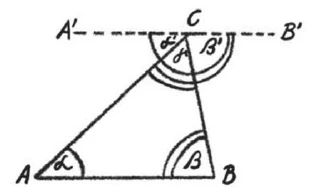
[ 14 ] One might say that there could not be anything clearer or more vivid. However, the assumption made in proving this is that the upper line \(A’-B’\) is parallel to \(A-B\). For only in this way am I able to carry out the proof. However, in all of Euclidean geometry there is no way to prove that two lines are parallel—that is, that they intersect only at infinite distance, or do not intersect at all. It only appears as though they are parallel as long as I remain within the imagined space. Nothing guarantees that this is also the case in real space. And if I therefore assume only one thing—that these two lines do not intersect at infinite distance, but actually intersect earlier—then my entire proof of the 180° sum of the angles of a triangle breaks down, and I would find — that, although not in the space I construct for myself in my mind and with which ordinary geometry deals—and although in this space the angles of a triangle do indeed sum to 180°—as soon as I consider a possibly different, real space, the sum of the angles of the triangle is no longer 180° at all, but may in fact be greater. This means that, in addition to the ordinary geometry derived from Euclid, other geometries are possible in which the sum of the angles of a triangle is by no means 180°.
[ 15 ] Nineteenth-century thought, particularly since Lobachevsky, has devoted considerable attention to debates along these lines, and as a result, the following question inevitably arose: Can the processes of reality that we observe with our senses actually be grasped—fully and completely grasped—by the concepts we derive as geometric concepts within the space we conceive? The space we conceive is, without a doubt, a figment of our imagination. We may, of course, cherish the pleasant notion that what happens out there beyond us partially corresponds to what we devise about it, but this offers us no guarantee that what happens out there operates in such a way that we can fully comprehend it through the Euclidean geometry we have conceived. It could very easily be—though only the facts themselves could tell us this—that things out there proceed according to an entirely different geometry, and that we only translate them into Euclidean geometry and its formulas when we conceive of them.
[ 16 ] This means that, if we limit ourselves to what is currently available to the natural sciences, we initially have no way of determining how our geometric—or, more generally, our phoronomic—concepts relate to what appears to us out there in nature. We calculate and depict natural phenomena insofar as they are physical. But whether we are merely sketching something superficially on the surface or penetrating into something within nature—there is, at first, no way to tell. And once one begins to think most thoroughly within the physical sciences in particular, then, my dear friends, one will find oneself in a terrible dead end; one will see that one cannot proceed any further. And one will only make progress if one first educates oneself about the origin of our phoronomic concepts—our concepts of counting, of geometry, and also our concepts of mere motion, not of forces.
[ 17 ] Where, then, do all these phoronomic concepts come from? Well, one can generally assume that they arise from the same source as the concepts we also gain when we engage with the external facts of nature and process them rationally. We see through our eyes, hear through our ears; we process what is perceived by the senses with our intellect, initially in a primitive way—without counting it, without drawing it, without observing its motion. We rely on entirely different conceptual categories. Here, our intellect is active through the phenomena of the senses. But when we now begin to apply so-called scientific concepts of geometry, arithmetic, algebra, [or] motion to what is happening externally, then we are doing something else entirely; then we are applying concepts that we most certainly have not derived from the external world, but rather have spun out of our inner selves.
[ 18 ] Where do these ideas actually come from? — that is the crucial question. Where do these ideas come from? These concepts, you see, do not come at all from our intellect—the one we use when processing sensory perceptions—but rather from the intelligent part of our will; we form them with our volitional structure, with the volitional part of our soul. There is a vast difference between all other concepts formed by our intellect and the geometric, arithmetic, and kinesthetic concepts. We gain the other concepts through our experiences of the external world; these concepts—the geometric and arithmetic ones—arise from the unconscious part of us, from the volitional part whose external organ is the metabolism. From this, for example, geometric concepts arise in the most eminent sense. These come from the unconscious within the human being. And when you apply these geometric concepts—I will now use them also for arithmetic and algebraic concepts—when you apply them to phenomena of light, sound, or tone, then in your cognitive process you combine what arises from within you with what you perceive externally.
[ 19 ] Yes, the entire origin of the geometry you are applying remains unconscious to you. You combine this applied geometry with external phenomena. The entire origin remains unconscious to you. And you form theories such as the undulation theory—it really doesn’t matter whether you develop this one or Newton’s [emission] theory—you form theories by uniting what arises from your unconscious with what presents itself to you as conscious daily life. [In] sound phenomena and so on, [you] interweave one with the other. At first, these two things do not belong together. They belong together just as little, my dear friends, as your power of imagination belongs together with the external things you perceive in a kind of half-sleep.
[ 20 ] I have often given you examples in anthroposophical lectures of how human dreams symbolize: A person dreams that he is standing with another person—a fellow student—at the door of a lecture hall; the two get into an argument, the argument intensifies, they challenge each other—it’s all a dream—; they dream of walking out into the forest, and a duel is arranged. The person in question still dreams of firing the first shot. At that moment, he wakes up and—the chair has fallen over. That was the jolt that carried forward into the dream. The imaginative power has connected with what is external appearance in a purely symbolic way, not in an appearance adequate to the object.
[ 21 ] In a similar way, what you bring up from the subconscious part of your being in the Phoronomic connects with the light phenomena. You draw rays of light geometrically. What you are doing there has no more reality than what is expressed in a dream when you symbolically imagine objective facts such as the bump of a chair. This entire process of processing the visual, auditory, and, to some extent, thermal external world through geometric, arithmetic, and kinetic concepts is, in truth—albeit a very sober one—a form of waking dream about nature. And until one recognizes that this is a waking dream, one will not be able to come to terms with natural science in such a way that it provides one with realities. That which one believes to be an entirely exact science is, in fact, the natural dream of modern humanity.
[ 22 ] But if you now descend from the phenomena of light and sound, through the phenomena of heat, into the realm entered upon by these radiation phenomena—which constitute a special chapter in the study of electricity—then you connect with that which, externally in nature, is equivalent to the human will. From the very same realm within the human being—which, as the realm of the will, corresponds to the sphere of action of cathode rays, canal rays, X-rays, alpha, beta, and gamma rays, and so on—from this very same realm, which in humans is the realm of the will, emerges that which we find in our mathematics, in our geometry, and in our concepts of motion. That is where we first enter into related fields.”
[ 23 ] However, contemporary human thought in these areas has not yet advanced far enough to truly think within them. “Modern man can dream by devising wave theories, but he is not yet capable of mathematically grasping the realm of phenomena—insofar as it is related to the realm of human will, from which geometry and arithmetic also arise.” To achieve this, arithmetic, algebraic, and geometric concepts must themselves become even more imbued with reality, and it is precisely this path that the physical sciences must take.
[ 24 ] If you talk today with physicists who received their education back when the undulation theory was in its heyday, you’ll find that many of them feel quite uncomfortable with these newer phenomena, because the mathematical concepts involved tend to fall apart a bit at every turn. And in recent times, people have resorted to other methods: since the entirely lawful use of arithmetic and geometry no longer worked, they have introduced a kind of statistical method that allows one to establish empirical numerical relationships based more on external empirical facts and to operate with probability theory, whereby one is permitted to say: “One simply calculates a regularity that persists throughout a certain sequence; then one reaches a point where the pattern no longer holds.”
[ 25 ] Such things often demonstrate, particularly in the development of modern physics, how one may lose one’s train of thought, yet precisely by losing that train of thought, one enters into reality. For example, it would have been easy to imagine that, based on certain rigid notions about the nature of a heated gas or heated air and the behavior of this heated air toward its surroundings under certain conditions, someone might have proven with just as much mathematical certainty that air could never have been liquefied. Yet it has been liquefied, because it was demonstrated at a certain point that certain concepts, which bridge the laws of a sequence, no longer apply at the end of that sequence. Many such examples could be cited.
[ 26 ] Such examples show how reality today—especially in the field of physics—often forces people to admit to themselves: With your thinking, with your imagination, you no longer fully immerse yourself in reality. You must begin the whole thing from the other end. — And precisely in order to begin at this other end, my dear friends, it is so necessary to sense the connection between everything that arises from the human will—and this is where phoronomy comes from—and that which confronts us externally in such a way that it is separate from us, revealing itself to us solely through the phenomena of the other pole: Everything that passes through those [discharge] tubes manifests itself as light and so on. But what flows as electricity is not perceptible in and of itself. That is why people say: If one had a sixth sense for electricity, one would also perceive it directly. — This is, of course, nonsense, for only when one ascends to intuition, which has its foundation in the will, does one enter the realm—accessible even to the external world—in which electricity lives and weaves. But at the same time, one realizes that in these phenomena—which we have here in the realm we last considered [that of electrical phenomena]—one is, so to speak, faced with the opposite of what occurs with sound or tone.
[ 27 ] What is distinctive about sound or tone is that, simply by being situated in the world of sound or tone—as I have characterized it— there is this distinctive feature: that human beings immerse themselves in sound or tone as such solely with their soul, and that what they take in through the body is merely that which, in the sense of the kind of contemplation I have presented in recent days, draws in the true essence of sound or tone —you recall the comparison with the emptied vessel—, absorbs it! There I am, in the [experience of] sound, in tone, in the most spiritual realm. And what the physicist observes—who, of course, cannot observe the spiritual or the soul—is the outer, so-called material parallel phenomenon of movement, of the wave [in the physical external world].
[ 28 ] When I turn to the phenomena of the last area we considered [electricity], then, my dear friends, I find outside myself not only the objective—so-called—materiality, but I also find outside myself that same [psychic-spiritual] element which otherwise lives within me as sound and tone, which lives in the psychic and spiritual realms as sound and tone. It is essentially present in the external world as well, but I am connected to this external world. Here [with electricity], within the same—I would say—sphere [of the external world] in which I have only the waves, the material waves of sound, I have that [psychic-spiritual] element which, in the case of sound, can otherwise be perceived only psychically. There [in the external world], I must perceive physically what I can perceive only psychically when [experiencing] sound.
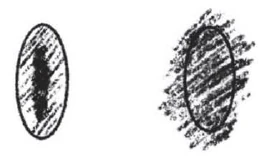
[ 29 ] At completely opposite poles in the relationship between human beings and the outside world lie the perception of sound and, for example, the perception of electrical phenomena. When you perceive sound, you, in a sense, split yourself into a human duality. You are immersed in the element of waves and undulations, which is, after all, verifiable externally as well. You sense that there is something else within it besides the merely material. You are compelled to become inwardly active in order to grasp the sound. With your body—your ordinary body, which I am sketching schematically here [on the left]—you perceive the undulation, the vibrations. You draw your etheric and astral bodies inward, so that they then fill only a part of your space, and you experience what you are meant to experience in the sound, within the inwardly concentrated etheric and astral aspects of your being.
[ 30 ] When you, as human beings, encounter the phenomena of the final realm [of electricity], then, my dear friends, at first you perceive absolutely nothing [through your senses] of any vibration or the like. But you feel compelled to expand that which you previously concentrated. You project your etheric and astral bodies outward across your entire surface, enlarging them, and thereby perceive these electrical phenomena [supernaturally].
[ 31 ] Without advancing to the spiritual-soul aspect of the human being, one will not be able to arrive at a truthful and realistic understanding of physical phenomena. One will have to imagine, more and more: sound and tone phenomena, as well as light phenomena, are related to the elements of our conscious imagination; electrical and magnetic phenomena are related to the elements of our subconscious will; and heat lies between them. Just as feeling lies between imagination and will, so does the external heat of nature lie between light and sound on the one hand and between electricity and magnetism on the other. The structure of our observation of natural phenomena must therefore become more and more—and it can become so if one [methodically] follows Goethe’s theory of colors—it must increasingly become an observation of the light-sound element on the one hand and the completely opposite electricity-magnetism element on the other. Just as we distinguish in the spiritual realm between the Luciferic-light-like and the Ahrimanic-electricity-like, Ahrimanic-magnetism-like, so too must we view the structure of natural phenomena. And lying indifferently between the two is that which confronts us in the phenomena of heat.
[ 32 ] With this, I have provided you with a sort of guide for this field—guiding principles—into which I wanted to provisionally summarize what I was able to present to you during these few improvised hours. It goes without saying that, given the haste with which the whole thing had to be put together, the presentation remained at the level of general intentions, and that I was only able to offer you a few suggestions—which I hope can be developed further here in the very near future. But I also believe that what has been presented here can help you—and can help the teachers at the Waldorf School in particular—by ensuring that, when you teach the children scientific concepts, you take care not to instruct them directly—or, I would say, in a fanatical manner—in such a way that these children then go out into the world and say: “All university professors are idiots.”
[ 33 ] For in these matters, it is not so much the facts that matter, but rather that realities can develop in an appropriate way. The point, then, is that we do not mislead our children. But we can at least ensure that we do not introduce too many impossible notions into our lessons—notions derived solely from the belief that the dreamlike image we form of nature has an external, real existence. Thus, if you imbued yourselves with a certain scientific mindset—one that permeates, for example, what I have presented to you in these lessons—then this approach can serve you in the way you speak with the children about natural phenomena. But I also believe you can gain much from a methodological perspective. Although I would have preferred to move through these phenomena at a slower pace than was necessary, you will nevertheless have seen that it is possible, in a certain way, to combine the outwardly perceptible aspects of the experiment with that which evokes ideas about things, so that people do not merely stare at things but reflect on them, and if you structure your lessons so that you let the children reflect on the experiment and discuss it with them in a thoughtful way, then—especially in science classes—you will develop a method that will make this science fruitful for the children entrusted to your care. In this way, I believe I have added something—precisely through an example—to what I said in the “Pedagogical Course” at the beginning of my teaching at the Waldorf School.
[ 34 ] And now I must make one more minor remark. After all, the time I was able to spend here this time was limited, and I had intended to fill it with various activities. Ever since we were able to hold the pedagogical course, my time has been so fully occupied that I haven’t yet gotten around to—just as I haven’t gotten around to many other things—preparing the transcribed lectures from the pedagogical course for you to reproduce.” Of course, this must be done very soon. But I had thought that the matter could be finalized during my stay here. But then you would not have had these [science] courses. So there is no other option—I believe you will have to wait at most another fourteen days—but to postpone the matter. I will, however, ensure that you receive the transcripts of this pedagogical course, provided you are teachers here at the Waldorf School.
[ 35 ] Of course, there were other things that weren’t possible either. But I believe, on the other hand, that by being able to establish these courses, we have nevertheless done something that can in turn contribute to the flourishing of our Waldorf school, which really ought to develop—and after such a good, truly commendable start, it certainly can—and which should be the beginning of a creative endeavor, born of something new, for the development of humanity. If we imbue ourselves with this awareness—that there is so much that is fragile in what has developed thus far in human evolution, and that something newly formed must take its place—then we will have the right awareness precisely for this Waldorf school.
[ 36 ] It is precisely in physics that we see that a whole host of ideas are truly extraordinarily fragile, and this is connected—more than one might think—to the overall misery of our time. Isn’t it true that when people think sociologically, you immediately notice where their thinking goes awry—that is to say, most people don’t even notice it. But one can notice it, because one knows that sociological ideas permeate the social order of human society. Yet we do not have a sufficient grasp of just how deeply physical concepts permeate the entire life of humanity, and so we do not realize what harm the sometimes truly terrifying ideas of modern physics have actually wrought. I have often quoted—including in public lectures—how Herman Grimm, who merely, I might say, viewed scientific concepts from the outside, quite rightly pointed out how future generations will find it difficult to comprehend that there once existed such a mad world that explained the development of the Earth and the entire solar system based on the Kant-Laplace theory. Understanding this scientific madness will not be easy in the future.
[ 37 ] But just like this Kant-Laplace theory, there is much that is part of our current conception of inorganic nature. “But look, how much people will still have to free themselves from Kantian-Königsbergian ideas and the like if they want to move toward thorough, sound conceptions! One comes across quite strange things there, from which one can see how what is wrong on one side is linked to what is wrong on the other. It is, after all, something like crawling up a wall—something one can experience in the following way. Recently—as they say, by chance—I was presented with a printed copy of a lecture given by a German university professor—who even identifies himself in this lecture as adhering to the Kantian-Königsberg school—at a university in the Baltic region on the relationship between physics and technology. The lecture was delivered on May 1, 1918. Please note the date: May 1, 1918. The man, a contemporary scholar of physics, articulates his ideal at the end of this lecture, saying something to the effect that: The course of this war has clearly shown that we have been far too unsuccessful in establishing a connection between the scientific laboratory work of the universities and militarism. In the future, so that humanity can continue to develop appropriately, a much closer bond must be forged between military authorities and the work being done at universities; for everything that science can contribute to make mobilization particularly effective must already be incorporated into the mobilization efforts of the future. At the beginning of this war, we suffered greatly from the fact that this close bond had not yet been forged—a bond that should, in the future, extend from scientific research institutes into the general staffs.
[ 38 ] My dear friends, humanity must relearn, and it will have to relearn in many areas. If it can bring itself to relearn in a field such as physics, it will find it easiest to be willing to relearn in other areas as well. But physicists who think in this old-fashioned way will never be very far removed from that charming coalition between the scientific research institute and the general staff.
[ 39 ] Many things must change. May the Waldorf school always be a place where what is meant to be different takes root! With this hope, I would like to conclude these reflections for now.