

Second Scientific Course
The warmth at the boundary
between positive and negative materiality
Insights from Spiritual Science on the Development of Physics
GA 321
1 March 1920, Stuttgart
Translated by Steiner Online Library
First Lecture
[ 1 ] The scientific reflections that were undertaken during my last stay here are now to be continued in a sense. This time, I will begin with that chapter of physical reflections which may be of particular importance for laying the foundation of a scientific worldview in general—namely, the study of the thermal conditions of the world. In today’s introduction, I will attempt to explain to you precisely how such an examination—as we now intend to pursue it—can foster an understanding of the significance of physical findings within a general human worldview, and how this can lay the foundation for a kind of pedagogical impetus for science education. As I said, today we want to begin with a kind of introductory overview and see how far we can get with it.
[ 2 ] The so-called theory of heat took shape in the 19th century in a way that greatly promoted a materialistic view of the world. It was promoted for this reason because the thermal conditions in the world primarily lead one to turn one’s gaze away from the actual nature of heat—from the essence of heat—and direct it toward the mechanical phenomena that arise from those thermal conditions.
[ 3 ] People first become aware of heat through the sensations they describe as cold, warm, lukewarm, and so on. However, people very soon realize that this sensation seems to involve something that is, at first, vague—something that is, in any case, subjective. Anyone who performs this simple experiment—we don’t need to do it here, as it would only slow us down, but anyone can do it for themselves at any time—can verify the following:
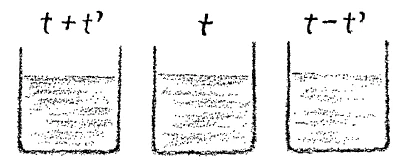
[ 4 ] Imagine you have a container here, filled with water at a specific temperature \(t\). To the right of it, you have another container, also filled with water, at a specific temperature \(t - t’\)—that is, at a temperature that is significantly lower than that in the first container. Then you have another container with water at a temperature of \(t + t’\). If you now take both your arms and dip your fingers into the two outer containers first, you will perceive the thermal state of the two containers through sensation. You can then dip the fingers you just dipped into the middle container, and you will see that to the finger that was dipped in the lower-temperature liquid, the temperature in the middle container feels relatively warm, while to the finger that was dipped in the warmer liquid, the temperature feels cold. Thus, the same temperature appears different to subjective perception, depending on whether one was previously subjectively exposed to one temperature or the other. Everyone knows, after all, that when they go into a basement, the experience can differ depending on whether they go in during the summer or the winter. If one enters in winter, the cellar may, under certain circumstances—even if the thermometer reads the same temperature—seem warm, whereas if one enters in summer, the cellar seems cool. And from this one initially concludes only this: Yes, the subjective sensation of warmth is not decisive; the point is to be able to determine objectively, in some way, what the thermal state of any body or any place is. Well, I don’t need to go into the basic phenomena here, nor the basic instruments for measuring heat. These must be taken for granted. Therefore, I can simply say: When one objectively measures the temperature of a body or a room with a thermometer, one has the feeling: Yes, one simply measures the degrees from the zero point upward or downward, and one obtains an objective measure of the thermal state. One then makes a fundamental distinction in one’s mind between this objective determination—in which, so to speak, the human being is not involved—and the subjective determination through sensation, in which the human being is involved.
[ 5 ] Well, with regard to everything that was strived for during the 19th century, one can say that this separation was, in a certain sense, fruitful and yielded results. But we are now in an era where one must certainly pay attention to certain things if one wishes to make fruitful progress in this or that field of knowledge or practical life. And therefore, certain questions must be raised today from within science itself—questions that were simply overlooked under the influence of conclusions such as those I have outlined. One question is this: Is there a difference—a truly objective difference—between my organism’s perception of the temperature of a room or a body and the thermometer’s measurement of that temperature? Or am I mistaken—it may be useful for my life to make this distinction—when I incorporate this distinction into my ideas and concepts, which science is then supposed to develop? — The entire course will have to serve to show how such questions must be posed today. For, starting from the fundamental questions, I will have to move on to those questions that today—precisely because such things have not been taken into account—simply elude practical life in important areas. You will yet see how they elude life in the field of technology. For now, I simply wish to draw your attention to the following in principle: Among the considerations I will characterize shortly, attention to the nature of heat itself has actually been entirely lost. And as a result, the opportunity has been lost to relate this nature of heat to the very organism with which we must, above all, relate it in certain areas of practical life: the human organism itself. If we are to characterize this today in merely rough terms—and this is meant only as an introduction to what is at stake—we must point out that in very specific cases we are obliged today to measure the temperature of the human organism itself, for example, when it is in a feverish state. From this you can see that the relationship between the unknown—at least initially unknown—nature of heat and the human organism has a certain importance. I will consider the most radical aspects—as they pertain to chemical and technical processes—later. But one will never be able to focus one’s attention properly on this relationship between the thermal entity and the human organism if one proceeds from a mechanical conception of the thermal entity, because one then overlooks the fact that within the human organism, depending on the organ, there is a very different sensitivity to heat itself, and that the heart, the liver, and the lungs have very different capacities for relating to heat. That one therefore cannot conduct a genuine study of certain disease symptoms without taking these different heat capacities of the individual organs into account—this simply escapes consideration because the physical conception of heat provides no foundation for it. Today we are not in a position to carry the physical conception of heat—which we developed over the course of the 19th century—into the realm of the organic. This is evident today to anyone who has an eye for the harm that current so-called physical “research” does to the higher branches of knowledge—namely, the understanding of the organic being itself. Therefore, certain questions must be raised—questions aimed above all at establishing clear, transparent concepts. Nothing troubles us more today, especially in the so-called most exact sciences, than unclear, opaque concepts.
[ 6 ] What does it actually mean when I say: If I have dipped my fingers here, on the right and left (see drawing on page 12), then when I dip both fingers into a container of liquid at a certain temperature, I experience different sensations; what does that mean? Is there really an objective difference in the definition of the concept compared to the so-called objective measurement by the thermometer? Just imagine: If, instead of your finger here (see drawing, right), you dip the thermometer in here and there (center), you’ll get different thermometer readings depending on whether you dip it here or there. If you use the two thermometers instead of the two fingers, the mercury column will also register different readings in one thermometer compared to the other. You’ll have a lower reading here (right) and a higher reading here (left); one will rise, the other will fall. You see, the thermometers do nothing different from what your own sensations do. When it comes to determining a concept of intuition, there is no difference between the two thermometers and the sensations in your fingers. Here and there, exactly the same thing is determined, namely: the difference from the previous reading. And what matters in our sensation is that we do not possess a zero point within ourselves. If we did possess a zero point within ourselves, we would not merely ascertain what constitutes immediate perception, but would have a mechanism within us to relate the temperature we subjectively perceive to a zero point within ourselves; then we would be able to ascertain—through something that does not actually belong to the matter at hand, something that has nothing to do with the processes—the very same thing that we can ascertain through thermometers. So you see, there is no difference when it comes to establishing the concept.
[ 7 ] This is the question that must be asked today if we are to arrive at clear concepts in thermodynamics at all. For all these concepts that exist are, in essence, unclear. But do not think that this has no consequences. The fact that we cannot identify a zero point within ourselves is connected to our entire existence. If we could identify a zero point within ourselves, we would have to have an entirely different state of consciousness, an entirely different inner life. It is precisely because this zero point is hidden within us that we live our lives.
[ 8 ] You see, much of life depends on the fact—in the human organism, and ultimately in the animal organism as well—that we are not aware of certain processes taking place within us. If you had to experience everything that goes on in your organism as subjective sensations, just imagine how much you would have to deal with. Think of the entire digestive process—if you had to experience it in every detail. Much of what constitutes our living conditions depends precisely on the fact that we do not consciously experience certain things taking place within our organism. This simply means that we do not consciously carry a zero point within us; we are not thermometers. Thus, the distinction between the objective and the subjective, as it is currently made, is simply no longer sufficient for further considerations of the physical world.
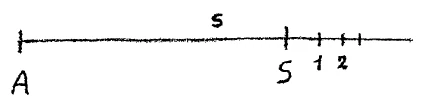
[ 9 ] This is essentially a question that has long been an open one in human thought since ancient Greece, but one that could be left open—it can no longer remain open in the future. For even the ancient Greek philosophers—Zeno above all—I must point this out today, even though it may seem pedantic to you—they drew attention to certain processes in human thought that stand in stark contradiction to external reality. I need only recall the Achilles paradox, which I have often brought to your attention. Let’s assume we have here the distance \(s\) that Achilles \((A)\) travels, say, in a certain amount of time. That’s how fast he can run. And here we have the tortoise \((S)\). It has a head start of \((AS)\). Achilles runs after the tortoise. Let’s take the moment when Achilles arrives here at \(S\). The tortoise keeps running. Achilles has to chase after her. By the time he covers this distance \((A S)\), the tortoise has already arrived here (at 1), and by the time he covers this next distance \((S 1)\), she has already arrived here (at 2). And so the tortoise always moves a little bit forward. Achilles must first run after her to catch up to the distance she has already covered. And Achilles can never catch up to the tortoise.
[ 10 ] People generally treat this story the same way that, no doubt, some of you sitting here today would approach the matter. I can tell by the look on your faces. You’re thinking: I know this very well—Achilles naturally caught up with the tortoise in no time, and it’s simply silly to draw the conclusion that Achilles must always cover the same distance first, that the tortoise is ahead, and that he’ll never catch up. “It’s just silly,” people say. But you can’t say that, because the conclusion is absolutely compelling and binding; there’s no arguing against it. And it’s not at all silly that this conclusion has been drawn; rather, it’s an extraordinarily—in terms of human reason—clever conclusion, because it’s absolutely binding, and there’s no getting around it. But what is the whole thing based on? As long as you’re merely thinking, you can’t think any differently than this conclusion dictates. But you do not think that way, because you simply look at reality and know: Achilles will, of course, soon catch up to the tortoise. And there you confuse thinking with reality; you no longer engage with thinking. People are not concerned with engaging with thinking, and so they say: Anyone who thinks that way is simply stupid. — Through reasoning, one can arrive at nothing other than the conclusion that Achilles does not catch up to the tortoise. But on what does this rest? It rests on the fact that, when we apply our reasoning consistently to reality, what we conclude turns out to be false in light of the facts of reality. It must be wrong. As soon as we apply our rationalistic thinking to reality, nothing can prevent us from establishing so-called “truths” that are false. For we must simply conclude that, if Achilles chases after the tortoise, he must traverse every point that the tortoise has also traversed. That is, in theory, entirely correct. In reality, however, he does not do this; he does not pass through those points. His strides are longer than those of the tortoise. He does not go through what the tortoise goes through. We must therefore observe what Achilles actually does. We cannot content ourselves with merely thinking about it. Then we arrive at different conclusions. These things sometimes have very little impact on people’s consciences, but in truth they are extraordinarily significant. And especially today, in the current era of scientific development, they are of the utmost importance. Only when we realize how much reality there is in our thinking about natural phenomena, when we move from observations to so-called explanations, do we come to terms with these things.
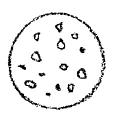
[ 11 ] Isn't it true that a visual example is something that simply needs to be described? The fact that I can do the following simply needs to be described: Here I have a ball. If I throw it through this hole, it goes through. That is the visual example. Now let’s just warm up this ball a little. As you can see, I can now place the ball on the hole, but at first it doesn’t go through. It will only fall through again once it has cooled down sufficiently. The moment I cool it down by pouring water on it, it goes through again. That is the illustration. That is what I simply need to describe. But let’s say—I’m now beginning to theorize. I’ll start off very roughly, since this is just an introduction: So this would be the sphere; the sphere would consist of a certain number of small parts—molecules, atoms—whatever you like. This is something that is no longer a visual example; it’s something I’m theorizing about. At this moment, I’ve moved beyond the visual example. And at that moment, I find myself in an extraordinarily tragic position. Only those who can engage with such matters can sense the tragedy. For if you examine whether Achilles can catch up to the tortoise or not, you might begin to think: Achilles must traverse the tortoise’s path, so he will never catch up to it. This can be strictly proven. Now try the experiment. Set the tortoise down and place Achilles—or someone else, even if they don’t run as fast as Achilles—next to it. You can prove at any time that what you see tells you the opposite of what the logical conclusion suggests. You will catch up to the tortoise very soon.
[ 12 ] But if you now want to theorize about the sphere—how its atoms and molecules are arranged—and in doing so you abandon the intuitive image, you cannot look inside and verify it; you will only be able to theorize, and in this field that is no better than the argument you put forward regarding the stretch of road that Achilles could not traverse. In other words: You carry the full imperfection of your reason into your reflections on that which is no longer intuitive. That is the tragedy. We construct explanation after explanation by abandoning the intuitive, and believe we can explain it precisely by formulating hypotheses and theories. And the consequence of this is that we are then compelled to follow our mere thinking—but this thinking abandons us the moment we go beyond intuition. It no longer corresponds to intuition.
[ 13 ] I already pointed out this distinction in the previous course by drawing a sharp line between kinematics and mechanics. Kinematics merely describes processes of motion or equilibrium, but it limits itself to stating what is immediately apparent. The moment you move from phoronomy to mechanics—the moment the concepts of force and mass must be introduced—we can no longer rely on mere thought alone; instead, we simply begin to deduce from what is observable. In the simplest physical processes in which mass plays a role, mere thought is no longer sufficient. And those theories that were developed in the course of the 19th century—even though they have proven practical for limited areas, which is beside the point—arose in such a way that, in order to verify them, it would actually be necessary to conduct experiments down to the level of molecules and atoms. This applies to the small scale, but it also applies to the large scale. You will recall that in my lectures I have often drawn attention to something that will now confront us in these considerations with a thoroughly scientific character. I have often said: Based on what physicists today theorize about thermal conditions and also about certain other things connected with them, they form certain mental images of the Sun. They describe—with a certain claim to accuracy—what the physical conditions, as they say, are like on the Sun. Now, I have always said: Physicists would be extraordinarily astonished if they could carry out the experiment of actually traveling up to the Sun and saw how none of what they calculate or theorize based on earthly conditions corresponds to the realities of the Sun. Today, these matters actually already have a very specific practical significance, particularly in light of current scientific developments. Just a few days ago, news spread around the world that, after great effort, the results of British research on the deflection of starlight in outer space were also presented in Berlin before a scholarly society. The following point was rightly raised there. It was said: Yes, the research by Einstein and others on the theory of relativity has received a certain degree of confirmation, but one could only speak definitively once we were able to conduct spectral analysis to determine how sunlight actually behaves, particularly during a solar eclipse. For then one would see something that cannot yet be observed with current physical instruments. — That was the news following the last meeting of the Berlin Physical Society. This is extraordinarily interesting. For the next step must, of course, be to seek a way to truly examine sunlight using spectral analysis. The path must lie in developing measuring instruments that do not yet exist. Then one will simply be able to confirm retrospectively certain things that can already be derived today from the principles of the Spiritual Science—as has indeed been the case with many discoveries that have emerged over the years and which, as you know, have also recently been confirmed by physical experiments. Then we will come to realize that it is simply impossible to take what we are able to calculate from observations—namely, of thermal phenomena in the earthly sphere— to the conditions of outer space or to the conditions of the Sun, and to create a mental image of the solar corona and the like, which arise from premises derived from the observation of terrestrial conditions. Just as our thinking misleads us when we abandon the concrete and delve into the world of molecules and atoms through theory, so too does it mislead us when we venture into the macrocosm and apply what we have established through observation in terrestrial conditions to something like the Sun. There, one believes that the Sun is something like a glowing ball of gas. There can be no question of a glowing ball of gas when it comes to the sun. What we have in the sun is something entirely different. Just imagine: We have earthly matter. Every form of earthly matter has a certain degree of intensity in its activity; whether this is measured in one way or another—by density or the like—is irrelevant. It possesses a certain intensity of action. This intensity can also drop to zero—that is, we can be faced with seemingly empty space. But that is not the end of the matter, any more than it is the end—well, let’s look at the following: Imagine you say, “I have a son.” The guy is actually a reckless spendthrift. I did give him a small fortune, but now he’s started spending it. He can’t go any lower than zero. He might end up with nothing—that’s how I console myself—he’ll just hit zero at some point. —Yes, but afterward I might actually experience a disappointment: the guy starts running up debts. Then he won’t stop at zero; then the situation will get even worse than zero. And that can have very real consequences. Because as a father, I’ll actually have less if the guy goes into debt than if he just stays at zero.
[ 14 ] You see, the same line of reasoning applies to the conditions of the Sun. One does not even go down to zero, but only as far as the greatest possible dilution; one speaks of a thin, incandescent gas. But one would first have to go down to zero and then beyond. For what one would find in the sun would not be comparable at all to our material world, nor would it be comparable to our empty space, which corresponds to zero—rather, it goes beyond that. It is in a state of negative material intensity. Where the Sun is, one would find a hole leading into empty space. There is less than empty space there. Thus, all effects observable on the Sun must be regarded as suction effects, not as pressure effects or the like. The solar corona, therefore, must not be viewed as physicists view it today, but must be viewed with the awareness that what is happening is not what it appears to be—such as pressure effects directed outward—but rather suction effects emanating from the hole in space, from the negation of matter. Here, reason abandons us. Here, our thinking fails us in relation to the macrocosmic, just as it fails us in relation to the microcosmic. In the case I have indicated, we can only theorize about the atomistic.
[ 15 ] When we subjectively assess the thermal states of our surroundings, we do not actually experience real thermal states, but rather differences. The thermometer also shows differences; there is no difference. We experience the differences between our own state of warmth and the one we enter. In fact, the thermometer does the same thing. It’s just that we have obscured the matter through factors that have nothing to do with these actual facts—namely, by establishing a zero point. This is something that is extremely important to take into account. When we turn our attention to light phenomena, the situation is such that we essentially perceive these phenomena with an organ that is highly isolated within our organism. I described this in the previous course. As a result, we never actually observe light—light is an abstraction—but rather we observe color phenomena. When we observe heat subjectively, the organ of sensation, the organ of perception, is our entire organism. Our entire organism corresponds here to our eye. It is not an isolated organ. We expose ourselves as a whole to the state of warmth. When we expose ourselves to warmth with a limb—for example, with a finger—this is no different from a part of the eye in relation to the whole eye. So while the eye is an isolated organ and, as a result, the world of light is objectified for us in colors, this is not the case with warmth. We are, as it were, entirely a thermal organ. But as a result, what constitutes heat does not confront us from the outside in such an isolated way as what constitutes light does. Our eye is objectified within our organism. What constitutes the thermal equivalent—because we are that very thing ourselves—we cannot experience. Just imagine that you could not see colors with your eyes, but could only distinguish brightness, and that colors as such would remain entirely subjective, mere feelings: you would never see colors. You would speak of light and dark, but colors would have no effect on you. It is the same with the perception of heat. Those distinctions that you perceive in light because of the isolation of the eye—you no longer perceive them in the world of heat. Yet they live within you. So when you speak of blue and red in relation to color, you have this blue and red outside of yourself. When you speak of the analogous in heat, because you are the heat-perceiving organ itself, you have within yourself what would be analogous to blue and red in heat—you are that very thing. That is why you do not speak of it. And this means that a completely different method is necessary for the study of the objective nature of heat than for the study of the objective nature of light. And nothing, I would say, has been as seductive in the 19th-century approach to observation as the tendency to standardize everything schematically. You find a “physiology of the senses” everywhere in works on physiology. As if such a thing even existed! As if there were anything about which one could say uniformly, “This applies to the ear as well as to the eye,” or even to the sense of touch or the sense of warmth. It is absurd to speak of a “physiology of the senses” and to say that a sensory perception is this or that. One can only speak of the isolated perception of the eye, of the isolated perception of the ear, of the isolated perception of our organism as a thermal organ, and so on. These are entirely different things, and one can only come up with insubstantial abstractions when speaking of a uniform sensory process. But today you find everywhere a tendency to unify these things. And so conclusions arise that, were they not so harmful to our entire lives, would actually be humorous. When someone says: There’s a boy; another boy beat him up. —- And alongside that, it’s claimed: “Yesterday he was beaten by his teacher; the teacher beat him up.” I observed the beating in both cases. There’s no difference. I conclude from this that the teacher from yesterday and the naughty boy who dished out the beating today are of the same inner essence. — That would be absurd, wouldn’t it? It would be completely impossible. But one can conduct the following experiment. We know that when light rays are directed in a certain way onto a concave mirror, they travel parallel; when they are collected by another concave mirror, they converge at the focal point and produce light phenomena. One does the same with so-called heat rays. Once again, one can observe: When the rays are made to converge at the focal point via concave mirrors—one can verify with a thermometer that a kind of thermal focal point is created. This is the same phenomenon as with light; therefore, light and heat are based on one and the same principle. The beatings of yesterday and the beatings of today are based on one and the same thing. If one were to draw such a conclusion in life, one would be a fool. If one draws it in science, as is done everywhere today, one is not a fool, but often a leading figure.
[ 16 ] Nevertheless, what matters today is striving for clear, transparent concepts, and without these clear, transparent concepts, we will not make any progress. Otherwise, a physical worldview will never lay the foundation for a universal worldview unless we make a concerted effort, particularly in the field of physics, to arrive at clear, vivid concepts. As you know—and as has also become clear from my last course here, at least to a certain extent—Goethe brought some order to the field of light phenomena, but these ideas have not been recognized.
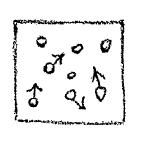
[ 17 ] In the field of thermal phenomena, the situation is particularly difficult, because in the post-Goethean era, thermal phenomena have become completely entangled in the chaos of theoretical conceptions, and in the 19th century, the so-called mechanical theory of heat caused one absurdity after another; on the one hand, by providing intuitive concepts in a field where intuition falls short, and by offering concepts that are easily grasped by anyone who believes they can think but in reality cannot; These are the concepts through which one has created a mental image of the following: A gas in a vessel closed on all sides consists of gas particles, but these gas particles are not at rest; rather, they are in constant motion. And of course, if these gas particles are in constant motion—since the gas particles are small and the distances between them are represented as relatively large in the mental image—a single gas particle will weave its way through without colliding with another for a long time, though it will occasionally do so. It then bounces back, and thus the gas particles collide with one another inside the vessel. They begin to move. They are constantly bombarding one another. When you add up all these small impacts, they exert pressure on the wall. On the other hand, it is possible to measure how high the temperature is. Then one says to oneself: Well, the gas particles inside are in a certain state of motion; they are bombarding one another. The whole system is in a state of agitated motion. They collide with one another and with the wall. When you heat it, they move faster and faster, colliding with the wall with ever-greater force, and you can say: So what is heat? — The motion of the tiniest particles. It is certain that today, under the weight of the facts, such mental images have already fallen somewhat out of favor, but they have only fallen out of favor on the surface. The entire way of thinking still rests on the same foundation. People have become very proud of this so-called mechanical theory of heat, for it is supposed to explain an extraordinary amount. It is supposed to explain, for example: If I simply run my finger over any surface, the effort I exert—the work, the force—is converted into heat. I can convert heat back into work—for example, in a steam engine, where I can perceive forward motion as a result of the heat. And people have formed the common, highly convenient mental image: Yes, when I observe externally what is happening in space, these are mechanical processes. The locomotive and the railcars move forward, and so on. If I then, let’s say, perform work through some means and heat is generated as a result, nothing else has actually happened except that the outwardly perceptible motion has been transformed into the motion of the tiniest particles. That is a convenient mental image. One can say: Everything in the world is based on motion, and it is merely the visible motion that is transformed into invisible motion. This is then perceived as heat. But heat is nothing other than the collisions and jostling of the tiny gas particles—which collide with one another, collide with the wall, and so on. Heat has gradually been transformed, in essence, into what would now happen if this entire corona suddenly began to set itself in motion, if it were constantly colliding with one another, colliding with the wall, and so on. This is Clausius’s mental image of what takes place in a gas-filled space. This is the theory that emerged from applying the Achilles paradox to abstract concepts, without realizing that one is subject to the same impossibility as when applying the same line of reasoning to Achilles and the tortoise. In other words, things do not turn out the way one thinks they will. Inside a gas-filled space, things happen differently than we imagine when we transfer abstract concepts to concrete experience.
[ 18 ] That is what I wanted to say by way of introduction today. You will see from this that, fundamentally, the entire methodological approach that emerged particularly during the 19th century is beginning to falter at its very foundations. For a large part of this approach rests on the fact that one simply conceives of what one observes as a concrete fact in such a way that one derives the expression—including the mathematical expression—of that observation, thereby arriving at differential mental images. If one expresses mathematically what one has as an observable fact—namely, a gas-filled space under a certain pressure—and does so by assuming that the movements of the smallest particles are taking place there, one can transform this into differential mental images and then indulge in the belief that, by integrating again, one will uncover something about reality. One must realize that, when making the transition from ordinary mental images to differential equations, one must not treat these differential equations using integral calculus—at least not without completely losing touch with reality. This is the basis of 19th-century physics: through a misunderstanding of the relationship between integrals and differentials, one has succumbed to false mental images of reality. One must be clear about this: In certain cases, one may differentiate, but what the differential forms yield must not be conceived as if it could be reintegrated, for then one does not arrive at reality but at something ideal. It is of great importance in relation to nature that one sees through this.
[ 19 ] For, you see, when I carry out a certain transformation process—when I say that I perform work and obtain heat—I can in turn obtain work from that heat, and we will see to what extent this applies within inorganic nature, specifically in the phenomena of heat. But I cannot simply reverse an organic process. Nor can I reverse large inorganic processes; for example, planetary processes are irreversible. We cannot create a mental image of the reverse of the process that proceeds from the formation of a plant’s roots to flowering and fruit formation. The process proceeds from the seed to fruit formation; it cannot run in reverse like a process in the inorganic world. This does not factor into our calculations. For even if we remain within the inorganic realm, this does not apply to certain macrocosmic processes. Today, in no mathematical formula—even if I could devise one for the growth of a plant (though it would be very complicated)—could I assign certain values a negative sign; this does not correspond to reality. I could not assign a negative value to the development of the flower from the development of the leaf. I would not be able to reverse the process. Nor can I reverse the actual process when it comes to the larger phenomena of the world. But that does not affect the calculation. If I have to factor in a lunar eclipse today, I can simply calculate what a lunar eclipse was like before our era, in Thales’s time, and so on; that is, I can certainly reverse the process in the calculation itself, but in reality the process would not be reversible. We cannot regress from the present stage of world development to earlier stages—for example, to a lunar eclipse that occurred in Thales’s time—by reversing the process. I can work through a calculation both forward and backward, but what I capture through the calculation usually does not correspond to reality. This calculation hovers above reality. One must be clear about the extent to which our mental images and calculations are merely mental images. Although they are reversible, there are no reversible processes in reality. This is important, for we will see that the entire theory of heat is built upon questions of this kind: To what extent are natural processes reversible within the realm of thermal conditions, and to what extent are they not?