

Second Scientific Course
The warmth at the boundary
between positive and negative materiality
Insights from Spiritual Science on the Development of Physics
GA 321
2 March 1920, Stuttgart
Translated by Steiner Online Library
Second Lecture
[ 1 ] We touched on this yesterday: under the influence of heat, what we call a “body” in everyday life expands. Today, let us begin by considering how so-called solid bodies expand under the influence of heat. For this purpose—so that we can commit these concepts to memory and then apply them appropriately in class (after all, it is simple and elementary at first)—we have clamped an iron rod in place here. We will heat this iron rod and demonstrate its expansion by having the lever arm attached here indicate the change in length at this mark. When I press here with my finger, this pointer moves upward.
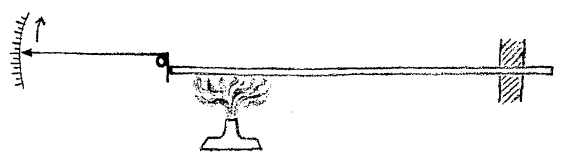
[ 2 ] You will see that when we heat this rod here, this pointer will also move upward, which will prove to you that the rod is expanding. You can already see how the pointer is moving upward. And you can see that as it continues to heat up, the pointer moves higher and higher, which proves that expansion increases with temperature. If I had used any other metal instead of the material in this object and we were to measure it precisely, we would obtain a different degree of expansion. We would find that different bodies of this kind expand to varying degrees. Thus, we would first have to conclude that the capacity for expansion—the degree of expansion—depends on the material. For now, let’s set aside the fact that we actually have a cylinder in front of us. Let us first create a mental image in which we simply have a body of a certain length, with no thickness or width, and let us initially observe the expansion in only one dimension. If we visualize this, we arrive at the following:
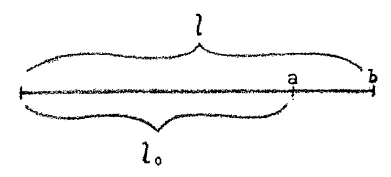
[ 3 ] If we hold a rod here and consider it simply as a length, let us first denote the length of this rod as \(l_0\) for the temperature—the degree of heat—from which we start. And we will then denote the length the rod assumes when we first increase its temperature by 1 degree as \(l\). Now, I said that rods expand to different degrees depending on whether they are made of one substance or another. We can always express the degree of expansion—in this case, from \(a\) to \(b\)—as a fraction that represents the ratio of the expansion to the rod’s original length. Let us denote this—that is, this relative magnitude of expansion—by \(\alpha\). Then we can think of the length of the rod after it has expanded—that is, the length \(l\)—as consisting of its original length \(l_0\) and the small increment in length it has gained due to the expansion. We must add this to the total. Since I have defined \(\alpha\) as a fraction that indicates the ratio between the expansion and the original length, I obtain—by multiplying \(l_0\) by \(\alpha\)—the rate of expansion of the rod; and since the expansion becomes more significant as the temperature rises, I must multiply this by the temperature increase \(t\). Thus, I can say: The length \(l\) of the rod after expansion
$$l = l_0 + l_0 \alpha t = l_0(1 + \alpha t)$$
[ 4 ] That is to say, if I want to determine the length of a rod that has expanded due to heating, I must multiply its original length by a factor given here as 1 plus the temperature, multiplied by the relative coefficient of expansion of the substance in question. Physicists have come to refer to \(\alpha\) as the coefficient of expansion for the substance in question.
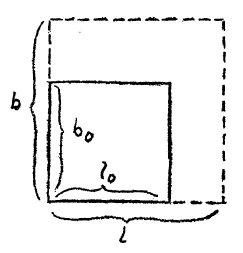
[ 5 ] Now I have considered a rod here. In reality, we do not have rods with no width and no height. In reality, we have three-dimensional objects. If we now move from this linear dimension back to the purely hypothetical two-dimensional extension, we can transform this formula as follows: Let’s assume that, instead of the linear dimension as shown here, we are now considering the areal dimension. If we had a surface here, we would have to realize that the surface extends in two dimensions; thus, upon heating, it would have approximately this size. We would then have not only the expansion in length along \(l\), but also the expansion in width along \(b\). And if we first consider the expansion in length—here \(l_0\)—we would again have the expansion in the direction I have just specified, along \(l\). And we have
$$l = l_0(1 + \alpha t). \qquad (1)$$
[ 6 ] If we now also consider the width \(b_0\), which has expanded to \(b\), I would have to write—since it goes without saying that the law of expansion remains the same—
$$b = b_0(1 + \alpha t) \qquad (2)$$
[ 7 ] Now you know that the area is calculated by multiplying the length by the width. So I obtain the total area—which is the original one here—by multiplying \(b_0\) by \(l_0\), and the area after the expansion by multiplying \(l_0(1 + \alpha t)\) by \(b_0(1 + \alpha t)\).
$$lb = l_0(l + \alpha t)b_0(1 + \alpha t) \qquad (3)$$
That means I get:
$$lb = l_0b_0 (1 + \alpha t)^2 \qquad (4)$$
But written out in full, that means:
$$lb = l_0b_0 (1 + 2\alpha t + \alpha^2 t^t) \qquad (5)$$
[ 8 ] That would give me the formula for the area of a shape.
[ 9 ] If you now imagine that the surface also has a thickness, I must treat this thickness in the same way. I would then have to add d and obtain:
$$ lbd = l_0b_0d_0(1 + 3\alpha t + 3 \alpha^2 t^2 + \alpha^3 t^3). \qquad (6)$$
[ 10 ] And when you look at this formula, I ask you to pay special attention to the following: If we consider the first two terms of this formula (6), you will find that t appears at most to the first power. If you look at the third term, you’ll find \(t\) raised to the second power, and the last t raised to the third power. I ask you to pay very special attention to these last two terms of the formula for expansion. Note that when we have the expansion of a three-dimensional body, we obtain a formula for it that contains the third power of the temperature—I will set aside the second power of the temperature for now. It is extremely important to emphasize precisely this fact: that we obtain the third power of the temperature here.
[ 11 ] Since I must always bear in mind that we are, after all, here at the Waldorf School and that everything must be oriented toward educational goals, it is necessary to point out to you that if you now study the same derivation I have presented here in standard physics textbooks, you will find a considerable difference between the way I have presented the matter here and the description in those textbooks. I will now explain how the concept is presented in standard physics textbooks. They state: “It is a ratio—usually a fraction. The expansion is very small in relation to the rod’s original length. If I have a fraction whose denominator is larger than its numerator, then when I square or cube it, I get a much smaller number. For if I square one-third, I already get one-ninth, and if I cube one-third, I get one-twenty-seventh. That is to say, the cube is already a very, very small fraction. “& is a fraction that usually has a very large denominator. That is why standard physics textbooks say: If I now take the square, \(\alpha^2\), or even \(\alpha^3\), which I have to multiply by \(t^3\), these are very small fractions that can simply be omitted. So the standard physics textbooks say: We simply omit these last terms of the expansion formula and write \(l \cdot b \cdot d\)—which is, after all, the volume that an expanding body assumes at a certain temperature, so I’ll write \(V\)—:
$$V = V_0(1 + 3 \alpha t). \qquad (7)$$
[ 12 ] This is how the formula for the expansion of a solid is written—by simply assuming that the fraction \(\alpha\), when squared or, more specifically, cubed, yields numbers so small that they can be omitted. As you know, this is how it is presented in standard physics textbooks. However, this approach omits the very most important point—the one that really matters if one wishes to study thermodynamics properly. This will become clear as we proceed.
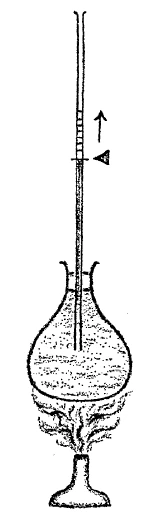
[ 13 ] It is not only solids but also liquids that expand due to heat. Here, so that you can see it, is a colored liquid. We will heat this colored liquid (see diagram). You will now see that after some time, the column of colored liquid rises, and from this you will conclude that liquids expand just as solids do. You can see that the colored liquid is rising; therefore, the liquid expands when heated.
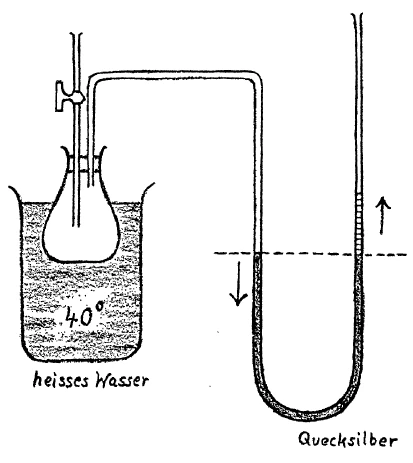
[ 14 ] Well, in the same way, we can investigate the expansion of a gaseous body. To do this, we have air here in the flask that simply flows in from the outside (see diagram). We will now seal off the air inside the flask and heat it. We have a system of communicating vessels here. The property of communicating vessels is that the level of the liquid inside them is the same on both sides, that is, it covers both sides. You will now see what happens when we simply heat the air inside here—that is, a gaseous body. We’ll achieve this by placing heated water at a temperature of 40° in the vessel (see diagram on page 36). You can see that the mercury column on the right is already rising. Why is it rising? Because the gaseous substance inside this flask is expanding. The air flows out here, pressing on this mercury (on the left); on the other side, the mercury column is raised by the pressure, and you can see from this that this gaseous body has expanded. So we can say: Solid, liquid, and gaseous bodies all expand under the influence of the nature of heat, which is still unknown to us.
[ 15 ] But now, as we proceed from the study of expansion in solids, through the study of expansion in liquids, to the study of expansion in gaseous bodies, we immediately encounter something very significant. I have previously stated that “here,” the ratio of expansion to the original length of the rod, varies for different substances. If we were to examine \(\alpha\) for different liquids—which would, of course, require further experiments that we cannot carry out here—we would still obtain different values for \(\alpha\) for different liquid substances. However, if we investigate \(\alpha\) for gaseous bodies—namely, for gases—we observe the peculiar fact that \(\alpha\) is no longer different for different gaseous bodies, but rather that \(\alpha\), the coefficient of expansion, as it is called, is the same for the various gases, namely approximately \(\frac{1}{273}\). This fact is of the utmost importance. We see from it that, as we move from solid bodies to gaseous bodies, new relationships actually arise under the influence of heat. We see from this that the various gases do not behave according to their differing substantiality, but that they behave toward the nature of heat simply according to their property of being gases; that becoming a gas is something that, in a sense, can be a common property shared by all bodies. Indeed, we see from this that the process of becoming a gas is something that unites all gases known to us in the earthly realm—at least with regard to this property of their capacity for expansion—into a single unity. Note that it is simply through the capacity for expansion brought about by heat that we are led to that, as we move from solid bodies toward gases, the differentiated capacity for expansion that we find in solid bodies transforms into a kind of unity—a uniform capacity for expansion—in gases; that is, the solid state in our earthly realm is linked to a differentiation of physicality, if I may put it cautiously. I could also say that an individualization of physicality is linked to the process of solidification. Very little attention is paid to this fact in modern physics. It is not pointed out because the most important things are simply concealed by eliminating certain quantities that one cannot really make sense of.
[ 16 ] One can only gain a deeper insight into what this is all about by drawing a little on the history of the development of physics. All the mental images that prevail today in physics textbooks and in the study of physics in general are, after all, not very old. They essentially date back to the 17th century, and indeed, they acquired their fundamental character through everything that was undertaken in the 17th century as part of the revival of a certain scientific spirit in Europe—through the Accademia del Cimento in Florence, which was founded in 1657 and where an extraordinary number of experiments were conducted in a wide variety of fields, particularly in the fields of thermodynamics, acoustics, the nature of sound, and so on. Just how recent our current mental images are in this field becomes clear when one delves a little into certain specific activities of the Accademia del Cimento. There, for example, the foundation for our modern thermometry was actually laid for the first time. It was there that it was first observed how, in a glass tube sealed at the bottom with a cylinder—as you can see on any thermometer—heating affects the mercury with which the glass tube is filled. It was there, for example, that people first became aware of an apparent contradiction between the view they had otherwise formed—for instance, through an experiment in which a liquid simply expands—and what became particularly evident when they conducted an experiment intended to be instructive. People had generally come to the conclusion that liquids also expand. But when the experiment was conducted with mercury, it initially dropped when heated, and only then did it rise. It wasn’t until the 17th century that an explanation had to be found for this—an explanation that was, in fact, easy to arrive at by reasoning as follows: When I heat it, I first heat the outer glass. That expands. The space filled by the mercury becomes larger; it sinks at first, and the inner body begins to rise only slightly once the heat has penetrated to the interior. — Such concepts did not emerge until the 17th century. But by the 17th century, Europe had fallen far behind in all the ideas through which one sought to understand the physical world, precisely because, up until that time—the actual Renaissance—Europe had paid so little attention to scientific concepts of this kind. It was a time when Christianity had to spread, which, in a certain way, prevented concepts from taking hold and developing regarding physical phenomena. Then, when the Renaissance arrived, as people became familiar with the mental images that had already existed in ancient Greece, the situation was roughly as follows: On the one hand, encouraged by all manner of willing support, institutions such as the Accademia del Cimento were established, and there one could now conduct experiments. One could directly demonstrate how physical phenomena unfold. On the other hand, however, people were weaned away from forming concepts about things. They were weaned away from truly thinking through the phenomena. They took up the old Greek mental images again—which were now widely embraced—but no longer understood them. And so they also adopted the concept of fire or heat without being able to grasp, in any way, what was meant by these terms in ancient Greece. And now a deep chasm formed between thinking and what can be provided to intuition through experimentation. This chasm widened more and more, particularly since the 17th century. The art of experimentation was then perfected, especially in the 19th century, but clear, distinct concepts did not develop in parallel with this perfection of the art of experimentation. And today we find ourselves, lacking such clear, distinct, intuitive concepts, we are often at a loss in the face of those phenomena that thoughtless experimentation has produced over time—phenomena that can only be fruitfully incorporated into the development of the human spirit if we once again find the way not merely to experiment and observe the course of the experiment from the outside, but to truly enter into the inner workings of natural processes.
[ 17 ] You see, as we delve into the inner workings of natural phenomena, it becomes extraordinarily clear that entirely new conditions arise with regard to the capacity for expansion when we move from solids to gases. But we will never truly be able to come to terms with such things—which, in fact, already exist today—without expanding our entire physical conceptual framework. In addition to these facts, which we have already mentioned, there is another that is extraordinarily significant.
[ 18 ] Isn't it true that, as a general rule, we can derive the following statement from what we have already presented here: When we heat bodies, they expand; when they cool down again, they contract. Thus, the general principle could be formulated as follows: When heated, bodies expand; when cooled, they contract. But you know from elementary physics that there are exceptions to this statement—above all, a cardinal exception concerning water itself. When water is caused to expand and then contract again, a curious phenomenon occurs: if water is at a temperature of 8° and is then cooled, it contracts. That goes without saying, I would say. But if you continue to cool it, it does not contract; rather, it expands again. As a result, ice formed from water—we will discuss this formation process later—can float on water because it is more expansive and thus less dense than water. A peculiar phenomenon—that ice can float on water! It stems from the fact that this general law of expansion and contraction exhibits an irregularity precisely in the case of water; that water, in general, does not readily follow this law. It would indeed be a peculiar state of affairs in the entire order of nature if it were otherwise, if this exception did not exist. If you observe a basin, a pond, and so on, you will see that even in the depths of winter there is only a layer of ice, and the water does not freeze all the way to the bottom. The reason the water at the bottom remains unfrozen is that the ice forming on top floats and thereby creates a cover, which in turn protects the water beneath it from further cooling. You always have a layer of ice on top and protected water below. This irregularity that occurs here is therefore connected to something that actually—if I may use this somewhat bourgeois expression—has an extraordinary deal to do with the “household” of our nature. Now, you see, the physical approach to which we wish to resort here must be exactly as I already indicated in the last course. We must avoid heading down the path toward the “Achilles and the Tortoise” conclusion. We must avoid turning away from the intuitive; we must definitely make the effort to remain within the intuitive—that is, within what can be ascertained through intuition. Therefore, we will always adhere strictly to the intuitive and attempt to find an explanation for the phenomena from within the intuitive. And especially those things that simply arise in direct perception—such as extension and the kind of irregularity in extension that we encounter in water, that is, in a liquid—we want to keep such actual things before our eyes and remain within the realm of facts. This is true Goetheanism in the field of physics.
[ 19 ] Let us therefore note what is not merely a theory, but a fact that can be observed in the external world: With the transition to the gaseous state, a unification of all substances on Earth occurs. And with the transition downward into the solid state, a process of individualization—a differentiation into distinct individuals—takes place. If we now ask ourselves: How can this actually be? What could be the underlying cause that, with the transition from the solid to the gaseous state through the liquid state, a unification occurs? Then, using the concepts currently in common use, we find it extremely difficult to arrive at an answer. In order to remain within the realm of the concrete, we must begin by asking profound questions. We must first ask: Where do we even get the ability to cause bodies to expand and thereby gradually lead to gasification and the characteristic unification? You need only take a look at everything you know about the physical processes on Earth, and you will have to admit: Without the influence of the Sun, we could not have any of these phenomena—which also occur under the influence of thermal processes—on Earth at all. You must consider the immense significance the Sun, in its very essence, holds for earthly phenomena. And when you consider this—which, after all, belongs to the realm of fact—you will have to admit: precisely that unification that occurs during the transition from the solid to the liquid to the gaseous state could not take place if the Earth were left entirely to its own devices. We can only gain clues to understand this matter if we go beyond earthly conditions. But this statement carries extraordinary weight. For with this transition in physical thinking—through the approach of the Accademia del Cimento and everything associated with it—the old mental images, which were still quite common in Greece, were stripped of all non-earthly elements. And you will see that in the coming days, without historical assistance, purely from the matter at hand, we will arrive at the same conclusion. But I may be able to make this easier for you to understand if I include this brief historical digression, which I will now present.
[ 20 ] As I have already said: The true meaning of those concepts and ideas through which people in ancient Greece sought to understand physical phenomena has been lost. People began to experiment and, I would say, literally adopted these concepts and ideas without following the inner line of thought that was still pursued in Greece. As a result, humanity forgot, so to speak, everything that was still connected to these physical concepts in ancient Greece. Ancient Greece did not yet speak of “solid, liquid, gaseous”—rather, what ancient Greece said can be translated into our language by saying:
In ancient Greece, anything solid was referred to as “earth.”
In ancient Greece, anything that was liquid was referred to as water.
In ancient Greece, anything that was gaseous was referred to as “air.”
[ 21 ] And it is entirely incorrect to believe that, just because we have our own meanings for the words “earth,” “water,” and “air,” and then find the corresponding words somewhere in older writings—which are still influenced by the Greek view of physics—they must mean the same thing. If we see the term “water” somewhere in ancient texts, we would have to translate it as “liquid”; if we see the term “earth,” we would have to translate it as “solid bodies.” Only in this way would we be translating the ancient texts correctly. But there is something very significant in this. Because the solid state—as I said, we will explore this from the subject matter itself in the coming days; today I merely wish to gain an understanding of it through this historical digression—because the solid state was designated as “earth,” this specifically expressed that this solid state alone is bound to the laws of our earthly planet. The solid was therefore called “earth” because the intention was to express this: When a body becomes solid, it comes entirely under the influence of earthly laws. When, on the other hand, a body becomes water, it is no longer merely under the influence of earthly laws, but under the influence of the entire planetary system. The forces at work in a liquid body—in water—do not originate solely from the Earth, but from the planetary system. The forces of Mercury, Mars, and so on act upon what is liquid. But they act in such a way that, so to speak, they exert their influence from the directions in which these planets are situated, thereby becoming a kind of resultant force in every liquid.
[ 22 ] Thus, by referring only to solid bodies as “earth,” people had the impression that only these were subject to earthly laws; that when a body melts, it becomes subject to laws that are extraterrestrial. And by calling gaseous bodies “air”—as I said, I am now presenting this to you from a historical perspective—people had the impression that such a body is subject to the influence of the unifying solar being. It is lifted out of the earthly realm and out of the merely planetary realm and is subject to the influence of the unifying solar being. And people also held the view of the earthly air entity that the forces of the Sun are essentially at work in its configuration, its inner nature, and its substantiality. Ancient physics had a cosmic character. Ancient physics was inclined to reckon with forces that belong to the realm of the factual. For the Moon, Mercury, Mars, and so on are facts. But having lost the source of this view and, at first, being unable to develop the need for new sources, one completely lost the ability to form any other mental images than these: Just as solid bodies—even in their capacity for expansion, in their entire configuration and form—are dependent on the Earth, so too are liquid and gaseous bodies. You will say, of course, that it would never occur to a physicist to disregard the fact that the sun warms the air and so on. He does not do that, but by proceeding from mental images such as I characterized yesterday—by conceiving of the sun’s ability to warm only according to the pattern of concepts derived from the terrestrial—he earthbound the sun, instead of explaining the terrestrial through the solar.
[ 23 ] The essential point is that, between the 15th and 17th centuries, the awareness that our Earth is a body within the entire solar system was completely lost, that every single being on Earth must therefore also be connected to the entire solar system, and that the solidification of bodies is based precisely on the fact that, in a sense, the earthly emancipates itself from the cosmic—that it breaks away and establishes its own independent laws—while, for example, the gaseous, the air, remains subject to the laws of the solar entity, which is uniform for the entire Earth. This is what has led to the necessity of finding earthly explanations for phenomena that were previously explained in terms of the cosmic. Since one refrained from seeking the forces that must emanate from the planetary system when a solid body—such as ice—becomes liquid, turns into water—by refraining from seeking them in the planetary system—one had to locate them within the body itself. One had to reflect on and speculate about how such a body is composed of molecules and atoms. And one had to ascribe to these unfortunate molecules and atoms the capabilities that were now supposed to bring about, from within, the transformation of a solid into a liquid and a liquid into a gas—capabilities that had previously been derived from what actually existed in space, albeit in the extraterrestrial cosmos. This is how one must understand the transition in physical concepts, as it was particularly evident in the crass materialism of all the treatises of the Accademia del Cimento, which flourished for about ten years, from 1657 to 1667. One must have in one's mental image that this crass materialism arose because people gradually lost the ideas that illustrate the connection between our earthly realm and the cosmic, the extraterrestrial. Today we face the necessity of reversing this trend once again. We will not escape materialism unless we once again place ourselves in a position to be less philistine, particularly in the field of physics. For the philistine mindset lies in the transition from concrete to abstract concepts, since no one loves abstract concepts more than the philistine. He wishes to encompass everything with a few formulas, with a few abstract concepts. But physics itself will not make any progress if it continues to spin out such views—I do not even wish to mention the theories alone—as have become commonplace since the materialism of the Accademia del Cimento. We make progress by attempting, precisely in a field such as thermodynamics, to reconnect with ideas that are more comprehensive and far-reaching than those of modern materialist physics.