

Second Scientific Course
The warmth at the boundary
between positive and negative materiality
Insights from Spiritual Science on the Development of Physics
GA 321
3 March 1920, Stuttgart
Translated by Steiner Online Library
Third Lecture
[ 1 ] Today, in order to move toward the goal we must already be approaching in the early days of our considerations, we will examine a few more phenomena concerning the relationship between the nature of heat and the so-called states of matter—that is, what, as I told you yesterday, was designated in the old physical worldview as earth, water, and air. As you know, earth, water, and air—or, as we call them today, solid, liquid, and gaseous bodies—can be transformed into one another. In this process, however, a very special phenomenon becomes apparent with regard to the nature of heat. I will first describe this phenomenon, and then we will simply observe it: If we take any solid body and heat it, it simply becomes warmer and warmer until it reaches a point at which it transitions from the solid to the liquid state. Now, if we use a thermometer, we can observe how, as the body gets hotter and hotter, the thermometer rises. The moment the body begins to turn into a liquid—that is, to melt—the thermometer stops rising. It waits until the entire body has become liquid, and it begins to rise again only within the liquid that has formed from the body. Thus, we can say: During the process of melting, the thermometer shows no rise in temperature. However, one must not believe that heat itself is uninvolved. If we were to stop supplying heat, the melting would cease. We must therefore supply heat to bring about melting, but this heat is not indicated on the thermometer; rather, the thermometer begins to show a rise in temperature only after the melting is complete and the liquid that has formed from the solid body is further heated. These phenomena must first be carefully examined. For you can see that these phenomena cause an interruption in the steady rise of the temperature. Let us compile a number of such phenomena, which will then lead us—without resorting to any contrived theories—to an understanding of the nature of heat. We have prepared here, to begin with, this solid substance: sodium thiosulfate. We will bring this substance to a melt. You can see here a temperature of about 25°. Now the task is to apply heat to this substance, and I ask someone to come up here as a representative to observe how, during the melting of this substance, the temperature actually does not rise. (Meanwhile, the thermometer has risen to 48°, the melting point of sodium thiosulfate, and it has melted.) Now the thermometer is rising rapidly because the melting is complete, whereas earlier it remained stationary throughout the entire melting process.
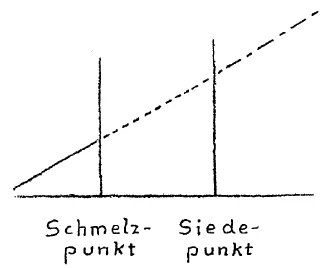
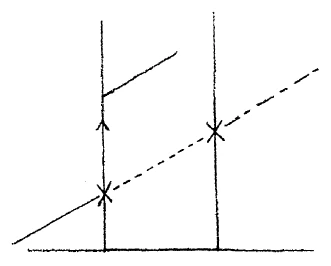
[ 2 ] Now let’s simply visualize this process. We can do this in the following way. Let’s think of the rise in temperature as a line that rises in this manner. Suppose we have reached the so-called melting point as the temperature rises. Here, the substance begins to melt. The temperature, as indicated by the thermometer, remains constant. If I continue to heat it now, the temperature rises again. One would observe that, as the temperature rises—that is, as more heat is added—the liquid in question expands. Now, the point is that we continue to heat this body, which has become liquid. Then the temperature rises again, starting “from the same point at which it was during melting” (dotted line). It continues to rise as long as the body remains liquid. We can reach a second point at which the liquid begins to boil and evaporate. We observe the same phenomenon again: the thermometer stops showing an increase in temperature—until the liquid has completely evaporated. The moment the liquid has evaporated, if we could hold the thermometer into the vapor, we would again see the thermometer rise (dashed line). You can observe here once more that during evaporation, the thermometer does not rise. So here I have a second limit at which the rise in temperature stops.
[ 3 ] Now, regarding this phenomenon that I have just demonstrated to you, I ask you to consider another one that may be very familiar to you from everyday life: If we take the solid body that served as our starting point, it is, as you know, such that it retains the shape it once had by its own nature (1).
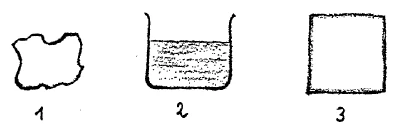
[ 4 ] If I place any solid object here, it remains as it is. If you take a liquid—that is, something that has passed through its melting point when heated—you know that I cannot place a liquid in pieces, but rather I must hold it in a vessel, and it takes the shape of the vessel and forms a horizontal surface at the top (2). If I take a gas—steam that has passed through its boiling point—I cannot contain it in such a vessel. It escapes. I can only contain such steam in a vessel that is closed on all sides; otherwise, the steam escapes in all directions (3). This applies, at least at first glance, and let us start from this superficial observation for now. And now I ask you to consider the following points with me. We are making these considerations so that, by bringing them together, we may ultimately arrive at a genuine understanding of the nature of heat. By what means, then, did I actually observe the rising “temperature”? I observed it through the expansion of the mercury. This expansion of the mercury took place in space. And even though mercury is a liquid at our average temperature, we must be clear that, even though it is contained within the vessel, the expansions in all three dimensions add up, and we observe this expansion only in one direction. After all, in the case of mercury’s expansion in all three dimensions, we have reduced this to just one dimension, so that we thus observe the rise in temperature through the expansion of a body.
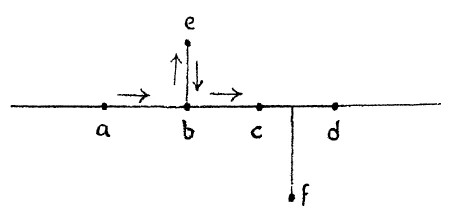
[ 5 ] Let’s start from this observation, which we have taken as our basis, and consider the following: Let’s take a line (see drawing)—of course, a line can only be imagined—and suppose that there are a number of points on this line: \(a\), \(b\), \(c\), \(d\), and so on. If you want to reach these points, you can certainly stay on this line. For example, if you’re standing here at \((a)\), you can reach point \(c\) by moving along the line. You can walk back and reach point \(a\) again. In short, if I want to reach the points \(a\), \(b\), \(c\), \(d\), I can certainly stay on the line. The situation is different if we consider point \(e\) or point \(f\). You cannot stay on the line if you want to reach points \(e\) and \(f\). You must step off the line to reach points \(e\) and \(f\). So you have to walk along the line for a while and then step off the line to reach these points.
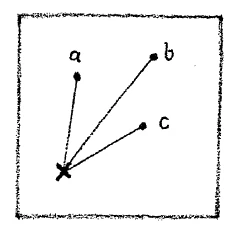
[ 6 ] Now suppose you are looking at a surface—let’s say the surface of the blackboard—and I mark a number of points on that surface: \(a\), \(b\), \(c\). To reach these points, you can certainly remain on the surface of the blackboard. If you are here \((\times)\), you can take a path that never leaves the blackboard to reach any of these points. However, if you want to remain on the blackboard, you cannot reach this point here (in front of the blackboard), which represents another point. To get there, you must leave the blackboard. In this way, it is possible to gain an intuition about the dimensionality of space by saying to oneself: For points that lie within the first dimension, it is possible to reach them through that single dimension. For points, however, that lie outside that single dimension, one cannot reach them without leaving that dimension. Similarly, one cannot reach points lying in the third dimension by traversing the plane. What happens if I speak only of the points \(e\) and \(f\) with respect to the single dimension in which the points \(a\), \(b\), \(c\), and \(d\) lie? Imagine a being that is capable of observing only a single dimension, one that has no mental image of a second or third dimension. Such a being would move only within that one dimension, just as you move in three-dimensional space. The moment this being moves point \(a\) (see diagram) to this point \((b)\) and the point then diverges and moves toward \(e\), at that very moment the content of that point would simply vanish for this being. It is not there for such a being, which could only perceive within that single dimension, the moment it leaves that one dimension. Similarly, all points lying outside the two dimensions of the plane do not exist for a being that can perceive only within the two dimensions of the plane. And if a point lying on the plane were to leave the plane, this being would have no way of continuing to track that point. It would disappear from the realm of its space. Such a being—a being capable of perceiving only within a single dimension—what kind of geometry would it possess? It would possess only one-dimensional geometry. It would be able to speak only of distances and the like within that single dimension, and of their laws. A being capable of perceiving only in two dimensions would be able to speak only of the laws of plane figures; it would possess only two-dimensional geometry. We humans, for our part, possess three-dimensional geometry. A being with one-dimensional geometry would have absolutely no way of geometrically conceptualizing what a point does when it moves beyond that single dimension. A being with two-dimensional geometry would have no way of following what a point does when it moves out of the two dimensions and ends up there (in front of the blackboard). We humans—I’ll say it again—have three-dimensional geometry. Now I might just as well—since this is, after all, what I’m actually doing, as I mentioned earlier—in the case of the expansion of mercury with three dimensions reduced to just one dimension, I might, just as I have drawn a line here in two dimensions—prompted only by the blackboard—draw it in such a way that I relate it to a spatial coordinate system. I would have an x-axis here, a y-axis, and a third axis perpendicular to them, and I would be able to draw this line as a spatial line. The moment I reach either the melting point or the boiling point, I am unable to continue drawing this line in any way.
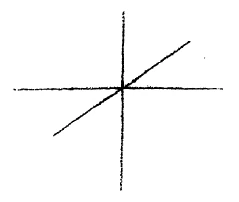
[ 7 ] Theoretically, hypothetically speaking, there would be a way to proceed. Let’s assume I could do it this way: Let’s say the rise in temperature were represented by this line (see diagram). I would then have to—while keeping certain factors constant—change other things here and could then continue from a different point at the top. That way, I would still have a point of reference to stay in my world. But I do not have such a point of reference. For when I draw this temperature curve, I must simply start from the same point at which the temperature stands after the body in question has melted or evaporated (\(x\) \(x\) in the diagram)—the same point at which it had reached when the melting or evaporation began. You can see from this that, when it comes to the melting point and boiling point, I am simply forced into a situation that can be compared to nothing other than the position of a one-dimensional entity when a point from its single dimension disappears into the second dimension, or of a two-dimensional entity when a point disappears into the third dimension. If the point re-enters and continues from the same spot—that is, if point \(a\) has been carried away to this point (see diagram), exits, and we then wait for it to return—I must continue to trace its path from the same spot within that single dimension. Strictly speaking in terms of appearance, when the heating disappears at the melting point and boiling point, I am faced with nothing other than the interruption of my temperature curve, which I must then continue from the same point after some time. But what happens to the heat during this interruption also falls outside the range in which I plot my curve—and I explicitly state that I can plot it as a spatial curve. There is, at first—and I say “at first”—an analogy between this disappearance of point a from the first dimension into the second and what happens there with the heat indicated by the thermometer while the thermometer stands still at the melting point and boiling point.
[ 8 ] The task now is to relate this phenomenon to another. You see, everything hinges on this relating of phenomena; not on devising theories of any kind, but on bringing the phenomena together so that they shed light on and explain one another. This is the difference between Goethean physics and the physics that prevails today: Goethean physics simply brings the phenomena together so that they shed light on one another, whereas modern physics—if it dares to move on to theories at all—is intent on theorizing and fantasizing about the phenomena. For atoms and molecules are, in essence, nothing other than additions and fantasies tacked onto the phenomena.
[ 9 ] Let us, then, consider another phenomenon in connection with the disappearance of the warming—as measured by the thermometer—during melting. This other phenomenon becomes apparent when we examine yesterday’s formula:
$$V=V_o(1 + 3 \alpha t + 3 \alpha^2 t^2 + \alpha^3 t^3)$$
[ 10 ] Yesterday I said that you should pay particular attention to the last two terms of this formula. It is especially important for us today to focus on \(t^3\), the cube of the temperature. Consider an ordinary three-dimensional space. In this ordinary three-dimensional space, when dealing with a mathematical solid, you speak of length, width, and height. These are, in essence, the three spatial dimensions. Now, when we heat a rod, as we did yesterday, we can observe the expansion of that rod. We can also observe the temperature of this rod. But there is one thing we cannot prevent: that the rod, as it expands, does not release heat into its surroundings—that it does not radiate heat. We cannot prevent that. It is impossible for us to conceive of thermal expansion—please pay attention to the word—in only one dimension. We can certainly conceive of pure spatial expansion—as we always do in geometry—in one dimension, namely as a line; but we can never even conceive of a thermal state that expands merely along a line. If we bear this in mind, we cannot say that the progression of heat—now conceived as a curve, not in space—is really anything other than what is symbolized by this curve that I have drawn here (see diagram). I do not encompass the entire process of heat with this curve. There is something else at play here besides what I can grasp through this curve. And whatever is at play must alter the entire nature and essence of what I am actually representing through this curve—which I use as a symbol to depict the state of heat, regardless of whether I conceive of it geometrically or arithmetically.
[ 11 ] So what is peculiar here is that if we try to grasp the thermal state—insofar as it manifests itself through temperature—using our conventional geometric lines, we cannot fully grasp it. But this has another effect. Imagine you have a line (see drawing). This line has a certain length \(l\). If you square this line, you can represent this \(l^2\) by this square area.
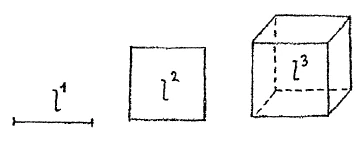
[ 12 ] Suppose you are forming \(l^3\); you can represent this third power by a cube, a three-dimensional solid. But suppose I am forming the fourth power, \(l^4\); what am I supposed to do now if I want to continue drawing? I can move from a line to a plane, and from a plane to a solid, but what can I do now to move on to the fourth power if I want to continue using the same method? There’s nothing I can do within our three-dimensional space. This applies, first of all, to mathematical spatial quantities. But we have seen that the thermal state, insofar as it is made visible by temperature, cannot be expressed at all in terms of spatial quantities. There is something else at play here. Otherwise, a thermal state that exists along a rod could be conceived of as merely extending along a rod. But that is impossible. The consequence of this is that, if I proceed consistently, I am unable to conceive of the powers of \(t\) in the same way that I conceive of the powers of spatial quantities. I am unable to think of the power of \(t\) in the same way that I think of the power of \(l\) or any other mere spatial quantity. And if, for example—I want to treat this only hypothetically for now—if, for example, I had only the first power of \(t\), and this could not be expressed as a line, then the second power \(t^2\) could not be expressed as a plane. And the third power, \(t^3\), certainly could not be expressed by a spatial quantity. Just as, with mathematical spatial quantities, I only emerge from space after forming the third power, I might already emerge from our space at the second power, and no longer be within it at the third.
[ 13 ] So imagine that you have to create a mental image of \(t\) that is of a completely different nature than spatial quantities. You would have to conceive of the ordinary \(t\) as something squared—as a second power—and you would have to conceive of the squared \(t\) as a third power and the cubed \(t\) as a fourth power, thereby stepping outside our ordinary space. Think about it: this formula would then take on a very special character. Then the last term in this formula would force me to step outside of three-dimensional space. I would then, simply by doing the calculation, be compelled to move beyond three-dimensional space with the last term of my formula. I’m saying this purely hypothetically—as a possibility, as one does with mathematical formulas. Isn’t it true that when you look at a triangle and observe that it has three angles, you initially have an imagined triangle? Because thinking is too convenient, you draw it to make it more concrete. But the drawing has nothing to do with it. You’ve stated: The sum of the angles is 180°. Or: In a right triangle, the square of the hypotenuse is equal to the sum of the squares of the two legs. That is something one initially treats abstractly, just as I have now treated \(t\) to a power. Now let’s go back and look at what we’ve observed as a phenomenon. That’s how it’s done in geometry: If I need to observe a triangle on a bridge or anywhere else, what I’ve thought about the abstract triangle is verified. What I had in mind regarding the abstract \(t\) initially—we want to get closer and closer to reality, but step by step—bears a certain resemblance to what is depicted in melting and evaporation. I was unable to fit melting and evaporation into the three spatial dimensions. I can only incorporate them by stopping to draw the curve and then continuing it again. If the conditions I set forth earlier hold true, then I would also be compelled to step outside of three-dimensional space when dealing with the third power—the cube of temperature.
[ 14 ] You see, I have shown you a path that must be followed in a certain way if one wishes to attempt a simple synthesis of the phenomena that present themselves in relation to the nature of heat, in order to gain from this synthesis something similar to what we achieved in the previous course on the nature of light. The physicist Crookes started from entirely different premises. And it is remarkable that, through his considerations, he nevertheless arrived at a result similar to what we have now presented merely as a hypothesis—the reality of which we will then tackle in the following considerations. He, too, comes to regard changes in temperature in general as something related to a kind of fourth dimension of space. It is important to point this out today for the reason that the relativists, with Einstein at the forefront, by going beyond the three dimensions of space, find themselves compelled to turn to time and designate it as the fourth dimension, so that in Einstein’s formulas, time is generally designated as the fourth dimension, whereas Crookes found himself compelled to regard the decrease or increase in the state of heat as the fourth dimension. This is a historical aside.
[ 15 ] Regarding these phenomena, I would now like you to consider what I mentioned earlier. I said: I can lay down an ordinary solid object, and it will retain its shape—that is, it has a definite outline. A liquid, on the other hand, I must pour into a vessel. It always forms a level surface and, moreover, takes on the shape of the container. This is not the case with gases or vapors. They expand in all directions. To confine them, I must enclose them in a container that is closed on all sides. This container, closed on all sides, gives them their shape, so that with a gas, I have a shape only when I enclose it on all sides.
[ 16 ] If I have a solid body, it has its shape precisely because it is a solid body. It has it, so to speak, by its very nature. I will now omit the liquid as an intermediate state and describe the solid and gaseous bodies as opposites. The solid, so to speak, provides itself with what I must add to the gas: walls on all sides. Now, however, something peculiar occurs with the gas. If, instead of keeping the gas inside, you enclose it in a smaller vessel—the same volume of gas, by compressing the walls on all sides—then you must press, you must exert pressure.
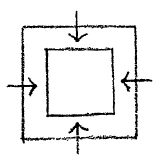
[ 17 ] This means nothing other than: They must overcome the pressure of the gas. They must contend with pressure against the walls that form the container. We can therefore say: A gas that tends to escape in all directions is held together by the resistance of the walls. This resistance exists by its very nature because I have a solid body. So, without theorizing at all but simply considering the very ordinary facts, I can define a polar opposition between gas and solid in such a way that I say: What I must add from the outside to the gas is already present in the solid by its very nature. But now, by cooling the gas—returning to the boiling point—you can obtain the liquid from the vapor; by continuing to cool it down to the melting point, you can obtain the solid from the liquid. That is to say, you can simply, through processes related to the nature of heat, bring about a situation where you no longer need to impart shape from the outside, but rather the shape forms itself from within. Since I have done nothing other than alter the thermal state, it goes without saying that this formation is somehow connected to the change in the thermal state. In a solid, there is something present that was not yet present in the gaseous state. If we place any wall against a solid body, the solid body does not initially exert pressure on that wall unless we ourselves apply pressure. If we place a solid wall against a gas, the gas always exerts pressure on the solid wall. As you can see, this brings us to the concept of pressure, and we must again relate the emergence of this pressure to the thermal state. We must therefore say: We must seek a specific relationship between the structure of the solid and the counteracting force exerted by the wall pressure against the gas’s tendency to spread out in all directions. If we investigate these relationships, we can hope to truly penetrate the nature of the connection between heat and bodies.