

Second Scientific Course
The warmth at the boundary
between positive and negative materiality
Insights from Spiritual Science on the Development of Physics
GA 321
4 March 1920, Stuttgart
Translated by Steiner Online Library
Fourth Lecture
[ 1 ] You may have noticed that these considerations essentially hinge on a certain objective. We want to compile a series of phenomena from the field of thermodynamics in such a way that we can ultimately determine what thermodynamics actually consists of. So far, we have essentially familiarized ourselves with certain relationships that we may encounter through phenomena within the field of thermodynamics, and we have specifically observed the relationship between thermodynamics and the capacity of bodies to expand. We then attempted, first of all, to establish some mental images of the form of a solid body, a liquid body, and an air- or gas-like body. And I have also spoken about the relationships between thermodynamics and these transformations that can be brought about in bodies: the transition from the solid to the liquid, and to the gaseous or vaporous state. Now I would like to demonstrate to you the phenomenon that will show us what conditions arise when we are dealing with gases and vapors—which, as we already know, have a certain connection to the nature of heat in that we can induce the gaseous state through heat, and that, in turn, through a certain change in temperature, we can produce a liquid from a vapor and gaseous body into a liquid. You know that when we have a solid body, it is impossible for this solid body to penetrate another solid body. Observing such simple, elementary relationships is extremely important if we wish to delve into the true nature of heat. What is about to be demonstrated here will show how the water vapor we generate here first passes over into this flask and then remains inside it. So we will gradually fill this flask with water vapor and will now introduce another vapor from the other side, the formation of which you can observe because it is colored here. (The experiment is demonstrated.) So you see, even though we had filled the flask with water vapor, the other vapor entered the space filled with water vapor from the other side; that is to say: one gas does not prevent another gas from entering the same space in which one is already present. Let us also note this phenomenon as such for the time being; let us therefore be clear that gaseous or vaporous substances are permeable to one another to a certain extent.
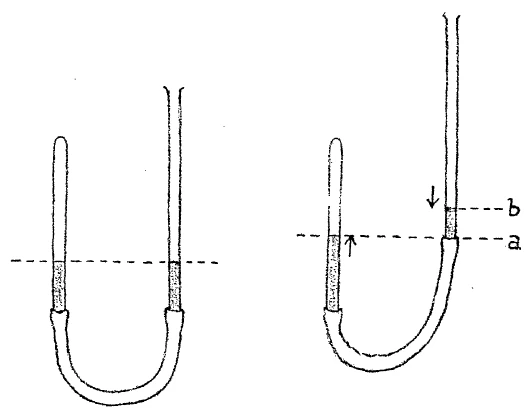
[ 2 ] I will now demonstrate another phenomenon to you, which is intended to show you yet another connection between the nature of heat and other facts. Here in the left tube, we have air that is simply in the same state as the outside air that constantly surrounds us. I must mention that this outside air, which constantly surrounds us, is under a certain pressure—our normal atmospheric pressure—which, of course, also constantly exerts pressure on us. So we can say: The air we have in here on the left is under exactly the same pressure as the outside air itself, as evidenced by the fact that the mercury columns on the left and right remain at the same level—from the fact that the mercury columns on the left and right are at the same height, you can see that here (on the right) the outside air—which still has free access from above—is under exactly the same pressure as the air here in the glass tube closed on all sides (on the left). Let us now induce a change by increasing the pressure exerted on the air in the left glass tube. We can achieve this by lifting the right tube here (drawing on the right). By raising this tube, we have added to the normal atmospheric pressure on the left the pressure resulting from the raised mercury column. So I have simply added the weight of the mercury column from here \((a)\) to here \((b)\). However, because we have in this way increased the pressure exerted on this air here by an amount corresponding to the weight of this mercury column, we see that the volume—as it is called—in the other glass tube has decreased, so that we can say: When we exert increased pressure on a gas, its volume decreases. We must note this as a further phenomenon; we must note that volume and the pressure exerted on the gas are inversely proportional to one another. The greater the pressure, the smaller the volume; the greater the volume becomes, the lower the pressure exerted on the gas must be. From this phenomenon, we can derive the equation that the volume \(V_1\) is inversely proportional to the volume \(V_2\), just as the pressure \(P_2\) is inversely proportional to the pressure \(P_1\)
$$V_1:V_2 = P_2:P_1$$
from which it follows:
$$V_1 \cdot P_1 = V_2 \cdot P_2$$
[ 3 ] This therefore yields a relatively general law—we can, after all, only speak of relative laws; we will see why in later discussions—this yields, for the relationship between volume and pressure in gases, that the product of volume and pressure remains constant for gases “if we keep the heat constant.” Such phenomena must, as mentioned, be brought together in order to approach the nature of heat. Since we wish, through our considerations, to lay a foundation for the pedagogical treatment of the subject in school while also gaining insights, the task at hand is, on the one hand, to understand the way of thinking in contemporary physics and, on the other hand, to familiarize ourselves with what must be done to overcome the various I might say, obstacles that prevail in contemporary physics and stand in the way of a true understanding of the nature of heat.
[ 4 ] If you consider that, in addition to the nature of heat, we have essentially been dealing with volumetric expansion—that is, with changes in space—and with changes in pressure, then you must realize we have encountered—for I must speak as precisely as possible to achieve our goal, which is not usually the case in this field—mechanical phenomena in the course of our examination of the nature of heat: changes in space, changes in pressure. We have encountered mechanical phenomena. Now, for the development of modern physics, the fact remained that mechanical processes occurred when one examined the nature of heat. These mechanical phenomena became, so to speak, the very basis on which thermal phenomena were observed. The nature of heat is, so to speak, left in the realm of the unknown, and one essentially considers the mechanical processes that take place under the influence of heat. By setting aside the sensation of heat as something supposedly subjective, one observes—in the change of the thermal state—the expansion, say, of mercury, that is, something that belongs to the realm of mechanical phenomena. We then examine the dependence of the thermal state—say, of a gas—on pressure conditions, which we will explore further, and here again we find ourselves dealing with the fact that we are actually observing something mechanical and, so to speak, setting the nature of heat aside. We saw yesterday that there is actually a good reason why this aspect of thermal behavior has been set aside. For we have seen how, the moment we introduce it into the calculation, this aspect of thermal behavior causes difficulties for ordinary calculations—for example, we cannot treat a cube of temperature in the same way as an ordinary cubic volume. And since conventional thermodynamics has been unable to make sense of the powers of temperature, it has simply omitted the second and third powers of temperature from the expansion formula, as I have already mentioned in earlier discussions.
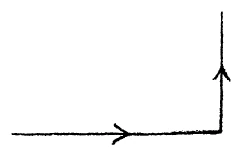
[ 5 ] Now, however, you need only consider that, in the realm of external nature, the state of heat always arises in connection with external mechanical processes—above all, spatial processes. The spatial processes are already there. Heat then manifests itself in connection with these spatial processes. This means that, compelled by this simple consideration, we must treat heat in the same way that we treat that spatial line which leads us from the first power of an extension to the second power of extension. If we consider the first power of extension—the line—and wish to move on to the second power in our consideration, we must go beyond the line. We must therefore add one dimension to the other; we must somehow transition from the first power to the second. We must conceive of the line of the second power quite differently than we conceive of that of the first power. But we must do exactly the same thing when we consider a state of temperature. In a sense, the first power is present in extension. The change in temperature is something that, in relation to extension, appears just as the second principle appears here in relation to the first principle. I have no choice but to draw the diagram in such a way that, by adding the change in temperature to extension, I add the ordinate axis to the abscissa axis. But this means that we are compelled to treat everything that arises from the nature of heat—that is, the change in temperature—not as a first power, but from the outset as a second power, and the second as a third. And once we have the third power of temperature, we can no longer remain within our ordinary space. A simple line of reasoning—which, admittedly, must be carried out using somewhat subtle concepts—shows you that it is impossible, when we consider the heat prevailing in space—that is, in the third dimension—to remain within the third dimension of space. It shows you that the moment we deal with the three dimensions of space, we are compelled, when considering the effect of heat, to step outside of space itself.
[ 6 ] Modern physics, however, sets itself the task of remaining within three-dimensional space in order to explain phenomena. And by setting itself this task, it must—since the essence of heat cannot be found within three-dimensional space—pass over the nature of heat. It can only grasp the nature of heat through its manifestations in three-dimensional space.
[ 7 ] You see, this is a very important point where, in a sense, even within inorganic natural phenomena—physical phenomena—a kind of Rubicon must be crossed on the path to a higher worldview. And it must be said: Precisely because so little effort is made to achieve clarity on these points, this clarity is so lacking in the realm of our higher worldview. Just imagine for a moment: if physicists were to teach their students that one must simply step outside the ordinary spatial conditions in which mechanical processes take place by observing thermal phenomena, then these physics teachers would instill in those people who are regarded as thinking individuals—because they have acquired a grasp of something like physics— they would create in them a mental image of the idea that one cannot truly understand physics without stepping beyond three-dimensional space. And then it would be much easier to establish a higher worldview among the people of the world. For these people of the world would say—even if they have not studied physics: “We cannot judge this, but those who have studied physics know that, through physics, one must first rise from space to conditions other than those that can take place within space itself.” That is why so much depends on our arriving at such conditions in physics as will be attempted here in these considerations. Otherwise, it would always turn out that, on the one hand, an attempt would be made to spread a worldview based on spiritual foundations among the general public, only for physicists to then assert: “We explain all phenomena through purely mechanical processes.” — This leads people to say: “Yes, there are only mechanical processes in space; life must also be a mechanical process, mental processes must also be merely mechanical processes, and spiritual processes as well.” — “Strict science” wants nothing to do with any spiritual foundations of the world. And “strict science” exerts a particularly intense authority precisely because people do not know it. For what one knows, one usually judges for oneself and does not allow it to impose an authoritative power upon one. That which one does not know, one usually succumbs to as an authority. If more were done to popularize so-called “rigorous, exact science,” then the authoritative powers of certain people who, behind closed doors, possess this “exact science” would diminish significantly.
[ 8 ] Over the course of the 19th century, another fact has been added to those we have already observed, is the other one I have also already hinted at, which consists in the fact that not only do we see mechanical processes occurring in the course of phenomena involving heat, but that we can also, first of all, convert heat into mechanical processes—as you can see in the ordinary steam engine, where heating takes place and the mechanical process of motion occurs; and conversely, that mechanical processes—friction and the like—can in turn be converted into heat, in that the mechanical process, as it were, causes heat to be generated. Thus, thermal processes and mechanical processes can be converted into one another. Today we will first take a preliminary look at the matter and then examine individual phenomena that fall within this field.
[ 9 ] It was subsequently discovered that not only thermal processes, but also electrical processes—processes that fall within the realm of chemistry—can be converted into mechanical processes. And from this developed what came to be known, in the course of the 19th century, as the mechanical theory of heat. This mechanical theory of heat thus has, as its first fundamental principle: heat and mechanical work, let us say, can be converted into one another. Now, we must first take a closer look at this statement. I really cannot spare you from having to examine the elementary components of the propositions that belong to the field of physics. If, precisely in these crucial considerations, we were not willing to seek out the elementary components of these propositions, we would have to forgo achieving any clarity at all—especially in the field of thermodynamics, which is a crucial one. We must therefore raise the question: What does it actually mean when I demonstrate somewhere that heat, which I generate—as in a steam engine—produces external motion, that is, external mechanical work? What does that mean when I transform it into the judgment: “External mechanical work has been performed by heat”? Let us clearly distinguish between what we can establish as facts and what we have then appended to these facts as a judgment. We have established that a process which manifests itself as a thermal process subsequently reveals itself through a process of work, through a mechanical process. Now the judgment has been attached to this: the thermal process—heat as such—has been transformed into the mechanical process, into mechanical work.
[ 10 ] Yes, when I walk into this room and find a temperature in it that is comfortable to me, I walk in and say to myself inwardly—perhaps quite unconsciously, without actually saying it out loud: “I feel comfortable in this room.” I sit down at the desk and write something. This came about as a result of what happened before—I entered the room, and the warmth had an effect on me. What I wrote down came about afterward. In a certain sense, I could say to you: Well, if I had found basement-like cold here, I would have taken off and would not have carried out this work—the work of writing down what subsequently emerged. If I were now to add the following judgment to this fact: “The warmth that was conveyed to me was transformed into the work that subsequently became visible”—then I have evidently omitted something from my assessment. I have omitted everything that I alone could have accomplished. But if I want to capture a complete reality in my judgment, I must include everything I have omitted. The question now arises: If, in the entire equivalent sequence of events, there is heat that I have generated—as in the heating of a steam boiler—and work subsequently arises—the locomotion of the locomotive—and I simply say, “the heat has been transformed into work,” have I not perhaps made the same mistake here as I do when, in the preceding judgment, I simply speak of the transformation of the state of heat into the effect—which, however, occurred only because I myself intervened? It may even seem trivial to draw attention to such a matter, but this very triviality is overlooked and forgotten throughout the entire mechanical theory of heat. And this is of extraordinary importance. What matters is that one connects two things: first, that at the moment one crosses over from the sphere of mechanical processes into the sphere where heat acts, one must leave three-dimensional space altogether. And second, that simply by observing external natural phenomena, one may not have what one has in that case as an intervening factor when heat is transformed into my written work. When heat is transformed into my written work, then I can observe in my external physical manifestation that something has intervened. But if I am simply faced with the fact that I must leave three-dimensional space whenever heat is transformed into external output for me, then I can still say: Perhaps the most important thing leading to this transformation takes place outside of three-dimensional space. That which would correspond to my own intervention takes place outside of three-dimensional space. And I commit the same superficiality when I simply speak of the conversion of heat into mechanical work as I do when I speak of the conversion of heat into my written work, forgetting in the process that I myself am involved.
[ 11 ] This, however, has a very significant, universal consequence, for it compels me to conceive of external nature—even in its inanimate, inorganic manifestations—as guided by a being that does not express itself within three-dimensional space, but rather, in a sense, reigns beyond three-dimensional space. And this is a decisive factor with regard to the observation of the nature of heat itself.
[ 12 ] Now that we have identified this as a fundamental component of our perception in the realm of heat, we can look back a little at what we have already hinted at: the human being’s own relationship to the nature of heat. We can compare other spheres of perception with the sphere of perception of the nature of heat. I have already pointed out that, for example, when we perceive light, we see this perception of light and color as bound to separate organs that are simply embedded within our organism, so that we cannot say that we face the nature of color or light with our entire organism, but rather that we face the nature of light or color with only a part of our organism. The same is true of acoustic phenomena, of sound phenomena. We face the realm of sound with a part of ourselves—the organs of hearing. We face the realm of heat with our entire organism. This, however, determines our relationship to the realm of heat. And if we look more closely, if we try to transform this fact—I would say—into an understanding of the human being, then we must say: We are, in fact, this realm of heat ourselves. Insofar as we move about here in this room as human beings, we are indeed this thermal entity ourselves. The moment you were to imagine the temperature rising by a few hundred degrees, you could not be identical with that temperature state—any more than if you were to imagine the temperature dropping by a hundred degrees. Thus, the thermal entity belongs to that which we are constantly immersed in—which we experience as a self-evident reality—but which we do not bring into our consciousness. Only when deviations from the normal state occur do we become aware of them in some form.
[ 13 ] Now, building on this fact, a second one can be observed. It is this: If you approach a warm object in any way and observe its state of warmth with your body—you can do this with your fingertip, or even with the tip of your toe; you can do it at another part of your body, say, with your earlobe—in a sense, you can perceive the state of warmth with your entire body. But there is something else you can perceive with your entire body. You can perceive what is exerting pressure on your body. And here, too, you are not bound in the strict sense—as you are, for example, with color perception, which is tied to the eye—to a specific part of your body. It would, of course, be very pleasant if, for example, at least the head were exempt from this perception of pressure. Then we wouldn’t have to subject it to discomfort and bear the consequences. We can say: There is an intimate connection in the nature of our relationship to the outside world between sensations of warmth and sensations of pressure. Today we have spoken of pressure conditions in relation to changes in volume. We now return to our own organism and find that thermal conditions are intimately related to pressure conditions. We must certainly take this fact into account as a basis for what follows.
[ 14 ] But there is something else we must preface our subsequent considerations with. As you know, especially in the standard textbooks on physical and physiological processes, quite a lot of emphasis is placed on the fact that we have certain organs—or that we ourselves possess the capacity—to perceive ordinary sensory qualities. We have the eye for color, the ear for sound, the organ of taste for certain chemical processes, and so on; distributed throughout our entire organism, we have, so to speak, a unified organ of heat, but also a unified organ of pressure. Now, attention is usually drawn to the fact that we also perceive other things for which, as they say, we have no organs: magnetism, electricity—which we perceive only through their effects, which, so to speak, remain external to us, which we do not perceive directly. It is also said that if our eye were not sensitive to light but to electricity, it would, when looking at a telegraph wire, perceive the flowing electricity within it. It would perceive the electricity not merely through its effects, but directly, just as it perceives color and light phenomena. We cannot do that. We can therefore only say: Electricity, for example, is something for which we have no organs for direct perception. There are thus natural qualities for which we have organs of perception, and natural qualities for which we have no organs of perception. — So they say.
[ 15 ] The question now is whether, for those who view phenomena with a somewhat more open mind than those who arrive at this judgment, something else might not emerge after all. You all know how closely connected what we call our ordinary passive mental images—through which we perceive the world—are to the impressions of the eye and the ear, and to a lesser extent to what we perceive through taste and smell. Just try, drawing purely from the stock of language, to distill the essence of your higher life of imagination, and you will see that even in the words we use to represent our concepts, one can still perceive everywhere the remnants of the higher sensory qualities. Even when we utter the very abstract word “Being,” its formation is connected to “I have seen.” I call “being” that which is, that which I have seen. The “having seen” is still contained within “being.” And without falling into materialism—we will see why there is no need to do so—one can say that our world of imagination is actually a kind of filtering of seeing and hearing, and to a lesser extent of smelling and tasting, since fewer of these sensory perceptions are contained within our world of imagination. Because our consciousness is intimately connected with these higher sensory qualities of ours, our consciousness also takes on this passive, higher nature of imagination.
[ 16 ] However, within our soul being, we also have our will coming from the other side, and you will recall how often I have emphasized, particularly in my anthroposophical lectures, that in relation to the will, the human being is actually asleep. Fundamentally, the human being is awake only in the realm of his higher passive mental images. After all, you perceive what you want only through these mental images. You have the mental image: “I am picking up this glass.” Yes, the elements of this mental image are indeed something that contain the remnants of external perceptions. You imagine something that definitely belongs to the realm of the visible. Even when you think it, you have the afterimage of the visible. You cannot obtain such an afterimage in a direct way from the actual volitional process—from what is happening as you extend your arm, grasp the glass with your hand, and lift it. This is a process that remains entirely in the unconscious—what takes place there between consciousness and the finer processes in the arm. This remains as unconscious as the states of sleep into which we fall—from falling asleep to waking up—remain unconscious to us. But can we deny that these processes, even if we do not perceive them, are nevertheless there? These processes must surely be intimately connected with our human being, for it is we who lift the glass. We are thus guided, within the realm of our human being, from what lives directly in consciousness to the processes of the will that, so to speak, extend beyond the ordinary realm of consciousness. Let us assume that everything lying above this line is within the realm of consciousness. What lies below—that is, what sinks into the processes of the will—let us consider to be outside of consciousness. Let us now move from there to the realm of external natural phenomena: We find our eye intimately connected to the phenomena of color, something we survey with our consciousness; we find our ear connected to the phenomena of sound, something we survey with our consciousness. Taste and smell are obscure, yet still, in a dreamlike way, comprehensible to consciousness. Here again we have something that certainly belongs to the realm of the conscious, yet is intimately connected with the external world.
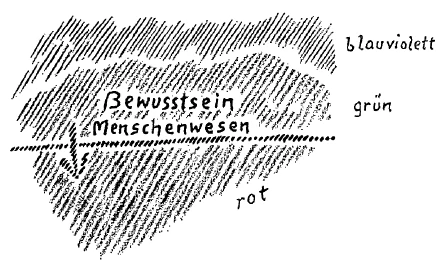
[ 17 ] But as we turn to magnetic and electrical phenomena, that which is at the heart of electricity, magnetism, and so on eludes us—it lies beyond what we can grasp through the direct connection of our senses with nature. It eludes us. This is precisely where physicists and physiologists say: We have no organs for this; it can only be perceived externally; it separates itself from us; it is out there (see diagram, above). — We thus have a realm that we approach when we turn toward the external world. There we find phenomena of light and heat. And what about electrical phenomena—where do they slip away from us? We no longer sense the connection to our organs. As we process light and sound phenomena, we have filtered impressions within our mental image. But when we go down there (below, red), our very being slips away from us into the will.
[ 18 ] I’m going to say something paradoxical now, but think it over until tomorrow. Imagine that we aren’t living human beings, but living rainbows, and that our consciousness is situated right in the green part of the rainbow—the spectrum. With our unconscious, we would border on one side with the blue-violet of the rainbow, which would fade away from us in that direction like electricity; on the other side, we would border on yellow and red, which would fade away from us, just as our will fades inward. If we were rainbows, we would not perceive green, just as we do not perceive what we immediately are in an immediate way; we experience it. But we would border on our own inner self by, so to speak, moving from the green into the yellow. We would say: I, the rainbow, am approaching my redness, which I no longer perceive as my inner self; I, the rainbow, am approaching my blue-violet, which, however, eludes me. I am right in the middle of it. — So if we were thinking, living rainbows, we would sit there within the green, with the blue-violet pole on one side and the red-yellow pole on the other—just as we now, as human beings with our consciousness, sit somewhere, with on one side the qualities of nature that elude us, such as magnetism and electricity, and on the other side the inner qualities that elude us, such as the manifestations of the will.