

Second Scientific Course
The warmth at the boundary
between positive and negative materiality
Insights from Spiritual Science on the Development of Physics
GA 321
5 March 1920, Stuttgart
Translated by Steiner Online Library
Fifth Lecture
[ 1 ] I would have liked to demonstrate a few more experiments to you today that would supplement the series of facts we need to achieve our goal, but that is not yet possible today, and so I must structure the lecture somewhat differently than I had intended—partly because we were unable to get the apparatus into the necessary condition, and partly because we could not obtain any alcohol, just as we lacked ice yesterday.
[ 2 ] So I will essentially continue with the discussion I began yesterday. You need only look back at all the facts we have examined in order to gain an overview of how various bodies behave in relation to heat, and you will see that certain typical phenomena present themselves to us in such a way that we can say: There is an expression in these phenomena that must be related to the nature of heat—which is initially unknown to us—to its relationship to the pressure that can be exerted on any body, to the deformability that a solid body, for example, can assume, and precisely to the degree of heat, to the state of heat, as well as to the size of the spatial volume, to the volume. We can indeed observe how, on the one hand, solid bodies liquefy. We can see how, during the liquefaction of a solid body, an increase in temperature cannot be detected externally by a thermometer or temperature gauge, so that, in a sense, the increase in heat comes to a standstill until the liquefaction is complete. Once we are dealing with a liquid, however, it continues to expand as heat is added. On the other hand, we can observe how a liquid transforms into vapor or gas, and how the same phenomena—the apparent disappearance and reappearance of the temperature increase—occur once the entire body has transitioned to the gaseous state. Here we have—and you can visualize for yourselves what this entails—a series of facts that we can, so to speak, observe with our eyes, our senses, and with instruments. Then, yesterday, we drew attention to certain inner experiences that a person undergoes under the influence of the principle of warmth, but which they also undergo under the influence of other sensory qualities, such as light and sound, and which they experience in connection with external phenomena such as magnetism and electricity—phenomena that do not give rise to a true sensory perception, at least not directly, because, as conventional physics states, humans lack the organs for this. After all, we perceive the effects of electricity and magnetism only indirectly, by observing how magnetic bodies attract other bodies, and we observe a wide variety of effects in electrical phenomena. However, we do not possess a direct faculty of perception for electricity and magnetism, as we do for light and sound.
[ 3 ] We have thus particularly brought to mind—and must especially note—that our actual passive mental images, through which we cognitively bring the world to mind, are in fact distilled, higher sensory perceptions. You will see, wherever you examine, that you possess such higher mental images. You will see how, ultimately—I even mentioned this yesterday in connection with the concept of being—your higher mental images are, in retrospect, distilled perceptions of the higher senses. You can still hear the echoes of sounds in the terms we use for these higher mental images; you can still see, everywhere, the light that shines through them. Only with a very specific series of mental images can you not do this, as you will soon notice. You cannot do so with strictly mathematical mental images. With these mathematical mental images—I mean, insofar as they pertain to mathematics—there is no way to trace them back to anything auditory or visible. Of course, we must not confuse the two here. People are immediately reminded of sound when they speak of the frequencies of sound waves. That is not what I mean here, of course. I mean everything that is gained through mathematical mental images and that is purely mathematical—for example, the content of the Pythagorean theorem, or that the sum of the angles of a triangle is 180°, or that the whole is greater than its parts, and so on. For what underlies these purely mathematical mental images does not ultimately lead back to what has been seen or heard; rather, if one traces it to its source, it actually leads back to impulses of the will within us, however strange that may seem at first. You will see everywhere—if you truly acquire a kind of psychology of these things—that when people draw a triangle —the external triangle is, after all, merely a sensory representation—that in the mental image they form, they envision the threefold unfolding of their will as it turns the corner three times: a threefold unfolding through the movement of the hand, or through walking, or through turning around. What you have there as mental images of the will, you actually carry over into purely mathematical concepts. That is, after all, the real difference between other concepts and mathematical concepts—the very difference that causes Kant and other philosophers, for example, so much of a headache. You can distinguish the inner compulsion of mathematical mental images from the merely empirical, the non-compelling nature of other mental images. This difference stems from the fact that mathematical mental images are so closely bound to ourselves that we carry our volitional being into them and incorporate into mathematical operations only what we experience within the sphere of the will. That is why the results appear so certain to us. And what we do not feel so closely connected to ourselves—but rather perceive only through an organ located in a particular place—appears to us as uncertain and empirical. That is the real difference. Now I must draw your attention to the fact that when we descend into this sphere of the will—where, in the realm of the abstract, the sum of our purely mathematical and geometric mental images begins to dawn—we enter the realm of the will, which, in its actual course as it reigns within our organs, is as unknown to us internally as electricity and magnetism are unknown to us externally. And I tried to illustrate this yesterday by asking you to create a mental image of yourself as a living, thinking rainbow that was holding your consciousness in the color green—thus not perceiving the green itself, but plunging on both sides into the unknown. I compared red to plunging into the unknown sphere of the will, and blue-violet to plunging outward into the electrical, magnetic, and similar spheres.
[ 4 ] Well, at this point in our course, I introduced this—I would say—psychological-physiological perspective because it is absolutely essential that, in all future physical considerations, what is actually physical be traced back to the human being. It is impossible for the confusion that physics exhibits today to be resolved within physics itself unless we reconnect with the human being. We will see this as we continue our examination of thermal phenomena. But this reconnection with the human being is—at least for today’s way of thinking—not all that easy, precisely because people today really do not know how to bridge the gap very well between what they perceive externally in the world of spatial phenomena—or, more generally, external sensory phenomena—and what they experience internally. There is such a dualism today between everything we acquire as knowledge about the external world and everything we experience inwardly that this bridge is extraordinarily difficult to build. But this bridge must be built, precisely for the sake of physical science. Therefore, we must refer—more for illustration than for explanation—to a phenomenon within the human being itself, through which it becomes at least somewhat comprehensible how we should actually approach the consideration of such weighty physical phenomena as those of the nature of heat. I would like to draw your attention to the following:
[ 5 ] Suppose you are memorizing a poem. As you memorize this poem, you will first need to bring to mind the mental images underlying it, and at first you will always be very tempted, as you recite the poem, to let those mental images play out in your mind. But you will also know that the more often you recite the poem—especially if some time has passed in between—there comes a time when you can, to a certain extent, spare yourself the need to let those mental images play out internally with the same intensity as you did at first. And there may come—though this is often looked down upon, let’s discuss it anyway—at least approximately, asymptotically, I would say, a time when we are able to recite the poem mechanically, without giving further thought to its content. Certainly, because we are human beings, we will be reluctant to approach this stage of purely mechanical recitation simply because of our state of mind, but it is at least conceivable that we might reach a point where we no longer need to think at all; rather, once we begin with the first line, the poem flows out without us having to think much. Do you sense that this is a final state toward which one approaches, just as the asymptote approaches the hyperbola? But this leads you to the realization that, when we recite a poem, we are essentially dealing with the convergence of two different activities of our organism: with the mechanical unfolding of certain processes within our body and with our mental images accompanying this mechanical unfolding. In other words, with something that we can quite rightly describe as a mechanical, external process taking place in space, and, on the other hand, with something that, as a mental phenomenon, entirely eludes the very essence of space.
[ 6 ] If you now—in your mind, at least—focus solely on what is happening mechanically and physically, for example, when a poem is recited in a language you do not understand, then you are observing a mechanical, physical process. The moment you think about what inwardly accompanies this mechanical process, you have a psychological element that you cannot bring into the realm of spatial phenomena. You cannot project the thoughts with which the reciter accompanies his recitation out into space in the same way as the mechanical processes of speech and the flow of words.
[ 7 ] I would now like to draw your attention to an analogy: If we track the heating we apply to a solid until it reaches its melting point, the temperature keeps getting higher and higher. We can observe this on the thermometer; we see that the thermometer stops rising until the solid has melted. Once it has melted, the thermometer begins to rise again. It is, of course, impossible at first to track, by means of the thermometer, what is happening with the thermal properties of the solid while it is melting. There is now an analogy between what we can observe externally with the thermometer—the external physical processes—and what we can observe physically in the sequence of words; and there is an analogy between what eludes us—what the reciter experiences in his mental image—and what happens to this thermal entity while the melting is taking place. You see, here we have an example where we can—at least initially—draw an analogy between an external observation and something within the human being. We do not have such obvious examples of this bridging in other areas of human activity as we do in speech, because in the case of human beings, on the one hand—even if at an almost infinite distance—we have the possibility of merely rattling off what we have memorized mechanically, and on the other hand, we do not rattle it off but, without speaking, merely think inwardly, whereby it withdraws from the realm of space. In other spheres, we do not have this human activity; we do not have the opportunity to actually see how one thing transitions into another. Above all, this is not so easy for us when we want to investigate the nature of heat, because there we must already conduct physiological and psychological investigations into how heat behaves once we have absorbed it into ourselves.
[ 8 ] Yesterday, just to illustrate a point, I told you: I walk into a room that is comfortably warm. I sit down and write something. I cannot easily find the connection between what I experience when I enter the warm room and what is happening inside me as I write down my thoughts. I cannot easily establish this connection, just as I can establish the connection between the sound of speech and inner thought. That is why it naturally becomes difficult to find, through inner experience, anything that would correspond in purely inner experience to the external experience of warmth. Nevertheless, the point is that we are gradually approaching mental images that can lead us further along this path. And here I would first like to draw your attention to something you know from anthroposophy.
[ 9 ] You know, when we attempt to deepen our thoughts through meditation—to deepen them in terms of inner intensity—that is, when we train our thinking in such a way that we repeatedly return to the state where we know we are engaging in inner soul activity without relying on the body—then this does not happen without our entire inner soul life being transformed. One cannot enter a higher realm of human soul life with ordinary abstract thoughts. The thoughts then become pictorial, and one must first translate them back from the imaginative element into our abstract element if one wishes to present them to those who are unfamiliar with the imaginative. But you need only look through a single presentation that strives to be as objective as possible—such as my *Outline of Esoteric Science*, which is precisely why it so shocked the purely abstract-minded. One must make an effort to translate things into the pictorial realm, as I had to do to the utmost degree in my descriptions of Saturn and the Sun. There you will find purely pictorial mental images interwoven with the abstract. It is very difficult for people to transition into the pictorial realm, because there one can no longer translate things into the abstract. The underlying reason is that when we think abstractly—when we operate within the narrow mental images to which people today are most accustomed and which are most frequently applied in science, particularly in the natural sciences—these are, in fact, mental images for which we need our physical bodies. For example, we absolutely cannot do without the body if we want to think through what is today presented as the laws of physics in physics textbooks. There we must think in such a way that we use our body as an instrument. When one ascends into the sphere of the imaginative, then all abstract mental images must be transformed, because there one no longer uses the body for the inner life of the soul.
[ 10 ] So now you can look at—I would say—the entire realm of imaginative thinking. Within ourselves, this realm of imaginative thinking no longer has anything to do with what is still bound to our external physicality. We ascend into a region where we experience ourselves as soul-spiritual beings, without this having anything to do with our external physicality. But in other words, this means: At the moment we ascend into the imaginative, we step out of space. We ourselves are then no longer in space.
[ 11 ] You see, this has a very significant consequence. In the previous course, I had to draw a strict distinction between everything that is purely kinematic and those cases where mechanical factors—such as mass—come into our consideration. As long as I stick to the kinematic, I need only sketch things out mentally on a blackboard or a sheet of paper, and I get a visualization of what I can conceive in the realm of motion, spatial volume, and so on. But I must then limit myself to what is spatially and temporally perceptible. Why is that so? It is so for a very specific reason. You must be clear about this: All human beings, as they live here on Earth, are—just like you—embedded in space and time. They occupy a certain space and relate as spatial bodies to other spatial bodies. So, when you speak of space, you are not at all in a position—if you consider things without prejudice—to seriously frame them in Kantian mental images. For if space could be within us, we ourselves could not be within space. We can only imagine that space is within us. We are immediately freed from this mental image, from this illusion, when we realize that this “being within” space has a very real significance for us. If space were within us, it would make no difference whether I was born in Moscow or in Vienna. But where I was born into real space does have a very real significance. Even as an earthly, empirical human being, I am entirely a product of the facts of space; that is to say, as a human being, I belong to the conditions that take shape in space.
[ 12 ] The same is true of time. You would all have become different people if you had been born twenty years earlier. This means: Your life does not contain time, but rather time contains your life. As empirical human beings, you therefore exist within space and time. And when we speak of space and time—even when we express our volitional impulses pictorially in geometry, as I just mentioned—it is because we ourselves live within spatial and temporal relationships and are thus intrinsically connected to them, enabling us to speak of them a priori, just as we do in mathematics.
[ 13 ] If you even just turn to the concept of the masses, it doesn’t work that way. You have to tell yourself: As a human being in relation to the mass—if you’ll excuse the trivial expression; the Austrians will understand me—you carve out a special place for yourself in relation to the mass, while you cannot say that you’re tearing a piece out of space or time; rather, you live within general space and time. You are part of it. In fact, even when you eat and drink, you take something out of the general mass and make it your own mass. This mass is then within you. There’s no denying that this mass, with all its activities and all its potentials, is at work within you. That is something that belongs to you. But at the same time, it is that which we cannot speak of in the same way we speak of space and time. Precisely because you participate in it yourself—I would say, through your inner ownership of mass—and experience it within yourself, this mass does not allow itself to become as conscious within you as space and time. We thus enter, in the very realm where we possess our own share of the world, into territories unknown to us. This is connected to the fact that, for example, our will is, to the highest degree, dependent on mass processes within us. But these mass processes are precisely what we do not know. We are, as it were, asleep with regard to them. And while our will is active, our relationship to a mass process within us is no different than that between falling asleep and waking up somewhere in the world. We know nothing of either. There is no immediate difference between these two states of human consciousness.
[ 14 ] This is how we come to gradually bring the physical aspect closer to human beings. It is precisely what physics is so reluctant to do: to bring it closer to human beings. But there is no other way to gain truly accurate mental images of the world than by becoming just as familiar with that which in the world is initially unfamiliar to us as we are with space and time. We speak of space and time from the perspective of, shall we say, our reason. Hence the certainty of the mathematical and kinematic sciences. As for that which we experience merely externally through our senses and which is connected to mass, we can, again, initially speak of it only through experience. But we would begin to be able to speak of it just as well if we could elucidate the connection between the activity of any part of mass within us and the activity of external mass just as clearly as the obvious relationship between us and time or between us and space. That is to say, we would have to be as intimately intertwined with the world for physical concepts as we are for mathematical or kinematic mental images.
[ 15 ] But this is the peculiar thing: as we become independent of our own body—in which everything resides, including what we overlook, such as the manifestations of the will—and as we advance toward mental images, we take a step into the world. We come ever closer to what otherwise reigns unknown within us, and there is no other way to enter into the objectivity of facts than to move forward within ourselves through our own inner spiritual development. As we distance ourselves from our own materiality, we draw ever closer to what is happening out there in the world.
[ 16 ] However, the most basic experiences in this area are not all that easy to have, because you really have to make a conscious effort to notice things that are not usually observed. But I’d like to share something with you that might already amaze you. Suppose you make a bit more progress in the realm of imaginative mental images—you really begin to enter into them. Then something happens within you that might just astonish you. It will now be easier for you than before to simply rattle off a poem you’ve learned—not harder, but easier. Indeed, if you observe yourself very closely, without sparing your soul’s egoism, you will even find that you are much more inclined to rattle off a poem without following it with your thoughts after undergoing occult development than before such development. Nor do you despise this “slipping into the mechanical” as strongly after undergoing occult development as you did before. These are the kinds of things one does not usually anticipate, but which are meant when people repeatedly say: “The experiences during occult development are actually the opposite of the mental images one usually forms at first, before one has entered into occult development,”
[ 17 ] And so it is that, once one has crossed just one more threshold, one finds it easier to observe one’s own mental images in everyday life. That is why anyone who makes progress in the occult faces a very real danger—though as a rule, if they undergo proper occult training, they are protected by that training, the danger still exists—of subsequently becoming a materialist. The temptation to become a materialist is particularly strong for those undergoing occult development. I will explain why using a specific example.
[ 18 ] You see, in everyday life, it is indeed the case that theorists claim the brain thinks. But in everyday life, no one has ever observed this. In everyday life, one can easily recall a conversation I had with a childhood friend who was a staunch materialist and became more and more so over time. He said: “When I think, my brain thinks.” — I always replied back then: “Yes, but when you walk beside me, you always say, ‘I want this. I’m thinking.’ Why don’t you say, ‘My brain wants this’?” ‘My brain thinks.’ Then you’re lying all the time.” — That’s because someone who is a theoretical materialist, quite naturally, never has the opportunity to observe the processes of the brain. He cannot observe the material processes. Therefore, for him, the whole of materialism remains theory. For the moment one takes a step forward from imaginative to inspired mental image, one is able to actually observe parallel processes in the brain. Then what lies in the materiality of the physical body truly becomes vivid to one. Aside from the fact that what one observes there in one’s own activity is extraordinarily alluring, it appears to one again and again as something admirable. For this activity of the brain is, in actual observation, something far more admirable than anything the theoretical materialists can describe about it. Thus, the temptation arises—precisely because one arrives at the vivid activity of the human brain—to become a materialist. But, as I said, one is already protected from this. However, by presenting this stage of occult development to you, I have at the same time led you to see how, through occult development, one simultaneously gains the ability to delve more deeply into material processes. That is what is peculiar about it. Anyone who elevates themselves to the spiritual realm merely as an abstract thinker becomes quite powerless in the face of natural phenomena. Anyone who truly elevates themselves to the spiritual realm comes to be able to look even deeper into nature. They then become one with the other phenomena of nature, just as they were previously one only with space and time.
[ 19 ] We must now, so to speak, set aside what we have just illustrated, and place on the other side what we have encountered so far in the phenomena of heat. What have we encountered in the phenomena of heat? Well, we observe the rise in temperature as we heat a solid until it melts. We observe how the rise in temperature disappears for a time, then reappears, until the substance begins to boil and evaporate. And when we continue to observe it, we can notice something else. We can observe—as will become clear from the experiment we intended to conduct and will soon carry out— —that we must enclose a gas or vapor on all sides if it is to have a shape, but also that this gas or vapor exerts pressure on its surroundings from all sides, striving to disperse in all directions, and that we can impart a shape to it only by countering this pressure with a counterpressure—that is, only by applying it from the outside. The moment we achieve the transition to a solid by lowering the temperature, the solid takes care of giving itself form. By experiencing purely an increase in temperature and a temperature gradient, we observe, from the outside, a process of taking shape, of forming. We observe a process of taking shape and a dissolution of form. The gas dissolves the form for us; the solid forms the shape for us. We also experience the transition between the two—and this very transition—in an extraordinarily interesting way. For consider this: when you think of the state that lies midway between the solid and the gas—water, the liquid—you need not keep it in a vessel closed on all sides, but rather in one that is closed only at the bottom and on the sides. At the top, it forms the level surface on which the line of gravity—the line connecting a particle to the center of the Earth—always stands perpendicular, so that we can say we have here a transitional state between a gas and a solid. With a gas, we have no such level surface anywhere. With water, we still have that one level surface. In a solid, we have all around us what we have in water only at the top.
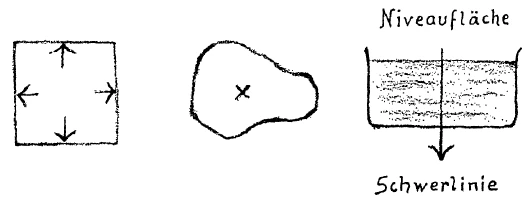
[ 20 ] You see, this is an extraordinarily interesting and significant connection. For it points out to us that a solid body actually has something like a level surface everywhere, but it establishes this surface through its own nature. How, then, does water establish this level surface? The Earth’s line of gravity stands perpendicular to it. It derives this level surface from the entire Earth. So we can say: When we have water, a point in that water assumes, in relation to the entire Earth, the same relationship that a point in a solid body has to something within it. As a result, the solid body is a self-contained entity, which water merely represents in its relationship to the Earth. And the gas goes on strike. It no longer enters into this relationship with the Earth at all. It withdraws from this relationship to the Earth. It has no such level surface anywhere.
[ 21 ] But you can see from this that we are compelled to return once again to an old concept. I pointed out to you in one of the previous lectures that even in ancient Greek physics, the solid body was called the Earth. This was not done based on those superficial mental images that are often associated with such things today, but rather because people were aware that the solid body performs for itself a function that, in the case of water, is performed by the earth. It assumes the role of the “earthly” for itself. One is merely justified in saying: The “earthly” is present in a solid body. In water, it is not entirely contained within it; rather, the earth reserves for itself the role of forming a level surface.
[ 22 ] So you see, even by moving from a solid body to water, the necessity arises not only to extend our considerations to what we have before us, but we cannot even obtain information about water unless we conceive of all the water spread across the Earth as a single entity and relate this unity to the center of the Earth. To view a piece of water in the same physical terms as a piece of a solid body is nonsense—just as much nonsense as viewing a piece of my little finger, which I might cut off, as an organism in and of itself. After all, it dies immediately. As an organism, it has meaning only in conjunction with the entire organism. Water does not possess, on its own, the significance that a solid body has. It only has that significance in connection with the entire Earth. And this is true of all liquids found on Earth.
[ 23 ] And again, when we move from the liquid to the gaseous state, we find that the gaseous state withdraws from the earthly realm. It does not form an ordinary level surface. It participates in all that is not earthly. This means: We must not seek what acts within the gas merely on Earth, but we must draw upon the Earth’s surroundings, venture into vast spaces, and seek the forces there. If we wish to understand the laws of the gaseous state, there is no alternative but an astronomical perspective. Thus you can see how this is integrated into the entire context of the Earth when we consider these phenomena, which we have so far merely listed. And when we reach a point such as the melting or boiling point, things occur that must now strike us as quite remarkable. For when we reach the melting point, we move from the earthly nature of a solid body—where it maintains its own form and structure—into that which is wholly earthly. The Earth begins to take over the solid body as it transitions into the liquid state. Upon reaching the melting point, the solid body moves from its own realm into the sphere of influence of the entire Earth. It ceases to be an individual entity. And when we transform the liquid body into a gaseous state, we find that even that relationship to the Earth—which manifests itself through the formation of the level surface—is dissolved; that at the very moment we transition to a gas, the body enters the realm of the non-earthly, detaching itself, as it were, from the earthly. When we encounter a gas, we find within the forces at work in the gas that which has already withdrawn from the Earth. Thus, precisely when we observe these phenomena, we cannot help but move from the ordinary physical-earthly realm into the cosmic realm. For we are no longer within reality if we do not pay attention to what truly acts within things.
[ 24 ] But now we are confronted with other phenomena. Take, for example, a phenomenon such as the one you know very well, the one I have already drawn your attention to: that water behaves in a very peculiar way—that ice floats on water, meaning it is less dense than water—but that, as it transitions from a solid to a liquid state and its temperature rises, it contracts and becomes denser. It is only because of this that ice can float on water. So between 0 and 4 degrees, we have a situation where water once again defies the general processes we otherwise encounter when temperatures rise—namely, that a body becomes thinner and thinner as it heats up. This 4-degree range, where water becomes increasingly dense, is very instructive. What do we see in this range? There we see how water struggles. As ice, it is a solid body with its own internal structure, a kind of individuality. Now it is supposed to selflessly merge into the entire realm of the Earth. It is not willing to accept this selflessness right away. It struggles against this transition into an entirely different sphere. Such things must certainly be taken into account. But then it will also begin to make sense to observe how, under certain conditions—for example, at the melting point and boiling point—the thermometrically measurable heat recedes and disappears. It disappears in the same way that physical activity disappears for us as we ascend into the imaginative realm. We will return to these matters later. It will not seem so paradoxical to you if we try to trace what happens when a state of heat compels us to raise the temperature to the third power—that is, into the fourth dimension in this case—and thus to step outside of space. Let us first take this premise to heart and then discuss it further tomorrow. Just as the activity of our body transitions into the spiritual realm when we enter the realm of the imaginative, a transition could just as well take place between the outwardly visible—what is happening in the realm of heat—and the phenomena lying behind it, to which only an allusion is made when the heat, as thermometrically measurable heat, disappears from before our eyes. We must ask: What is happening behind the curtain? What tells us about the processes taking place behind this curtain? That is the question we want to ask ourselves today. Tomorrow we will continue our discussion.