

Second Scientific Course
The warmth at the boundary
between positive and negative materiality
Insights from Spiritual Science on the Development of Physics
GA 321
6 March 1920, Stuttgart
Translated by Steiner Online Library
Sixth Lecture
[ 1 ] Today we will first examine a few phenomena that pertain to the relationship between heat, pressure, and the expansion of bodies. For you will see that by comprehensively considering what we can observe in such phenomena, the path to understanding what heat actually is will open up to us. We will first examine the phenomenon that arises here from the contents of these three tubes (see diagram, 1, 2, 3). In the first tube on the right (1), we have a column of mercury, as found in a barometer tube, and some water at the top. Water contained in this way within a space evaporates continuously. The water is contained in what is known as a vacuum—an empty space—and we can say that water evaporates. The small amount of water inside continuously evaporates. We can observe this evaporation through the presence of water vapor inside: If you compare the height of the mercury column here in this tube (1) with the mercury column inside here \((b)—which is under normal atmospheric pressure, meaning there is no evaporated water, and thus no water vapor—you will see that this mercury column (1) is lower than that one \((b)\). Of course, this mercury column can only be lower than the one in the barometer if there is a pressure being exerted from above, whereas up here \((b)\) there is no pressure from anything. It is an empty space, so that this mercury column is counterbalanced only by the external atmospheric pressure, which maintains equilibrium. Here (1), it is forced downward. If we measure it, we will find that here \((b)\), starting from this height, we have a higher mercury column. The reason it is lower here (1) is due to the pressure—the so-called tensile force—of the evaporating water contained within it; that is, the mercury column is forced downward. We can see, then, that vapor always exerts pressure on the walls, and specifically, a certain pressure is exerted under a certain thermal condition. We can confirm this by heating the upper part of this glass tube. You will see that as the temperature rises, the mercury column will drop—that is, the pressure will increase. We will thus see that the higher the temperature of a vapor, the greater the pressure it exerts on the wall. You can already see the mercury column dropping, and observe how the tensile force—the pressure—increases with temperature. The volume that the vapor then seeks to occupy increases.
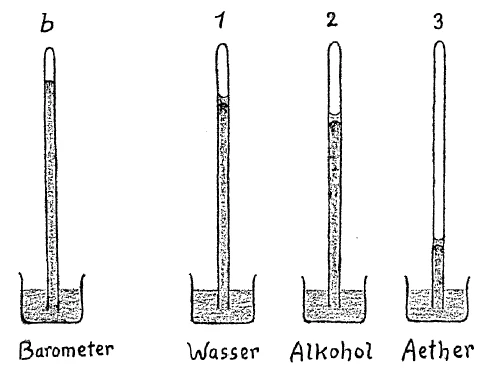
[ 2 ] In the second tube (2), we have alcohol above the mercury. Again, you can see the alcohol inside, occupying a certain volume as a liquid. It also evaporates, which is why this column is shorter than the one on the left side of the barometer. However, when I measure it, I will also find that it is lower here than the mercury column used to be under the influence of the evaporated water. We must wait until the column here (1) rises again to the same height as
[ 3 ] Well, that was before it was heated. Then we’ll find that the pressure also depends on the substance itself that we’re using. So this pressure is greater with alcohol than with water. Here too (2), I could heat it again. You’ll see that the tension becomes significantly higher as we increase the temperature. If we cool the vapor until it’s back at the same temperature as before, the mercury rises—meaning lower pressure and lower tension. You see, the column rises.
[ 4 ] In the third tube (3), under otherwise identical conditions, we filled it with ether, which in turn evaporates. As you can see, the column here is very low. From this, you can see that when we cause ether to evaporate under otherwise identical conditions, it exerts a pressure that is significantly different from that of evaporating water. Thus, the pressure exerted by a gas on its surroundings depends on the temperature, but also on the substance itself. Here, too, you can see that the volume increases significantly when we heat it, meaning that the evaporating ether exerts a significantly greater pressure. Let us again record these phenomena here, since it is precisely by surveying the phenomena that we intend to arrive at our conclusion.
[ 5 ] Well, one phenomenon I would particularly like to demonstrate to you is this: You know from the preceding considerations—and also from elementary physics in general—that we can transform solid bodies into liquid ones, and liquid bodies into solid ones, by raising or lowering their temperature above or below the so-called melting point. Now, when a liquid substance becomes solid again—that is, when it is cooled below the melting point—it initially appears to us as a solid. The remarkable thing—and what we must keep in mind as we survey this—is that if we now apply a greater pressure to the solid than the pressure under which it solidified, it can become liquid again. So, it can become liquid again at a lower temperature than the one at which it transitions to the solid state. As you know, at 0° water transitions to the solid state and becomes ice. Ice should therefore be a solid at all temperatures below zero. We are now going to conduct an experiment on this ice, through which you will see that we can turn it into a liquid without raising the temperature. If we wanted to turn it into a liquid under normal conditions, we would have to raise the temperature, but we will not raise the temperature; instead, we will apply a powerful pressure to the ice. We will apply this pressure by hanging this weight on it. The ice will melt here. So you will see that the ice is being cut through here because it liquefies under the pressure exerted by the wire. You would now expect that, as this block of ice turns into water in the middle due to the pressure, the two pieces of ice on the left and right will fall off. If we were to speed things up, we would see the experiment succeed. (The process of cutting through the block of ice proceeds so slowly that the following is added only at the end of the lesson:) If you step over here now, you’ll see that even if you were to wait until the cut is fully complete, you still wouldn’t have to worry about two pieces of ice plopping down. The ice will immediately grow back together above the wire, and the wire will pass all the way through, falling through to the bottom, while the block of ice remains intact. From this you can see that where pressure is applied through the wire, liquid is formed. But the moment the pressure is no longer applied, the liquid above it immediately solidifies back into ice—that is, it fuses back together. This liquefaction of the ice caused by the wire lasts only—provided the temperature remains the same—under the influence of the pressure in question. It is therefore possible to liquefy a solid below its melting point. However, it then requires the continued application of this pressure to remain liquid. If the pressure ceases, the solid state returns. This is what you would have observed if you had waited here a few more hours.
[ 6 ] The third point we wish to consider—and which will serve as a further foundation for our analysis—is the following: We could take any suitable substances, for in principle this applies to everything we wish to examine—to all those substances that form an alloy with one another, that is, that can combine in such a way that they interpenetrate without forming a chemical compound. Here in one test tube we have lead. Lead is a substance that melts at 327 °C—that is, it transitions from a solid to a liquid state. In another test tube we have bismuth, which melts at 269 °C, and here we have tin, which melts at 232 °C. So we have three substances, all of which have melting points above 200 °C. We will now combine these three substances—by first melting them, that is, converting them to a liquid state—into an alloy, so that they mix together without forming a chemical compound. (The three metals are melted separately and then cast together.) You can easily imagine: If we simply place any of these three metals—which all have melting points above 200 °C—into boiling water, it will remain solid, because water has a melting point of only 0° and a boiling point of 100°; therefore, none of these three metals can melt in this water. Now, however, we will conduct an experiment by adding the alloy—the combination of the three metals—to water that is just beginning to boil, that is, to water at 100°C. We can already state what the underlying principle is here. We dip the thermometer into the alloy of the three metals and observe a temperature of 175° within the still-liquid metal mixture. From this you can see: None of the individual metals would still be liquid at this temperature; each would already be solid. The alloy of the three metals is still liquid. So we can already conclude from this: When we mix metals together, the phenomenon can occur where the melting point—the point at which the metal mixture becomes liquid—is lower than the melting point of any of the individual metals. So you can see how substances influence one another. And it is precisely from this phenomenon that we will have to draw an important foundation for our overview of thermal phenomena.
[ 7 ] Now we gently pour the still-liquid metal alloy at 100° into the boiling water, which is also at 100°. And now we let the water cool down. Let’s observe the temperature. The metal alloy is still liquid inside; it will then solidify. This means we’re reaching the melting point, and as the water cools below its boiling point, we can determine—based on the temperature the water has reached—when the metal alloy solidifies, that is, where its melting point lies. So you see: The melting point of the metal mixture is lower than the melting point of any single metal.
[ 8 ] Well, we have once again added these phenomena to the others in order to have a broader foundation for our overview, and we can now add a few more observations to what we already considered yesterday regarding the difference between the solid, liquid, and gaseous or vaporous states. You know that solid bodies—namely, a large number of metals and other mineral substances—do not occur in indeterminate forms, but rather in very specific forms, in so-called crystals. Thus, we can say: Under the ordinary conditions in which we live on Earth, solid bodies appear to us in crystalline form, that is, in very specific configurations. This naturally calls for reflection on how such crystalline forms arise and what forces underlie them. To gain mental images of these matters, we must now examine the behavior of, for example, the totality of solid bodies found on the Earth’s surface that are not directly connected to the Earth’s mass. As you know, when we hold a solid object in our hand and let it go, it falls to the ground. In physics, this is usually explained by saying that the Earth attracts these solid objects; it exerts a force. Under the influence of this force—gravity—the object falls to the ground.
[ 9 ] If we take any liquid substance and cool it, it will, upon solidifying, take on certain crystalline forms. The question now arises: What is the relationship between the force to which all solid bodies are initially subject—gravity—and the forces that must also be present and must, in a certain way, cause solid bodies to take on crystalline forms? You can easily imagine that gravity as such—the force by which a body falls to the earth, if we are to speak of such a force at all—cannot be the one that simultaneously plays a role in the formation of crystal shapes. For all crystal shapes are subject to this gravity; no matter what a body’s external shape may be, it follows this gravitational force. We find that when we treat a number of solid bodies by removing their support, they all fall in lines parallel to the Earth. We can illustrate this falling in roughly the following way. We can say: Whatever shape any solid bodies may have, they fall toward the Earth in the direction of a perpendicular to the Earth’s surface. If, on the other hand, we draw the perpendicular from these mutually parallel lines, we obtain a plane parallel to the Earth’s surface. We can treat all possible vertical lines of gravity passing through any bodies in such a way that we draw a common plane—parallel to the Earth’s surface and perpendicular to these lines of gravity. This plane is, at first, an imaginary one. We ask ourselves: Where is this surface really? It is real in the case of liquids. Take a liquid that I pour into a vessel; I can see how what I would otherwise draw as a perpendicular to the individual line of gravity actually exists as the liquid level.
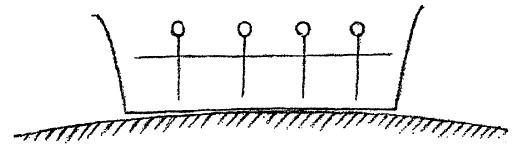
[ 10 ] What exactly is this, and what does it actually mean? What we have just put together here is something incredibly serious. Just imagine the following: Someone might say—as if to explain to you how the liquid’s surface works— There is a vessel; inside it, I have a liquid that forms a surface. Every particle of the liquid tends to fall toward the ground. Because the forces within the liquid itself prevent the particles from falling toward the ground, this is how the surface is formed. It is truly there. The liquid causes this to happen.
[ 11 ] Consider this: if you take the initial position of solid bodies that you let fall, nature itself illustrates what you have drawn here for the purpose of this explanation. And you must imagine the level surface as well. That is why I said earlier: For solid bodies, the level surface is initially conceived as the perpendicular to the line of gravity. If you think this through, you will find the remarkable fact that what you would otherwise do to introduce concepts into the liquid is already being done for you by a number of solid bodies. They, in a sense, illustrate for you what is materially present in the liquid. We can say: The body in a lower state of aggregation—the solid body in its behavior on the Earth’s surface—reveals to us, as in a picture, what is actually present in the liquid, what is material in the liquid, and what prevents the realization of this line as a line of fall. This becomes clear when I consider the solid body in its entire relationship to the Earth.
[ 12 ] Just think what this would allow me to do. If I were to plot the lines of gravity and the level surface while observing the fall of a system of solid bodies, I would thereby obtain a picture of the effect of gravity. That would be a direct representation of fluid matter.
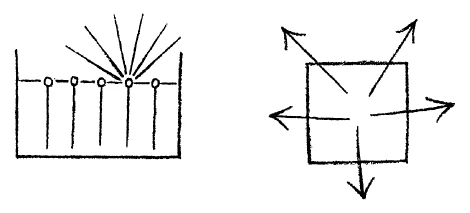
[ 13 ] We can take this further. If we leave water in a bowl at any temperature for long enough—which is why I said that everything is relative—it will dry out. In one way or another, water always evaporates; that is to say, there is really only a relative state in which we can say: The water forms a surface of equal level; its shape must simply be held in place by the other sides, while it forms a surface of equal level on one side. — It evaporates continuously, and thus more quickly in a vacuum. Therefore, we can say: If we draw lines here toward which the water is actually constantly tending, these must be lines of force of the water, whose direction as a path is then truly maintained even as the water evaporates. But when I draw these lines toward which the water strives, I get nothing other than a picture of a gas that is in a space closed on all sides and that truly strives in all directions, dispersing in all directions. At the surface of the water, there is a striving that—if I draw it to explain this striving—is an image of what actually happens when I release a gas and it spreads in all directions. So that I can say once again: What I perceive as a force in the liquid is, to me, an image of what is a material reality in the case of a gas.
[ 14 ] Here is a curious fact: When we observe liquids in a certain way, we perceive images of the gaseous state within them. When we observe solids in the right way, we perceive images of the liquid state. In each subsequent state moving downward, images of the preceding state emerge. Let us extend this concept upward. We can say: In a solid, we discover images of the liquid state. In a liquid, we discover images of the gaseous state. In a gaseous body, we discover images of heat. This is what we will need to explore in greater detail tomorrow in particular. But I would like to add this: Today we have tried to find the transition in thought from gases to heat. It will become even clearer tomorrow. And if we continue to follow this line of thought:
in the solid, the images of the liquid
in the liquid, the images of the gas
in the gas, the images of heat
[ 15 ] Then we have indeed taken an important step. We have gained the ability to observe, in the images that will arise for us from the gaseous state—within the realm of human perception—manifestations of heat, and specifically of the true nature of heat. We gain the ability to elucidate what we have always had to describe as initially unknown by seeking its images in the gaseous state in the proper manner. We must seek the images of the nature of heat in bodies in the gaseous state; however, we must do so correctly. If one simply describes the scope of the phenomena we have already observed in the manner customary in contemporary physics—that is, if one speaks of gases in this way—one gets nowhere. But if we correctly focus on what has become apparent to us regarding bodies under the influence of pressure and temperature, then we will see that we will in fact arrive at the conclusion that it is the gaseous state that first reveals to us what the nature of heat actually is.
[ 16 ] Now, however, the nature of heat continues to exert its influence as it cools into liquid and solid states. And we will be compelled to examine—as we can see most clearly in the gaseous state—what the nature of heat is; in the liquid and solid states, we will have to see whether the nature of heat undergoes a specific change of its own, so that we may then, through this difference—as it manifests itself in the gaseous state, where it reveals its characteristics to us, and in the liquid and solid states—arrive at the true nature of heat itself.