

Second Scientific Course
The warmth at the boundary
between positive and negative materiality
Insights from Spiritual Science on the Development of Physics
GA 321
7 March 1920, Stuttgart
Translated by Steiner Online Library
Seventh Lecture
[ 1 ] You may recall that yesterday we had this block of ice here, which at first might have led one to assume that if we cut through it with a wire weighted at one end, half the block would fall off on the left and right. Even though we were only able to show the beginning of the experiment, you have already seen for yourselves that this is not the case at all—that, in a sense, once liquefaction has occurred due to the pressure in the direction of the wire’s passage, the block of ice immediately fuses back together at the top. This means that liquefaction has occurred solely due to the pressure, but because we are preserving the ice as ice, the thermal process immediately comes into play here—I want to use my terms very precisely—so that the block simply comes back together again.
[ 2 ] Doesn’t that surprise you terribly at first? But it only surprises you because you are not looking at it in the way that is necessary for a truly proper investigation of physical phenomena. In another case, you perform this experiment all the time and aren’t at all surprised by it—namely, when you take a pencil and move it through the air, you’re constantly cutting through it, and afterward it closes up again. You’ve done nothing other than carry out the same experiment we did yesterday with the block of ice, only in a slightly different sphere, a slightly different realm. But we can learn quite a lot from this observation, for we see from it that when we simply move the pencil through the air—we will not examine here by what mechanism—the cut we have made closes again due to the properties of the material nature of the air itself. In the case of ice, given the circumstances, we cannot help but conclude that the nature of heat is involved, that it does the same thing that the air itself does. This is simply a further illustration of what I told you yesterday. If you imagine the air, and you imagine it being separated by a cut and then repeatedly rejoining, the material substance of the air carries out everything you perceive in this process. If you take a solid body—that is, ice—then heat is active within it in the same way as material air itself is here. That is to say: You gain a true picture of what is happening in heat, and you have once again confirmed that, by observing the gaseous, vaporous state—air is vaporous, gaseous in fact—we find in the material process of the gas itself that which can serve as a picture of what is taking place in the nature of heat.
[ 3 ] And when we then observe thermal phenomena in a solid body, what we are essentially seeing is nothing other than the solid body on one side and, on the other, what is taking place in the realm of thermal phenomena. In a sense, we see unfolding before our eyes—as phenomena within the realm of heat—what we otherwise see unfolding in a gas. From this we can now conclude—not even conclude, we are merely describing what is evident—we can now say: If we wish to approach the true nature of heat, we must try, as best we can, to penetrate the realm within the gaseous body. And in what happens within the gaseous body, we will simply see reflections of what is taking place within the essence of heat. Thus, by revealing certain phenomena in gaseous bodies to us, nature conjures before our very eyes that which is a reflection of the processes within the essence of heat. You see, what guides us here is, of course, far removed from the current way of thinking, as it is customary in the field of the natural sciences—truly the natural sciences, not merely physics. But where does such a way of thinking ultimately lead? I have here a work by Eduard von Hartmann in which he addresses a specialized field from his own perspective—namely, modern physics. A man who has truly cultivated a broad horizon entirely from within the spirit of the present, so that, as a philosopher, so to speak, he has placed himself in a position to speak about physics. Now it is interesting to see how such a person speaks about physics from within the entire spirit of the present. He begins right in the first chapter: “Physics is the study of the movements and transformations of energy and of its decomposition into factors and summands.” Of course, in saying this, he must immediately add the following: “Physics is the study of the movements and transformations of energy and of its decomposition into factors and summands. The validity of this definition is independent of whether one conceives of energy as an independent ultimate entity that is only mentally decomposed by us, or whether one regards it as a product truly arising from other factors, and it is also independent of whether one adheres to this or that view regarding the constitution of matter. It merely presupposes that all perception and sensation can be traced back to energy, that energy can change location and form, and that, by definition, it is decomposable.”
[ 4 ] What does it mean when one says something like that? It means: One attempts to define what one has physically before one in such a way that one does not need to address its essence. One formulates a definition whose particular nature makes it unnecessary to address the essence, because one excludes the essence. One constructs a concept of energy and says: Everything that confronts us externally in a physical sense is merely a transformation of this energy entity. That is to say, one expels all essentiality from one’s concepts and believes oneself to be entirely certain that, by no longer grasping anything, one is at least providing reliable definitions. But this has crept into our physical mental images in a truly dreadful way. It has crept in to such an extent that today we can hardly find ourselves in a position to conduct experiments that truly illustrate what is. All of our experimental instruments—such as we can procure for our physical investigations—are already designed in such a way that they are, so to speak, trained to conform to the theoretical perspective of contemporary physics. We cannot easily use what we have at our disposal today to physically penetrate the essence of things. The only solution will lie in a certain number of people first coming together to familiarize themselves with the necessary methodological implications of a genuine exploration of the nature of physical phenomena, and in this group of people then working together to design not only the experimental setups but even the very instruments used in the experiments in such a way that we can gradually penetrate to the essence of things. In fact, we need not merely a conceptual transformation of our worldview; today we definitely need research institutes of our own, based on our own perspectives. We will not be able to reach people from an anthroposophical perspective as quickly as is necessary unless, on the other hand, we can steer the lines of thought customary today off their well-worn tracks by simply showing people through experimentation that “what we say about these things is correct,” just as physicists today are able—through the very apparatus that factories have already set up for them—to show people, or seemingly show them, that what they tell them is true. But for this, of course, it is truly necessary that we first advance toward genuine physical thinking. And part of genuine physical thinking is, after all, that we bring ourselves into a line of thought such as I first indicated these past few days, and especially yesterday.
[ 5 ] Isn’t it true that today’s physicist simply observes what is happening, and when he observes what is happening, he will strive as much as possible to set aside what he perceives and look only at what he can calculate? So he also conducts this experiment—which we want to present to our minds as early as possible today—as early as possible, precisely because it will only develop further as the hour progresses. Here we immerse a rotating paddlewheel in a liquid, so that by setting the wheel in motion through this conversion apparatus, we perform mechanical work—we have the machine perform it. However, because this mechanical work interacts with the processes in the water in which the paddlewheel is submerged, we will cause a considerable warming of the water, and we have before us the simplest, most elementary experiment through which, as they say, mechanical work is converted into heat or, as they also say, into thermal energy. We now have a temperature of 16 ° and will measure the temperature again after some time.
[ 6 ] Now let us return once more to what we have already discussed. We have, so to speak, attempted to grasp the physical fate of corporeality by tracing this corporeality through the melting point and the boiling point, whereby the solid body becomes liquid and the liquid becomes gaseous. I will now speak in simplified terms. We have seen that the essential characteristic of a solid body is that it possesses form. It emancipates itself, so to speak, from what gives a liquid its form—or at least its relative form—provided the liquid is not allowed to evaporate over time. The solid, then, possesses its fixed form in some way; the liquid must be contained within a vessel and, in order to establish its level—which manifests equally everywhere on the surface of the solid—is subject to the forces of the entire Earth. We have, after all, kept this in mind. So we have no choice but to say: When we essentially consider the sum total of all liquids on Earth—if we truly wish to examine this sum total of all liquids on Earth from a physical perspective—we must regard it, together with the Earth, as a single physical entity. The solid, however, emancipates itself from this connection to the Earth; it individualizes itself and assumes its own form. If we now—while initially retaining the terminology of conventional physics—see in what is called gravity the cause of the formation of the liquid’s level, then, if we remain within the purely intuitive realm, we must in some way relocate that which is otherwise simply set against the level formation at a right angle into the individualized solid body. One must somehow conceive that what is involved here in the formation of levels—and what is thought of as the Earth’s gravity—is also, in some way, situated somewhere within the solid body and brings about the various levels; that is, the solid body, so to speak, individualizes gravity. We see, then, that the solid body appropriates gravity for itself. But on the other hand, we also see that the level effect ceases the moment we transition to a gas. A gas does not form a level. If we want to give a gas a shape—a boundary to its volume—we must achieve this by enclosing it in a vessel on all sides. Thus, as we transition from a liquid to a gas, we see the formation of levels come to an end. We see this striving even beyond this still earthly remnant of form-formation, which manifests itself in the level, and we see how all gases—which have already presented themselves to us as a unity by revealing the same coefficient of expansion—together emancipate themselves from the Earth as a unified material entity.
[ 7 ] Now consider this idea very strictly: You stand here as a human being—that is, as a carbon-based organism—on solid earth, subject to the phenomena caused by the Earth’s solid bodies. These, as such, are subject to gravity, which is said to manifest everywhere. So that, in fact, as you stand here on Earth as a human being, you are surrounded by solid bodies that must, in some way, have appropriated gravity to form their shapes. But in the phenomena that these solid bodies bring about as they fall—as I mentioned yesterday—to which you must add an ideal level that you can form anywhere, there you have something you can conceive of as a kind of continuum, as something that spreads everywhere, which is, so to speak, an invisible fluid. So that the solid bodies, insofar as they move on Earth and produce phenomena, represent a fluid in the sum of these phenomena. They do the same thing that a material fluid does in itself. So that we can actually say: By standing on solid ground, we perceive and call “gravity” that which creates levels in water.
[ 8 ] Now imagine, however, that we, as human beings, were able to live on a liquid celestial body; that we were organized in such a way that we could live on a liquid celestial body. Then we would have to be above the level at which this liquid forms. And we would then be in the same relationship to the gaseous state—which strives outward in all directions—as we are now to the liquid state. But this means nothing less than that we would not be able to perceive gravity there. Talking about gravity would cease to make any sense. Thus, only those beings perceive gravity, and only those physical bodies are subject to it, that are on a solid planet. Beings who could live on a liquid planet would know nothing of gravity. One could not speak of it. And beings who live on a gaseous celestial body would have to regard the opposite of gravity—the tendency to move in all directions away from the center—as the norm. To put it paradoxically: For beings inhabiting a gaseous planet, their bodies would have to be constantly flung away rather than falling toward the planet. So that when we make the transition to truly physical thinking—not merely mathematical thinking, which stands outside of reality—but when we think in truly physical terms, we must tell ourselves: We begin by standing on a solid planet in order to have gravity. And as we move from the solid planet to the gaseous one, we pass through a kind of zero state and arrive at an opposite state—a spatial manifestation of force that could only be conceived as negative in relation to gravity.
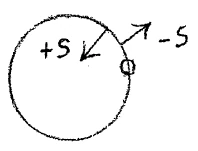
[ 9 ] So you see, by passing through the material realm, we actually arrive at a zero point in spatial existence, at a zero sphere in spatial existence, so that we can speak of gravity only as something very relative. Yes, but when we supply heat to a gas—we have conducted experiments to this end—heat that continually increases its dispersive force, do we not already see the picture I have sketched for you? (See drawing on page 100.) Is not that which is active in the gas already beyond the zero sphere toward which gravity tends? Can we not, while remaining within the realm of phenomena, take our thinking a step further and conclude that, as we find the transition from a solid to a gaseous planet, we pass through a zero point? Below it lies gravity; above it, this gravity transforms—in physical terms—into its opposite, negative gravity. But we find it; we do not even need to conceive of it. The nature of heat does the same thing that this negative gravity does. We certainly have not yet reached our goal, but we have already achieved enough to grasp the nature of heat relatively, to the extent that we can say: The nature of heat manifests itself precisely like the negation of gravity—negative gravity. So if, in physical formulas that contain gravity, one substitutes a negative gravitational quantity, then—according to thinking that corresponds to reality—this formula must no longer create a mental image of a gravitational line or gravitational quantity, but rather a thermal force line and thermal force quantity. You see, then, that it is only in this way that mathematics can truly come to life. We can simply take the formulas that arise from what we regard, purely mechanically, as a gravitational system. If we set the quantities in these formulas to negative values, we are compelled to regard what was previously gravity as heat. From this, however, you can see that it is only by grasping phenomena in their concrete form that we arrive at real results. As we move from solids to liquids, we see how form dissolves under the influence of becoming liquid. The form is lost. When I dissolve a crystal or bring it to a melt, it loses the form it previously had. It assumes the form that it initially takes—because it is transitioning into the general state, into a liquid—under the influence of the Earth. The body assumes a level surface relative to the Earth and must be stored in a vessel.
[ 10 ] But it becomes apparent—let us for now again consider the matter merely from an observational standpoint; we can understand it more concretely later—that if the volume of liquid is small enough, a drop forms, taking on a spherical shape. Liquids, therefore, when they are sufficiently small, have the ability to emancipate themselves from general gravity and, in a special case, to adopt the very property that otherwise causes polyhedral shapes to appear in crystals. But liquids then have the peculiarity of forming a uniform shape: the spherical shape. And when I now look at this spherical shape, it is, in a sense, the synthesis of all polyhedral forms, of all crystal forms.
[ 11 ] If I now proceed from the liquid to the gas, I have the expansion, the dissolution of the spherical shape—but now outward. Now, however, we come to a somewhat more difficult concept: Imagine for a moment that you are facing some simple shape—a tetrahedron—and that you were to turn the tetrahedron inside out, just as one turns a glove inside out. Then, in fact, you would notice that if you wanted to turn it inside out entirely, you would have to pass through the spherical shape, and that the negative body would then appear—one for which all proportions are negative—which, so to speak, is such that if you have the tetrahedron here, filled in some way, you would have to create a mental image of this negative body in such a way that all the remaining space is filled. It is gaseous there. Now imagine a tetrahedral hole carved out of this filled space. It is hollow there. If you were to grasp the matter realistically, you would then have to assign negative values to all quantities relating to this tetrahedron. Then you get the negative tetrahedron—the hollowed-out tetrahedron—whereas otherwise there is matter inside the tetrahedron. But the intermediate state, where the positive tetrahedron transitions into the negative tetrahedron, is the sphere. Every polyhedral body transitions into its negation by passing through the sphere as if through a zero point, a zero sphere.
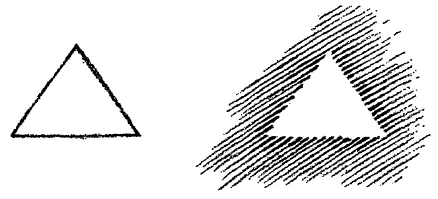
[ 12 ] Now observe this concretely in the case of bodies. There are solid bodies with forms; they pass through the liquid state—that is, the spherical form—and become gases. If we are to view gases correctly, we must regard them as forms, but as negative forms. We thus arrive at forms that we can only grasp if we enter the negative realm through the sphere of nothingness. That is to say: as we turn to the processes of gases—which are images of thermal processes—we do not at all enter a formless realm; it merely becomes more difficult for us to grasp them than the forms in our surroundings, which are positive forms, not negative forms. Yes, but at the same time we see from this that every body in which a liquid is present anywhere is in an intermediate state. It is in the intermediate state of transitioning from the shaped to what we call the unshaped—that is, to the negatively shaped.
[ 13 ] Is there an example somewhere where we can observe something like this—in our immediate surroundings, in what we look at but don’t actually experience? After all, when we stand next to a solid body as it liquefies or a liquid body as it evaporates, we remain pretty much in the same state of experience as we were before. But can we somehow witness something like this? We can witness it, and we are constantly experiencing it. We experience it because we are earthly human beings, and because the Earth—in the vicinity where we inhabit it—is indeed a solid body, and on it stand bodies that bring about the various phenomena in our surroundings that we then observe. But beyond that, the liquid is embedded in the earthly realm and is part of it, and the gaseous state is also part of it. And there is indeed a great difference between what I would like to call—so that we have a term for it—what I would like to call a “night of warmth” and a “day of warmth.” What is a night of warmth? A night of warmth, in contrast to a night of light, is what happens to our Earth under the influence of the cosmic warmth. What can happen there? Well, in the coming days we will observe the phenomena on Earth in such a way that we will truly see what is, however, very easily grasped through thought: Under the influence of the “night of warmth,” the entire Earth—we could limit ourselves for now by saying: the Earth’s atmosphere—strives toward form. During the night of warmth—that is, while our earthly being is not exposed to the solar being, while the earthly being is left to its own devices, while it can emancipate itself from the influences of the cosmic solar being—it strives toward a solid form, just as a drop strives toward a solid form when it can escape the surrounding gravitational force. So, by considering the night of warmth instead of the night of light, we have the Earth’s constant striving for form. But it is not entirely accurate to say: “The Earth strives for the shape of a drop.” It strives for much more during the night of warmth: for formation, for crystallization. And what we experience at night is a continuous emergence of lines of force striving toward crystallization, whereas during the day, under the influence of the solar being, there is a continuous dissolution of this striving toward crystallization—a continuous desire to overcome form.
[ 14 ] And when we speak of the thermal dawn and twilight, we must actually speak of the fact that during the thermal dawn—after the Earth has attempted to crystallize during the thermal night—this crystallization process dissolves again, and the Earth, together with its atmosphere, assumes a spherical shape during the thermal dawn; then it attempts to disperse. After the heat day comes, in turn, a heat twilight. The Earth again attempts to form a sphere and to crystallize during the night, so that we must capture the Earth within a cosmic process that consists of the Earth attempting to contract during the heat night—so that, if this process were to continue and the Sun were to be made to disappear, the Earth could become a crystal. This is prevented at the right moment by the Earth once again passing through the warm morning twilight, assuming a spherical form; then the Earth attempts to disperse into outer space until, once more, these forces are counteracted by the warm evening twilight. Thus, when it comes to our Earth, we are not dealing with something that we could depict as a fixed entity in outer space, but rather with something that constantly oscillates within the cosmos, oscillating through the heat day and the heat night.
[ 15 ] You see, we will have to equip our research institutes to study such things. In addition to our usual thermometers, hygrometers, and so on, we will have to devise instruments with which we can demonstrate that certain processes taking place within the Earth—namely, within its liquid and gaseous components—occur differently at night than during the day.
[ 16 ] So you see: Here, a proper physical approach leads us to finally take action and, using appropriate measuring instruments, demonstrate those subtle differences that arise between day and night for all phenomena that occur specifically within liquids and gases. In the future, we will have to conduct a certain experiment during the day, repeat it at the corresponding hour at night, and we will need precise measuring instruments that show us how the phenomena differ between day and night. For during the day, the forces that strive to crystallize the Earth are not present throughout our phenomena, whereas at night they are precisely there. At night, forces arise that come from the cosmos. And these cosmic forces, which seek to crystallize the Earth, must reveal this in the phenomena. And this opens up the path of experimentation for us to once again establish the Earth’s connection with the universe.
[ 17 ] As you can see, the research institutes that will need to be established in the future in accordance with our anthroposophically oriented worldview will have significant tasks. They will truly have to take into account factors that are currently considered only in the rarest of cases when dealing with certain phenomena. Of course, with light phenomena we already do this today—at least with certain phenomena—by having to artificially create darkness, darken the room, and so on; but with other phenomena that take place below a certain “zero sphere,” we do not attempt this. Instead, we then arrive at the idea of transferring what we would find as observable results—if such observable results actually existed—into the interior of the bodies and speaking of all sorts of forces at work between atoms and molecules. The whole thing rests solely on the belief that we can investigate everything during the day. We will, for example, only discover differences in crystallization patterns by first conducting the same experiment during the day and then at night. This is precisely what requires special attention. Only in this way will true physics emerge. For today, physical phenomena essentially exist in a chaotic jumble. We speak of mechanical energy, for example, and of acoustic energy. But when we conduct physical research on these things, we fail to take properly into account that all mechanical energies can only occur where there are solid bodies of some kind. Acoustic energies, however, always indicate that we are no longer in the realm of solid bodies, so that the realm of liquids lies between purely mechanical energy and acoustic energy.
[ 18 ] Yes, but if we now move beyond the realm in which we can most easily observe acoustic energy—that of gaseous bodies—we arrive at the next so-called state of matter, namely heat, which is superimposed on the gas just as a liquid is superimposed on a solid. And so, if we were to view this from the outside, we would have:
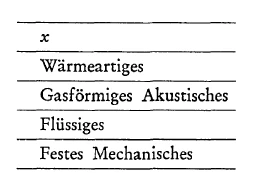
[ 19 ] Within the solid, we would find the mechanical as its characteristic feature. Within the gaseous state, we would find the acoustic as its characteristic feature. Just as we have omitted the liquid, we must omit heat here, and find something else up here, which I would initially designate as \(x\). So we would still have something to look for on the other side of the thermal entity. Between this \(x\) and our ordinary acoustic phenomena that occur in the air, the thermal entity would lie, just as the liquid state lies between gaseous and solid bodies. You see, we are trying to define the thermal entity in some way, to approach it in some way. And if you say to yourself: Since the liquid lies between the gaseous and the solid, then the thermal realm must lie between \(x\) and the gaseous—then you must similarly seek the transitions through the thermal realm to \(x\). So you must find something that lies just beyond the essence of heat—such as the world of sound, insofar as it manifests itself through the air—which lies on this side of the essence of heat.
[ 20 ] Here, however, you see an attempt to actually form physical concepts that go beyond the merely abstract and seek to grasp the physical. Just as geometry truly captures spatial forms, but mechanical concepts can never capture anything other than the motion of solid bodies, so such concepts—as we are now forming them—actually capture the physical essence. They immerse themselves in the physical essence. And we must strive for such concepts. Therefore, I would believe that it is, in the truest sense, part of what could emerge from the universal principle—from which the Waldorf School is conceived—if one were to attempt to truly expand the experimental aspect in the way that has been suggested today, and to incorporate into the physical experiment that which has been greatly neglected in our observations of physical phenomena: time and the passage of time.