

Second Scientific Course
The warmth at the boundary
between positive and negative materiality
Insights from Spiritual Science on the Development of Physics
GA 321
8 March 1920, Stuttgart
Translated by Steiner Online Library
Eighth Lecture
[ 1 ] Yesterday, we conducted an experiment designed to demonstrate, according to common understanding, how mechanical work, which we produced by causing a paddle wheel to rotate and thus generate friction against a mass of water, is converted into heat. We showed you that the water rubbed against by the paddle wheel became warmer.
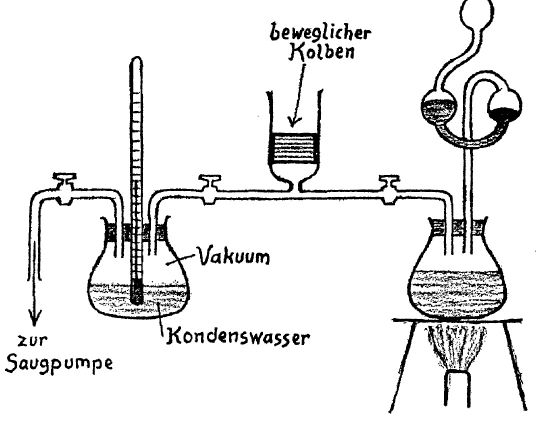
[ 2 ] Today, we want to do the opposite, so to speak. Yesterday, we showed that we must somehow find an explanation for the fact that, if we now express the facts more accurately than through the idea of mere transformation, heat can be generated under the influence of work performed. Now we want to follow a reverse process. First, we want to generate steam, i.e., we want to generate pressure and tension in the course of a combustion process—in other words, we want to create something mechanical from heat—and, following the same principle that drives all steam engines, we want to convert this heat into mechanical work via the detour of pressure. By applying pressure on one side here on the surface below, this piston is driven upwards (see drawing on page 118). By cooling the steam again, the pressure is reduced, the piston moves back, and we obtain mechanical work, the upward and downward movement. We will be able to observe how the water that is produced when we cool it down, the condensation water, enters this vessel, and we will then examine whether, after we have allowed the entire process to unfold, the heat we have generated here has been completely converted into such work, into the work of moving this piston up and down, or whether we have somehow lost heat. The heat that is lost, that is not converted, would have to appear in the heat of the water. In the case where all the mobile heat is used to generate mechanical work, the condensation water would then be unable to show an increase in temperature. If there is an increase in temperature, that is, if we can see on this thermometer that the water is heated above the usual temperature, then this heating comes from the heat we have applied. Then not all the heat has been converted into work; we were not able to do so, and something has remained. So we want to determine whether all the heat can be converted into work, or whether something remains and is reflected in the warmth of the condensed water. The water is at 20°, so we will see whether the condensed water has really cooled down to 20°, meaning that all the heat has been used for work, or whether the temperature of this condensed water rises and heat is lost as a result. Now we condense the steam, the condensation water drips over, and in this way, of course, a machine can now be driven. If the experiment is completely successful, you can be sure that the condensation water here shows a significant increase in temperature, and this is the way in which it can be shown that, if one performs the opposite experiment to yesterday's, converting heat into mechanical work, which consists precisely in the piston moving up and down, it is then impossible to convert all the heat that has been generated completely into mechanical work; that when heat is converted into mechanical work, heat always remains, so that in every instance of heat used to generate mechanical work, there is a portion that remains as a residue and cannot be converted into mechanical work. For now, we will simply note the phenomenon, but now we will present the ideas that conventional physics and those who base their views on it have about the whole matter.
[ 3 ] First, we are dealing with the initial fact that we can convert, as they say, heat into mechanical work and mechanical work into heat. From this, as I have already mentioned, the view has developed that every such form of so-called energy—heat energy, mechanical energy, and one could also conduct the experiment for other energies—can be converted into another. Let us now disregard the extent of the conversion and stick to the fact alone. Now, the current physical thinker says: It is therefore impossible that when energy appears somewhere, a force effect appears, that this comes from anything other than another already existing energy. So if I have a self-contained system of energies somewhere, initially energies of a certain form, and other energies appear, then these must be the conversion of the energies already present in the closed system. Nowhere in a closed system can energy appear other than as a product of conversion. Eduard von Hartmann, who, as I have already indicated, incorporates current physical views into his philosophical concepts, has expressed this so-called first law of mechanical heat theory in the following words: “A perpetual motion machine of the first kind is an impossibility.” What would a perpetual motion machine of the first kind be? A perpetual motion machine of the first kind would be a device by which energy as such would be generated in a closed energy system. Eduard von Hartmann summarizes the relevant facts by saying: “A perpetual motion machine of the first kind is an impossibility.”
[ 4 ] Now we come to the second series of facts, which has been illustrated to us by today's experiment: in a seemingly closed system of energies, we can convert one form of energy into another. However, it is apparent that this conversion is subject to certain laws that are related to the quality of the energies, in such a way that thermal energy cannot be completely converted into mechanical energy without residue. It is therefore impossible to convert thermal energy into mechanical energy in a closed system in such a way that all the heat actually appears as mechanical energy. If it were possible to achieve this, so that all heat appeared as mechanical energy, then it would in turn be possible to convert the mechanical energy into heat. It would be possible for one quality of energy to be converted into another in such a closed system. This would offer the possibility of always converting one into the other. Eduard von Hartmann expresses this sentence in such a way that he says: Such a closed system, in which, for example, all the heat present could be converted into mechanical work, where mechanical work could in turn be converted into heat, where a cycle is created, would be a perpetual motion machine of the second kind. But even such a perpetual motion machine of the second kind is impossible, he says, and these are basically the two main principles of the so-called mechanical theory of heat for thinkers of the 19th century and the early 20th century in the field of physics:
[ 5 ] “A perpetual motion machine of the first kind is an impossibility.” “A perpetual motion machine of the second kind is impossible.” The matter is even connected with the history of physics in the 19th century. The first person to draw attention to this apparent conversion of heat into other forms of energy, or other forms of energy into heat, was Julius Robert Mayer, who essentially became aware of the connection between heat and other forms of energy as a physician when he noticed that venous blood had a different composition in hot zones than in cold zones and concluded from this that there was a different type of physiological work in the human organism in each case. Based mainly on these experiences, which he expanded upon, he later developed a somewhat confused theory, and for him this “theory” had no other scope than this: that one form of energy can be converted into another. The matter was then further elaborated by various other people, including Helmholtz. Already in Helmholtz's work, a peculiar form of physical-mechanical thinking appears as the starting point for the entire consideration. If we take Helmholtz's most important treatise, in which he attempts to support the mechanical theory of heat in the 1840s, it is already based on Hartmann's idea as a postulate: A perpetual motion machine of the first kind is impossible; because a perpetual motion machine is impossible, the different types of energy must be mere transformations of each other; energy can never arise from nothing. The statement from which we start, “A perpetual motion machine of the first kind is impossible,” can be transformed into another: The sum of energies in the world system is constant. Energy is never created, energy is never destroyed. Energy is only transformed. The sum of energy in the world system is constant. — The two statements
“There is no perpetual motion machine of the first kind.”
“The sum of all energy in the universe is constant.”
basically contain exactly the same thing. Now, the point is that we should shed a little light on this whole way of thinking using the approach we have already applied in all our considerations.
[ 6 ] Such an experiment shows that when one attempts to convert heat into so-called work, heat is lost in the conversion into work, that heat reappears, and that therefore only part of the heat can be converted into work, into another form of energy, into mechanical energy. What we see here can then be applied to the universe. This is what the thinkers of the 19th century did. These thinkers said something like this: In the world we live in, mechanical work exists, heat exists. Processes are constantly taking place that convert heat into mechanical work. We see that heat must be present in order for us to generate mechanical work at all. Just think how we have based a large part of our technology on the fact that we can extract mechanical work from the original use of heat. But in doing so, it will always become apparent that we can never completely convert heat into mechanical work, that there will always be a residue. And if that is the case, these residues must accumulate to such an extent that no more mechanical work can be performed, that we simply cannot convert the heat back into mechanical work. The residues of unusable heat accumulate, and the universe is heading toward a state in which all mechanical work will have been converted into heat. It has also been said that the universe in which we live is heading toward heat death, as it is also known in more scholarly terms. We will discuss the concept of entropy in one of our future considerations. For now, we are interested in the fact that an experiment gave rise to ideas about the course of our universe, which is of primary concern to humans.
[ 7 ] Eduard von Hartmann explained the matter nicely by saying: We can see—and this can be proven physically—that the world process in which we live initially proceeds through processes: on the one hand, heat processes, and on the other, mechanical processes, but that ultimately all mechanical processes will transition into heat processes. Then no more mechanical work will be possible. The universe will have reached its end. Physical phenomena show us, says Eduard von Hartmann, that the world process is winding down. This is his way of expressing himself about the processes within which we live. We therefore live in a universe that sustains us through its processes, but there is a tendency for it to become increasingly sluggish and ultimately to come to a complete standstill — I am merely repeating Eduard von Hartmann's own words.
[ 8 ] Now, however, we must be clear about the following: Is there such a thing as the possibility of bringing about a sum of processes in a closed system? Please note what I am saying: when I stand with the sum of my experimental tools, I am certainly not standing in a vacuum, in empty space, and even if I could believe that I am standing in empty space, I am still not entirely sure whether this empty space only appears to be empty because I do not initially perceive what else is in it. Am I ever standing with my experimentation within any closed system? Is not what I do even in the simplest experiment an intervention in the entire process of the universe that surrounds me? When I do this whole thing here, for example, can I present it in a mental image other than something similar, in the context of the entire world process, to taking a small needle and pricking myself here? When I prick myself here, I feel a pain that prevents me from grasping a thought that I would otherwise have grasped. But if I want to consider what is happening here in its entire context, I certainly cannot just consider the pressure of the needle and the damage to the skin and muscles, because then I would not be considering the entire process. The process is not exhausted by this. Imagine that, through clumsiness, I take a needle, prick myself, and feel the pain. I will move away. What occurs as an effect cannot be grasped if I only consider what is happening here in this part of the skin. And yet, moving away from the needle is nothing more than a continuation of the processes I describe when I only consider the first part. If I want to describe the whole process, I must take into account that I did not prick my clothes with my needle, but rather the organism, which I must consider as a whole, which in turn reacts as a whole organism and as such causes what is then the consequence of the first.
[ 9 ] Can I simply say here, when I imagine such an experiment: I have heated, caused mechanical work, and the heat that remains in the condensation water has remained there by itself? I am not connected to the entire setup here in the same way as if I had drilled it (into my finger). The generation or retention of heat, its occurrence in the condensation water, could be related to the reaction of the entire large system to the process here, just as my organism reacts to the small process of pricking the needle. So what I have to take into account above all else is that I must never view the experimental setup as a closed system, but must remain aware that this entire experimental setup is subject to the influences of the environment and also to the energies that may be acting from this environment.
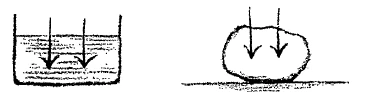
[ 10 ] Now combine this with another: Suppose you again have a liquid in the vessel with a level surface, whereby you assume a force acting vertically on the level surface. Now imagine that this liquid is transformed into a solid body by cooling. It is quite impossible not to think that these directions here, these directions of force, are not crossed by another in some way. For these directions of force cause me to store the water in a vessel, so that the shape of the water is only there because of the level surface. If a closed, shaped form is created during solidification, it is absolutely necessary to assume that forces are now added to those that were previously present. This provides the immediate insight that forces are added to those that were previously present. And at first, the idea is quite absurd to believe that those forces that were somehow already present in the water cause the shape, because if they had been present, they would have had to cause the shape in the water. So they have appeared. They cannot have been contained in the water system; they must have come to it from outside the water system. If we therefore take the phenomenon as it is, we must say: when a form appears somewhere, it actually appears as a new creation. If we remain only within the realm of what we can clearly observe, the form appears as a new creation. We see this clearly when we create a solid body from a liquid. The form appears clearly as a new creation, and it is abolished again when we transform the body into a liquid form. Let us just consider this for a moment based on what our perception tells us. What follows from the whole process when we really transform what we perceive into a concept? It follows that the solid body tries to become independent, that it tries to form a closed system within itself, that it enters into a struggle with its environment in order to become a closed system.
[ 11 ] I would like to say that it is obvious here that the solidification of the liquid is nature's attempt to achieve perpetual motion. The perpetual motion machine does not come into being only because the system is not left to its own devices, because the entire environment acts upon it. So you can advance to the view that in our given space there is a constant tendency at various points for a perpetual motion machine to come into being. But immediately a counter-tendency arises against this tendency. So we can say: whenever the tendency to form a perpetual motion machine arises somewhere, a counter-tendency forms in the environment to prevent the formation of the perpetual motion machine. If you orient your thinking in this way, you completely modify the abstract thinking of 19th-century modern physics. It assumes that a perpetual motion machine is impossible, therefore — and so on. If you remain in the world of facts, you have to say: a perpetual motion machine wants to arise continuously. Only the constitution of the universe prevents this.
[ 12 ] And what is the form of a solid body? It is the expression of struggle. This image, which forms in the solid body, is the expression of the struggle between the substance as individuality, which wants to form a perpetual motion machine, and the prevention of the formation of the perpetual motion machine by the entire universe, the relative universe, in which this perpetual motion machine wants to form. The form of a body is the result of the prevention of this striving to become a perpetual motion machine. I could also say, instead of a perpetual motion machine, because that might be more appropriate here or there, a monad, a self-contained body that carries its own forces within itself and generates its own form.
[ 13 ] We come, and here lies a crucial point, to reverse the entire starting point, not of physics, insofar as it provides experiments based on facts, but of the entire physical way of thinking of the 19th century. It worked with invalid concepts. It could not see how, in nature, there was a universal striving toward what it considered impossible. It was relatively easy for this way of thinking declare it impossible, but it is not impossible for the abstract reason that physicists assumed perpetual motion to be impossible; rather, it is impossible because the moment it is supposed to arise in any body, the environment immediately feels envy—if I may use a moral expression here—and does not allow perpetual motion to arise. It is impossible on the basis of facts, not on the basis of logic. You can imagine how many contradictions there must be in a theory that establishes its basic postulates apart from reality. If one sticks to reality, one cannot avoid what I first presented to you yesterday in the diagram. We will continue to elaborate on this diagram in the coming days.
[ 14 ] I told you: First we have the realm of solid bodies. These solid bodies are those that have solid forms. Adjacent to the realm of solid bodies, so to speak, we have the realm of liquids. The forms dissolve and disappear when the solid body transitions into liquid. We have the complete opposite of the solid in the striving apart, in the dissolution of the shape of the gaseous body: negative shape. But how does this negative shape manifest itself? If we look at gaseous or airy bodies without prejudice, if we observe them, for example, where they show how perceptible that which corresponds to their shape can be. Yesterday I pointed you to the field of acoustics, the world of sound. You know that in gases, sound is produced by compressions and rarefactions. But we also deal with compression and rarefaction in the whole gas when we change the temperature. So if we skip over liquids and look for what corresponds to the definite form of solid bodies in gases, we must look for it in condensation and rarefaction. In solid bodies we have definite form; in gases we have condensation and rarefaction.
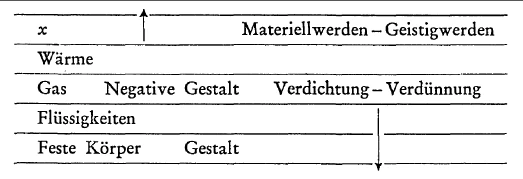
[ 15 ] And now let us turn to the area adjacent to gas, which, like liquid, is adjacent to the area of solid bodies — and we know that just as solid bodies represent the image of liquids, liquids represent the image of gases in their entirety, and gases represent the image of heat — we must imagine the area of heat as the next one. As the next area, I will first have to postulate an x. And if I initially try to proceed only by analogy—we will verify this in the following considerations—then I must look for something else in this x area instead of compression and rarefaction. I must look for something corresponding to compression and rarefaction in x (skipping heat), just as I have skipped the liquid here (below). If you first have a solid, closed form, then come to the conclusion that in the case of a gaseous body, the form is only expressed in the liquid form of condensation and dilution, and you imagine increased condensation and dilution, what must happen? As long as there is condensation and dilution, there is of course still matter. But if you continue to dilute and dilute further and further, you will eventually leave the realm of the material. And you must say, as a further continuation, simply by remaining in the character of the whole: become material — become spiritual. By ascending above the realm of warmth, you enter into x; you enter, simply by holding fast to the character that lies in the transition from solid form to liquid form, from condensation and dilution into materiality and non-materiality. You cannot help but speak of materiality and non-materiality. That is to say: as we pass through the realm of warmth, we actually enter into something that, in a certain sense, proves to be a just continuation of what we have observed in the lower realms. The solid body resists warmth; warmth cannot quite cope with it. The liquid body is already more responsive to the intentions of heat. The gas follows the intentions of heat completely; it allows heat to do with it what it wants; in its material processes, it is completely a reflection of the nature of heat itself. I can say that gas is essentially similar to the heat entity in its own substantial behavior. The degree of similarity between matter and heat increases the further I proceed from the solid body through the liquid body to the gas. This means that the liquefaction and evaporation of matter signifies a becoming similar of matter to heat. But when I then cross over into the realm of heat, when matter becomes, so to speak, completely similar to heat, it cancels itself out. Thus, for me, heat stands between two very different realms that are essentially different: the realm of spirit and the realm of matter. Between them lies the realm of heat. However, the transition to reality is now somewhat difficult for us, because on the one hand we have to ascend to where it seems to become more and more spiritual, and on the other hand we have to descend to where it seems to become more and more material. And there it seems to ascend into infinity and descend into infinity (see arrows in the diagram).
[ 16 ] But now another analogy presents itself, which I will outline to you today for the reason that, by vividly pursuing the individual facts of nature, a healthy natural science can indeed develop, and it may be useful to let the matter sink into the soul. If you look at the spectrum as it usually appears, you have red, orange, yellow, green, blue, indigo, and violet.

[ 17 ] You have the color series in about seven shades running side by side like in a band. But you also know that the spectrum does not end here, and also that here (on the left), as we follow the spectrum, we come to warmer and warmer areas and finally have an area where there is no more light, but still heat, the ultra-red area. Beyond violet, we also have no more light; we get ultraviolet, which only has chemical, i.e., material effects.
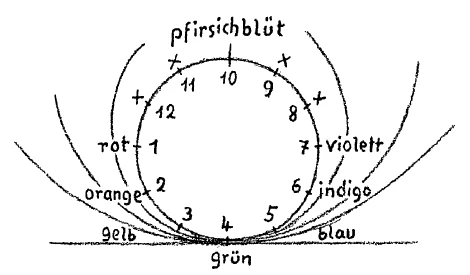
[ 18 ] But you know, on the other hand, that in the sense of Goethe's theory of colors, this line here can be turned into a circle and the colors can be arranged differently, so that one no longer merely observes the behavior of the light from which a spectrum is formed, but observes the darkness from which a spectrum is formed, which then has peach blossom in the middle instead of green, and the other colors starting from there. When I look at the darkness, I get the negative spectrum. And if I put the two spectra together, I get twelve colors that can be precisely distinguished in a circle: red, orange, yellow, green, blue, indigo, violet. Here, the violet becomes more and more similar to peach blossom; here, there are two nuances between peach blossom and violet; here, again, two nuances between peach blossom and red; and then, if you follow the entirety of these color nuances, you get, so to speak, twelve color states, if I may use that expression. From this you can see that what is usually described as a spectrum can also be thought of as arising from the idea that I could create this color circle here through something, and would make it bigger and bigger on one side; as a result, these upper five colors would move further and further away until they finally disappeared; the lower curve would almost become a straight line, and I would then obtain the usual spectrum sequence of colors, with only the other five colors disappearing on the other side.
[ 19 ] I now placed the colors last. Couldn't it also be the case (diagram) with going into infinity, as it is here with the spectrum? Namely, that I would get something special if I now searched: What happens when what seems to go into infinity (diagram) rounds into a circle and comes back again? Could there be something like a different spectrum that encompasses, on the one hand, the state from above heat down to matter, but which I can also close on the other side, as here with the color spectrum to the color of peach blossoms? We will continue this train of thought tomorrow.