

Second Scientific Course
The warmth at the boundary
between positive and negative materiality
Insights from Spiritual Science on the Development of Physics
GA 321
9 March 1920, Stuttgart
Translated by Steiner Online Library
Ninth Lecture
[ 1 ] Precisely when discussing the transformations of forces and energies as assumed by modern physics, it becomes necessary to draw attention to how one might point toward what actually lies behind these transformations. In these reflections, we will approach what lies behind these energy transformations in a completely systematic manner. To this end, I would like to present another experiment today alongside yesterday’s, in which we also perform work by expending a different kind of energy than the one that appears directly in this way. We will, so to speak, evoke in a different sphere an image of what also happened yesterday by setting a wheel in rotation here—that is, by setting it in motion—and thus performing work. For we could then transfer the rotation of the wheel to some machinery and use this rotation as motion. We will cause the wheel to rotate by simply allowing water to flow into these blades, which, through its weight, sets the paddlewheel in motion. The force that is simply inherent in the flowing water—it is this force that we transfer into the rotational force of the wheel (experiment).
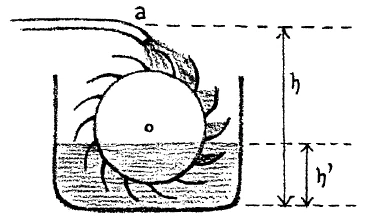
[ 2 ] We will now let water flow into this trough so that the water flowing down encounters a level sooner than was the case in the previous experiment. What we actually want to demonstrate is that by creating a level surface at the bottom, we cause the wheel to rotate more slowly than it did before. In fact, the rotation slows down the more the lower level approaches the upper one, so that we can say: If we denote the height from the absolute water level to this point here \((a)\), where the water flows onto our wheel, as \(h\), and the vertical distance between the absolute water level and the level surface we have down there as \(h’\), then we obtain a difference of \(h-h’\), and we can say: The work we can perform on the wheel will be related in some way—exactly how, we will seek to determine in the course of our analysis—to the difference between the two levels. We also had a kind of level difference in our experiment yesterday. For consider this: let us denote the thermal state prevailing in our room at the beginning of our experiment by \(t’\), and let us denote the thermal state that we induce through the heating we carry out so that the mechanical work we performed yesterday in the rising and falling piston can be done; we denote this thermal state by \(t\); then we will also be able to say in some way: The work performed depends on this difference between \(t\) and \(t’\), that is, here too on something that, in a certain sense, can be described as a level difference.
[ 3 ] I must draw your attention in particular to the fact that these two experiments, first and foremost, show us how we must proceed whenever something occurs that is today referred to as the conversion of energy involving a difference in energy levels. As for the role this difference in energy levels plays, what actually lies behind the transformation of energies—and what, for example, Eduard von Hartmann first had to work through before he could proceed to define physical phenomena—we will only discover this if, in order to shed light on the full scope of thermal phenomena, so to speak, we continue yesterday’s line of thought today and bring it to a certain conclusion. When it comes to these matters, one must again and again point to a beautiful phrase that Goethe spoke in reference to physical phenomena. He expressed this idea in various ways; he said, for example: “What, after all, are all the phenomena of external physical apparatus compared to the musician’s ear—to that which thus confronts us as a phenomenon, as a revelation of nature’s workings, through the musician’s own ear!”—Goethe simply wanted to point out that one certainly does not reach the goal by considering physical phenomena in isolation from the human being. Only by correctly considering physical phenomena in connection with the human being—that is, acoustic phenomena in connection with human auditory perceptions—can one, in Goethe’s view, truly reach the goal. But we have seen that great difficulties arise when we bring something like thermal phenomena into relation to the human being and now wish to consider them genuinely in connection with the essence of the human being. And even the very fact that led to the so-called discovery of the modern mechanical theory of heat points to such a way of looking at things, I would say. What haunts the modern mechanical theory of heat actually originated from an observation made on the human organism by Julius Robert Mayer. Julius Robert Mayer, who was a physician, noticed during bloodletting procedures—which he was compelled to perform in Java, that is, in tropical regions—that the venous blood of tropical people there had a redder color than that of people in more northern regions. From this, he rightly concluded that the process responsible for the color of venous blood differs depending on whether a person lives in a warmer or colder environment—that is, whether they are forced to lose more or less heat to their surroundings—and is therefore also forced to replace more or less heat through oxygen uptake and respiration. Julius Robert Mayer proceeded from the premise that this—in a sense—internal work, which a person performs by further processing the process to which they are subjected through oxygen uptake, is essentially internalized when the person is less compelled to interact with the external environment. In tropical regions—that is, when a person is less compelled to lose heat to their environment—they need to perform less work in conjunction with external oxygen than they do when they lose more heat to their environment. And as a result, in colder zones, human beings are, so to speak, constituted in such a way that they perform the life work necessary for their very existence on Earth more in communion with their environment. They must work more in conjunction with the oxygen in the air in colder regions than in warmer ones, where they work less in conjunction with the environment and more within their inner being.
[ 4 ] At the same time, you are looking into the inner workings of the entire human organism. You see that it simply needs to be warmer in the environment, and that a person works more internally and individually than when it is colder in their environment—and they therefore have to work more in harmony with the external processes of their surroundings. The mechanical theory of heat originated from this process, which thus represents, in a sense, a relationship between human beings and their environment. This observation led Julius Robert Mayer in 1842 to first submit his short treatise to the Poggendorff Annals. In essence, the entire physical movement that followed stemmed from it. Reason enough, then, to reject Julius Robert Mayer’s treatise as utterly lacking in merit when it was submitted to the Poggendorff Annals at the time. We are faced with the peculiar phenomenon that today physicists say: “We have set physics on an entirely new course; we think about physical phenomena quite differently than we did before 1842”—but at the same time, it must be pointed out that the physicists of that era—and they were, in fact, the very best physicists who had to decide on the matter—declared this treatise by Julius Robert Mayer to be utterly lacking in merit and did not include it in the Poggendorff Annals.
[ 5 ] Now one might say: With this treatise, a certain conclusion has been drawn regarding earlier physical considerations—which, though imperfect, were nonetheless approached in such a way that, in the spirit of Goethe, they were brought closer to human beings or even to the very essence of humanity. Following this treatise, a new physics emerges that sees the salvation of physical inquiry in, so to speak, regarding human beings as non-existent when one wishes to speak of physical facts. This is, after all, the essential characteristic of contemporary physical considerations—in some publications this is even emphasized as something necessary for the well-being of physics—namely, that nothing should play a role in them that is in any way related to human beings themselves, to human beings themselves, even if it concerns only their own organic processes. But this approach simply leads nowhere. And continuing yesterday’s line of thought—which, after all, is drawn from the world of facts—will lead us to relate physical phenomena to human beings.
[ 6 ] I would like to outline the essentials for you once again. We begin with the realm of solid bodies and find a unifying principle—initially as it appears—in their form. We then proceed, so to speak, through the intermediate state of the liquid—which retains form only in the formation of levels—to the gaseous bodies, which possess what is present in the realm of solids only as a formless essence, as rarefaction and condensation. We then arrive, adjacent to the gaseous realm, at the realm of heat—again, in a sense, much like the liquid realm, an intermediate realm—and then arrive at our \(x\). We saw yesterday that, if we continue this same real line of thought, we must consider \(x\) in terms of the formation of matter and dematerialization. It is now almost self-evident that we can proceed from \(x\) to a \(y\) and to a \(z\), just as we can proceed, for example, by moving forward in the light spectrum from green to blue, to violet, and to ultraviolet.
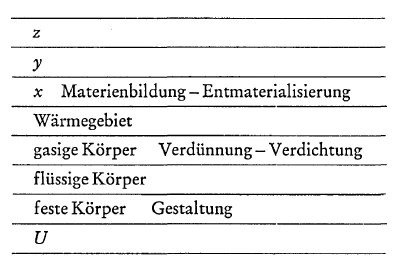
[ 7 ] And now the task is to study the interrelationships between these various realms. We see emerging in every realm very specific, characteristic—I would say, essential—elements: In the lowest realm, we see a closed form emerge; in the gaseous realm, a liquid form, so to speak—the condensation and rarefaction that—to be precise—accompany the presence of sound under certain conditions. As we proceed through the realm of heat into the \(x\)-realm, we then observe materialization and dematerialization. And the question that must arise here is this: How does one region influence the other? Now, I have already drawn your attention to the fact that, in a certain sense, when we speak of gas, the processes in the gaseous region can be conceived in such a way that their course reflects what happens in the thermal realm. We could say that the gas is, so to speak, carried along by the thermal phenomenon and, in its material form, conforms to what the thermal phenomenon wills, so that in the processes within the gas-filled space—the processes bound to the gas—we see, so to speak, reflections of what heat does. We can therefore say: In the gas, we find, so to speak, images of what happens in the thermal phenomenon. It is not possible to create a mental image of this in any other way than by imagining gas and heat as, in a certain sense, interpenetrating one another, so that the gas is in fact gripped in its spatial extension by what the thermal entity wills. Gas and heat would thus interpenetrate one another; it is precisely through this interpenetration that the processes in the gas reveal to us what is actually happening in the realm of heat. Again, we can say: The liquid exhibits, in a certain sense, a relationship to the gaseous state similar to that of the gaseous state to the thermal realm. The solid exhibits the same relationship to the liquid as the liquid does to the gas, and the gas to heat.
[ 8 ] But what, then, occurs in the realm of the solid? In the realm of the solid, forms appear—true forms, forms that are self-contained. These are, in a sense, what in turn serve as an image for us of that which merely operates in the fluid. Now we can turn to a region \(U\) within the solid, which we shall initially assume hypothetically, and we shall form concepts in order to then see whether these concepts are applicable anywhere in the realm of external, perceptible phenomena. By continuing this line of thought—which, as you surely sense, is rooted in reality—we wish to create concepts from which we can hope that, precisely because they are derived from reality, they will in turn carry us a step further into reality. What would have to happen if something like the region \(U\) were a reality? Then, in a sense, what is actually an external fact in the preceding region—the region of solid bodies—would have to appear figuratively within the region \(U\) as well. This region \(U\) would in turn have to provide us with the pictorial realm of the region of solid bodies. In the region of solid bodies there are forms—forms that are, of course, shaped by their inner essence or at least by their relationship to the world—we will be able to explore this further in the coming days—but forms do appear; forms must appear in their mutual relationships.
[ 9 ] Let us return once more to the realm of liquids. There, in a sense, because of the level surface that encloses the liquid on the outside, we have this liquid as a body connected to the entire Earth. We must therefore find something in gravity that is analogous to the forces that shape solid bodies. So, if we continue this line of thought realistically, we must find something that occurs in the region of \(U\) in the same way that form-building occurs in the region of solid bodies—namely, because the region of solid bodies provides the image of liquids. In other words: We must be able to see the effect in the region \(U\) that the various forms exert upon one another. We must somehow be able to see this effect. We must be able to see how, under the influence of forms that relate to one another in different ways, something comes into being. There must be something in the realm of reality that arises under the influence of the various forms in the realm of the solid. Today, we actually have only the beginning of such a thing. For take any body, for example, tourmaline, which carries within itself a principle of form. Let the shaped tourmaline—I mean its inner tendency to form—act in various ways so that form can interact with form. This is what you experience when you look through two pieces of tourmaline; for example, when you take a pair of tourmaline tweezers and look through them: sometimes you can see right through them, and sometimes your field of vision darkens. You have merely twisted the tourmalines relative to one another, bringing their formative power into a different relationship. This phenomenon is intimately connected with the one in which—allegedly through the passage of light through physical systems that are differently configured—the so-called polarization figures appear to us. These polarization phenomena always arise under the influence of the interaction of the formed elements upon one another. We are faced with the remarkable fact that, in the realm of solids, we are, as it were, looking into another realm that relates to solids in the same way that the realm of solids relates to liquids. And when we ask ourselves: Where, under the influences of the form-forming force in the realm of U, does that which occurs arise—just as when gravity, which in the liquid state merely creates levels, acts as a formative force in the realm of the solid?—we must say: This happens when we observe the so-called polarization figures, which lie in a realm situated below the solid state. We are in fact looking into a region that lies below the solid.
[ 10 ] But we can see something else from this as well. We could, of course, look into such a physical system for a long time, and all sorts of things might be happening there among the various forces—representing the interactions of different configurations—yet we would see nothing unless something else were to penetrate the solid bodies, beyond the initial interpenetration of the solid region with the region \(U\). For example, light penetrates into it, which is what makes these effects of form visible to us in the first place.
[ 11 ] What I have just said led 19th-century physics to establish itself within the realm of light itself, and to regard that which becomes visible only through light as an effect of light itself. When one looks at these polarization figures, one must seek an origin entirely different from that of light. What happens there has absolutely nothing to do with light itself. Light merely penetrates this region \(U\) as well and makes visible what occurs as a result—namely, that these formations take on the character of images. So that we can say: We are dealing with an interpenetration of the various regions that we have laid out here in a fan-like pattern; we are dealing with an interpenetration of these various regions in reality.
[ 12 ] And we will now also be able to approach, in an appropriate manner, what appears to us—for example, in the realm of the gaseous—through the formative principle, still in a sort of liquefied form. We will be led to a better understanding of what has been said when, as condensation and rarefaction occur, the facts of sound present themselves to our soul through the mediation of the organ of hearing. And we will not need to identify the condensations and rarefactions in the gaseous body directly with what appears to us as the various sound effects; rather, we will have to look for something that then occurs in the realm of condensations and rarefactions within the gas when these are present in an appropriate manner. We are compelled to describe what actually happens in such a way that we say: For the time being, let us leave what we call “sound” in the realm of the indefinite. But when we bring about certain lawful compressions and rarefactions in the gaseous medium, what becomes conscious to us in our perception of sound then arises. Isn’t this way of describing the matter quite analogous to if I were to say: We can create mental images of thermal states in the universe with very high temperatures, over 100°; we can create mental images of thermal states with very low temperatures, deep down, states of cold; and in between, we find a region in which human beings can exist and develop? — We will be able to say: If somewhere in the universe such a great oscillation takes place—where the state of heat transitions from a very high temperature to a very low one—then there is something in between where human beings can arise. The opportunity for human beings to arise is given, provided that other causes for the emergence of humanity are present. But in any case, we will not say: Human beings are the damping out of the thermal state of bodies into a low temperature and the subsequent rebound—for the rebound would also create the opportunity again—we will never say that. But in physics we constantly say: Sound is nothing other than the compression and rarefaction of air; sound is a wave motion that expresses itself in the compression and rarefaction of air. Through this, we completely accustom ourselves to viewing the matter in such a way that we see in the compressions and rarefactions merely the carrier of the sound, not the sound itself. So that even in the case of the gaseous state, we must create a mental image of something that simply penetrates the gas but belongs to a different realm, and which, within the realm of the gas, is given the opportunity to manifest itself in such a way that mediation between it and our hearing organ becomes possible. Only when concepts are formulated in this way can one actually speak correctly about physical phenomena. But if one formulates the concepts in such a way that one simply identifies the sound or the formation of sounds with air vibrations, then one is led to identify light as well with ether vibrations. One proceeds from something that is only imprecisely grasped to the invention, the fantasizing of a world of facts that is actually nothing more than the creation of imprecise thinking. In many respects, what physics speaks of—particularly at the end of the 19th century—is nothing other than the product of imprecise thinking. And when we follow conventional physics, we are still deeply entrenched in having to accept, within the concepts of physics, nothing more than the products of imprecise thinking.
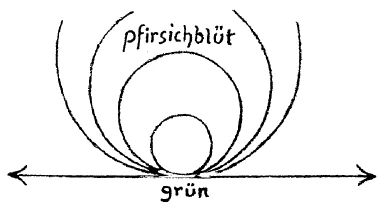
[ 14 ] Now, the point is that when we proceed from the region of heat to \(x\), \(y\), \(z\), we have, so to speak, the prospect of having to continue into infinity, and here (at \(U\)) we have the prospect of likewise having to continue into infinity. I already pointed this out to you yesterday: the same phenomenon occurs in the spectrum, where—when we form a mental image of the spectrum as it usually appears—we are, so to speak, compelled, as we trace the path from green through blue to violet, to proceed, so to speak, into infinity or at least into the indefinite, and likewise toward red. However, when we consider the entire spectrum—the entire realm of color phenomena—we can imagine this spectrum as consisting of the truly complete series of twelve colors, which can only be characterized by a circle that has green at the bottom, peach blossom at the top, and the other colors in between. And we can imagine that this circle is now expanding more and more; that peach blossom is lost to us here at the top and extends, on the one hand, toward red and, on the other, toward violet, and beyond both. Thus, in the ordinary spectrum, we actually have only a part of what would be there if the full range of colors could appear through the world of phenomena surrounding human beings. We have only a part of it.
[ 15 ] Now there is something that is highly peculiar. I believe that if you take a look at the standard descriptions of optics in physics textbooks and turn to what is usually given there as an explanation of a specific spectral phenomenon—namely, the rainbow—you will, if you prefer to stick to clear concepts, feel somewhat uneasy. For the explanations of the rainbow are really structured in such a way that one is left completely at a loss. One is compelled to take refuge in the raindrop and to trace all sorts of paths taken by the light rays inside it, and one is then compelled to piece together this fairly uniform picture of the rainbow from a multitude of small images that are particularly dependent on one’s perspective—images that are actually produced by raindrops. In short, these explanations have something of an atomistic conception of a phenomenon that appears quite unified in our surroundings. But we may feel even more uneasy than we do when considering the rainbow—that is, the spectrum that nature itself conjures up before us—when we realize that, in fact, this rainbow we are talking about never actually appears on its own. No matter how much it may hide itself, the second rainbow is always there. And what belongs together simply cannot be separated. The two rainbows—one of which is merely less distinct than the other—necessarily belong together, and when attempting to explain the formation of the rainbow, one must not even try to explain only one of the colored bands; rather, one must be clear that the totality of the phenomenon—the relative totality—is precisely something that is one thing in the center and has two outer bands. One of these outer bands is the slightly more distinct rainbow; the other is the less distinct arc. We are dealing with an image that appears to us in the vastness of nature and that, in fact, extends almost throughout the entire universe. We must regard this as a unified whole. Now, if we look closely, we will indeed become quite aware that the second rainbow—the secondary rainbow—is actually an inversion of the first, that the second can in fact be understood in a certain way as a kind of mirror image of the first, that it, so to speak, mirrors the first, more distinct rainbow. So, as soon as we move beyond the partial phenomena that occur in our immediate surroundings to a relative totality—which we encounter when we view our entire Earth in relation to the cosmic system—we find something that actually changes its very character. For now, I simply wish to point out this phenomenon. We will examine these phenomena more closely as our discussion progresses.
[ 16 ] However, the appearance of the second rainbow turns the phenomenon that appears there (see drawing) into a closed system, so to speak. The system remains open only as long as I am facing the spectrum that appears specifically here in my surroundings. And the appearance of the rainbow should actually lead me to think that when I create a mental image of this spectrum through an experiment, I am holding onto only one corner of nature, that something is lost to me somewhere at the opposite corner; that there is still something out there in the unknown, that I actually need the secondary rainbow to accompany every seven-colored spectrum.
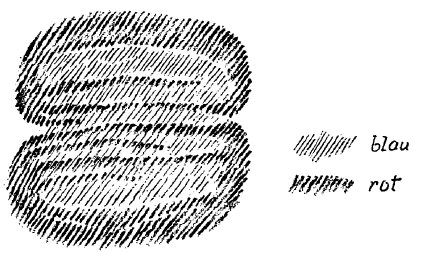
[ 17 ] Consider this phenomenon and its transformation into concepts, together with the development of our real concept that we have taken into account here (see diagram). Here (see drawing), we are attempting to bring together the band of colors that extends into the indefinite by merging one into the other. If we were to do the same here (diagram), what would happen? We would, by moving out from the solid body into the \(U\) and perhaps continuing even further down that path, shape it in such a way that it would come back to us from above and close. But now, if we were to take this path downward and return from above to close it, what would form there? What would happen there?
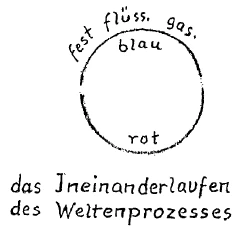
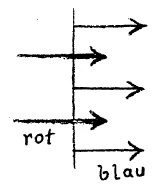
[ 18 ] To guide you through this, I’ll try the following: Suppose you are actually following a drawing that illustrates this concept in one particular direction. Let’s start, say, from the sphere where, in these considerations, we have been able to say that gravity becomes negative. We have, so to speak, arrived at one of the spheres. We proceed downward from there, and we form the mental image that, on our way down, we must enter the realm of liquids and solids. Now, however, if we continue on from there, we would actually—it is difficult to draw—have to return from the other side. As we return from the other side, what comes back from there would push its way into the previous region. That is to say, as I proceed from the solid into the U-region, if I were to take the entire tail there, turn it around, and bring it in, I would have to force it through here. I could also draw the diagram this way (see Figure 5.146 above), so that I depict the progression from the zero sphere through the liquid into the solid, the \(U\)-region, then go back again and re-enter here. So that I could say, for example: I am observing the gas, which tends toward this side—where I have drawn the blue—in this direction. But in the cycle of the worlds, what comes from the other side penetrates it, permeates it, yet appears within it only as an image. It impregnates, so to speak, what is returning—that which is moving away—and appears within it as an image. The liquid, by its very nature, penetrates the realm of the solid by following it, and appears within it as form; or something that, in our symbolic drawing, is situated higher up penetrates the realm of the gas and appears within it as sound. Consider for a moment this returning and the resulting intermingling of worldly processes, which leads you to the necessity of conceiving not merely a simple cycle of the world, but a cycle such that, as things continue here, what is continuing always re-enters into what was already there—that is, pushes its way through what was already there. Then you will gain a foundation for real thoughts that will also help you, for example, to see the manifestation—let’s say, of light, which must lie in an entirely different realm—within matter, in that matter is simply that which has run away, while the light follows behind and pushes its way in. However, if you wish to examine these things using mathematical formulas, you will then be compelled to expand those mathematical formulas somewhat.
[ 19 ] If you like—it is the ancient symbol of the serpent biting its own tail, the symbol of ancient wisdom. Except that ancient wisdom expressed all of this in symbols, and we are compelled to approach the real things.