

Second Scientific Course
The warmth at the boundary
between positive and negative materiality
Insights from Spiritual Science on the Development of Physics
GA 321
10 March 1920, Stuttgart
Translated by Steiner Online Library
Tenth Lecture
[ 1 ] Before we continue the discussion we resumed yesterday—and which we are nearly finished with—let us support it with a few experiments. First, we will create a light cylinder here by allowing light to shine through this slit, and we will place a blackened balloon inside the light cylinder so that the light cannot pass through it. We have illustrated what happens using this thermometer. You see, our—let’s call it—energy cylinder causes the mercury column to drop here by transmitting to us what is externally revealed by the light. We are thus dealing with what normally occurs under the influence of expansion. We must therefore assume that heat is passing through here and causing expansion, and that this expansion becomes evident to us in the sinking of the mercury column. So we can say: If we were to intercept the beam of light—say, through a prism—a spectrum would be produced here. We do not produce a spectrum, but simply intercept the light, collect it, and—by having now collected what is in this energy cylinder—we obtain a strong expansion here. You can see that the mercury column drops very sharply. We will now place a solution of alum in the passage of the energy cylinder, and we will see what happens as a result. So what passes through there—which would also manifest itself to us through its luminous aspect—is influenced by the fact that we have placed a solution of alum in its path, and we will now see what happens under the influence of the alum solution. In this way—as you will see in the end—we can restore the perfect state of equilibrium between the right and left mercury columns, whereby you will see that heat had previously passed through, but is now blocked by the alum solution; thus, no more heat passes through, but only the heat that is generally present in the room is expressed here as well. So it is at the very moment I place the alum solution into the energy cylinder that it prevents the heat from continuing onward. That is to say, I separate the heat from what manifests to me as both light and heat, and allow only the light to shine through here—for now, let us consider only this; other things are also shining through. But from this we can see that we can deal with the spreading light-heat energy in such a way that we allow the light to continue on its path and, by placing the alum solution in its path, separate out the heat.
Translate text Select source language. Currently selected: English (detected) Select target language. Currently selected: German Toolbar Source text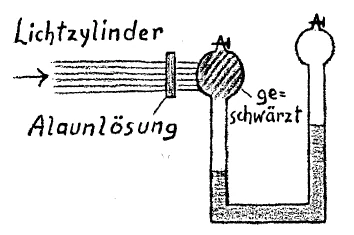 Translation results
Dictionary
Click on a word to look it up or to see alternative translations.
You’re logged in and have a DeepL Pro plan. Your content is secure.
Translation copied
[ 2 ] That is one thing we can initially observe purely as a phenomenon. The other thing we wish to keep in mind as a phenomenon before proceeding further in our considerations is this: If we wish to investigate the nature of heat, we can initially examine its behavior by heating any body at any point. We then notice that the body does not remain warm only at the single point where we heat it, but that the heat I apply at one point is transferred to the next part, then to the next part, and so on, so that ultimately heat is distributed throughout the entire body. Not only that. If we now bring another body into contact with the first, the second body also becomes warm; it will become warmer than it was before, and in modern physics we have become accustomed to saying: Heat spreads through conduction. We speak of heat conduction. Heat is conducted from one part of a body to another, and it is also conducted from one body to another body that is in contact with it. Even through very superficial observations, you can determine that this heat conduction varies among different substances. If you take a metal rod, hold it between your fingers, and place the other end into a flame, you will probably drop it soon. Heat is conducted very quickly from one end to the other. We then say: A metal is a good heat conductor. If, on the other hand, you pick up a wooden stick and hold it in the flame, you won’t be tempted to drop it quickly due to heat conduction. Wood is a poor heat conductor. And so we can speak of good and poor heat conductors. But this actually becomes clear only through another experiment. And we cannot perform this other experiment today either, because it would have been in vain if we had tried a second time to obtain ice and then even had to process the ice in a certain way. That would not have been possible. In more favorable circumstances, such an experiment can be carried out: If, under certain conditions, one shapes a lens out of ice—similar to a glass lens—and then a heat source—simply a flame — one can, just as the common expression says that light rays converge, also cause heat rays to converge; and one can use a thermometer placed here to confirm that there is indeed something like an accumulation of heat under the influence of the ice lens, through which the spreading heat has passed (see drawing).
Translate text Select source language. Currently selected: English (detected) Select target language. Currently selected: German Toolbar Source text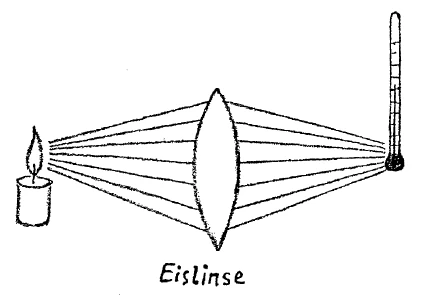 Translation results
Dictionary
Click on a word to look it up or to see alternative translations.
You’re logged in and have a DeepL Pro plan. Your content is secure.
Translation copied
[ 3 ] Now, from this experiment, you can easily see that this cannot be the same process as heat conduction, even though the heat has spread; otherwise, the ice lens could not have remained an ice lens. The point, then, is that we have two distinct types of heat propagation: one that essentially affects the bodies through which the heat propagates, and another in which it does not matter what stands in the heat’s path—in which case we would be dealing with the propagation of the very essence of heat, where, so to speak, we see heat itself propagating. However, to be precise, we must first ask: What is it, actually, that propagates when we impart heat to a body and then observe that it becomes warmer bit by bit? Is it not perhaps a highly ambiguous expression to say that it is heat itself that spreads from one part of the body to another, when we observe this warming only in the body itself?
[ 4 ] You see, here I must again point out that the goal is to form truly precise mental images and concepts: Instead of simply feeling the heat here (on a heated rod), take a fairly large iron rod—a metal rod—and heat one end of it, but do so in such a way that it won’t cause any harm if you then line up a row of boys on it. Now let the boys—but it mustn’t be too hot—scream when it gets warm at the bottom; then the first one will probably scream first, then the second, then the third, and so on. One after another, the boys scream. But you won’t be tempted to say: What I’ve observed here with the first boy carries over to the second, to the third, to the fourth, and so on. But if you heat it here (at one end) and then feel the warmth here (at the other end), today’s physicist says: The heat is simply conducted. Whereas in reality, he is merely observing, bit by bit, what the body does—namely, giving him the sensation of heat—just as here, the boys squeal when they experience the heat. You cannot say that the screaming propagates.
Translate text Select source language. Currently selected: English (detected) Select target language. Currently selected: German Toolbar Source text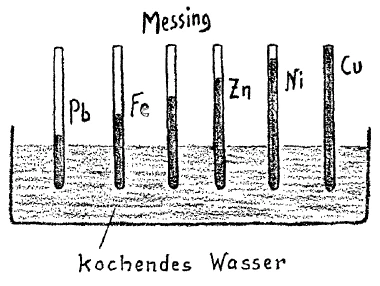 Translation results
Dictionary
Click on a word to look it up or to see alternative translations.
You’re logged in and have a DeepL Pro plan. Your content is secure.
Translation copied
[ 5 ] We will now attempt to demonstrate how various metals—present here in the form of rods—behave differently with respect to what is commonly referred to as heat conduction, and we will endeavor to introduce concepts that accurately reflect reality. We are pouring hot water into this setup. As the rods are submerged in the water at the bottom, they are heated. We will now observe the effect this has on our experimental setup—how one rod after another heats up—so that we can then actually create a mental image of a kind of scale. We will be able to demonstrate the effects of heat continuously as they occur in the various substances (see diagram. The rods are coated with yellow mercury iodide, which turns reddish when it reaches a certain temperature. The color change rises up the various rods at different rates.) Lead, then, is the poorest heat conductor among these metals, as they say. — The experiments are presented here so that we may now form the overview—which we have discussed on several occasions—of the phenomena within the nature of heat, in order to gradually advance toward an understanding of what the nature of heat actually is.
[ 6 ] Now, as we saw in our discussion continued yesterday, when we consider the realm of physicality, we can in a certain way distinguish the realm of the solid, in which we can essentially trace what takes shape. We then have, so to speak, the liquid as an intermediate stage, and proceed on to the gaseous. And in the gaseous state, we must regard condensation and rarefaction as corresponding to the formation found in solids. Then, again as a kind of intermediate state, we have precisely what we are seeking: heat. We have seen why we may include it here (see diagram). Then, as I said, we enter a kind of \(x\), and if we were to continue this line of thought in a completely realistic manner, we would encounter materialization and dematerialization, and would then have to ascend to a \(y\), to a \(z\), as I said, in a manner similar to how, in the light spectrum, we find the transition from green through blue to violet and then seemingly into infinity. However, we had to acknowledge yesterday that we can also extend the realm of the solid here (diagram below) into a kind of \(U\), so that we can create mental images of the realms of our physicality through this arrangement modeled after the spectrum; we can create mental images of them precisely if we wish to remain within reality.
Translate text Select source language. Currently selected: English (detected) Select target language. Currently selected: German Toolbar Source text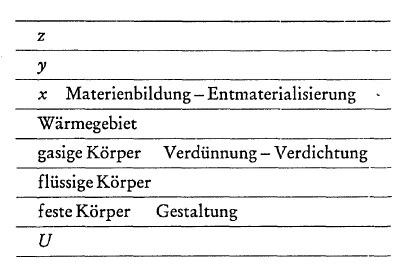 Translation results
Dictionary
Click on a word to look it up or to see alternative translations.
You’re logged in and have a DeepL Pro plan. Your content is secure.
Translation copied
[ 7 ] Now the point is to pursue further the idea we already expressed yesterday: Just as we can summarize, in a circular manner, the parts of the spectrum that fade toward violet and toward red—by bringing together the spectrum that extends in a straight line to the left and right—so too can we conceive of the changing . states of physicality on one side and the other in such a way that they are not actually characterized by a straight line that strays off into infinity in one direction or the other, but rather that what here seemingly extends into the indeterminate or the infinite recedes here, and likewise this, and that what is actually present can be characterized by a circle—by a line that at least returns upon itself.
[ 8 ] This raises the question: What can we find here? If we look at the ordinary spectrum, we can at least find something there. From the perspective of Goethean optics, you know that we can arrange the spectral colors in such a way—if we take the spectrum not one-sidedly but with all its possible colors—that on one side we have green, which is, so to speak, the middle color when we make a light color part of the spectrum, and on the other side the peach-blossom color, which is likewise a middle color when we make a dark color part of the spectrum. So we have green, blue, and violet, fading into peach blossom on one side, and on the opposite side, green, yellow, orange, and red, fading into peach blossom. By closing the circle, we can observe the peach blossom color at the point where it closes.
[ 9 ] If we now close our circle of states here for the various states of physicality, can we find anything there? We have now reached an extraordinarily important point. What must we place here, in the same way that we place the color of peach blossoms here in the ordinary spectrum—which, in a sense, is meant to give us a picture of the spectrum of states? What must we place here? Perhaps the idea that must simply emerge from the world of facts here will not be all that difficult for you if I first try to introduce it in the following way. What, then, is it that we actually have before us, vanishing, as it were, to one side and then to the other, just as the color spectrum vanishes toward violet on one side and toward red on the other? What is it that we have before us? It is, in essence, nothing less than the whole of nature. You cannot find anything in what is called the realm of nature that does not have to be placed somewhere within “form,” beneath “form,” in what I have here designated as \(x\), \(y\), \(z\), and so on. (See diagram) Nature disappears from us on one side as we trace the physical states through heat; on the other hand, it slips away from us when we trace the forms—first the forms of the solid realm, then those of the sub-solid realm—which we see in the polarization figures, where form acts upon form. You can look at these tourmaline tweezers; then you will see something light or something dark. It is only through the interplay of these forms that what appears dark at one moment and light at another—and so on—comes into being.
[ 10 ] For us, the essential thing now is to determine what we must place here when we trace nature on the one hand to the point where it encounters, on the other hand, what can be characterized as a current. What is there? There is, in fact, nothing else there but the human being as such. Humanity is there. Humanity is there in such a way that it perceives what comes from one side and perceives what comes from the other. How, then, does it perceive what initially comes this way (from below)? It is formed. If we ask about his form among the forms that other bodies possess, we must say: Human beings also have a ‘form.’ So that which acts as formative forces is also within him. But we must ask ourselves: Does that which acts as formative forces belong to the sphere of consciousness? Not in the case of the consciousness that arises in the human being. For imagine for a moment that you would not gain a concept of the human form by observing yourself or by seeing other people. Through inner experience, you would not initially be able to gain a concept of form. We are formed, but in our immediate consciousness, form is not given to us. What do we have in our immediate consciousness instead of form? One can only experience this by gradually observing—completely impartially, so to speak—the development of the human being in physical life. To begin with, when a human being enters physical life, they must relate very flexibly to their formative forces; that is, much must be shaped within them. The closer we come to the state of complete childhood, the more is shaped within us, and our aging is entirely accompanied by the receding of the formative powers. And to the same extent that the formative powers recede, our conscious powers of imagination emerge. They come forth from within us the more the formative powers recede. The more we lose the ability to shape ourselves, the more we can create mental images of forms. This is, at least during the period of human growth, a fact that is truly just as clear as other clear facts. From this, however, you can see that we can say: We can experience the formative forces; we can experience that which shapes bodies on the outside. How do we experience this? By it becoming a mental image within us. We have now reached the point where we bring the formative force into contact with the human being. The formative force is not something one can simply dream up. We must provide the answers to the questions nature poses to us not through speculation or philosophizing, but from reality itself. And in reality we see: The formative force reveals itself to us where, so to speak, the form itself dissolves before us in our mental image, where it becomes an image. In the mental image, we experience the force that eludes us externally as bodies take shape.
[ 11 ] So if we place the human being here (see the note on page 157), we can say: From below, the human being experiences the forms as mental images. What, then, does the human being experience from above—where, if we start with the gaseous, something like warmth appears to us—what does the human being experience there? Well, here again, if you look impartially at the phenomena in the human being himself, you will not be able to help but ask yourself: How is the human will initially connected to the phenomena of warmth? You need only consider—from a physiological standpoint—how we require a certain cooperation with the external natural world in order to generate warmth, in order to arrive at volition. But as we bring volition into reality, it is precisely warmth that appears. We must therefore regard heat as related to volition. Just as we must regard the formative forces outside in things as related to a mental image, we must regard everything that manifests externally as heat as related to what is will within us; we must therefore regard heat as will, except that in our will we experience the very essence of heat.
[ 12 ] So how could this form—when it appears to us externally—define us? We look at it, this form, in some solid body. We know that if this form had been transformed by our own life process under certain conditions, a mental image would have arisen. This mental image is not contained within the external form. It is roughly as if I were to see the spiritual-soul aspect separating from the physical body at the moment of death. When I see the forms in nature externally, that which brings about the forms is not there. In truth, it is not there. It is not there in the same way that the spiritual-soul aspect is not there in a corpse, yet was once within it. So when I turn my gaze to the external world of nature, I must say: There is something at work in the form—I do not want to say “has been at work,” but rather “is becoming active”; we will see this later—there is something at work that is the same as what lives within me as a mental image. When I perceive warmth in nature, the same thing that lives within me as will is somehow at work. In the human being who creates mental images and wills, we find that which confronts us out there in nature as form and as warmth. |
[ 13 ] But there are, of course, all sorts of intermediate stages between willing and creating a mental image. If you engage in even moderately careful self-observation, you will soon discover that you never actually create a mental image without making an effort of will. An effort of the will, however, is perceived as uncomfortable by most people, especially nowadays. People tend to surrender more to the unconscious will, to the flow of thoughts; they do not like to direct the will into the realm of thought. But thought content entirely devoid of the will actually never exists, just as there is no will that is not guided by thought. So, when we speak of thought and will, of mental images and will, we are actually dealing only with boundaries—with what constitutes the realm of thought on one side and the realm of will on the other. And we can therefore say that, by experiencing within ourselves the thought-bearing will and the will-bearing thought, we truly and essentially experience the outer form and the outer warmth in nature. There is simply no other way than to seek within the human being the essence of that which confronts us externally in its manifestations.
[ 14 ] Now take this line of thought further. If you continue to follow the states of physicality in one direction, you could say that you would have to trace their progression linearly into the indefinite. The same applies in the other direction. But how must it be here in human beings? Precisely the opposite must be the case here. Yes, we must actually trace back that which we here (see diagram on page 153) trace into infinity. Instead of it proceeding into infinity here in such a way that we cannot actually trace it any further, we must assume here (in the human being) that it disappears out of space; likewise, that which moves from below to above, we must regard as disappearing out of space. This means: The force inherent in heat, in its effect on the human being, must manifest itself in such a way that it moves out of space within him; likewise, the formative force within the human being moves out of space. This means that we must arrive at a point within the human being where that which otherwise appears spatially in the external world—form and the propagation of heat—exits space, where it becomes impossible to mathematically capture what is becoming as it ceases to be spatial.
[ 15 ] Here we see, in what I believe to be an extraordinarily significant way, how simply by properly observing natural phenomena we are compelled, the moment we approach human beings and correctly place them within the existence of nature, to step outside of space—just as we must create a mental image of space here (see diagram) that extends infinitely upward and downward. By approaching human beings, we must step outside of space. We cannot find a symbol that spatially expresses how natural phenomena intersect within human beings. To create a correct mental image of nature means that we must leave it behind when we consider it in relation to human beings. Otherwise, by focusing on the content of nature in relation to human beings, we cannot approach human beings at all.
[ 16 ] But what does that mean mathematically? Suppose you designate that line—along which you trace the states of matter into infinity—and you designate its successive values as positive. Then you must designate that which acts within human beings as negative; and if, on the other hand, you designate this line here as positive, you must designate that which acts within human beings as negative. Whatever positive and negative may be—I believe we will have to discuss positive and negative in the coming days, following a lecture by one of the gentlemen—and however we may understand them, what becomes clear to us here is that we must transform the essential nature of warmth—insofar as this essential nature belongs to the warmth of the external world—into the negative when we trace it in human beings; just as we must also transform the essential aspect of form into the negative when we trace it in human beings. So that, in fact, what lives in the human being as a mental image relates to what lives in the outside world as form in the same way that positive number sequences relate to negative number sequences—or vice versa—let us say: like assets and liabilities, but what is a liability for one person is an asset for another, and vice versa. Here we come to the realization that what is form in the outside world lives within the human being as the negative. So when we say: Out there in the world there is a body that has matter, I must say: If I now create a mental image of its form, I must also imagine the matter in some negative way. By what is matter first and foremost characterized for me as a human being? It is characterized by its pressure effect. If I move from matter, which reveals itself through its pressure effect, to my conception of form, then the opposite of the pressure effect must be present: the suction effect. This means that we cannot conceive of what occurs in human beings as a mental image in material terms if we symbolically represent the material as a pressure effect. We must conceive of its opposite. We must conceive of something active within the human being that is as opposed to matter as the negative is to the positive. We must symbolize that which is active—when we symbolize matter through the effect of pressure—by means of the effect of suction. As we move beyond matter, we arrive at nothingness, at mere space. But as we proceed further, we arrive at less-than-nothing, at that which matter absorbs; we move from pressure to suction. There we find what reveals itself within us as a mental image.
[ 17 ] And when we consider the effects of heat from the other side, they again turn negative as they pass into us. They step out of space. They are, if I may continue this metaphor, absorbed by us. We experience them in such a way that they manifest themselves in their opposite form. They are nothing else—any capacity remains a capacity, even if it means a debt for the other. Because we are compelled to designate external heat, as it acts within us, as “nothing” with a negative sign, it thereby becomes nothing else. But you see, in turn: We are compelled by the force of the facts themselves not to form a mental image of us humans as purely material, but to presuppose within us something that is not only not matter, but which, in all its effects, relates to matter in the same way that suction relates to pressure. And if you create a mental image of our human nature in its purest form, you must conceive of it as that which continually destroys and absorbs matter.
[ 18 ] The fact that modern physics has not developed this concept at all—this concept of negative matter, which relates to external matter in the same way that suction relates to pressure—is the misfortune of modern physics. What we must develop is this: the moment we are compelled to address any effects that manifest themselves within the human being, we must give all our formulas a different character by introducing negative quantities for manifestations of the will in contrast to manifestations of heat; and by introducing negative quantities for manifestations of imagination in contrast to the formative forces.