

Second Scientific Course
The warmth at the boundary
between positive and negative materiality
Insights from Spiritual Science on the Development of Physics
GA 321
11 March 1920, Stuttgart
Translated by Steiner Online Library
Eleventh Lecture
[ 1 ] Now I would like, so to speak, to build a bridge—because I will need it for the following considerations—between the topics covered in this course and those covered in the previous course. Today we will study the so-called light spectrum and its relationship to the thermal and chemical effects associated with it. Perhaps the easiest way to visualize what we’re dealing with is to first create a spectrum and study how the various parts of the spectrum behave. So let’s create a spectrum here by passing light through this slit. (The room is darkened, and the spectrum is demonstrated through the experiment.) As you can see, we have a spectrum here on this plate. You can now see for yourselves that we have placed something in the red part of the spectrum here. We will then be able to observe something using this instrument. We will now try to show you how thermal effects occur primarily in the red part of the spectrum. You can already observe these thermal effects by seeing how, under the influence of the energy cylinder—if I may put it that way—the air here expands and exerts pressure, causing the alcohol column to descend here and rise here. This descent of the alcohol column demonstrates that there is essentially a thermal effect in this part of the spectrum. It would, of course, be interesting to show—though it cannot be done so quickly—that if we were to shift the spectrum and position this instrument in the blue-violet region, the thermal effect would not be observed. This thermal effect is thus essentially observable in the red part of the spectrum. And now, just as we verified the occurrence of the thermal effect in the red-yellow part of the spectrum through the fall of the ethanol column, we will verify the occurrence of the chemical effect of the spectrum in the blue-violet region by placing a substance here in the space that is traversed by the blue-violet part of the spectrum, and you will see that this causes the substance to phosphoresce—that is, as you know from the discussions in the previous lecture, chemical effects are demonstrated. From this you can see that there is, in fact, still an intrinsic difference between the part of the spectrum that extends into the indefinite on one side and the other part of the spectrum that extends in the opposite direction. You can see how the substance has become luminous under the influence of what are called chemical rays. We can now also cause the middle part of the spectrum—which is the actual light portion—to be separated. We probably won’t succeed completely, but we will still be able to isolate the middle part—that is, to create darkness in the middle part instead of brightness—by simply letting a few drops of iodine tincture drip into the substance formed by a carbon disulfide prism. This gives us a mixture of carbon disulfide and iodine tincture. It turns out to be a substance that does not transmit light, and if we could carry out the experiment completely—which, unfortunately, we cannot do, but we can at least point the way—we would be able to demonstrate perfectly that thermal effects occur on one side and chemical effects on the other, while the actual light component, the middle part of the spectrum, disappears. If I were to place alum in the path, the thermal effects would cease, and you would then see that the alcohol column rises again, because the alum—the alum solution—prevents the passage of the thermal effects—so to speak. Very soon, because the alum is in the way, this alcohol column would rise again, since heating would not take place. We would obtain a cold spectrum here.
[ 2 ] It is very interesting that one can also make the chemical component disappear by placing a solution of esculin in the path of the spectrum’s propagation—a solution we, unfortunately, were unable to obtain. The thermal and optical effects remain, but the chemical effects cease. Let us now place a solution of iodine in carbon disulfide in the path, and the middle part of the spectrum will disappear. You can clearly see the red part—which, however, would be gone if the experiment were to succeed completely—you see the violet part, and nothing in the middle. Thus, by carrying out a sort of partial version of the experiment, we have succeeded in eliminating the most significant part of the light—the middle section. If we were to carry out the experiment in its entirety—as certain experimenters, such as Dreher in Halle fifty years ago, have succeeded in doing—we could also completely eliminate the two luminous spots and then demonstrate the resulting rise in temperature, as well as the effects of the chemical rays emitted by the “luminous matter.” This is a series of experiments that has not yet been brought to a conclusion—a series of experiments that is extraordinarily important. It shows us how that which can be conceived as active in the spectrum fits into the general context of the universe.
[ 3 ] In the course I taught during my previous stay here, I demonstrated how, for example, a powerful magnet affects spectral ratios, in that certain lines and certain formations within the spectrum itself are altered by the influence—by the force—emanating from the magnet. And the point now is simply to expand the line of thought that has been introduced here in such a way that one truly has the physical processes present in one’s mind. You know from the considerations we have just made that a complete spectrum—that is, a compilation of all possible colors—would actually consist of twelve colors; we would, so to speak, obtain a circular spectrum instead of one extended in a single direction in space. We would have green here, peach blossom here, violet here, and red here, with the other color shades in between—twelve color shades that can be clearly distinguished from one another (see drawing).
[ 4 ] The point is that, within the context of earthly conditions, we can only visualize such a spectrum figuratively. If we were to depict a spectrum within the realm of earthly life, we could only do so figuratively, and thus we always end up with the familiar spectrum that runs in a straight line from red through green to blue and violet. So, we obtain a spectrum which, as I have already mentioned several times, can be derived from the above by making the circle larger and larger, with the peach blossom fading toward the other side, the violet here (see drawing, right) extending into apparent infinity, the red here (left) pointing toward apparent infinity, and the green remaining in the center.
Translate text Select source language. Currently selected: English (detected) Select target language. Currently selected: German Toolbar Source text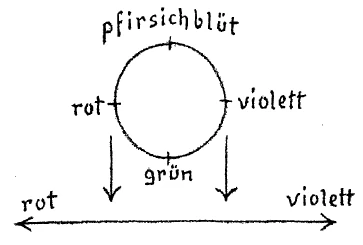 Translation results
Dictionary
Click on a word to look it up or to see alternative translations.
You’re logged in and have a DeepL Pro plan. Your content is secure.
Translation copied
[ 5 ] We might ask ourselves: How does this fragmentary spectrum, this fragmentary band of colors, arise from the completeness of color formation—from the formation of twelve colors, which must surely be possible? If you hypothetically assume that the complete circular spectrum would arise here (see drawing), you can form a mental image of forces at work that enlarged the circle by stretching it apart here. Then a moment would occur when this part up here actually tears apart, and through the forces at work, the circle is transformed into a straight line—that is, into infinite length, into seemingly infinite length.
[ 6 ] When we find this spectrum—which can be conceptualized as a straight line—in the realm of earthly life, we must ask ourselves: How can it come into being? It can only arise through the separation of the seven familiar hues from the fullness of colors. They are separated by forces that must, so to speak, act within the spectrum. But we have actually already found these forces within the realm of earthly existence. We have found them by pointing to the formative forces. This, too, is a form: the circular form has, after all, been transformed into the straight-line form. This is a form we have encountered here. And it is, I would say, evident that forces are at work somewhere within the earthly realm that make our spectrum possible only when we can see that the inner structure of the spectrum is influenced and altered by the influence of magnetic forces. If this is the case, then we must assume that forces may already be at work in our spectrum, which we always regard as primary. We must therefore not merely observe variations in light within our ordinary spectrum, but we must also conceive of forces within this ordinary spectrum that make it necessary for this ordinary spectrum to be symbolized by a straight line.
Translate text Select source language. Currently selected: English (detected) Select target language. Currently selected: German Toolbar Source text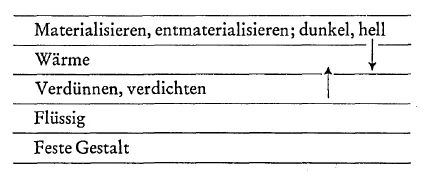 Translation results
Dictionary
Click on a word to look it up or to see alternative translations.
You’re logged in and have a DeepL Pro plan. Your content is secure.
Translation copied
[ 7 ] Let us connect this line of thought with another that will present itself to us if we ascend once more in the manner we have done so often before: from the solidly formed, through the fluid, to the condensed, the diluted—that is, the gaseous—to the entity of warmth, to what we have called materialization and dematerialization in x. Here we encounter a higher intensification of condensation and dilution beyond the thermal entity, just as condensation and dilution themselves appear to us as an intensification—as, so to speak, a liquefaction of form. When form itself becomes liquid, when we have a variable configuration in the gas, this is an intensification of definite formation. What is occurring here? Here we see an intensification of rarefaction and condensation. Keep this firmly in mind: we are entering a realm where an intensification of rarefaction and condensation occurs.
[ 8 ] What does an increase in dilution mean? Isn’t it true that when matter becomes thinner and thinner, it already reveals to us—if it is a certain kind of matter—what is struggling against it as it becomes thinner and thinner? If I make it denser and denser, it will turn out that it no longer allows a light behind it to pass through. If I make it thinner and thinner, it lets the light through. If I continue to thin it out further and further, eventually only brightness as such will appear to me. Thus, that which I must here regard as still lying within the realm of the material will always appear to me empirically as the manifestation of brightness. Dematerialization will appear to me as bright; materialization will always appear to me as dark. Thus, in the realm of worldly effects, I must understand illumination as an increase in dilution and darkening as a condensation that has not yet occurred sufficiently, so that the condensation does not yet appear sufficiently as matter, but the effects are only on their way to becoming material.
[ 9 ] You see, I find the region of light above the region of heat, and now the region of heat also appears to me, in a completely natural way, to extend into the region of light. For if you consider that what lies further down always, so to speak, reflects what lies above it, you will have to find in the nature of heat something that is, so to speak, a reflection of lightening and darkening. In the realm of heat, which appears to us at one end of the spectrum, we must find something that appears as an image of lightening and darkening. But we must also be clear that we do not only find the upper part of our realm of reality in the lower part in this way, but also the lower part of the realm of reality in the upper part. If I have a solid body, it can certainly exist within the liquid realm while retaining its solidity. That which gives it form can extend upward into the next, unformed realm. I must be clear that when I deal with realities in my mental images, I am dealing with the mutual interpenetration of the qualities of reality. However, this takes on a specific form in the realm of heat. It takes the form that, on the one hand, dematerialization must act downwards into heat from above (arrow), while on the other hand, the tendency toward materialization acts upwards into heat.
Translate text Select source language. Currently selected: English (detected) Select target language. Currently selected: German Toolbar Source text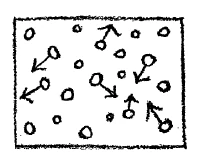 Translation results
Dictionary
Click on a word to look it up or to see alternative translations.
You’re logged in and have a DeepL Pro plan. Your content is secure.
Translation copied
[ 10 ] You see, I am approaching the nature of heat by recognizing in it, on the one hand, the emergence of a striving toward dematerialization and, on the other hand, a striving toward materialization. So that when I now seek to grasp the nature of heat, I can only do so by recognizing that there is a life, a living interplay within it, which reveals itself in that everywhere the tendency toward materialization is permeated by the tendency toward dematerialization. Now you can see what a considerable difference there is between this truly discovered nature of heat and the nature of heat that featured in Clausius’s so-called mechanical theory of heat. There, if you have a closed space, you find atomistic or molecular particles that collide in all directions, bump into one another, strike the walls, and perform purely external, extensive movements. And it is decreed: Heat actually consists of this chaotic motion, this chaotic mutual collision and collision with the walls of the material particles—about which there was then only a lively debate as to whether they should be regarded as elastic or inelastic. This is, after all, a matter of deciding whether one finds the formula for elasticity or that for inelastic, solid bodies more applicable to one phenomenon or the other. It was thus an expression of a conviction based purely on space and spatial motion when it was said: Heat is motion. We must now say it in an entirely different way: Heat is motion—it is motion, but motion to be conceived as intense, motion in which, in every part of space where heat exists, there is a striving to create material existence and to cause material existence to disappear again. No wonder that we, too, need heat in our organism. We simply need warmth in our organism to constantly transform what is spatially extended into what is spatially unextended. When I simply walk through space, what my will accomplishes is the shaping of space. When I create a mental image of it, something exists entirely outside of space. What makes it possible for me, as a human organism, to be externally integrated into the spatial relationships of the Earth? By walking upon it, I am, after all, altering the entire form of the Earth; I paint black dots in a certain place; I am constantly changing its form. What makes it possible for me—as that which I am within the entire context of the Earth and which manifests itself in spatial effects—to grasp this inwardly, without reference to space, as an observer in my thoughts? It is because I myself bring my existence into being within the medium of heat, which allows material effects—that is, spatial effects—to continually transform into immaterial effects, that is, into effects that no longer occupy any space. I thus actually experience within myself what heat truly is: intense movement—movement that continually oscillates from the realm of pressure effects into the realm of suction effects.
Translate text Select source language. Currently selected: English (detected) Select target language. Currently selected: German Toolbar Source text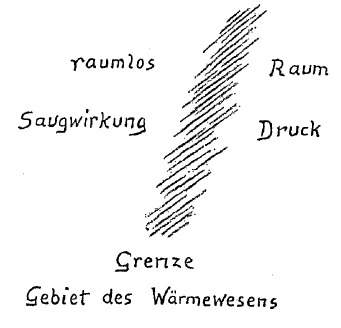 Translation results
Dictionary
Click on a word to look it up or to see alternative translations.
You’re logged in and have a DeepL Pro plan. Your content is secure.
Translation copied
[ 11 ] Suppose you have here the boundary between pressure effects and suction effects. The pressure effects extend through space, but the suction effects, as such, do not extend through space; rather, they extend beyond space. For my thoughts are based on the suction effects, yet they do not extend through space. Here, beyond this line (see drawing on page 170), I have the non-spatial. And when I create a mental image of what occurs neither in the realm of pressure—in space—nor in the realm of suction, but rather in the realm of the boundary between the two, then I arrive at that which occurs in the realm of thermodynamics: a continuous search for equilibrium between material pressure effects and spiritual suction effects. It is very strange how certain physicists today are, I might say, having these things thrust right under their noses, yet they are absolutely unwilling to address them. Planck, the Berlin physicist, once stated this explicitly: If one wishes to form a mental image of what is always called the ether, the first requirement today—based on the insights one can gain from physics—is that one must under no circumstances conceive of this ether as material. — That is a statement by the Berlin physicist Planck. So, the ether must not be conceived of as material. Yes, but what we find here as lying beyond the effects of heat—which already includes the effects of light—we must not form a mental image of as material to such an extent that we no longer find the characteristic property of the material world today—namely, the effect of pressure—but only suction effects. This means we are moving beyond the realm of ponderable matter and entering a realm that, of course, asserts itself everywhere, but which manifests itself in a manner opposite to that of the material realm; a realm we can conceive of only through suction effects emanating from every point in space, whereas we naturally conceive of the material as pressure effects. But here we come to a direct grasp of the nature of heat as an intensive movement, as an oscillation between suction and pressure effects—not, however, in such a way that one side of the suction effects is spatial and the other side of the pressure effects is also spatial, but rather that we step outside the realm of the material—of three-dimensional space itself—the very moment we seek to comprehend heat. Therefore, when a physicist expresses certain effects using formulas, and these formulas contain forces, if these forces are introduced with a negative sign—if compressive forces are introduced in such a way that they can be regarded as suction forces, but at the same time it is taken into account that we no longer remain within space but emerge entirely from it—then it is only with such formulas that we enter the realm of light and heat effects; that is to say, only partially into the realm of heat effects, for in the realm of heat we have the interplay of suction and pressure effects.
[ 12 ] This matter, my dear friends, still seems—I would say—quite theoretical today when presented to an audience like this. However, we should never forget that a large part of our most modern technology arose under the influence of the materialistic worldview of the second half of the 19th century, which lacked all such mental images, and that therefore these mental images cannot even arise within our technology. But if you consider how fruitful the one-sided mental images of physics have become for technology, you can get an idea of what technical consequences would also arise if one were to truly put to productive use—in addition to the compressive forces that are the only ones currently at play in technology—the spatial suction forces we have, which are, after all, also merely compressive forces; I mean suction forces that are qualitatively opposite to compressive forces—were these suction forces also truly put to productive use.
[ 13 ] However, we must do away with certain concepts that still feature prominently in physics today. That is to say, we must now truly do away with the common concept of energy, which is actually based on a very crude mental image: If I have heat somewhere, I can convert it into work, just as we saw in our experimental setup that heat could be converted into the up-and-down motion of the piston-like body. But at the same time, we saw that heat always remains; that is, we can only convert a portion of the heat available to us into what physicists call mechanical work—the other portion we cannot convert. That was, in fact, the proposition that led Eduard von Hartmann to identify it as the second most important proposition of modern physics: A perpetual motion machine of the second kind is impossible.
[ 14 ] Other physicists, such as Mach—who is much discussed in recent developments in physics and who has indeed thought very deeply about many things—but who always thinks in such a way that one can see he is a man who was indeed astute, but who could only apply his acumen under the influence of purely materialistic educational principles, so that materialistic mental images always underlie his thinking; Mach then seeks to astutely develop and apply the concepts and ideas available to him. Consequently, what is distinctive about him is that, wherever possible, he uses common physical mental images to reach the very limit where doubts arise—and then goes on to describe those doubts very elegantly. Despondency then sets in, for he reaches precisely only as far as the limit where he poses the doubts. Even his manner of expression is extraordinarily interesting. Just imagine, if in a physical analysis—where everything is tangible—one were to stylize a certain view that one has arrived at in the same way that Mach stylized it. He says: “But it makes no sound sense to attribute a value of work to a quantity of heat that can no longer be converted into work”—we have seen that such a quantity exists—“nor to ascribe a value of work to it. Accordingly, it seems that the energy principle, just like any other conception of substance, is valid only for a limited range of facts, beyond which one is only too happy to delude oneself out of habit.” Just imagine: a physicist who begins to reflect on the phenomena before him and is compelled to say: Yes, in the course of my observations, heat arises that I can no longer convert into work. But it makes no sound sense to simply regard this heat as potential energy, as work that is merely invisible. One might perhaps speak of the conversion of heat into work within a certain realm of facts; outside of it, this no longer applies. And people generally speak of the fact that every form of energy can be converted into another—merely out of habit—so that, for the sake of this habit, one easily deceives oneself. — It is extraordinarily interesting to pin physics down precisely where it can be caught in the doubts that must necessarily arise when one truly and consistently considers the series of facts as they stand. Is not the path already there, where physics overcomes itself, if physicists are already compelled to make such admissions? For, after all, the energy principle is, at its core, nothing more than an assertion. It can no longer be upheld—just as it was a kind of gospel for Helmholtz and his contemporaries. There may be areas in which this energy principle can no longer be asserted.
Translate text Select source language. Currently selected: English (detected) Select target language. Currently selected: German Toolbar Source text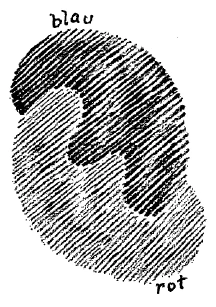 Translation results
Dictionary
Click on a word to look it up or to see alternative translations.
You’re logged in and have a DeepL Pro plan. Your content is secure.
Translation copied
[ 15 ] You see, if one were to ask: How might we attempt—symbolically, that is, for essentially everything becomes symbolic the moment we begin to record something—how might we attempt to symbolically represent what occurs in the realm of thermal phenomena? If you take all these mental images together—which I have developed for you and through which I have tried, while remaining within the realm of reality, to approach the nature of heat—then you will come to conceptualize this nature of heat in the following way: Imagine, for a moment, that here is a space (blue) filled with certain forces, with forces of pressure; and here is the non-spatial (red), which is filled with suction forces. If you now create a mental image of this, you get a region here, and along with this region something else that constantly slips into it and disappears inside—after all, we have only projected outward into space what can only be conceived as spatial-non-spatial, for the red part must be conceived as non-spatial. Consider this space here (blue and red) as a symbol of what is spatial-non-spatial. So imagine the intensive represented by the extensive, by that in which the material continually arises. But as the material arises, the immaterial arises on the other side; it slips into the material, destroys its materiality, and we have a physical-spiritual vortex that manifests itself in such a way that whatever arises physically is continually destroyed by the spiritual, which also arises in the process; we thus have a vortex effect where the physical arises and is destroyed by the spiritual; the spiritual arises and is displaced by the physical. We have a continuous spillover of the non-spatial into the spatial; we have a continuous absorption of that which is in space by the entity that is outside of space.
[ 16 ] What I am describing to you, my dear friends, is—if you visualize it—a whirl-like formation here. But one must see the whirl merely as an external, extensive visualization of the intensive. With this, I would say, we have already approached the nature of heat through figurative imagery. It now remains for us to show how this nature of heat acts in such a way that phenomena such as heat conduction can arise; or that the melting point of an alloy lies much lower than the melting point of any individual metal; or what it actually means that thermal effects manifest at one end of the spectrum and chemical effects at the other.
[ 17 ] We will have to seek out the manifestations of heat, just as Goethe sought out the manifestations of light, and we will then have to investigate how an understanding of the nature of heat affects the application of mathematics and the imponderables of physics—in other words: How truly real mathematical formulas must be formulated so that they can be applied, for example, in thermodynamics and optics.