

Second Scientific Course
The warmth at the boundary
between positive and negative materiality
Insights from Spiritual Science on the Development of Physics
GA 321
12 March 1920, Stuttgart
Translated by Steiner Online Library
Twelfth Lecture
[ 1 ] Unfortunately, we have to postpone the experiments we had planned for today until tomorrow. They will be ready tomorrow to be presented exactly as I need them to be if I am to discuss the entire matter—specifically, what is to be tested in this regard. We will therefore take some time today to discuss the matters we still need to address, then set up the experimental arrangements tomorrow so that we can bring our discussion to a preliminary conclusion the day after tomorrow.
[ 2 ] The first point I would like to raise—as a starting point for the perspectives we need to develop regarding the nature of heat—is that I must point out to you that there is a certain difficulty in understanding what a transparent body actually is. I am not speaking of heat at this moment. But you will see—especially once we have completed these experiments—how we will gain a conceptual framework based on light to help us understand the nature of heat. There is a certain difficulty, I say, in understanding what a relatively transparent body is and what an opaque body is—that is, a body that, so to speak, reveals itself to us under the influence of light. I must speak somewhat differently than is usually done. The language of conventional physics would say: An opaque body is one that, due to a certain property of its surface, reflects the light rays that fall upon it, and thereby becomes visible as a body. — I cannot choose these forms of expression, not because they do not accurately describe the facts, but because they are expressions of preexisting, specific theories that we cannot simply take for granted. For to speak of rays, to speak of light rays, is theory. I have, in fact, already spoken about this in my previous course. Everything we encounter in reality is not a ray of light, but an image, and that is certainly something worth noting. Furthermore, we cannot simply say: A transparent body is one that, due to its internal molecular structure, allows light to pass through it, and an opaque body is one that reflects the light. For how could there possibly be a way to justify such a theory without further ado? And if you recall what I have presented in recent days as the relationships among the realms of reality—solid, liquid, and gaseous bodies; thermal entities; \(x\), \(y\), \(z\), and then, adjacent to the solid bodies, the \(U\)-region—you will see that the region of light must be related in some way to the thermal region, and the region of chemical interactions must also be related to it. On the other hand, what we encounter—I would say—as the liquid form in the realm of heat and in the realm of air must stand in some relationship to what constitutes the true essence of sound. For sounds arise on the occasion of condensations and rarefactions in gaseous or air-like bodies.
[ 3 ] We can therefore initially assume that somewhere in the realm where we have posited \(x\), \(y\), and \(z\), the essence of light can also be found. But the question is whether, where we seek the essence of light, we must also seek, for example, the essence of the transparency of certain bodies. This essence of the transparency of certain bodies cannot be readily derived from the essence of light alone or solely from the relationships between light and solid bodies. We have the \(U\)-region, and this \(U\)-region must, through its effects, have some kind of relationship to solid bodies on the Earth’s surface. And we will have to raise the question—at least initially—and work toward answering it in these reflections, which are still available to us while I am here: What influence does the \(U\)-region have on solid bodies, and might the difference that arises between transparent bodies and the ordinarily opaque metals reveal something about this influence to us? So such questions must occupy us for the time being. And we will find the path to answering such questions if we now attempt to supplement what emerged for us yesterday regarding the nature of heat with a few other concepts.
[ 4 ] Of course, within the field of physics, we have observed phenomena that manifest as thermal phenomena. One has observed phenomena such as those understood under the concept of heat conduction, which we have also demonstrated to you. Above all, one has observed this type of heat propagation during heat conduction—that is, the flow of heat either through a single body or beyond the point of contact between two or more bodies in contact with one another. This flow of heat has been imagined as if there were some kind of indeterminate liquid—initially merely as a mental image of the flow of heat, of the thermal state. And now we can build on what external observation provides: Just as water flows in a stream—that is, arriving at a later point further downstream than it was before, which nature so vividly illustrates—so too can we trace the flow of heat from one point to another when so-called heat conduction takes place. A wide variety of people have reflected on this flow of the thermal state in the sense of heat conduction. Quite clear mental images—though we could also start from others—come from Fourier, and we want to build on these a little and then see how we can reconcile these mental images with the insights we have already gained.
Translate text Select source language. Currently selected: English (detected) Select target language. Currently selected: German Toolbar Source text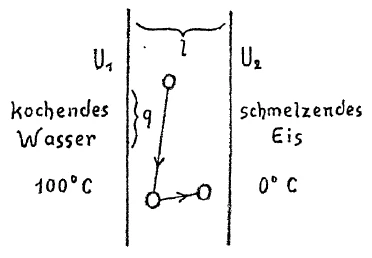 Translation results
Dictionary
Click on a word to look it up or to see alternative translations.
You’re logged in and have a DeepL Pro plan. Your content is secure.
Translation copied
[ 5 ] You can create a mental image of it this way: We are looking at a closed body—some kind of metal—that is sharply bounded by a plane here and by another plane here. We can imagine it extending indefinitely upward and downward. By immersing this boundary of the metal in boiling water, we attempt to maintain it at a temperature \(U_1\)—which in this case could be approximately \(100°C\)—and we attempt to keep the other boundary in contact with melting ice in such a way that we have a temperature \(U_2\), which in this specific case can be \(0°C\). If you consider the entire situation, we are dealing with a difference: \(U_1\) here, \(U_2\) there; \(U_1 - U_2\) gives us a temperature difference. The process of heat conduction will depend on this temperature difference. For, of course, if the temperature difference is large, heat conduction must proceed differently than when the temperature difference is smaller. I do not need a large amount of heat when this temperature difference is smaller; I need a larger amount of heat when this difference is greater to achieve the same effect, so I must therefore say: The amount of heat I need to achieve a certain effect will depend on this temperature difference \(U_1-U_2\);. It will also depend not only on this difference \(U_1-U_2\), but if I denote the length of the body by \(l\), then the amount of heat I need to achieve a certain effect will be smaller when this length is large than when this length is small. That is to say: the amount of heat will be inversely proportional to \(l\). For a given cross-sectional area—which I’ll denote as, say, \(q\)—I’ll be able to calculate the amount of heat I need to achieve a certain effect of heat conduction. The larger this cross-sectional area is, the more heat I will need; the smaller the cross-sectional area is, the less heat I will need. So \(q\) is directly proportional—I will have to multiply by it. Then, ultimately, the whole thing will depend on time. I will have to multiply by time. Of course, since none of these quantities directly provide heat, I must multiply the whole thing by something that already contains heat—because none of this is heat itself—by a constant that represents the measure of heat, \(c\), and then I get my amount of heat \(w\). This amount of heat \(w\) is therefore directly proportional to \(U_1-U_2\) and the other factors, and inversely proportional to \(.\) You can see, when you compare all the other factors in this context with \(U_1\) and \(U_2\), that what is actually flowing here is not directly a thermal state, or anything related to heat, but rather a heat gradient—a difference in level. I ask that you always keep this in mind. Just as we are dealing with a difference in level when, for example, we let water cascade from above to below at a lock and set a paddlewheel in motion—and just as the driving force developed there depends on the difference in level that must be taken into account—so too are we dealing here with a gradient, and that is what we must pay particular attention to.
[ 6 ] Now, the point is that if we wish to gain a deeper understanding of the nature of heat, we must also explore another of Fourier’s considerations, so that we may, as it were, correct these common mental images and proceed in our reflections in a manner more in keeping with reality than the physicists of the 19th and 20th centuries did. So far, I have essentially only considered what happens during the transmission of heat from one end of a body to the other, but I assume that something else is also taking place within the bodies themselves. I now ask: If, hypothetically, the situation were such that heat did not simply propagate uniformly from left to right, but rather unevenly on the inside, how would I then apply these formulas here to the internal irregularities? So if there were irregularities in the distribution of heat—if heat were conducted from here to here (compare the connecting line inside the metal, drawing on page 179) and so on—I would have to take this internal conduction of heat into account somehow. I would then have to take into account the changes in these differences that manifest themselves inside; in other words, I would have to consider the temperature equalization processes occurring within the body itself. As you can easily see, this would alter my formula. I would first have to say:
$$w = \frac{U_1-U_2}{l} \cdot t \cdot c \cdot q.$$
Now I am no longer dealing with the length \(l\) that is given here, but rather with small distances. And I want to consider what happens along these small intervals in the same way as it happens across the entire width here: the factor \(\frac{U_1-U_2}{l}\). So the point is that I’m considering this for small intervals \(d \ x\) within it. When I do this, this finite quotient simply transforms into \(\frac{d \ u}{d \ x}\), where \(u\) is supposed to be the small change in the thermal state. And if I consider this over a certain small time interval, I would still have to multiply by \(d \ t\)—I could also omit the \(dt\) for now if I disregard time. Thus, in this \(w\), we would have the expression for the heat quantum that, at any given point, by the very nature of the matter itself, would have to be expended as heat during internal work in order to follow the necessary temperature gradients in all directions and to equalize those gradients. You must bear in mind that this formula here
$$w = c \cdot q \cdot \frac{d \ u}{d \ x} \cdot d \ t \qquad (1)$$
would describe such effects, which arise due to internal temperature gradients within the bodies.
Translate text Select source language. Currently selected: English (detected) Select target language. Currently selected: German Toolbar Source text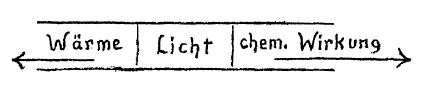 Translation results
Dictionary
Click on a word to look it up or to see alternative translations.
You’re logged in and have a DeepL Pro plan. Your content is secure.
Translation copied
[ 7 ] In this context, I would now ask you to consider what we briefly touched upon yesterday and what will become quite clear to us tomorrow, when we have the relevant experimental setups. Nevertheless, I can already mention today that we must consider how the phenomena of heating, luminescence, and chemical action manifest themselves in the spectrum. I already pointed this out yesterday: When I have an ordinary terrestrial spectrum, I have the actual light effects in the center, the thermal effects toward this side, and the chemical effects toward that side. Now the point is this: We have seen that if we want to draw a diagram of this spectrum, we cannot possibly make this diagram—which is supposed to represent light effects, heat effects, and chemical effects—into a straight line. We must extend the line to the left here (out of the plane toward the front) if we draw the line for light this way (horizontally) in order to find the corresponding symbol for heat. For the chemical effects, we must extend the line this way (out of the plane toward the back). It could also be the other way around, but let’s stick with this for now.
Translate text Select source language. Currently selected: English (detected) Select target language. Currently selected: German Toolbar Source text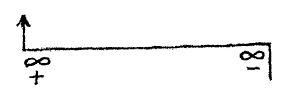 Translation results
Dictionary
Click on a word to look it up or to see alternative translations.
You’re logged in and have a DeepL Pro plan. Your content is secure.
Translation copied
[ 8 ] So, we have no way of remaining within this level if we want to symbolically encompass heat; we have no way of remaining within this level if we want to symbolically encompass chemical effects. We must step outside this level. And to grasp this whole concept, let’s make one thing clear: How should we actually designate this when we express, through this formula, any quantum of heat that is active within a body? How should we designate it if we had a chemical quantum that is quantitatively related to it? We wouldn’t be able to make sense of it unless we somehow introduced a term that indicates that, while we must move outward with heat, we must move inward with the chemical effects. We cannot manage unless we take this into account. If we regard w here as a positive quantity—we could also take it as a negative quantity—then, when it comes to seeking the corresponding distribution of chemical effects, we have no choice but to consider the corresponding
$$w = - c \cdot q \cdot \frac{d \ u}{d \ x} \cdot d \ t \qquad (2)$$
. This corresponds to the chemical effects.
And this
$$w = + c \cdot q \cdot \frac{d \ u}{d \ x} \cdot d \ t$$
corresponds to the thermal effects.
[ 9] In fact, these considerations already show us that we cannot simply choose the quantities at will when we want to create formulas and, at the same time, express in these formulas that we are dealing with a field of observation or a field of action where heat and chemical effects occur. Even in the case of ordinary combustion, where we wish to relate the chemical process to the heat effect, we must—when working with formulas—simply assign a negative value to everything we assign a positive value to for the heat effect, for the corresponding chemical effects.
[ 10 ] If you now continue your considerations and observe that heat, so to speak, curves outward, while chemical effects curve inward (see diagram on page 182), then only what is present in light actually remains in the plane. But if you have now reserved the + for heat and the — for chemical effects, then you can no longer make do with just any positive or negative sign for the effects of light; you must apply everything you can only intuit—which has not even been clarified today—namely, the relationship between positive and negative numbers and imaginary numbers—to the effects of light, and when dealing with the effects of light, you must say:
$$w = \sqrt{-1} \cdot c \cdot q \cdot \frac{d \ u}{d \ x} \cdot d \ t \qquad (3)$$
This means that you have to work with imaginary numbers—mathematically imaginary numerical ratios—in order to truly identify the relationships between light, heat, and chemical effects that are all part of the same experimental setup.
[ 11 ] But we’ve already said to ourselves: This spectral band that we actually form within the Earth is, in essence, merely the stretched-out spectral circle, and the complete spectrum would have the color of peach blossoms up here. If you were to use powerful forces to shape the spectral band into a circle, you would obtain up there the union of what seemingly extends to infinity on the left and to infinity on the right. And this union—as you can imagine—cannot simply be achieved by a circle. For if you proceed through heat, you are simultaneously moving outward and moving in that direction (forward); and if you proceed through chemical processes, you are moving toward the other side (backward). You are thus now placed in the position of: first, moving seemingly into infinity in one direction, and second, moving seemingly into infinity in the other direction. You do not merely have the unpleasant task, as with a straight line, of going there (from left to right), seeking out the infinitely distant point, and returning on the other side—if this infinitely distant point (on the right) is the same as the other (on the left)—in which case you are at least on a single plane. But now you stray off course, going this way (front left) and that way (back right), and cannot return unless you assume that infinity here and there leads you to the same point. But as you go that way, you also wander off into infinity. So you walk in such a way that you not only walk off into infinity on one side, but you also walk up here (in the lower drawing on page 182, the arrow on the left, which spatially means “forward”) into infinity and must return from two infinities (corresponding to the horizontal line and the direction of the arrows). So you are taking a doubly complicated path. Only then would you find this peach blossom here—not by simply bending it together, but by also bending it at a right angle to one side and then to the other.
[ 12 ] Imagine if you were to treat the color ribbon with an electromagnet; you would also have to rotate that electromagnet. But that leads you to say: You couldn’t describe what you would find there using any of these characters. You would have to resort to precisely what was brought to our attention yesterday in the discussion: the hyper-imaginary number.
[ 13 ] Now, you may recall that we were able to point out here that these over-imaginary numbers are controversial, that they are difficult to handle mathematically, and that, so to speak, they cannot be written down unambiguously. There are mathematicians who doubt, in fact, that we have any right to speak of these over-imaginary numbers at all. Here, however, physics itself does not immediately lead to a proper formulation of the over-imaginary numbers; but the need for these over-imaginary numbers leads one to realize that such over-imaginary numbers are necessary if one wishes to express in formulaic terms what occurs, first of all, in the realm of the chemical, the luminous, and the thermal, and what further occurs when we move beyond that and return to the higher realm. Anyone with the aptitude for this will find something highly peculiar here. They will find something which, I believe, if thought through properly, is ultimately of great value for a proper understanding of physical phenomena. What I mean is this: one encounters the same difficulties when, in the natural sciences, one considers the inorganic realm and then moves from the concepts formed within that realm to the attempt to comprehend life. It doesn’t work with inorganic mental images. It simply doesn’t work. This is evident, on the one hand, in the fact that there are thinkers who say: The earthly-organic must have arisen from the inorganic through a kind of spontaneous generation. But it is impossible, at first, to associate anything real with this view. Other thinkers, such as Preyer or those of a similar persuasion, derive everything inorganic from the organic, thereby coming closer to the truth. They conceive of the Earth as an originally living body, and what is inorganic today they regard as a byproduct—something that has died off from the organic. But even these people cannot move beyond a conventional image. The same difficulties one encounters when relying on purely natural concepts are also present within mathematics itself when one attempts, through a well-considered system of formulas, to move from what can be grasped in the realm of heat, in the realm of light, and in the realm of chemistry, to what exists somewhere where the spectrum of colors would close in a natural way —for we must assume that this spectrum of colors will close somewhere: it will certainly not close within the realm of the earthly. We must point out how mathematics, through its own considerations, stands before the problem of life. With what is available to it today, mathematics can master that which lies within the realms of light, heat, and chemistry; it cannot master that which we evidently find connected to these: the end of the spectrum, which, however, cannot be expressed by such formulas as the rest.
[ 14 ] To begin with, we help ourselves by simply using a set of terms. But as you can see, even with this terminology, we are now arriving at fairly concrete mental images. We said: Something real underlies the situation when we need formulas like these for w. We speak here of heat ether; something real underlies the situation when we have to use these formulas (2), in which what is positive in formulas (1) must appear negative, and we then speak of chemical ether; we speak of light ether when we need to venture into the imaginary in our formulas; and we actually speak of life ether when we need to use mathematical formulas that we do not yet have in reality, about which we are unclear, about which we are just as unclear in mathematics as natural scientists are about life.
[15 ] Here you see a very interesting parallel between the course of thought in mathematics and the course of thought in the natural sciences themselves, from which you can see that this really cannot, at first glance, be an objective difficulty, but must instead be a subjective one. For, quite independently of the natural sciences, the same line of reasoning occurs in the field of pure mathematics, and yet no one would believe that, based on precisely such considerations, they could deliver a beautifully stylized lecture on the limits of inner mathematical knowledge, just as Du Bois-Reymond did on the limits of knowledge of nature. At least not using the same kind of reasoning. Within mathematics, it must be possible—provided the concepts and formulations do not elude us due to their complexity when we seek to grasp them—to arrive at conclusive formulations in the realm of pure mathematics. The difficulty mentioned can only be something related to our relative imperfections; it cannot be conceived that these might be real limits of human cognition. It is very important to consider such a matter thoroughly. For this shows, first of all, that the simple application of mathematics does not work as long as we seek to grasp reality in the physical realm. For we cannot simply say, as energy physicists do: “A quantum of heat is transformed into a quantum of chemical energy, and vice versa.” We must not say that; rather, when something like this happens, it becomes necessary to introduce different numerical values. Then it becomes necessary to recognize that the main point is not that one form of energy mechanically excites another, but rather that we are dealing with a truly qualitative transformation—one that can already be captured numerically when, as they say, one form of energy is converted into another.
[ 16 ] If one had become aware of this qualitative transformation of one form of energy into another—a transformation that can already be observed in the numbers themselves—one would not have arrived at the mental image that says: Well, at a superficial level, heat is simply what we perceive as heat; mechanical work is what we perceive as such; and chemical energy is what manifests itself in chemical processes; internally, it’s all the same. Mechanical motion takes place. Heat is nothing else either. — One would not have arrived at this notion of molecules or atoms colliding and jostling against one another, against the walls, and so on—at this quest for an abstract unity of all forms of energy, which is precisely mechanical motion—if one had realized that, even when making initial calculations, it is necessary to take the qualitative differences among energies into account. It is therefore interesting that Eduard von Hartmann, when he considered the theory of heat from a philosophical perspective, found it necessary to devise definitions for physics that disregard all qualitative aspects. Then, of course, one can find only unambiguous mathematics in physics. And apart from cases where something emerges as negative from purely mathematical relationships, physicists do not like to deal with such numerical-qualitative distinctions in physics itself. They work with positive and negative values, but these are things that arise solely from mathematical relationships. In conventional energy theory, it would never be justified to designate one form of energy as heat and another as chemical energy, with one having a positive sign and the other a negative sign, simply because they are different types of energy.