

Second Scientific Course
The warmth at the boundary
between positive and negative materiality
Insights from Spiritual Science on the Development of Physics
GA 321
13 March 1920, Stuttgart
Translated by Steiner Online Library
Thirteenth Lecture
[ 1 ] What I had already intended to do yesterday can be carried out for now, since it will allow us to bring our reflections to a provisional conclusion. Tomorrow, I will then attempt to bring to a close the entire series of reflections that we have begun here during my current visit. We will now see for ourselves that, in fact, within what we call the ordinary solar spectrum or light spectrum, thermal effects, light effects, and chemical effects are intertwined in a very significant way. And yesterday we already saw that, in a certain sense, life effects must also be intertwined with these effects—only that we have no way of incorporating the life effects into our experimental setup in the same way as the chemical effects, the light effects, and the thermal effects. For there is, after all, no simple experimental setup that could truly demonstrate the effectiveness of the twelve-part spectrum. That will be reserved precisely for the research institute that will join the circle of our endeavors—not merely so that certain investigations may be completed, but so that they may also be brought to a full conclusion.
[ 2 ] And I would like to draw your attention to something else: If we ourselves—hypothetically taking into account the effects of life—trace the intertwining of life effects, thermal effects, light effects, and chemical effects within our—at least imagined—experimental setups, we find that an important area is missing, one that, in a sense, imposes itself more physically than the area of the aforementioned effects; we are missing the acoustic effects—those acoustic effects that first and foremost confront us through moving air, that is, through a moving gaseous or air-like body. And this raises the important, fundamental question: How do we arrive, on the one hand—since they are indeed indicated in the thermal, light, and chemical spectra—at the effects of life, and how do we arrive, on the other hand, at the acoustic effects? This is the question that simply presents itself to us once again through a survey of the phenomena, and about which we can only educate ourselves—in the spirit of Goethe’s physical worldview—just as we have done so far, and about which we should not theorize hypothetically.
[ 3 ] Now let us first demonstrate the following: If we place a solution of alum in the path of the light beam that we pass through a prism to produce the spectrum, we eliminate the thermal effects from the spectrum. First, we allow the thermometer to rise due to the thermal effect present within the spectral body. If we now place the alum in the path of the spectral body, we must—since the alum removes the thermal effect—be able to observe the thermometer column falling again. (The thermometer, which had previously risen very quickly, now rises considerably more slowly.) The proof is already established by the fact that the thermometer rises more slowly. Thus, the alum solution eliminates the thermal effect in the spectrum. We can consider the proof established. The experiment has also been conducted countless times and is well known.
[ 4 ] The second thing we will do now is to introduce a solution of iodine in carbon disulfide into the path of the light cone. You will see that this completely extinguishes the central part of the spectrum. The other part is significantly weakened. Now, as you know from the considerations we made in the previous lecture, the central part essentially represents the effects of light. Thus, the solution of iodine in carbon disulfide blocks the light just as the ° alum solution blocks the heat. Now the thermometer rises rapidly again because the thermal effect has returned.
[ 5 ] The third thing we want to do is to introduce an esculin solution into the path of the light cylinder. This solution has the property of neutralizing the chemical effects, so that the chemical effects are absent from the spectrum. We can therefore treat the spectrum in such a way that we eliminate
the heat component via the alum solution;
the light component via the iodine solution in carbon disulfide;
the chemical component via the esculin solution.
[ 6 ] As for the chemical effects, we will observe that, once we have the chemical component in place, the phosphorescence of the phosphorescent body will occur. As you can see, we have now placed the phosphorescent body within the cone of light. If you shield it with your hand, you will see that it phosphoresces. Now it must be dephosphoresced by heat. Now let’s place it back in the spectrum, but insert the esculin solution into the path of the light cylinder. The effect is very subtle. No phosphorescence is visible.
[ 7 ] Let us now imagine that we have, first of all, the realm of heat, the realm of light, and the realm of chemical effects. From all the considerations we have made, you can at least infer with some degree of certainty that there must be a similar relationship, a similar connection, between these domains as there is between what I have referred to in recent days as the x-domain, the y-domain, and the z-domain. But this is precisely what we want to work toward: that we can gradually identify these two sets of domains.
[ 8 ] First and foremost, let us consider the following: It is clear to us that if we have the heat region here and our \(x\_-, \(y\)-, \(z\)-regions here, then we have the gas region, the region of liquids, the region of solids, and here our \(U\)-region, which we have discussed (see diagram). Now, simply by remaining within the realm of phenomena, you need only bear in mind that we have been able to observe a certain very loose correlation between thermal effects and what occurs within any given mass of gas. We have been able to observe that, in a certain sense, the gas, in its material forms, participates in what heat does. We can, in fact, find in what the gas does the material expression of what heat does. If we visualize what is happening in the interaction between heat and gas with a sufficiently concrete concept—that is, if we truly have a vivid mental image of this interplay between the effects of heat and the material effects of the gaseous realm—then we will also be able to discern, in this visualization, the difference between the realm of \(x\) and the realm of the gas. We need only reflect on what we see countless times in life: that what we call light does not relate to the gas in the same way as heat does. The gas does not participate in what the light does. When light propagates, the gas does not follow suit and take on greater tensile force or the like.
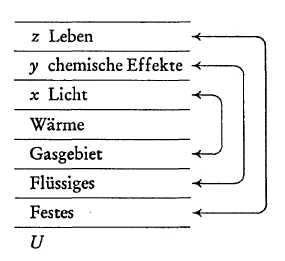
[ 9 ] So, if light exists in a gas, then that is a different relationship than if heat exists in a gas. And as we were able to say in our previous considerations: a liquid lies between a gas and a solid; heat lies between the \(x\)-region and the gas region; and likewise: the solid region yields images of the liquid region, the liquid region yields images of the gas region, and the gas region yields images of the heat region; so we can now say: Our \(x\) can be mapped onto the heat region, and the heat region, in turn, is mapped onto the gas region. Thus, in a sense, we have images of images of the \(x\)-region within the gas region. Consider that these images of images are actually present when light passes through the air. In the way the air, with its various phenomena, behaves in relation to light, we are not dealing with a direct image, but rather with an independent behavior of light in the air—in the gas—a behavior so independent that we can truly compare it to the following: Suppose we paint a landscape on a picture, hang the picture in the room, and then photograph the room. Now, when I photograph the room, the mere fact that I change something in the room will alter the entire configuration of the room into something else. If I were in the habit of always sitting in this chair during these lectures, and some ill-wisher were to take this chair away from me during the lecture without my noticing it, I would do what sometimes happens in life: sit on the floor. The relationship of things to one another in the room undergoes a real change simply because I alter something in the room. If I hang the painting from one spot to another, the relationships between the figures depicted in the painting will not change in relation to one another. What appears as a relationship in the painting is independent of the changes that occur in the room. So, my experiments with light in any room filled with air are independent. My experiments with heat are not independent within the room—you were able to see this for yourselves just now when it was pointed out that the entire room became warm. But I can present my experiments with light in their own essence; I can isolate them from their surroundings, so that in fact, precisely when I experiment with \(x\) in the air-filled room, I obtain the same relationships as when I experiment with light. I can identify \(x\) with light. And if you follow this line of thought, you will identify \(y\) with chemical effects. We will have to identify \(z\) with the effects of life. But then, as you can see, there are relationships of a certain independence between the realm of light and the realm of gas. This same relationship can be found if you continue this line of thought—you can do it yourself; it would take us too far afield today—when you look for chemical effects in liquids. After all, to produce chemical effects, we always need solutions. Within them, the chemical effects behave exactly like light in air. We would have to identify \(z\) with the solid state; that is, if I designate this region as \(z\), this one as \(y\), and this one as \(x\), then I have heat as the intermediate state, and if I designate the gas region as \(x’\), the liquid region as \(y’\), and the solid region as \(z’\), then I have now visualized the following:
$$z \quad y \quad x \quad heat \quad x’ \quad y’ \quad z’$$
\(x\) \(x’ \ \) like light in gas,
\(y\) \(y’ \ \) such as chemical effects in liquids,
\(z\) \(z’ \ \) Now, first, let’s consider the \(z\)-effects in solids. So far, we have only encountered them as configurations.
In a sense, this results in interconnections, which are, however, nothing more than a conceptual expression of things that are, in fact, very real in life:
\(x\) \(x’ \ \) is simply the gas filled with light,
\(y\) \(y’ \ \) is the liquid in which chemical processes take place.
\(z\) \(z’ \ \):
[ 10 ] After yesterday’s discussion, you can hardly doubt that just as we find light by ascending from heat, and find chemical effects by ascending from light, we must proceed from chemical effects to the effects of life. We did, after all, discuss this at least preliminarily yesterday. So we can say:
\(z\) \(z’ \ \) Life effects in solids.
[ 11 ] However, there are no signs of life in solid bodies. We know that earthly life requires at least a certain degree of fluidity. Signs of life in purely solid matter do not exist in earthly life. But this earthly life compels us, in a certain sense, to assume that such a thing does not lie entirely outside the realm of reality, for the idea occurs to us at the same time that we form \(y\) from \(y’\) and \(x\) from \(x’\).
[ 12 ] We find solid bodies, we find liquid bodies, we find gas. We find solid bodies without the effects of life. In the earthly sphere, we find the effects of life unfolding only alongside the solid bodies, entering into a relationship with them, and so on. But in the earthly realm, we do not find a direct coupling of the effects of life with what we call the solid in the earthly realm. It is precisely through this last link, \(z\) becoming \(z’\)—life in the solid—that we are led, in a certain way, to what must be the case with \(y\) becoming \(y’\) and \(x\) becoming \(x’\): If I have a liquid body on Earth, it must—albeit in a weakened form—stand in the same relationship to the chemical as the solid body does to life. And if I have a gas in the earthly realm, it must stand in the same relationship to light as the solid body does to life. This leads me to recognize that solids, liquids, and gases in the earthly realm, in a certain sense, represent to me something that has already died, through their subsequent relationships to light, chemistry, and life.
[ 13 ] One cannot make this idea as tangible as is very popular today in the demand for so-called “concrete” understanding. You must actively engage with it internally if you wish to recognize these considerations as true to reality. And as you continue this line of thought, you will find that there is a relationship between the solid and the living, the liquid and the chemical, the gaseous and the light; that heat, in a certain sense, stands on its own, but that this relationship is not directly expressed in the earthly realm. For this relationship, which can occur in the earthly realm, points to one that once existed but is no longer present. We are compelled into the concept of time by the inner relationships within things. When you look at a corpse, you are compelled into the concept of time. The corpse is there. You must consider everything that makes it possible for the corpse to be there at all, for it to look the way it does; you must consider the soul-spiritual, for the corpse has no possibility of existence in and of itself. After all, a humanly formed body would never come into being without the presence of the soul-spiritual. What the corpse thus presents to you compels you to say: It is as it is because it has been forsaken by something. This is nothing other than saying: The earthly-solid has been forsaken by life, the earthly-liquid by the emanations of chemical effects, and the earthly-gaseous by the emanating light effects. — And just as we look back from the corpse to the life in which the corpse was connected to the soul-spiritual, so do we look back from the solid bodies of the Earth, tracing these solid bodies back to earlier states of a physical nature, when the solid was connected to life, when the entire Earth was not a solid in our present state, any more than the corpse was a corpse five days ago, when the solid was not present everywhere in the earthly realm, where the solid can only exist in connection with life; where the liquid can only exist in connection with chemical effects; where the gaseous can only exist in connection with light effects. Where, in other words, there was no gas that did not glow from within, that did not simultaneously, through its condensations and rarefactions, glow from within, darken, and phosphoresce in waves; where there was not merely a liquid, but a living, continuous chemical process; where underlying it all was life that solidified, just as life solidifies, for example, in the formation of horns in cattle, where it in turn volatilized, liquefied, and so on—in short, here we are driven out of our own time by physics itself into a prehistoric era, when the Earth had other such regions, where that which is now torn apart—the realm of the gaseous, the liquid, and the solid on the one hand, and the realm of light, chemical effects, and life on the other—was intertwined, only not directly interlocked, but folded over (see the arrows in the diagram). And heat is in between. It does not appear to participate in this unity of something more material and something more ethereal. But since it is situated in between, it follows with a self-evidence that could not be greater that it participates in both natures. If we designate the upper regions as the ethereal regions and the lower ones as the ponderable regions, it goes without saying that we conceive of heat as that which, by its very nature, constitutes a state of equilibrium between the two, and in heat we have found that which is the state of equilibrium between the ethereal and the ponderable-material—that which is therefore both ether and matter at the same time, and which, precisely because it is dual in nature, points from the outset to what we find everywhere in heat: the differences in level, without which we cannot do anything at all in the realm of thermal phenomena, nor can we observe anything at all.
[ 14 ] If you follow this line of thought, you will be led to something far more fundamental and important than the so-called second law of thermodynamics—that a perpetual motion machine of the second kind is impossible—could ever provide. For it effectively isolates a realm of phenomena that is connected to other phenomena and that—by its very nature—is quite naturally modified by these other phenomena.
[ 15 ] If you realize that the realm of gas and the realm of light were once one, that the realm of liquid and chemical effects were once one, and so on, then you will also have to conceive of the two polar opposites of the realm of heat—the etheric realm and the realm of ponderable matter—as having once been a single, original unity. This means: You will have to conceive of heat in ancient times quite differently than you do now. But then you will come to realize that you must say to yourself: What we today call physical phenomena—which are, after all, merely the expression of the physical entities, the physical essences that exist—has only a temporary significance. Physics is not eternal. It no longer applies to entirely different kinds of realities. For, of course, a reality in which the gas is directly luminous from within is an entirely different reality than one in which the gas and the light are relatively independent of one another.
[ 16 ] We thus find ourselves looking back on a time when there was a different physics and looking toward a future when there will be a different physics. And our physics can only be that which reflects the current phenomena to us—that which exists in our immediate surroundings. This must be derived from physics itself, so that we do not commit the paradox—indeed, not just paradoxes, but absurdities—of studying the physical phenomena of our earthly realm, formulating hypotheses about them, and then applying these hypotheses to the entire world. We apply our terrestrial hypotheses to the entire world and forget that what we know about physics is, in fact, limited in time to the Earth’s sphere. And we have already seen that it is spatially limited. For the moment we venture out into the sphere where gravity ceases and everything flows outward, at that very moment our entire physical worldview comes to an end.
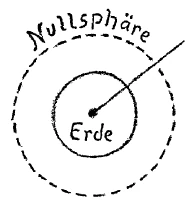
[ 17 ] We must therefore say: Our Earth is not merely spatially limited, but spatially limited as a physical entity, and it is nonsense to imagine that beyond the sphere of zero (see diagram) there must be something out there to which the same physical laws apply. Nor is it possible to conceive of the same physical laws as applicable at a specific point in the past or after a specific period of development. This is the folly of the Kant-Laplace theory—the belief that one can apply, in any arbitrary manner, what has been abstracted from the present physical phenomena of Earth retroactively. But it is also the folly of contemporary astrophysics to believe that what has been abstracted from terrestrial physical effects can, for example, now be applied to the constitution of the Sun—that one can speak about the Sun on the basis of the physical laws of the Earth.
[ 18 ] But something extraordinarily important becomes apparent to us when we bring together the observations we have gathered with what else has emerged—that is, when we combine one series of phenomena with another. We have, after all, pointed out that physicists have arrived at the view that Eduard von Hartmann captured with the beautiful expression—the second law of mechanical thermodynamics—namely, that whenever heat is converted into mechanical work, heat remains; thus, ultimately, everything must be transformed into heat, and heat death must occur—this view, which Eduard von Hartmann describes by saying: “The world-process has a tendency to ‘loiter.’” Well then, let us assume that such a “slacking off” of the world process takes place in this direction; what do we see happening? We see, when we conduct experiments intended precisely to illustrate the second law of mechanical thermodynamics, that heat arises. We see the mechanical effects disappear and heat arise. What we see happening there continues to unfold. Similarly, if we were to generate light from heat, we could demonstrate that everything in heat that corresponds to light cannot correspond to it in any other way than heat corresponds to the mechanical process in the sense of the second law of mechanical thermodynamics—only in reverse. And so, in turn, the relationship between light phenomena and chemical phenomena.
[ 19 ] But this has led us to say that we must create a mental image of the entire spectrum of the universe that forms a closed circle. So, if it were really true—which is, after all, merely a summary of a certain series of phenomena—that the entropy of our universe is tending toward a maximum, that the cosmic process is winding down, then it would be ensured that there is always someone following behind. As it winds down on one side (as illustrated), it continues from the other side, because we must represent it as a circle. So if heat death were to actually occur on one side, what counterbalances it—which, in turn, is the creation of a new universe as opposed to the death of the universe—would arrive on the other side. This follows from a sober observation of the phenomena themselves.
[ 20 ] This also justifies starting out in physics with considerations that do not view the process of the universe in the same way we usually view the solar spectrum—by letting it extend in one direction, toward the past, into infinity—just as we trace the red end into infinity—and in the other direction, toward the future, into infinity—just as we trace the blue end into infinity—but rather, we must symbolize the world process as a circle. Only then do we come closer to understanding the world process.
[ 21 ] Now, if we symbolize the world process with a circle, then inside it we have what is located in our regions. But in these regions, we have had no reason to include acoustic effects. In a sense, they do not lie on the plane. There, we have something else entirely. We’ll talk more about that tomorrow.