

The Boundaries of Natural Science
GA 322
28 September 1920, Dornach
Translated by Steiner Online Library
Second Lecture
[ 1 ] For all those who expect a lecture series bearing a title such as this to contain absolutely nothing that might, so to speak, interrupt the objective and impersonal flow of the presentation, I would like to note—since today I will frequently have to refer to specific individuals—that the moment it becomes a matter of truly presenting the results of human judgment in their relationship to life, to full human existence, it is inevitable that one must point to certain individuals from whom such judgment originated, and that even in scientific exposition one must, to some extent, remain within the realm where judgment arises—the realm of human struggle, of human striving toward such judgment. And here, above all, the question to be answered is: What can be drawn from the scientific formation of judgment in modern times for social, for living thought—the kind of thought that seeks to transform the results of thought into impulses for life? — One must certainly be mindful that the entire course of the inquiry one undertakes be torn away from the study and the lecture halls and, in a sense, be situated within the living process of human development.
[ 2 ] Behind what I took as my starting point yesterday—the modern pursuit of a mechanistic-mathematical worldview and the dissolution of that worldview; behind what then culminated in the famous 1872 speech by the physiologist Du Bois-Reymond on the limits of scientific knowledge—behind all of that, however, lies something even more significant; something more significant that forces itself into our observation precisely when we seek to speak, in a living sense, about the limits of our knowledge of nature.
[ 3 ] A figure of extraordinary philosophical stature still looks out at us today with a certain vitality from the first half of the 19th century—it is Hegel. In lecture halls and in philosophical literature, Hegel has only in recent years once again been mentioned with somewhat more respect than immediately prior to that. In the last third of the 19th century, Hegel was indeed opposed—specifically by academics. Yet one could probably demonstrate quite scientifically that the assertion made by Eduard von Hartmann in the 1880s—that it could be proven that only two university lecturers in all of Germany had actually read Hegel—is correct. People opposed Hegel, but they did not understand him on philosophical grounds. Yet they understood him in another way, and in a certain sense, they still understand him today. Hegel, as he is presented—or rather, as his worldview is presented—in the large number of volumes that stand on library shelves as Hegel’s works, in this form that is uniquely his own, is indeed known to few. Yet in certain transformed forms, he is, one might say, precisely the most popular philosopher the world has ever known. Anyone today, but perhaps even more so anyone who, a few decades ago, took part in a proletarian assembly and heard what was being discussed there—anyone who had an inkling of where the entire mode of thought formation in such a proletarian assembly originated—knew, if they possessed a genuine understanding of recent intellectual history, that this mode of thought formation had indeed originated with Hegel and flowed through certain channels into the broadest masses. And anyone who were to examine the philosophy and literature of Eastern Europe specifically with regard to this question would find that the thought forms of the Hegelian worldview are fully woven into the intellectual life of Russia on the broadest scale. And so one can say: Anonymously, so to speak, Hegel has perhaps become one of the most influential philosophers in human history in the last few decades of modern times. — Yet one might say that when one becomes acquainted once more with what lives on as “Hegelianism” in the broadest strata of modern humanity, one is reminded of that portrait of a somewhat unattractive man painted by a benevolent artist—who painted it in such a way that the family was pleased to look at it. Then, when a younger son—who had previously paid little attention to the portrait—grew up and saw it, he said: “But Father, how you’ve changed!”—One might say, upon seeing what Hegel has become: “But my philosopher, how you’ve changed!”—And there is indeed something highly peculiar about this Hegelian worldview.
[ 4 ] No sooner had Hegel himself passed away than his school fell apart. And one could see how this Hegelian school took on the very form of a new parliament. There was a left wing, a right wing, a far right, a far left, a most radical wing, and a most conservative wing. There were very radical people with a radical scientific and a radical social worldview who considered themselves the true intellectual heirs of Hegel. On the other hand, there were devout positive theologians who, in turn, traced their fundamental theological conservatism back to Hegel. There was the Hegel Center with the amiable philosopher Karl Rosenkranz, and all—every single one of these figures—claimed for themselves that they held the true Hegelian doctrine.
[ 5 ] What, then, is this strange phenomenon in the history of the world, arising from the realm of the development of knowledge? It is this: that a philosopher once attempted to elevate humanity to the highest heights of thought. No matter how much one might wish to oppose Hegel for having dared to attempt to make the world inwardly and spiritually present in the purest forms of thought, this cannot be denied. Hegel raised humanity to an ethereal height of thought. But curiously enough, humanity immediately fell back down from this ethereal height of thought. On the one hand, it drew materialistic conclusions from this; on the other, positive theological ones. And even if one takes the Hegelian core as presented by Karl Rosenkranz, one cannot say that Hegel’s doctrine remained, in the amiable Rosenkranz, as Hegel himself had conceived it. So here we have the attempt to ascend to the highest heights using the principle of science. But, so to speak, by subsequently processing Hegel’s ideas within oneself, one could allow the most diametrically opposed judgments and the most diametrically opposed directions of knowledge to emerge from them.
[ 6 ] Well, one can argue about worldviews in the study, within academic circles, and, if necessary, even in literature—provided that such literary disputes are not accompanied by wild gossip and factionalism. But with what Hegel’s philosophy has become in this way, one cannot separate the judgment from study rooms and lecture halls and carry it out into the world so that it becomes an impetus for social life. One can engage in intellectual debate over opposing worldviews, but one cannot peacefully contend with opposing outlooks on life in the external world. One would have to use this last paradoxical expression precisely for such a phenomenon. And so, I would say, in the first half of the 19th century, a factor in the development of knowledge looms alarmingly before us—one that has proven to be, to a high degree, socially useless. And in light of this, we must then raise the question: How do we go about forming our judgment in such a way that it becomes useful in social life? We can observe this social uselessness of Hegelianism for social life particularly in two phenomena.
[ 7 ] One of those who studied Hegel most vigorously in their hearts—who truly brought Hegel to life within themselves—is Karl Marx. And what do we encounter in Karl Marx? A peculiar form of Hegelianism! Hegel stands atop the highest peak of the realm of ideas, at the very summit of idealism—while his faithful disciple, Karl Marx, immediately turns that image on its head, using what he believes to be the same method, by seeking to bring out precisely that which is the truth in Hegel, and out of this emerges historical materialism—that materialism which is to be, for the broad masses, the worldview or conception of life that is now truly to be carried over into social life. Thus, in the first half of the 19th century, we encounter the great idealist, Hegel, who lived only in the spiritual realm, in his ideas; thus, in the second half of the 19th century, we encounter his disciple Karl Marx, who delved only into the material realm, who wanted to see reality only in the material realm, and who saw only ideology in everything that lived in ideal heights. One need only truly grasp this shift in worldviews and conceptions of life over the course of the 19th century to feel within oneself the full force of what drives us today to gain such an understanding of nature that, once we possess it, it triggers within us a judgment that is socially viable.
[ 8 ] Now, if we look in another direction, at something that, while not so strongly emphasized as to be attributed to Hegel, can nonetheless be historically traced back to him quite well, we find the “I-philosopher” still present in the first half of the 19th century, but extending into the second half, we find Max Stirner. While Karl Marx takes the one pole of human perception—which we pointed out yesterday—namely matter, as the foundation of his analysis, Stirner, the “I-philosopher” Max Stirner, proceeds from the other pole, the pole of consciousness. And precisely because the modern worldview, in aiming toward the material pole, cannot find consciousness within it—as we saw yesterday in the example of Du Bois-Reymond—the consequence on the other side will be that a personality who now stands entirely on the ground of consciousness alone cannot find the material world. And this is the case with Max Stirner. For Max Stirner, there is essentially no material universe governed by natural laws. For Max Stirner, there is only one world, populated solely by human “I’s,” by human consciousnesses that seek nothing but to live out their own existence. “I’ve staked my claim on nothing”—that is one of Max Stirner’s mottos. And from this perspective, Max Stirner himself rebels against divine governance of the world. He says, for example: Certain ethicists, certain moralists, demand that we should not commit any act out of selfishness, but rather that we should commit it because it pleases God; we should look to God when we commit an act—to what pleases him, what he commands, what is pleasing to him. Why should I—says Max Stirner—who want to place my cause solely at the pinnacle of self-consciousness, why should I concede that God is now the great egoist who can demand of the world, of humanity, that everything be done as it pleases him! I do not want to give up my personal egoism for the sake of great egoism. I want to do the things that please me. What business is God to me when I have only myself?
[ 9 ] This is becoming entangled and confused within consciousness, which then can no longer break free from itself. Yesterday I pointed out how, on the one hand, we can arrive at clear ideas by awakening to external, physical-sensory existence; yet how, when we then descend back into our consciousness, we arrive at dreamlike ideas that project themselves into the world as if driven by instinct, and from which we cannot escape. Karl Marx had already arrived at clear ideas—one might even say, super-clear ideas. And that was the secret of his success. Marx’s ideas are so clear that, even though they are complicated, they are understandable to the broadest circles, provided they are presented properly. In this case, clarity has contributed to popularity. And as long as it goes unnoticed that humanity is lost precisely within such clarity, people will—if they wish to be consistent—continue to adhere to this very clarity.
[ 10 ] But if one’s entire disposition leans toward the other pole—the pole of consciousness—then, indeed, one moves more toward Stirner’s side. Then one despises this clarity; then one feels that, when applied socially, this clarity does indeed turn people into a well-oiled cog in a social order conceived in mathematical and mechanical terms—but just a cog. If one is not predisposed to this, then the will rebels—that will which operates at the very depths of human consciousness. And then one rebels against all clarity. Then one mocks, as Stirner mocked, all clarity. Then one says: What business is it of mine what anything else is like? What business is nature itself to me? I set my “I” apart from myself and see what becomes of it. - We shall yet see how it is highly characteristic of the entire recent development of humanity that such extremes—such sharply defined extremes—arose precisely in the 19th century, for they are the flashes of lightning of what we are now experiencing as social chaos, as a thunderstorm. One must understand this connection if one wishes to speak of knowledge at all today.
[ 11 ] Yesterday we came to point out, on the one hand, what a human being accomplishes by entering into an interrelationship with the natural, sensory external world. His consciousness awakens to clear concepts, but it loses itself—it loses itself to such an extent that a person can only pin down concepts that are empty of content, such as the concept of matter—concepts before which he then stands in such a way that they become a mystery to him. But it is precisely by losing ourselves in this way that we arrive at the clear concepts we need for the development of our full humanity. We must, in a certain sense, first lose ourselves so that we can find ourselves again through our own efforts. But today the time has come when we should learn something from these phenomena. And what can we learn from them? We can learn that, while the full clarity of concepts and the full transparency of the life of the imagination can indeed be gained for human beings through interaction with the external sensory-natural world, this clarity of concepts becomes useless the moment we seek more in the natural sciences than mere phenomenalism, namely the kind of phenomenalism that Goethe, as a natural scientist, sought to cultivate; if we want more than natural science—namely, Goetheanism.
[ 12 ] What does that mean? Well, when we approach the interaction between our inner world and the external world—the sensory-physical external world—we can still use the concepts we form based on nature, so as not to remain stuck at the level of apparent nature, but to think beyond this apparent nature. We do this when we do not merely say that in the spectrum the color green appears next to the yellow color and the bluish tones begin on the other side; when we do not merely link the phenomena, the appearances, together with the help of our concepts, but when we want to pierce through this tapestry of sensory impressions, as it were, with our concepts and construct something beyond it through our concepts. We do this when we say: From the clearly derived concepts, I construct atoms, molecules, that which is supposed to lie behind the phenomena of nature, and movements within matter. For something remarkable happens here. What happens is that when I am here as a human being (see drawing), facing sensory phenomena, I do not use my concepts merely to establish an order of knowledge for myself within this sensory world, but rather I pierce through the boundary of the sensory world and construct atoms and the like behind it. In a sense, I cannot stop with my clear concepts at the sensory world. I am, so to speak, a disciple of inert matter, which continues to roll on even after it has arrived at a certain point, even if the force driving it forward has already subsided. My knowledge reaches as far as the sensory world, and I am inert; I possess a certain persistence; I roll on with my concepts beyond the sensory world and construct a world for myself there, which I then doubt again when I realize that I have merely followed my own inertia with my entire thought process.
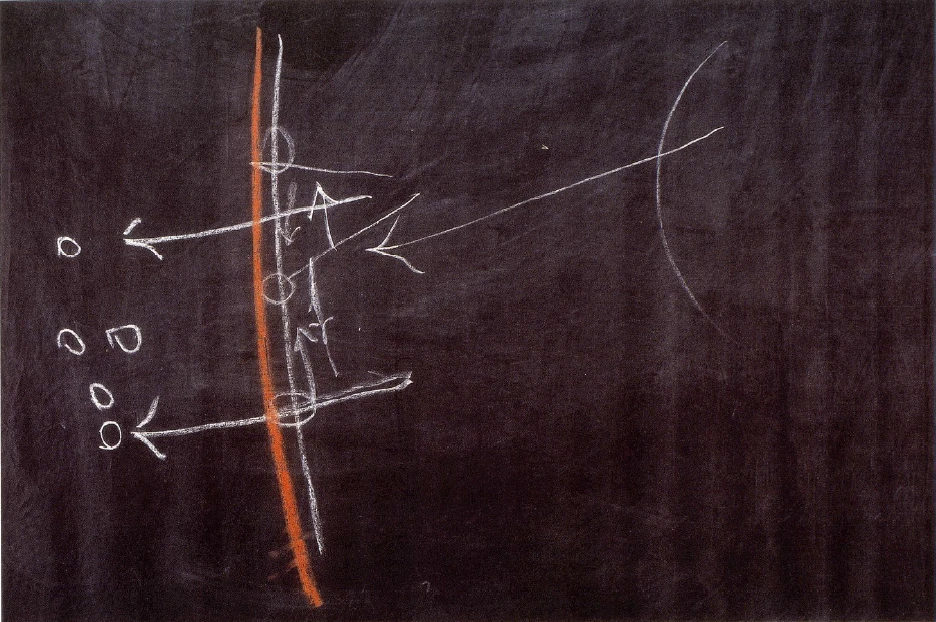
[ 13 ] It is interesting that a large part of philosophy—which, after all, does not operate within the realm of the sensible—is, in essence, nothing more than a similar rolling along in inertia, trailing behind what actually exists in the world. One cannot stand still. One wants to think further and further back, and so constructs atoms and molecules—and, under certain circumstances, even constructs many other things that philosophers have devised to explain what lies behind them. No wonder that one must then, in turn, dissolve this self-woven web that one has erected in the world out of sheer persistence.
[ 14 ] Goethe rebelled against this law of inertia. He did not want thought to roll on like that; he wanted to stop, to stop firmly at this boundary (see drawing: thick line), and he wanted to apply concepts within the sensory world. So he said to himself: In the spectrum, yellow appears to me; in the spectrum, blue, red, indigo, and violet appear to me. But when I penetrate these various color phenomena with my conceptual framework and remain within the phenomena themselves, the phenomena—the appearances themselves—come together for me, and from the fact of the spectrum I arrive at the following: If darker colors—or darkness in general—are placed behind lighter colors—or behind brightness in general—then I obtain that which lies opposite the blue of the spectrum. Conversely: If I place the light behind the dark, I obtain that which lies opposite the red of the spectrum.
[ 15 ] What did Goethe actually want? Goethe wanted to select simple phenomena from among the complex ones, but specifically those that would allow him to remain within this boundary (see drawing)—ones that would prevent him from rolling into a realm accessible only through inertial momentum, through a certain intellectual persistence. Thus, Goethe wanted to remain within phenomenalisme. If one remains within phenomenalisme in this way, and if one directs one’s entire thinking toward remaining there—toward not following the inertia I have characterized—then the old question arises in a new way: What significance does that which I bring in from mechanics and mathematics—what I bring in terms of numbers, measures, weights, or temporal relationships—have in this world that I view so phenomenally? What significance does that have?
[ 16 ] As you may know, a more recent view held that what is initially present in the phenomena of sound, color, heat, and so on should be regarded, so to speak, as purely subjective, whereas the so-called primary qualities of things—spatiality, temporality, and weight—should be regarded not as something subjective but as something objective, inherent in things themselves. This view, which essentially goes back to the English philosopher Locke, also dominates to a large extent the philosophical foundations of modern scientific thought. But fundamentally, the question is: What position do mathematics and mechanics—which we actually derive from within ourselves, at least at first glance—occupy in our entire scientific system with regard to external nature? We will have to return to this question by considering the specific form it has taken through Kantianism. But without delving directly into historical details at this point, we can nevertheless emphasize that we are instinctively convinced that when we measure or count things, or when we determine their weight, we are establishing something fundamentally different about the external world than when we ascribe the other qualities of the external world to things.
[ 17 ] After all, it cannot be denied that light, colors, sounds, and taste sensations stand in a different relationship to us than what we can represent in the external world as being subject to mathematical and mechanical laws. For it is, after all, a remarkable fact that must be taken into account: that—as you know, honey tastes sweet, but to someone with jaundice, it tastes bitter—so that we can say, we already stand in a peculiar way in relation to these qualities of the world within this world, while we cannot really say that a normal person would see a triangle as a triangle and a person with jaundice would see it as, say, a square! So distinctions are already there, and we must learn from these distinctions, but we must not draw absurd conclusions from them. And to this day, philosophical thought stands, in a strangely unexplained way, in relation to these fundamental facts of all the development of knowledge. For example, we see how a more recent philosopher, Professor Koppelmann, in his Weltanschauungsfragen (Questions of Worldview), goes even further than Kant by saying—you can read this on page 33 of Koppelmann’s Weltanschauungsfragen—: Everything that relates to space and time, we must first construct internally with our intellect, whereas we perceive colors and tastes directly within ourselves. We construct the tetrahedron, the octahedron, the dodecahedron, and so on; we can construct the ordinary regular solids only by virtue of our rational faculties. Is it any wonder—says Koppelmann—that we encounter in the world only those regular solids that we can construct through our reason? — And so you’ll find almost verbatim in Koppelmann the statement: It is impossible that a geologist might one day come along and present a geometer with a crystal bounded by seven equilateral triangles, simply for the reason—says Koppelmann—that such a crystal would have a shape that would not fit into our minds. — This is “over-Kantianism.” And one might say that, in the world of the thing-in-itself, such crystals bounded by seven regular triangles might indeed exist under certain circumstances, but since they do not fit into our minds, we pass them by; they are not there for us.
[ 18 ] Such thinkers forget just one thing—and this is what we intend to emphasize forcefully, with all the evidence at our disposal, in the course of these lectures— they forget that our mind is constructed according to the same laws of external existence from which we construct regular polyhedra and so on, and that our mind, by virtue of this very construction, constructs no other polyhedra than those that also occur in the external world. For, you see, this is one of the fundamental differences between the so-called subjective qualities—sound, color, warmth, as well as the various qualities of the sense of touch and so on—and what we encounter in the mechanical-mathematical worldview. That is the fundamental difference: sound and color exist outside of us; we must first take them in; we must first perceive them. As human beings, we stand outside of sound, color, warmth, and so on. It’s not quite the same with warmth—I’ll discuss that tomorrow—but to a certain extent, the same applies to warmth as well. They first take us outside of ourselves, and we must perceive them. This is not the case with form, spatial relationships, temporal relationships, or weight relationships. We perceive things spatially, but we ourselves are situated within the same space and subject to the same laws as the things outside of us. We are situated within time just as external things are. We begin our physical life at a certain point in time and end it at another. We are situated within space and time in such a way that these things, as it were, pass right through us without our first having to perceive them. We must first perceive other things. As for weight—well, my esteemed audience—you will also admit that this has little to do with perception, which is, after all, subject to a certain degree of arbitrariness; for otherwise, many who, due to their corpulence, attain a weight they find undesirable would avoid it through mere knowledge, through the mere faculty of perception. Ladies and gentlemen, even in terms of our weight, we are perceived quite objectively by the world, without being able to do anything about it through the very same mechanism by which we connect with color, sound, warmth, and so on.
[ 19 ] And so, above all else, we must ask ourselves today: How does the mathematical-mechanical judgment reach us in the first place? How do we arrive at mathematics and mechanics, and how is it that these disciplines are applicable to external nature? And how is it that there is a difference between the mathematical-mechanical qualities of things in the external world and what we perceive as the so-called sensory qualities of a so-called subjective nature—sound, color, qualities of warmth, and so on?
[ 20 ] Well, this fundamental question lies at one end. We will discover another one tomorrow. Then we will have the two starting points of scientific inquiry. We will then move on and find, at the other end, the formation of social judgment.